
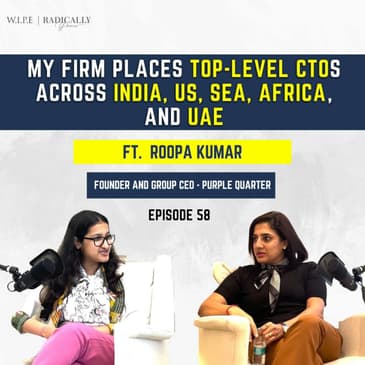

Dive into the latest episode of "Wiping Out the Norm" with host Radhika Bajoria as she delves into a captivating conversation with Roopa Kumar, the powerhouse behind Purple Quarter!
Roopa, founder and group CEO of Purple Quarter, wears many hats - from Entrepreneur to Executive Coach and Investor! With over six years of expertise, she's led Purple Quarter to be a domain-agnostic bespoke CTO search firm, placing over 150 top-level tech leaders worldwide! But her impact doesn't stop there!
As an Executive Coach at Purple Labs Search, Roopa mentors founders and CEOs to scale their ventures in the digital era, leveraging her Stanford Seed certification and MBA in HR! Purple Quarter isn't just a firm; it's a vision to empower businesses and global leaders on their growth journey! With offices spanning across Santa Clara, Bangalore, Singapore, Dubai, and London, they're bridging the gap between companies and their perfect technology leadership fit!
Their secret? Purple Quarter Talent Mapping, combining IQ on Technology + EQ as a Leader + BQ as an Individual! Discover how they synergize Leadership Consulting Search, assessing both client culture and candidate aspirations to forge sustainable relationships! At the heart of their process lies the Behavioural Metrics Model (BMM), a scientifically modulated approach focusing on technical skills, personality traits, and individual aspirations! And let's not forget their Leader Personas - Creator, Nurturer, and Reconstructor - shaping the future of tech leadership!
With a talent pool of 10,000+, 120+ Candidates Placed, 100+ Active Clients, and a remarkable 92% Offer Acceptance rate, Purple Quarter is setting the standard in CTO search and leadership empowerment!
Watch the full episode to learn about Roopa's journey of founding Purple Quarter and the challenges and strategies that made her start this Bespoke Executive Search Firm On A Mission To Create Tech-Leadership Consulting Synergy.
Watch the full video- https://youtu.be/rdZSuRV3yqw
Join the movement!
#PurpleQuarter #CTOsearch #LeadershipEmpowered #TechInnovation #ExecutiveCoaching #BusinessGrowth #GlobalLeaders #EmpoweringVisions
[00:00:00] Thanks Rupa for coming to our show.
[00:00:08] No problem.
[00:00:09] And very happy to have you here.
[00:00:11] So you've been the solo female founder of an executive search firm.
[00:00:15] We don't see many such women in this category at the senior levels.
[00:00:19] And our show is all about people who are wiped out the norm in their own ways, in their own work fields.
[00:00:24] So it's a pleasure to have you here.
[00:00:26] And would love to know about how you got started, what really picked up your interest in this world of talent search.
[00:00:33] And you started your journey in tech.
[00:00:36] So why not build something of your own as a startup in the tech field and why you know go along the path of the CTO executive search form.
[00:00:46] So I'd like to know how did you start Purple Quarter to begin with?
[00:00:50] Sure.
[00:00:51] Purple Quarter was in like a strategy game.
[00:00:54] We didn't go after saying that, hey, executive search, so let's think of it, we'll build a firm which is around bespoke CTO search.
[00:01:02] It was more out of a chance than choice in all honesty because 2015 Q4 saw a lot of barrier talent moving to India.
[00:01:11] There were a lot of startups which managed to get a lot of these folks, tech visionaries and tech leaders,
[00:01:17] moved to India and Bangalore, Mumbai, Gurgaon, Delhi, multiple of these specific locations.
[00:01:25] The only caveat was they didn't last for a long time.
[00:01:29] Okay, they all moved back to the US in less than a year.
[00:01:34] Now that became an opportunity in disguise because we really wanted to break in and see what went wrong.
[00:01:42] Why did they leave within a year?
[00:01:44] Now I'll tell you the backstory.
[00:01:46] As soon as these guys came in, we said, wow, this looks like an opportunity.
[00:01:50] Let's talk to more people in barrier.
[00:01:52] Let's bring them to India.
[00:01:53] We called it the Boomerang project.
[00:01:56] So we spoke to a lot of Indians in the barrier and said, hey, look, there are more of your sort who come here.
[00:02:01] So why don't you also jump in?
[00:02:03] So it takes about six to eight months, Radhika, to actually bring someone here to India because you're already settled and you want to move.
[00:02:10] So post that six to eight months of dating some of these guys saying that, hey, come and join startups here.
[00:02:18] You can imagine it was a kind of a we did happen to have a situation when these guys went back the ones, the examples that they were giving.
[00:02:26] Now that kind of made them think is India really ready for technology talents like them?
[00:02:33] Yeah.
[00:02:34] We were put in a spot.
[00:02:36] We had no way to go ahead and say put on the patriotic hat and say, forget them.
[00:02:40] You know, you guys come change the piece.
[00:02:43] Rather we did a case study.
[00:02:45] We figured out why one of these startups, I'm not going to name them, but why one of these startups lost their global CTO when we actually zoomed in and checked it was not to do with the person's tech jobs.
[00:02:58] It was not to do with the person's abilities.
[00:03:01] Yeah.
[00:03:02] Nor was it the company's failure or the founder's failure.
[00:03:05] That the plot thickens, right?
[00:03:07] You're wondering what really went wrong there.
[00:03:09] So we zoom in a bit.
[00:03:10] It's just two subtle factors.
[00:03:12] The first factor is the person came from a very large setup and was put into a startup dynamic equation.
[00:03:18] Yeah.
[00:03:19] And you have different ways of that people have, you know, decision making is very different.
[00:03:24] Like a startup founder can have an epiphany in the night and say, hey, let's shut the other project down.
[00:03:29] Let's start something new.
[00:03:31] Whereas a person who comes from a larger ecosystem is going to take time to say, is this idea really viable?
[00:03:37] You know, even if you have to launch this project, let's do this over a certain amount of time.
[00:03:42] So that was the first mismatch.
[00:03:44] They didn't do a courtship.
[00:03:45] They got into a marriage and I'll land it in under wars.
[00:03:47] That's what we say at our end, right?
[00:03:49] The second piece is technically the person's family never moved to India.
[00:03:55] And I don't know how the company missed it.
[00:03:58] Yeah.
[00:03:59] The firm that had engaged with them missed it because that was the biggest thing.
[00:04:02] It was really subtle, but they didn't move.
[00:04:05] Yeah.
[00:04:06] So these two became the main reasons why the person did not work.
[00:04:09] And we took a case study of just one firm in the neighborhood.
[00:04:13] Yeah.
[00:04:14] Right.
[00:04:15] So typically we realized that this was not about so much about the best talent and the best company.
[00:04:21] This is very similar to what Jack Ma says, right?
[00:04:24] Get the right talent in the right company.
[00:04:26] So that's what we went after.
[00:04:28] So that was the opportunity statements staring into us.
[00:04:31] We said, first let's go and talk to about 200 plus technologies and tech visionaries across the world
[00:04:36] and figure out what is it that they really want.
[00:04:39] Yeah.
[00:04:40] And mind you, we didn't reinvent the wheel.
[00:04:42] We didn't say that, hey, let's bring out some new methodology or sorts, right?
[00:04:46] So we took 10 parameters which are being used by all search firms across Blugli.
[00:04:50] And we went out and met with them.
[00:04:52] Yeah.
[00:04:53] Now I'll tell you what these 10 parameters are basically they're taught.
[00:04:55] They talk about what is your aspiration?
[00:04:57] What's your motivation?
[00:04:58] What do you want to do in life?
[00:04:59] What are your value system?
[00:05:00] Yeah.
[00:05:01] So there are 10 of these parameters.
[00:05:03] But why we met these 200 people, we presented to them the opportunity that we're trying to look at the landscape.
[00:05:10] Right.
[00:05:11] You can imagine we didn't go with a job role.
[00:05:13] Yeah.
[00:05:14] So I would call these guys and these guys would say purple what?
[00:05:16] Sorry, what lady you want to have coffee with me and do, I mean, what conversation are we having, right?
[00:05:21] So we started at that part.
[00:05:23] Yeah.
[00:05:24] And we were like, hey, this is what we're looking at.
[00:05:26] This is the opportunity.
[00:05:27] Yeah.
[00:05:28] Now we want to solve for that.
[00:05:29] And now we want you guys to also support us while we're doing this.
[00:05:34] When that happened, it led to a mind blowing 83 plus parameters that we discovered on the journey.
[00:05:40] Oh my God, from 10 to 83.
[00:05:42] Absolutely.
[00:05:43] Over a six month period after meeting 200 plus people, right?
[00:05:47] Kudos to them and of course we put it on our site as well.
[00:05:50] Thanks to them.
[00:05:51] We were able to build something called as a behavioral metrics model.
[00:05:54] Okay.
[00:05:55] See, most search firms talk about, hey, I'll get you a guy who's value driven, we'll fit into your culture.
[00:06:00] We didn't want to go that route because if you go back to the case study we did, it was nothing to do with the culture.
[00:06:06] Right?
[00:06:07] It was more to do with the subtle areas.
[00:06:09] So what we definitely did is we figured out 65% of that was technology agility.
[00:06:16] How agile was the person, right?
[00:06:18] From a technology landscape to fit into an equation.
[00:06:22] Then the remaining pieces we covered where the parameters around let's talk about the kind of people they've managed.
[00:06:29] What is the leadership style, right?
[00:06:31] When I talk about leadership style, the part that people miss is for example, if I were to ask you Radhika and I'm going to ask you this question.
[00:06:38] How many people have you hired?
[00:06:40] 10.
[00:06:41] 10?
[00:06:42] Yeah.
[00:06:43] Let me ask you the second question.
[00:06:44] How many of those will you rehive?
[00:06:47] Yes, that's a very good question.
[00:06:49] She's not responding.
[00:06:50] Great.
[00:06:51] So you can imagine when we talk to any of these guys, they give us the numbers in triple-digit numbers of how many people have you hired.
[00:07:03] Now those numbers drop to a single digit.
[00:07:05] Don't tell me it's single digit.
[00:07:07] Oh God.
[00:07:08] As soon as you say how many of those you want to rehive, right?
[00:07:12] That's a concept we try and evaluate.
[00:07:14] It's not about the number of people you've gotten, the number of people you'd rehire again.
[00:07:18] Yeah.
[00:07:19] Also talks a lot about what have you managed to actually build in terms of a relationship?
[00:07:25] What do you want that person to really do along with you?
[00:07:28] Yeah.
[00:07:29] Right?
[00:07:30] So along with these factors, we also talk about value system which is again deeply rooted in all of us,
[00:07:36] with respect to where we come from, the conditioning that a person has,
[00:07:40] whereas the family based out of, based out of, right?
[00:07:43] And what kind of people do you hang out with?
[00:07:45] Socially how active are you?
[00:07:47] Yeah.
[00:07:48] There are also parameters we gauge in terms of, hey Radhika, you're going on a trip.
[00:07:52] So how do you usually spend your holidays?
[00:07:54] Now you may turn it on and ask me how is that even relevant?
[00:07:57] Right?
[00:07:58] So we're actually looking at a risk versus reward ratio.
[00:08:01] What I mean by that is if you say, hey, I'm a backpacker.
[00:08:04] And I love going into the mountains, right?
[00:08:06] Which means you're up for challenge.
[00:08:08] But if you were to say, hey, I always go to a seven star and luxury and I want the
[00:08:14] spine, the Michelin star restaurant, then there is a different way that they assess
[00:08:21] the person.
[00:08:22] We're saying nothing is good over there, but it's each one's choice.
[00:08:26] So these guys get put on those valuation.
[00:08:29] And that's your 83 plus parameters, which actually talk about a person's
[00:08:34] complete persona.
[00:08:35] Now these persona, we've managed to put them into three different buckets.
[00:08:40] The first one we call it as creator.
[00:08:43] So think of it as a person who's able to create something from the scratch.
[00:08:48] Now you have a product market idea.
[00:08:50] The person comes in and helps you make it a product market fit to technology is
[00:08:55] the storyteller.
[00:08:56] He's the person or he or she is the person who's able to build that for the company.
[00:09:01] Yeah.
[00:09:02] So the second block we put these people into is called the nurturer.
[00:09:06] Think of it more as a time when a company scales, they all run into similar kind
[00:09:11] of turbulence as we call it.
[00:09:13] Because you're moving upwards, but you really are going through some areas
[00:09:17] that you need to work upon.
[00:09:19] So B2C is running to scope off, let's say that they want to move from
[00:09:22] monolith to microservices.
[00:09:24] They're talking in terms of, hey, I want to bring the cat down.
[00:09:27] I'm looking at my LTV.
[00:09:28] So what do I do customer retention?
[00:09:31] Yeah.
[00:09:32] So that's what the person comes in does for a B2C.
[00:09:34] There is a B2B game.
[00:09:36] You're talking more in terms of distributed systems.
[00:09:38] You're saying what do I do with my data?
[00:09:40] How do I get my platforms to integrate with older technology because
[00:09:44] I'm working with enterprises and I can't customize so much.
[00:09:48] How do I build a pure platform that will work for all?
[00:09:51] So a nurture comes with a very different mindset, skill, potential
[00:09:55] to fill in for that kind of a stage of company.
[00:09:58] Then you have a reconstructor.
[00:10:00] Now the reconstructor comes in at a stage when the company is already
[00:10:04] a billion dollar company, but they run into, they grow being plateaued.
[00:10:09] Now what does this person come into?
[00:10:11] It comes in with innovation, right?
[00:10:13] Things of new strategies, of course with the risk taking aptitude as well
[00:10:18] where they build about 10 different product lines, 8 may fail and 2 succeed.
[00:10:22] And that's what the person does as a reconstructor.
[00:10:25] Now this model that I just told you of a creator, a nurturer and a reconstructor
[00:10:30] we do exactly the same piece with companies as well.
[00:10:34] So we put them, we take their 18 months business roadmap,
[00:10:38] tech roadmap and put them into creator, nurturer and reconstructor
[00:10:42] not based on their valuations or the stage of companies, how large, how small
[00:10:47] none of that. And then we married these two off.
[00:10:51] So Purple Quarter coming back to what you asked, Purple Quarter was actually
[00:10:55] built on just this piece of by chance, right?
[00:10:59] And going after this problem statement and finding a solution.
[00:11:03] And six years passed forward today's date, we are in the seventh year of operations.
[00:11:07] We managed to do about 150 plus searches across the world
[00:11:10] and kept what I just told you intact.
[00:11:14] So we put a method to this madness.
[00:11:18] That's nice. And how did the name Purple Quarter come?
[00:11:22] Technically Purple is, think of it as the colour Purple itself is
[00:11:26] associated with the Royal Clam. Are you aware that purple flowers
[00:11:30] are available only in the mountainous region?
[00:11:33] And they would go pick them only during winter.
[00:11:37] Now using those purple flowers is how the purple colour originated.
[00:11:41] Purple didn't just land out anywhere.
[00:11:44] So that was used in some of the attire that they wore.
[00:11:50] And also on the crown, I don't know if you've seen the Royal Crown
[00:11:53] has purple on it. Purple rubies, purple, you have this purple colour around it.
[00:11:59] So it's more associated with unique and royal, unique.
[00:12:03] I'll put it as unique. Quarter is your management grid 5,5.
[00:12:07] So a management grid has where you plot people in performance.
[00:12:11] So this is where you get the person on 5-1 people and 5-1 performance.
[00:12:16] So it's your unique 5,5 is what we are after.
[00:12:20] That's what Purple Quarter really means.
[00:12:23] So we're part of the Stanford SEED program.
[00:12:26] Purple Quarter is, I represent Purple Quarter so I go for that Stanford SEED.
[00:12:30] So we were selected out of 400 odd people.
[00:12:33] So there are 87 companies across Southeast Asia that's going through this program.
[00:12:37] So technically you're transforming yourself, right?
[00:12:40] We want to be at 200X of what we are today and hence we got into the program.
[00:12:44] And when did you get selected for the SEED program?
[00:12:47] We're almost at the end of the program. We're on part 4 of it.
[00:12:50] When I said we have 8 more people in the company.
[00:12:54] So we picked up people, we ran a premotor exercise and said who will be part of this program.
[00:12:59] Some of them are function leaders. They do get to be.
[00:13:02] But we also have two other people downstream who are also part of this program.
[00:13:06] And how does the program help you with?
[00:13:09] So it helps you with the overall transformation of the company.
[00:13:12] So you're talking in terms of building your vision, vision statements,
[00:13:16] not just for now but 5 years down the line.
[00:13:18] We're also talking about, hey what are your values that you want to build in?
[00:13:22] Where do you see yourself growing?
[00:13:24] How do you put your roadmap in place?
[00:13:29] How are you thinking of objectives for the company?
[00:13:32] Financials, so you're actually creating a framework for financials.
[00:13:36] 5 years ago?
[00:13:37] Yeah, 5 years ago.
[00:13:38] So we had already put an AOP for 3 years but now we are looking at 5 years.
[00:13:42] And how do you create new lines if for example we have our own technology head?
[00:13:47] So that becomes a completely different roadmap versus a search engine that we have.
[00:13:51] So we had to build these two roadmaps separately.
[00:13:54] So it gives you a lot more clarity and that's when you can transform your business.
[00:13:58] So most founders, because we deal with a lot of founders,
[00:14:01] I think where we all get stuck is, you've heard the saying right when writers block.
[00:14:10] So founders have a founders block as well.
[00:14:14] Everything's going well and then you're thinking,
[00:14:17] everything's going well, maybe we should do something else.
[00:14:20] So we're getting that block.
[00:14:22] And then we don't know what to do next because we can't strategize
[00:14:25] and say, hey, what do we do differently?
[00:14:27] What more can we do?
[00:14:29] So during the system of what more can we do is when maximum we fail because we make mistakes.
[00:14:35] Because we spread our wings too far off and then we are chipped off
[00:14:39] and then we are saying, oh my God.
[00:14:41] So Stanford Seed actually helps you bring in a lot more clarity.
[00:14:46] And then you also evaluate out of these 5 ideas, how many are doable
[00:14:51] and when should we execute it, which is very meaningful for a business.
[00:14:55] And you also need to allocate funds and you need to budget
[00:14:59] and you need to be thinking of, okay, let's say, so we are bootstrapped.
[00:15:02] There are other firms which are also looking for funds.
[00:15:05] So how do you put yourself in front of investors?
[00:15:08] How do you go about making sure that your financials are in order?
[00:15:11] How do you look at creating your HR systems in order?
[00:15:14] Your OKRs, your milestones?
[00:15:17] It's a part of everything.
[00:15:19] And for the benefit of the audience, what's the duration of this program?
[00:15:23] It's a year. It's a one-year program.
[00:15:25] Oh, it's like a full diploma course, like practically where you get taught
[00:15:31] and you do things in real world.
[00:15:33] Yeah, you do a lot of pre-work, post-work.
[00:15:36] And then there is a transformation plan that we have to submit to a panel.
[00:15:41] They give you a certificate if you clear that.
[00:15:44] Okay.
[00:15:45] And your team and the person that is myself,
[00:15:49] we get awarded by Stanford that we've completed the program,
[00:15:53] which is quite prestigious in its own nature.
[00:15:55] Nice.
[00:15:56] Yeah.
[00:15:57] And they help you with all the talent, investor connect
[00:16:00] and whatever they can from their ecosystem.
[00:16:02] They help you with an alumni which has about 800 odd other entrepreneurs,
[00:16:06] which I think is wonderful.
[00:16:08] Wow.
[00:16:09] And this is across the world, right?
[00:16:10] Yeah.
[00:16:11] So you are talking just limiting yourself to one part of it.
[00:16:13] It opens up a network.
[00:16:14] So there is an alumni that gets connected.
[00:16:16] Yeah.
[00:16:17] Of course, investors are the least thing that one needs to be worried about.
[00:16:24] Every specific place has to invest in our VC firm, right?
[00:16:28] So I think it's more to do with how you connect with other founders.
[00:16:32] How do your network, how can you be part of an ecosystem
[00:16:35] and add value to the whole piece?
[00:16:37] So I think that Stanford does that really well.
[00:16:39] So this is what typically for people who are 3 million above,
[00:16:43] you can't get into the course.
[00:16:45] Oh, is it?
[00:16:46] Yeah.
[00:16:47] So you can't get into the course below a specific amount.
[00:16:48] Okay.
[00:16:49] And you go through like evaluations.
[00:16:51] So they do about five rounds of questioning
[00:16:53] and that's how you get into the program.
[00:16:55] Oh my God.
[00:16:56] Yeah.
[00:16:57] You submit stuff just like the way you get into a course.
[00:16:58] Yeah.
[00:16:59] That's very typical of that.
[00:17:00] Yeah.
[00:17:01] As a company, you're doing that.
[00:17:02] Yeah.
[00:17:03] That's very interesting actually.
[00:17:04] It is very interesting.
[00:17:05] It is very interesting, very supportive.
[00:17:06] When you started this form of what was your vision like?
[00:17:10] I'm sure Stanford C guys would have asked you this many times.
[00:17:14] Yeah.
[00:17:15] That's one of your peers.
[00:17:16] But do any of us see it going towards like from a founders perspective,
[00:17:20] what's your vision for Pupup Water?
[00:17:23] So when we started the firm,
[00:17:24] I think the vision was to be in,
[00:17:26] be the bespoke of CDEO search,
[00:17:28] be the number one firm in India.
[00:17:30] Yeah.
[00:17:31] I think six years down the line,
[00:17:32] we've managed to grab attention in our five balls.
[00:17:36] I'm not going to be,
[00:17:37] I take pride in saying that we are a notable firm.
[00:17:40] Yeah.
[00:17:41] And people do consider us as number one.
[00:17:43] We don't yet.
[00:17:44] But people do consider us as number one.
[00:17:46] They have good things to say about us.
[00:17:48] The one thing that as we were building Radhika,
[00:17:51] we figured that there's a very thin line
[00:17:54] between greed and vision.
[00:17:56] Yeah.
[00:17:57] The moment you're,
[00:17:58] you steer away from your vision,
[00:18:00] you move towards greed.
[00:18:01] Right.
[00:18:02] Which means that what I mean by that is
[00:18:04] you can't offer other roles.
[00:18:06] Why don't you do this?
[00:18:07] This seems more interesting.
[00:18:08] Apart from a CTO,
[00:18:09] you help us close a CTO.
[00:18:10] Why don't you do, you know, a CPO,
[00:18:14] which is like closest to technology.
[00:18:16] Why don't you do that?
[00:18:17] Why don't you do a digital role?
[00:18:18] Why don't you do a design role?
[00:18:20] Right.
[00:18:21] So we steered away from these distractions.
[00:18:24] We actually said no.
[00:18:27] Right.
[00:18:28] Because we didn't,
[00:18:29] we wanted to be firmly focused on our vision.
[00:18:31] Yeah.
[00:18:32] We wanted to take up greed.
[00:18:34] So that's,
[00:18:35] that was periodically the value system that we built.
[00:18:38] Yeah.
[00:18:39] And that became the vision of the company of how
[00:18:41] we wanted to place ourselves to be the top one search firm globally.
[00:18:45] Yeah.
[00:18:46] Now that's what we're going for right now.
[00:18:48] I already told you where in multiple places.
[00:18:50] Right.
[00:18:51] So though we are establishing India,
[00:18:52] we're not establishing the other regions Radhika.
[00:18:54] And I have no qualms saying that.
[00:18:55] Yeah.
[00:18:56] Right?
[00:18:57] Because we know in the next three or four years,
[00:18:58] we'll be able to build that kind of,
[00:19:01] yeah, absolutely.
[00:19:02] And some shape and form of being
[00:19:04] recognized in those regions as well.
[00:19:06] Yeah.
[00:19:07] And when you started out,
[00:19:08] what was like the revenue model you decided upon?
[00:19:11] Because there are so many things in the market today
[00:19:13] and people are just fighting for that small margin.
[00:19:16] And,
[00:19:17] you know,
[00:19:18] people are really curious about how we can improve our scalability
[00:19:22] and profitability.
[00:19:23] So in all this chaos,
[00:19:24] how did you try to decide your own revenue model
[00:19:27] and the structure,
[00:19:28] how your business will function?
[00:19:29] So we are a,
[00:19:30] you know,
[00:19:31] very low capex company because our only expenditure is
[00:19:35] that human and the office rent.
[00:19:39] Absolutely.
[00:19:40] So we are a very high margin business.
[00:19:42] So we went after being the most expensive search firm in India
[00:19:47] from day one.
[00:19:48] Oh, nice.
[00:19:49] Because we were carving or something super niche
[00:19:51] and we were going so deep into being thorough
[00:19:54] of, you know,
[00:19:55] actually offering what we did.
[00:19:56] Yeah.
[00:19:57] Right?
[00:19:58] So of course the first two clients didn't sign up
[00:20:01] for the amount and we did,
[00:20:02] we were okay with it
[00:20:03] because we were just setting ourselves up.
[00:20:05] From the third one onwards to date,
[00:20:08] we've kept the fees pretty standard.
[00:20:10] Okay.
[00:20:11] So it's either a percentage model
[00:20:13] or a fixed fee model that we offer.
[00:20:15] Okay.
[00:20:16] And they can actually go about talking to anybody else
[00:20:19] that we worked,
[00:20:20] we've kept it standard
[00:20:21] whether it's a stealth mode company
[00:20:23] or even if it's an S.
[00:20:25] But you choose the two options
[00:20:28] on the basis of whichever is higher
[00:20:30] or you give the option to the client.
[00:20:32] No, you give the option to the client.
[00:20:33] See, actually it's more sentimental, right?
[00:20:35] So let me explain this to you.
[00:20:37] So it's more like, hey,
[00:20:38] if I were to take the fixed fee option, right?
[00:20:41] Yeah.
[00:20:42] Then I don't have to worry about the search firm
[00:20:45] thinking about how much base is this person going to be
[00:20:48] because the percentage model
[00:20:50] is dependent on the base that gets offered.
[00:20:52] Right.
[00:20:53] So the fixed fee model is fixed.
[00:20:55] Yeah.
[00:20:56] So Radhika gets a two CR, Radhika gets a six CR,
[00:20:59] it doesn't matter
[00:21:00] because Purple Quarter's just going to get that fixed fee amount.
[00:21:03] Right?
[00:21:04] So typically we offer both
[00:21:06] it's about what people want to choose.
[00:21:09] Right?
[00:21:10] US typically works on a fixed fee
[00:21:12] and US is pretty straightforward
[00:21:14] because you have percentage models as well
[00:21:16] but everybody is already aware.
[00:21:18] In India, we go through the most amount of negotiations.
[00:21:20] I'm sure you do too.
[00:21:21] Yeah, I know.
[00:21:22] I know.
[00:21:23] I used to ask the lawyers how much Indian clients negotiate.
[00:21:26] Absolutely.
[00:21:27] That's why I stopped working with them.
[00:21:29] Oops.
[00:21:30] Are you guys listening?
[00:21:32] Yeah.
[00:21:33] Yeah.
[00:21:34] So you understand that
[00:21:36] but we explain it to them that it's a value-based transaction.
[00:21:39] Yeah.
[00:21:40] So you shouldn't be looking at what are you cutting.
[00:21:42] You know, one person or two person here does not really
[00:21:46] is not going to add dent into anybody's P&L.
[00:21:48] Yeah.
[00:21:49] So what are you even going down that direction?
[00:21:51] Look at the value that we'll add.
[00:21:52] Yeah.
[00:21:53] And we've had 98% of the people that we've placed
[00:21:55] have stayed around for three years.
[00:21:57] So that is the value we're going to be offering you.
[00:21:59] So look at the return that you're going to have
[00:22:01] on the investment that you make, right?
[00:22:02] Right.
[00:22:03] So don't look at it as a cost.
[00:22:04] Look at it as an investment.
[00:22:05] So that's what we go about telling our audience.
[00:22:07] So we are the most expensive search mom in India
[00:22:10] to be honest with you.
[00:22:12] But you said you are the most expensive.
[00:22:13] So what's the market average?
[00:22:15] Like what is the market functioning on in terms of the percentage?
[00:22:17] So we are doing different numbers, right?
[00:22:20] So there are people who offer 18% because it was 18%.
[00:22:23] I believe now with the market turbulence,
[00:22:26] people are offering even 15%.
[00:22:28] We don't go down that route.
[00:22:30] We are two X of that.
[00:22:31] Oh my God.
[00:22:32] Yeah.
[00:22:33] So we've been very clear on our stance
[00:22:35] who are we working with saying that, hey, this is what we do.
[00:22:38] Because we super niche, right?
[00:22:40] You're not going to be like a 15% I could tell you
[00:22:42] how to do all your researches.
[00:22:44] And you still make your monies, right?
[00:22:46] For us, it's more or less one search, which is your technology.
[00:22:49] With the equal money.
[00:22:51] Yeah.
[00:22:52] That's a better approach to go after.
[00:22:54] Why would you want to spread yourself too thin?
[00:22:56] Absolutely.
[00:22:57] So the different firms have seen not saying who's right, who's wrong.
[00:23:00] But I'm sure they make sure that they get make their profit margins by
[00:23:04] Like how do you do client sourcing?
[00:23:06] I mean now of course it's easier because it's been
[00:23:09] you've been in the under operations more than six years now.
[00:23:12] And how was your first month of the first year?
[00:23:15] Like I want to know that.
[00:23:17] And I asked this to a lot of founders because that's where
[00:23:19] the real chaos and the real action starts, you know,
[00:23:22] when you look out for everything, when you have nothing
[00:23:25] and still get it done.
[00:23:27] So how is it for you when it came to client sourcing?
[00:23:30] So leads generally come through networking a lot, right?
[00:23:33] Our first client that we signed up in movie
[00:23:36] happened through technologists who told me that in movies
[00:23:41] looking and I want to work for them.
[00:23:43] Oh.
[00:23:44] So, yes.
[00:23:45] So we, you know, we knew Mohit Saxena.
[00:23:48] So we gave him a call and fixed the meeting and said,
[00:23:51] Hey, I have a candidate for you.
[00:23:52] He wants to work with you, but you have to work with us
[00:23:54] to get the candidate, right?
[00:23:55] So that's how in movie happened.
[00:23:57] That was our first deal.
[00:23:58] But what if the company engages with the client directly?
[00:24:02] Like with the.
[00:24:03] Wouldn't do that because the person's already talking to
[00:24:05] us, right?
[00:24:06] So the person knows we're well connected in the industry.
[00:24:09] The client knows that hey, these guys come with some background
[00:24:12] and if they're being so open and transparent about there's
[00:24:15] somebody who wants to work with you because see,
[00:24:18] more where I had already advertised a role for a year plus
[00:24:21] and they were not able to find someone for a year.
[00:24:24] And we have them fill that talent in 17 working days.
[00:24:28] Oh my God.
[00:24:29] How did you get that job?
[00:24:30] I got it.
[00:24:31] I got it.
[00:24:32] I got it.
[00:24:33] And I got it.
[00:24:34] I got it.
[00:24:35] I got it.
[00:24:36] I got it.
[00:24:37] So that's how I got that talent in 17 working days.
[00:24:40] Oh my God.
[00:24:41] How did you meet this person who told you just the 200 plus
[00:24:44] people that we're meeting just like that on that go?
[00:24:47] Yeah.
[00:24:48] So by the end of the sixth month, I met this gentleman and
[00:24:51] he said he wanted to work with him movie.
[00:24:53] And that's how I found my first line and fixed a meeting
[00:24:56] on the other side.
[00:24:57] And luckily for me,
[00:24:58] the person was traveling to the US for two weeks.
[00:25:00] And I was in the company with him movie.
[00:25:02] Wow.
[00:25:03] I'm sure he must have given you some bonus on top of this.
[00:25:07] No, he doesn't even know.
[00:25:08] He doesn't know.
[00:25:09] Both of them,
[00:25:10] both parties didn't know that that's how it happened.
[00:25:12] Yeah,
[00:25:13] so that's the backstory.
[00:25:14] But deals do come to you when you network quite rigorously.
[00:25:17] And but after that over a period of time over your view
[00:25:19] invested heavily in a lot of branding marketing
[00:25:22] initiatives where the only search firm that actually does
[00:25:26] banners, you know, holdings.
[00:25:28] Oh, is it?
[00:25:29] We've done one in Mumbai, Chennai, Bangalore.
[00:25:32] I think it was in July when people travel the most.
[00:25:36] Yeah.
[00:25:37] So this was towards the terminal one airport.
[00:25:40] We had one Bangalore, which is near the,
[00:25:43] we call it the ORR where, you know,
[00:25:45] the outer ring road where you have all the tech companies
[00:25:47] and Chennai.
[00:25:48] This was outside the airport as well.
[00:25:50] Chennai was more like a trial.
[00:25:51] Wanted to see how it works out.
[00:25:53] A Delhi we were insured.
[00:25:55] Oh, see, it's more in terms of recall.
[00:25:57] Yeah.
[00:25:58] Brand recall people identifying purple quarter and what do you do?
[00:26:01] Right.
[00:26:02] So we want to put that out there.
[00:26:04] Correct.
[00:26:05] So those are initiatives that we do and we do a lot more
[00:26:08] outbound reach than we have.
[00:26:10] We connected the entire VC community,
[00:26:12] strategic relationship partnerships.
[00:26:14] Yeah.
[00:26:15] So we do all of that to win our clients.
[00:26:17] So we started that from year one itself.
[00:26:19] So we, of course the holdings didn't start from year one.
[00:26:21] Of course we didn't have the capital to do that.
[00:26:23] But we did do a lot of marketing through LinkedIn.
[00:26:26] We did a lot of these SEO stuff.
[00:26:30] Very nascent.
[00:26:32] Radhika, I would say that it's been a journey in six years.
[00:26:34] We really ace that game.
[00:26:35] But the first year I can imagine we tried everything.
[00:26:39] Yeah.
[00:26:40] Right.
[00:26:41] And we failed but it was okay.
[00:26:42] We tried something new.
[00:26:43] So we managed to get a lot of good run because of the kind
[00:26:46] of progress we did.
[00:26:47] We did three closures in less than six months from the time
[00:26:50] that we kicked off from this in movie happened.
[00:26:52] We did three major closures.
[00:26:55] First was in movies, second was browser stack.
[00:26:57] Third was Swiggy.
[00:26:58] When we got Swiggy there, a head of engineering who began
[00:27:01] this a year later.
[00:27:02] But that was a big one.
[00:27:04] No.
[00:27:05] Because we moved this gentleman from Amazon to Swiggy.
[00:27:08] Okay.
[00:27:09] $2 million to, they were a million dollar company at
[00:27:11] that point in time.
[00:27:12] And thank you Swiggy for believing in us as well because
[00:27:15] we were an unknown name.
[00:27:17] Right?
[00:27:18] But it was, it was an interesting case by itself
[00:27:20] because at the end of the day food delivery was not
[00:27:23] the best thing for someone like a leader in Amazon
[00:27:26] to go in and join.
[00:27:28] Right?
[00:27:29] So that was a risk that he took.
[00:27:31] And the company of course was rewarded because he was,
[00:27:34] he was there for about five years before he left.
[00:27:37] So typically if you were to look at it,
[00:27:40] that became the biggest hit for us.
[00:27:42] In three closures in record time of six months,
[00:27:45] purple quarter was already being spoken about in
[00:27:48] multiple forums and word of mouth and people knew
[00:27:52] what we did.
[00:27:53] And that's when I told you about the arrogance that he
[00:27:56] did.
[00:27:57] Yeah, yeah.
[00:27:58] We thought we had arrived and all of that stuff.
[00:28:01] But yeah, but at the time I think we've gotten wiser.
[00:28:04] But I love how open you are about these things.
[00:28:07] It's what it has to be because you know,
[00:28:10] I don't want to play God.
[00:28:12] Yeah.
[00:28:13] So at the end of the day, I think,
[00:28:17] see, I think I was talking to somebody in the US
[00:28:20] and we said one thing that as Indians,
[00:28:22] we're not used to accepting his failures because we've
[00:28:26] been coaxed right from the beginning that if you fall,
[00:28:29] don't cry.
[00:28:30] Just show like nothing happened.
[00:28:32] Yeah.
[00:28:33] We've been told this, right?
[00:28:35] So we've been conditioned and preconditioned.
[00:28:38] But if you cry, people will know they come and help you.
[00:28:41] They'll support you in the whole thing.
[00:28:43] Right?
[00:28:44] So failures are the biggest reason why you're
[00:28:46] successful and talking about them doesn't make
[00:28:49] you any less.
[00:28:50] Right.
[00:28:51] It actually helps you become a better person.
[00:28:53] Yeah.
[00:28:54] Right?
[00:28:55] And it's okay to be vulnerable and say that I failed.
[00:28:57] I was arrogant and now I'm not hopefully.
[00:29:00] Well, being humble is a journey.
[00:29:03] So yeah.
[00:29:04] Yeah.
[00:29:05] Yeah.
[00:29:06] But how do you really make sure that this candidate
[00:29:08] like a person who's been working in an Amazon
[00:29:10] and since you work with a lot of startup companies,
[00:29:13] how do you make sure that the person actually believes
[00:29:16] in the transition and thinks that, okay,
[00:29:19] this other path might be a better path for me.
[00:29:21] And I'm sure the truth is play a very,
[00:29:23] very big role in that convincing part.
[00:29:25] So how's that journey for you guys?
[00:29:28] Well, see all technologies are deeply inquisitive
[00:29:31] and you need to be data driven.
[00:29:33] You need to have a lot of knowledge.
[00:29:34] You need to be telling them what is the startup
[00:29:36] ecosystem like?
[00:29:37] What are they getting into in the first place?
[00:29:40] If you don't have answers to those questions,
[00:29:41] these are passive guys.
[00:29:42] They're not actively in the market.
[00:29:44] Right.
[00:29:45] So you can't move them to anything.
[00:29:47] I'm using the word who is don't hit me wrong.
[00:29:49] But you can't typically tell them that hey,
[00:29:53] move here.
[00:29:54] Right.
[00:29:55] And you need to know the company that you're talking about
[00:29:57] also in a completely different order.
[00:29:59] You know, for example, they could come say,
[00:30:01] Hey, but Zomato has been there longer.
[00:30:03] But why should I look at Swiggy?
[00:30:05] Because shouldn't I be looking at Zomato then?
[00:30:07] And I don't think Swiggy as he's at that point
[00:30:09] of time, Swiggy was not even the company
[00:30:11] that you can talk about today.
[00:30:13] Right.
[00:30:14] They were really struggling to hire.
[00:30:16] They had their reasons for not being the best
[00:30:19] of in the industry.
[00:30:21] But Zomato had already played like 12 years
[00:30:23] in the game and they were just like what four years.
[00:30:26] So it's super important to know the actual
[00:30:29] dynamics at Swiggy.
[00:30:31] What are they going after?
[00:30:33] So Harsha had already thought of how it's not
[00:30:36] going to be a delivery for delivery app.
[00:30:38] It's going to be a delivery convenience app.
[00:30:41] They were already thinking of Instamart.
[00:30:43] They were already thinking of Genie.
[00:30:45] They were already thinking of what are the other things
[00:30:47] that we can do to make it a super app.
[00:30:49] Right.
[00:30:50] And how do you build the supply chain ecosystem
[00:30:53] to actually honor some of these things?
[00:30:55] Right.
[00:30:56] So if you give them that journey of what,
[00:30:58] you know, the vision that the company has,
[00:31:00] then you can actually charm a technologist
[00:31:03] and give them the whole spiel of saying,
[00:31:05] Hey, this is what you're going to be building.
[00:31:07] This is the impact you're going to go and create.
[00:31:09] So that actually becomes the captivating piece.
[00:31:12] And that's why they want to say, okay,
[00:31:14] let me at least talk to them and see how this is going to be.
[00:31:16] Right.
[00:31:17] So we roped in Axel and we roped in a partner from
[00:31:20] their end to actually have the first conversation
[00:31:22] with this gentleman.
[00:31:23] And that's that actually made had an impact on the
[00:31:27] technologist because the person from Axel also
[00:31:30] is MS, right?
[00:31:32] And the person is from computer science.
[00:31:34] It was easy for the two of them to connect
[00:31:36] and talk a little bit.
[00:31:37] And we got that going.
[00:31:40] So we knew who exactly had to be the first runner
[00:31:43] to talk about the company as well.
[00:31:45] Right.
[00:31:46] That is also something that we play Cupid and say that,
[00:31:49] hey, not this CEO, but maybe in certain companies,
[00:31:52] we look at the CMO seems to be giving the story telling
[00:31:55] a little better.
[00:31:56] So he put that person as a front face
[00:31:58] when they're talking to a C level technologist
[00:32:01] because we want, we want the person to also get
[00:32:03] attracted to the storytelling concept.
[00:32:05] Right.
[00:32:06] Yeah, so yeah, stories sell more than anything.
[00:32:08] Look at you.
[00:32:09] Me all gig out of this.
[00:32:13] Do I get paid by the other?
[00:32:15] Just no.
[00:32:16] Good.
[00:32:17] You gave that disclaimer because a lot of people might
[00:32:19] think that they do think about a lot of shows
[00:32:22] that happen.
[00:32:23] So I still market it for you.
[00:32:26] I need to get paid for this.
[00:32:28] But coming to our rapid fire segment,
[00:32:32] I'll ask you a quick question before we come
[00:32:34] to the end.
[00:32:35] What's been the best and the worst advice that you've ever
[00:32:37] received?
[00:32:39] The best advice that I've received is,
[00:32:42] it's not people that are bad, it's just situations
[00:32:44] that make them.
[00:32:46] The bad advice that I've received is,
[00:32:50] dude, should I really say it?
[00:32:52] Yeah.
[00:32:53] Because a person listening will know I've
[00:32:54] said it's their advice.
[00:32:55] I hope they don't listen.
[00:32:57] Okay.
[00:32:58] All right.
[00:32:59] The bad advice that I've received is,
[00:33:02] let people work for you.
[00:33:04] You don't work for people.
[00:33:06] Okay.
[00:33:07] Yeah.
[00:33:08] Being in talent, this was the advice you got.
[00:33:12] Yeah.
[00:33:13] Okay.
[00:33:14] Oh my God.
[00:33:15] Yes.
[00:33:16] That's lethal.
[00:33:17] Okay.
[00:33:18] Yeah.
[00:33:19] And let me ask you now, who's been your mentor?
[00:33:23] Well, a couple of people.
[00:33:25] Yeah.
[00:33:26] All right.
[00:33:27] Because I'm on the tech side of eco-cler,
[00:33:28] the gentleman I moved to Swiggy is a form of a mentor.
[00:33:31] I also have, we also have mentors internally.
[00:33:35] So there is, I don't know if you've heard of Abhishek Gowel
[00:33:38] from Traction.
[00:33:39] Yeah, I have.
[00:33:40] I interviewed Neha recently.
[00:33:42] Oh nice.
[00:33:43] Nice.
[00:33:44] So yeah, Neha and I also know each other pretty well.
[00:33:47] So Abhishek is a mentor.
[00:33:48] So I go to him when we starting off anything new.
[00:33:51] So I run most strategy through him.
[00:33:53] Right?
[00:33:54] And Mekin used to be a mentor, but he's gotten really busy.
[00:33:57] Mekin Heshwari used to be the CPC.
[00:34:00] The CPO chief people officer before that.
[00:34:02] He was a CTO with Flipkart.
[00:34:04] So he used to be a mentor from the recruiting angle
[00:34:07] because he's really hired a lot of people.
[00:34:09] Amar Nagram is a dear friend, but he's still a mentor.
[00:34:11] Of Amar Nagram?
[00:34:12] Amar Nagram used to be the CEO of Minstra.
[00:34:14] Okay.
[00:34:15] And now he runs a company called Virgeo.
[00:34:17] So he's definitely a mentor.
[00:34:19] Okay.
[00:34:20] And you know I run past anything which we are building
[00:34:23] from a technology standpoint.
[00:34:24] So is Dale, Dale Vaz, who used to be the CTO of Swiggy,
[00:34:28] the one that we got from Amazon to Swiggy.
[00:34:31] But now he runs his own firm as well.
[00:34:33] Dale runs his own firm.
[00:34:34] A friend, but he's a very good mentor.
[00:34:36] So he cautions me when I get all ballistic about an idea
[00:34:39] and say, hey, I think it's good.
[00:34:41] I need to go after this and say,
[00:34:43] I don't think so.
[00:34:45] Maybe you need to reevaluate some of these pieces.
[00:34:47] Yeah.
[00:34:48] So these are some of my mentors.
[00:34:50] I have a coach as well.
[00:34:51] There's a difference between a mentor and a coach.
[00:34:53] I hope you know.
[00:34:54] So mentor, we go to them with a specific question.
[00:34:56] They give you an answer.
[00:34:57] But I do have a coach who helps me look inward.
[00:35:02] Yeah.
[00:35:03] Is it like a life coach, business coach?
[00:35:06] It's a business coach.
[00:35:07] And he also does a little bit of life coach as well.
[00:35:10] And on, so I do learning lunches with founders.
[00:35:15] So on a learning lunch with Khashah,
[00:35:17] he told me that two coaches great.
[00:35:20] You have one, but the best coach is books.
[00:35:22] So I read a lot of books and that helps me look inward
[00:35:26] as well.
[00:35:27] Yeah.
[00:35:28] So all these books, maybe some of them I have read.
[00:35:30] Yeah.
[00:35:31] Maybe some of them.
[00:35:32] Yeah.
[00:35:33] I have to look the up for it.
[00:35:34] It's not.
[00:35:35] We'll give you the best one.
[00:35:36] Thank you.
[00:35:37] Thank you.
[00:35:38] Yeah.
[00:35:39] Actually, you should read this,
[00:35:40] managing the professional service firm.
[00:35:43] That's very nice.
[00:35:44] Because you're also in the services industry
[00:35:46] and so are we in the law firm
[00:35:48] and it has some really good tactics and more.
[00:35:51] Yeah.
[00:35:52] That'd be really interesting.
[00:35:54] Yeah.
[00:35:55] But it's interesting.
[00:35:56] You keep doing these learning lunches, is it?
[00:35:59] Yeah.
[00:36:00] It's not a hashtag.
[00:36:02] It's actually from a guru.
[00:36:04] I forget the name of the gentleman.
[00:36:06] I think so I went to this 10 X show,
[00:36:09] Grand Cardone.
[00:36:10] That's when one of these coaches had come in
[00:36:12] and he spoke about the learning lunch,
[00:36:14] which I made notes of and I executed that.
[00:36:16] I did it for a year,
[00:36:17] but it's very difficult to continue.
[00:36:20] So some ideas are great,
[00:36:22] but if you can't continue them,
[00:36:24] then so in one of these learning lunches,
[00:36:26] I learned from this person.
[00:36:27] There was another learning lunch where I learned about
[00:36:29] where a person used to go in.
[00:36:31] So let's say you have a problem in life.
[00:36:33] What do you do generally?
[00:36:35] Speak about it.
[00:36:36] Speak about it.
[00:36:37] All right.
[00:36:38] So I think about it, right?
[00:36:40] But this person goes into a room,
[00:36:42] shuts himself into that room
[00:36:44] till he solves that problem and comes out.
[00:36:46] By himself?
[00:36:47] Yeah.
[00:36:48] Okay.
[00:36:49] So it could run into like a day, two days.
[00:36:51] Yeah.
[00:36:52] But you stay in the room.
[00:36:53] Stay in the room,
[00:36:54] find a solution and come out right?
[00:36:56] And I'm like, wow.
[00:36:58] This is amazing.
[00:36:59] Oh my God.
[00:37:00] Yeah.
[00:37:01] How did you get to the 10X show?
[00:37:03] Like how did you know about them?
[00:37:04] So Grand Cardone,
[00:37:05] of course the 10X book was one that got attracted to
[00:37:10] and definitely a great sales guy, right?
[00:37:13] So I just wanted to see how is this going to be,
[00:37:16] how the show is going to be.
[00:37:17] So it was very interesting
[00:37:19] because when I went there,
[00:37:20] I was quite amazed by,
[00:37:23] it was in a football stadium.
[00:37:27] The entire stadium was flooded with people.
[00:37:29] What?
[00:37:30] Yes.
[00:37:31] For their thing?
[00:37:32] Yes.
[00:37:33] And he jumped out of a plane in a parachute
[00:37:35] and he sold the, you know,
[00:37:38] the parachute, the dress that he was wearing.
[00:37:41] He sold it right there.
[00:37:43] Told.
[00:37:44] To one of the guys who wanted to buy it
[00:37:46] and that's why I like him because he can sell anything.
[00:37:49] Oh my God.
[00:37:50] Yeah, yeah.
[00:37:51] True.
[00:37:52] He sold that suit, the parachute.
[00:37:53] I don't know what you called it,
[00:37:54] but the entire suit to somebody,
[00:37:56] I think the guy paid him like $700 or whatever
[00:37:59] for the suit and bought it right there.
[00:38:01] I love that part.
[00:38:03] Yeah.
[00:38:04] I love that part of Grand Cardone.
[00:38:06] So that's why I went for that show.
[00:38:07] Yeah.
[00:38:08] But through that show,
[00:38:09] I did learn quite a few things
[00:38:10] of what the coaches really do across the world.
[00:38:12] And one was learning lunch
[00:38:13] and that's how I got into that.
[00:38:15] So some of the other ones that I think I learned was,
[00:38:17] there was this lady who came in and she spoke
[00:38:19] about how it is important to fail
[00:38:21] and you know, you fail continuously every year
[00:38:24] and keep track of your failures.
[00:38:25] So I don't know if you have a journal
[00:38:27] to keep track of your failures,
[00:38:28] but the moment you have a journal
[00:38:30] to keep track of your failures
[00:38:32] and you keep looking at it,
[00:38:33] you'll be amazed to know Radhika
[00:38:35] that the number of solutions that you'll come up after a year
[00:38:37] will be very different from what you thought
[00:38:39] of when you actually sold it.
[00:38:41] Right.
[00:38:42] And that was one of the most interesting ones.
[00:38:44] There's also a disappointment journal
[00:38:46] that she spoke about.
[00:38:47] Yeah.
[00:38:48] So you get to know a lot of things
[00:38:50] that you can look inward, right?
[00:38:52] Very interesting.
[00:38:54] And because the show is named like Wiping Up the Norm,
[00:38:56] I'd like to ask you of one instance
[00:38:58] where you think you have done the norm.
[00:39:00] Talent comes with potential.
[00:39:02] Yeah.
[00:39:03] Either you have it or you don't have it.
[00:39:04] Yeah.
[00:39:05] You don't have to be a male or a female.
[00:39:07] You know, we spoke about someone painting this picture
[00:39:10] in this room too.
[00:39:11] By looking at the picture,
[00:39:13] I'm not going to say it's been painted by a male or a female.
[00:39:16] Yeah.
[00:39:17] I'm just going to say what a lovely piece of art.
[00:39:18] Yeah.
[00:39:19] Right?
[00:39:20] Very similar to that.
[00:39:21] Yeah.
[00:39:22] Is how I think potential should not be graded with agenda.
[00:39:25] Yeah, yeah, yeah.
[00:39:26] Yeah.
[00:39:27] So I never felt that piece ever coming to me
[00:39:30] or people saying,
[00:39:31] oh, you are a woman.
[00:39:32] So we want to do business with you
[00:39:33] or we won't do business with your work.
[00:39:35] You know, how can you be so straight up
[00:39:37] and I'm considered to be very straightforward.
[00:39:40] Yeah.
[00:39:41] Yeah.
[00:39:42] Yeah.
[00:39:43] Yeah.
[00:39:44] So, but you can talk of any instance
[00:39:45] where you have wiped out the norm
[00:39:46] maybe professionally or personally.
[00:39:49] So whatever wiped out is I'm very straightforward
[00:39:52] as a person.
[00:39:53] So, see diplomacy doesn't come to me.
[00:39:56] Yeah.
[00:39:57] So it's something that I'm in the consulting piece,
[00:40:00] remember?
[00:40:01] And I'm still not diplomatic.
[00:40:03] Yeah.
[00:40:04] And I've wiped out that norm
[00:40:05] that you have to be diplomatic to,
[00:40:07] you don't need to please anybody, right?
[00:40:10] You have to speak your mind.
[00:40:12] And they're paying you for that.
[00:40:14] Yeah.
[00:40:15] They're paying you so you can speak your mind
[00:40:17] and tell them that this is wrong.
[00:40:18] This is right.
[00:40:19] So most consulting search firms professionally
[00:40:22] don't speak their mind.
[00:40:24] They just want to be nice.
[00:40:28] You can be kind yet speak your mind.
[00:40:31] Yeah.
[00:40:32] Right?
[00:40:33] But you have to be straightforward.
[00:40:34] So I think that's wiping out the norm
[00:40:36] in our industry professionally.
[00:40:37] Nice.
[00:40:38] I think it's all preconditioning
[00:40:40] and conditioning that I wiped out from my head.
[00:40:42] So I don't think of myself.
[00:40:43] I think of myself as a person
[00:40:45] and everything else doesn't matter.
[00:40:47] Yeah, absolutely.
[00:40:48] But it was great to have you
[00:40:50] on the show.
[00:40:51] Love the conversation.
[00:40:52] Absolutely.
[00:40:53] It was so transparent and honest.
[00:40:54] Likewise.
[00:40:55] Thank you so much.
[00:40:56] That's me.
[00:40:57] No pleasure having you.
[00:40:58] Thank you so much, Harika.
[00:40:59] Thanks for that.
[00:41:00] Yeah.
[00:41:01] Thank you for listening to this conversation.
[00:41:06] I hope it allowed you to dive deep
[00:41:08] into the mind of a senior women leader
[00:41:10] where hopeful to see more such women leaders
[00:41:12] in the future who have wiped out the norm.
[00:41:14] If you loved this episode,
[00:41:16] please share it with your friends
[00:41:17] who might be fundraising or building a business.
[00:41:19] Also tell us if you have any questions
[00:41:21] that you would like us to ask our women leaders.
[00:41:23] Till then, stay tuned for our episodes
[00:41:25] where we speak with
[00:41:26] Global Women Leaders.
[00:41:27] We are going to talk about
[00:41:28] the future of women leaders
[00:41:30] who speak with Global Women Leaders
[00:41:32] from countries like Palestine,
[00:41:34] Argentina, Mexico, America,
[00:41:36] India and others.
[00:41:46] Thank you for listening.
[00:41:48] We hope this conversation was helpful
[00:41:50] and allowed you to deep dive into the mind
[00:41:52] of a senior women investor.
[00:41:54] We are certain that we will soon see
[00:41:56] more women wiping out the norm
[00:41:58] by becoming senior leaders in investing.
[00:42:00] If you think you derived great learnings
[00:42:02] from us in this podcast,
[00:42:04] please share it with your friends
[00:42:05] who might be fundraising
[00:42:06] or are just wanting to get that push
[00:42:08] to get started.
[00:42:09] Also tell us if there's any questions
[00:42:11] you would want us to ask
[00:42:13] our transnational women leaders
[00:42:15] in our next interviews.
[00:42:16] Till then, stay tuned for our other episodes
[00:42:18] where we speak with women investors
[00:42:20] from places like Palestine,
[00:42:22] Brazil, Argentina,
[00:42:24] Mexico and others.
[00:42:28] Thank you.