
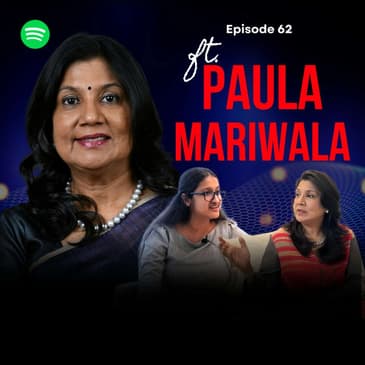

Meet Paula Mariwala - the Stanford alumna turned entrepreneurship evangelist, in this unfiltered conversation with Radhika Bajoria.
In our chat, we explored Paula's unconventional journey that will leave you inspired:
➡️ From Stanford to the heart of India's startup ecosystem, Paula took the leap in 2006 by founding Seedfund Advisors - a pioneering VC firm backing over 30 game-changers like Unacademy, Pixxel, Chalo, and more across ed tech, health tech, and impact sectors.
Paula and I spoke on our podcast "Wiping Out The Norm" about
✅ Her visionary investment strategy and success stories like unicorn Unacademy.
✅ Founding Stanford Angels & Entrepreneurs India (2015-2021) to nurture the entrepreneurial ecosystem
✅ Co-founding Aureolis Ventures in 2021 to champion impact investing
✅ Serving on boards of non-profits like Team4Tech, and Indian School of Leadership focused on education, women's empowerment, and human rights
✅ Her pivotal roles in academia - founding KREA University board member, Governor at K.J. Somaiya Engineering, advisory roles at IIT Delhi and Stanford
✅ Balancing boardrooms with passions like community service, painting, poetry, hiking, and cooking
[00:00:01] Thanks Paula for being in the house with us and doing the show with us.
[00:00:10] Like you know, R.C. Lee, the Stachelnest, Wiping Out The Norm and you clearly have been
[00:00:15] one of the crucial forces in this regard because you started your journey from being a physicist,
[00:00:22] studied physics all throughout your career and today you are a well-known investor,
[00:00:27] a career that is of course unconventional and something that others can't envision.
[00:00:31] So this requires some kind of strength and belief in yourself to be able to do it.
[00:00:36] So to start things, how did you even start your studies in physics?
[00:00:41] Where did that interest come from?
[00:00:43] Thanks Radhika and great to be here.
[00:00:47] I love the Thank You Doctor show, Wiping The Norms.
[00:00:50] I will be doing many more.
[00:00:53] I am so grateful that you are talking to so many of us and there are so many out there
[00:00:58] who I am sure will meet that.
[00:01:00] So coming to my journey, I actually am from a business family but my father was an entrepreneur,
[00:01:06] one of the early tech entrepreneurs and because of that I had early exposure to
[00:01:14] technology, to actually scientists in India and abroad.
[00:01:21] And I think that fueled my interest.
[00:01:23] We were the first tech and IT company back in the 60s.
[00:01:33] So when I was young, I would meet this past amount of young
[00:01:38] scientists from the government or engineers and I think that was the main factor in
[00:01:49] getting my interest in science.
[00:01:51] I was also quite good at it and also because I had very good teachers in this school
[00:01:59] and my physics teacher and math teacher were really outstanding.
[00:02:05] So they were not just bookish or creating marks but they really created interest.
[00:02:13] My brother also was very interested and both of us used to talk a lot about it.
[00:02:18] So all that led me to go into the sciences and actually I did.
[00:02:24] I would have gone for engineering but I wanted to pursue pure physics.
[00:02:28] So I was very enamored by the challenge of a technical subject like physics
[00:02:34] and the possibilities that it had.
[00:02:36] So I chose to do physics at the series college.
[00:02:40] It is a great place, then I had some great professors, some unclean peers.
[00:02:47] He did some good amount of stuff with his hands to build things.
[00:02:53] And I think that allowed me to continue my initial interest.
[00:02:57] I went to study abroad in the US and I continued with physics.
[00:03:03] Even in the US actually, I was one of two women in my department at Stanford University.
[00:03:12] In the department of life physics, it was a tough department.
[00:03:16] It was a tough subject.
[00:03:18] But again, I had never thought that physics is something we will touch too.
[00:03:24] Because I think my father was always very influential.
[00:03:28] My teachers as well.
[00:03:30] So I never thought that it is something special to be a woman studying physics.
[00:03:34] It was when I was in the US that I realized that actually the representation is very
[00:03:39] I was also teaching assistant like most graduate students are in the US.
[00:03:45] And a class full of students are graduates.
[00:03:49] We have very few girls in physics.
[00:03:52] So I recognized that this is not something that is very common.
[00:03:58] Even in engineering, my brother went to IIT.
[00:04:00] There were very few girls in that department.
[00:04:02] It's not talking about 80s.
[00:04:05] I don't think it has changed drastically.
[00:04:09] IIT actually has changed quite a bit.
[00:04:11] There are lot more women there now.
[00:04:13] But overall, the representation of women in STEM continues to be less.
[00:04:19] Nonetheless, I think I got to see how science can be any fact.
[00:04:24] That also sort of encouraged me to pursue this further.
[00:04:29] Because I saw how various technologies come out of physics sciences.
[00:04:36] If you stop for physics, then all the semiconductors are already there.
[00:04:40] In the phone, in the cameras, telecommunication network, all of that.
[00:04:44] Fundamentals are physics.
[00:04:46] So for me that was really going beyond what is in the material or in your textbooks.
[00:04:54] You're actually using fundamental sciences to create things which is not only of
[00:05:01] use to humans, to mankind, but is actually completely changing the way we live.
[00:05:07] So there is a big, big fact.
[00:05:10] My father had started a company in the job with a venture life-stream technology.
[00:05:16] That was in 1966.
[00:05:18] So since then he had envisioned that.
[00:05:20] And one can see today all the more how having a phone in the hand of a remote
[00:05:27] village, for example, in a country like India or Africa, or having technology which will enable somebody in a
[00:05:35] remote place to have telemedicine.
[00:05:39] Or we have satellites which are doing so much data which can help farmers.
[00:05:46] I mean there's so many applications.
[00:05:48] So I think that was also big motivation for me to continue to study sciences and physics.
[00:05:57] And how did this opportunity of Stanford come into picture?
[00:06:02] You've already done your MSc in physics.
[00:06:05] So what led you to study more and more in the same area and what led you to Stanford?
[00:06:11] So, you know, Stanford is one of those education institutes which I would say does not look in the real world.
[00:06:20] It does not look on its past.
[00:06:23] It looks in the future.
[00:06:26] So how can we use what we have to build something for tomorrow?
[00:06:30] So they are a forward-looking institution.
[00:06:33] And I think that is always attractive to it.
[00:06:36] Now physics as a subject is a role subject.
[00:06:39] A lot of things have been done and of course you have to study it.
[00:06:43] But what to do with it?
[00:06:45] I think that is where I thought the University of Stanford really had integrated very well with CSI.
[00:06:53] Silicon and material science always lacking in physics.
[00:06:56] And the chips all came from there.
[00:06:58] A lot of the companies which are today household-age, Intel and all, we don't even pay a thought,
[00:07:05] but it all came, so many of those came from the universities like Stanford.
[00:07:10] So I thought it's a great place if you want to apply sciences or things that I have not done.
[00:07:18] So I applied to the Department of Applied Physics, which is in the Department of Theoretical Physics.
[00:07:23] And I got in again, it's a very solid physics department but very closely linked to CSI.
[00:07:31] A lot of the projects that we did were supported by companies in the Valley or even the government
[00:07:41] or various other global institutions like NASA etc. to the founders of the company.
[00:07:50] Right, yeah that's so true actually.
[00:07:53] And these days it's like the power of capital has shifted from it being in the hand of the founders
[00:08:00] when they chose their investors to now investors coming back and choosing their own companies
[00:08:05] after the frenzy that we all saw.
[00:08:08] Just to ask you as to how do we differentiate ourselves from being a strategic investor
[00:08:14] from the other parts?
[00:08:15] What value do we have in the option of our space?
[00:08:20] So, you know, when I look at every investment, of course you want that to understand the
[00:08:27] investment pieces.
[00:08:28] You look at what value the founders make, what experience they will bring and so on.
[00:08:34] And what are the gaps?
[00:08:36] You know, particularly in the startup where there are many gaps that the platform industry
[00:08:41] may have.
[00:08:42] The ecosystem itself may be quite broad.
[00:08:45] It has to take time.
[00:08:46] It's one of the pieces I don't know how to say it.
[00:08:49] We think that lots of complex problems in the world are there because of the crisis
[00:08:56] in climate and we need to solve those problems.
[00:09:01] When we look at those complex problems, we have to have a founder who is able to understand
[00:09:09] that.
[00:09:10] We have aligned large pieces that we need to solve this problem.
[00:09:16] Because it's a complex problem, it needs not just money but let's say connections
[00:09:24] between different organizations, different regulators even, different stakeholders.
[00:09:31] So, for example, there is a company that we invested in, Pixel, which is a satellite
[00:09:40] in that company.
[00:09:41] They made actually that whole product themselves and that price was reached by them.
[00:09:48] And they actually put the satellite up now and then they made the camera that they made.
[00:09:55] But now, the young people, the intellectual, the dystopian, the Nasa people, they are
[00:10:02] young, they have the understanding.
[00:10:05] So, along with money, you see, what are the different applications you get?
[00:10:12] How can we build these spaces to solve this problem?
[00:10:18] There is another young entrepreneur who is very concerned about pollution, air pollution.
[00:10:24] And he has created this product which can suck up the air.
[00:10:29] A very difficult technology as well as difficult to solve.
[00:10:34] To solve this at scale, he needs to connect properly with customers, with governments,
[00:10:39] with other parties who are into this.
[00:10:43] So, we can begin value by first-hand defense message, by connecting them to the right
[00:10:48] people.
[00:10:49] Also just giving them advice on how to do sales, how to do sales for example, or
[00:10:55] how to reprice these products.
[00:10:59] So, I think there are a lot of things particularly in the startup business.
[00:11:03] Then as they mature, we need to be the bounce people.
[00:11:06] And because by then they know more than we do.
[00:11:10] In any case, they probably know because they have worked in that area.
[00:11:14] But as they grow, there are larger investors coming.
[00:11:18] As early investors, I think we have the trust.
[00:11:22] So, strategically they would like to bounce off the dust as early investors.
[00:11:27] So, you need to keep that trust up.
[00:11:30] They also face a lot of setbacks.
[00:11:32] Any startup does.
[00:11:34] Before they can use a large company.
[00:11:35] So, I choose companies to come in that search.
[00:11:39] I choose founders when they are open to be found.
[00:11:44] They are open to accepting that what can go wrong and not wishing it away.
[00:11:52] So, that they prepare for these challenges.
[00:11:55] And founders who work with investors who solve various problems.
[00:12:05] Those are the kind of founders we choose.
[00:12:09] In terms of investors choosing companies, of course we have our own pieces.
[00:12:17] For example, for Lois we look at climate is one, deep tech is another, health, and AI is another.
[00:12:27] So, we look for companies which are breaking down some problems in these kind of spaces.
[00:12:37] So, one of the companies that we invest in is two young women, one is a data scientist, one is a neuro scientist.
[00:12:45] And they have created a product which is machine learning to do better diagnosis of neuro diseases like Alzheimer, autism and so on.
[00:12:54] It's a difficult problem.
[00:12:56] But we obviously needed the right kind of entrepreneurs.
[00:13:00] So, it matched our thesis and the founders also sort of peaked with not only the passion, but the commitment and also the right background.
[00:13:09] So, you have to look for a good package.
[00:13:14] Earlier I invested in that type of young woman who wanted to give access to energy programming also.
[00:13:26] And she had worked in microfinance.
[00:13:29] So, we went with her to those villages and we realized it's a big problem.
[00:13:34] The villagers actually have needs, they also have money, but they don't get access either to energy or to lots of other products.
[00:13:44] So, we decided to support her.
[00:13:47] And today she is 35,000 women of the ground who are talking to villagers and understanding their needs.
[00:13:54] And from FinTech to phones to agri products to makeup, she is selling all kinds of things, shoes, women on the ground.
[00:14:07] And so it's called Frenzy Markets.
[00:14:10] And amazing example of resilience and you know actually large opportunity as well.
[00:14:20] But a difficult one to crack going into the village as well.
[00:14:26] So, then she needed investors who understand and understood that it's not easy to solve this.
[00:14:32] She is looking for patient capital.
[00:14:36] Yes, she is looking for patient capital.
[00:14:38] So, she chose investors who were able to give her patient capital.
[00:14:43] In some of the copies, you know, when I get value with my technical background or with the setup of this factory and access to our co-price,
[00:14:54] that's another sort of angle that you bring.
[00:14:58] With your connections with US and Stanford and other universities, that's another value that you give me.
[00:15:05] So, I think as an investor also you have to be mindful of what else you can do besides capital.
[00:15:15] But it has to be something that the founders want.
[00:15:18] It cannot be over imposed.
[00:15:21] We cannot impose any of these things on the founders and we have to also know where to draw that.
[00:15:27] It's not, in the company as we run by the company.
[00:15:30] But I've seen, you know, most of the founders are very experienced, are very helpful for strategic.
[00:15:40] We need to be, for example, taking senior team members.
[00:15:45] It's very difficult for young founders.
[00:15:48] You also have invested in cello which we see raised another round of funding.
[00:15:53] So, could you tell us the story of how you happened to invest in the company?
[00:15:57] Yeah, this is one of my favorite stories because cello founder Mohit Pooja is the founder of one of my first investors ever.
[00:16:05] A company called Kalwani that he invested in when I was with CITF in 2006.
[00:16:11] And I had seen Mohit and his team and his co-founders build up this amazing company of used cars and cars, nothing like that existed.
[00:16:20] And they do very well and seen how he builds the team with great discipline and how he executed on the ground.
[00:16:28] So, I knew that for Mohit, execution is the key.
[00:16:34] Cello, you know, which is challenging to Mohit, which is actually focused on public transport.
[00:16:41] I think has a very strong thesis which matches our thesis that public transport can really be a win.
[00:16:49] We have been big changers, we have been public transport.
[00:16:53] We don't have the proper skills to do it.
[00:16:56] So, of course, he is part-part, but unless we build good public transport, we never overcome the problems of public transport.
[00:17:04] So, the skill that was required was that of talking to bus operators, talking to people on the ground, convincing BSE for PMC or other business corporations.
[00:17:17] For adopting digital technologies and improving the experience for users.
[00:17:23] And I think he did this so successfully on the ground in the car rally.
[00:17:29] So, whatever it was, like whatever Mohit does, I think he did best.
[00:17:34] So, it was sort of like my second generation.
[00:17:37] But also it aligned with the thesis that I was trying at the beginning.
[00:17:44] So, it was a strong match and I participated in all these jobs.
[00:17:49] I participated in the faculty very early when it was just that major.
[00:17:54] Oh wow! Your stake must be valued very high now.
[00:17:58] This will be like a pendulum, come in the future but come back in the present.
[00:18:02] Come back, that's the good way to do it.
[00:18:05] But you have yourself also grown your father's business.
[00:18:11] How did you face different challenges into that?
[00:18:17] And you must have been tested also being IPO, it was one of the first Indian IT companies to do so.
[00:18:24] So, tell us about that journey of yours of building India.
[00:18:29] So, the IPO actually happened when I was still young.
[00:18:33] I was a student in the US but it was the first IPO in the country.
[00:18:38] Back in 1988, so I had seen the scale happen.
[00:18:42] I had just joined venture with digital development, HB.
[00:18:46] So, it was definitely very momentous.
[00:18:49] After that, I started a block to communication initiative with Adderall face.
[00:18:54] So, I worked with Adderall, Zedralax and so on.
[00:18:56] There were lots of challenges because our business in India is challenging
[00:19:01] but also working in technology side is challenging.
[00:19:05] But it was quite exciting to be part of the first teams that were involved in the option
[00:19:13] to find a head start for the country which is led to the telecom generation.
[00:19:17] So, I worked with many companies like TAP, TransUnited,
[00:19:21] and the department of telecom communication itself.
[00:19:24] And the solar instrumentation and solutions and it was exciting this time to do this.
[00:19:30] So, that was very, very exciting.
[00:19:33] Very challenging because you had to, it was a very hard work because the cellular equipment
[00:19:39] and the telecom communication, the women were also in the block to the power, which is not easy.
[00:19:47] It's not as bad as India.
[00:19:50] There were some very good people out there.
[00:19:53] And we did a little bit of infrastructure development.
[00:19:56] So, it was quite a learning experience to build the team that will do that and so on.
[00:20:03] There were also Zedralax and we did a whole project with the very large telcos
[00:20:10] to build a video network which would be with the set of boxes, also with the set of boxes.
[00:20:18] To have what we see today is there was no data side even then.
[00:20:30] So, the two options were either you put the side on the shape of the moon and it
[00:20:33] was very, very good at home or you could have done on the Tata Skyroo which is satellite.
[00:20:42] We did the fiber because the quality is much better.
[00:20:46] It is the entire QC for that but the company chose to do the satellite.
[00:20:55] So, the entire thing was done.
[00:20:58] It was then adopted by the United States but that particular thing was the entire project
[00:21:04] with the set of boxes which were IPT.
[00:21:07] So, the IPT is now also very important.
[00:21:11] So, that project failed.
[00:21:14] So, that was also a learning experience.
[00:21:17] Technology was the best but that's not enough.
[00:21:21] That was a great learning that I also applied on my MSD.
[00:21:25] Just the technology is what.
[00:21:28] You see the whole problem is still there.
[00:21:32] Is the ecosystem ready to adopt it?
[00:21:36] Maybe ahead of the curve.
[00:21:39] A lot of the companies that we even saw in C5, I think that was before data became
[00:21:45] big.
[00:21:47] When you land in Melbourne, you turn the data out of the phone because it was so
[00:21:51] expensive to have data outside of the moon by the way.
[00:21:53] So, it was very difficult for a lot of companies to scale.
[00:21:57] Credit card penetration was very low.
[00:22:00] There was no TPL.
[00:22:02] Even RedBus had online and all these things.
[00:22:06] So, the learning I had from my business woman was that you can't just be focused
[00:22:14] on your network.
[00:22:16] We were all very focused on saying this is the best technology and I will deliver
[00:22:20] the best video quality at the home.
[00:22:22] But you can't put that last mile fiber because it will regulate your
[00:22:26] rights.
[00:22:28] You will not succeed in meetings.
[00:22:30] My mindset, I went to them but I learned a lot from them.
[00:22:34] So, lots of good.
[00:22:38] Tell me that you said that your keynotes solving hard problems that data
[00:22:44] technology as a part of it as well and creates a deep impact.
[00:22:50] But when it comes to consumers specific brands like MCAPI, it might not be a
[00:22:55] necessary need for everyone but once introduced in the market, it can be either
[00:23:00] adopted or not taken in a good light.
[00:23:04] So, how do you really see consumer as a category of investment because that
[00:23:08] doesn't really require a lot of technology as such?
[00:23:10] Well, so the way I think you put technology is that everybody has a technology
[00:23:18] very efficient.
[00:23:20] So, I wouldn't say that's now sort of your part of any business.
[00:23:25] I think there is innovation.
[00:23:27] So, I think technology by itself is useless.
[00:23:31] I think the innovation for example that MCAPI is using a particular product,
[00:23:38] a particular ingredient and creating a whole market segment around it.
[00:23:44] And it is impacting the whole class of the company because they are
[00:23:49] promoting also the dark skin is good and it's also very character.
[00:23:55] So, they are very focused on packaging and so on.
[00:24:01] I also see it as an opportunity to influence others.
[00:24:04] It's a more focused thing.
[00:24:17] So, it is addressing some needs of women and bringing them up.
[00:24:24] Gender lens is also very important.
[00:24:28] In which other sectors are you seeing the market pre-induced?
[00:24:31] Like you said this was a new product and it created its market on its own.
[00:24:36] Which other sectors or rather industry are you seeing such innovation?
[00:24:40] So, I mean wellness is a lot of stuff.
[00:24:43] One of the companies we have invested in for example Angels and also
[00:24:47] a company called Goldken.
[00:24:49] It's men's sexual wellness.
[00:24:51] It's something that's very difficult to talk.
[00:24:54] And there are no organized, very few organized solutions.
[00:24:58] So, it's a category created.
[00:25:02] It's created in BigFact and it's an interesting brand.
[00:25:06] But it is more for the BigFact.
[00:25:09] We have a health care clinic which is for insurance to give access
[00:25:17] to organized healthcare to your life, you know, very class-oriented.
[00:25:25] Which is the next stage.
[00:25:26] How do they use technology? They use data.
[00:25:30] I think wellness is another of the health and wellness.
[00:25:41] I mentioned the main side which is a little bit of a new way of being
[00:25:47] which is a brand. That's more I would say big-tap.
[00:25:51] Then of course, I would like to tell you about its usability.
[00:25:57] In direct-to-consumer, we have seen a lot of brands.
[00:26:03] We have seen one brand for example, Skincare which is using technology
[00:26:08] to actually solve problems.
[00:26:13] So, it's just a...
[00:26:14] We have invested but we have seen companies which will just
[00:26:19] look at your image and use AI to do so.
[00:26:23] So, I mean in Ektek, there's a huge Ektek company
[00:26:29] to do outcomes, learning outcomes.
[00:26:32] There's a company called Kera.2 that we invested in.
[00:26:36] It's an Ektek company for climate.
[00:26:38] So, if you want to do a climate startup or you want to do
[00:26:41] a climate startup, you can take courses.
[00:26:45] So, there's a category in Ektek, a company like that.
[00:26:48] Another company like Ektek called Inspirit, they're using
[00:26:52] 3D technology which teach STEM more effectively and
[00:26:58] learning outcomes are amazing.
[00:27:01] In the US, they've just signed with key state governments
[00:27:05] to implement it in government schools.
[00:27:07] So, imagine if learning outcomes in STEM teams for people
[00:27:13] in government schools are involved, it's a huge impact.
[00:27:17] And if there is absolutely no use of technology.
[00:27:20] So, I'm not...
[00:27:22] We should not also box ourselves in technology
[00:27:25] because like I said, we have to look at the institution.
[00:27:29] I always think of my failure, I was totally
[00:27:31] focused on the technology and ignored the rest.
[00:27:35] So, why it's very important and I will definitely
[00:27:41] one some part of my family only focus on Ektek.
[00:27:44] I want to solve important problems.
[00:27:47] Like I said, I want my company to use for some
[00:27:49] important problems.
[00:27:51] Getting women to take charge of the finances is an important problem.
[00:27:56] We have another company which is using technology
[00:28:02] for enabling smaller businesses to better through
[00:28:07] Insta and WhatsApp, so that they can track and
[00:28:11] they can market it and it's a quality window.
[00:28:14] There is another company which has got a great
[00:28:18] air platform to translate on the fly and
[00:28:22] use voice to reach to new investors.
[00:28:26] So, these are all technology based problems, not limited.
[00:28:31] You also spoke about problem solving.
[00:28:35] Sometimes the problem might not be visible as such.
[00:28:38] You really identify your market first and then
[00:28:42] tell the consumers, this is a problem.
[00:28:44] Consumers won't even know that it's a problem.
[00:28:46] So, in that case especially with D2C brands
[00:28:49] which are more so tasteful like Skippy which
[00:28:52] recently came on Shark Tank.
[00:28:53] It's not solving any problem as such, but it's
[00:28:56] a good add-on in any consumer's life's journey
[00:28:59] for their tasteful experience.
[00:29:01] So, what do you have to say for that kind of category?
[00:29:03] No, see it's innovation.
[00:29:05] We meet these categories also through there.
[00:29:08] I think the point is whether we can add value
[00:29:11] to such a company.
[00:29:13] I mean I think food is very important because
[00:29:17] what you consume is an experience that
[00:29:20] also will affect you.
[00:29:22] So, food for example, we have seen
[00:29:26] Google, we have seen the alternatives,
[00:29:29] we have looked at alternative things or
[00:29:32] things like CV and so on which are good for you.
[00:29:35] You are not out there.
[00:29:37] They created these key marches.
[00:29:40] They created categories and you are
[00:29:43] giving access to the consumer.
[00:29:45] So, I think that's important to be responsible.
[00:29:47] I would not want to support a brand which is
[00:29:53] not good for a product like Google.
[00:29:56] It's just what it's called.
[00:29:58] So, we need responsibility to this by
[00:30:03] being in this.
[00:30:05] I funded a company which was very
[00:30:08] well-fixed because it had excellent products.
[00:30:12] It was called Keto diet, Rokat diet.
[00:30:18] You would have all the ingredients listed
[00:30:21] and everything and there were some
[00:30:25] meals and so on.
[00:30:27] So, this is a week to see.
[00:30:29] A week to see but I will not call it.
[00:30:31] But it was there was innovation in how
[00:30:34] we were acting, how we were relating.
[00:30:37] So, you have to be broad about innovation.
[00:30:40] I think you can use technology when it is required.
[00:30:46] So, you have to have right technology.
[00:30:48] It doesn't all have to be in time.
[00:30:50] The reason I brought in the white
[00:30:52] so this is going on is this.
[00:30:54] We can't, it is in our case we are not
[00:30:56] looking only at the future but we do want
[00:30:59] certain more of a capital to go to that
[00:31:02] because it is a difficult problem.
[00:31:04] It requires a lot more time and a lot
[00:31:07] of health products.
[00:31:09] It requires a lot more time to do.
[00:31:12] In fact, investing in the value system
[00:31:14] was simple.
[00:31:16] Now, other people are also doing it.
[00:31:19] They are using some technology to
[00:31:21] enable but you take what impact it will
[00:31:25] do. So, I think the first thing we
[00:31:27] have to see is the founder.
[00:31:29] Whether the value system is aligned
[00:31:32] with the mission itself.
[00:31:34] The second is what problem are we
[00:31:35] solving and how.
[00:31:38] Whether technology is part of it
[00:31:41] or not is one question to ask.
[00:31:44] There are many other questions
[00:31:46] that we need to ask.
[00:31:48] In D2C grants, for example, there
[00:31:50] is active wear of the actual
[00:31:53] company.
[00:31:55] Some of them are solving the
[00:31:58] problem of unpaid fees.
[00:32:00] They always say that look today
[00:32:03] the second world clear towns in India
[00:32:05] are not going to buy the
[00:32:08] free things of access.
[00:32:10] So, I think one should not be
[00:32:12] limited.
[00:32:14] But we try to give a certain
[00:32:16] value to the best goods of the
[00:32:18] world.
[00:32:20] We think that we are simply
[00:32:22] and originally just a muscle.
[00:32:24] So, you know what works.
[00:32:26] Right.
[00:32:28] With this, we come to the last
[00:32:30] round of our interview which is
[00:32:32] the rapid fire segment.
[00:32:33] So, what are the top three
[00:32:35] qualities that you will look at
[00:32:37] in a formless pitch which really
[00:32:39] catches your attention as an
[00:32:41] investor?
[00:32:43] So, the first thing is clarity.
[00:32:45] The second thing is honesty.
[00:32:47] And the third thing is
[00:32:50] you know attention to detail.
[00:32:53] It may sound
[00:32:55] but I do think that the
[00:32:57] problem has to be not every
[00:32:59] day but every day.
[00:33:01] There is a lot to do that.
[00:33:03] So, I think the third thing
[00:33:05] is honesty.
[00:33:07] What's the best and the worst
[00:33:09] piece of advice you have ever gotten?
[00:33:11] I think the best piece of
[00:33:13] advice I have gotten is
[00:33:15] curiosity.
[00:33:17] That's the easy one.
[00:33:19] The worst piece of advice
[00:33:21] is
[00:33:23] a difficult one.
[00:33:25] But I think
[00:33:27] you know you should
[00:33:29] follow certain rules
[00:33:31] because you are a woman.
[00:33:33] I will give you
[00:33:35] certain advice that
[00:33:37] you don't speak up too much.
[00:33:40] That's the
[00:33:42] best advice.
[00:33:44] Yeah.
[00:33:46] Following that, what are
[00:33:48] the kind of advices that you
[00:33:50] faced in your career so far?
[00:33:52] Because you spent a lot of
[00:33:54] time in India
[00:33:56] and people there, especially
[00:33:58] the white men as
[00:34:00] what it calls them to be,
[00:34:01] they don't
[00:34:03] accept to put a thing on the
[00:34:05] same table as them, especially
[00:34:07] when it comes to
[00:34:09] foreign meetings.
[00:34:11] Well, when I first went to
[00:34:13] US and actually like I said
[00:34:15] I am nobody in India
[00:34:17] somebody in the US
[00:34:19] study physics but you are a
[00:34:21] woman and I never heard
[00:34:23] that so that you know also
[00:34:25] put it in my head that
[00:34:27] people there are not the
[00:34:29] same exactly.
[00:34:31] I didn't really face
[00:34:33] that till I got up to boards
[00:34:35] and one particular board
[00:34:37] of one of my companies where
[00:34:39] we had a strategic investor
[00:34:41] which is the last corporate
[00:34:43] and their CEO goes on the board.
[00:34:45] He would not pay any
[00:34:47] I contact him.
[00:34:48] He also told me that
[00:34:50] Madam G should not do certain things.
[00:34:52] May I advise you now?
[00:34:54] After a soft review.
[00:34:56] And also he would say
[00:34:58] that you know this is a
[00:34:59] hard thing, let me tell
[00:35:01] the founder some
[00:35:03] difficult things that
[00:35:05] you will not be able to
[00:35:07] do.
[00:35:09] Let me do this.
[00:35:11] You just
[00:35:13] don't want to be
[00:35:15] with you.
[00:35:17] So the longest time they
[00:35:19] would not even pay I contact.
[00:35:21] There was a founder who came
[00:35:23] into our office
[00:35:25] and me and my colleague
[00:35:26] and we sat
[00:35:28] and we looked around
[00:35:30] and he said I just
[00:35:32] waited.
[00:35:33] So I said you can start
[00:35:35] putting a presentation on this
[00:35:37] thing.
[00:35:39] No I will wait for the partners
[00:35:41] to come.
[00:35:43] This is a young man
[00:35:45] young
[00:35:47] very arrogant
[00:35:49] and then now
[00:35:51] I said we are the partners.
[00:35:53] I don't know social impact.
[00:35:54] So
[00:35:56] and
[00:35:58] then we were very
[00:36:00] back to the show.
[00:36:02] So you know
[00:36:04] this has happened
[00:36:06] quite a few times.
[00:36:08] Also in the
[00:36:10] Bay area
[00:36:12] usually you know
[00:36:14] they are
[00:36:16] usually very
[00:36:18] curious about
[00:36:20] how we got here.
[00:36:22] But I think it
[00:36:24] has changed.
[00:36:25] I think I don't think I have
[00:36:27] experienced too much
[00:36:29] of that in the Bay
[00:36:31] and the US.
[00:36:33] I think we need to change
[00:36:35] the attitudes as well.
[00:36:37] I mean particularly in the VC
[00:36:39] industry as you know we are
[00:36:41] very few in finance
[00:36:43] industry.
[00:36:45] I often say I remember every
[00:36:47] woman who speaks to me because
[00:36:49] I am so few.
[00:36:50] The last 17 years
[00:36:52] when I read in the space
[00:36:54] I have read very few.
[00:36:56] In the last I think my
[00:36:58] journey in technology is happening
[00:37:00] since I was a child.
[00:37:02] We are seeing more
[00:37:04] and
[00:37:06] there is more confidence
[00:37:08] in the women.
[00:37:10] But there is still a lot of
[00:37:12] alpha male
[00:37:14] vibe in the VC industry.
[00:37:16] You know like by age
[00:37:18] some people are able to collect.
[00:37:20] So which is why you have to
[00:37:22] tame your greed.
[00:37:24] Yeah that's true.
[00:37:26] But when it comes to the
[00:37:28] founder investor
[00:37:30] term sheet what are some of
[00:37:32] the terms that are
[00:37:34] not negotiable for you?
[00:37:36] So for me I want to make sure
[00:37:38] that it is a fair agreement
[00:37:40] but I have to look at
[00:37:42] my own interest.
[00:37:44] So an exit clause is
[00:37:46] extremely important.
[00:37:48] You know tagalog and
[00:37:50] tagalog rights which
[00:37:52] make sure that you don't
[00:37:54] have to go to the investor
[00:37:56] you know
[00:37:58] then also get the upside
[00:38:00] which makes it
[00:38:02] right.
[00:38:04] This is something called
[00:38:06] liquidation.
[00:38:08] The company shuts down
[00:38:10] you have to get the
[00:38:12] liquidation and without that
[00:38:14] you get nothing and your
[00:38:16] capital has scaled up
[00:38:18] the company or you can't
[00:38:20] do that.
[00:38:22] I also like to put in anti
[00:38:24] terms so that the
[00:38:26] founders takes on the
[00:38:28] founder factors.
[00:38:30] So all this is just
[00:38:32] for the founders.
[00:38:34] I don't like to put very
[00:38:36] on the rest of the
[00:38:38] founders that will be
[00:38:40] covered in the
[00:38:42] house of management but
[00:38:44] I do want to make sure
[00:38:46] the founders
[00:38:48] are responsible and
[00:38:50] respect the founders.
[00:38:52] So the standard term sheet
[00:38:54] is the
[00:38:56] term of exit,
[00:38:58] duration.
[00:39:00] A lot of it is legal
[00:39:02] which is legal terms
[00:39:04] but it also
[00:39:06] is not always
[00:39:08] enforced.
[00:39:09] It's a deterrent and
[00:39:11] we have companies where
[00:39:13] the founders we have
[00:39:15] given our liquidation
[00:39:17] to us because
[00:39:19] founders are not zero.
[00:39:21] And reverse is also
[00:39:22] the founders got that
[00:39:24] issued and not been
[00:39:26] fed to the
[00:39:28] investors.
[00:39:29] They are given from their
[00:39:31] own base to
[00:39:33] investors.
[00:39:34] So I think a lot of it is
[00:39:36] on the relationships but
[00:39:38] when legal terms are
[00:39:40] concerned you certainly
[00:39:42] have to protect
[00:39:44] yourself.
[00:39:45] There are all kinds of
[00:39:47] founders out there so you
[00:39:49] certainly have to use
[00:39:50] that.
[00:39:51] If I really find even in
[00:39:53] negotiations that
[00:39:55] there is distrust,
[00:39:57] I have walked out of
[00:39:59] several meetings.
[00:40:01] You feel like why is the
[00:40:03] founder not signing this?
[00:40:05] Not trusting you or
[00:40:07] they are putting in some
[00:40:09] clauses which are not
[00:40:11] made and there is too
[00:40:13] much time wasted on it.
[00:40:15] You just walk away.
[00:40:17] You just extrapolate as to
[00:40:18] what is going on.
[00:40:20] So exit clauses
[00:40:22] are very important.
[00:40:24] You are having a founder
[00:40:26] who is exiting our meeting
[00:40:28] books because you can
[00:40:30] think from those.
[00:40:32] What is your most
[00:40:34] fond childhood memory?
[00:40:36] Fond childhood memory?
[00:40:38] There have been many.
[00:40:40] I think I went with my
[00:40:42] father to see
[00:40:44] the launch of the satellite.
[00:40:46] Wow!
[00:40:48] That is very special.
[00:40:50] Lastly, what is the last
[00:40:52] thing that you did for
[00:40:54] the first time in your
[00:40:56] life?
[00:40:58] The last thing that I
[00:41:00] did for the first time
[00:41:02] in my life?
[00:41:04] Well, I have been
[00:41:05] trekking a lot.
[00:41:07] For the first time
[00:41:09] when I went to
[00:41:11] Lada, I went to
[00:41:13] cross nine rivers
[00:41:15] to come back.
[00:41:16] I was so scared.
[00:41:18] Yeah!
[00:41:20] But it is so nice to see
[00:41:22] you do that at this
[00:41:24] age also.
[00:41:26] We get tired during
[00:41:28] this age doing all this.
[00:41:30] My sons were there who
[00:41:32] were very
[00:41:34] motivated because they
[00:41:36] were going so fast but
[00:41:38] it was very scary because
[00:41:40] it was so flooding and
[00:41:42] we had to get out.
[00:41:44] I do want to check again
[00:41:46] with you Paula.
[00:41:48] Thanks a lot for sharing
[00:41:50] your insights.
[00:41:51] I just felt like some
[00:41:53] other founders sitting
[00:41:55] with an investor brainstorming
[00:41:57] about how the
[00:41:59] decades have changed in
[00:42:01] India when it comes to
[00:42:03] the world of
[00:42:04] entrepreneurship and it is
[00:42:06] so great to see you
[00:42:08] be a part of it and
[00:42:10] share it with all of
[00:42:12] us today.
[00:42:14] Yeah, I mean it is always
[00:42:16] my experiences
[00:42:18] that have been
[00:42:20] industry for a long time
[00:42:22] and I have done a lot of
[00:42:24] other things.
[00:42:26] Great!
[00:42:28] Cool, thanks for your time.
[00:42:49] Thank you for listening Wife.
[00:42:51] We hope this conversation
[00:42:53] was helpful and
[00:42:54] allowed you to deep dive
[00:42:55] into the mind of
[00:42:56] a senior woman investor.
[00:42:57] We are certain that
[00:42:58] we will soon see more
[00:42:59] women wiping out the norm
[00:43:01] and becoming senior
[00:43:02] leaders in investing.
[00:43:03] If you think you
[00:43:04] are a senior woman
[00:43:15] investor, please
[00:43:17] subscribe to our channel
[00:43:19] and click the bell icon
[00:43:21] to get notified
[00:43:23] when we upload new videos
[00:43:25] and we will see you
[00:43:26] soon.