
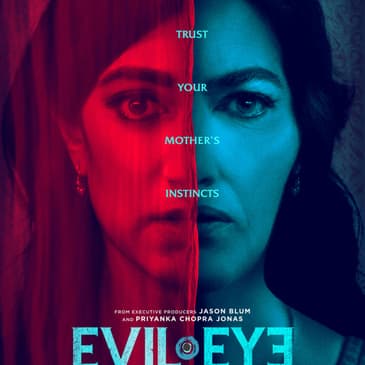
Starring Sarita Choudhury, Sunita Mani, Omar Maskati and Bernard White, the chilling, psychological thriller Evil Eye is available to stream on Amazon Prime Video now.
Shownotes:
Head over to the Khandaan Podcast page for a full review Evil Eye with Justin J Rao
You can hear me on BBC Asian Network's Big Debate talking with friend of the show Haroon Rashid and Qasa Alom about Dilwale Dulhania Le Jayenge's 25th anniversary by going here. (only available for UK listeners)
The New Season of The Tolly Folly Podcast is now out: subscribe to our Upodcast: Bollywood Edition feed so you don’t miss Amrita, Sujoy and Beth’s new limited Podcast series by clicking here. Follow and subscribe to Amrita's new Youtube Book channel by going here!
Find us on Apple Podcasts! and Stitcher! and AudioBoom! and iHeartRadio! and Spotify! and Google Podcasts!
And now you can also listen to us on Hubhopper! Follow us on Twitter! Like us on Facebook!
You can follow all of us on @AmritaIQ, Sujoy on @9e3k and @asimburney
Sujoy’s instagram which has amazing shots can be found here, we strongly recommend you follow him!
@blumhouse @PrimeVideo @priyankachopra @PurplePebblePic @dassanir @elandassani #WelcomeToTheBlumhouse #EvilEyeMovie
[00:00:04] Hi everybody, welcome to YouPodcast- Bollywood Edition. I'm Asim Berney. This week we had the chance to speak with the team behind Amazon Studios Blumhouse
[00:00:32] collaboration with Priyanka Chopra Jonas called Evil Eye. First we speak with writer Madhuri Shekar who is mainly a playwright who wrote the audible play the movie is based on and then adapted from which was also done by Madhuri.
[00:00:45] Then we speak with both of the Dassani brothers Elan and Rajeev who are LA-based producers, visual effect artists and directors. They've been making TV, sci-fi and horror for a while.
[00:00:56] I had a really fun chat with all three of them and we do review Evil Eye in much more details on episode 77 of the Haanlan podcast.
[00:01:04] If you want to hear our full thoughts, I will add the links in the show notes. Evil Eye is available now to stream on Amazon Prime Video. Now let's hear our chat with writer Madhuri Shekar.
[00:01:18] Hey, hey, have we met? Wow, use that line a lot. I'm Sunvi. I love you. Beautiful name. Thank you.
[00:01:34] I'm uh, um, I've met someone. This is such good news. Thanks for joining us Madhuri. Thanks for taking the time to speak with me. It must be like a crazy time for you.
[00:01:43] Uh, it's a, yeah, it's a really fun time right now. I'm really glad people are able to see the movie at last. So where are you based? You're in New Jersey at the moment. I am. I live in Jersey City.
[00:01:56] Okay. And how's the whole lockdown COVID thing been for you? For a second, I thought you were going to say, how's the weather out there? I can't ask. I'm in London so I have no right to ask about anybody else's weather.
[00:02:09] Um, oh my gosh. Well, I feel like everybody knows the state of the country from reading the newspapers but um, you know, it's uh, we're just, you know, we're staying home. We're wearing our masks. We're trying to be as careful as possible to get through this.
[00:02:27] Yeah, I think a lot of people had really good intentions when lockdown started. You know, I'll write a book. I'll do this. And that's why I'm asking because you are actually a writer, you're a creative person.
[00:02:37] So I'm wondering how many books have you written in these nine months we've been in lockdown? I, uh, none because um, uh, I had a baby this year so he was born about, thank you, he was born about two months before the lockdowns began.
[00:02:52] So that, he's been my huge project and we're very grateful to have him. Wow. Okay. Yeah. So yeah, I think he's probably been keeping you busy then. So tell me how did this project come about for you? How did it all get started?
[00:03:07] Yeah. Um, so Evil Eye was originally an audio play and it was commissioned by Audible. They wanted playwrights to write plays for the audio format.
[00:03:17] So when they commissioned me, um, I had this idea to write a play that was told entirely through phone calls which would be really good for the audio format.
[00:03:27] Um, I talked to my mom on the phone every day. She lives in India. I live here. So we talk on the phone and um, so the idea of a mother daughter phone call story, you know, was interesting.
[00:03:39] And I was really, uh, I wanted to try and challenge myself and write something scary because I hadn't done that before.
[00:03:45] And so, um, uh, you know, it was just, it was thinking about like what is the scariest thing in the world to me, which is something bad happening to my parents. Of course, from my mom, it's something happening to me when we're so far away from each other.
[00:03:59] Um, yeah. And my husband kind of encouraged me to think about like, is there anything in Indian culture that is specifically like a horror trope or a suspense trope or something that you could use that just culturally specific and um, I thought of reincarnation which is not a horror trope at all but um, uh, it can be if you think about it in a certain way.
[00:04:20] So yeah, yeah. That was kind of um, that was where all the pieces kind of came together.
[00:04:28] And was that because audible is an Amazon company and then you're it's premiering on Amazon Studios. Was it always an idea that some stories might get developed or this was complete surprise for you?
[00:04:40] No, it was never, it was never in the original conversations. It was, I mean, it was just, I'm a playwright. That's what I do. So this was always meant to just be, um, I hadn't even considered it as a stage play.
[00:04:51] It was purely supposed to be for the audio format. Um, but my manager for TV and film, uh, liked to play a lot. And so he while I was still working on it, he sent the script around Hollywood and um, so purple pebble pictures came on board.
[00:05:05] Amazon and Blumhouse came on board and Amazon and Blumhouse already had a deal going. Um, and Franca Chopra had an overall deal in the works with Amazon. A lot of corporate synergy happened, you know, to make, uh, to make this movie.
[00:05:20] So yeah, the timing worked out really well. And how, then you also wrote the screenplay for the movie, right? Yes. Yes. So how was that, how was that transition going from the audio play and adapting it? Did you need to trim something out?
[00:05:33] Did you need to add something more? I know that you wanted to show the part where they kind of meet together, right? So you wanted to flesh that out with them?
[00:05:41] Yeah, I mean it was, um, uh, it, it was hard because all, all writing is hard. Um, but um, turning the, bringing the story over to the visual medium gave us a lot of opportunities to do things that I just couldn't do in the audio format so we could actually see Pallavi and Sundi fall in love which we don't, we only hear about, you know, second hand in the audio play.
[00:06:06] Um, we get to see Usha and Krishnan together in their intimate domestic sphere and we actually get to see how good they are with each other and to each other.
[00:06:14] And um, we get to see their worlds and how they've set up their worlds. They're like the, I don't know, just like their apartments in this movie are so beautiful, you know, like the, just the visual eye candy is so amazing.
[00:06:27] And of course it's just like, there's so much more that an actor can do on film than they can in when they're limited to just voice, right? So um, yeah, there were just like a lot of opportunities and so there was definitely, yeah, it's fundamentally the same story as the audio play but I feel like you will get to really
[00:06:48] find different experiences of the story with each format. I mean, I'm Asian, you're Asian, there were definitely themes when I was watching the movie that definitely resonated with me.
[00:06:59] The one thing that stood out to me was this hold that our desi parents have over us and I thought it was really interesting how it mirrored an abusive relationship in the past and in the present.
[00:07:13] So how did you kind of, hey, were your parents kind of mad about this or like when you kind of explained the story? Like, you know, is it autobiographical or anything like that? How did you kind of want to deal with that?
[00:07:27] My parents love it. My parents loved the audio play. They loved the movie because they're, I don't know, I guess spoiler but they're like, they're kind of the heroes of the story, you know? So it's not fully autobiographical. The opening scenes are.
[00:07:47] My mom has called me upset that other people are getting engaged before me. That has happened. I was set up so many times in my 20s. That was definitely something that I experienced.
[00:08:03] And the nature of the relationship between the daughter and the mother is so similar to what I have with my mom. So, yeah, they, sorry, you asked something before that. That's kind of how my parents reacted to it.
[00:08:20] Yeah, I was just wondering how you know the hold that our parents have over us, you know, the expectation that they have is almost feels like sometimes an abusive relationship, right?
[00:08:32] Like, you feel that you're never good enough. And that line that that was in the movie really kind of resonated with me. I was just wondering how you wanted to because after it does feel that they are the heroes of the movie.
[00:08:44] This almost feels like it validates the behavior of the mom. So that's what I was kind of wondering how you wanted to, you know, portray that on screen in a way.
[00:08:56] I don't know. I think that's an interesting way to look at it. I think, um, I think an abusive relationship which can absolutely happen between parents and children is not really the one that this movie talks about.
[00:09:11] Um, I think there's a tremendous amount of tension between that can happen in very loving relationships as well, which is what I experienced with my mom at times where, like the only reason I agreed to go on setups is because I love my mother and I respect her
[00:09:30] I do genuinely trust her judgment. You know, it's like if she did like find someone for me and vet them for me, then it would be rude of me to just dismiss them outright without giving them a chance, right?
[00:09:42] So that's kind of why I went on so many setups, but it was also really frustrating because at the end of the day my mom doesn't know who I'd be attracted to.
[00:09:53] So it was like really like hard, but it was at the same time it was like her saying, you know, I'm never going to force you to marry anybody. You don't want to marry. That's never going to happen.
[00:10:02] I'm just trying to help you. I'm just trying to like send dudes your way. Yeah.
[00:10:09] So, you know, I but I think like the line that you mentioned right about never feeling like you're good enough that is very true. And you know that's like one of that's the line that really resonates from me as well when I was writing it is that that's a painfully honest and dark
[00:10:25] thought that I have had that, you know, that I feel like can happen in in even like good and loving relationships as well.
[00:10:37] I think like it's interesting about validating bad behavior maybe I have, I've seen a lot of like stories about like first generation second generation like, you know, immigrant families and stuff where the focus and the complexities on the younger
[00:10:55] generation and the older generation the parents are not explored as as well or at the writers and directors don't seem to be as curious about them.
[00:11:05] And that's always sat with me in a wrong way. I'm kind of like, no, I, we're all really interesting. We're all really complicated people.
[00:11:13] And I want to know why people are the way they are, you know, so and I, you know, I wanted to write something for my mom and I want to write something for an actor in her 50s and 60s to play where she gets to be validated doesn't happen often.
[00:11:30] You know, so, you know, media. So those are all the places that I came from. So final question I mean coming back from that Asian perspective, you know, feeling not good enough feeling like a failure. Do you now feel good. Do you feel you've made it.
[00:11:48] Um, I feel lucky. And I mean like, you know, it's um,
[00:11:56] You know, like in the movie like the mom comes back and says I'm so sorry I've ever made you feel that way you've always been good enough, you know, I'm sorry if I ever did anything that made you feel like that.
[00:12:05] And that's kind of how it is with my mom. I'm very lucky and that I'm married to an incredible human being that my mom absolutely adores and my dad absolutely adores, but that's not like an accomplishment I just got really lucky.
[00:12:20] That we met. Um, uh, yeah, I'm I'm and I'm just so happy that I have the story that is about my parents and that they love and that they're proud of and I get to like share this part of my life with people. Yeah, so I feel pretty good.
[00:12:35] I mean, it's amazing. The movie's out on Prime now so everybody can watch it and enjoy it and thank you so much for talking with us. Thank you.
[00:12:43] So that was my chat with Madri. Now let's go over to go over to Ilan and Rajiv Dasani, the twin directors of this movie. And afterwards I'll be back with some show notes.
[00:12:53] Really excited to talk to you guys. I mean, this is like such a big thing, a movie with South Asians working with Blumhouse on Amazon. Like how excited are you guys?
[00:13:04] We're very excited. Yeah, I mean truly we we understand the kind of responsibility and we hold both working Blumhouse working with Amazon.
[00:13:13] You know, produced by Pranakachopra Jonas like like we know it's a very big thing. We know that a lot of people have been very excited about it and we from minute one knew that we had a responsibility to deliver to really deliver something special and unique and I think we really we tried our hardest to make sure to do that.
[00:13:32] So I know Blumhouse has kind of a very set way of working like tight budgets and genre filmmaking. Was there any hesitation getting like full on horror because when I hear Blumhouse I think horror, but I don't think evil eyes like horror like at least how you know it's not goory or scary necessarily that way.
[00:13:52] So Blumhouse I mean they're they're kind of known for horror in terms of what they've done but if you look at their filmography there, they've been involved in a lot of sort of interesting projects and especially with Amazon which is known for more elevated work and for sort of thrillers and dramas and different things
[00:14:07] I think that this is another chance for Blumhouse as an entity to do sort of more diverse projects and so this this I think is more of a psychological thriller than it is a straight horror.
[00:14:20] The thing about Blumhouse is that what they all they really care about if they really care about a quality product, and when they're when they say that that they're conscious of the budget.
[00:14:30] It means that they want to spend the money on what ends up on screen so they're very conscious about making sure that all that money goes toward the quality of the project.
[00:14:39] I was, I read about when Jordan P was making get out and even a few interviews I read with Tessa Thompson she said that, you know, sci fi and horror allows people to tell stories about diversity or people of color that a lot of times other movies cannot do.
[00:14:58] Is there something that an aspect that kind of interested you that you know within this playhouse of, you know, horror you can tell a story that's a bit more.
[00:15:06] Absolutely. I mean, we mostly work in work in genres and mostly working sci fi super natural that kind of thing. And I think part of why we do that is, is because you're, you're right.
[00:15:16] I mean, it is one of those things that a lot of people like you know our film ostensibly is has this kind of thematic core about domestic violence about kind of you know about deeper gender issues and all this kind of stuff.
[00:15:28] But I think a lot of people who wouldn't go see a straight drama about those topics will go see a supernatural thriller.
[00:15:35] I think it's a way to kind of like open it up to a broader audience but still speak the deeper themes and I think you're right there it also allows you to tell diverse stories because a lot of people again who might not go to a Indian American drama will totally like be like
[00:15:49] Oh, but I'll watch a cool thriller with Indian Americans and the Indians and I think, you know, we, we love that it's like, I mean honestly our goal with anything we do is to deliver something that people want to watch.
[00:15:59] If you can deliver something special and show them a culture they haven't seen before and make it fun to watch. That's where genre really excels. So you adapt adapted this from a kind of a teleplay an audio playwright, and then it became a feature movie.
[00:16:17] I mean, that's a challenge I imagine right like going from a short and I think they were all phone call based also.
[00:16:24] Were there any scenes that you were working on and said, we need to work a little bit more on this this needs to be adapted while you were shooting that it just wasn't gelling and you kind of needed to maybe go back to the drawing board and kind of figure it out.
[00:16:37] I think shooting that's interesting. Yeah, I mean they're so so the adaptation process was done by by the original writer of the audio play.
[00:16:48] Yeah, he did a wonderful job on that but I think you know something where because she was working in this sort of that she used to working as a playwright we work with her a lot to figure out how to make things like a lot of the flashbacks.
[00:17:03] We worked a lot with her because a lot of those weren't in the original script because we really wanted to visualize and to dramatize what we should like what actually happens or and show India and show all that texture.
[00:17:17] And one of the scenes I think that was the most.
[00:17:20] That was the trickiest I think was the one where where should she describes that flashback where you know the original version of that scene sort of wasn't working when we first rehearsed it and you know a lot of it was because
[00:17:35] it's a long scene and like the pacing of it has to be like you know directing it. It's almost like its own little short film that scene because it's such a long specific scene with the flashback and the else and so we had to figure out.
[00:17:48] It's not in the rewriting but how we stage the chain is because we realize that there is more motion, there's more activity and how the flashbacks were used like that's what we came up with it with this idea of dinner water sequences everything else to kind of add more to it.
[00:18:07] And what was your connect because obviously we know we're South Asian guys and we have that pressure of our parents wanting us to get married but it's not the same pressure that women have right.
[00:18:17] Like, so there is a difference there so how did you kind of connect with that theme that Madri is obviously writing from, you know, her own perspective, we're coming at it as I'm coming at it as viewer as a guy you're directing it as a guy.
[00:18:31] How do you kind of connect that. Yeah, well, you know, like at the end of the day I think what you want to connect to is there's there's kind of two aspects to a movie there.
[00:18:40] There's seeing a fascinating story about someone who isn't you and kind of being invested in wondering what will happen to them, and then relating their story to your own experience so you know, so I think you're right that like you were not women, but we can understand
[00:18:55] and be interested and fascinated by women's story. That said I think we can bring to the table our experience as Indian Americans and also as men, kind of talk about kind of like toxic masculinity and like that kind of thing.
[00:19:06] But I think also just you know just just on a basic level, we can all empathize with the idea of on a like on a primal fear level of a loved one in trouble of being far away from someone who's being influenced by by a bad partner like it's a these are very primal
[00:19:24] feelings that I think that's the goal of you know especially horror films, if you tap into things that are universal fears that have a specific context of the movie. So,
[00:19:35] when you were making this movie was it meant to be streaming directly or where you was there a discussion of this being a theatrical release or was it always kind of the goal and does that change anything in your approach and filmmaking.
[00:19:48] It would change the approach in this case this this was always part of the Blumhouse of the welcome to the Blumhouse streaming series on on on Amazon there was no plan to have this in theaters I think, because they really wanted to release this as part of a Halloween
[00:20:04] film coverage as part of this, this a set of four films in the anthology way, you know, as well because they're they're thematically tied in a way that you would never do in a theatrical, you know release so all four of the Blumhouse films, you know, as part of this
[00:20:20] anthology are all about family and betrayal, and about, you know the these these kinds of themes so I think that if we were approaching it for theatrical.
[00:20:31] I think that we would have probably done it a little bit differently in terms of scope because I think that there's a difference because I think that on streaming.
[00:20:40] The big difference is, is that you have to, you have to start almost a little bit faster because because people can change change change the channel in one minute, whereas once people are in a theater.
[00:20:51] You kind of have them they've already paid their money they have their popcorn they have a drink so you can do a slower sort of opening and that's that's a big difference between streaming movies and and the and films met purely for theatrical.
[00:21:05] I think throughout the movie I felt that the pacing was really quick because not even you know the start anybody at home can just grab their phone and start scrolling or something, and you lose that focus but your movie was just always, you know constantly moving and I really
[00:21:18] appreciate that. The other thing I really appreciate in the movie was also your, your production design and your set design, because I don't know what I'm going to ask this was the Indian portion set in India because you almost fooled me like I don't know if it was actually said in India
[00:21:32] So I wanted to ask that question. Yeah, it's, it's anything you asked that so it was actually it was shot 90% in New Orleans so actually all of the Indian interiors, every single one was all shot in New Orleans, actually even the bridge scene was a shot in New Orleans as well so
[00:21:47] The bridge scene that really got me I was like, is this India?
[00:21:52] Yeah, you know basically we use set to that our our production designer Ryan Aladwire was absolutely amazing and he did a ton of research into essentially looking at photos of people's houses and like he had posters to the bridge and you know if you look closely you'll see that there's an Indian speed limit sign on the bridge
[00:22:12] Even down to things like you know, like 3D printing plugs that you look the same that you know in order to be on the other wall things like that it was very it was very intentional like we wanted to feel very authentically Indian even though we were shooting in New Orleans for kind of mostly budget reasons and
[00:22:26] you know, we did use visual effects for example to like adding any to the background and plates and footage what shot in India like mainly in the big flashback sequence where it's like where you know we're an old deli that was shot by a second unit in in old deli kind of like with doubles essentially
[00:22:45] in order and plates as well to kind of put in the background of our scenes in New Orleans going to make it all it was like a puzzle kind of That's a good question because I know you've been probably talking to a lot of people but No worries.
[00:22:57] So, because this wasn't a theatrical release there's not that same cycle of film criticism around it right the movies came out a couple of days ago. Have you been reading reviews is there anything that you kind of pick up and you say I want to kind of like, I want to, you know, get back at that or I want to address that
[00:23:14] Is there anything that kind of stood out to you that you want to
[00:23:17] There's one big thing which which is just that I think I mean you've had some very positive reviews and I think the reviewers that have been positive. I think understood that it was kind of a genre blend where it's both a family drama, kind of intense kind of like
[00:23:32] A lot of the drama meets supernatural thriller. I think those people who were expecting it to be a like kill a minute slasher film, I think we're disappointed. But I think I sort of would encourage those people to watch it in the spirit that it was intended which is it was meant to
[00:23:49] More of this kind of drama slash thriller and I think in that context that's a, I think I'm very, you know, obviously very proud of the film, but I feel like some people kind of let their disappointment kind of extend into like not about moving on its own terms.
[00:24:05] So, maybe they thought there was actually an evil eye like a demonic eye or something like that.
[00:24:10] You know, it's, I think, I mean like you know like Blumhouse has I mean they have made so many amazing films but because people associate them with very intense horror films which is great and they make amazing films.
[00:24:22] Sometimes they sort of assume they're all going to be like that which isn't necessarily the case. Guys, thank you for your time. I could talk like ages and have so many other questions but I mean amazing job and I'm really looking forward to what you guys do next.
[00:24:36] Thank you so much. Appreciate it. Yeah, thank you. Yeah, cheers.
[00:24:40] Well, I hope you guys enjoyed that drop us an email at your podcasting at gmail.com evil eyes now streaming on Amazon Prime Video. The entire review is on episode 77 of the hand on podcast, the new season of 30 folly podcast is live to on this channel so
[00:24:56] subscribe also check out my my appearance on the BBC's big debate last week. All of these I'll add and I think next Wednesday we're also dropping the episode 78 which is a review on Bazzi girl with the entertainment reporter Justin
[00:25:13] Rao so it's going to be a lot of fun. Subscribe to a hand on podcast subscribe to tolly folly podcast and to you podcast volume and edition. Thank you so much for listening guys.