
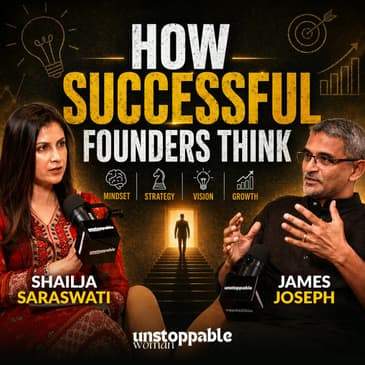
What happens when a leader leaves the speed of global boardrooms and chooses conviction, clarity, and contribution instead?
In this episode of Unstoppable Woman, Shailja Saraswati sits with James Joseph, Founder of Jackfruit365, for a conversation that moves far beyond the visible entrepreneur story. Together, they explore the inner shift from validation to conviction, from balance to resonance, from corporate success to social impact, and from building careers to building legacy.
James Joseph is a former Microsoft executive turned social entrepreneur, whose science-backed innovation with Jackfruit365 is redefining health and impact in India.
James speaks with striking honesty about childhood loss, resilience, family, conscience, leadership, entrepreneurship, and the clarity that comes when purpose is no longer tied to external validation.
This episode is about:
• the choice of conviction over validation
• the meaning of being a net contributor
• why resonance matters more than balance
• how inner authority is built through conscience
• the power of business ideas over charity
• raising children with conviction in a fast-paced world
What makes this conversation powerful is not just James’s story, but the depth of the inquiry itself. Shailja draws out the human transformation beneath the founder narrative, the part that is rarely discussed, but often matters most.
If you are navigating growth, reinvention, ambition, or inner change, this episode may feel less like content and more like recognition.
Watch till the end for a moving reflection on the unstoppable spirit in leaders.
Chapters:
00:00 - Introduction: Moving Beyond External Validation
04:15 - Anchors of the Past: Childhood Loss & Resilience
09:40 - The Corporate Ladder: Lessons from Microsoft
15:20 - The Turning Point: The Choice of Conviction
21:10 - Jackfruit365: Merging Science, Business, and Health
27:35 - Business Over Charity: Redefining Social Impact
33:50 - Becoming a Net Contributor to Society
39:15 - Seeking Resonance Over Work-Life Balance
45:40 - Raising Children with Conviction in a Fast-Paced World
52:20 - Concluding Thoughts: Building a True Legacy
[00:00:00] When you left Microsoft, what were you really choosing? My wife. What drives you more today, validation or conviction? Conviction. It's in grain. To me, I get satisfaction in doing it. The result is not in my control. What I do is in my control. What made you leave Microsoft?
[00:00:27] To me, that is what I call a net contributor to this world. James, charity is only a bandaid to the problem. The real impact comes from sound business ideas. So they sent a copy. But Dr. Kalam read the book. And he wrote back. And he wrote back to me. That's a mission I am on. For leaders, while the focus has been on the outcome, the outer success,
[00:00:56] but there's a lot of inner authority which needs to be built or realized. I think all of us have it. We sort of lose it. But you seem to be very in control of that authority.
[00:01:07] Welcome to the show, James. Thank you, Shailja, for having me. Unstoppable. What a brand. Thank you so much. Thank you so much.
[00:01:33] And your story is unstoppable from the start to the end into 100x. There's so many pivots you've taken from boardrooms of Microsoft Office across the world and then launching something so innovative back in your hometown in Kerala, which is science-backed. I don't think I have come across anybody like you in my life
[00:02:02] who would leave such a high-stature job and you passionately did what you did and then start something which leaves the legacy behind. But to get to that, we have a small ritual, if you allow me. Okay. Yeah. So, we call it the three keys, the three unstoppable keys. I'm going to just ask you this question. You have to reply in one word.
[00:02:30] When you left Microsoft, what were you really choosing? My wife. Fair enough. What did you have to let die to start Jackfruit 365? Unplanned. Unplanned. What drives you more today, validation or conviction? Conviction. Conviction. An exceptional childhood because at the age of three, we had a major disaster.
[00:03:00] My mom passed away from cancer. Sorry to interrupt. Okay. So, but that changed whole perspective for me. So, from that, a lot of people came together to make who I am. Okay. Okay. So, that is why I have this strong connection with my roots that I owe my success back to
[00:03:27] the roots and the ecosystem around me which protected me from that crisis. Okay. Okay. So, and that is why I came back because I felt that, okay, look, I need to give it back. So, I'm a strong believer in what I do, not the result. Okay. So, as they say karma. Karma. Okay. And it is not something somebody taught me. It's just that it just… It's ingrained.
[00:03:56] To me, I get satisfaction in doing it. The result is not in my control. What I do is in my control. So, that as a value came in very early. Very early. So, I only worry about what I have control over. Okay. I don't know how I got it, but this is something which… Stayed. Stayed with me from childhood. So, taking ownership and then doing that action. Action.
[00:04:25] That's it. And usually a result happens. Okay. Okay. And if it doesn't happen, I look at is there a way I can correct it or is there something else which I didn't know. So, it's like in a constant growth mode on, right? Intention was right. Yeah. Okay. I gave my 100%. Based on the knowledge which I had at the time, have I done it? If I took a shortcut, then I curse myself. Okay.
[00:04:53] As long as I did what I knew was right, then I will take the result the way it is. Okay. I'm more a laid-back person, but I think my brain works. So, I mean, I am all about permutation combination. Okay. Mind game. So, look at where is next. So, even when crisis happens, what is on the surface may not be what is behind. You go underneath. I go underneath.
[00:05:22] So, it doesn't perturb you. I mean, I can give you an example. Okay. Okay. Okay. So, when our study got published. Yeah. Okay. And the diabetes study got published. The Jacket for the Jacket for the Jacket for Flower. You know, when we did a fantastic study and got that published in ADA and the Nature Journal. We had a significant social media campaign against us. Okay. Okay.
[00:05:49] And then what I see on the surface, I couldn't see that this is where they are going. Okay. There is something else going on. Okay. Hmm. Hmm. Then I got the insight that they are after the publication. Okay. Okay. What we are seeing today is not what is the end goal. The end goal is to get the paper withdrawn. Okay.
[00:06:19] Okay. The moment I... So, that is what I was... Because my publication... Yeah. ...is the basis for my claim. Yeah. That is the evidence. Yeah. Okay. So, I got it published in a world famous journal. Okay. So, unless they pull the publication, they can't do anything. Okay. Because scientific evidence. So, basically, they are going to the source. The source and get that paper pulled. Get the paper pulled. So, once I got that sense... Yeah.
[00:06:49] So, I realized, okay, look, what is happening on the ground is not what I should be bothered about. So, I started planning myself to make sure, okay, when that request comes from the journal, I should be prepared. Hmm. And I did get that two months later. Within 24 hours. Okay. My response was ready and sent it right away. So, you were prepared for that. I was prepared for that.
[00:07:15] But when two months ago, I knew this is where it is heading to. Before we go to jackfruit. Okay. I know you are jumping to your life mission, but we are going to go a little back to understand the man behind the jackfruit a little better. So, you were leading executive relationship at Microsoft. And you were speaking passionately about it when the camera was off. And from the outside, this is authority.
[00:07:43] There's a lot of you, what I heard was very sure about a different design you wanted to lead it with. Not the conventional design of how conferences were conducted or how formats were given to you. So, you broke all those norms and you redesigned. So, you just talk a little bit about that. Okay.
[00:08:06] So, in Microsoft and in most large corporations, big events were the norm. Okay. You have a big event. You get the best entertainment and you have a large mala. Okay. That is how the norm was. Okay.
[00:08:28] And then, I ask myself, if I am that customer, what is it I would like? Okay. So, I can put myself in the customer's shoe. Okay. And for me, that is important for me. I need to understand how would it feel if I am the customer. Okay. And then, filter everything out.
[00:08:54] If it is not something which adds value, remove all of that. Then, I realized, okay, look, large events are not a good use of their time. Okay. Okay. Because the amount of time it takes for them to be at a conference for that long, here is somebody who is living and breathing the problem. Right. Okay. And he is sharing, all of a sudden, everybody says, okay, look, we need that. Right. Okay.
[00:09:20] So, this is about you making the customers multiply the solution which they got with next. And that is more effective than us talking about technology. So, you are going straight to the problem and getting a testimonial almost from a customer to customer talk. Correct. Okay. Okay. So, you will then, there will be questions asked. So, there is an interactive discussion and everybody starts speaking. So, it is a brainstorming.
[00:09:50] Okay. And then, the more they speak, the more insight we get. Sure. Okay. Earlier, it was all about talking to customers. So, this was not customers talking to each other. Correct. I am there just to take notes. Yeah. Okay. Okay. So, I tell my team that, okay, look, we should treat our customer executives like your date. Every gesture, every comment they make, we have to pay attention.
[00:10:19] They should, and encourage them to do. So, I will know whenever somebody is trying to, and I reach out to them, do you have anything. So, making them speak is more important than us speaking. Hmm. And then, I get so much of insights from every account, which I pass it on to the team. So, I mean, from stage to a large audience, to smaller groups, their sharing about themselves was actually helping us. Sure. Sure.
[00:10:48] You were also talking about, from the beginning, you had this entire thing about being an individual contributor. Right? And you spoke about being a global manager. And that was a very foundational sort of insight through your coaching sessions, which became very pertinent for your career growth.
[00:11:12] And that is very unlike anybody who's joined such a big organization's approach, right? They would want to work in teams, in structures, then jump the hierarchy and go up and up and up, like I say. But you said, no, I want to be an individual contributor. What was, what will it cost if you were not an individual contributor? So, it's about self-realization. Each one has their own strength. Okay? And their own, you know, how do you get positive energy?
[00:11:41] How do you get negative energy? Okay? So, that self-realization is very important. Okay? You have to reflect, you have to ask, critically think yourself. Okay, look, one day I'm very happy. One day I'm not happy. And what happened that day where I was happy? And so, then I realized, okay, look, I get a lot of positive energy when I hear business models. Okay? And I told you about this Czech story, right?
[00:12:11] Yeah. That is a real life business problem of a bank. Okay? And my MBA, all of them, I like to play business models in my mind. Okay? And where do you get business models? Where do you get to learn? When you meet customers. Okay? I get to learn about different businesses. So, to me, meeting customers was enriching my knowledge about business models.
[00:12:40] So, to me, spending time with customers, not just one customer, it's about, you know, customers. That is what was giving me insights. That is giving me a lot of positive energy. Right. But sitting in internal meetings, to me was, I mean, these are individual. Okay? This is, you have to, I mean, a lot of people, you know, leading teams is something which they get a lot of energy. They get energy from that. Energy. Energy. So, each one has, you need to assess yourself.
[00:13:09] So, for me, external to the company was giving me more energy than being internal to the company. Okay? So, and for that, when you are a team leader, 80% of your time is internal. Yes. Yes. You're managing people in the system and the processes. Okay. And politics. Correct. So, I was lucky to have a good mentor. Okay?
[00:13:33] Who was actually in a leadership role, then realized he was actually, I mean, stressing, he was losing his energy. Then he quit that role and became an individual contributor. Significantly, but, you know, the corporations, they know your caliber. Yeah. Okay? So, you can, there are roles where such seniority is required. Okay? So, you can pick a role where that's, like, for me to have a conversation with my CX,
[00:14:03] source. Yeah. At the business acumen was important for that role. Okay? That only comes with experience. So, I could speak at shoulder to shoulder. In fact, one of the comments which I go to, you have the five-star hotel, I mean, managers, hospitality, and a senior execs business acumen.
[00:14:34] Those two, one is a marketing role. Yes. The other one is a business role. Business role. Okay? You have an amalgamation of both. You treat people very well. At the same time, you maintain the business conversation, what is relevant for Microsoft. Right. To have both is not easy. Absolutely. And I somehow got that.
[00:14:57] So, to me, I could just merge with my customers and it was never like a business meeting. Hmm. It was like hosting people at your home. Hmm. That is how relaxed my meetings were. What made you leave Microsoft? So, that comes back to the fundamental question. Why did I come back to India? Yeah. Okay.
[00:15:27] So, I had the strong desire within me to have a positive impact on a large number of people. Okay. Don't ask me. How? How? Why? Okay. But that was in the back of your mind. To me, that is what I call a net contributor to this world. So, that is a constant theme. Whether it's Kerala. Anywhere. Anywhere. Anywhere. So, you want to contribute. Because, to me, I take… To a larger number of people.
[00:15:56] I have taken a lot to be who I am. Okay. Okay. Then, when you leave this world, if you have not given back at least one ounce more, you're not a net contributor. Got it. Okay. So, to me, to be a net contributor in this world was something which is within me. Hmm. Okay. So, when I was, you know, in the UK, you know, why did I come back? Okay.
[00:16:23] So, to me, I mean, getting a transfer from Microsoft was an easy way to come here and then land in a job which, you know, I can hit the ground running. Right. Okay. Okay. So, that was an easy way to get back to India. Got it. Okay. So, I took a transfer. Yeah. But that was not the reason I came back to India. Hmm. Okay. So, I wanted to, you know, then, you know, some, you know, moving to India from UK. Okay.
[00:16:51] The company is helping me to come here. So, I need to make sure I paid back by delivering in India. Hmm. Okay. So, it took, take me three years to prove that, okay, look, I have contributed back to Microsoft India. Okay. And I did really well and went on to win the highest award. And so, I did that. So, my goal was do that, earn my right to advance. Okay. And the advance was to Gates Foundation. Okay. Okay. That's where I could work on large impact in the society. Okay.
[00:17:21] Okay. That was my desire. But that was completely thrown off in a flight. Okay. Tell us about it. So, we had, the Microsoft Chief Operating Officer was in Mumbai. Hmm. And I had gone there for the meeting. So, we were, I was hosting a CIO round table with him. And then meeting was all. And then I was flying back to Bangalore. Yeah. On that flight, the Microsoft India Chairman, Ravi Vengladishan, was also on the flight. Yeah. He is the one who helped me to move.
[00:17:51] In fact, the person whom I contacted, it was in a meeting in UK. Yeah. There was a corporate vice president came there. And during that conversation, I realized, okay, he was also on the board of Microsoft India. Okay. So, I told him about my, I said, how are you going back to the, he said, okay, so he is in two. Carbon footprint. Okay. So, he didn't come by taxi. He was going by train to London.
[00:18:21] So, I told him, can I drop you at the train station? He said, if it's okay, I mean, I can take a taxi. He said, if it's okay, I'll, I said, okay, no. Anyway, I'm going that way. I dropped him back at the train station. Yeah. In that journey, I told him about my desire to come back to India. Okay. He wrote to Ravi Venkateson and then Ravi reached out to me and then that is how my move happened. Okay. So, on the flight, Ravi Venkateson was on the same flight. Okay. Okay. So, and you know, we know each other.
[00:18:51] He knows I'm here and, but I never reached out to him after that. Okay. He came to my seat and there was a young girl who was sitting next to me. She said, okay, young lady, I would like to speak to this gentleman. Could you take my seat? So, this girl moved to Ravi's seat. Okay. He came and sat next to me. Just chit-chatting and then he asked me, it's been 18 months since you've moved to India and you have not reached out to me yet. How are you doing?
[00:19:21] Okay. I said, look, Ravi, you know, I've completed 18 months. Another 18 months, I think I can, I can, you know, justify the Rokula I've done. I mean, your decision to bring me back here, I can prove that it was justified. Yeah. Okay. After that, I would like you to help me move to Gates Foundation. And Ravi is very close to Bill Gates. Okay. So, I asked him, why do you want to move to Gates Foundation?
[00:19:49] I said, I have a strong desire to work on something which has got significant social impact. Okay. Large impact on people's lives. And then Ravi turned that around and he said, James, charity is only a band-aid to the problem. The real impact comes from sound business ideas. Yes. Look at what motorcycle has done for India. Hmm.
[00:20:18] When the government had no money to put roads into your house. Yeah. The motorcycle allowed you to travel faster. Correct. And the motorcycle helped them to get better jobs. And made, they made more money. Yeah. Because of the motorcycle. Okay. Look at what cell phone has done. An auto-rushed driver or a carpenter is able to get more money per day because of the cell phone. Hmm. And these are not charity. Correct.
[00:20:45] It is the beneficiary who is driving the business model. Yeah. Okay. It is sound business which has a larger impact on people's lives than charity. Yeah. Okay. So, the scale is higher. Correct. And what I'm also seeing is when you're talking about it, the marketing and the business acumen combo, India, something would have lit. So, then I realized, okay, look, he's right. Yeah. How much can you save and help people? In your individual capacity. That too.
[00:21:14] So, James, think of good ideas which will feed. The beneficiaries will pull the business. Hmm. Okay. And then you leave a self-running model. That changed my perspective. The way you were looking at it. About joining Gates Foundation. I didn't have an idea. But it changed. The way you were approaching it.
[00:21:43] Approaching about where. You want to do good. You were approaching in this direction. Correct. He put a scale to it. Correct. In that conversation. So, that changed my perspective about how can I make an impact. Even then. So, on that flight conversation. Yeah. Something else also happened. Which is. Okay. Okay. So, then Ravi asked me again. Is there anything I can do for you? Okay. And I told him I would like to attend the Microsoft CEO Summit. Okay.
[00:22:13] Which is Bill Gates invites top 100 CEOs of the world. Okay. In one room. This is like the biggest business model you can imagine discussion going on in the world. Absolutely. Okay. So, and I've been reading the, you know, as part of the team which is sending customers, I mean CEOs to that summit. Yeah. Okay. And every year I read through the notes from the meeting. Okay. I can feel it.
[00:22:42] I mean, it'll be something which money can't buy. Yeah. Okay. So, I want to go there next year. Not this year. Next year. Next year. Okay. I said, why don't you go this year? Okay. I'll arrange for you. I said, this year I'm moving to Kerala. So, I'm going to work from Kerala. You told him. I told him. Who approved it? You're telling your country head that you're moving back to your hometown.
[00:23:12] You should be working close to my office. Who approved it? I could sense that, okay, look, my 15-year plan is going to be nuked if I don't do anything in the next minute. Okay. If Ravi vetoes the whole thing, my goal of moving back to Kerala is dead. Yeah. So, I had to come up with the one line. Yeah. Which Ravi couldn't refuse.
[00:23:40] So, I told Ravi, when you get the opportunity to work for the best company in the world and live where you grew up, that should be taken. And how did he respond or react? He couldn't respond. Okay. He said, if you put it that way. Yeah. I agree with you.
[00:24:09] And from that home, I went on to win the Circle of Excellence Award from Steve Ballmer. So, nobody could even question whether my performance went down. Okay. So, and you asked me this question. So, it was not work-life balance. It was work-life resonance. Okay. Okay. Both were performing at its best. That is when the natural frequency, that is when resonance. So, to me, I had the time of my life. Okay.
[00:24:39] The moment I switched off from Microsoft, I'm in this beautiful nature surrounded by, you know, nature. Many generations of friends and family. Yeah. And spirituality. So, that is what I call. Yeah. It's beautiful. And my children. In fact, one of the reasons for me to move back to Kerala and to village was, I had this reflection in the US when I was playing golf with my brother.
[00:25:07] Look, my last 20 years is because of my first 20 years. Hmm. Hmm. Okay. I was what I call, I was riding on an elephant, which was slow, but so secure I could even sleep. Yeah. Things were very slow, but it's so, I mean, it's conducive for you to sock up everything at your own pace. Yeah.
[00:25:37] Okay. But the last 20 years was like riding on a cheetah. We moved faster than the rest of the world. I mean, professions, I mean, our age group moved faster than the rest of the world. Okay. That was, but cutthroat competition. So, we were actually in a fast pace mode. Yeah. Okay. But my children are also on the cheetah. Yes.
[00:26:04] If I have the conviction, my first 20 years is what gave me my last 20 years. Last 20 years. I have a responsibility to do it back to my kids. It's a personal conviction. It's not for everyone. I had that conviction. My wife agreed with that conviction. We both decided, okay, look, we want to move to a slower pace life. But my professional, I mean, both of us have a, you know, doctor, you know, significant professional expertise. So, she's a doctor. She's a doctor. Okay. I mean, I could.
[00:26:34] How do you keep steady in all of this? Like, I do a lot of work in inner authority. And that's, that's a space I'm building. That's a mission I'm on. Right. For leaders, while the focus has been on the outcome, the outer success. But there's a lot of inner authority which needs to be built or realized. I think all of us have it. We sort of lose it. But you seem to be very in control of that authority. It's a tricky one. Okay.
[00:27:03] You give power to your conscience. Okay. If you give power to your conscience, the conscience controls you. Okay. Then you can't mess with it. Doesn't matter what happens. You have to stay true to it. Look, the reason I, I'm eternally thankful for the experiences which I have got. Okay.
[00:27:32] So, and I have no other intention to do something good. Okay. Now, I don't need a lot of money to live. As long as I give education for my children. Yeah. Okay. But the strong purpose within me is doing good. Yeah. Okay. And not taking any shortcuts. Okay. Okay. So, it doesn't matter how long it takes. Correct.
[00:28:01] So, to me, I mean, long horizon to see unconstrained view. Okay. Okay. And being in the open. Yeah. Okay. And being with nature allows things to come out. And you deal with them. Clear them up. Okay. Okay. And that brings you to calmness. And calmness, what gives you clarity in seeing things. Why do I see things which others don't see?
[00:28:31] Okay. It's because I have cleared all these clouds. Right. Okay. So, I have clarity. Okay. So, those morning walks help me. And being, you know, with God. Okay. Okay. Also, it's a meditation. It clears everything from your, you know, things which are bothering you, which is clouding your mind. Yeah. Comes out. So, all of this has a purpose. To keep me clear.
[00:29:02] Sure. To see things as it is. I mean, it's a... First of all, are you taking care of your responsibilities? I mean, as a father, as a husband. So, I mean, are you taking care of that responsibility? That's one. Okay. That's something which, I mean, as that is my personal responsibility. Am I taking care of that? That's number one. Okay. Then, do you have your support of your whole family?
[00:29:32] Yeah. Okay. If you have that, and then that is when, you know, you ask the question, okay, like, you can't do it alone. Because you took responsibility to be a family man. Yeah. Okay. So, you have to have solid support from your family. Yeah. Without that, you can't do it. Yeah. Okay. So, if those two are there, then, you know, you can give it an indefinite time. Then you can sort of unleash yourself. Correct.
[00:29:59] Then you feel the comfort of unleashing without... Uninhibited. And then, are you willing... There's no guarantee. That too. Okay. So, are you willing to take the ups and downs? And that is why I look at myself like a movie. Okay. Okay. I can take both ups and downs the same way. Both extremes. Both extremes. And it will not move you. No. It won't shake you.
[00:30:29] Because that is not the driver. The driver is to get to where you want to. There will be ups and downs in this process. Those are all a given. It's a short... I mean, if you look at from the long term view... Long term view. These are minor events. Turbulences. Yeah. Which are going to be part of the journey. Correct. Because your eye is on the target.
[00:30:58] So, entrepreneurship was not in my mind at all. Okay. So, I left because my wife got license to practice as a doctor. Yes. So, for her to get back to work... I mean, after five years of break... Yeah. Yeah. She would have to do weekends and nights during the first year. So, my children were too small. So, to me, if I'm not at home, she can't be doing weekends and nights. Sure. So, one year break made sense. Sure. Okay. And at that point, because I've got three girls, it is more important for her to work... Sure. ...than me. Sure.
[00:31:28] That's a... That's a... You know... And again, you know... You can save as much money as you want. But if your children are self-driven... Yeah. You don't need money. Yeah. They can make a lot more money if... So, like... I've accomplished something because I have the drive from within. All I had was basic education. Yeah. From there, whatever I have accomplished is the drive from within. Yeah. Okay.
[00:31:54] If I can switch on the engine within my children, I don't need to worry about them. So, you brought them back to your hometown. You were conscious that your wife would need that one year break to restart. Correct. In the new country, new context.
[00:32:13] And you decided to move out of a corporate job, which gave you your name, your fame, your position, your title, your experience, to settle your kids and to settle your wife. Correct. That's a huge price to pay, James. No. My wife took a five-year break. Okay. As a doctor, she... I mean, somebody who was working really well in NHS in the UK to take a five-year break because of the license.
[00:32:44] My one year is nothing. Nothing compared to that. Okay. And for me, one year break was nothing because I can always bounce back because I was doing very well. I mean, I had enough connects. I could always get back to another job. May not be asked who does this one. I would be able to get back to another job. Okay. So, to me, that one year was not a big deal. Okay. When I was sitting on the attic and I'm looking through the window and I can see the jackfruit tree in my backyard.
[00:33:10] That's how my attention went to the jackfruit. And? Okay. And then I said, look, I'm seeing it every day. And I said, look, when we were living in the US and in Europe. Yeah. So, after holidays, we would go into mainly salad food. Right. Because in the holidays, you ate too much and then salad would cleanse it all up.
[00:33:34] So, and then we feel like the same thing happens when we eat the traditional jackfruit as a meal. Yeah. So, in Kerala, we prepare a mashed potato equivalent. Right. With the mature, unrived jackfruit. Right. And it's a rice replacement. Yes. And that is significant fiber. Yes. Okay. It's tasty but fibrous. So, look, this is like salad. Yeah. Okay. But it's gone out of fashion. This was Kerala's traditional salad.
[00:34:05] Nobody knows it's a salad. Okay. Why do you say it went out of fashion? It takes 90 minutes and four hands to cut this jackfruit. It's a big fruit. Yeah. And it's a lot of work. And it's seasonal. And seasonal. Okay. When you have the season, you get a lot of jackfruit. And you mentioned something interesting in the break.
[00:34:28] We said that any house which had jackfruit tree, it was a legend that it increases the age by 10 years. So, my maternal uncle used to say this to me when I was a kid. A jackfruit tree in your backyard extends your life by 10 years. It's because of the amount of… I mean, that is all he would say. It's something which is passed on from generations. Okay. But the reason, nobody knows. Okay. It's like wisdom of the ages.
[00:34:58] Okay. Now, 50 years later, in Chicago at the American Society for Nutrition Conference, I presented the evidence that it is actually reversing all metabolic markers like a Mediterranean salad. Okay. Okay. All the anti-aging benefits of Mediterranean salad, we could prove that it is there in the jackfruit flower.
[00:35:24] Now, this is an ancient wisdom which was passed on by generations in Kerala. Nobody unpacked it. Unpacked it. So, but it took me a lot of effort. But that one spark of you sitting in that balcony, writing that book and looking at the jackfruit tree every day. So, I felt like, okay, look, it's going to fall off. I mean, it's… So, when I started on October 2nd, Gandhi Jain Di, to write the first page of Godson Office, it was just a tiny little jackfruit.
[00:35:53] It started growing. Growing. I knew… Oh, my God. I'm seeing it every day. Yeah. It's 15 kg hippopotamus. It's going to fall off from the tree. Because I had connections with chefs at Microsoft Time, I called a few chefs and I had read that McDonald's did the aloo burger. Yes. Okay. Okay. So, if we can… And that is the fastest selling new burger in the McDonald's worldwide. Because the vegetable burger.
[00:36:22] If McDonald's can do a vegetable burger from aloo, why can't we do it with jackfruit? So, I called a chef and I said, look, you know, can you make a burger with it? I said, James, I'm busy, but you know, it's going to fall off. Yeah. It's like you take the jackfruit, half you use it, other half you give it to me, I'll keep it in the freezer. Yeah. When I have free time, I'll try and make the burger. Okay.
[00:36:46] He called me later and he made a burger and he used the roasted jackfruit seeds instead of breadcrumbs. Okay. And we got a very crunchy, tight burger. It was much better than the vegetable burger of McDonald's. McDonald's. But then there was a problem, which is the call chain in India is not well established because I went to a burger manufacturer. He said, okay, if you're exporting, I'll give it to you.
[00:37:14] But if it's in India, I won't do it because the call chain is not well established in India. Okay. Then I learned about freeze drying. Then I got the jackfruit freeze dried and I gave it to the chef and we got both ripe and unripe. Okay. The unripe, he made the burger. Yeah. With the ripe, he made a jackfruit pie. Okay. Okay. And that pie was so tasty. Yeah. So in the US, apple pie is sour, but pecan pie is more sweeter. So I was a big fan of pie in the US.
[00:37:44] Okay. But this ripe jackfruit pie was so delicious and sweet. Hmm. I took one of the jackfruit pie and I gave it to an IS officer who was then the IT secretary of Kerala. Okay. So I know him from Microsoft days. And so he was in Kochi and he called me and I went to him and I gave him this jackfruit pie. He took a bite. Yeah. And he kept on eating. So James, I'm diabetic. I can't put this down.
[00:38:13] It is so tasty. And he said, for the last 10 years, at various responsibilities as an IS officer, I have given 15 lakh rupees for jackfruit research. He said that. He said that nothing has come out as good as this. James, can you spend one year on this jackfruit and create a market for this? A lot of jackfruit going waste in Kerala. This is a huge source of income for the farmers in Kerala. Yeah.
[00:38:44] But nobody has cracked it. I said, look, I am not. I have. This is not my cup of tea. I am a career employee all my years and I don't want to get into anything bureaucratic. I don't want to get into labor issues, all of that. So this is not my cup of tea. I will do a marketing campaign provided if I get in trouble, you will bail me out. I wanted to create awareness. Jackfruit is cool. Okay. It only had a perception issue.
[00:39:15] It was an inferior food back in South. Okay. Okay. It is too sticky. It is a poor man's food. Okay. You eat it because you cannot get rice. Okay. So replacement of rice. Replacement of rice. Rice is not available, then you take it. Okay. And rice has now become subsidized and it is available. So all of a sudden… It is taken in a backseat. Taken in a backseat. Yeah. So I need to change the perception about jackfruit. So what we call, you know, rebranding a commodity. Yeah. That is marketing. Yeah. Okay.
[00:39:44] In fact, my strategic marketing course at Warwick in the UK, I had learned about… I scored highest in the class. Okay. But I had learned about one case study about Häagen-Dazs ice cream. When Häagen-Dazs was launched, it was only available in the high streets in New York, Paris, London, and Tokyo. Okay. And everybody… This was a limited launch campaign. Limited launch for one year. For one year.
[00:40:14] Okay. So anybody who goes to the high street would have Häagen-Dazs ice cream and those were days, but it will be talked about. Okay. So not the days of social media, but even then it used to get… Amplified. Amplified. Yeah. So you will associate Häagen-Dazs with your trip to Paris, your trip to London, to your… You know, so after one year, they launched it in supermarket with a premium price.
[00:40:42] So they took commodity ice cream to a premium. Premium. Yeah. Okay. That's called rebranding. Yeah. I said, okay, how do I do that with jackfruit? Interesting. So I asked a lot of favors from the corporate chefs whom I knew. I said, okay, look, I took the mess away. It's freestyle. It's in fact like pasta. Yeah. Okay. Jackfruit is going waste. Yeah. I'll give one example. Okay. Chef Joy Bhattacharya. Mm. Of Trident, Mumbai. Yeah.
[00:41:13] I went to him and I told him, look, you know, Chef, 80% of jackfruit in India is going waste. Yeah. And he personally connected with that. He said, James, I grew up in Jamshirpur. For two months, there was a riot. We couldn't step out of our house. And we had a jackfruit tree in our house. And we lived on the jackfruits. Yes.
[00:41:41] I owe to this jackfruit. And when I had to do a special dinner for a 50th birthday for someone, a VVIP. Yeah. Jackfruit was not available in India. I imported jackfruit from Thailand. Oh. And he made a jackfruit buna. Yeah. Okay. And he made, he said, okay, look, you call anyone, I will prepare spectacular dishes with jackfruit for you. This is what I replicated in every city.
[00:42:09] Instead of CXOs of my corporate clients, I got the chief editors of newspapers and channels. To experience that. To experience that. The chefs would do fantastic. We had a chammin chakka lasagna. The lasagna filling was jackfruit. Amazing. With shrimp. And the worky crab, which I had at Taj Mahal Palace. Yeah. Chef made a worky jack. So the crab meat was replaced with the raw jackfruit.
[00:42:38] So these were publication editors coming and experiencing this and then writing about it. And writing because, and like my corporate CXO dinners. That hat came on. So I just replaced the CXOs with the editors. And for them it was awestruck. They never thought jackfruit could be served. And the chefs are fantastic. It's not about the taste, right? It's the presentation. It's the presentation. So fantastic images.
[00:43:09] So this is which year? This is 2013 to 2014. Okay. So all of a sudden, we became a hit feature story in every newspaper. I mean, Economic Times called it James and the Jackfruit Factory. It became Sunday supplement in so many papers. Jackfruit is now five star. And I would rotate different cuisines by going to different chefs. Okay.
[00:43:39] We had a galauti kebab. We had a machi kathalki. Fish and jackfruit together. And the editors could not make out which is fish, which is jackfruit. Because the spices got, this is in Leela in Bangalore. Bangalore. Okay. So, and that is what got. You changed the perception. Perception. Okay. All of a sudden, everybody started looking at jackfruit differently. So hang in there.
[00:44:08] Like first you figure out that this is seasonal. You need to make it perennial by bringing it throughout the year. The freeze try. You started freezing it. Yeah. So when you freeze try, it has one year life. One year life. And that ingredient was given to the chefs to prepare for the editorial and the publications. And that sort of repositioned, rebranded. Correct. Right. To make it cool. Cool. Okay. All of a sudden, from a commodity to five star. Five star. Okay.
[00:44:37] Everybody is, I got the attention. Yeah. You got the awareness, got the attention. You disrupted. Correct. Okay. Right. But that is what led to anybody with any knowledge about jackfruit trying to reach out to me. So this publicity brought a lot of knowledge back to me. And knowledge and engagement. Correct. Okay. So people started connecting. So reluctantly I stayed back because I had the pressure to finish the book. Okay. So I stayed back because it's a priest.
[00:45:07] So I stayed back. He came shop at 7 p.m. And then he was a farmer's son. So he was curious what I was doing with jackfruit. Ah. Okay. So I told him about, you know, how freeze trying technology and, you know, how I told him, look, this is about placing it in five star. I saw that people started eating jackfruit again. Okay. Then he asked me a question. Is it possible that jackfruit has insulin?
[00:45:31] So I told him, Father, I have heard all kinds of stories, but this is the weirdest of all. There is no way. Why did he ask you that? He explained to me, I've been taking insulin for five years. And the doctor told me to avoid jackfruit and mango. Too sweet. Okay. Avoid those two fruits. Okay. So I was not eating jackfruit at all.
[00:45:57] But one night, one of my batch mates, a priest who came from Maharashtra, came to visit me. And he specifically asked for the traditional jackfruit meal of Kerala. Sure. Because he was fond of, okay, from his childhood memory. Yeah. And the nuns prepared the meal. And then, so they both had the jackfruit meal for dinner. Yeah. And then they were sitting and chatting for some more time. And then once the guest left, he went back to his room and took his normal dose of insulin.
[00:46:27] He collapsed. He had a severe hypoglycemia. Oh. He said, when I started insulin, my doctor had told me to keep a packet of sugar next to my bedside table. I never had to use it. But he could, you know, stretch and get that packet, put that in his mouth. And he was on the floor for two hours. Then he got the energy to get up. He checked the sugar level, it was 50. Okay.
[00:46:56] Severe hypoglycemia. That is after this sugar, after taking this sugar. Right. And two weeks later, the nuns brought the jackfruit meal again. And he said, give me some ripe jackfords as well. And he reduced insulin by half. And by 2 a.m., he became shivery again. Not as severe as last time. This is the second time. Second time. Second time. Kerala is the diabetic capital of India. Of course, yeah.
[00:47:27] I got shit scared. Am I pushing people into danger? I am asking everyone to start eating this again. Yeah. And if somebody was on insulin, unknowingly, if they start taking this, am I going to cause more damage than good? Hmm. I was doing it for a good purpose. I got scared. Hmm. Yeah. I had to find the truth. Yeah.
[00:47:57] That is how this diabetes journey started. Is it a one-off case? Is there a scientific explanation for what this happened? Yeah. Because I am worried about... No. So to me, I come from an engineering background. Yeah. If it can happen to one... We believe in factor of safety. Hmm. If it can happen to one person... It can happen to others as well. To others also. Yeah. Unless you understand why it happened. Okay. So for me, I couldn't sleep without knowing why this happened.
[00:48:26] That is what led to... Investigation. Investigation. Investigation. Yeah. How did you go about that investigation? He took natural jackfruit. Correct. Okay. People have a problem with natural jackfruit and diabetes. That is between them and the doctors. Correct. You are declaring it as jackfruit. So you have no liability. Yeah. But this is an interesting observation. You may want to find out what causes this. Hmm. He connected me with a scientist. Okay.
[00:48:55] And the scientist said, okay, look, I've heard about jackfruit leaf extract having hypoglycemic properties. Okay. But not about the fruit. Hmm. Let me see if there is any literature out there which gives some indication. Otherwise, we'll have to do a primary research. Hmm. Give me two weeks. I'll come back to you. Two weeks later, he sent me an SMS. It's real. Check your email tomorrow. So it drops the GI. It was low GI index. So it drops insulin levels.
[00:49:25] He sent me a study from Ceylon Medical Journal. The only other place on earth where this raw jackfruit cooked like a mashed potato meal is in Sri Lanka. Only Kerala and Sri Lanka has this custom of replacing rice with the raw jackfruit cooked as a meal. Hmm. They did a study, glycemic study on this traditional jackfruit meal versus bread. Oh. In that study, there was a graph. The sugar level goes up.
[00:49:54] After 30 minutes, it takes a sudden drop. It goes up and then drops. And the priest had taught me, whereas with the bread, it goes up and like a mound comes down in two hours. That is what happens with normal food. That's why you have postprandialis. It stays longer. Yeah, postprandialis two hours later. Yeah. So it goes and gradually it comes down. Yeah. The jackfruit went up and 30 minutes, it just sharp declined. Within 30 minutes. Within 30 minutes.
[00:50:21] And the priest had told me he took insulin 50 minutes after the meal. Okay. So the graph is going down. 50 minutes later, he applied insulin. It went down, two down. So it's already stabilized in his system. And then he's taken the shot and obviously it's dropped to glycemic. Low glycemic. Low glycemic. Into hypoglycemia. Hypoglycemia. Okay. So now it made sense. Correct. So this can happen to anyone. Yes. Okay. Okay.
[00:50:49] So if you are replacing rice with the traditional jackfruit meal, which is a salad, you should be treating like replacing biryani with a salad. You can't be having the same amount of insulin because your intake carbohydrate is low. Okay. Okay. So the glycemic load is low. It made sense. This is science now. Right. But 50 years, everybody in Kerala has been told, if you're diabetic, don't eat jackfruit.
[00:51:19] And the biggest mistake is in the language. In all South Indian languages, the unrived jackfruit has a different name than the ripe jackfruit. Which is? So in Malayalam, it is chakka. Correct. And when it is ripe, it is chakka palam. In Tamil, it's palakai and palapalam.
[00:51:41] In Kannada, it is halseena kaa and halseena hannu. Okay. In Telugu, it is panasakka and panasapandu. But English took the name chakka and turned it into jackfruit. They put the fruit into the name itself.
[00:52:10] Hmm. So jackfruit is bad for diabetes. It is only meant for the ripe jackfruit. So our medical education is in English. That's why Bharat was important in your life. Correct. Okay. So jackfruit is bad for diabetes. It is continuously applied to both ripe and unrived jackfruit.
[00:52:31] Whereas when you look at jackfruit as a vegetable, compared to any other vegetable, it has got more carbohydrate. Yeah. Okay. Okay. So it's not a green leafy vegetable. Yeah. Higher carbohydrate. But people are not using it as a sabji. Correct. In Kerala, people are using it as a rice replacement. Rice replacement. Yeah. So you should be comparing with rice. Right.
[00:52:56] So when I looked at the nutritional value, one cup of raw jackfruit is actually 40% lower in carbohydrate, 40% lower in calorie, 4 times more fiber. Which is exactly what a diabetic person is supposed to do. Reduce carbohydrate, reduce calorie, increase fiber. This is very profound. It's very profound. Okay. Okay. 50 years. No one knew this. No gift allowed.
[00:53:26] And I got a bit shaken. So this is not gift. This is my sweat. This is jackfruit. Oh, you're the jackfruit man. Sit down. He pulled the chair and sat next to me. And then he wanted to know what I was doing with jackfruit. So I told him over the five star short conversation. So he sat in the same room. Same room. Prasad's room. Okay. Guests are waiting there. He sat there. And then I told him, so what I'm working on right now is, this is good for diabetes.
[00:53:54] And I showed him the graph. He was quiet for three minutes. I told him, I'm not getting much support from doctors to investigate this. Exactly what he told me. The M in Mbps is medicine. This is not medicine. This is pure science. This is absolute science. A high fiber meal translates to low absorption of sugar. Fiber. Fiber travels faster through the intestine.
[00:54:24] So it doesn't get enough time to absorb. That is why the graph is dipping. Yeah. It's moved out of the intestine. Yeah. Okay. From a small intestine. So the glucose absorption. So it's going up. But then it's suddenly coming up because it's moved. Moved. Okay. It's a given. There's only one thing new here. Most fruits, when they're unripe, the acidity is very high. Yeah. You can't even make a sabji. Yeah. Jackfruit, the acidity is low.
[00:54:53] That is why you're able to eat as much as rice. Okay. Okay. Apple or mango, when it is not ripe, it's very sour. It is. Okay. You can't even make a sabji. Yeah. Whereas, it's like potato. Jackfruit, you can have it as a whole plate. Got it. But only Malayalians know this. Yes. Yeah. But James, don't forget. Diabetes is all across this country. There's a diabetes expert running in this country.
[00:55:21] But changing eating habits is more difficult than changing religion. So technically what you're saying is that this is replacing the roti now. Roti and rice. Roti and rice. Okay. Roti and rice is like what he said, the eating habits. Correct. That's a challenge now. The behavior. How do you change the behavior? There are a lot of good food, but people are not willing to change what they grew up with. Yeah. Okay. So he's like, look, you're an engineer.
[00:55:50] You find a way to reduce rice and wheat with the jackfruit without changing the traditional food, the eating habits. You figure out a way. If you can crack that, you come to me. I will travel with you all over India. We will invite housewives in every city, the homemakers in every city. Okay. And you get your chefs to demonstrate how they can use the jackfruit to reduce rice and wheat.
[00:56:19] We will travel all over India because there is a huge problem in this country. I told him, look, and that is an inspiring ask. He kind of ignited something within me. Okay. I said, look, I will give it my 100%. If I crack it, I'll come back to you. But to my luck, I took 1000 kg of jackfruit to make this flour.
[00:56:44] The first 125 kilo, that batch, the roti started dancing. Okay. So you mixed this with atta. Atta. What proportion? It's, so one third is initially one third. Okay. So two cups of atta, one cup of jackfruit flour, blend it together and you make. People can do this at home. At home. Okay, guys, please listen to this. Two cups of. So it's. You can say it in the camera. Yeah.
[00:57:10] Two cups of atta, one cup of jackfruit flour, blend it together. You can make a normal, soft, dancing fulka. Okay. Okay. Now, simpler one is, you take one tablespoon of jackfruit flour, two tablespoons of atta, and you get three fulka. Perfect. The third fulka is, raw jackfruit, a vegetable, but you can't make out. It behaves like normal fulka.
[00:57:40] So sirfake chamach, in your breakfast, lunch, and dinner, you get the equivalent of one plate of raw jackfruit, which is the tradition in Kerala. And the same health benefits, which you mentioned that it's going to reduce the. Glycemic load. Yeah. In 30 minutes. Yeah. So what happens is, when you take three fulka, you're only getting two fulka. Three fulkas you need to eat. When you eat three fulka, you're only getting two fulka. The third fulka is a vegetable.
[00:58:10] Vegetable. Okay. It's kachakatal. Got it. It is not ripe jackfruit. It is a vegetable. Okay. But the person who is eating, can't make out. Yeah. It is like normal fulka. Yeah. Okay. But the trick was, the first 125 batch, we could make the fulka. The next 125, we couldn't. The dancing fulka. Dancing fulka. Yeah. Only chapati. It only was a flat chapati. Only flat chapati. Yeah.
[00:58:40] Just breaking. Yeah. And breaking also. And breaking also. Yeah. Okay. So, what has changed? So, I had to dig deeper into what happened to this fruit. That is when I realized jackfruit is a fast ripening fruit. The moment you cut, the sugar value goes up. Ah. Okay. In two days, the sugar value goes up by 5x. Once it's cut. Once it's cut. Okay. Okay.
[00:59:09] So, the first 125, we got it right. But the next 125, the sugar value is too high. Because it was already cut. Already cut. So, to get the dancing roti, you need to have the soluble fiber high and the sugar low. And if you don't maintain this, you don't get the dancing roti. You don't get the full cup. I understand. Okay. Okay.
[00:59:36] So, that required a fast processing machine. So, as you cut, you have to continue to process. And so, what I did with the first 125, within that time, I have to complete the entire process for every jackfruit I take. Correct. So, the whole thousand kilo, I had to do it in that short time. Right. To get this dancing fulka. Dancing fulka, yeah. Okay.
[01:00:06] And they came back and it was happening. The machine was working. The machine was doing what I wanted to do. That's how we cracked the jackfruit processing machine. That helped me to maintain the sugar value and the soluble fiber value in every batch. Okay. And then we made the flour. Which every batch makes the dancing roti. Okay. And this happened in 2016? 2016.
[01:00:35] So, 2013 to 2016. 2014. 2013 to 2014 was the five-star campaign. Five-star campaign. 2014 to 2016 is the Dr. Kalam's ask. Right. Okay. But unfortunately, by the time I cracked it, Dr. Kalam passed away. So, I lost my campaigner. And this is a claim. Okay. So, I then sent... So, I need to do a study. Dr. Kalam told me, you don't need to do a study.
[01:01:04] This is pure science. Okay. If he is campaigning, we don't need anyone. So, that is when I had to do the studies. Then I had to get into the scientific... Because regulatory requirements. So, I first sent it to Sydney University because the world's best in glycemic study. And the study claim out, the jackfruit 265 has a 40% lower glycemic load than rice or roti. So, you've got the study in your hand by then. Yeah. So, by this time, you know, the media is now...
[01:01:34] The Sydney University study again back at it because now we've got a bigger cause. Okay. Diabetes. Yeah. Jackfruit is good for diabetes. Yeah. First, it was looking good. Now, it's looking relevant. Relevant. And healthy. And you asked me this question about, you know, South has an affection for jackfruit. North doesn't have... Or, you know, it's not universal, right? Yeah. No. But that is when a profound wisdom came from us. You know, I was speaking at a Thai conference and one of the CEOs of Kerala, he called me and
[01:02:03] he said, James, you're one in a hundred people in Panembalina, which is, you know, upmarket location in Kochi, worries about the wastage of jackfruit. I am a diabetic solution company. I mean, I had both ripe jackfruit and raw jackfruit. Yeah.
[01:02:30] I realized, okay, look, it is the raw jackfruit customers who are coming back every month. Yeah. Ripe jackfruit consumption was nostalgia. Yeah. They only need once in a year. Right. But the people who are taking it for the purpose of diabetes, they were sticking to the repeat purchase. They were the diehard repeat customers. And you were selling this through the distribution channels? Online. Only website. Okay. Only? Only on the website. Website. Okay. The news is getting... What is the website called?
[01:02:59] So jackfruit365.com. Jackfruit365.com. Okay. So once I got the City University study done on the glycemic study that this is actually 40% lower than rice or roti, that became a second round of news. It's a big surprise to everyone because jackfruit is bad for diabetes. From there, it is going to be great for diabetes. Okay. And that news spread. So all of a sudden, people started eating jackfruit again in Kerala. Okay. It is not about the spice starts.
[01:03:28] Now there is a functional purpose. Okay. People started eating jackfruit again. And then, you know, Kerala government declared jackfruit as the official fruit of Kerala. Okay. Okay. In the assembly. In the assembly. 2018. Okay. Okay. 2018. And I'll talk about some of the stoppable stops. Okay. So one was the dancing roti. Roti. Okay. Which we cracked. Yeah. So then, in 2018, Kerala declared jackfruit as official.
[01:03:57] So every vegetable shop started selling jackfruit. Okay. People were eating jackfruit again in mass. Okay. Okay. And then, 2018, December. And we ran a campaign. So we had a TV ad. We had, you know, 140 billboards across Kerala saying one meal jackfruit. I've seen those boards. Yeah. One meal jackfruit, countless benefits. Yes. Okay. So I was riding the wave of the government PR campaign. And then on top of that, our ads.
[01:04:27] And then all of that. So in mass consumption of jackfruit. So I achieved my initial goal of getting jackfruit back to the center of a plate. Got it. This is still focused on Kerala. Kerala. Did it go out of Kerala? Later. Later. Okay. This is only on Kerala. Yeah. So 2018, you know, I mean, jackfruit was everywhere. Okay. But then something else happened.
[01:04:55] I got a call from Adolescent Standard Council of India. In Mumbai. I had a meeting with the DG. And they received a complaint. That you're making a claim. This ad cannot be run. Because it's direct connecting to health. Health. And disease. And disease. So they thought I was talking about ripe jackfruit. I said, it's not ripe jackfruit. I'm talking about the unribe jackfruit. Okay. So that is a vegetable.
[01:05:25] So replacing rice and roti with a vegetable is good for diabetes. And I've got it done on the glycemic study. So what happened in Kerala was, I then got the data from the government medical services corporation. That in the jackfruit season of 2018, the diabetes medicine sales dropped by 25%.
[01:05:49] Because it's mathematically impossible for you to have the same amount of medication if you replace a cup of rice with a cup of raw jackfruit. Because you will have the hypoglycemia. Yeah. So you will calibrate your medicine down. Yeah. And then April, May, June, the jackfruit season, it dropped. Then from it started climbing up again. Okay. Once the season was over, it went back to the same. Back to the same day. Okay. Then only you can run the study. So the top was put in front of you.
[01:06:22] Look, what do we need to do to do the study? We have seen the impact. Yeah. We have seen the impact in Kerala. Yeah. Okay. Dr. Kalam has asked, I've started the movement in Kerala. Yeah. And this needs to reach all over India. Yeah. Okay. So if a study is required, the studies are designed for drugs. So placebo controlled double blind study is possible with drugs. With food, it's impossible to blind a food.
[01:06:52] Okay. That's a Mediterranean salad. If you give it to somebody, they will know it is Mediterranean salad. Yeah. Okay. So the bias hits it. Okay. Whereas in a pill, you can have a pill with a molecule without the molecule. Because it's a pill. It's a pill. Yeah. Okay. What's inside? So these studies are designed for the drugs. Got it. Okay. You can inject a placebo. You can inject the COVID vaccine. Yeah. Okay.
[01:07:19] It's so easy to do drug study, which is double blind placebo controlled randomized control trial. So food, you can't do that. So all food studies are only for two weeks. You can do a randomization, but you can't blind. So the less complex the study is, the more subjects you require. Okay. Okay. An open label study requires more people. And the more subjects you have, the more costly the study is. Yeah.
[01:07:47] And I'm not from this background. Yeah. I would ask stupid questions. I said, why can't I do a double blind placebo controlled randomized controlled trial? How do you blind food? People will know. I said, the whole reason I made this flower is the roti should taste the same thing. Yeah. So if I use wheat flour, that's a placebo. Yeah. People who are taking, they wouldn't know. Yeah. The dosa doesn't change the taste. The idli doesn't change the taste.
[01:08:17] The roti doesn't change the taste. Why don't I use rice flour as a placebo for breakfast and wheat flour as a placebo for dinner? Okay. Yeah. Makes sense. So we gave one group two bottles. I mean, we gave two bottles. So the first group gets, you know, jackfruit flour, two bottles of jackfruit flour, breakfast and dinner.
[01:08:44] Other group gets rice flour for breakfast and wheat flour for dinner. So control group. Control group. And it's double blind because you can't make out what it is. So double blind, placebo. So wheat flour is placebo. Rice flour is placebo. It's placebo controlled. Yeah. Randomized. And then instead of two weeks, I said, let's do HPA1C was considered as the gold standard. Yeah. Okay. So unless you demonstrate HPA1C, doctors will not say that, okay, there's a real reduction of average blood sugar level.
[01:09:12] And to me, I also wanted to know, can people eat it for 90 days? If people cannot eat it for 90 days, it's pointless. Yeah. I said, let's do the study for 90 days and see if people stick to the diet or not. All of them completed the study. All of them. All of them. Because they were getting variety. Yeah. So one day you're eating dosa, idli, puri, paratha, chapati. That is the beauty of Indian diet. Right. You get variety.
[01:09:37] So we are the first diet study, which is double-blind, placebo-controlled, randomized-controlled trial for 90 days. In the world? In the world. Okay. And I didn't know all of this. My incentive was to reduce the number of subjects. Yeah. So my cost of the study is the lowest. Yeah. Okay. Because it's 90 days, it went down for one year. Okay.
[01:10:04] But then that we proved adherence to the diet was proved because people completed the study for 90 days. Okay. And the group which had the jackfruit flour had a reduction in HPA1c. The group which had the placebo, wheat flour and rice flour had an increase in HPA1c. Okay. So we got an excellent statistically significant data. And this was which year? 2020. 2019 is when the study. 2020 is when we got the data. I had to take permission. Okay.
[01:10:31] Because by this time, I realized this is an indefinite game. Okay. Okay. So, I mean, I had a significantly comfortable job. I mean, wealth, all of that. So, this is not a short time game. So when you said take permission from your family. From my family. Yeah. Okay. Because this is so I asked my wife.
[01:10:56] Look, if I take the first investment, then there is no going back. Till now, I was using my own money. And for how many years? Three years. Three years. All your investments. All your investments. All my money. So this is all my money going into it. Okay. So, but from this point, if I start taking external investment, I am putting somebody else's money into it. Okay.
[01:11:26] So, I have to, so I don't know why I've been, look, we have to make a decision. Do I do it or not? And then she told me, James, we came back here for a purpose. I don't think you can do anything better than this. And you have done so much. And you have done so much. So, you know, you should not give up. Continue. So that permission is what gave me the right to advance. Sure. Okay. Sure.
[01:11:53] And that is when, that is the only thing which I needed permission to, you know, because the family has to be with me on this. Right. And brilliant walk the talk, you know, but if you look at the 25 year old James, what will that 25 year old James think of you today? Very proud.
[01:12:20] Very proud to say that, look, I would, the 25 year old me would look up to me like the way I looked up to Dr. Kalam. Okay. So, and look, I'll give a clear example. When I took this decision, I went back and reread, I too had a dream of Vargas Kuriyan about the Amul journey.
[01:12:46] And one thing which struck me, in fact, I went to Tadakshindharma to visit Amul. Okay. So one thing which struck me was somewhere in the book, he says his last salary was 6,000 rupees. Someone who built Amul. Okay. So, because, but he left something significantly big for this country. Yeah.
[01:13:17] Okay. Okay. So are my, so the question to me was, are you prepared? Is it worth doing that? And to me, this problem and the solution is so huge. Hmm.
[01:13:58] At least the ones who are listening to help you to move this agenda ahead. Teach 10. Spread the word. Okay. Look, because you cannot advertise your way at this stage. Hmm. Yes. It can happen. Right. Word of mouth. Okay. Right now, I am only doing fulfillment.
[01:14:24] I don't, I mean, I do research and the research gets to people. They come and buy it on Amazon. Okay. Okay. I try to do it on retail. Okay. Okay. Because the homemaker staple is not bought online. Okay. Staple is bought in retail. Got it. Okay. Because this happened because we overtook the number one ATA brand for one full month. Okay.
[01:14:50] So, after the study got published, we won the National Startup Award. Hmm. Okay. So, we were a Kerala project. But once we got the National Startup Award, I got a two-minute interaction with Prime Minister Modi. Okay. That video went viral. That is how we became a national sensation. Okay. One full month, we were the number three best sell on Amazon.
[01:15:17] So, today, I have 14,000 reviews on Amazon. Not many FMCG companies can claim that number of reviews. It takes 7 lakh people to get 14,000 reviews. Yeah. Okay. And these are all incoming inquiries. I am not reaching out to anybody. Sure. We just do the fulfillment. Hmm. But that way, we are profitable. Right. But if I start advertising and try to acquire customers, I need a sustainable campaign for
[01:15:45] three years for one state to be profitable. Okay. Or, government takes lead. Hmm. Okay. Like the millet campaign. Yeah. When the government took lead, everybody started consuming millets. Yeah. Okay. Okay. So, at some point, so I keep on generating more and more customers and more and more reviews, more and more evidence, scientific evidence, more and more doctors and nutritionists are recommending.
[01:16:12] At some point, the government will act as the pull. Hmm. So, anybody who has influence with the government should act as a catalyst for that pull to happen. Right. Then we can win. We got twin causes here, right? One is 2.5 billion jackfruit goes waste. Yeah. This is farmer's income. Yeah.
[01:16:40] And 234 million people in India have prediabetes or diabetes. 234 million. Okay. And diabetes is too late. Okay. Fatty liver is upstream. And we have another study which I presented at the American Society of Nutrition Conference that, okay, this reverses fatty liver in three months. Grade 2 to grade 1 or grade 1 to nil. Okay. That is the latest study which I presented at the American Society of Nutrition Conference. Okay. And fatty liver is upstream.
[01:17:10] So, the liver is where the fat gets stored first. Then it gets to the pancreas. So, if you ignore fatty liver, you're just postponing the problem. Okay. If you can reverse fatty liver, you prevent diabetes. And you mentioned in the break that the journey is 10 years. Correct. Right. Okay. Okay. So, a lot of people ignore fatty liver because there's no medicine. But fatty liver is the early indicator of the metabolic dysfunction. Dysfunction.
[01:17:39] Okay. So, if you can use soluble fiber and more fruits and vegetables to reduce your rice and wheat, you will start reversing the fatty liver. And how this is beautiful. Like my uncle's statement, the jackfruit tree extends your life by 10 years. Now, what I found out later is the soluble fiber which I use for the dancing roti. Yeah. Becomes a great food for the gut microbiomes. I call the butterflies in our tummy. Yes. Okay.
[01:18:09] When they start getting the soluble fiber, the prebiotic, they multiply. They grow. Okay. And then from the gut to the liver, a trigger happens. And it starts burning the liver fat and reduces insulin resistance and brings down all the inflammatory markers. So, it's an anti-inflammatory food replacing an inflammatory wheat. Interesting.
[01:18:37] I'll, you know, in the middle of all the scientific studies which you've shared, I'll just give you a very intuitive thought I got in the middle of all this. You know, they always say that if you're inflicted with something as a problem, the God always gives solution around it. So, when you said that Kerala is a diabetes state, the solution was always around it.
[01:19:02] And I think your role in this life and your mission in this life was just to come and discover that and build that connection then which can amplify to the rest of India. Yeah. I'm just an enabler. You're just an enabler. The problem and the solution were together. It's already there. Already there. Already there. Okay. But all these actors in my life came and guided me and gave me the inputs and the inspiration.
[01:19:26] But more important is that you have been centered with your inner authority to listen to those suggestions and voices and take it ahead. Right. I have no other agenda than doing good. Okay. That was the only purpose. And you give me something bigger to do, I would consider. Or find somebody who can do is faster than me, I would give it. Sure. But my intention is very simple.
[01:19:57] But you can't, I mean, all my global experience, my business acumen, my training, all of that, I will use. Absolutely. My communication skills. Absolutely. I will use to serve this purpose. That is my role in this act. Beautiful. Beautifully put, James. And, you know, we appreciate your life's mission.
[01:20:24] We appreciate that you took out time to come today, share your journey with us, with our audience. I am also going to take a few quick bites from you. We are all hungry as well, as you can see. So corporate, you have to do it.
[01:21:11] So corporate, you have to just fill in the sentence. Conviction feels like water. Once you have conviction.
[01:21:44] Once you have conviction, it just flows. And unstoppable is with you on your unstoppable journey. Thank you so much. Thank you.