
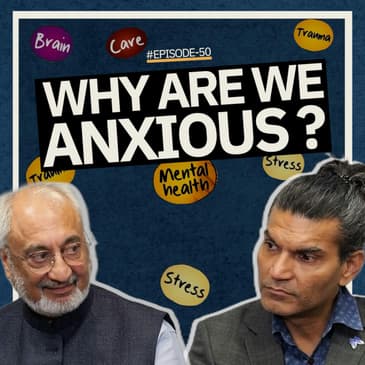
“Change in behaviour of a child is a classical symptom of something not going well,” says Dr. Subodh Dave, Dean of the Royal College of Psychiatrists.
“And if you’re not on social media, you’re an outcast,” adds Prof. JS Bamrah CBE, Senior NHS Consultant Psychiatrist, speaking about the growing pressures facing young people today.
At a time when the UK is moving towards phone-free schools and debating stronger protections for children online, the bigger question remains: are we doing enough to understand the pressures, problems, and solutions behind rising anxiety in both children and adults?
With 75% of mental illnesses beginning before the age of 24, and loneliness becoming a growing public health concern, this conversation feels more urgent than ever.
Marking Mental Health Awareness Week (11-17 May), Why Are We Anxious? on India: A Story in the Making brings together Prof. JS Bamrah CBE and Prof. Subodh Dave in a deeply relevant conversation on:
•anxiety, stress and loneliness in modern life
• social media pressure, cyberbullying and children’s mental health
• the debate around phone-free schools and online safety
• how anxiety shows up physically and emotionally
• warning signs parents should not ignore
• immigrant experiences and culturally sensitive mental health care
• stigma around therapy, medication and asking for help
• yoga, spirituality, therapy and practical coping tools
• kindness, community and why early support matters
An honest conversation about the “anxious generation” and what action, awareness and compassion should look like in today’s world.
EPISODE LIVE NOW ON:
📺 YouTube:
https://www.youtube.com/@loveenatandonproductions
🎙️ Podcast – Smart Link:
https://bingepods.com/podcast/podcast-rn7moe
💬 Join Our Discord Community:
https://discord.gg/p2UYt9uV5d
Learn more about your ad choices. Visit megaphone.fm/adchoices
[00:00:00] We know that 75% of mental illnesses will start before the age of 24. Chronic loneliness is as bad as smoking 15 cigarettes a day. Suicide rates actually increase as people's pockets get hit. One of the biggest stressors on children is social media. If you're not on social media, you're an outcast. In the world of Tinder and Grindr, we have to kind of think about what does that modern attachment look like. Change in behaviour of a child is a classical symptom of something not going well.
[00:00:25] Tell us three top tools that people can use to handle their normal anxiety. This is India A Story in the Making and I'm your host, Loveena Tandon. Hello and welcome to India A Story in the Making. I'm in the company of people who look after something that we often don't look after, which is our minds.
[00:00:51] The pandemic might have gone, but the pandemic of mental health continues. In the UK itself, for the immigrant population like us, we find less avenues, even if we want to access them, that match our culture. And this is where I pitch the conversation today to first talk about the rise in anxiety and what are the reasons?
[00:01:16] How do we actually deal with that at our level? And when do we draw a line to say, you know what, we need to see a psychiatrist. Thank you very much for your time. I'm here joined by Professor Subodh Davey, who is the Dean at the Royal College of Psychiatry,
[00:01:37] a part from doing all his normal job in Derbyshire, and Professor J.S. Bhambra, who is a huge and big name in the world of psychiatry forever from BMA to BAPU to being lots of other things. Globally, Satan, Jupiter, such a lot. He's been to all the planets and sorted everyone out. So now you have to sort us out and tell me, why are we so anxious?
[00:02:07] And is it our generation or is the coming generation which is more anxious? Anxiety and worry has always been there. There's a small difference. Everybody has worries. Then you take it to the next level. Excessive worry then becomes pathological, something that you lose sleep over, something that is affecting your physical health, giving you headaches, stomach pain, chest pains, all that. That then becomes more serious. WHO will tell us that, that actually that has increased.
[00:02:35] So that in England, for instance, one in four person has a mental health problem. One in one in seven person. These are underestimates. Pandemic protected us, our mental health. You know, we were all shut down during that time. But actually once it opened up, then all the other stresses came to be. At the start of the pandemic, we had in the UK something like 1.3 million people in contact with mental health services. Now we have almost 2 million. But Jay is right that that was a very sheltered period.
[00:03:07] Normal childhood, that didn't happen at the time. That has had its consequences. And then that consequence we will see unfold over coming years, not in this short period now. We will see that unfold over years because the genesis of mental illnesses in particular, but also other illnesses is very much what we call neurodevelopmental. So as the growing brain is most vulnerable. We know that 75% of mental illnesses will start before the age of 24.
[00:03:35] If things have not gone well in childhood, that's not going to impact solely in childhood. It will have an impact lifelong. I really was stuck by this number one in four and one in seven. Do you think there's anything to do with the family structure, the way it is as well? Yes, undoubtedly families are a protective factor for most people. Whereas of course in Manchester as I see families are now fragmented, very fragmented. Previously it was white Caucasian families.
[00:04:04] Now we find Asian families as well being fragmented a bit. It's not black or white. While families can be protective, they can sometimes be over-involved, over-enmatched. And then you can lose that individual autonomy and that in itself can become a stressor. We have the right balance. But the broader point I think is that are social factors influencing the genesis of mental illness? I think social factors influence the genesis of all illnesses. What are the adults so worried about to make them so anxious?
[00:04:33] I think loss is a big factor, right? Loss of role, loss of actual livelihood, loss of relationship. Bigger now than before? There's been a lot of insecurity that's been generated. Loneliness has become a big factor. Chronic loneliness is as bad as smoking 15 cigarettes a day for you. Really? Yeah. Particularly in UK we talk about social determinants of health and they mostly mean physical health. But actually the social determinants of mental health are equally important if not more important.
[00:05:02] So we know that a lot of mental illness is created by housing conditions, by work situations, by unemployment, by being currently asylum seekers or refugees or immigrants. The rhetoric you get from politicians affects us, makes us more insecure. And of course the cost of living crisis has a major impact when you look at the trends over decades. Suicide rates actually increase as people's pockets get hit.
[00:05:32] COVID is a historical issue for particularly our next generation. This is going to have a lasting trauma, not just from the loss that Subodh was telling us about, but just the sheer impact of loss of education to children, loss of education for the people who went to universities, loss of relationships,
[00:05:53] not being able to grieve properly for parents or family who died in India whom you couldn't even visit, not being able even to go to the cremation. Yes. All of these has a lasting impact. Let's take it to children. What is making the child today anxious? Firstly, I think there's a lot of conversation about children are creating snowflakes, not being resilient enough. We have to look at what is the, what is the context in which children are growing up today.
[00:06:21] Financial factors, fragmentation of societies and communities, role models in society. I think it's very difficult when your leaders are behaving in a way that you can't predict and then look up to. There are a lot of wider factors for children. Online world has changed things significantly. And what is the change in the way we form relationships in person versus forming it online.
[00:06:46] Now in the world of Tinder and Grindr, I think we have to kind of think about what does that modern attachment look like? We know that loneliness has worsened. The fact that we are so well connected and excessively would have improved our sense of, you know, connectedness. If anything, that loneliness has worsened. The young people are feeling loneliest that you don't have a child in secondary school who doesn't know firsthand someone, another child who either has a severe eating disorder or has harmed themselves.
[00:07:15] So in a relatively short period of like two decades, we've got to that level. I'm not a child psychiatrist. I'm an adult and all-age psychiatrist. I'm Subodha's liaison psychiatrist. So he sees across the patch, you know, but I know this from the patients that I speak to. One of the biggest stressors on children is social media. And we know now from a lot of anecdotes and the reports like people like you, the reporters produce, which is that suicide rates have also increased.
[00:07:44] Some of these social media are very sick. There's so much cyber bullying going on. So much sexual abuse going on. I'm sorry to say that. But all of that adds to children a huge pressure. And if you're not on social media, you're an outcast. And that isolation, which isolation, loneliness is a big factor throughout, particularly at the two age spectrums in children and in older people. It's a major issue. What the problem is, how will the solution be?
[00:08:10] Because you can't stop my child, for example, going on TikTok from going on… Sure. What should he say? You can. So the first responsibility I would put on is on the governing regulatory authorities. I understand. The second responsibility, because they can stop these things happening. You know that in some countries they've stopped WhatsApp. They've stopped TikTok.
[00:08:34] So it is the responsibility of the government to put legislation in place, which children at impressionable ages, which is usually under the age of about 16, that they have access to educational stuff, not to the toxic stuff. And what are the symptoms of anxiety that will show up? That's a good question. Normal worry is something that we all have experienced. Butterflies in the stomach.
[00:09:00] But if these things are becoming more constant and there's no break from that, then that's an early sign that things are not going okay. Then as it gets worse, your psychological symptoms might expand to feeling that there's something really bad going to happen, a sense of impending doom, what we call almost a sense of panic that, am I going to die now? So those are the psychological symptoms. And there are a whole host of somatic symptoms, you know, so from chest pain to kind of feeling tremulous, sweating,
[00:09:30] heart beating very fast, having palpitations, wanting to go to the toilet over and over again. So these are all the classic symptoms of anxiety. And then obviously that has an impact on your sleep, on your appetite. And that kind of sets in motion a slightly vicious cycle because then you're not sleeping, so you're not recharging well. And then as that becomes worse, sometimes people get pushed into the level of mental illness.
[00:09:55] In the kind of earlier stage, then the kind of things that Jess was talking about where people can talk to you and then talking therapy may help. But if it goes beyond that, then that's where it becomes a severe mental illness where people like Jess and I, psychiatrists, get involved. What is that point? Firstly, you've got to know your child and you've got to know where your child is. So you've got to know who are the friends, you know, who do they hang out with, do they spend time on social media, too much on their iPhone.
[00:10:24] Change in behaviour of a child is a classical symptom of something not going well. Either they being abused, cyber or physically, or something else is going on that we should know about, about our children and grandchildren. So that's what you would look out for really. And then you want to make sure that you try and sit down with them and get to understand that and address the problem, obviously with the educational authorities as well.
[00:10:52] Okay, for people looking like us, how easy or difficult is it to get care here? Is it harder for people looking like us to be heard in a way that will help us? We found that access to health care, including a general practice and secondary care, is poor for people who look like you and I, as you said. When we get access, we are often misunderstood.
[00:11:19] We might present with a headache or a stomach pain, but actually what we're trying to say to you, Dr. So-and-so is, we are stressed or depressed. So that there's a cultural thing in that as well. Then when we get access, then we may not get the right treatment as well. So, for instance, psychological therapies, we did a large study which we funded through the Race and Health Observatory to look at talking therapies. And we found that there was a problem because over 80% of therapists were white female.
[00:11:49] And ethnic people found that quite difficult. And a lot of the treatments that are available, like CBT, are not culturally based. So they dropped out after two or three sessions. So the dropout rate is huge. We also need to understand that people who come from ethnic backgrounds, they have a particular fear about medicines as well. So that communication is so important to be able to say to somebody, you are going to need an antidepressant. I don't know, Subodh, whether you agree with all of that.
[00:12:19] So that the way that we communicate has to be culturally based as well. A hundred percent. And I think I work in Derby. I've come across patients where I think you can imagine, I'm sure a lot of the viewers from South Asia who are watching will resonate with this, is that I think when we have family tensions, I think often a therapist here will ask you to exercise your individuality.
[00:12:45] I think for most people coming to South Asia, they are very mindful of the way the family and the wider society will respond to that. So exercising your individual autonomy may not be the easiest thing for them to think about. So a good therapist will take into account all of those things. But then if a therapist has not trained or doesn't understand those nuances, and I come across a lot of my patients who really struggle with that because they don't feel heard or listened to
[00:13:11] when they have encounters with therapists who don't really understand their cultural background. What does it mean to be, to experience shame? What does it mean to be judged by your community? If that's not understood, then, and if you say, well, just walk out, why can't you walk out? No. So some people that walking out is not, doesn't feel like an option, you know? So I feel that those are real challenges, I think, as Jess has outlined. There's also stigma. Awareness of mental illness has increased, has improved dramatically.
[00:13:41] But even now, you will see people feeling that, well, I don't think we really want to go to a doctor, we'll go to a healer. And I think spirituality has its place. So this is not about being anti-spiritual or anything. But it's also about recognizing that where are things reached a point where you need a trained professional involved in your care. Sometimes treatment is delayed for a very long period, especially with things like psychosis. We know that the more you delay the treatment, the worse are the outcomes.
[00:14:09] And there's, the stigma is a huge thing, Subodh said. Really, it's big in India as well. It's big here as well. So imagine that you are a 24 year old woman who is marriageable age and you develop severe depression. Well, you can't talk about it because you won't get married. If you've got married, you won't have children because that stigma of just being able to say that you've got a mental health problem is huge. And we really need to counter that.
[00:14:39] A lot of the time, yoga and meditation are seen as the starting point to resolve a mental health crisis. Did we get it right in the times? Or did India get it right? No, we got it right. It's not wrong. So I don't know whether you know this, but I get, you know Sadhguru. So he asked me to do a couple of podcasts with him. One of the things he said in the second series, which is on YouTube, by the way, which was so important.
[00:15:08] He said, don't stop your medication. On top of that, if you have meditation, a bit of counseling, therapy, all of that, we know that is good for your physical wellbeing and mental wellbeing. I think the issue is that yoga is not going to sort out your psychosis if you have a very severe mentalness. And I think that's where you need both. Even if you have severe psychosis, something like yoga will help you to kind of deal with some of the side effects of medication and help you stay fitter.
[00:15:33] Sometimes people view the whole idea of the medical model with suspicion. The medical model is not just about medication. Medical model will also look at yoga. We'll also look at psychotherapy. We'll also look at social therapy like housing. You will see increasingly a lot of GPs are doing things like social prescribing in this country because that has been shown to be evidence based in improving those particular conditions.
[00:15:58] Tell us three top tools that people can use to handle their normal anxieties. First, recognize it. Once you've recognized it, try and manage it yourself as far as possible. If you can't manage it, then ask for help. That might be from your GP. It might be from somebody else that you know who might be able to give you some advice.
[00:16:21] And the third thing is do everything you can to have the right plan in place for your health, mental health particularly. Not everything has to be prescribed. Sometimes we over-medicalize everything. That what needs to happen is a good recognition and then finding solutions. In India, people are more likely to find solutions. I think in some ways the NHS amazing institute, it is probably the best in the world.
[00:16:47] But sometimes we expect too much from the GP who is already under pressure. So I think try and find the right tools to manage that. That may not be chat GPT by the way because that might not give you the right answer all the time. But in that, I would say modern medicine and modern psychiatry is going to be about those apps. There are lots of apps. I've seen some really good apps that give you a good experience in terms of therapy and advice.
[00:17:17] In addition to all the assessors, recognizing seeking help early and then seeking help from the professional and making a transition from self-help to professional help is important. I'm going to suggest tightly to look at it also from a carer's perspective. My first tip would, let's be compassionately curious. Why is this person looking so anxious? Why are they behaving maybe irritably with me? I think rather than responding back with irritation, you know, I think just be, let's try and be kind to them and to ourselves.
[00:17:46] So that's my first point. But that's the essential kindness and being curious to why is this person behaving in this way, I think is important. My second point would be that it's useful to try and explicitly label what emotion you're experiencing. I'm feeling annoyed. I'm feeling upset. I'm feeling angry. I'm feeling sad. Being a bit more reflective is always helpful. My third point, apart from professional help, is that we should underestimate what we can do to each other.
[00:18:15] It's easy to ask someone else that you've got a broken leg. What's going on? Somehow in the world of mental health people kind of in its mental illness, we all back off. When you see somebody looking sad, looking depressed, we tend to turn our head away rather than engage. It's tight upper lip as well. We have been now told. 100%. And that's something we can learn because this is a very human thing to do. To be nurturing, to be caring is a very human thing and I think you shouldn't forget that. Okay. On that note, let's do a quick fun high five.
[00:18:49] This is High Five India section. I ask you five questions and your reward is my high five to you. Okay. Number one, you are both a psychiatrist, but when you get low and in your dark moments, what do you do? Who do you go to? I will talk to my friends. I'll talk to my wife. I'll talk to my family. They may not know it that I'm feeling low, but I will actually, I'm pretty expressive in these things.
[00:19:17] And I will try and seek help early because we can't resolve everything. I mean, my mum and my wife believe in the power of prayer and not so much of a praying person, but it's about what we individually think is good for us. And good for me would be just meet with a friend, just have a chat with them, sit down with them over a meal. My running is my thing. You already kind of demonstrated that.
[00:19:42] It does help me stay fit and also kind of mentally fit. I think it helps me keep my mental energy and ward off a lot of stress, I think. So I think it's also my dynamic meditation time. The other thing that I'm running, it's like doing yoga, that the way yoga works for some people. I mean, I would struggle to do yoga myself personally. So that's good. But I think the talking is really important. I also have people whom I can talk to.
[00:20:09] And I think that's really important that we have someone maybe whom we can be ourselves with. Ourselves with. Absolutely. Absolutely. And I think that's sometimes. No judgement. Absolutely. No judgement. Just be. And I think that's to just be with someone you can be with. Correct. Isn't it? Okay. How much do you run in a week? So I run anything around 40 miles, which is about 50-60 kilometres that I'm training. So I'm going to be running the Cape Town Marathon next summer.
[00:20:38] So I think that's what I'll build up to. I'm running about 40 kilometres now. Wow. Well done. Well done. Well done. And you don't have your, any music? Not usually. I remember last year when I ran a very long ultra marathon, which I ran, this is the longest, one of the oldest ultra marathons, which was 88 kilometres from Durban to Bita Marisburg. When I was training for that, I used to, I felt guilty to just use three, four hours of running time without doing anything. So I should listen to podcasts.
[00:21:08] But mostly I do. I'm more than I am. I'm more than I am. But that's a very good way of doing it. But actually it's a great meditation. I've heard runners say that. A very dear friend of mine is a runner. He tried to get me into it and I got plantar fasciitis. And then since then I stopped and I gained weight. I always say to people, low and slow. I think I use a watch only to make sure I don't run faster than what I should. So what is lower and slower for starters? So for starters, just walk, you know, just start walking and then maybe add a little bit. You want to train with him? Yes, exactly. I think yes. Go to Dabush.
[00:21:38] 40 kgs less. That will sort out my anxiety. One. And two. Okay. Let's go to the second one. Second V, just on the second one. You both are doctors of Indian origin and psychiatrists here. How is it different for you to be in this environment? And have you been seen differently? How do you give care differently?
[00:22:04] Any migrant will realize and show that once you take that plane, things are never going to be exactly the same. Home is both places, you know, and it's very difficult. You always have a dual identity and there always be that pros and cons balancing. We've all probably faced direct racist abuse. We've been called names by our patients, sometimes by other people. So that's not great when that happens. Both Jess and I have spent our lives fighting the health inequalities for our patients, but also inequalities for our colleagues.
[00:22:34] Because we know that that is harder. But then you also bring some advantages. And I think the community building skills that we already have innately within us. The lot of India, being Indian is about taking joy in small things. The entrepreneurial mindset that most people have and that you grow up with, you know.
[00:22:54] When you've grown up in a system where you constantly have to hustle and make things work, then you bring that energetic and problem-solving mindset, which is a great boon to places like the UK. So I think it's got pros and cons. I think we're enriched. I mean, I'm very proud of my Indian heritage. I was born in East Africa. I did my medicine from Poteala, went back to Tanzania and then came here. I feel very enriched by that experience.
[00:23:21] What is the one thing from the India setup that the mental health in the UK system could learn or benefit from? I would say as an adult psychiatrist and a community psychiatrist, I think we could be doing a bit more in terms of the community building and then tapping into the communities. You can't have the statutory services acting as a quasi-community. So you can't have a doctor and a social worker and nurse making the community for your patient.
[00:23:48] I think, sadly, for many of my patients, that's probably still the case, that they don't have any other wider community. And I think that is something that I feel people like Jason and I could do a bit more consciously in terms of adding that community building skills. I would agree with him. Yoga should be all part of mainstream, to me, to be truthful. I might be biased, but I think yoga has definitely one of those. Okay. What is it about India that you miss the most here?
[00:24:16] I miss those friends and family, you know, medical school, all those formative years when we had, we still go, we have a reunion. I miss all of that. I don't miss the parathas because we have lovely parathas at home. We have lovely ladus at home. We have, and now here in the UK, you get fantastic Indian cuisines. You'll get Delhi street food if you come to Manchester. Yes. You'll get Mumbai street food if you come to Manchester. It's really Indian chefs who come here.
[00:24:46] So I know people miss that Indian food. You go here, you can get fantastic Indian food. I miss that informalness. People can just go out in chapels and nobody's judgmental. People can just relax. I like the color. My wife always said this when she came here first. She said, why is everybody wearing black weather? It's a celebration. Grey, white, black, blue and navy blue. But that color that we bring from India, that vibrant color.
[00:25:14] What is not so impressive about that? I am coming to Manchester to eat all of that. I was going to say color, but yes. I mean, I think going to India is like a sensory explosion. I think I miss the noises, the mitti ki kushbu, the sands. I think especially the Bombay rains, the Mumbai monsoon. I think I really miss that. And colors definitely. I don't miss the traffic noise and the honking. But I saw a reel recently. I do that when I go. But I saw a reel recently where somebody said that,
[00:25:44] well, I've come back from India to the UK and I'm missing that. And they were carrying around a recourse of voice. Are you serious? It's gone viral that reel has. I can tell you that. So I don't particularly miss that. But I think still the whole sensory experience of all the senses. I think all the senses are. Can I just disagree with him on just one thing? I love that. That honking and everything. I do that when I go there as well, you know. It is most freedom. My challenge is always I tell my friends, look, I'm going to drive in Mumbai, not honk at all.
[00:26:13] And we still do it. And then they say, well, are you sure? I always say, I don't know why. Do you win tight or you don't? I do. I drive without. I always drive when I go to India. Do you? And are you able to come back and drive as well? Absolutely. I have stopped driving in India after learning to do it. I love driving in India. It's amazing. Oh, yeah. It's up to you. It's up to you. It's up to you. My son's bucket list includes sitting on the top of the bus. I've done that.
[00:26:42] He said, that's my bucket list. Hanging from the bus. Hanging from the train is, you know. There's some joy and freedom. And TT, TT came here. Get off, get off. I feel like this one thing. That I feel quite regulated, if you like. I feel less freedom. The moment I step foot in India, I just feel that I've been a good job. I can do what I like. Here I feel... Who are those? He's been turned.
[00:27:12] No, no, no. So don't do both marathon. Don't do it. No, I agree with you actually. I love it. Do I get six high fives? Me get five. I'll tell you the... I mean, I don't know if they have time for this whole story, but this is Tanzanian story. So I think I should tell where JS is there. Because we had a near-death experience when we went to Tanzania. Because you know, exactly like in the freedom. We went to Zanzibar and we took a little boat to Graveyard Island. You know, it's Graveyard Island? Yeah. It's Graveyard Island. Anyway.
[00:27:41] And the thing is, on the way out, the weather was lovely. Way back, the weather was terrible. Two-meter waves. And there were 17 of us on the boat and only five life-share kids. And my mum and dad, sorry, yeh wo. So, you know, so I think too much of the... You know, traumatic. You were very traumatic. You really died on that. Oh, I'm very sorry. I don't support... So this was his therapeutic experience, by the way. He was better for it. So I would not support the regulation to say safety na ho.
[00:28:09] But somehow, I don't know if I'm right. I don't... Well, we might check it later on. But there are less accidents as compared to the population because we are always vigilant on the Indian roads. Here we are driving in zombie mode. There is some... I'm used to that. You know what they said? You take out all road signs and then let all the chaos merge in and everybody is very, very vigilant. You know, two things we could bring from the culture there, you ask me. One is, chalta hai. That's a good attitude.
[00:28:39] Not always, but often. Mentally also. And the second thing is, jugal. In India, there is a jugal for everything. Yes, creative. It's called creative solution-making. That's why mental health is okay. I know. Now that I've forgotten the number, but let me just... What is it about India that the world doesn't clock? The world does stereotype Indians.
[00:29:02] And the images you will see on a lot of the social media and in news is not about the India that I was growing up in as I was in medical school. Of course, there's a lot of poverty, but there's a lot of kindness in India as well. It's an amazingly, despite all of the problems we have in India. Very true. It is so kind, you know. I find... So that's one thing. And they don't get all the noise that we make, the music, the Bollywood title stuff.
[00:29:31] They don't get that, you know. They don't understand the changing the bulb culture, you know. They don't understand music in a film. I think that particularly in the UK, but also maybe across the world, what they don't get is national pride. That how we can have... I mean, we had a lot of debates here in the UK about people putting flags up. And I think it's created so much controversy. And I think to get it right where, you know, you have pride in the nation and how that can be a big force.
[00:29:59] And I think I see that in a lot of people where they just take vicatious pride in the fact that India is doing well, you know. And they might themselves not be doing very well. That's quite amazing to see that you can still take pride in the nation doing well when you have not benefited from it. And I think that's something that people don't get, you know, because I think people across the world sometimes feel that, well, if I have not benefited from it, how can I take joy in countries? So it's more community.
[00:30:27] The same comes from community feeling and the fact that you can feel happy. Also, just the respect for the nation. Nation. Yeah, yeah. How do you balance that? I think that's something that is not easy to do. When you go back to India now, how different do you see it? Do you think it's changed? I think it changes every time. But I think also India is very resistant to change.
[00:30:49] I think when I first came here, I think MTV was just coming in or had just come in and people were thinking that, oh, my God, like India is going to become westernized, etc. And what's happened is that all those channels have had to learn how to speak Hindi and then, you know, communicate with. And if anything, people speaking Hindi, it's all survived, you know. So I feel that people have worried a lot about Indian identity or Indian cultural identity being appropriated or be replaced by other identities. I think it's quite resilient.
[00:31:18] I think I have a very completely opposite view. I think we are quite relaxed with the fact that, okay, you do it, we do it. I think it's not a mean, I mean, I feel that it's actually quite, I think it used to be people used to worry about it, right? I mean, I feel that on the whole, we are quite welcoming of other cultures because we know that I think things will change and then we will. I think that chicken pikka masala is the favorite here. Our house is not even made here. Okay, India for you in one word.
[00:31:48] Energizing. Vibrant, going places. Brilliant, thank you very much. That was three words. What do you do in India marathon run? Of course, Mumbai marathon, two times. Yes, do you eat pav bhaji or do you go to Mumbai? 100% cannon pav bhaji, which is so much butter that I think... Well, you can run it out. One of the countries, butters will probably run out. You can't run off a bad diet. Your favorite, the must go India food? Oh, must go India, vada pav. Vada pav, okay.
[00:32:18] I love it. Go to Indian food when you go to India. Listen, I am Punjabi. You know paratha. Paratha. Alluwala paratha. Oh, here, makkidi roti te saag. With a touch of butter on it. Salted butter. And I tell you, Hari Mirch. I tell you, my mouth is watering even now. Honestly. This is not the only mental health problem. Oh, it's not. Saag, three times a day. Saag, three times a day on prescription. Ayan, ayan.
[00:32:48] Okay, I think this is the best question. Which food will sort out your mental health problem? No, which food will sort out your anxiety? Straight off, half 50%. Does Patiala pack count for it or no? Trust the Punjabi do come up with that answer. Jaldi bola dave ji. For me, I know. I know. I have South Indian food for a very good sambar. That is my personal dave. For anxiety? Okay. Yeah. Shakar with a bit of keho on it.
[00:33:18] And you eat it with paratha. It's so beautiful. Gurka shakar, right? Or Golgappa. You get a nice thanda, you put it in the house. Beautiful. Or if you're really feeling great and you're feeling like a rabble, then drink some water there. You don't get it. You get it? I'll tell you. I'll tell you. Oh, oh, oh, oh. I can guarantee proper water. But water is good. I'll get it in the house. I'll eat it. Paan shabbi, right?
[00:33:48] Ha, ha. Paan shabbi. But we haven't cracked the Golgappa, Panipuri. I mean, there are too many names. Or Vada Pao completely here in the UK. Puchka, right? But Patasha. But we've done it. Yeah. Thank you very, very much. I think kindness and compassion is something where a lot of the mental health
[00:34:17] involved answers start. And it probably starts with your neighbor, in your own house as well, and with yourself. I think that's what we lose the most, being kind to yourself. So thank you so much for joining on India's Story in the Making. It's okay. And take care. God bless. This video is created for educational, informational, and entertainment purposes only. The views and opinions expressed in this video are personal and may include commentary on geopolitics and global affairs. They are shared for general awareness, discussion, and understanding and are not intended to offend,
[00:34:47] harm, or misrepresent any individual, community, organization, country, or religion. The information presented in this video is based on publicly available sources as well as material provided by our guests. All visuals and content used in this video have been included with the consent of our guests, while efforts are made to ensure accuracy. Viewers are encouraged to do their own research and form their own opinions before drawing any conclusions.