
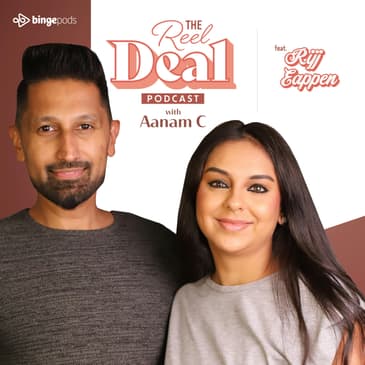

From being the "King of Clubs" to an influencer, Rijj Eapen found his calling on the social scene quite by accident. But he's more than embraced it to build a loyal and committed following.
Catch this amazingly insightful episode where he shares his journey and more.
Like what you hear? Don't forget to rate and review us ★★★★★ :)
New episodes every Wednesday!
Hang with Aanam in-between uploads:
Instagram: https://www.instagram.com/aanamc/?hl=en
Podcast Instagram: https://www.instagram.com/thereeldealwithaanamc/?hl=en
To listen, download Bingepods on iOS or Android. Or subscribe or follow wherever you get your podcasts.
Learn more about your ad choices. Visit megaphone.fm/adchoices
[00:00:01] Ladies, gentlemen and others, get ready to meet the guest in today's episode. He's the man behind WILE, you'll know about that in a hot second, the world's first social currency platform. As if that's not impressive enough, he's also a TEDx speaker
[00:00:15] and sharing his wisdom and experience with the world with us today. The man who is all about living life king-size, the one and only Rijj Eapen. Welcome to the pod! Hi Aanam, thank you for having me. I am so glad we could do this. Yeah, I know, right?
[00:00:28] I have never actually, you know, when I was prepping for today's episode, I was like, I've never really asked him how he got into the influencer space. And I think this is my opportunity to be like, wait, how did you land up here?
[00:00:40] We were just talking about accidental influencers and I am probably the perfect example of an accidental influencer. I moved to Bombay in 2016 from Dubai and my friend Malini used to harrow me saying, listen, why aren't you on social media? Like, why aren't you more active on social media?
[00:00:57] You should do more stuff on social media. And my area of interest was food and beverage and nightlife and stuff like that. So I started posting about places I used to go to, party, travels, experiences, but all from that nightlife angle and hence my handle, king of clubs.
[00:01:13] And it started from there, but everything that I did was also in the luxury space. So I started talking about maybe hotels and clubs and restaurants, high and fine dining places. And it started from there and then Brand started reaching out saying,
[00:01:31] do you want to wear something of ours? And I was like, that's not bad. Yeah, sure. It literally just started from there. And then I was like, okay, this is not a bad gig. Yeah. And then I started being a little more conscious about what I was posting
[00:01:43] because then I was like, okay, fine, if I'm going to do this, then I might as well do it right. And yeah, I just started being a little more consistent with posting and that's pretty much how I got started. Yeah. So 2016 to now, that's about 17.
[00:01:56] No, I actually started a year later. So 2017. Okay. You remember what your first ever brand collaboration was? Or the first time somebody invited you to an event, I guess. So the thing is, one of the reasons this transition was easy for me
[00:02:09] was also because I used to live here from 2004 to 2011. And I was very a part of the social scene. I used to have a bar at Phoenix Mills back then and back in 2006 and we used to rock it. And what was it called? How do I know that?
[00:02:25] It was called White. It was called White. And then they broke down the building and then Palladium and everything came up. So yeah, you probably wouldn't have seen it. We shut in 2009 when they wanted to break the building down. So they bought us all over. Yeah.
[00:02:36] So I've been a part of the social scene. So for me, getting invited was not the tough part. But I mean, I never consciously thought about working, collaborating with a brand and stuff like that until it came to me.
[00:02:48] And then I was like, yeah, OK, I mean, this seems interesting. And this is something I could do. So was monetizing the challenge? Monetizing. No, I wasn't. So for me, I was never doing it full time. I've never done it full time.
[00:02:57] And I've never looked at monetizing as a challenge because I always only would post things that I like and work with brands that I wanted to. And I'm, you know, otherwise I wouldn't. And so that's where it kind of stuck.
[00:03:08] And I wasn't like particularly going after brands actively. Whatever came inbound was all I always did. At least the first few years, I never went out. And I never had a manager and things like that. So yeah, I was OK with whatever came in.
[00:03:24] That's pretty much how I got started. And then, yeah, it started rolling. And but I stuck to my niche, my really small, tiny niche of men's luxury. So then it kind of expanded into automobiles. I love riding bikes. So I would work with motorcycle companies,
[00:03:42] travel the world with them, have great experiences, cars, travel, of course, because I used to travel a lot. So I used to get a lot of invites from hotels or from airlines saying, would you like to go to Coachella? I was like, yeah. So that was great.
[00:03:55] That was one of my first early days when British Airways asked, would you like to go to Coachella on British Airways and kind of document your entire experience? And I was like, hell yeah. What year was this in? 18, I think it was. So that was great fun.
[00:04:10] So those kinds of experiences. So that's also true to who you are, right? Because that's a very important filter we have to have as creators, especially if you're looking at longevity in the field. Absolutely. What was the biggest thing that you said no to, let's say for example?
[00:04:23] Because I feel like when the cash comes in, there are moments where you're like, oh my God, this is a lot of money, but you've got to stick to who you are and say no. Absolutely. You know, I think I've said this before on interviews and stuff
[00:04:33] that I think you can only be great at this job or this career if it's your chosen career, if you are absolutely authentic and true to what you like. So for me, it never hurt me that I was saying no to brands
[00:04:47] or to genres or segments or verticals that was not really me. If I wouldn't use it, I wouldn't necessarily talk about a brand. So I've said that to brands as well. That look, I mean, you wouldn't see me using it
[00:04:59] or you wouldn't hear me talk about this ever. So then why would you necessarily want to work with me? I mean, I'm probably not the right fit for you. And I think that is the key. If you're not authentic, people will see it. Eventually people will know.
[00:05:13] And I think that's it. And so it never really bothered me that I would have to say no. And I was okay with that. But you've had so many wonderful things happen to you also then credit to your authenticity. You were a TEDx speaker. Yeah, that's right.
[00:05:25] Can we talk about that for a quick second? Absolutely. What and how does it feel A to B there? And I feel like that's one of those moments that's definitely an I've arrived kind of moment. So what was that experience like? Right.
[00:05:35] So for me, I think the TEDx talk happened because going to what I'm doing now with my new venture, the new startup that you were talking about. I definitely want to dive into also. Yeah, I know. I mean, we get to that part.
[00:05:46] But just one step before that was it came from this one fundamental idea that my co-founders and I had that we truly believe that every single person in the world is an influencer. On some level, we all impact people every single day.
[00:06:01] Just that not everybody thinks of themselves as influencers or we don't look at leveraging it in any specific manner or in any substantial manner. But we all have influence. I mean, everybody out there, someone with a thousand followers is also an influencer of thousand people.
[00:06:17] And so we believe that everybody has social currency and we earn it every single time we have a social interaction. Every single time you positively impact another person and that person goes away feeling good about you, I believe you've earned social currency.
[00:06:32] And if you asked me a year ago to do a TED Talk, I would say I really have nothing to say because I didn't really have anything that I believe so strongly about that I should talk to people about on a TEDx platform.
[00:06:45] But when this came about and they said, what would you like to talk about? It was clear in my head it was social currency and the impact you can have every time you have an interaction with another person
[00:06:56] and what that could mean for you in the long run. And so that was the exciting part. I now had something to say. So I wouldn't necessarily say that just because I did that, I have arrived but I think it gave me a platform
[00:07:08] to put into words what we actually believe and that was great for me. And actually the process was more fun. It's a great milestone. Yeah, it is. Yeah, absolutely. It's a fantastic milestone to have. It is, yeah. And it was great fun doing it.
[00:07:19] Honestly, that process was just so much fun. You know, I had help from, so this was TEDxHR College and there were these two young HR college students who would come and sit a couple of times a week and brainstorm with me and IDAID and stuff like that.
[00:07:33] And that was a great process as well because you know, you now were thinking from a 19-year-old's point of view as well and not just my point of view and I loved bouncing ideas with them and I loved coming up with a flow
[00:07:45] that would resonate not just with people from my generation but also people like Gen Z. And that was important and I think that made all the difference because when I got up on that stage the room was filled with Gen Z. So if I took a different approach
[00:08:01] I probably wouldn't have had that impact because I had people, you know, clapping and standing up and that's because I had help from these guys. And that's why I really enjoyed that process. How long was the prep? About three weeks. I've heard so much about the prep period
[00:08:15] because like I had a friend who told me, oh, you know not everything makes it onto the social media for example. That's a big filter on how the talk goes and what the audience reactions like. Where did you think you were before
[00:08:26] and during the process versus obviously now after? When I started off I was like, God, what did I say yes to? I was like, you know, getting on a stage is one thing because we're all comfortable on camera now. But that was not the problem.
[00:08:38] The problem is you have so many things that you want to say. What if you miss out? What if you keep a few parts and then you're like all jumbled up? Don't you have like a teleprompter for those things? Usually you don't
[00:08:48] but in this one they allowed us to have one. And that was easy but usually apparently they don't allow it. I always just thought, you know, when you were on stage you see those little screens that prompt you into your... They're not screens. Those are monitors.
[00:08:59] Apparently they want you to deliver it straight up. But I'm not sure if this is true because these guys checked and said, yeah, it's okay. Like for example, if you're talking about data and stats I feel like it's fair to have somebody from those two.
[00:09:10] Well, you can have like a presentation running in the back and you can use that as kind of a pointer or kind of a reference point. But they... Yeah, I don't know. Honestly, I don't know if other places do it or allow it. I'm glad you got it.
[00:09:22] So glad I got it. I'm so glad I got it. I want to talk about wild because I feel like that's... I have to say, I mean, I already know quite a bit. I won't say everything about it. But I feel like you're under something that's really big
[00:09:35] that social media doesn't have. I would say globally, not just in India. It's a whole new mold of a footprint. Correct. So for everyone who's listening or watching how would you describe wild and introduce it to them? So wild, like I said,
[00:09:48] you know the basic premise of our business model revolves around that one fundamental belief that we have that everybody is an influencer and how do you let them monetize? And that was what we were solving for. And the second part of that belief is that for a brand,
[00:10:00] there really couldn't be a better evangelist than your own customer. Right? If every single person that came to your e-commerce platform or walked into your store, went out and told all of their friends every time they made a purchase, you really wouldn't need to do much marketing anymore.
[00:10:13] Right? But it rarely happens. And today when you think about it, everybody's a social junkie. And yet, you know, no one has managed to leverage the power of that social junkie shopper or customer of yours. Right? And that's what we want to do now.
[00:10:26] So we built a platform that allows everybody on social media or anyone with as little as a thousand followers on Instagram. We're starting with Instagram as a platform. You know, so someone with as little as a thousand followers on Instagram can leverage their social cloud
[00:10:41] and brands can leverage the social network of every customer that walks into their store. And that's the platform that we're building. So we said the medium that we're using is a payment card. So we said that to apply for the card. So it's a visa-powered prepaid card.
[00:10:56] We're coming up with a credit option later this year as well. It's a prepaid card you load it using, you know, UPI or bank account or credit card or whatever. Number of followers alone is not an indicator of influence. Right?
[00:11:08] So we built an algorithm called the wild score, which is like your civil score. Right? So it's a, so it's a, it's an algorithm that rates users or assigns a score to every user based on their number of followers, vis-a-vis their reach, their engagement, their frequency of posts.
[00:11:23] I don't think people understand the value of that. You could have 500,000 followers and suddenly stop posting and Instagram will not push your content anymore. Like if you stop posting for six months and that's, and so, you know, a whole bunch of parameters,
[00:11:33] whether you're fake followers, all of this and we assign a score to every user. And now the score becomes the basis for everything that happens on wild, you know, post that. And so these are two options. So you can pick between whichever one of these options
[00:11:46] that you want. Yeah. And just for this name to be written like this, we had to send it to vis-a-global for approval because we wanted, we were, you know, hell bent on the card being beautiful because payment cards are boring.
[00:11:58] I hate to say this, but payment cards never look great. And no one wants to flaunt it unless you have an American Express since you're in black card. But otherwise nobody cares about, you know, what your card looks like.
[00:12:08] So we said, you know, we wanted to build a card that would enhance your lifestyle. A, because what you can do with this is great. Right. Because imagine you've loaded this with a card. Like today we have over 200 brands signed up with us.
[00:12:22] So obviously this is a visa card, so you can shop anywhere. Mm-hmm. But if you shop with my partner brands, you have the option to, I mean, you make a purchase. Imagine you go to a social, have a meal.
[00:12:32] After you're done, you could take a picture of your meal or of the place, post it on your Instagram. You click a button on the app that says, you know, I've posted our system checks to see if you adhere to the terms and conditions and all of that.
[00:12:45] Captions, places visible, logos visible. You know, the brand has been tagged or whatever. And you can earn anywhere between 30% and 100% of your transaction value back into your card based on your score. So your score determines what cashback you get. So you could have 2,000 followers
[00:13:03] and an extremely engaged audience and have a great score. Or you could have 100,000 followers and crap engagement and you'd have a low score. And that's democratizing word of mouth marketing. And that's what we're setting out to do. That's amazing.
[00:13:16] So the idea is to literally shop without really paying money or paying lesser off it than the MRP value based on what your social media is like. I have never seen a better use of social media cloud than this because it, like you said, democratizes it
[00:13:31] but also at the same time gives the power in the hands of both ends in a very balanced, in a very balanced fashion, which is fantastic. How long did you take to work on this concept idea and especially the algorithm that you mentioned?
[00:13:45] What was the backend work like? So we started, so my co-founders, Deshant and Yash. So Yash is from IT. Deshant comes from a business background and they've been working together for about four years in the influencer marketing space. And so they were managing, doing influencer marketing,
[00:14:04] connecting brands to influencers. Yash being from IT and this tech geek, he loves building systems for everything. You know how we go out to have a drink on a weekend? He loves to sit down and call. He would build systems for everything.
[00:14:18] And so they had massive insight and data and that's when we met about a year and a half ago and it was a random meeting, a chance encounter introduced by Malini actually. And it was just a chance encounter saying that you guys should talk because
[00:14:32] you guys seem to be in the same space. At that time, they were thinking of a solution for influencers and then we got to talking and we said, look, why just for influencers? Because they get everything. Right? And that's just the tip of the iceberg.
[00:14:46] The bottom of that is so vast because if you think about it, today there are 200 million Instagram users in India. There are almost 100 million people that have over a thousand followers and nobody talks to them and nobody gives them solutions and nobody does anything for them.
[00:15:01] So we said, let's create a solution for everybody. I think that aha moment was when we said, let's make everybody an Indian influencer. I love that. We're going to be the next to LA. Yeah, exactly. Everybody in LA is an influencer. That's true. It's a cheltap hirtha Instagram.
[00:15:17] Exactly. Exactly. But are you also going to get like other social media platforms on? Because for example, Instagram is the most, I mean especially with luxury being your background. It sits most well, I would say. But at the same time, YouTube has such a wide and varied audience
[00:15:36] and conversions from YouTube are just as strong as conversions on Instagram. Absolutely. So you're going to branch out into any other, or Twitter for that matter. I mean, I'm advocating for all channels. Sure. No, absolutely. Today there are about 650 million
[00:15:49] social media users across all of these platforms in India and that's, I mean, we obviously want all of them. So we will be getting every platform on. What we're doing is we're going to start with Instagram because the most amount of insights and data
[00:16:02] that we can get today is from Instagram. And then we roll out in the metros to start with. And then eventually we will start adding other platforms as well. Yeah. It's like a community, social media community driven thing at the end of the day.
[00:16:15] Also because the idea is right there and everybody is going to get at it. Absolutely. Is this available for people to go on and apply for immediately right now? So we issued our first card last week. Oh my God, congratulations. Thank you. We just went live.
[00:16:29] So it was great timing. And what we're doing is we have initially the first 5000 members, users is what we're looking at. We have a wait list of over 10,000. But we're being extremely picky. The first 5000 users will be our founder members.
[00:16:43] In fact, the card will actually have founder member and only 5000 cards that will ever be printed will have founder member. And so we're going to be handpicking those 5000 people. So you're between obviously being a creator, being an entrepreneur. You have the credit card version of this card.
[00:16:59] Yeah, later this year. In process. Is there anything else that's happening that you'd want us to like have an in on and be like, what else is there cheap enough to? Yeah, the accidental influencer podcast. I'm super excited about that. We've got some great guests.
[00:17:11] It is like I said, it's literally a show where we talk to people that did not set out to become influencers, but set out to change the world and found the spotlight. And great conversations revolving around the idea of how did life change when suddenly,
[00:17:28] like, I love, I'll give you a sneak peek on. One of our guests is Anupam Mittal. So Anupam is an old friend of mine and I've known him for 20 years. And I've known him from, you know, Shadi.com early those days.
[00:17:41] And his life has changed completely in the last year from his explosion on shock tank. And that's the story. And that story is amazing because, you know, it's interesting to see where he started off. Yeah, he's just set out to change the world.
[00:17:55] And, you know, and he did that. And then, you know, he found other ways to blow up. And those are the best kind of stories when you don't realize what's happening and you're like, oh wait, this is snowball into a whole career or what just happened. Exactly.
[00:18:06] I can totally relate. Drum rolls please. It's time for our next segment. Associate This. A fast-paced word association game where my guests get no more than 10 seconds to respond. So get ready, get set, associate. So we played this little game over here
[00:18:24] on the real deal with NMC called Associate This. Think of it as a pod version of rapid fire. Okay. And you're on my couch, you're not on Karan's couch. But I'm going to throw words at you. And I just want you to tell me the first thing
[00:18:38] that comes to your mind when I say that. Sure. All right. Swanky. Har. Pizzazz. Me. You're so, you're so like, you're so understated. I love that. Authenticity. People's voices have to be authentic. I think I kind of feel that if everybody's voice out
[00:18:57] on social media can be authentic, I think there'd be so much more respect for what we do. I agree so much. Success. Moving goalpost. Innovation. AI. Legacy. Children. Wild. We're going to change the world. I love that. Thank you so much for sitting here and chatting with me
[00:19:19] and telling me about everything amazing that you've been up to. I'm so excited to just see everything you have going on and especially with Wild. I feel like that's a project that I'm really, I'm going to be following really closely. Thank you so much for having me.
[00:19:31] This was so much fun. I'm so glad we could. Thank you. Thanks for coming on the pod. My pleasure. All right.