
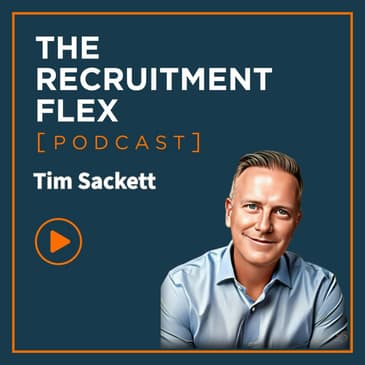

This week we welcome the OG HR Famous Tim Sackett. Tim has come up with a great follow up book to the Talent Fix by releasing volume 2
After 5,000 blog posts, at what point do you just write a few books?
With his latest book, Tim brings the wit and humour we all need after a long day in TA.
Fun fact, he is one of the few people who can honestly say they were born to be in this profession.
Our favourite takes from his new book:
- Money fixes everything
- Hiring Managers are mad because they see us as HR
- Laughable metrics in TA
- Talent Streaming
- Referral to Interview ratio - aim for 90-100%
The Talent Fix Volume 2 is out now!
[00:00:04] Welcome to The Recruitment Flex with Serge and Shelley. I'm Serge. And I'm Shelley, and we talk all things recruitment starting right now. Bonjour and welcome to The Recruitment Flex. Shelley, one of our favorite guests of all time, one of our most downloaded guests of all time is back.
[00:00:28] Yes. Boy, are we lucky. I feel like this is one of the originals who in the early days of The Recruitment Flex came on and shared his story and boosted our ratings just out of the goodness
[00:00:42] of his heart. Don't say that we owe him a check if you do that, so let's hide that. But he is one of the OG and he is probably the first HR famous person that we've had on the show for sure.
[00:00:53] Yes. Yes. So we are super pleased to welcome back to the show the one, the only Mr. Tim Sackett, who is the author of the Talent Fix Volume 2, and that is a leader's guide to recruiting great talent. And he is also the president of HRU Technical Resources. Tim,
[00:01:12] how was that for an intro? That sounds amazing. Thanks for having me. By the way, I'm not the only Tim Sackett. Like I tell people all the time, people are like, tell me like how people can reach you. And I'm like, if you just Googled Tim Sackett,
[00:01:23] you're going to get me on like the first hundred pages because of all the SEO over the years. But back in the day, there was another Tim Sackett that would show up and he was a
[00:01:30] truck driver chaplain out of Minnesota. And I always told people, I'm like, wouldn't it be amazing if I was the same guy? Like I'm the recruiter guy during the week and I'm a truck
[00:01:39] driver chaplain on the weekends. I go now he probably hates me because I took all of his SEO. He doesn't show up anymore. He's obviously not a LinkedIn, but what I've done in the
[00:01:48] past when I see my name on LinkedIn, I connect with them. I'm like, oh yeah, connect. Yeah, I do with even just the Sacketts in the world, right? Because there's not a lot of
[00:01:57] those people will see me too or see the name and go, oh, do you know like Ben Sackett in Oregon? I'm like, no, I don't know. So I'm going to start with certainly anyone who's not
[00:02:10] heard of you. I'd be shocked because I don't know anyone in our industry that puts out as much content as you do, consistent and funny. I love your sense of humor. Oh my God. There's
[00:02:24] one chapter in your new book. I am just like, I honestly, I laughed out loud. I got aggressive. I got aggressive with a couple of chapters. Yes. So there's one that I'm just like, oh my God, this is so good.
[00:02:36] So let's start with you though. Just share with the audience a quick background on who is Tim Sackett. Well, I was born in recruiting. Like people always say they fell into recruiting, but my mom started a recruiting company that I actually own and run now. So 45 years ago,
[00:02:51] my sister and I, she was a single mom starting her own company and we would sit on the bed, watch TV with no volume and she would make recruiting calls. And I never thought I was going
[00:02:59] to be a recruiter. Like I went to college to be a teacher and then she just called and said, hey, the company's growing. We need some help. Would you willing come back and do it?
[00:03:08] Fell in love with it. Fell in love with HR too. Like I had a mentor who was a previous GM, HR manager who talked me into going and getting my master's in HR.
[00:03:18] So I thought like, you know, you're young, you're kind of naive. Like here I am working for my mom's company, but I'm like, oh yeah, I'm going to go be an HR person at GM.
[00:03:26] And not thinking, oh, how's mom going to take that? Ended up, we did a split and I went and started my HR career. And then I kept getting yanked back into TA.
[00:03:36] Every time I was in a company, I'd be in these meetings and I loved HR. Like I really enjoyed it. And like somebody would be talking about the pain of recruiting. We can't do this. We're
[00:03:45] not going to be able to open this location if you don't do it. And I was always like, it's not that hard. And then when you open your mouth and like those meetings, some executive goes, we need to talk and now you're going to run recruiting.
[00:03:55] So I went back and forth like that. I kept taking like higher level roles in HR and then getting yanked into recruiting because it seemed like all my HR peers hated recruiting.
[00:04:05] And I liked it. People were like, what do you like best? I'm like, I love both. Like I really did enjoy both sides. And then I got a call. Mom had a health scare and was like, hey, I'm going
[00:04:14] to get rid of the company unless you want to come and take it over. And so I came back and did that. And it's been great. At the same time that all of that happened, I started blogging
[00:04:23] and it was like me and five other HR bloggers and then a bunch of mommy bloggers. And then it just grew from there. My mom actually wanted me to stop writing and blogging altogether. She's like, that's a waste of time. Like you're just
[00:04:35] wasting your time. And so I actually had a speaking gig at a Shurm conference and I said, well, I have this thing already planned. I can't like cut out on them. Why don't you come and
[00:04:44] see me? And she came and thankfully it was like jam packed room, people sitting on the sides. And I did well. And she goes, okay, I get it now. I understand how you can get yourself out there. And from a Legion standpoint alone in the staffing role,
[00:04:59] like just getting yourself out there and creating this kind of authority, thought leader persona worked out really well. That turned into book deals, turns into speaking all over the world. And it's been fun. So I really enjoy it. Can you tell me honestly, Tim, like where do you
[00:05:16] come up with that much content? Do you have a ghost writer? Come on. When I first started blogging, it was Chris Dunn who had the HR capitalist and he had started Fistful of Talent.
[00:05:26] And I had found him online. And again, this is before there was a lot of content online. And I'd sent him an email and he immediately responded to me. And so we started this friendship
[00:05:36] and he's like, oh, you should write for us. And I'm like, I have no idea if I could write or not. So he made me write two blog posts. One was like, this guy needs to know how smart
[00:05:44] I am in HR. It was some FMLA boring as shit kind of thing. Oops, sorry, you can beep that search. Otherwise you won't be heard in India. It was boring. And then the other one was I
[00:05:55] just left Applebee's HR and was working at a house system. And my wife is like, you have like a 30 year closet as Applebee's jackets and shirts and hoodies and all this
[00:06:03] crap. What are we going to do with this? And so I wrote this entire story of where does corporate logo wear go to die? Like where do, after you have all this stuff and it has
[00:06:11] like your name on it and you send it to Goodwill or whatever, where does it actually end up? So the story was I was in Safari in Africa and came across a guy coming at me that had my
[00:06:20] Applebee's jacket on. And I was like, that's my jacket. And he's like, always write like that, never write the other stuff. But then I never considered myself a writer even in college or
[00:06:30] high school. Like it wasn't who I was. And I just found out I have a skill. Like you guys could give me a topic right now. And in 15 minutes, I could give you a somewhat entertaining
[00:06:41] post of 500 plus words. And I can just kick that out for whatever reason. I don't know why I have that skill, but that's a skill I have. Do you think there is some practice in there?
[00:06:50] Cause if you ask me, write something in 15 minutes, it would take me four hours to even start thinking about the idea. Just practice. Like how much practice do you do? Yeah. Like I post something every single day. I probably write a couple of times a week. And sometimes
[00:07:06] you get on a roll and you just start writing and it just goes from there. Definitely practice. So Jessica Lee, who was on HR famous pod with me, she was also my first editor at
[00:07:15] Fistful of Talent. She would tell you for sure practices made me better because she had to edit my stuff when I first started and I'm awful at grammar. I don't think I'm really that bad at
[00:07:25] grammar. I'm just a fast writer who doesn't care about grammar. And obviously like Grammarly and all these kinds of tools have helped me along the way as well from that standpoint. Part of it, you know, Serge was like, I got to that mentality of I might write something
[00:07:38] to think it's the greatest thing I've ever written and I'll post it and gets like no traffic, no one's comments. And I'm just like, if you get depressed because you're like that had so much heart in it and I loved it. And then I'll write something that literally,
[00:07:51] it took me 10 minutes. I didn't even think about it. I just put it up there to have content and the thing goes viral. And you're like, why does that dumb thing go viral?
[00:07:59] And the other thing didn't. So I got into this mentality of just ship it. I write it. It's good enough. Put it up there and go. Some stuff I think is really good. Some stuff
[00:08:08] is crap. Most of it's average, but when you write that much, like that's just kind of what's going to happen. So now that you have two books and that is a completely different journey.
[00:08:18] Every practitioner or HR leader we've had on the podcast, they've told us it's been the hardest experience, professional experience that they've ever gone through. Now you're doing it for a second time. Why? And how hard was it? The second time was way easier.
[00:08:36] The first time I put myself in a box of what a business book should be. It should be 10 chapters and 5,000 or 8,000 words a chapter. And it had this structure to it in my mind that
[00:08:47] really forced me in these guardrails that I was uncomfortable with because I was a blog writer. I've written over 5,000 blog posts in my career, probably more than that now. And I was really good at that. And then actually Steve Brown, who has written some
[00:09:02] really successful books in HR space. When I saw his book, I was like, holy crap, he's got like 45 chapters and this chapter only has 500 words and you can do that? They're like, yeah, you can do anything you want. So the next book was way easier
[00:09:15] because I was free to not have those constraints on me and write a 1200 word chapter or a 10,000 word chapter or whatever I wanted to do. I'm already started my third book. So it really did
[00:09:26] for me. It opened up my eyes to say, just be the writer you are and people will find that entertaining. But if they don't, then that's okay too. So I have to say the fun chapter I was referring to at the top of the show,
[00:09:40] money fixes everything. That's it. The end. And you did put a little color around it, but I'm like, yes, like any recruiting problem you have can be solved with money. And so many people want to say money
[00:09:54] can't fix that kind of problem. I'm like, actually in recruiting, if you give me enough money, I can fix every problem you have. And that's just the reality. But the reality is we don't have unlimited budgets. We don't have unlimited money. We're always stuck with not enough
[00:10:07] resources. So that's the difficulty of it. Yes. And who is this book targeted for Tim? Is it for someone who knows nothing about TA or is this just for TA leaders? Like who should be
[00:10:19] picking up this book and memorizing it? I think again, I wrote it for primarily the TA leaders because I was getting so many questions on the blog around, hey, we're not being able to do this or we can't fix this or we're looking for
[00:10:31] something like this. And all those questions were really just, I need help. I feel overwhelmed. I don't know what to do. I don't know where to start, especially for leaders taking over
[00:10:39] a function or coming in. But what we found is a lot of hiring managers actually really like it because they don't really understand what we do in TA. And they get frustrated because they're sitting there and they're like, I'm failing in my own function because I don't have
[00:10:51] the talent I need. And I'm waiting for somebody over here not knowing really what they do or don't do. I actually was speaking at a construction. So it was basically CEOs and COs of big
[00:11:01] construction firms. And I was shocked at how they were just like on top of it because to them that's their biggest pain point is talent, like talent acquisition and attracting talent. They've outsourced it so much to HR. And then they're all the hours frustrated and angry at
[00:11:18] HR because it's not fixing the problem and they don't really know what has to happen. And so when they read the book and they knew what to do, they're all saying, oh,
[00:11:26] why aren't we doing this stuff? Then a lot of times like when I go into those meetings, it's like you're not doing that stuff is because your TA leader thinks you're going
[00:11:33] to tell them no or your HR leaders going to tell them no. And so they don't even ask. They're just like, I have to figure this out without help. And you're like,
[00:11:39] that's just not how this works. And that ties in perfectly. One part of the book that I really love is when you're talking about TA and HR, and we've always had that argument of should
[00:11:52] TA be in HR? Is it different? We've always been treated as the as a stepsister. I can say that I'm a ginger. I stopped myself actually. I was like, no, that's not going to go well. So you mentioned that talent acquisition was treated like Cinderella
[00:12:10] before she became a princess and you've seen that shift and I've seen it shift too. But why do you think that perception is changing? I think because organizational leaders have finally figured out before it was just all HR
[00:12:25] and it was like witchcraft, whatever you guys do over there in HR, just whatever. I don't know what you do. Just keep doing it. To them, it was payroll and benefits, getting people hired. But I think they've really figured out, wait a minute, this talent thing for
[00:12:36] us is like paramount. If we can't hire enough people, the right people, we can't grow, we can't be successful. And if you have the personality in TA to actually have really dynamic conversations with your leadership team, you automatically will be elevated to a status higher
[00:12:54] than many times the HR leader who just doesn't have as sexy a stuff to talk about. And I think in talent we do. We can talk business in a real way for them.
[00:13:05] Do you think that shifted though? Because the type of conversations that we were having as TA leaders, we're really focused on maybe some metrics like time to fill, but now we're talking about, okay, here is what the cost of not having these roles filled. I've seen the
[00:13:20] big shift. Have you seen that shift in how TA leaders are approaching the business? I hope. I still think we're way behind. I still think so often we're not having the right metrics conversations around the business that we could. I think we could have really
[00:13:35] dynamic conversations. It's interesting because I do about a dozen projects a year where I work with enterprise HR TA leaders on helping them just transform their TA practices. And a lot of the conversation we have is around the data side and how they can actually use all that
[00:13:51] information to really create a great story to the CFO, the CEO and get what they want. And when I go and have those conversations with this leadership team within minutes are like, yes, we need to do this. Yes, move. Yes, you have approval. And I'm always looking at
[00:14:06] where it's like the HR TA leader who brought me in and they're always like, we've been trying for years to get this stuff. Why all of a sudden you can come in in 15 minutes and it's because you're speaking the language of business to them versus speaking like a
[00:14:19] great example. And I tell people all the time, I'm going to die with time to fill is not a success metric. I'm like tombstone because I'll go to the CEO and they'll say our recruiting
[00:14:29] has sucked. It's sucked for five straight years. And I'm like, do you realize that your recruiting team actually got paid out full bonuses five straight years? And then you go and go, why did they get a bonus if they suck so bad? And it's like,
[00:14:40] well, they went from 38 days to 37.7 days and then they went to 37.2 days and aren't they getting better because they're getting faster? And you're like, no, there's no correlation about being faster and being better in TA. You're just a little bit faster.
[00:14:55] But if you're already in that ballpark, then you're still the same. And if you're broken, you're broken. Maybe the market rate to fill that job is 23 days and you just keep getting incrementally a little bit better, but you're not really better. So I think it's always
[00:15:08] interesting to really try to figure out what are those success metrics we have to have. I'm glad you're going down that road. So what should they measure instead? Because we talk about metrics like time to fill and you bring up quality of hire in your book, but
[00:15:22] if you were looking at it as a business owner, what metrics would you put down to the recruitment team as far as station measure this? Yeah, at the end of the day, we have to measure the funnel of a recruiter and really to understand what's happening,
[00:15:34] what's not happening. And I say that not because I want to micromanage recruiters. I need to know what the capacity of my team is. So I want a capacity metric. I need to know,
[00:15:42] can my team fill 25 roles a month? Can they fill 50 a month? Can they fill 100 a month? What is that capacity? Because when I go to them and say, hey, in the fourth quarter, we have to
[00:15:52] increase our hiring by 200, they only have the capacity for 50. And we don't change anything. They're going to fail every time. But yet most TA leaders, HI leaders will go, we'll work harder and we'll make it happen. They don't. They fail and then they get fired.
[00:16:06] And so for me, it's about really understanding what that capacity is. And then you can always back that capacity into resource numbers of what you need. Like, okay, cool. If we need to hire 200,
[00:16:16] I need two more heads and I need 2,500 or more in marketing spend. I need this and this. And you'll get to where you need to get to. But so often, we don't do that. And we just
[00:16:26] started going, oh, it's our time to fill is at 37 days. So if we make it 25 days, then we can meet that. You're like, you're not going to drop 12 days off. You're just never going to do that. Come on, be realistic. The quality of hire one is interesting because
[00:16:39] I think it's a holy grail metric. One is I would say it's not a TA metric. If I go into a room of 1,000 TA leaders and say, is quality of hire important? You raise your hand, 90% would
[00:16:49] raise their hand. And then you go, okay, if it's so important, 90% of you said it was important. How are you measuring it? And there would be crickets because they'd be like, Tim, you just know if someone's better quality than the last. There's no measure there.
[00:17:04] There's no real measurable result. Now, what you find is that they're measuring 90-day turnover or they're measuring really quality of applicant kind of stuff, which I think is valuable. But they're not really measuring quality of hire. Crosscheck is maybe the one company
[00:17:19] in our space that actually has figured out quality of hire. And they've done it in a way where they're going back to a hiring manager and saying, hey, give them the chance. Right? Would you still make this hire again? But it's a hiring manager metric. It's not
[00:17:30] really a TA metric. And I think that's where it gets lost, right? That we think it's some kind of an HR metric and it's just not. And it's not standardized. That's one of the biggest things that I've seen because I've actually tried probably four different methods
[00:17:44] of how we measure it. One was like an MPS score type of thing going to the hiring manager and the employee now then 90 days, 100 days performance evaluation. All of it was bullshit.
[00:17:55] I didn't get a really good sense from it. No. And that's the hard part, right? We'd say that it's so important in every study that you find, every survey that you find with HR leaders
[00:18:05] and TA leaders quality of hire is the number one metric they say is the most important. And it's laughable because none of them are actually measuring in a way that has any impact on the business whatsoever. So true.
[00:18:18] So let's come back to capacity, Tim, because how should a TA leader be measuring capacity? That again seems like it's not standardized. If I've got five roles, but every single one of them
[00:18:30] are unicorns versus I need to hire 30 roles of the same thing. And that means I need to interview 150 people in the next five days. Two different things. When you talk about capacity, how should you be determining that? Yeah, I think most of the shops that do
[00:18:48] it pretty well are breaking down the kinds of roles they hire until three or four buckets, right? So you have our low-scale, no-scale high-volume hiring. We have our mid-career. We have our unicorn really hard, right? So you have three buckets. And those funnels for
[00:19:01] recruiting are basically going to look the same. We need X number of candidates at the top of the funnel. We need to screen X number. We need to get assessments. We need to interview.
[00:19:08] We need to offer to get that individual hire. And as you go through all of those, you can start to see the capacity at every segment, right? So if somebody came to you
[00:19:17] and said, hey, we need to hire 25 more unicorns, you can back the numbers up and actually understand. And people always get nervous about that because they're like, don't the recruiters feel like you're micromanaging? And I'm like, you're using it completely wrong.
[00:19:30] If I have a recruiter sending 20 screened applicants to hiring managers on a weekly basis and they're getting two interviews, they have what, 10% hit rate? And that's awful, right? So I need to go then and figure out what's going on. Why are you sending
[00:19:47] candidates that hiring managers aren't willing to interview? Because in my mind, if you're a corporate TA person, that should be like 90 to 100%. Like every time I send you somebody, if I have a great relationship with you and I know the position you have open and I know
[00:20:01] the candidate coming in, I'm only going to send you somebody that I truly feel you should interview. And in fact, their holy grail, that should be the point where I'm not even
[00:20:09] going to send them to you. I'm just going to set you up with the interview, right? Because we already know that this is going to be great. And so often I'll go into organizations and their
[00:20:18] quality of applicant ratio is like 25, 30%. And I go, do you understand how much resources you're wasting by allowing your hiring managers to say no constantly to great talent that you have? And like they shouldn't be able to do that. And yet we just go, oh, that's fine.
[00:20:34] Can you imagine General Motors saying, hey, seven out of every 10 cars that come off the line, we're just going to send to the junkyard because they're crap. They would be out of
[00:20:41] business tomorrow. And yet in TA we think it's fine. We're like, oh yeah, seven out of 10 people we send you just throw in the waste basket because they're crap. They're not crap. I wouldn't send them to you. I wouldn't waste your time if they were.
[00:20:54] So one of the things that you talk about in the book is the fact that the future of our talent, we've got the boomer generation retiring now. We've known that was coming for years,
[00:21:07] but essentially we just won't have enough people. We'll have more work than we have people. What should organizations be doing if they're feeling a little nervous about this? What should they be doing today? It's a great conversation that we could talk for hours on because I think
[00:21:26] there's a lot of things they could be doing. And I think there's a lot of things they should be doing, especially in your local markets with apprenticeship programs, whether that's white collar, blue collar apprenticeship programs. But we tend to be really reactionary
[00:21:37] around talent. We don't really make it a problem until it's a problem. And then we try to fix that problem in the moment. And when it's like, a lot of times it's just too late.
[00:21:48] In the U S we should have been dealing with our immigration issues decades ago and we haven't. In Canada you guys have seen massive immigration to help fill a lot of your labor
[00:21:58] needs. And there's challenges with all of that. And we would have challenges with that in the U S. So instead we just kick that bucket down the road to the point where we are now losing talent
[00:22:09] to all the other rich countries in the world, right? The UK, all these other, has way farther ahead in immigration than what the U S is. And especially being in an election year in the U S, no matter what side you're on, it doesn't matter. Nothing's
[00:22:22] going to happen. Then it will take years for anything to happen and we're going to be behind the eight ball. The one caveat and thing that will probably make us lucky is that again, AI
[00:22:32] automation that's going to be hitting us will probably help in a lot of ways and cover up some of our misdeeds over the years in terms of immigration reform. But it's a problem.
[00:22:42] If you take a look at where Japan is, you take a look at the cliff that China is going to hit in the next decade. Like people tend not to look at demographics and really realize how
[00:22:51] it's going to impact your economy. It's going to impact a lot of things. And that's one of them. Now, I guess we'll see what happens in the U S but at some point we have to figure out a way
[00:23:00] to make more humans, whether we invite them into the country or we start paying people to have babies. I don't know what we're going to do again. Japan knew 30 years ago they had a
[00:23:10] baby issue and they've yet to be able to fix it. It's a tough one politically. It's almost impossible to resolve, right? I was just thinking of Elon Musk and his whole theory. He's been talking about demographics for a long time, but he's also come out
[00:23:24] and said, AI is going to take a lot of jobs and we're going to have to come out with universal basic income across the board. Do you think that is a possibility? I know that's like a big question, but I'm curious what your thoughts around that is.
[00:23:39] It is interesting. I think again, it's going to be a political thing. A lot of times when I talk to enterprise, like HR, TA leaders, it's hard for them to bring AI into their shops
[00:23:49] because their legal people are pushing back and saying, no, no, no. There's so many of these things that we can't have happen. The adoption will be slower in our space than what we'll see
[00:23:58] in some of the other spaces, but it's going to happen and people will lose their job. Every other technological revolution in history, ultimately it's created more jobs. We stress out and we freak out because we don't know what those jobs are. We know the jobs that are
[00:24:14] going away. We don't know the new jobs that are going to be created and that's the stressful part. Completely agree. I think there are so many examples of what's happened and it's actually created more jobs. I just think when we look at it, skills is going to
[00:24:28] be part of the answer to this equation. We're not going to be a typecast in a particular job. Our skills are going to transfer into different types of roles, but talking about the future of
[00:24:40] talent acquisition, you have a chapter dedicated to it. This is the last question we ask all the time on a podcast. Take out your crystal ball, what does talent acquisition look like in
[00:24:50] five years? You wrote it now so you have an answer already ready. Tim, what does the future of talent acquisition look like? It's easy to say the robots, right? It's easy to say AI.
[00:25:02] It's easy to say all that. To me, I think it's speed. At the end of the day, the speed at which we attract and hire and acquire talent is going to be elevated at a
[00:25:13] level that we just have never seen. Companies like Amazon, you can get an hourly job in under 20 minutes with them from apply to offer. You see stuff happening, but then you go, wait a minute,
[00:25:25] Amazon can't be great on the quality side. Nope, they're awful. Then you go, okay, well it's a combination of the speed and quality. Then all of that stuff comes back to how much does it cost to do all of that? It's that classic example of the triangle of
[00:25:38] speed, quality, price. Pick two. I really think the future might be, no, we're going to get all three, right? We're going to get really fast. We're going to get high quality and we're going
[00:25:46] to get it for a pretty low cost. When I see some of the live voice interview stuff that's happening with generative AI, it is scary how realistic it is and how the latency is almost
[00:25:59] gone. They're having real conversations with somebody that if you didn't know that was a bot, you just would have no idea. It sounds that real and I'm like, wow. Then again,
[00:26:08] you get into the legal aspect of wait a minute, then you're going to have AI selecting or you're going to have AI judging should somebody move on the process. I think that's a red herring.
[00:26:18] When you take a look at how biased we are as humans, the closest thing we can get to bias free hiring is going to be the AI. Yet we think it's the opposite. We think, oh no,
[00:26:29] it's going to have bias that we don't know of and it's not going to hire women. I'm like, no, it'll be completely focused on we don't care if you're a woman, male, non-binary, black,
[00:26:38] white, green. We don't care what school you went to is going to be back to that skills and that assessment of can this person actually do the job? I think for the first time in our history, we'll get closer to having 100% of people actually have a chance
[00:26:51] at every job that they want to have a chance at. Right now, we don't. If you get 100 recruiter and 100 people apply to a job in a day, you're going to cherry pick five or six
[00:27:01] resumes or applications. You're going to call those people or reach out to them, whatever, and 90% of those people will never get a sniff. I think we have a point in the future where AI is going to finally give candidates across the board a chance to actually
[00:27:15] have a fair chance at getting hired. I do think in the world of AI, like a human touch, it will be the luxury. You have this window where you go, hey, if everybody's doing AI in terms of talent acquisition and everything is going to be the robots,
[00:27:30] what about the company that actually has a real human reach out to you? That becomes the luxury. That becomes holy crap. They really want me because a real human actually reached out to me. It wasn't Tim the AI bot kind of thing. To me, that becomes the
[00:27:43] real differentiator that I think we'll start to see that as well. Now, it won't be as many because it's more extensive. We go back to that quality cost time thing. If you're in a really specific area with a high competition,
[00:27:57] that might be the way to make yourself stand out. Really good insights, Tim. This is always a pleasure when you come on the show and we really appreciate it. For anyone wanting the book, I'm assuming you can get it on Amazon
[00:28:11] everywhere. You can also get it on the Shurm site. If anyone wants to get a hold of you, what's the best place, Tim? Just call me directly. My cell phone number. My number is. Connect with me on LinkedIn. I'm really good about replying to messages there.
[00:28:28] You can Google me. You can go to timsaka.com. Again, I'm pretty easy to find after all these years. Shelly, put out the book. You have a hard copy. We got to show it. Go get it now.
[00:28:39] We are big fans of the first one. We are even bigger fans of the second one and the second one we were told in a green room is actually outselling the first one, which is hard to believe,
[00:28:49] but congratulations, Tim. It's a fantastic book. If you're an HR or TA leader practitioner, hiring manager, go get it on that note. Tim, always a pleasure. Thanks for having me. Thank you, Tim. Shelly, let's face it. Texting candidates is the easiest way to hire quicker today,
[00:29:17] but your cell phone doesn't connect to your ATS. You're sharing your personal number with strangers. That's pretty scary, right, Shelly? And it's not even legally compliant. This is where our friends at Rectex come in. They've created simple yet powerful text
[00:29:32] recruiting software that works with your ATS. Plus, it's designed by recruiters for recruiters, so you know it works. To learn more and book a demo, visit www.rectxt.com, mention the recruitment flex and get 10% off annual plans. Do you love news about LinkedIn, Indeed, Google,
[00:29:56] and just about every other recruitment tech company out there? Hell yeah. I'm Chad. I'm Cheese. We're the Chad and Cheese Podcast. All the latest recruiting news and insights are on our show. Dripping in snark and attitude. Subscribe today wherever you listen to your podcasts. We out.