
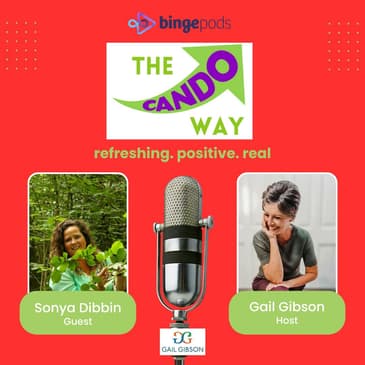

In this episode of The Can Do Way, I am talking to Sonya Dibbin, a forest therapy trainer and guide.
Following the birth of her son, Sonya regularly went for slow countryside walks and realised she felt better than she had in years, despite the 'New Mum' struggles.
Driven by a deep curiosity, Sonya swapped her corporate role for an 18-month journey of personal transformation, retraining as a guide in Forest Therapy, EcoNIDRA, and Mindfulness. Since then, she has introduced hundreds of like-minded individuals to the magic and science of Deep Nature Connection, proudly referring to herself and her community as "Nature Nerds”.
From a childhood shaped by ‘fair weather only’ experiences, Sonya’s life changing Can Do story led her to embrace nature's beauty in all seasons. Mastering the art of solitude and silence and finding awe in the small wonders of everyday life, are joyful practices that continue to inspire her journey today.
Listen for Sonya’s Can Do tips:
1. When you are too busy to spend 20 minutes in nature, you need to spend 1 hour.
2. When you are really stuck, do something.
3. Every ‘No’ you receive is a step closer to your dream.
Learn more about your ad choices. Visit megaphone.fm/adchoices
[00:00:01] Hi, I'm Gail Gibson, accredited Master Performance Coach, International Speaker, Podcast Host and Author.
[00:00:09] Known as The Can Do Coach, I thrive on enabling leaders to step up, shake it off and shine.
[00:00:17] Welcome to my podcast, The Can Do Way.
[00:00:20] My guests from across the globe have Can Do stories of growth, resilience and success to share.
[00:00:27] Tune in and be inspired by these individuals who have developed a strong Can Do approach.
[00:00:34] Each one of their stories is unique.
[00:00:37] Each one of their stories has a key message.
[00:00:42] In this episode of The Can Do Way, I'm delighted to be talking to Sonya Dibbin, a forest therapy trainer and guide.
[00:00:50] Following the birth of her son, Sonya regularly went for slow countryside walks and realised she felt better than she had in years.
[00:00:59] Despite the new mum struggles.
[00:01:02] Fueled by her curiosity, a couple of years later, she pulled on her big girl pants and swapped the corporate hustle for an 18-month journey of transformation.
[00:01:12] Retraining as a guide in forest therapy, eco-nidra and mindfulness.
[00:01:18] She has since introduced hundreds of like-hearted folk to the magic and science of deep nature connection and fondly refers to herself and the community she's built as nature nerds.
[00:01:30] So welcome to the show today, Sonya.
[00:01:34] Hi, Gail. Thank you.
[00:01:37] Wonderful.
[00:01:38] If we can just find out a little bit about you first, Sonya, if you can take us on a brief journey through your life, just to give the listeners a glimpse into your background and the passion that fuels the work that you are now delivering.
[00:01:52] Yeah, sure. So, well, I started off actually with a very clean childhood.
[00:01:57] We didn't really go outdoors unless it was warm and sunny.
[00:02:02] And, you know, it wasn't really warm and sunny very often when I was young, 50 odd years ago.
[00:02:08] And so there was a whole lot of misery in my family home.
[00:02:14] And I grew up thinking that that was normal.
[00:02:17] You were depressed if it wasn't sunny and warm and you moaned a lot about the weather.
[00:02:21] And these things are outside of our control.
[00:02:23] And I did not want to be doing that.
[00:02:25] So the minute that I found out that I was going to be a mum, that's when I knew.
[00:02:30] Seriously, the first thought was, oh, goodness me.
[00:02:32] And the second thought was, oh, right.
[00:02:35] So now everything's got to change.
[00:02:36] So I, yeah, I mean, I realized I couldn't do the role that I'd been doing, which was corporate IT with a lot of travel and hard working hours, long hours.
[00:02:48] You know, couldn't do that with a baby.
[00:02:51] But more so, I wanted to teach him, as it turned out, to adore the outdoors in all weathers because I knew the impact it would have on his mental health.
[00:03:02] And I wasn't going to pass that same kind of seasonal affective disorder down to him as it had been previously passed down to me.
[00:03:12] And so the work that you're now delivering, what is it that really fuels that passion?
[00:03:16] Apart from wanting to lead a future that you could walk into that you'd already experienced and one for your son,
[00:03:23] what else brings out that magic in you when you're working with the people in nature, your nature nerds, as you call them?
[00:03:31] Yeah.
[00:03:32] There's a big thing around preventative health.
[00:03:37] So, I mean, I genuinely believe that we humans are struggling because of our lack of connection to nature.
[00:03:45] And I don't mean time in nature.
[00:03:48] That is sort of an aspect of it.
[00:03:50] But actually, connection to nature goes deeper.
[00:03:53] It's where you have almost a spiritual relationship with nature.
[00:03:58] You believe that nature is your kin.
[00:04:02] And all of the nature beings that are around us everywhere we go, you know, they are your friends.
[00:04:09] And when that, it's like a switch being flicked.
[00:04:14] Suddenly, lots of people feel very lonely and isolated.
[00:04:18] That weird feeling that you can't quite explain because you're like, well, I'm not lonely and I'm not isolated,
[00:04:23] but I still feel there's something hollow.
[00:04:25] That goes away.
[00:04:27] And it has a huge impact on your own ability to maintain your mood, your resilience, your emotional well-being, et cetera.
[00:04:38] So, there's that.
[00:04:40] I genuinely believe that if we were all and, you know, you can adapt this practice.
[00:04:46] You don't have to be in a forest.
[00:04:48] There are different ways that you can adapt it to still get the same benefits.
[00:04:52] We would all be better versions of ourselves and happier versions of ourselves if we could all do this.
[00:04:57] Plus, the impact of it is that your behaviors change and you, in turn, start taking action to protect the natural world,
[00:05:09] to be kinder to the natural world.
[00:05:11] So, it's this reciprocal relationship where the natural world is helping you and you're helping them.
[00:05:18] And it's there for everybody and it's free.
[00:05:21] You just need someone to help you flick that switch in the first place because we've come so far away from it.
[00:05:27] It now seems weird to go out and just spend time in nature marveling at a tree.
[00:05:33] You know, we laugh at tree huggers, that kind of thing.
[00:05:35] But actually, it is that.
[00:05:39] Amazing.
[00:05:40] Amazing.
[00:05:40] And I love the fact that you brought up that connection to self because I think that's so vital.
[00:05:45] And it comes through a lot in the work that I deliver as a coach as well.
[00:05:50] And so, when you talk about that connection, I've read a lot and heard a lot in podcasts as well recently around that idea of solitude.
[00:06:01] And particularly because I work with women and I don't know whether women is the higher percentage within the groups that you take out into the forest, Sonia.
[00:06:12] But talk me through this connection into the forest work that you do when it comes to helping people be okay with solitude.
[00:06:25] Oh, this is a big, big thing.
[00:06:28] So, I call it connected solitude.
[00:06:30] It is mostly women that I guide that come on sessions with me and actually choose to go on and train.
[00:06:35] That was not a deliberate thing, but that is how it's worked out.
[00:06:41] You know, many women won't go out into nature alone because of perceived or real health, safety issues.
[00:06:51] So, being able to go out with a small group but still in a quiet, slow, connected, gentle, calm, da-da-da, kind of feels like you're alone.
[00:07:04] So, you're getting that restorative time but without being unsafe, without feeling unsafe.
[00:07:11] So, there's a big thing there.
[00:07:13] There's a massive thing also around silence and the gift of silence.
[00:07:18] You know, so I've started, I've noticed it has always been since I've been doing this, which is over five years,
[00:07:26] that people, some people struggle with silence.
[00:07:29] Now, this goes back to my counselling training from 20 years ago and I did four years because I became fascinated.
[00:07:36] And this was one of the things that intrigued me, how uncomfortable we are with silence because we have to sit with our own thoughts and feelings.
[00:07:45] And, you know, how crazy is that, that we have found ways to block listening to ourselves.
[00:07:55] So, we do a lot of comfortable silence in the sessions and that's when mostly people come on their own.
[00:08:04] So, they actually, after, you know, in fact, I can see the relief when I say to them at the start,
[00:08:10] okay, you don't need to make any idle chit-chat.
[00:08:12] There's no networking here.
[00:08:13] And you can see shoulders relax and a few giggles where people think, oh, goodness me, thank God,
[00:08:18] I can't get any time on my own.
[00:08:19] And this is the only time I've...
[00:08:21] And also in my training, actually, you know, a number of the guides, trainee guides,
[00:08:30] have shown and, you know, recognised that they are struggling with holding that silence,
[00:08:39] with the long pauses, with the time that you have to give your guests and your participants
[00:08:43] so that they can percolate, they can integrate, they can work it out themselves.
[00:08:48] It's so powerful when they do.
[00:08:50] So, I've started including practising silence in my training.
[00:08:55] And I'm looking at the moment at offering silent retreats to...
[00:09:03] as part of the training, you know.
[00:09:05] So, we're going to go on this six-month programme and there's going to be...
[00:09:07] it's going to culminate in this silent experience that we're going to share together.
[00:09:13] And, you know, because I've got to get my trainee guides to be comfortable enough with it themselves
[00:09:20] so that they can hold that safe space for their participants.
[00:09:24] It's so valuable, silence.
[00:09:27] But, yeah, we really struggle with it.
[00:09:29] But I can indeed agree with you there because it's something that I have been embracing,
[00:09:36] I think, through the recent months and going through a particular personal challenge of my own.
[00:09:44] And so, that time in nature and just using your senses to look around you, I think,
[00:09:49] and not having anybody with me to walk with.
[00:09:52] So, I can really relate to all of what you're saying and being able to embrace the silence
[00:09:59] rather than be scared of it.
[00:10:01] So, I want to come back to the start when you were explaining that in your childhood,
[00:10:09] your family were kind of fair weather about the outdoors.
[00:10:15] And yet, you started to take those slow countryside walks when you had your first child.
[00:10:21] So, you were stepping into this realm of solitude and being able to embrace it.
[00:10:27] So, what do you think was that key defining moment when you fully embrace this,
[00:10:33] I'm going to be okay with the whole year and every part of the changes that happen with all four of the seasons?
[00:10:41] I think there's a few different things, actually, that go on there.
[00:10:46] One was the sheer determination that I was not going to do this to my son.
[00:10:53] Absolutely, categorically, that habit had to be broken.
[00:10:55] So, you know, I mean, the way that I know how to do that,
[00:10:59] I read Feel the Fear and Do It Anyway when I was younger.
[00:11:04] And I also, at that point in my life,
[00:11:10] overcame a number of different fears around doing things alone, going it alone.
[00:11:15] And I was living quite a lot of my life on pause, waiting for, you know, the perfect partner to come along.
[00:11:23] And, you know, I'm not alone in that.
[00:11:25] And I realised one day that it was more sad to not do the things that I wanted to do
[00:11:33] rather than do them on my own.
[00:11:36] Because I'd still done the thing I wanted to do, which was, you know, like,
[00:11:39] I'm living my life rather than being too frightened to do it because I thought it was embarrassing to do it on your own.
[00:11:46] So by this point, I was very, very okay with just going out and doing things on a limb.
[00:11:54] And, yeah, there was sort of never any doubt.
[00:11:57] And then once I, because Leo was a February baby, so it was freezing.
[00:12:03] And, but, you know, oh, God, they've got those excellent snow suits and all of that stuff.
[00:12:08] So I was enjoying wrapping him up and going out and doing, getting our daily dose of nature
[00:12:14] and realised how much the winter has to offer.
[00:12:21] Embracing those changing seasons, as you say, you know, so taking the opportunity to rest more.
[00:12:27] It doesn't work when you've got a tiny baby, but about that year.
[00:12:32] As the years have gone on, embracing change.
[00:12:35] Now I'm self-employed as well, so I'm able to call my shots and I absolutely take more time off in the winter to rest and recover.
[00:12:44] And, but falling in love with winter was life changing.
[00:12:48] And now, you know, I say, I say about all the seasons, but it's my favourite season.
[00:12:53] There's so much out there that we miss.
[00:12:56] It's so easy to miss in the winter months.
[00:12:59] So I'm actually very passionate about, I still work right up until early part of December and I start again in Feb.
[00:13:07] I take January off just because, you know, I'm self-employed.
[00:13:10] Why not?
[00:13:10] It is a bit depressing and grey.
[00:13:12] I'm going to like, you know, do what I need to do in that month and not force myself out at six o'clock in the morning in the freezing ice or whatever.
[00:13:23] But yeah, so never look back really.
[00:13:27] Fantastic.
[00:13:27] And I love it.
[00:13:28] I could, I was just enjoying listening to your revelation of how you then fell in love with the winter.
[00:13:35] And yet that had been withheld from you as a child.
[00:13:38] So you didn't even know until you were older and yet you were willing to step out to go alone and to do the things that bring you absolute joy.
[00:13:49] And so you do them more and more and more.
[00:13:53] What would you say is one of the things that you have been absolutely astonished by in a winter landscape when you're out walking?
[00:14:02] What's one thing that really stands out for you?
[00:14:06] Oh my gosh, you keep asking me for one thing.
[00:14:09] There's so many.
[00:14:10] Oh, I can't have everything.
[00:14:17] So, well, autumn going into winter, it's when the cobwebs appear and you get the icicles, whatever you want to call it, on the cobwebs, right?
[00:14:26] So that's autumn leading into winter.
[00:14:28] That's always mesmerizing.
[00:14:30] And then I think once I get into winter, it's the ice, icy patterns.
[00:14:36] So, you know, sometimes we have something called a hoar frost, H-O-A-R.
[00:14:41] And that is a phenomenon that you have got to see to believe with these beautiful ice sculptures that come out of nowhere.
[00:14:48] And also the red berry and the yellow lichen on the branches that I've also got this white frost on.
[00:14:59] The popping colours.
[00:15:01] The simplicity of it, I think.
[00:15:03] I think that's what I like.
[00:15:04] And also love, sorry, I told you there was more.
[00:15:06] See, you can have three, I'll let you.
[00:15:08] Thank you.
[00:15:09] It's trees.
[00:15:11] When they lose their leaves, the deciduous trees, and you can see their trunk, the branches, then the smaller branches getting all the way up to the twigs, right?
[00:15:21] That makes a pattern.
[00:15:23] It's called a fractal pattern that you see quite often in nature.
[00:15:26] A really good, easy example of one is a bracken leaf.
[00:15:29] So it's the same shape, but changing in size, repeating, but changing in size.
[00:15:35] And so you can see how the tree is the same.
[00:15:38] Actually, scientifically, when we look at fractal patterns, we don't really understand why, but we get a little hit of serotonin and it makes us feel good.
[00:15:45] But I also feel that when the trees have lost their leaves, they're showing us their true selves.
[00:15:51] And so you can have a deep connection with them because it's like chatting with someone first thing in the morning before they've put their makeup on.
[00:15:57] You know, they're able to be a bit more vulnerable and true and real.
[00:16:02] And so there's this depth of connection, I think.
[00:16:06] If you are listening to this podcast today, I hope that if you have struggled with being in winter and seeing autumn and winter for the joyous seasons that they are,
[00:16:18] then perhaps Sonia has painted a beautiful picture for you of things that you can look out for and things that you can start to admire
[00:16:26] and be curious about when you go on an autumn or a winter walk.
[00:16:30] So thank you for sharing those.
[00:16:33] You painted such a beautiful picture for me.
[00:16:36] And I do hope the listeners can also go out and experience that joy too.
[00:16:41] So as you've traveled through your new journey, that is continuing at a wonderful rate, Sonia,
[00:16:49] who would you say has been your greatest supporter?
[00:16:53] That is that person that keeps encouraging you and keeps believing in you as you grow your business?
[00:17:05] I would probably say it was my mum, although she's no longer with me now.
[00:17:10] But, you know, her influence.
[00:17:13] Because she very much encouraged me to be my own me.
[00:17:21] She encouraged me to achieve and to push boundaries.
[00:17:30] And, you know, while I recognize now that some of that achievement was driven by feelings of inadequacy,
[00:17:39] as there's that thing, isn't there, about chasing more and more and more to feel good about yourself.
[00:17:43] So while I understand that piece, I also, she was an incredible woman at making the most out of life.
[00:17:51] She got on a boat from South Africa, not speaking a word of English, on her own at 18 to escape, you know,
[00:17:59] a life that wasn't exciting and wasn't going to challenge her.
[00:18:02] She was an incredibly clever lady and came over here and made a new life,
[00:18:07] traveled all around Europe, did all these incredible things.
[00:18:09] And she always said to me, whatever you do, I know what she meant here,
[00:18:15] but it does come out the wrong way.
[00:18:17] Don't settle down, have kids and get married because they ruin your life.
[00:18:23] Now, I know it sounds a bit weird, but what she meant by that was, you know,
[00:18:26] chase your dreams and talk to that stuff first.
[00:18:30] And, you know, and that is what I did.
[00:18:33] And so I can still hear her and recognize the fact that she's saying,
[00:18:39] and she was taken far too soon, which is even worse, you know,
[00:18:42] but she was saying, you've got one life, push, push, push.
[00:18:46] Yourself to live it, do the things you want to do.
[00:18:50] And, you know, yeah, she gave me a love of Kate Bush and Meatloaf in the process.
[00:18:56] Beautiful.
[00:19:00] An interesting pairing, but, you know, that's diversity and the curiosity that she has handed over to you
[00:19:07] and you're living your life that way.
[00:19:09] So, yeah.
[00:19:10] Yeah.
[00:19:11] What a beautiful, beautiful supporter that even though she's not here anymore,
[00:19:15] she can still, she's still coming through in you.
[00:19:17] And I'm sure you're passing that on to your son as well so that they,
[00:19:21] that they can also have a very full life and can experience in the moments that they want to enjoy
[00:19:28] and as and when in their future.
[00:19:32] So, as you grow your business, you know, before we came onto the call,
[00:19:36] you were talking about just what's going on in your world right now
[00:19:40] and what you're noticing in the general market of the forest and nature work that you're doing.
[00:19:46] So, what would you say is that go-to mindset habit that you rely on most to keep at your business,
[00:19:55] to build yourself, to not give up and to maintain resilience?
[00:19:59] You know, when there might be competitors in the market or anything or things that go wrong
[00:20:04] that just don't work out for you.
[00:20:06] What do you go to time after time to just keep going?
[00:20:09] Hmm. For me, it is about chasing awe, A-W-E, chasing awe,
[00:20:24] and finding those moments of awe in the everyday.
[00:20:31] So, yes, I feel awe when I see the northern lights, when it snows,
[00:20:38] when, you know, I look at field views, all of those, the seashore,
[00:20:43] you know, all of those things, of course, you have a sense of awe and wonder.
[00:20:47] But it's actually about finding it in the everyday.
[00:20:50] So, just earlier, the sun was shining through,
[00:20:53] and I've got a vase of flowers there.
[00:20:56] And the way that the sun was shining, it was making the shadow of the,
[00:21:00] it was showing the shadow on the back wall.
[00:21:04] And, like, you know, I was just mesmerised by that for about 10 minutes
[00:21:08] because it was so beautiful.
[00:21:10] And I went and I did this and I took some really random photos and arty this,
[00:21:14] you know.
[00:21:15] And so it's, for me, about seize the day, seize the moment when you notice
[00:21:23] these little things that bring you a bit of joy
[00:21:25] and then kind of nurture that sensation of joy.
[00:21:31] And remembering that it can be on the school run.
[00:21:34] Because, for me, I'm mad about moss.
[00:21:37] So, for example, on the school run, back from this morning,
[00:21:41] I noticed some gorgeous moss on one of the sort of the stony wall things,
[00:21:47] you know, and of course it's all icy and it's just absolutely fantastic.
[00:21:50] And staying with that for five or 10 minutes, if you can,
[00:21:53] and this is one of the joys of being self-employed, isn't it?
[00:21:56] But, you know, you can – I do not talk to people before 9.30
[00:22:00] because I want to do my school run and I want to take my time over it
[00:22:03] because that's something that's important to me starting my day.
[00:22:07] But, you know, I have it all the time.
[00:22:08] But with that sense of chasing awe.
[00:22:13] Beautiful.
[00:22:14] So when's your book coming out?
[00:22:16] That's a fantastic title.
[00:22:20] Oh, well, I mean, you know, I have thought about that now.
[00:22:24] With a wonderful chapter in there called Mad About Moss.
[00:22:29] There's a book in the making here, Sonia.
[00:22:31] It's just waiting to be written so that can perhaps be built
[00:22:36] into your 2025 or 2026 plans.
[00:22:40] So when you're not working in the forest or it's not working, is it?
[00:22:46] When you are embracing nature and all that it offers,
[00:22:52] what do you do when you're not working?
[00:22:55] What else do you get up to in your life?
[00:22:59] So I am, you know, a massive home bird actually.
[00:23:03] I'm a Libran.
[00:23:04] That's what we like.
[00:23:05] We like to be at home.
[00:23:06] And even though that wasn't how I lived the first part of my life,
[00:23:09] I absolutely love it now.
[00:23:11] I've recently moved house so that I could create a life that was,
[00:23:19] well, I wanted a simple life.
[00:23:23] I'm recognising that clutter and the unnecessary isn't particularly helpful for me.
[00:23:31] So I was trying to streamline, simplify my life.
[00:23:33] Why do I want to have a huge mortgage and a large property, you know,
[00:23:39] which no longer suited me at all?
[00:23:42] And I wasn't using it.
[00:23:45] So, yeah, downsize.
[00:23:47] And then the joy of that was that it's a little doer-upper and it's a project.
[00:23:53] And for the first time in my life, and I'm in my 50s,
[00:23:55] I get to actually, you know, design my garden and choose what I want to put where.
[00:24:01] And so my home and my garden, it's all about bringing the natural world into the home
[00:24:07] and creating, like, I garden for wildlife.
[00:24:13] Ecological gardening is the phrase I've heard recently where, you know,
[00:24:17] you're not using anything, any pesticides.
[00:24:19] You're thinking about nature beings when you create.
[00:24:23] I'm putting in a wildlife pond at the moment.
[00:24:25] But, you know, so the surroundings are all going to be, you know, logs.
[00:24:30] Yes, there's some stones, but it's about wood that's rotting down so that that creates habitat
[00:24:36] for little creatures that the frogs can then eat and the hedgehogs.
[00:24:40] And, you know, so I'm loving and, you know, have always loved that version of the outdoors as well.
[00:24:48] And I have particularly enjoyed going on fungi hunts this year.
[00:24:55] So I've tried and failed to find a wrinkled peach, which grows on elm.
[00:25:03] But I have found some first time finds, which I can't remember off the top of my head now,
[00:25:07] but that was very exciting.
[00:25:09] And, you know, learning about new things that I can forage, new medicine I can get from plants,
[00:25:15] things like that.
[00:25:16] But my dream, and this is something I still need to work on,
[00:25:22] is to have a camper van and to go out with other solos and travel around the UK exploring.
[00:25:31] Because actually when I was young, we went abroad quite a bit.
[00:25:35] And it's only since I've had Leo and that, you know, he's nine,
[00:25:39] but I've been exploring the UK and what a place of beauty it is.
[00:25:44] I don't need to go anywhere else.
[00:25:46] Yeah, indeed, indeed.
[00:25:48] There's no need to queue up in those passport control
[00:25:52] and wait those hours before you have to fly and spend all that money
[00:25:55] is so much on this doorstep, yes.
[00:25:58] So home, garden, fungi and the camper van, that's all to come
[00:26:05] and all to be featured in that book of yours as well, Sonia.
[00:26:11] So we'd love to hear from you about those three can-do tips
[00:26:15] that guide your daily life.
[00:26:17] What would they be?
[00:26:19] Okay, the very, very important one.
[00:26:21] If you're too busy to spend 20 minutes in nature every day,
[00:26:27] then you need to go out and spend an hour.
[00:26:30] So that's an old Zen proverb, actually, but it's so very true.
[00:26:34] And there's even been some evidence now that shows that by going out into nature,
[00:26:40] it gives you time back because you're able to filter out the noise,
[00:26:45] focus on what's important, and you'll leave refreshed
[00:26:50] and able to go and do the things that are important,
[00:26:52] but relieve a lot of that overwhelm.
[00:26:58] The other thing with overwhelm is to do something.
[00:27:02] It doesn't matter what, just do something.
[00:27:05] And you will find that it then creates a bit of a domino effect.
[00:27:09] So when you're really stuck, just do something.
[00:27:12] Don't worry about what it is.
[00:27:13] Just do one of the many things that you could be doing
[00:27:16] so that you're removing yourself from a place of stuckness.
[00:27:21] And my final one is that every perceived failure,
[00:27:26] if you want to call it that, or rejection or a no,
[00:27:31] is a step closer to the yes of your dreams.
[00:27:35] Oh, I like that one.
[00:27:36] I like that one.
[00:27:37] I like all three of them, but I like that one particularly.
[00:27:41] So thank you for sharing those.
[00:27:43] And for the listeners, think about if you can't spend that 20 minutes,
[00:27:47] perhaps you need to spend an hour and don't get stuck on the one thing,
[00:27:51] but just do one thing to get started and get closer to your dreams.
[00:27:55] So think about the things that are happening in your life.
[00:27:59] So to close the show today, and I've so enjoyed our conversation,
[00:28:04] my final question to you, Sonia,
[00:28:05] is what possibilities emerge when you embrace a can-do mindset?
[00:28:11] This one took me right back to the counselling training 20 years ago,
[00:28:15] and it's a phrase that stays with me forever.
[00:28:18] And it's the bottomless pit of endless possibilities, Gail.
[00:28:24] And that was what my tutor said to me.
[00:28:26] And we were talking about that kind of, you know,
[00:28:30] something's coming to an end or, you know, yeah, you can't do it.
[00:28:34] You're stuck.
[00:28:35] And he said, oh, you're at that exciting point
[00:28:40] where you're just stepping into that bottomless pit
[00:28:42] of endless possibilities.
[00:28:43] And I looked at him and I thought, good Lord, yes,
[00:28:48] now I'm suddenly excited about this.
[00:28:50] So that has stayed with me forever,
[00:28:53] and I hope that your listeners can take that with them as well.
[00:28:57] When it feels like something's coming to an end and you're not ready,
[00:29:00] you are at the precipice of the bottomless pit of endless possibilities.
[00:29:05] I love that.
[00:29:08] The endless pit of bottomless possibilities.
[00:29:11] That's quite a mouthful.
[00:29:13] But what a way to end today's show, which, you know,
[00:29:17] it's been a wonderful time with you to be inspired by your natural curiosity
[00:29:25] and explorations.
[00:29:27] And the story that you have shared,
[00:29:30] I hope has inspired the listeners as well
[00:29:33] to think a little bit more about embracing the whole year
[00:29:37] and not just those seasons that many people often cling to
[00:29:42] when the sky is blue and the sun is shining
[00:29:45] and the leaves are green on the trees.
[00:29:48] There's so much more to the wonderful world that nature is
[00:29:52] and Mother Nature shows us so much every single day.
[00:29:56] So thank you so much, Sonia,
[00:29:58] for being my guest on The Can Do Way today.
[00:30:01] Well, thank you, Gail.
[00:30:02] You're very welcome.
[00:30:03] Thank you for listening to my podcast, The Can Do Way.
[00:30:06] Do you live and breathe a can-do attitude?
[00:30:10] Since 2019, my podcast has gifted listeners across the globe
[00:30:16] access to an incredible selection of guests
[00:30:19] with stories to refresh your perspective,
[00:30:22] bring you joy and inspire can-do positivity.
[00:30:26] Always curious and with an insatiable appetite for a good yarn,
[00:30:31] I invite you to be a guest on my weekly show.
[00:30:34] If you have an inspiring perspective,
[00:30:37] a life-changing experience or an intriguing story to share,
[00:30:41] then drop me an email at gailmgibson.com.
[00:30:46] Until next week's show, do share the inspiration
[00:30:49] of The Can Do Way podcast with your friends,
[00:30:52] colleagues and clients,
[00:30:53] and wherever you are listening from in the world.
[00:30:57] Remember to make every day an amazing can-do day.