
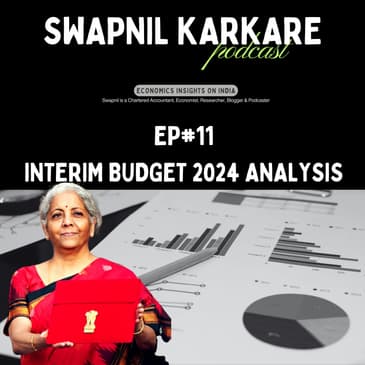
Presenting my budget analysis in the most unbiased way.
#budget #interimbudget #budget2024 #nirmalasitharaman #modi #bjp #economics #policy #politics #fiscaldeficit
Links to different materials used in the video -
Budget 2024: Focussed But Deducting 2 Marks, Swapnil Karkare - https://econgullyblog.wordpress.com/2024/02/01/budget-2024-focussed-but-deducting-2-marks/
(Links to many databases and images in this blog)
MSME 2023 Review, MSME Talk Podcast - https://msmetalk.com/podcast/msme-segment-review-2023/
Diwalinomics, Swapnil Karkare - https://youtu.be/41pIC5h_hZw?feature=shared
--------------------------------------------------------------------------------
⏱️ Time Stamps
00:39: Highlight of the budget - Fiscal deficit
03:19: How the government will earn money in FY25? Government Receipts
06:44: How the government will spend in FY25? Government Expenditure
08:27: Capital Expenditure
11:10: Analysing Income and Expenditure together
12:35: Risk factors in India & Misses in this budget
18:44: Conclusion
--------------------------------------------------------------------------------
👉🏼 Follow Me on -
LinkedIn - https://www.linkedin.com/in/swapkar
Twitter - https://twitter.com/Swap_Kar
Instagram - https://www.instagram.com/swap_kar/
Blog - https://econgullyblog.wordpress.com/
Support the channel - https://donate.stripe.com/3cs2aD26u4bB5UYeUU
[00:00:00] Hello and welcome to this special episode on budget, the day where everyone becomes an economist. So here's my analysis on the current interim budget of 2024. If you have been watching the budget and post budget, you know, media analysis regarding the budget, so you would have seen that everyone was praising the finance minister Nirmala Sitaraman, which is a good thing actually, because, because a lot of
[00:00:29] steps that the government has taken will make India's macro economy very strong and stable. The highlight of this particular interim budget is the fiscal deficit figure. So the fiscal deficit is nothing but government's receipts minus government's expenditure. So if the government's receipts are more than the expenditure, there is a surplus which is called fiscal surplus.
[00:00:58] But if the receipts are lower, then that is called fiscal deficit. So if the fiscal deficit is very high, then there are problems with the stability of the economy. But if it is in a reasonable range, and that range kind of changes, but overall it is seen like 3% or 4% is reasonable, it is something which is manageable in the long run.
[00:01:26] So right now, it is at 5.8%. So right now, it is at 5.8%. The government is planning to make it to 5.1% in the next year, that is in financial year 2025. But in financial year 2026, it has planned to reduce below 4.5%. That is a very major step.
[00:01:47] And due to this particular announcement, the debt market of the bond market has quite cheered up. Though the equity markets, the share market has not appreciated that much because it's not directly related to the equity markets in general, this is not a kind of budget where the share market will, you know, celebrate a lot because there are no major announcements regarding any particular sector, any particular thing.
[00:02:16] Instead, I found that there are no major sectors that are missed from the particular announcement list. And probably they might have missed on purpose or I don't know. But hopefully, in the full budget, which will be, you know, in July or August, in that budget, things might change. Probably some sectors will get some kind of announcements like SOPs or benefits or incentives that can help those particular sectors.
[00:02:46] But apart from that, from a macroeconomic point of view, I would think that this particular budget is the economist's budget because a lot of things are very technical in terms of understanding the impact of budget on the macroeconomic. But overall, let us find out each and every component of how the government is going to earn the money and how it is going to spend the money.
[00:03:11] So, coming on the earnings part, so the nominal GDP will probably, the government has estimated that it will grow by 10% in the next financial year, which is a reasonable assumption considering, you know, the impact of global economy on Indian economy, considering a little bit slowdown in consumption in Indian economy.
[00:03:34] So, this is, I believe, a reasonable assumption, a fair assumption that the country will grow by 10%. This is the nominal GDP and not the real GDP. Real GDP is something which is adjusted for inflation. So, for example, if the inflation is 6%, then the real GDP will be 4%. So, depending upon the inflation level, the real GDP will be different. So, the government has estimated that the tax revenue will grow by 11%, which is again a reasonable assumption.
[00:04:04] We have to see the assumptions of nominal GDP and tax revenue. These assumptions, these growth assumptions are in line. See, taxes cannot grow at 20% and GDP at only 10% and or vice versa.
[00:04:23] As in, if government has assumed that, you know, GDP will grow by 20%, but taxes will grow at 10%, then certain things are amiss, right? Because taxes and GDP will automatically go hand in hand. If the economy is growing, that means the people's incomes are increasing, that means tax revenue will also increase. So, that's the relationship of the GDP and taxation.
[00:04:50] So, the assumption that the tax revenue will grow by 11% is a fair assumption. And within the taxation, corporate tax, income tax and GST, they are likely to grow by 13%. That is the government's estimate. But customs duty and excise duty, their growth rates are just 5% to 6%.
[00:05:10] Then the other main component in terms of revenue for the government is the disinvestment, which is nothing but if there is a government company, the government will sell some of which shares to the market, to the public. And, say, for example, if 75% of the company is owned by the government, then they can offload 10% or 5% of it, which is called as disinvestment.
[00:05:37] A couple of years ago, we have seen the listing of LIC, which is a part of disinvestment. So, that's another bigger source of receipts for the government. But in India, disinvestments have been controversial because still we have not got, you know, ahead in terms of privatization. And these terms in India are still controversial.
[00:06:03] The opposition party can, you know, make this as a particular point that, okay, government is selling the national assets or national companies or something like that. That is a problematic thing. Plus, another thing with the disinvestment is that wherever we have set some target, like, okay, 1 lakh crore of disinvestment, 50,000 crore of disinvestment, we have never achieved that particular target. So, I don't know the exact reason for this, but in this budget, there is no amount of disinvestment.
[00:06:32] They have mentioned amount under non-debt capital receipts, which is the heading under which disinvestment comes. So, they have just kept it that and they have not given the breakup of disinvestment. Then next thing is the spending part.
[00:06:46] So, the government is going to spend 47 lakh crore rupees, 47 lakh 65,000 crore rupees in financial year 2025, which is just 6% more than what they are planning to spend in the current financial year, which is financial year 2024. So, what is this 6%? Okay, because 6% is very less.
[00:07:12] Because if we think that, okay, GDP is going to grow by 10%, tax revenues are going to increase by 11%, then why do you want to control your expenses to only 6% growth? The answer is that they are trying to control the fiscal deficit number, which we talked about just a while ago. So, that's one reason. And the second reason is that in this particular year, they have not announced anything which is populist.
[00:07:40] They have not announced some farm loan waivers. They have not announced income tax deductions, increase limit or something like that. They have not announced any welfare schemes. They have not announced any kind of increased allocation to the PM Kisan, which was announced in the last time budget. Right? In 2019's budget, PM Kisan was introduced during the interim budget, which was turned as populist. But they have not done any kind of this thing this particular year.
[00:08:08] And so, they are very much keeping their pockets tight and not spending a penny even more, which is like wasteful or populist or something like that. So, they have cut the expenditure growth to just 6%. And the most important thing that they have done is spending on capital expenditure. So, there are two types of expenditures for the government. One is revenue expenditure. One is capital expenditure.
[00:08:37] Revenue expenditure is something like paying salaries to government employees. Okay? Administrative expenses, interest expenses on the loans of the government. All those things. Capital expenditure is something which is actual kind of investment by the government in building roads, dams. That has increased. And the government is aiming at spending 11 trillion rupees in financial year 2025, which is 3.4% of GDP,
[00:09:07] which is the highest till date. In the current financial year, that is financial year 2024, the government had earlier planned that it will spend 10 trillion rupees. But they have not been able to achieve that particular target. They are just spending around 9.5 trillion rupees, which is also quite remarkable because it is 28% higher than what they have spent in financial year 2023.
[00:09:33] So, it is commendable that capital expenditures are planned and they are executed by the government, which is a very commendable move. And that is important for the growth of the nation. Right now, the government is doing all the heavy lifting. Private investment has just started to pick up in a few sectors. So, if by the next year, things turn around, then there will be higher capital expenditure by government also, then there is private investment also.
[00:10:02] So, in this budget, what has happened is that the capital expenditure growth for FY25 is kept at 17%. In the earlier two years, it was more than 25%. Now, it is 17%. It is still a quite huge number, but the growth rate is lesser. And that can be because of an anticipated private investment.
[00:10:25] So, there is a chance that private sector will come and invest a lot of money in India, which has been lagging for quite some time now. So, there is this kind of hope that from next year, private investments will also increase and government investments is already there. So, hopefully, that will create a nice virtuous cycle in the economy where government as well as private sector is coming and investing.
[00:10:52] Jobs are getting created and that is just making the cycle work. So, this is about the government's income and government's expenses. And fiscal deficit is what we have already discussed. So, what does this everything tell us? One thing it tells us that the government's revenues, the estimate which is 10%, 11%, that is very low.
[00:11:19] So, there are high chances that the government can earn more than 10% the next year. And that will leave a bigger room for the government, you know. But now it depends on the government what they will do with the extra room. If they got the extra room of say 2% or 3%, they can either spend it on different things or they can reduce the fiscal deficit.
[00:11:44] So, that is something which is the different kind of match we can see in the next year. But even if we assume that, okay, there are many other risks like, for example, geopolitical risks. What if the oil prices shoot up suddenly? What if there are uncertainties in the global economy? What if there is a recession in the advanced economies? What if there is a recession in India?
[00:12:09] So, all these things considered, this is a fair assumption by the government that we will grow at 10% only. We are not making any tall claims that we will get to 15% or 12%. We will just generate 10% to 13% of tax revenue. Which is a fairly good assumption because there are many risks. So, now what are the risks? So, the risk factors in India right now are.
[00:12:38] So, firstly, what we have seen in the couple of months ago on my YouTube channel only, the topic which I have discussed about was Diwali norms. Which is basically nothing but how the third quarter of financial year 2024 is going. And the review is not that great because there is a problem with the demand. The consumer demand in India has fallen down. The rural economy is even weaker than the overall.
[00:13:06] So, that can be a bigger problem in the financial year 2025. So, that is one risk. The second kind of risk is that the consumer confidence which is nothing but RBI's survey. So, RBI surveys a lot of people and they ask different kinds of questions. And one of the question is how do you think has the economy performed? Is it improved from the last year or worsened from the last year?
[00:13:36] So, the middle and lower income groups have told the RBI that they feel that the economic outlook has worsened since the last year. But the upper income group has said that the economic outlook is improved. So, that is a dichotomy in India. If this kind of divergence continues even in the next year and if it is widened, then we can see a fall in consumer demand also.
[00:14:07] The rural economy is already in not good shape. So, that is another problem. And actually on the rural economy itself, there are no bigger incentives or no big announcements as such. They have announced Aavas Lojana, but it takes time to build a house. But if the problem is not the house, if the problem at the current juncture is the demand, then there has to be income in the hands of people and not the house.
[00:14:37] So, that is one particular concern which I have in mind. The another thing about the rural economy is that, so usually what happens if the urban economy is not doing good, then the government increases Manrega allocations. So, what is Manrega? It is nothing but there are many kind of works in the rural sector, in the villages where, you know, they will tell that, okay, build this particular government office, build this road, build this footpath, something like that.
[00:15:07] And this allocation is increased. So, what happens if that allocation is increased? A lot of people come to the village and work. And that they have implemented during COVID because a lot of people migrated from cities to villages, right? And during that point, government relied on Manrega for sustaining rural economy.
[00:15:30] After COVID, since people were free to go, free to roam everywhere, they migrated back to cities. And the Manrega allocations were decreased because cities were also developing and cities kind of recovered from COVID quickly. But now what has happened is that the rural economy is not going good. Therefore, many people were telling that, you know, Manrega allocations should have increased because the rural economy is not doing good.
[00:15:56] And one of the journalists also asked the finance minister in the press conference the same question. And the reply was that they have calculated it, they have analyzed the situation in the rural economy. And that's why they have made this kind of allocation, which is nothing but the same. Same as financial year 2024, they have kept it same. They have not changed at all. So ideally, they should have increased it.
[00:16:20] But who knows what's the real problem is, if they have analyzed or not, if they have analyzed and if this is not the solution they feel. But they have not proposed any alternate solution. So that's where the problem lies in. But they could have addressed this rural economy problem. That's my personal belief. I don't know about others. So this is what has happened in this particular budget.
[00:16:45] There is not much to tell because it's already an interim budget and there is a chance that things might just, you know, change in the new budget. So just a couple of things more. We have already seen like the last couple of years, in the last many years, actually, that infrastructure development is the core point of this government.
[00:17:05] But the allocation for the entire transport ministries has not increased much in the next year. So what's the scene going on there? Has the infrastructure development got saturated at a particular point or not? So that is one thing. Second is MSMEs. They have been ignored this year.
[00:17:34] There is no increase in allocation. MSMEs have not done well. I have done a podcast on MSME talks. You can listen to that particular podcast where I'm talking about how MSMEs performed in the year 2023. And the thing is that, yes, there is an improvement from, say, for example, COVID. But we have not reached the pre-COVID level yet. We are still recovering from COVID. So MSMEs was something I think is a bigger miss this year.
[00:18:04] And lastly, education sector. So the education sector allocation for the financial year 2024, that is the current financial year, it is around 1,30,000 crores. But in the next year, it is 1,20,000 crores. It is fall by 7%.
[00:18:23] So I think if India needs to reach as a developed nation category, then education is something which you cannot afford to lose on. Right. At least that's my personal favorite topic. And that's something which I feel is bad in this budget. So, to sum up, government is really, really confident of getting re-elected.
[00:18:48] And that's why they have not announced anything big bang things in this current budget. They can afford to miss on certain items like education, like MSMEs, like Mandrega and all those things which we have discussed. But I feel that on a macro level, it was really good budget because the macroeconomic stability is something which is necessary for any country. So what it will give us? One, it can give us better credit rating.
[00:19:18] It can give us inclusion in bond index in international. So that the international capital can flow into Indian economy, which can generate different things like they can increase investments into India. They can improve the foreign direct investments also. So all those things can happen. But a couple of things are missed, which we have discussed. And that's why I'm giving them 8 out of 10 in this particular budget.
[00:19:46] And this is something which I relate to Arun Jitli's first budget. When India came to power in 2014, he made all those populist announcements too. But he focused on macroeconomic stability. So earlier in up to 2012, we all know that macroeconomic stability of India was not great. There were many problems. And in 2014, from 2013, 2014 onwards, things started looking good.
[00:20:14] And that has kept India growing for a couple of years. After that, the growth was again declined. So I think that this particular budget will kind of create a room for us so that the next governments, whichever party, whatever it is, those governments can make good policy decisions based on macroeconomic stability. And hopefully that can help us. So I have written an article also on my blog.
[00:20:44] You can check that out, which will be a more detailed kind of version. But all the main points have been covered in this video also. So follow me for more updates on economics and finance. If you have any questions regarding budget on which specific topic I should talk about, then do let me know. I will try to cover that in my next video. Thank you. Bye-bye.