

At fourteen, you're asked what you want to become.
At sixteen, you're expected to choose a stream.
At seventeen, you're choosing a degree.
And somehow, you're expected to know what you want to do for the next forty years of your life.
But what if you're still discovering who you are?
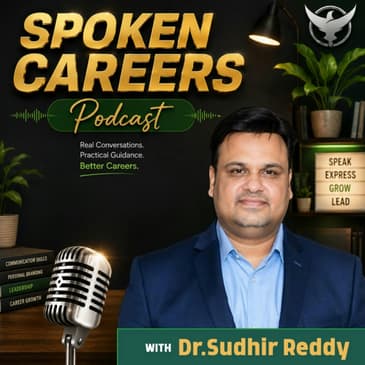
In Episode 42 of Spoken Careers, Dr. Sudhir Reddy explores the hidden cost of making career decisions too early—and why changing your mind isn't necessarily a sign of confusion or failure.
Through the story of a student who decides very early that he wants to become a doctor, only to later discover a strong interest in technology and robotics, this episode explores how career choices can gradually become expectations, identities and sources of pressure.
You'll discover a simple three-stage approach to career decision-making:
Explore.
Expose yourself to different fields, people, experiences and possibilities.
Test.
Turn curiosity into evidence through projects, conversations, observation and real-world experiences.
Decide.
Make an informed choice based on what you've learned—not simply what you once believed.
The episode also explores why parents can help by asking better questions, why discovering what you don't want can be valuable, and why changing direction after new evidence appears isn't failure.
Career Decision Intelligence isn't about constantly changing your mind.
It's about knowing when your evidence is strong enough to change it.
Career Myth: The earlier I decide my career, the better.
Career Truth: The earlier you explore, the better. The earlier you permanently commit, not necessarily.
Your career is not one decision made perfectly. It is a series of decisions made with better and better information.
Spoken Careers — Home of Career Decision Intelligence.
[00:00:19] At 14, you are asked what you want to become. At 16, you are expected to choose a stream. At 17, you are picking a college degree. And somewhere in between, you are supposed to know what you want to do for the next 40 years. That is a heavy burden for someone who is still discovering who they are. Welcome to Spoken Careers, home of Career Decision Intelligence. I am Dr. Sudhir Reddy.
[00:00:44] I once worked with a student who decided in middle school that he was going to be a doctor. He hadn't shadowed a physician. He hadn't stepped into a clinic. He had simply made up his mind early. And once he announced it, that decision became his identity. His parents told the relatives. His teachers praised his focus. His friends knew him as the future doctor. Then came class 11. He discovered a genuine obsession with robotics and computer science. He loved building hardware and writing code.
[00:01:13] And slowly, an uncomfortable realization hit him. What if medicine isn't what I actually want? But changing his mind felt like failure. Not because medicine was right for him, but because too many people were invested in his original plan. This is the hidden cost of choosing too early. A decision becomes an expectation. And an expectation turns into a cage.
[00:01:38] You stop evaluating the path and start defending the label. Think about buying a pair of shoes at age 12. They fit perfectly. But four years later, your feet have grown. Would you keep forcing your feet into those shoes just because you loved them at 12? Of course not. You grew. Career decisions work the exact same way. The person you were at 14 is rarely the person making decisions at 18. That isn't inconsistency. That is growth.
[00:02:06] Let us look at today's career myth. The earlier you pick your lifelong career, the better. Here is the career truth. The earlier you explore, the better. The earlier you permanently commit, not necessarily. Curiosity is not commitment. Exploration means asking, what is engineering really like? How does psychology work in practice? What do designers actually do every Tuesday?
[00:02:30] Commitment means locking the door. Too many students jump straight from curiosity into a lifetime contract. So how do you navigate this intelligently? Use a simple three-step framework. Step one. Explore. Talk to working professionals. Read beyond your syllabus. Attend workshops. Sample different fields without the pressure to pick one immediately. Step two. Test. If you think you love coding, build a real app. If you think you want medicine, shadow a doctor and observe the unglamorous art.
[00:03:06] Step three. Decide. Make your choice based on real data from your tests, not on what sounds impressive to relatives. And parents. Here is where you play a vital role. Instead of asking, what are you going to become? Try asking, what did you test this month? What surprised you? What did you try that you didn't enjoy? Eliminating a path you dislike is just as valuable as finding one you love. It removes noise and gives you clarity.
[00:03:34] Remember this, your career plan is a GPS, not a legal contract. If a road is blocked or a better route appears, the GPS recalculates. It doesn't force you into a dead end just because you set the route at 9 in the morning. When your skills evolve, your interests mature and new industries emerge, you have full permission to recalculate. Here is today's golden minute. Don't confuse an early decision with a wise decision.
[00:04:01] At 14, your job is to stay curious. At 16, your job is to gather evidence. At 18, your job is to make an informed choice. Your career is not a single test you must pass on the first try. It is a lifelong series of intelligent adjustments. Ask yourself today. If you were completely free from everyone else's expectations, would you still choose the path you are on right now?
[00:04:28] To explore more frameworks, visit www.spokencareers.com. I'm Dr. Sudhi Reddy. This is Spoken Careers. Home of career decision intelligence. Don't let an early decision trap your future. Explore widely, test honestly, and decide from evidence. Keep learning, keep growing, and always lead with love.