
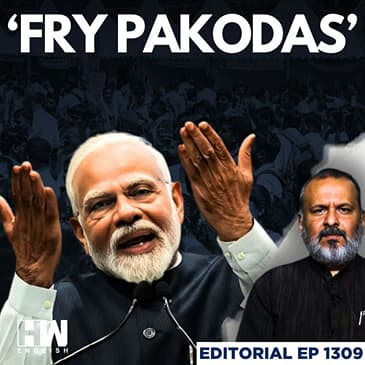

In this episode of Editorial, Sujit Nair analyzes the growing concerns surrounding unemployment, economic governance, and leadership priorities in India. Are the CJP, Gen Z protest justified. Are more Jantar Mantar and Shivaji Park protest on the anvil. Will the Indian youths keep quiet, accepting the mandir- masjid theory thrown at them .
The discussion spotlights controversial remarks made by Uttar Pradesh Deputy Chief Minister Brajesh Pathak during the launch of Bharat Taxi. Pathak advised youth not to get caught in the chase for jobs and instead buy vehicles or drive taxis. Sujit Nair critiques this narrative alongside other political stances—such as suggestions to fry pakodas or dismissive attitudes toward inflation and economic metrics—questioning whether such approaches represent visionary governance or a failure to address structural job creation.
Additionally, the episode references former Prime Minister Atal Bihari Vajpayee’s stance on structural economic growth and job opportunities, emphasizing the crucial duty citizens have when evaluating their elected representatives.
Learn more about your ad choices. Visit megaphone.fm/adchoices
[00:00:00] Jobs, Healthcare, Education, Food. These are 4 things people need. You have to get it. If you can't get it, put somebody who can. Walk out and get somebody who can. Your popular leader who tells you I'm going to build 10 temples and 200 mosques is not a leader. He gives you nothing. He gives you nothing. Namaskar.
[00:00:34] Welcome to another episode of Editorial. See, imagine this situation where you are sitting behind a car and you realize that the driver in front of you doesn't know to drive. And the car is going full speed. Full speed. The driver constantly tells you I will take you to your destination in next one hour and he's driving full speed. You realize driver doesn't know to drive the car. What would your feeling be? What would your feeling be?
[00:01:03] You see, Deputy Chief Minister, not a small person, Deputy Chief Minister of Uttar Pradesh says that don't get caught in race of jobs. He says don't get caught in race of jobs youngsters. He says buy vehicles, join Bharat Taxi Baba. You drive taxis. Job is done. Why try educate yourself or go in
[00:01:32] the race of jobs and all that. Why do all that? This is what a minister is telling you. The driver's driving. The driver's driving. The driver's driving. Five cars are on the bus. It's not yet. It's a big change. How did you drive the car? foreign
[00:02:04] foreign
[00:02:29] That is minister. Now let me talk to you about the prime minister. The prime minister tells you, you don't get a job. You fry bhajiyas, fry pakodas. What kind of aspiration? What kind of goal are you setting for your youth? What kind of goal are you setting for your youth? Now you understand what I meant by saying that when I am sitting behind and I realize that the driver doesn't know how to drive. Are you getting the context? And this is not straight case.
[00:03:00] The advisor to the economic council of India, Shamika Ravi, she says, dollar is 100 rupees. So what? She says, so what? It's all a figure, Baba. It is all a figure. So what if dollar is 100 rupees? I don't know. I don't know. These are the people who gives us direction. These are the people who are our drivers. These are the people who are driving this nation.
[00:03:27] And I don't know what they are thinking in those closed doors. 100 rupees. So what? Oh, hunger index. So what? Unemployment rate. So what? Labor participation. So what? Malnutrition rate. So what? I don't know. Possibly this is how these people would be thinking.
[00:03:48] End of the day everything is a number. No. GDP is also a number. So what? This is how our leaders are thinking. This is how our leaders are thinking. Let me give you some more example. Our good finance minister. When somebody told her that the onion prices are going up. She says, okay, I don't eat onion. I don't eat onion.
[00:04:12] If this is how our leaders are thinking. If this is how people who form our policies are thinking. Where are we headed to as a country? I'll give you more example. Pramod Sawant, the chief minister of Goa. The Bharatya Janata Party chief minister of Goa in 2025 September says that job crisis is less about lack of jobs. More about refusal to take up a job.
[00:04:35] He says, you know, job crisis is less about job. Where is job crisis? People do not want to take up a job. That is why job crisis. Otherwise, there is no job crisis in India. The chief minister is saying so. And he's asking you, make me lead. Make me lead. I will lead the state and we are voting. My question is, I am not saying against any party party and all that. Let me be clear. I am talking about leaders.
[00:05:02] Are these the kind of leaders who are going to lead us? And if they are going to lead us, which they are, where are they taking us? I hope we don't realize it once it's too late. And then we reach somewhere where we never wanted to go. And then we realized where we came. I mean, that's what it's looking at the moment. Think about it. I'll give you some more example.
[00:05:27] Our home minister in 2017 had said that, you know, I can't, we can't get everybody jobs. He said that, you know, it is not possible for the government to give everybody jobs. It has to be possible. Otherwise, don't govern. Jobs, healthcare, education, food. These are four things people need. You have to get it. If you can't get it, put somebody who can.
[00:05:56] Walk out and get somebody who can. You can't just get elected and say, come mamu, I have malumna here. I can't ensure that I give healthcare to everybody. I can't ensure I give jobs to everybody. Why are you running the economy? Why are you taking taxes? Why are you planning the economy for the entire country? Don't plan then.
[00:06:14] Because if you can't provide, then don't, don't command. Don't command. You see, again, my, I am not sitting here and saying that, you know, we are the only country facing all these challenges. I'm not sitting here to say that. I'm sitting here to say that every country faces challenges. But the country is rest assured when they have leaders who are able to confront the challenges and overcome the challenges.
[00:06:46] This was one of our leaders. Yenamout. I have been told that I have seen a lot of growth without jobs. It will be successful, but there will be no longer than the daily consequences. So where are you going? The people who will get the money? The people who will get the money? How many people will get the力? But now we will not be able to do the new technology. foreign
[00:07:44] doftar in the office. This is a difficult task. In the office of the office, there are people who have been involved in the office. So if there is no work, if there is no work in the office, then we will have to do it. And some of the work we have done is that there is no work in the office. But there is no work in the office. foreign
[00:08:14] ।
[00:09:02] When Atal Bihari Vajpayee stood there and spoke, he didn't say that I'm going to eradicate unemployment. He didn't say that. But at least he proposed a plan. At least he claimed, he understood what the problem is. He understood where the fault lies. He understood as to it has to be corrected. He accepted the fact that there is a problem. That problem needs to be addressed. That is the first step. And he proposed a plan.
[00:09:32] Now, I still am saying if the plan worked or the plan didn't, that still is not the matter. The issue is at least there was a plan. At least there was an understanding of what the situation is. He didn't stand there and say, you know, it is not unemployment, Baba. It is said that people don't want to get employed. People don't want to work. He didn't say that. Had he said that, I would have been worried.
[00:09:52] I would have been worried. My humble suggestion through this editorial is, when you are choosing a leader, ensure that the leader has the vision, capability and understanding of complex situations.
[00:10:08] Handling a society, handling a country, he or she understands it. Your popular leader who tells you I am going to build 10 temples and 200 mosques is not a leader. He gives you nothing. He gives you nothing. And that's exactly what we are falling for.
[00:10:26] My submission is, please, next time when you are going to vote, next time when you are sitting and defending your favorite political party, think about it. Do they have leaders who can lead this country? It's important now. Because this, we are going to enter a situation where decisions, planning and intelligence is going to play a very, very important role in our growth. Are we ready for it? That's a question you need to ask yourself before we talk about it.
[00:10:55] We talk about politics and we talk about others. Till I see you next time. That's tomorrow. Sorry, day after tomorrow at 10. Namaskar.