
What if having multiple interests isn't a sign that you're confused?
You enjoy coding. You like design. You're curious about business. You enjoy solving technical problems. And then someone asks you, "So, what exactly do you want to become?"
Suddenly, having many interests feels like a problem.
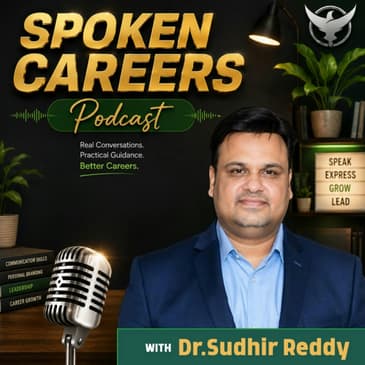
In Episode 41 of Spoken Careers, Dr. Sudhir Reddy explores why students don't always need to choose between the different strengths and interests that make them who they are.
Through a relatable student example involving robotics, coding, 3D design, creativity and entrepreneurship, this episode explores the power of combining capabilities rather than forcing yourself into a single career identity.
You'll discover why:
- Your strengths can work together rather than compete.
- Multiple interests don't automatically mean career confusion.
- Choosing a direction doesn't mean locking yourself into a permanent identity.
- Building depth in one area while developing complementary skills can create a powerful capability stack.
- Some of the most valuable career opportunities exist at the intersection of different disciplines.
The episode also introduces an important career mindset:
Don't ask only, "Which one am I?"
Ask:
"What can I build by combining these?"
For students and parents navigating career choices, this episode offers a more flexible and realistic way to think about strengths, degrees, skills and future opportunities.
Career Myth:
"I need to choose one subject, one degree, and one career identity."
Career Truth:
"Your career can be built from combinations."
Your career doesn't have to be a label. It can be a combination that becomes uniquely yours.
Spoken Careers — Home of Career Decision Intelligence.
[00:00:18] What if the problem isn't that you don't know what career to choose? What if the problem is that you're being asked to choose only one part of yourself? You're good at mathematics, you enjoy coding, you love designing things, you like talking to people, you're curious about business, and someone asks you, so, what exactly do you want to become? Suddenly, you feel like you have a problem, because you're not one thing, and maybe you were never supposed to be.
[00:00:42] Welcome to Spoken Careers, home of Career Decision Intelligence. I'm Dr. Sudhir Reddy. I recently came across a student whose interests were all over the place. He enjoyed robotics, he liked coding, he experimented with three-dimensional design, he enjoyed graphic design, and he was already trying to build something of his own.
[00:01:04] But when it came to choosing a degree, everyone wanted one simple answer. Electronics and communication, electrical and electronics, computer science, something else? The pressure was not really about choosing a college, it was about choosing an identity. And that is where many students get stuck. Because our education system often asks a very early question. What are you going to become? Doctor, engineer, lawyer, designer?
[00:01:34] Accountant? But human beings are more complicated than job titles. Think about a toolbox. A good toolbox doesn't contain only one tool. It contains different tools for different problems. A screwdriver doesn't become useless because there's also a hammer. A measuring tape doesn't need to compete with a wrench. Each tool becomes valuable when you know where to use it. Your career can work the same way.
[00:01:58] Your mathematics may be one tool. Your communication may be another. Your creativity another. Your ability to understand technology another. And your business thinking another. The question isn't always, which one should I choose? Sometimes the better question is, how can these strengths work together? Let's take a simple example. Imagine a student who loves technology, but also loves design. She enjoys understanding how things work, but also cares about how people experience them.
[00:02:25] If we force her to choose between technology and creativity, we may accidentally remove half of her potential. But look at the world of work. There are people working in product design, user experience, product management, creative technology, data visualization, technology consulting, entrepreneurship, robotics, digital communication, and dozens of emerging roles that sit between traditional categories.
[00:02:52] The intersection can sometimes be more valuable than either side alone. Now let's explore today's career myth. The myth is, I need to choose one subject, one degree, and one career identity. Here's the career truth. Your career can be built from combinations. You don't have to throw away one strength just because another strength is important.
[00:03:14] In fact, some of the most interesting career opportunities exist at the intersection of different abilities. Technology plus design, finance plus communication, psychology plus education, engineering plus entrepreneurship, biology plus data, writing plus technology, business plus creativity. The world doesn't always reward people who fit neatly into boxes. Sometimes it rewards people who can connect the boxes.
[00:03:41] But there is an important warning here. Don't use this idea as an excuse to avoid making decisions. Having multiple interests doesn't mean you should pursue everything at once. That's another trap. You still need depth, you still need discipline, and you still need to choose a direction. But direction is different from a prison. You can choose one primary path while keeping other strengths alive.
[00:04:06] You can study engineering and learn design. You can study psychology and develop communication skills. You can study commerce and learn technology. You can become a programmer who understands people or a designer who understands business. The goal isn't to become average at 10 things. The goal is to become deep in something, and unusually valuable because of what else you can combine with it.
[00:04:31] And parents, this is important. When your child says, I like many things, don't immediately respond with, then you're confused. Sometimes they're not confused. Sometimes they're still discovering their combination. Instead ask, which of these interests keeps coming back? What are you willing to practice? Which one would you like to become really good at? And where could these interests work together?
[00:04:55] Those questions are far more useful than simply asking, which course has the best scope? Because a career isn't just the degree you enter. It's the capability stack you build over time. Think about that phrase, capability stack. One ability builds on another. Communication, technology, problem solving, creativity, leadership, domain knowledge, business understanding.
[00:05:20] The combination can become your advantage. And this is one of the reasons career decision intelligence looks beyond marks and individual subjects. We examine patterns. What are you naturally drawn toward? What do you repeatedly practice? What problems do you enjoy solving? What environments bring out your best?
[00:05:41] And what combination of abilities could create meaningful opportunities for you? I remember the student I mentioned earlier. Instead of forcing an immediate answer, he started looking at his interests differently. Robotics wasn't just a hobby. Robotics wasn't just a hobby. Coding wasn't just another skill. Design wasn't unrelated. And entrepreneurship wasn't a distraction. They were pieces of a larger picture. And that changed the conversation.
[00:06:06] Instead of asking, which one of these am I? He started asking, what can I build by combining these? That's a much more powerful question. This is exactly where thoughtful career guidance makes a difference. Not by putting every student into a perfect box, but by helping them understand the pattern in front of them. Because your career doesn't have to be a label. It can be a combination. A combination that becomes uniquely yours.
[00:06:32] Before we close, here's today's golden minute. Don't be afraid of having more than one strength. Don't rush to eliminate every interest just because someone tells you that a career must have one clear label. Explore widely, choose deliberately, then build deeply. You don't need to become everything. But you also don't need to become only one thing. Sometimes, your career advantage is hiding in the space between the things you already love.
[00:06:58] And here's one question to carry with you today. What are two things you enjoy that you've been treating as completely separate and what might become possible if you combine them? To explore more insights and future-ready resources, visit www.spokencareers.com I'm Dr. Sudhir Reddy. This is Spoken Careers, home of Career Decision Intelligence.
[00:07:21] You don't have to fit yourself into a career box. Build a career that makes room for the person you are becoming. Keep learning, keep growing, walk your path with courage, live it with purpose and always lead with love.