

How certain do you need to be before you take the next step?
Many students and professionals believe career clarity should come first: understand exactly what you want, make the perfect decision, and then act.
But real careers rarely work that way.
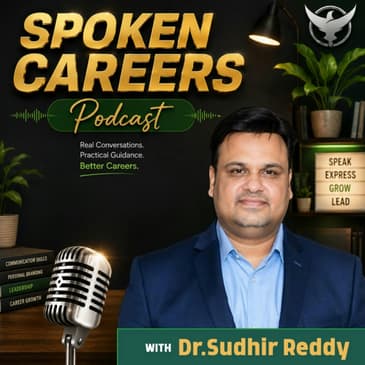
In this episode of Spoken Careers, Dr. Sudhir Reddy explores the hidden cost of waiting for certainty—and why some of the most important career answers can only be discovered through experience.
Through the story of Daniel, a student caught between technology and education, we explore how research can slowly turn into analysis paralysis, and why small experiments can reveal things that months of thinking cannot.
You'll discover why:
• Complete certainty is rarely available before an important career decision
• Overthinking can sometimes become fear disguised as preparation
• Career experiments can be more useful than endless research
• Changing direction doesn't mean you've failed
• Action can generate the clarity you're waiting for
Today's Career Myth:
“I should make a career decision only when I'm completely sure.”
Career Truth:
Important decisions rarely come with complete certainty. Career Decision Intelligence means making the best decision you can with the information you have—while remaining willing to learn and adjust.
One Question to Carry With You:
What small decision are you postponing because you're waiting for certainty you may never receive?
Because clarity isn't always something you find.
Sometimes, it's something you build—one step at a time.
Explore more insights and future-ready resources at www.spokencareers.com
Spoken Careers — Home of Career Decision Intelligence.
[00:00:15] Welcome to Spoken Careers, home of Career Decision Intelligence. I'm Dr. Sudhir Reddy. Here's a question I'd like you to think about today. How certain do you need to be before you take the next step? 100%, 90%, maybe 80%? Because if you're waiting for complete certainty before making an important career decision, you may be waiting for something that never arrives.
[00:00:44] Think of a waiting room. You sit down, you tell yourself, I'll move when I'm sure, I'll apply when I'm ready, I'll choose when I have all the information. I'll start when I know this will work. So you wait. And wait. And, strangely, waiting begins to feel responsible. After all, you're not making a bad decision. But you're not making a decision either.
[00:01:09] And sometimes, the most expensive career decision is the decision you keep postponing. Imagine a student named Daniel. Daniel is finishing university. He's interested in two areas. Technology and education. He enjoys building things. But he also loves explaining ideas and helping people learn. So he starts researching companies.
[00:01:33] Graduate programs. Graduate programs. Career assessments. Salary reports. He creates spreadsheets. Lots of spreadsheets.
[00:01:43] If career confusion could be solved by Excel. Daniel would have solved it. But every new piece of information creates another question. What if technology pays more? What if education is more meaningful? What if AI changes everything? What if I choose one and later discover I should have chosen the other?
[00:02:05] So Daniel decides, I'll wait until I'm certain. At first, waiting feels safe. But slowly, Daniel begins watching other people move. Friends accept jobs. Someone starts a master's degree. Another friend launches a small business. And Daniel is still researching. He isn't failing. He isn't moving backward. But every month he waits, the decision seems to become heavier.
[00:02:34] What began as careful thinking is slowly becoming fear disguised as preparation. Then one day, a friend asks Daniel to help with a small education technology project. Daniel almost says no. It isn't a permanent job. It isn't a perfect opportunity. And it certainly doesn't answer his big career question. But eventually, he agrees.
[00:03:01] And something interesting happens. For the first time, instead of thinking about the intersection of technology and education, he experiences it. He works with developers, talks to teachers, helps design learning material, watches students use something he helped create.
[00:03:20] And after a few weeks, Daniel understands something that months of research couldn't teach him. He likes building technology. But he loves building technology that helps people learn. The answer didn't arrive while he was sitting in the waiting room. It appeared after he started moving.
[00:03:41] I know he killed MacRae. Now let's explore today's career myth. The myth is.ディオンス。
[00:04:08] I should make a career decision only when I'm completely sure. Here's the career truth. Important decisions rarely come with complete certainty. There will always be something you don't know. A company can change. An industry can change. Technology can change. And you can change. Career decision intelligence doesn't mean predicting everything correctly.
[00:04:34] It means making the best decision you can with the information you have while keeping enough flexibility to learn and adjust. That doesn't mean making reckless decisions. There is a difference between movement and impulsiveness. If you're considering an expensive degree, research it. If you're considering changing careers, understand the consequences. If you're considering studying abroad, understand the financial risk.
[00:05:04] Reflection matters. Research matters. Good advice matters. But eventually, research reaches a point of diminishing returns. The tenth conversation may help. The hundredth may simply repeat the first ten. At some point, another spreadsheet isn't going to save you. You need experience. Try the internship. Build the project. Shadow the professional. Take the introductory course. Volunteer.
[00:05:33] Talk to someone doing the work. Create something. Test the road before deciding whether you want to travel it. You don't always need a five-year commitment. Sometimes, you need a five-day experiment. Before we close, here's today's golden minute. We often think confidence creates action. But sometimes, action creates confidence. You don't learn to swim by standing beside the pool, reading about water.
[00:06:03] Eventually, you have to enter the water. And careers can work the same way. Some things can be researched. Some things can be discussed. Some things can be planned. But some answers can only be experienced. So don't confuse uncertainty with unreadiness. You may not know exactly where the road leads. That's okay. You don't need to see the entire road to take the next intelligent step.
[00:06:31] Clarity isn't always something you find. Sometimes, it's something you build one step at a time. Before our next conversation, here's one question to carry with you. What small decision are you postponing? Because you're waiting for certainty you may never receive. Some questions deserve silence before they deserve answers. If today's lesson helped you see your career differently,
[00:06:58] share it with one young person and one parent. Because better conversations create better decisions. And better decisions create better futures. Remember, you don't need certainty about the entire journey. You only need courage for the next intelligent step. So leave the waiting room. The future isn't something you wait for. It's something you begin walking toward. To explore more insights and future-ready resources,
[00:07:26] visit www.spokencareers.com I'm Dr. Sudhir Reddy. This is Spoken Careers, home of Career Decision Intelligence. Keep learning. Keep growing. Walk your path with courage. Live it with purpose. And always, Lead with love.