

Learn more about your ad choices. Visit megaphone.fm/adchoices
[00:00:00] You're listening to The Quint's podcast. Hello everyone, I am Suparna Thomre and you're listening to Reel Deal, where we talk all things cinema and matters of the entertainment industry that really need to be talked about.
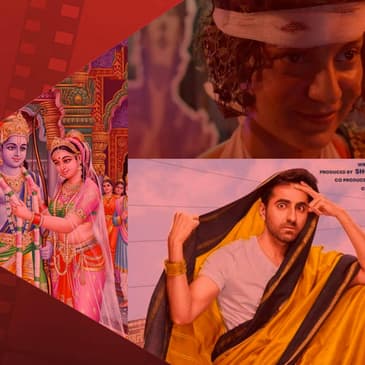
[00:00:35] So the dialogue you just heard was, Kaptak aurthon ko unki itchha ke bina baarte rahoge tum. Mahabharat ke time pe me too hotana to sapsse pehle tum log andar jaate. In case you don't know, these lines are from Ayushman Khurana's upcoming film Dream Girl.
[00:00:51] Now in this scene is shown in the trailer, I don't know if you've seen it yet, if you haven't go and check it out. In this scene Ayushman's character is on stage in the avatar of Draupadi and this is what
[00:01:05] he says in response to the Kauravas' Chirharan plan on stage after they win a game of gambling against the Pandavas, jino ne Draupati ko daav pe lagaya tha. And it leaves all the actors on stage perplexed.
[00:01:17] How much baat karne wale hai about the depiction of stage enactment of scenes from Hindu mythological tales of Ramayan and Mahabharat in Bollywood films. And how these scenes contemporaryize the old scriptures to convey relevant, empowering messages and especially so in the last few years.
[00:01:36] But before we begin discussing what these messages are, I want to let you know that you can tune in to listen to me every Friday on the Quince channel. So watch out for the space and if you like this podcast and want to hear more like
[00:01:48] it, you can head over to the Quince podcast section or subscribe to the Quince channel on Apple, Google Podcasts and Spotify. So this Dreamgirl scene is already quite hilarious. But baise picture abhi baaki hai.
[00:02:04] This is just a snippet from the trailer and the context of this scene will become clearer obviously once the film comes out. But as of now it looks like Dreamgirl is going to be raising some pot in questions,
[00:02:14] making some relevant statements on feminism and the treatment and position of women in Indian society today. Probably using the stage enactment of mythological stories of Ramayan and Mahabharat as devices to develop the lead character which is played by Ayushman.
[00:02:30] Now Ayushman who takes on female roles of Sita in the local Ramleela and Draupadi in Mahabharat looks like he starts understanding the mythology or looking at the mythology from the point of view of the female gender.
[00:02:45] This purely based on the trailer, I feel like this transition seems to have happened after he begins to pretend to be a girl on a hotline attending to phone calls from unknown men who are drooling over her or rather him.
[00:02:58] This Dreamgirl scene totally reminds me of the iconic climax of Jane Bidoyaro where the Kauravas are related after having won the game of dice against the Pandavas. But at the last minute, Nasiruddin Shah takes out the actor playing Duryodhan
[00:03:13] and replaces him on stage and then he refuses to violate Draupadi. And this is one of the most brilliantly written scenes with some iconic dialogues like Dhritrashtra saying, Ye kya ho rahe hain? Repeatedly to Duryodhan and Yudrishita trying to calm Bheem down and saying Shant Gadadari Bheem Shant.
[00:03:54] But apart from being a brilliantly written comic scene, it also manages to make a comment on how it was all the men who were deciding Draupadi's fate and that too without her consent. The thing is, Draupadi had no agency. First her father Drupad offered her in a swayamvar
[00:04:11] and then Arjun succeeded in the task at the swayamvar and won her in marriage. Then the Pandavas mother Kunti orders the five brothers to share her equally. And then in a moment which is considered as a definitive moment in the history of Mahabharat
[00:04:26] and the driving reason that led to the war of Gurukshetra between the Pandavas and Kauravas took place. Now Yudrishitra put Draupadi at stake in a game of dice and lost her to the Kauravas. Now she is dragged to court, she aimed for being married to five men
[00:04:41] and an attempt is made to undress her but is miraculously saved by Krishna. She later is also by the way abducted by another man who wants to marry her despite her refusal. This is exactly what Ayushman's character is referring to in the Dream Girl dialogue
[00:04:56] that Draupadi was passed around and fought over men without her consent and they would be put in jail if they tried to do that today. But unfortunately this continues to happen even today. Now Hindu mythological stories are rich in content and the characters and the plot
[00:05:12] and their interpretation can be used in many different forms on screen. Recently Sacred Games 2, even the season one actually had tons of references to mythology and used characters from these stories as episode names and themes within the episode
[00:05:29] from like Ashwadharma and Yayati in season one to Matsya and Vikarna in season two. Not everybody is totally clued into the context of these stories from the Hindu Puranas and scriptures and you know all these characters from Ramayana Mahabharat.
[00:05:43] But when you do see these references in shows or films, it does encourage you sometimes to go back and delve deeper and actually find newer interpretations or more contemporary interpretations of them and even for those who are clued in, these different interpretations
[00:06:00] offer you different perspectives and even the contemporary context to these stories emerges. Actually our film has been used a lot as crucial devices to Mahabharat and Ramayana and that too as part of stage performance on screen. Apart from Draupadi, Sita is another crucial female character in Hindu mythology
[00:06:20] who has been depicted on stage several times in films. Recently released, Judgmental Hai Kya Hoko Hilelo, this film's director Prakash Kovilamudi uses a play based on Ramayana being staged in London as a device and a major part of the narrative of the film.
[00:06:35] Okay so here are some spoilers from Judgmental Hai Kya. Now visualize this scene from the film. Kangana walks into Rajkumar Rao's apartment, she sees Rajkumar Rao trying to kill a girl and she actually believes that she's Sita and the scene actually shows her imagine herself dressed like Sita
[00:06:54] and she burns Rajkumar Rao to death. She sees him as a Ravan. In the film Kangana who suffers from mental health problems works as an understudy at a theater company, a backup actually for the role of Sita.
[00:07:07] She slowly starts believing she's Sita as she prepares for the play. Now while Sita couldn't really fight Ravan and seek her revenge herself and waited for Ram to rescue her, here Kangana's character decides to kill Rajkumar herself.
[00:07:22] He's the Ravan of the story for her, a psychopath killing for his pleasure. Her role on the stage plays out thus eventually in her real life and passes on an empowering message of being the new age Sita.
[00:07:34] Not waiting for someone to rescue you but take things in your own hands and fight the injustice yourself. I mean I'm not saying that you would go and murder somebody but it does offer a kind of new look at what Sita could be in today's context.
[00:07:50] But a great example of how varied the interpretations of Rama and Kanbi is a sequence in Ashutosh Gawarikar's film Swades. Now this part of the song comes during a Ramleela performance.
[00:08:35] Sita is singing the praises of Ram and calling out to him to come and rescue her from Ravan. In the middle of that Shahrukh Khan's character gets up from the crowd and sings about not waiting for Ram to come and rescue you.
[00:08:47] He sings about how Ram is inside everyone. Ram stands for unity and progress. Whoever can overpower Ravan inside himself or herself has Ram in their being. This is what is the message that he's trying to give out.
[00:09:00] The context of this is that the village is riddled with problems with one of the main things being electricity issues that the government really doesn't seem to care about. So this part of the song he's basically sending out a message to the people
[00:09:13] of the village that they need to get up and do something about this darkness literally the electricity issues in the village. They need to do something about that themselves instead of waiting for Ram or God or somebody to come and solve their problems
[00:09:27] because everything that Ram stood for is inside them too. This is a really important message actually for everybody who just expects sits around and expects everything to be hunky and dory in the country without really getting up and doing something themselves.
[00:09:41] The theme of the film was also that so this fit right into what Ashutosh Gowarikar was trying to say through the film that if you see problems in your country don't brush them on the carpet
[00:09:52] or don't try to blame each other for it but actually get up and do something for your country. This was a very different and unique interpretation of the Ramleela but Ramayana's Good vs Evil or Ram vs Ravan theme has been integral
[00:10:09] to plots and films for many years now. Many Bollywood filmmakers have actually either made contemporary versions of Ramayan and Mahabharat are adapted characters or storylines from these scriptures in some way on screen. Films like Hamsad Sathe which is the Suraj Badathya's version of Ramayan,
[00:10:26] this Prakash Jha's narration of Mahabharat set against the contemporary political scenario Rajneeti then Shyam Benegal's take on Mahabharat in 1981 in the form of Kalyug and we all know that Rajamali's Bahubali borrows heavily from Ramayan and Mahabharat
[00:10:42] but more often than not films don't really pick the entire plot of Ramayan or Mahabharat or the entire theme so stage plays are often used to make a comment that is
[00:10:50] integral to the character or the theme of the film and also for impact in drama and comedy of course. It was used you know in a similar way in Lajja like director Rajkumar Santoshi told the stories of four different women with all their names being versions of Sita
[00:11:10] the characters are called Methili, Janki, Ram Dulari and Vaidahi all names for Sita and Madhuri plays the role of Janki and she plays a theater actor in love with her Costa and while she plays the role of Sita on stage her boyfriend plays Ram. In real life Janki's
[00:11:26] pregnant and her boyfriend doubts if it's his baby and there's this major tension going on between them when they go up on stage to perform Ramayan during the scene where Ram
[00:11:37] makes Sita go through the Agni Pariksha as a test to prove her purity because she stayed with Ravan for several days a very angry Janki decides to botch the scene on purpose. Her outburst is significant to women everywhere she questions Ram's decision to put her through
[00:12:34] the Agni Pariksha and she refuses to go through with it unless he joins her too as he has stayed away from her also you know and Rajkumar Santoshi questions the owners of purity and virginity
[00:12:45] being put on women solely and then being subject to a very different standard from men. It kind of calls out Ram for his decision and mistrust of Sita especially so because Ram is always considered to be this figure who can do no wrong.
[00:12:59] I just had to play a part of the scene to you because the scene is actually 5 minutes long and as expected her rebellion is met with agitated audience members being flabbergasted at what just happened on stage and some of them are actually chanting Dharm ka upman hai ye.
[00:13:40] Now it's always up for debate if this is upman or if this is reinterpretation of old scriptures contemporary rising and finding messages that are relevant to today's times. Now obviously in Dreamgirl as well Aishman's character is trying to give out a message
[00:13:56] and it remains to be seen how the real life audience responds to that scene when the film comes out. Now will it be upman or will it be enlightenment? Dekte kya hota hai. On that note I'm going to sign
[00:14:06] off now and before I go though let me tell you this don't forget to subscribe to the Queen's channel on Apple Google Podcasts and Spotify. You can write into me on Twitter at
[00:14:18] supernattea or send me an email on supernat.thomri at thequeen to dot com. Until next time which is next Friday have a great time at the movies.