
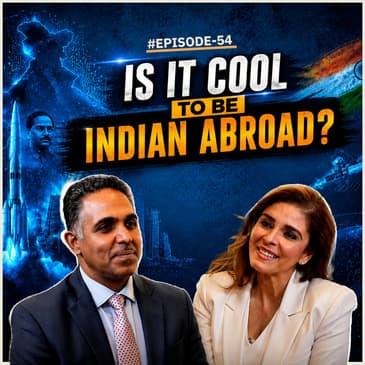

As India celebrates its 80th Independence Day, we ask a very different independence question: is it cool to be Indian abroad today? If so, when did India become cool, and what changed?
There was a time when being Indian abroad could mean trying to fit in, changing an accent, hiding your spirituality or keeping parts of your identity firmly at home.
Today, yoga, meditation, mindfulness, Indian food, music and culture have travelled far beyond India. But has the perception of Indians changed with them?
Shot at Ideas for India Week, organised by Bridge India, this episode of India: A Story in the Making brings together Raageshwari Loomba Swaroop, Singer, Author & Mindfulness Coach, and Mitesh Sheth MBE, CEO of the Dharma Endowment Foundation.
One hid part of his Indian identity. Another once thought being Western was cooler. Today, both tell a very different story! So, what changed? India? The world’s perception of India? Or the confidence of Indians themselves?
In this conversation:
• When did being Indian abroad become “cool”?
• Why some Indians once hid their identity, accent or spirituality
• Yoga, mindfulness and India’s growing soft power
• What the Bhagavad Gita can teach modern business and leadership
• Why success, wealth and status do not necessarily bring happiness
• Bollywood as soft power, and whether it is fulfilling its potential
• Raising children with Indian roots abroad
• What Britain can teach India, and India can teach Britain
• The uncomfortable question: does India practise the values it promotes?
• What should Brand India really stand for?
And perhaps the biggest question of all:
Has India become cool, or have Indians simply become more comfortable being themselves?
▶️ LIVE NOW on India: A Story in the Making. Watch the full conversation on YouTube.
EPISODE #LIVE NOW
📺 YouTube:
https://www.youtube.com/@loveenatandonproductions
🎙️ Podcast – Smart Link:
https://bingepods.com/podcast/podcast-rn7moe
💬 Join Our Discord Community:
https://discord.gg/p2UYt9uV5d
#India #IndianDiaspora #BrandIndia #SoftPower #IndianIdentity #IndiaUK #Mindfulness #BhagavadGita #Yoga #IndiansAbroad
Learn more about your ad choices. Visit megaphone.fm/adchoices
[00:00:00] I was called rags. I thought that was cool. I have three teenagers who are nearly adults and I will never be cool. The past 12 years I've been living in Ukraine, it has brought me closer to India. Now I fight to maintain my Indian accent. I struggle with feeling India or Hindu was cool. I found belonging and coolness in gangs. Do Indians feel cool abroad now?
[00:00:26] This is India A Story in the Making and I'm your host, Loveena Tandon. Something very cool I want to ask. Do Indians feel cool abroad now? And who else to talk about but someone who lived in India, worked in India, sang for India, now sings from the UK for the world, Rageshwari and Mitesh.
[00:00:57] Do you feel cool as an Indian abroad? That's such an apt question. Let me tell you my definition of cool has changed. So when I was in India, you've seen me, we've had a long association with your lovely sister as well. So I was an MTV kid, MTV singer of the year and platinum records. And from Rageshwari, I was called rags. I thought that was cool. And you know, as you grow and I, my father, my late father was a student of Maharishi Mahesh Yogi.
[00:01:26] And he would keep telling me about meditation. But I thought I was too cool. And then at the peak of my career, I had facial paralysis. I lost my face. I got into mindfulness, mind power. And life really taught me the most important lessons of dharma and karma and mental peace, inner balance. And then life introduced me to my wonderful soulmate, my twin soul, my husband, who's a barrister here.
[00:01:54] He's into human rights. So since the past 12 years I've been living in UK, let me tell you, it has brought me closer to India, to its spiritual wisdom. So for me, the definition of cool is, can I really connect with you on a compassionate level, in complete honesty and be as authentic? And can I completely give you my trust so that you would trust me?
[00:02:20] And now that is the definition. And I think Matejji and me are very much aligned with that definition. So I feel cool in a very beautiful way because I stand with the beautiful wisdom that India has often talked about. Vasudev Kutumbukam. We're one big family. Namaste. The divinity in me bows down to the divinity in you. Yes, beautiful. So that is the true definition of cool. Deshi, what do you have to say?
[00:02:50] Well, I have three teenagers who are nearly adults and I will never be cool when there was. I like to think I'm pretty cool. But jokes aside, I think if cool is about, for me, not losing your cool and being able to have a clear, calm head in crisis. And we live in uncertain, sometimes desperate, very challenging times.
[00:03:19] And I credit my ability to stay calm and stay cool to my spirituality. And in that sense, my spirituality, my faith, as I was introduced to the Bhagavad Gita at the age of 17 by a philosopher called Bandarang Shastriya Tavale. And he helped me realize that you can do whatever you want in business, in finance, as it tried to be a good father, a good husband, a good son.
[00:03:45] But at the heart of all of it is who are you and why do you do what you do? And that isn't the subject, not of science or politics. It's the subject of spirituality. It's your relationship with yourself and with others. And so I do feel cool. I feel when it's hot, I can stay cool. When tempers are getting hot, I can stay cool. When the pressure is on, I can stay cool. So even though my kids will never agree, I think I'm pretty cool. I want to pick on two things from each one of you.
[00:04:13] But I want to ask you, from your accent, it feels that you were born in Brooklyn. Born in Brooklyn. I'm third generation Indian. Oh, I see. My granddad came from India. So that's a very interesting question. Growing up, did you feel cool as an Indian and embrace your Indian-ness, if I can say? Or has it changed now? Is it cool to be an Indian origin person in the UK today? Oh, in the UK then you could answer. But in India, we all wanted to be Western.
[00:04:43] Yes. We all wanted to. Now I fight to maintain my Indian accent. Yes. But when I was in India, we were... So it was a subliminal message. It has to do with the British Raj that the West is a theory. We always wanted to talk in a very different way to sound international. And so when I became an MTV VJ, it was like a huge award. Yes. So it's so true. But you fit now still. No, I don't think so. In India. I think people are getting more and more.
[00:05:12] But I would say that yoga and mindfulness for that matter was not so celebrated. Yes. Right? I was born in 1975. I was a teenager through the 80s, 90s. So nobody really cared about dhyana or yoga. But when Madonna started doing yoga, suddenly India thought it was cool. So it has so much to do with how it's marketed. Yes. Yes. So growing up as an Indian then feels very different to how I feel as an Indian now. Living abroad. Living abroad.
[00:05:41] But I would say it would still be the same because I'm much more closer to the ancient wisdom. Yes. That simplicity.
[00:05:49] That simplicity.
[00:06:16] You realize that people all over the world think India is, wow, golden. So yeah. So my grandfather came from Gujarat. My parents were born in Africa. I was born here in England in Manchester. And I struggled with feeling India or Hindu was cool. At school, we were told, you know, we were taught that this was some backward country we had colonized. We didn't learn Indian history at school. And my parents were African before they were Indian. So they couldn't teach me much. They were just trying to struggle to survive.
[00:06:47] And so I found belonging and coolness in gangs. Wow. And in my teenage years, I really kind of fell off track in finding kind of brotherhood and camaraderie in gangs and lots of antisocial behavior. And it was only when my parents said, we need to go back to our roots and actually we'll study the Bhagavad Gita with you. At the age of 17, we together started to study our roots.
[00:07:14] They didn't know any more than I did because they were also not first generation Indians. And so together we studied Sanskrit. We studied the Bhagavad Gita. We tried to practice it in our day to day lives. And that ultimately took me to India and a monastery in India for a year. And so but even then, when I came back to the city of London, worked in finance, I didn't drink. I didn't smoke. I didn't go out to these parties every night.
[00:07:38] I was trying to maintain my spiritual practice whilst kind of climbing this slippery pole of finance. Yes. I didn't feel cool. And I hid a lot of my spirituality. It wasn't until I became CEO and I tried to be the Western version of CEO and I failed at it awfully. I ended up in hospital. I stress related illnesses. And it was only when I went, what is the version of CEO I know best? And that was rooted in my spirituality.
[00:08:07] And when I started talking about that, writing about it, blogging about it and leading with Siva and seeing leadership as a privilege and a duty and a dharma rather than something else, things transformed. And I felt cool. I think today, you know, as the leader of the Dharma Endowment Fund, I think we're doing something really cool and universally globally relevant. But yeah, it's a new evolving feeling. It's like layers of an onion that I've peeled back.
[00:08:36] And the more I've shown of myself, the more I've gone, actually, I feel like I belong in this world. So when you owned yourself, the world owned you the way you were. Yeah. That's that's absolutely. Accepted me the way I was, right? But did in the concept of the soft power India by this time was also like India buzz was already arrived and did that attribute to the whole process? Well, I love that answer.
[00:09:04] And, you know, my husband tells me because he was born and brought up here and he worked really hard and became a rare Oxford and Cambridge scholar, one of the youngest KCs. And I remember him telling me because he was growing up in Northampton. He said when India won the World Cup, he said I walked differently to school. And so I understand what he means by that. But yes, I totally agree with you that, yes, the heavy machinery that's at work to market
[00:09:33] yoga, to market mindfulness, all of that. I don't know if the intention is pure, hoping it is. But at the same time, it's helped Indians. Yes. So I often say that if you're only branding it and not practicing it, then everyday behavior is the greatest branding. Then you don't need to worry about the message. So that's the only thing I wish for all of all India to know, whether they're living in the UK or anywhere in the world or living back home.
[00:10:03] We talk about yoga. We talk about mindfulness. And I think that is our greatest soft power, spiritual wisdom. Yes. But do we practice it? Because philosophy will translate into practice, should translate into practice. So heritage should reflect in our modern choices and values should be seen in the emotional texture. So when we go back in our Indian streets, how do we treat? Do we see the hierarchy? How are we treating the lesser privileged? That's very important.
[00:10:32] They are the ones who are actually building our nation. Yes. And do we really give them the platforms they rightfully deserve? I totally agree. I want to go to that personal story you told me. You're an actor. You're very well known. We have seen you singing, act and all of that. And you said you had facial paralysis. I lost my view, yes. Yes. How did you cope with that? And what helped you cope with that? Yes. So I would say it was mindfulness. It was yoga.
[00:11:00] So I woke up and my face was completely lopsided. And totally. So my lips were touching my right ear. And it took a couple of days for the doctors to realize that this is Bell's palsy. It's the facial expression nerve that paralyzes your face. So half your face is active while the other one is paralyzed. So it pulls it in one direction. You start to speak with a slur. You cannot eat comfortably. So, of course, your career comes to a standstill.
[00:11:28] Thankfully, I came from a very simple and humble family that, you know, my father being deeply into meditation would often remind me, even though I was at the peak of my career, I hope you know it's got nothing to do with you or your talent, right? Or your hard work. There are many others who are working hard. It's your fate. It's your destiny. Be grateful. So that was the dialogue at home. So deeply humble and spiritual. And I was consistently reminded, what's the lesson here?
[00:11:56] So they were very far-fetched talks at home. And I was trying my best as a teenager to understand the spiritual wisdom there. Now I do. And they were telling me, be grateful. It could have been worse. So I was introduced to gratitude at a time when I said, but I have nothing to be grateful for. My first relationship has broken up. I don't have a face. I have no financial freedom now. No career.
[00:12:21] But then I understood that when you shift, you know, the lens you're looking at life from. And when I went for my electrical stimulation and I saw the others who were paralyzed neck down or someone who's paralyzed for the second time, had a stroke and hence ended the marriage, you realize, oh, I know what gratitude is. And then I started to research on it and realize, wow, this is scientific. It's so powerful. It should be a way of life. And that's why it ranks up there, right?
[00:12:50] In the psychology of happiness courses, be grateful. So that really changed my life. But yes, it took time, Laveena. Also, I realized that people mean well, even though they did not tell me very kind things, but they mean well. And sometimes they don't know any better. But what helped me was the amazing gurus I had, like Jack Canfield. I worked a lot with him, my own father.
[00:13:19] And he said, change your environment. Because my regular friends who were kind but were consistently reminding me of my lopsided face or my career that had come to a standstill. So I then said, let me be a kindergarten teacher. So I started to learn to be one. I started to be a fitness instructor. I changed the environment I was in. And that changed my thoughts. That automatically changed the energy. That changed the physics.
[00:13:48] I was consistently being grateful and imagining I will be better. If not acting, there's so much more I can do. And that shifts. So that works on a spiritual level. And that works on a scientific level, too. So when we talk about manifestation, it's a deeply spiritual experience. So don't just dream of the Masoretika if you want to. Sure. But you can actually try to manifest a happy, fulfilled, peaceful life. So that would be brilliant.
[00:14:17] And that's what I learned to do. I'm still a student. Oh, that's so amazing. It's a hard journey, especially when you're going through something. Was there a shift? Is there anything that shifted at any point in anyone's sense? And something? The positive shift? Positive shifts many. Okay. But Louise Hay, I did India's first Affirmation CD with her. Change your thinking. Change your life. That really impacted me.
[00:14:46] Jack Canfield consistently telling me that every thought has an emotion. Every word you speak has a frequency. And then my father consistently reminding me of the kingdom lies within. Aham Brahmasmi. I am Brahman. You know, think of sorting out your inner world. Refinement, right? From carbon to diamond. Yeah. It's not just going to happen. Yeah. The testifier. The testifier. Yes.
[00:15:13] Very interestingly, I was speaking to my mom in the morning and I was talking about how you might be a diamond, but you have to go through the grind. You have to. To fit in that solitaire. Yeah. Isn't it? And to find... That's beautiful. Thank you for sharing that, Shri. That's very sweet of you. I think you got me to Dharma and how you did read Gita at 17. My daughter started reading as well now. Quite interestingly, I never incited her, but she has. I'm very grateful.
[00:15:43] What are the three things from Gita that the world of business and finance must learn? The number one, if I could only have one, and then I'll think about another two, is to focus on your efforts, not the results. We live in an outcome-orientated world. Our corporates are judged by KPIs. We judge our own achievements based on our accolades and awards and titles and designations.
[00:16:10] Nowhere do we see an assessment of our efforts, our intention, our character. And that's what the Gita at the heart of it tells us to focus on. Focus on these things. The outcomes are not necessarily in your hand. It's very hard to tell this to a finance person that you can't have an ROI. What is your KPI? I mean, how do you run a company without having all of those? I think it's actually easier than you might think because anyone who leads a company knows
[00:16:37] the KPIs are not in their control, knows that the investment performance of a fund could be up, could be down, doesn't reflect a good decision. What you get to focus on as a great investor, as a great leader, is making good decisions, learning from those decisions, continuing to iterate, continuing to ask, where's my blind spot, continuing to listen, to be humble, to be courageous. That practice is a deeply spiritual internal practice.
[00:17:05] And that brings you both external success or failure, but also internal satisfaction. And I think to the point you were discussing earlier, the failures, the testifier, these problems, as a leader, you start to see them as what defines you, what shapes you, what molds you, rather than being fearful of it. A lot of leaders today just want to give every quarter's results must be a little better than the last one. We don't want to show any sign of weakness or failure.
[00:17:31] Yet, great companies, great leaders, great people are fashioned in challenge, in failure and struggle. That's where we really figure out who we are and we connect with ourselves. So I think it's so important. And that's what builds psychological safety, what Matej was saying. And that's when people peek in their potential. But when I put you against the test consistently, so that's why the Vedic sciences often talk about leadership just like parenting.
[00:18:01] I give you the safe space, you will peek in your potential. But if I consistently keep you on the edge that you're going to lose your job, I have deeply lost your trust, your faith. And you will also be looking out for better opportunities. But if I hold your hand lovingly, you have more potential. And it requires our leaders. Sorry to interrupt. The psychological safety point is so interesting. So my first version of CEO was, I'm supposed to have all the answers. I'm supposed to know what to do.
[00:18:31] And I leave from the front. This authoritarian, kind of confident leader. And that led me to hospital bed, right? The version of leadership that worked for me was like, I don't know the answers. I don't know the future. But I have a lot of smart, thoughtful, caring people around me. I'm going to listen to you. I'm going to make decisions quickly. We will make mistakes, but we'll learn fast and we'll adapt. And we created psychological safety because we invited everyone in to say, we don't have all the answers.
[00:18:59] Just because you're more senior, more titles doesn't mean you have any authority in knowing more. And we changed our entire organizations to be able to bring that to that safety. How receptive is the world abroad to such ideas or to the Indian origin ideas? Today, more than ever before. So I've practiced Surya Namaskari, Bhiragop, Branayam since I was 21. But I did it in secret.
[00:19:27] And then all of a sudden, sometime maybe 10 years ago, people wanted to know, why are you so calm? Why are you so thoughtful? Why are you asking these questions? Why do you care about the women, the underprivileged, the lower socioeconomic? And I started to share my beliefs, my spirituality. And the more I shared, the more people wanted to understand. To the extent that I was this unusual CEO that was running Branayam and yoga and mindfulness for all my employees. Or including all British.
[00:19:55] Of all races and ethnicities. And they were inviting it. They wanted it to be more resilient, to be calmer. And so I'm finding, to your point, right at the beginning, to bring us full circle, that there is a desire, a curiosity. Because I think wealth and success and titles hasn't brought us abundance, hasn't brought us peace, hasn't brought us happiness. So I think there is, in the West, a curiosity, a recognition that there's something more than this.
[00:20:23] You had this interesting question from the floor when you were on the panel about, in the hustle culture, how do you balance that with peace? And I think in our spiritual, in our dharma, we always say it's not the action, it's the hetu, the intention. If your hustle is because you come from emptiness, you will always be empty. But if your hustle comes because you want to serve and you want to, in your lifetime, make
[00:20:48] a difference, help people live a better life, then it will always bring you abundance and fulfillment, right? That's where does it come from? And I think there's a real deeper desire for this all around the world, I think. Sorry. Not at all, Mitesh. It's wonderful hearing you. I completely agree. And that's why service and lifting others up ranks right at the top at the Yale University course of Psychology of Happiness.
[00:21:14] You want to be happy, you want to build your self-esteem, it's lift someone else up. And our spiritual wisdom is often talked about seva. It's never isolated the mind. It's always taken service towards the environment, service towards people, the lesser privileged, always united. And also, the West come with a clean slate. So they, in fact, follow our practices very easily. I've seen that. And beautifully. Beautifully. I've seen that.
[00:21:44] While in India, we are spiritual, but more religious. So we're more ritual-based. And sometimes they find discomfort. And how do I just sit? I just observe my thoughts. Yeah. So, and also the West find great joy in seeing someone be content with very little. So that shifts the perception completely. Like, really? I could be happy?
[00:22:11] And they say, yeah, actually, you just look at the simple people in villages, not just here, anywhere in the world. And they're really content. Yeah. So the inner peace. There was this amazing research done where they took the richest people, Forbes' richest people, and then compared their happiness quotient with Maasai warriors. Was there a difference? Not really. The Maasai warriors just wanted a tap, the water. That's it. Nothing else. So that is the definition of happiness.
[00:22:39] It's just actually much more simpler. Yeah. But we've been taught to chase moving targets. Yeah. The better car, the better house, the better wife, the better husband, whatever. One of the charities you just reminded me of, that I'm a board director for something called iHeart Resilience. And we teach mental health and resilience to schoolchildren across the UK. One of the biggest lessons we teach them is your strength, your resilience, your power, your happiness is within you.
[00:23:08] The moment you put it outside, that you displace it to say, my happiness, my success, my resilience comes from this thing, this relationship, this certificate, this title or accolade, this card, this object. You always be unhappy. You outsource it. You can never be happy. Yes. Yes. And so the root is always to come back to go, it's within me or it's always been within me. Exactly. And I think the world of social media, that's why it's rattling the children today because
[00:23:37] they're constantly chasing that happiness. I think that's what, yeah. But also the schools, Laveena. Yes. So I think we can actually work with social media to our advantage because there's so much. For example, history, heritage and culture is much more accessible through social media. Like you'll know about the Rani, Rani Ki Vav, the beautiful historical temple, right? The inverted temple.
[00:24:03] Or you'll know about the Vithala temple with the amazing pillars that you can tap and it resonates music. All of this is on social media much more than films. It democratizes everything, right? Yes. So children can actually be taught to use social media well. Yeah. And also success being extrinsic has been taught in schools. We evaluate children according to how well they do in the report cards. Parents put that kind of pressure.
[00:24:30] So as Panchitantra says zero to seven is the blueprint of your life. Look at what we're doing to our children during that time. That person's doing really well. Why can't you get better marks in maths? It's a global issue. So we as adults, that's why I'm not happy because we've been programmed to believe I need to get this to be happy. I need to be married to be happy. I need to have children now to be happy. I need to have a house to be happy. And the children need to be successful to be happy. And it continues. It never ends. Oh my goodness.
[00:24:59] We get into another conversation when we talk about what is success to be happy. So the moving target will never be met unless we stop and say, I am enough. I am enough. And this is perfect. And I'm grateful. And that's why gratitude, shukar is a very powerful philosophy. It can bring you good health, happiness, joy, fulfillment. Yes. And I think somewhere it just, the moment you say it, the words have the power and you say it and you feel it. Yeah. And it'll be great.
[00:25:29] I am still practical. I would say that this, to be kind to yourself and be grateful as well. It's a journey. It's a really journey and I'm not very far ahead in it. So I must confess. Well, that's the best starting point because I don't think it is a destination. But I'm getting there now. It is a daily practice. I'm getting there now. So that's good. So I think we spoke about yoga and now the whole world is celebrating yoga. Do you feel that has arrived or still people think it is changing of the light bulb in the world?
[00:25:58] Where is Bollywood as soft power in the world? Well, I would say that it is a great tool because to understand anything intellectually, you must be emotionally attached to it. So that's why, you know, I mean, actors, musicians are far more powerful than a politician, though policy has its own place in building relations between countries. But actors, musicians can truly build relations between people.
[00:26:26] But are we making the kind of movies which are transformational? Not really, because you talk to producers and directors, they look at entertainment as a business. And sure, they have reasons. They said, we've got production houses, people to feed. But that's the issue. Because if you're only chasing commerce and the dominating system in Bollywood is that it will reward only mass appeal and scale and speed and success, then we are not going to
[00:26:56] have depth because anything that has speed will not have depth. So I guess the next evolution of Bollywood could be, I don't just want to have entertainment. I want to have meaning in my films, too. There have been, sure, a few number of films made. But I think that's great entertainment where you have meaning and you have entertainment. So you're not engaging with people momentarily, but you're transforming someone. That could be the greatest soft part because the knowledge is very much... Intention.
[00:27:26] Intention. Intention. Intention. And for me, it brings it back to funding. And the reason I'm so excited about Dharma Endowment is because if you're relying purely on the public, the masses, the lowest common denominator to buy your tickets, then you're selling to that lowest common denominator. You're not trying to raise the bar. And reach them. And so you need a source of funding, a way of being able to support the expensive production houses and everything else to tell stories.
[00:27:53] And stories are how we as a civilization, civilizations have thrived over the millennia. Stories are critical. But which stories do we tell? And how do we support and finance the stories that will help us think in generation terms rather than just next week's box office tickets? And I think that's why we need the world of investment and finance to come together with
[00:28:18] the world of spirituality, with the world of climate, with the world of kind of the future to say, how do we finance better things, right? And I think of that note, do tell about Dharma and how you're doing that, because the practice of it is the challenge. Yes. The Dharma Endowment was set up a couple of years ago by some hedge fund managers here in the UK. And they said, I can give my money to a temple. I can give my money to a charity. But then it's lost.
[00:28:47] I don't get any long term value from it. What if I could put my money in an endowment where it will be there for eternity? But all the income and interest earned will go towards good causes. So if Dharma is to sustain for generations, then can we have also funding that is available for generations, not just for the next project, but to be able to pay the salaries, the maintenance, the ongoing work that's required to change society?
[00:29:15] So at the heart of Dharma Endowment, and so the Christian faith, the Jewish faith, the Islamic faith, have billion dollar endowments that will be around forever and will be able to fund and support and sustain their faith. But actually a lot of the Eastern faiths, whether Hindu, Jain, Buddhist and others, there's no such major endowment fund that will be here long after we have gone. I see.
[00:29:42] And beyond the generosity of the current group of donors or wealthy. And so that's the vision behind the Dharma Endowment Fund. How do we create a fund established on Dharmic principles, universal Dharmic principles, not national ones, not just limited religious ones, and that will be around to fund, to support, to sustain good long term Dharmic work forever? Oh, how interesting. And how wonderful. Very inspirational. Yes, very inspirational indeed. Very, are you a new money?
[00:30:12] Through that? Yes. Yes. Sustaining? It's a page on. Well done. Okay. We have a high five India section. Okay. I ask you five high five India type questions. You wrap it, some rapid, some not so rapid. And your reward is my high five. Okay, great. You have to get the high five right. Super. Oh, goodness. Okay. Okay.
[00:30:40] So what has India's soft power done for its policy? I would say maintained peace. I think even if we do not believe in whichever government, you could, you know, side any which ways. But I think the foreign policy is that we maintain a wonderful warm friendship with most countries. I think at least we're consistently wanting that. We believe in progress. Foreign policy is better than most countries.
[00:31:10] We get along with everybody. We are consistently believing in peace. Just connection. I think it allows us to not rely too heavily just on policy. Because we, soft power by its nature gives us connection, warmth and a relationship with people and its diaspora and those that are kind of warm towards that soft power all around the world. So policy is a tool. It's a hammer. But everything doesn't have to be a nail, right?
[00:31:36] So it allows us to be much more manifold in how we engage with the world than just relying on policy. Okay. What is it about India that the world doesn't get? I think the spiritual wisdom, because it's so complex. It's so nuanced. So when we talked about Vasudev Kutambakam, we just say, really, what does that mean? The world is one family. No, it's somebody is suffering in the corner of the world. You are affected even if you cannot see it. So COVID taught us that or the current war.
[00:32:04] So that's what they don't understand that India is not just an ancient civilization. It's actually very futuristic. So when we talk about sustainability, I mean, we were the ones who were eating from steel plates or on banana leaves. We would eating, still love eating with my hands. So I think that's what people really do not understand, that we are interconnected in every time of Afghanistan. If I can just add to that, I think it's a great answer.
[00:32:31] I think what the world misses is that it thinks that devotion spirituality is individualistic and that our bhakti, our devotion takes us all inward and disconnect from everyone else. Whereas actually, I think the real strength of India is in our spirituality, there's a social force and a force for social change. Because by going inward, we connect with the humanity and everyone else. I think people miss that. They think that the secret we're all chasing is to isolate. That's not. How amazing.
[00:33:01] Because it's all about connection. That's what. It's such a great paradox as well, isn't it? So brilliant. It is very difficult as well to get that. We can only embody it. Yes. So we cannot, you know, contextualize it or even make people understand. It has to be practiced. Very, very quickly. What is brand India? I think the definition would be very different for others.
[00:33:24] For me, brand India should be about values that are depicted in the emotional texture on the streets in India, how we treat each other. I love that. Brand India for me is Basudeva Kutumbakampal. Yes. We are all one. Okay. What is Indian in you? Easier. Always empathetic and kind. To be inside out rather than outside it. What have you imbibed from the culture here? The one thing. Oh, deep respect, courtesy.
[00:33:54] For sure. I think bridging India and bridging Britain. My best friends are British. And I've really understood that while we say, can you have dinner with me? Can you have dinner with me? Can you have dinner with me? Have some more? Have some more? They're absolutely fine. They mean what they say. They say what they mean. So surely I absolutely love Britain. And I love the fact that they love chicken tikka masala. To me, it's the spirit of scientific inquiry. What is the India you see in Britain?
[00:34:20] Oh, the complete unity and the love they have for, for example, Jaipur or the brand is Figa London. And it's a British brand, but employing artisans in Jaipur and paying them much more than Indians would. So I think that's brilliant. Mitesh had to leave at this point. Thank you so very much, Mitesh. I know you have to join the panel, so I'll let you go. But Rageshwari, can I please continue this conversation with you? Do you still sing? You know, I lost my father to COVID. And so it was really traumatic.
[00:34:50] And all of my music has been made by him. And he was writing and composing. And every time I sang, I would see him across the glass door telling me, that's not good. You need to sing again. So for me, coming back to singing is not definitely going to be as a pop singer for sure. But devotional music is something that I'm looking into. Because I am a lot into mindfulness and I provide mindfulness solutions to corporations and children, I think devotional music could be brilliant.
[00:35:19] And I feel that it's also something that will add to not just brand India, but help me put forth the message that I'm constantly sending, that the power is within. And there's great power in kindness and service. Are you happy where you are? I'm so grateful because I love Britain. I love the love that they have for India. And also, our beautiful family, which has allowed me to evolve emotionally
[00:35:46] and be happy with a simple life of traveling in buses and traveling in tubes. It's a trap if you allow yourself to think you need the entourage and you need your luxuries. And I think isolation through my illness. And then also, when I was married, I was just by myself, just me and my husband. And I learned much more about India being here. So I would say that I'm extremely fulfilled, a deeper word than just happiness.
[00:36:16] It somehow happens, isn't it? When you are abroad. Not for everybody though, but for the deeper people, for sure. I've seen people want to be British, but I would say I want to be truly Indian when I'm with my British friends. And so I eat the way I like. I, in fact, invite them for Indian meals. But at the same time, I have great respect for the British. And, you know, my daughter sings in the choir, but I'm also trying to get her to learn, you know, shlokas.
[00:36:44] And so Hanuman Shali says, so I would say it's a beautiful world. Once we think of it as Vasudev Kutumbukam. But I would say that at this point with my mindfulness, I would be happy and fulfilled any place. Is there any particular mantra that you make your daughter listen to or that perks you up? I think the first thing is Karagre Lakshmi. Right. So it's so beautiful. Karagre Lakshmi.
[00:37:16] I think that's a beautiful mantra because it tells you that Lakshmi is in your hands in the work that you do. But keep the foundation filled with knowledge and wisdom. And that's how you must start the day. But she loves Hanumanji a lot because every Diwali, I put up a skit in the school. And also I did this with Google as well. Google UK. I said, can you do something for Diwali?
[00:37:43] And I said, I'm going to bring Indian and British kids and do a skit of Diwali. So Samaya is very connected to being Sita and very connected to Hanumanji. So everybody wants to play Hanumanji in the skit. What? He can fly and he's so, so brave. So she's naturally drawn to Hanumanji. But it's a very spiritual environment. We go to church. We go to the temple. We go to the Gurdwara and do seva.
[00:38:11] So she understands that Hinduism is not a religion. It's a philosophy. It's a way of life. Yes. And I spoke to, you know, there's a person called, who's head of Oxford Studies. And he said it's even beyond way of life. Wow. Yeah. It is, it is a civilization. Wow. It's the way of being. Because it's so complex and yet so liberating and yet so simple. Yes. Indeed. Indeed. Indeed. I could go on with you, but I know I can't.
[00:38:41] And I would definitely, I would love to do it one on one. I would love that. I would love that. And we're connected and sending you much love and success. And all your viewers. Namaste. Asalaam wa alikum. And a big hello and loads of success. Thank you. Would you mind singing a little bit? Having seen the whole world's world. How sweet. Achyutam Keshwam gaaein. Achyutam Keshwam gaaein.
[00:39:16] Achyutam Keshwam gaaein. Achyutam keshwam gaaein. Achyutam keshwam. Achyutam keshwam. Achyutam keshwam. Ah, what a brilliant place to end. Do you still do practice? I do. A little bit for sure.
[00:39:46] A little bit. But I definitely make sure that my daughter does that. Ah, so she's learning to sing. She's learning to sing. She loves her singing. But there's music. There's always, we start our day with music for sure. Ah, how wonderful. Thank you so, so very much. It's been absolutely brilliant. There is no way to, I mean, we have arrived. We are cool in ourselves, whether you like it or not.
[00:40:13] But, you know, what we can say that the world has finally registered the fact. How cool, how to be cool, rather. Is it? So thank you, take care and God bless. Hi friends, this is Raghish Vreen. You can watch me on India, a story in the making with the lovely Lavena Tandon. I had a wonderful experience. Such wonderful team members. And Lavena is an absolute delight. And they also trained me how to sing Krishnaji's bhajan rite.
[00:40:43] This video is created for educational, informational and entertainment purposes only. The views and opinions expressed in this video are personal and may include commentary on geopolitics and global affairs. We are shared for general awareness, discussion and understanding and are not intended to offend, harm or misrepresent any individual, community, organization, country or religion. The information presented in this video is based on publicly available sources as well as material provided by our guest. All visuals and content used in this video have been included with the consent of our guest, while efforts are made to ensure accuracy.
[00:41:12] Viewers are encouraged to do their own research and form their own opinions before drawing any conclusions. Viewers are encouraged to do their own research.