
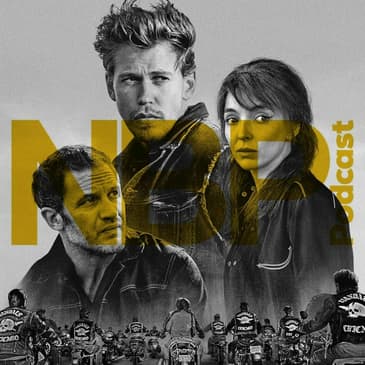

For this week's main podcast review, Lauren LaMagna, Dan Bayer, Sara Clements, Danilo Castro & Tom O'Brien, and I are reviewing the latest film from director Jeff Nichols, "The Bikeriders," starring Austin Butler, Jodie Comer, Tom Hardy, Michael Shannon, Mike Faist, Boyd Holbrook, Damon Herriman, Beau Knapp, Emory Cohen, Karl Glusman, Toby Wallace, Norman Reedus & Happy Anderson. After its world premiere at the 2023 Telluride Film Festival, the film passed from 20th Century Studios to Focus Features, and its theatrical release was delayed from December 2023 to now, in the summer of 2024. With it finally here, what did we ultimately think of it? Tune in as we discuss the writing, performances, themes, soundtrack, awards potential, and more in our SPOILER-FILLED review. Thank you for listening, and enjoy!
Check out more on NextBestPicture.com
Please subscribe on...
SoundCloud - https://soundcloud.com/nextbestpicturepodcast
Apple Podcasts - https://itunes.apple.com/us/podcast/negs-best-film-podcast/id1087678387?mt=2
Spotify - https://open.spotify.com/show/7IMIzpYehTqeUa1d9EC4jT
YouTube - https://www.youtube.com/channel/UCWA7KiotcWmHiYYy6wJqwOw
And be sure to help support us on Patreon for as little as $1 a month at https://www.patreon.com/NextBestPicture
Learn more about your ad choices. Visit megaphone.fm/adchoices
[00:00:00] Shopify grows your business no matter how far or big you grow. Shopify is the global commerce platform that helps you sell at every stage of your business. Whether you're selling your fans' next favorite shirt or an exclusive piece of podcast merch, Shopify helps you sell everywhere.
[00:00:20] Shopify powers 10% of all e-commerce in the US. Allbirds, Rothies, Brooklinen, and millions of other entrepreneurs of every size across 175 countries. Plus, Shopify's award-winning help is there to support your success every step of the way. Because businesses that grow, grow with Shopify.
[00:00:46] Sign up for a $1 per month trial period at shopify.com slash income, all lowercase. Go to shopify.com slash income now to grow your business, no matter what stage you're in. You are listening to the Next Best Picture Podcast, and this is our review of the Bikeriders.
[00:01:35] I'm thinking of starting a riding club. Why? All those clubs do is sit around talking about motorcycles. That's what we do. You don't belong nowhere else, so we belong together. But you're the man in charge. I'm Johnny. I'm Johnny. I'm Johnny. I'm Johnny. I'm Johnny. I'm Johnny.
[00:01:49] I'm Johnny. I'm Johnny. I'm Johnny. I'm Johnny. I'm Johnny. I'm Johnny. I'm Johnny. I'm Johnny. We're the raddos. I'm Brendan. I like you guys. Your boyfriends are getting into trouble. Shit. What the hell were you thinking back there? Nothing, I saw you scoring off of them guys.
[00:02:04] What do I need to think for? Yeah, you and me kid. All right everybody, you were just listening to the trailer for the Bikeriders, and the story is as follows. Over the course of a decade, a midwestern motorcycle club has been in the news for a decade.
[00:02:10] The Bikeriders are a group of young men who have been riding motorcycles for over a decade. They've been doing it for over a decade. They've been doing it for over a decade. They've been doing it for over a decade. They've been doing it for over a decade.
[00:02:17] They've been doing it for over a decade. Yeah, you and me kid. All right everybody, you were just listening to the trailer for the Bikeriders, and the story is as follows. Over the course of a decade, a midwestern motorcycle club evolves from a gathering place for local
[00:02:31] outsiders to a sinister gang, threatening the original group's way of life. The film is starring Austin Butler, Jody Comer, Tom Hardy, Michael Shannon, Mike Feist, Boyd Holbrook, Damon Harriman, Bo Knapp, Emery Cohen, Norman Reedus, and Happy Anderson.
[00:02:48] It is directed and written by Jeff Nichols, and here to join me today for this podcast review, I have Lauren LaMagna. Hello. Dan Baer. Hello everybody. Tom O'Brien. Hey everybody. Sarah Clements. Hello, hello. And Danilo Castro. Hey everybody.
[00:03:08] All right, we have a full house here to talk about the Bikeriders, a film that has had such a long life leading up to the theatrical release here. I say such a long life, but it hasn't even really fully been a year since it premiered
[00:03:21] at the 50th Telluride Film Festival back in August of 2023. But what really has made this feel like such a long time was that it was originally supposed to be released in December from 20th Century Studios, who then passed the film over to
[00:03:37] Focus Features after it was delayed due to the SAG Afterstrikes of 2023. Not to mention too, it's been, my God, how long has it been now? Seven years since the release of Jeff Nichols' last film, Loving, his largest gap between productions here.
[00:03:53] And so there's been a lot of anticipation for this film, and especially because, you know, it's starring some recognizable stars. It's definitely the biggest budget that Jeff Nichols has ever worked with before.
[00:04:04] So now that it's finally out in the world and playing in theaters at the moment, and everybody's going crazy over the accents that the recognizable stars are putting on for this. And then not to mention too, but also there is a fascination I think with bike culture
[00:04:19] from this era specifically. What do we think of it? Let's head on over to Sarah Clements first. Sarah, what did you think of The Bike Riders? You know, The Bike Riders as I was watching it felt to me kind of similar to a Western in a way.
[00:04:35] Like Westerns define, you know, the myth of the Wild West as cowboys chase freedom in the American frontier and The Bike Riders takes cowboys and sort of replaces them with a motorcycle gang defining the myth of another kind of American landscape in a different nostalgic period.
[00:04:54] I don't think I've ever seen really a film about a biker gang before. So this was, you know, kind of new, a new, I suppose, environment to watch. And they're also, you know, chasing freedom too. And I love that theme in this film.
[00:05:08] There's always kind of a desire to escape what you are expected to do and expected to be and just kind of drive off into the sunset without any care. Like there's this moment where, you know, Austin Butler's character is finally kind of got away
[00:05:22] from the cops and he just kind of screams out of exaltation. And I really, really enjoyed that scene. Yeah. And it's quite exhilarating to see. And I also love watching how this club, you know, how it kind of says it's inspired by
[00:05:36] films like The Wild One, how it transforms from sort of just a club of community and family to something more violent as like a younger generation takes over. But there got to a point where I started to feel kind of bored with the film.
[00:05:52] I can't really explain why at this moment, I'm trying to kind of remember at one point at which point I started to feel like it was waning on me. But the engaging performances, you know, kept me locked in. I really loved everyone's performance here.
[00:06:10] Although, of course, the accents are a little questionable. But Jodi Comer's accent work definitely needs to be studied. And I also love how she kind of brings humor to the piece through it. And it's interesting to see how her character navigates this world.
[00:06:23] And I loved Butler's, you know, endearing rebel cool style. But yeah, overall, you know, I did like this, although it did start to wane on me after a while. Okay. All right. I think we're gonna hear some similar sentiment here from some others probably.
[00:06:38] Let's head on over next to Tom O'Brien. Tom, if I remember correctly, didn't you see this at AFI back in like the fall? October, I think. You know, I know you had seen it at Telluride in September and a few of us saw it at AFI
[00:06:54] in October in anticipation of that truncated release. Yeah, because at the time, we didn't know when it was going to be coming out at that point actually. There was no new date for it. That's right.
[00:07:06] And I don't even know whether Focus had picked it up at that point. I think it was when, you know, at AFI, it was still, it still had the 20th logo on it.
[00:07:15] And you know, I had heard the reactions that you had and a bunch of folks had from the Telluride screenings. You know, and based on those, I really wasn't quite sure what to expect going into it.
[00:07:27] But then after I saw it, I still didn't quite know what to make of it. I mean, certainly the stills of Tom Hardy and Austin Butler in their leathers suggested kind of a updated Peter Fonda, Wild Angels kind of exploitation movie.
[00:07:44] And there's a little bit of that in here, you know, the burn the bar down scene kind of kind of things. But you know, it was the real interest I think of the film is elsewhere.
[00:07:56] The plot itself, I think was kind of pretty routine and a little bit with Sarah in that it began to meander a little bit for me. But it was the edges around the film that I really found myself responding to the bonding,
[00:08:11] the kind of mutter to sides people have to each other, which I thought were hilarious. And most of all, I think the desperation of their economic plight, they feel these characters feel like there's no one they can, who would understand them.
[00:08:27] No one likes them, which is I think the motivation for Johnny to begin the gang. Those are the parts of the film I really related to. I mean, Nicholas takes a lot of big swings here and it doesn't always connect.
[00:08:41] But you know what he does, I think it's created kind of a unique piece of Americana, you know, a snapshot of a very particular time in our culture that a group of people could come together and find community in a gang.
[00:09:01] I'd maybe call it an art film dressed in leather. But despite a few failings along the way, on the whole, I liked it a lot. All right. Let's hear next now from Danilo Castro. So I saw this movie for the first time last night. It's still fresh.
[00:09:19] And it has a lot of elements that I respond to generally in a movie. I'm a sucker for rise and fall of organizations movies. I'm a sucker for end of an era movies. I'm a sucker for Tom Hardy movies when they're not venom.
[00:09:32] So all these things really brought me in. I was ready to love this movie. And I don't mean it to sound negative. I very much like this movie. I don't think I got to the full love. I don't know entirely what I expected.
[00:09:46] The trailer was good in that it sort of evoked what the main sort of what the milieu was and what the characters were all about. But it didn't give any story, which I generally like.
[00:09:59] As the film kind of went on, it went, I would say, a conventional route. It hits a lot of familiar beats that we've seen before without sprucing them up or taking them in any sort of way that was entirely unpredictable for reasons both good and bad.
[00:10:16] I think I would say that like, I think there's a high floor on this movie. But I think the way that a lot of the story beats are executed gives it, I would say, a relatively low ceiling.
[00:10:30] So very enjoyable, but I don't think it is a transcendent piece of work. I'll get more into that later on. There's also one performance that sort of snags my attention throughout, but I will get more specific with which one a little bit later on.
[00:10:47] movie did not, I think, reach what it potentially could have, you know, when I sat down to watch it. Sure. Yeah, that's understandable. What about you, Dan Baer? I know you just saw this last night. What did you think of The Bike Riders?
[00:11:03] Yes, I happily purchased my ticket to see the Nosferatu trailer, and this was the nice bonus that I got afterwards. I mean, that's really what I want to review right now because come on. But anyway, we're here to talk about The Bike Riders.
[00:11:19] And there's a lot of really interesting things to talk about with The Bike Riders. I was very into this movie for the entire opening reel. And I think it's a fantastic hangout movie, especially for the first half.
[00:11:36] You can really feel Jeff Nichols wanting to get the aura right. He wants to get the feeling of this specific time and place and of these people. And it has that kind of, I call it like, Hollywood dirty look to it where everything looks dirty,
[00:12:00] but it's in a very presented way. They don't have actual dirt on them, and we all know that. But we all agree to buy into the idea that these guys have been working all day in their backyards or in their garages or whatever.
[00:12:18] And I think there is an element of that where for at least the first half, it plays almost exactly like an actual 1950s, 60s bike rider B movie. It plays very much like The Wild One or one of these other movies from that time period,
[00:12:40] including in the tone of how each of the characters speaks and how each of the actors performs. There are so many moments in the first half that I was like, this is directly from a 1950s Hollywood movie. I was having the time of my life.
[00:13:01] Jodie Comer, yeah, her accent work needs to be studied. It is hilariously on point. You can hear that woman. You know that woman. Just from the first couple lines she says, literally for the first half of this movie,
[00:13:20] I think every time she said anything, she's just so offhandedly nonchalantly throwing these things back to the other women around her. And in that voice, it's hilarious. I had a ball. But then the movie gets to focusing more on the plot.
[00:13:45] And a lot of dramatic things happen in the last act of this movie. That for me is when it kind of slowed down and took me out of the movie. Because if we're going to keep in this 1950s B-picture mold,
[00:14:06] the actors kind of have to go to a more melodramatic place than they would in a modern day picture. Just because that type of screen acting isn't something that people buy into these days. And they don't go to that place, which is a fine choice.
[00:14:29] Like I said, most audiences don't go for that these days. It is a film that's made in 2020s, not the 1950s. So I get that. But for me, that tonal shift really didn't work.
[00:14:46] It's kind of this mesh between eras almost that just you feel the first act of this movie and the last act kind of at loggerheads with each other fighting for dominance. And the movie that wins out is not the movie that I preferred.
[00:15:03] But there's a lot here that's really incredible. The soundtrack is great. I love the cinematography. There are some strikingly beautiful shots throughout this movie. And the performances are all really, really good. And I am at a loss for words when it comes to Austin Butler.
[00:15:31] He may actually be James Dean reincarnated. He has that cool that you can't describe, you can't put a finger on. He just exudes this movie star cool aura that I really don't think we've seen in a long time.
[00:15:52] And whenever he's on screen in this movie, I just kind of sat there with my jaw on the floor. How does he exist? Well, he was born. Well, I know that. But how does someone with this much charisma exist on this planet?
[00:16:10] As Lauren is very fond of saying, God, I have seen what you have done for others. All right. And now, Lauren LaMagna. Okay, first off, I love this time period. One of my favorite classes in undergrad was called Punk Cinema, where we looked
[00:16:28] specifically at this specific counterculture, both in America and England, and just analyzed films made during this time period about this time period and how film changed during this time period. So I love film set in a time where great change is occurring all at once.
[00:16:46] And I love Nichols. I think he's a very meditative director. And I love his films about that. I see this film less as a standard plot movie and more character study-ish film. And from a very restrictive subject matter, it's based just on a visual book.
[00:17:02] I think it's a very really meditative, nice film about what life was like during this time right before this intense counterculture is happening, where a much more angry generation and a much more active generation takes over.
[00:17:19] So that was really interesting to see that switch between a much more gentler side, even though we are in a motorcycle gang, into much more violence where what a modern audience kind of assumes this type of community is like.
[00:17:36] I really enjoyed the point of view of this, even though it is a very restrictive book. I love how Jodie Comer's character is looking at it from memory. And I think she's really amazing in those scenes specifically where she's trying to form her thoughts.
[00:17:51] And I just really enjoyed living with this gang and seeing how they communicated, how they respected each other, even though it is a quote-unquote motorcycle gang. There is some sort of sense of rules and respect for one another and kind of doing things from
[00:18:08] just a pureness before everything was taken away. So I really resonated with that. And I think it's a pretty strong meditative piece. Yeah, there's a real sense of that change. And I think that that is the thing that has divided a lot of people are the two halves
[00:18:29] of this movie. But it's so connected to Easy Rider in that regard as far as I'm concerned. And then also, it feels like it's Goodfellas in its first half at times in the way how
[00:18:45] it's edited and the story structure or the lack of story in some cases where you're just simply spending time with this gang. And for me, that first half was bordering on masterpiece homage level where I was like, my God, this could become the new Goodfellas.
[00:19:07] This has so much potential. This is fantastic. And I also have seen Sons of Anarchy, which is a modern biker gang story. But at the same time, it was combining elements of that with regards to brotherhood and loyalty and how this gang starts off as one thing.
[00:19:25] But then as it progresses, it becomes something entirely different and deeper and darker into a life of crime. And so there was so much at play here that I was so wrapped up into it.
[00:19:39] But then when the story, as was mentioned earlier, starts to become a little bit more focused and starts to depict the fall of this gang and its current leadership and what it was at the start of the film, that is where it started to lose me.
[00:19:53] You know, Jeff Nichols, I think when he focuses on just simply capturing a time and place and characters and less on the plot, I think this movie is actually at its strongest during that entire first half.
[00:20:09] And then all of a sudden, it's like something like we all said happens midway through. And we'll get into specifically what it is because I think I can pinpoint exactly what scene it is where things start to change.
[00:20:22] And it just becomes a less interesting movie at that point. It becomes more predictable and it just starts hitting very familiar beats at that point. So I find it to be a very evocative and masculine story in many ways.
[00:20:35] This movie just oozes sex appeal from its three main stars. Hell, maybe even the supporting cast, depending on what your freak is. There's a lot of really, really great supporting actors in this movie that when they pop up, you're like, oh, that guy. Oh, oh shit.
[00:20:49] Oh, okay, cool. Yeah, they're in this too. And so I like so much of this. I hate to admit that I don't love much of it. And as I was saying earlier, given that Jeff Nichols has been away for so long,
[00:21:07] and he's I think one of the best storytellers we have working today, he's just so good at like capturing moral complexities of characters set in these rural areas. And the Bike Riders follows the same theme of that here.
[00:21:22] But at the same time, there's just something about it that to me, it just didn't reach its full potential. As Danilo was saying earlier, I completely agree with that. Where I really felt like this could have been something truly great. But instead, what it is, is it's solid.
[00:21:38] It's entertaining in parts. And the three performances from Butler, Comer, and Hardy, I think go a long way towards keeping me engaged even through its more mediocre, slightly middling portions. So I want to first maybe start off with, because I think we're all on the grants, right?
[00:22:01] That the first half is better than the second half. Does anybody feel any differently than that? History is complicated. The story of human progress is long, messy, and riddled with controversies big and small. On Conflicted, we dive headfirst into history's most infamous events and contentious figures.
[00:22:25] We try and untangle the good from the bad, the facts from the fiction, and the monsters from the misunderstood. Was Genghis Khan a murderous butcher? Or a civic pioneer? Did the Allied powers go too far in firebombing the German city of Dresden at the twilight
[00:22:42] of World War II? And how did the Marquis de Sade acquire such a sinister reputation? And was any of it true? These are just a few of the tough questions we wrestle with and investigate on Conflicted.
[00:22:57] So if you love history or just enjoy a good story, please join me, your host, Zach Cornwell, for a fascinating new topic each and every month. Conflicted, a history podcast is available on Spotify, Apple, or wherever else you get your podcasts. I hope to see you soon. No.
[00:23:26] I don't think that the second half is, I probably enjoy it the most out of everybody based on what I'm hearing. But I agree that the first half has more of a shape and like a memorability to it.
[00:23:38] So would you all agree with me that the change in tone and focus really begins when, and for those that are listening right now, spoiler alert, when Brucie dies, Brucie's played by Damon Harriman, for the record. Probably somewhere around that.
[00:23:58] Right, because that's where you then start to see the vulnerability in Johnny's leadership start to wane a bit more. And then you realize that this kid played by Toby Wallace, who, FYI, he's been popping up in more and more things lately.
[00:24:13] Whenever I see him in something, I'm like, I know this guy. Where do I know him from? And then I inevitably look at his IMDb page. I'm like, oh right, baby teeth. Yeah, that's where I first remembered seeing him.
[00:24:27] Then this year alone, he was in the Royal Hotel. He was in Finest Kind, which I saw. And now he's in this and I'm like, oh my god, he's really coming up, I think, right now in terms of his agent getting him some meaty parts.
[00:24:40] But you start to realize, okay, this character's got to be important because they keep coming back to him. And then that's where then this whole change starts to take place, not just in terms of tone, but also in terms of storytelling structure and also in the characters.
[00:24:57] And they start expressing, especially Comer, more so what she wants from Johnny with regards to Benny's fate. Benny's kind of an enigma in that we don't exactly know what he wants other than to ride his bike and be with his gang so much.
[00:25:12] But I think the story starts to forget Benny to the point that by the time we reached the end of this movie, I was like, holy shit, Austin Butler might have, I don't know if
[00:25:22] he has top billing actually, but he's pretty much a supporting player in this when all is said and done really. I don't mind the second half. Jodie Comer has first billing on this film. She does. My memory. Yeah.
[00:25:34] I think I get really interested when the second generation of younger, more angry teenagers or young adults come in because Nichols has spent that entire first half building this community that we have a fondness for. We understand their rules.
[00:25:50] We understand their morals and their values, even though they are again, this quote unquote gang. There are rules and there's this very, again, this not innocence, but this like niceness where gangs can just come together and be and just live as fellow humans who love to
[00:26:06] ride just for the sake of writing. And you appreciate that. And then all of a sudden, everything is starting to go away and you see the other characters kind of fight this battle that you know that they're going to lose.
[00:26:17] So that kind of affected me and kind of had to be engaged in the story scene. All of these characters realize what they want and then realizing that they're going to lose to this younger generation because they're just stronger and have more passion
[00:26:31] because they're just kind of wronged by this world. And they just don't have that support system to be peaceful about it. So that really engaged me through the end of the film. I really liked that thread that the movie picked up.
[00:26:47] I also really liked that they never really come out and say it, I don't think. But there's this connection between the generation of men that started the club who had survived the World War II and then between the younger generation, which was Vietnam.
[00:27:08] And I think that each of those generations want something based on their generational trauma. I mean, like the original, it was a club for people who enjoyed riding motorcycles. And really, it was originally for racing. Yeah, getting together and having picnics.
[00:27:29] And it turned into a gang because they started letting anyone who wanted to join. And they let these younger guys in that were riding motorcycles because they saw all these older, cooler guys doing it and they thought it represented freedom and badassery.
[00:27:52] And there's a lot of thematic threads there that I feel like get picked up only at the halfway point in the movie. And I think if it had been seeded more strongly throughout the first half, I would have responded
[00:28:10] to it, to the movie as a whole, more positively. But I feel like it just sort of came up in the back half and they didn't really delve enough for me. So there's a scene earlier where there is a member of the Vandals, you know, the gang in
[00:28:31] this movie where he tells Johnny, played by Tom Hardy, that some of his friends in I believe Wisconsin want to start up their own chapter to be a part of this. And Johnny says no at first, because he doesn't know these guys.
[00:28:47] He doesn't know them the way that he knows these guys in the room. And for a gang that just starts off as a gathering of friends to have each other's backs, that are joined by this thing that they all love and cherish, when it starts to expand
[00:29:06] beyond its borders and into other parts of the country with other people that you don't know, all of a sudden then it could take on a life of its own. And as the leader of this organization, Johnny recognizes he cannot have complete control
[00:29:19] over what these other groups are going to do, what they're going to get involved in. So he rightfully I think says no to the request. You combine that then with these younger kids who are coming up, like you said, Dan, and
[00:29:32] it just feels like there's this like tragedy looming over the film in the sense of how this sea of change is inevitable. And what has been built as this almost utopian society of good times just simply cannot last forever for these characters. And I really, really like that.
[00:29:56] I truly do. I like it thematically. I just wish that it... There's a part of me that wishes that this movie had a little bit more time. I often wonder if this is something that could become a series or a mini series, like the
[00:30:15] way The Gentleman has kind of expanded upon Guy Ritchie's original film at some point. But also too, I feel like the movie just has this energy in its first half that the second half lacks.
[00:30:30] And what it's delving into, like you were saying, in terms of this moral complexity and the thematic undertones of the story, no offense to Nichols or anyone involved here, but it's very predictable.
[00:30:43] I don't think anybody here thought that this movie was going to go one way other than what it ended up going. And it just loses a bit of that momentum for me, unfortunately. Yeah, I get what you mean about the predictability of the plot in the second half.
[00:31:01] But there was one element in the second half that I really did respond to it because I really felt a sense of melancholy in the second part, half of the film. And getting back to something that Sarah had said early on, it did remind me also of a
[00:31:17] Western. Remember those late Westerns that Sam Peckinpah made about the old ways of the West ending and the horses being replaced by horseless carriages and industrialization and that passing of a time. And I really, you know, seeing in Johnny's face the realization that the club he founded
[00:31:41] and the rules he set to give some outcasts a place to go, that was over. And that because of decisions made that there was no going back on it will be gangs would be forever associated with crime.
[00:31:58] And Dan also made, but it's like the last gasp of the greasers of the 50s. But before the protest of the 60s really took hold, it was a huge shift that I think he captures in American culture, plot mechanisms and disappointments aside, I think that transition
[00:32:15] is something that he does handle very gracefully and quite well. I love the scene where Toby Wallace wants to join up so badly that Johnny allows for the kid. That's what he's called in the movie. He doesn't have a name.
[00:32:30] He allows for him to come into the gang, but he has to leave all his friends behind. And the kid is just so willing to do it that then Johnny's like, no, no, you're going to turn your back on your friends like that? You piece of shit.
[00:32:43] And that to me just signifies so strongly what this club was founded upon, what it was built on and what you needed to be a part of it was this loyalty to your brothers, to your to your friends.
[00:32:58] And this new generation are not are they're not they're not guided by these principles. They're guided by what Dan was saying earlier to just be a part of something that takes them away from the pain of their lives and what they're going through.
[00:33:14] I mean, we do see this kid's got a troubled life back at home, but it's more than that. It is the fallout of the Vietnam War. It is the drug hippie culture of the 1960s. It's the political uprising and of what's happened.
[00:33:29] I mean, that's not really touched upon so much in this movie, but we know from other movies and from history that it is all there. And so I really, really love how Nichols is able to capture those moments specifically of that change that is taking place.
[00:33:47] But at the same time, I keep coming back to this once again. I'm so sorry. I just think the first half of this movie is more, quote unquote, entertaining, mostly though, because and I mentioned Goodfellas earlier.
[00:34:01] It really does capture for me the same thing that makes Goodfellas so entertaining. Is that it's highlighting the good times when things were. Oh, it's going to sound so cliche, but it's like it's a world without rules, even though
[00:34:19] they have these rules that they do follow a code of ethics, if you will. There's such a feeling of freedom that you, the audience are experiencing alongside these characters. I would agree. And I think the scene, I'm glad you pinpointed that particular scene where Hardy sort of
[00:34:36] tests the guy is loyalty because that scene is sort of the microcosm of like where I both love this movie and am a little let down by it because the acting's great. The bait and switch that Hardy's character puts on that younger character is great.
[00:34:52] It asserts all of its themes right there. But also I would assume all of us, I had this thought as soon as that scene ends and they have their confrontation and Hardy basically tells that character to get out of there.
[00:35:04] It's like, well, he's coming back and that's how that resolution is going to end. You know, the way it goes down in the final act is exactly how you think. So there's a predictability wrapped around really good performances and really resonant themes.
[00:35:20] And it's hard for me to like pull apart where those two things intermingle in a lot of instances in this movie. We also lose like a sense of, I'm realizing this more from as we talk about the first
[00:35:33] and second half, but I realized that we kind of lose this sort of sense of intimacy where the first half you're kind of just with this particular group. And I love just the scenes of them being together in the bar and that's all you see.
[00:35:47] And then now all of a sudden all these new people are coming in and it's like, who I don't like, should I care about these people? I just want to hang out with my dudes at the bar.
[00:35:56] Like, you know, because I think in my original thoughts, I was sort of like, I'm not sure why I kind of was not interested anymore. But now I'm realizing more that it's just, I wanted to just hang with that group and
[00:36:08] it kind of lost that intimacy for me later. Well, I mean, there's a lot of supporting characters who are highlighted in the first half, whether it's Michael Shannon's monologue on not being able to go to Vietnam or it's
[00:36:22] um, the, even the little bits where, um, certain smaller characters just pop in really quick for a joke or two or whatever it is. But I really think the biggest issue of all Sarah with regards to kind of losing this
[00:36:37] movie's intimacy is I really think the second half of this movie forgets about Benny and just Austin Butler just disappears for a large chunk of the second half of this movie. I'm wondering if that's sort of like, like, I know he disappears, like literally.
[00:36:55] I wonder if they're sticking to the material and that's like, yeah, we lost him for a good chunk of time, but did his character that he's really based on actually leave? And they were like, well, we'll just keep that in there.
[00:37:08] I'm pretty sure that character has the least amount of pictures in the photo book. I think the only, I don't even think he shows his face in the actual photo, but there's the only picture is that still of like Austin Butler in the beginning where his head's
[00:37:21] down on the pool table. And I think we have to remember, you know, Jodie Comer's character, she's our POV and she's kind of looking at it through memory and he leaves her life for a good section. And that kind of makes sense.
[00:37:34] And I think, you know, this is Austin Butler's most quiet role. It's his most internal role for him. I've haven't seen him play introverted before. So this was kind of interesting for me to see him, you know, stretch his muscle in this
[00:37:46] way because he kind of thrives with these big, grand extroverted type of characters. Yes, I missed him, but I was also interested in how the world and especially, you know, Jodie's Comer's character was not thriving, but like existing without him and without,
[00:38:04] you know, this very strong, loyal supporter of the gang, what happens to it when he leaves? I think Benny occupies a really fascinating place in the narrative of this movie, because he's almost kind of in between these two generations of men that define the Vandals club, right?
[00:38:27] Like he's a little younger than Johnny, but he's older than the new kids and generations that are joining up. And I think that he's this tension point, he's this fulcrum. And without his presence in the movie, the movie kind of loses that tension and loses that fulcrum.
[00:38:49] It's a little off balance without him. I think that that is purposeful because it kind of mirrors what the transitory phase the club is going through. But I also think that the movie loses something because of it, and it doesn't really get it back.
[00:39:08] I think what it loses is it just makes a shift from focusing on character in the first half and exploring more of the plot instead. Yeah. Because in the first half, we see everything through Comer's point of view, like what was said before.
[00:39:24] And we get the beginnings of her relationship with Benny, Benny's relationship with Johnny, Kathy's relationship with Johnny. And so the first half of this movie just feels so much more relationship based.
[00:39:40] But then just where it goes in the second half is not all that interesting on a character level because all the decisions that the characters make are very, very predictable. But at least on a thematic level, it's interesting.
[00:39:52] But the problem I still have with it then is, for example, Kathy and Benny's relationship doesn't really come full circle with regards to what Jeff Nichols is setting up until their final scene together on the porch.
[00:40:08] But there's like this huge gap where Benny leaves and all of a sudden, what was once a strength of the movie, this push and pull between Benny's allegiance to Johnny into the club and Benny's allegiance to Kathy, that conflict is gone.
[00:40:28] The movie just like completely forgets about it for a section. And I think it just loses the audience. Well, frankly, I think that may be one of my issues with the movie is that like,
[00:40:39] I don't find the tension between Benny and Kathy versus Benny and Johnny slash the club, I don't find that particularly interesting. Because it's pretty clear from the beginning that like, if he has to choose,
[00:40:58] Benny's gonna choose the club and or at the very least, he's not going to choose her. And that's pretty much what happens. I like where it goes in terms of the writing between Kathy and Johnny, I thought that that was handled really well.
[00:41:17] But when you're watching the movie, I felt like that was sort of like the least interesting thing that they could have focused on. And when we get to the point where Benny is like, gone from the movie, there's a hole that both the character and frankly, Austin Butler,
[00:41:42] Phil in the movie that is really conspicuous. Like there's this gaping hole at the center of the movie. And what it tries to fill that hole with is plot, but the plot is not nearly as
[00:41:56] interesting as the character work that it did for the first half of the movie. I totally agree. I'm glad you brought that up, Dan. The plot point of Choose Between Me or the Club, it is pretty trite in terms of like,
[00:42:13] we know he's not going to choose one of these things and they hit that beat a couple times and it never really feels as though there's like a fluctuation in that. I'll say here, my unpopular opinion, I don't think Butler is as good as everybody else around him
[00:42:30] in this film. I find that there is a, obviously there's a performative quality to performance, but he's supposed to be the unpredictable, enigmatic, like the one that all the other bikers aspire to sort of be.
[00:42:45] And I do feel like there's a very self-conscious cool about his performance that is distracting. I would say other people inhabit their characters. It does feel like he is always Austin Butler in a leather jacket to me.
[00:43:00] And so while I think his absence is a structural flaw, it didn't bother me so much from an acting perspective. That's interesting because for me, I actually think that Butler is rising above the thin
[00:43:16] material for his character and not so much giving that character layers of death through his performance. But as mentioned earlier, a James Dean level of cool that simply not many actors in today's society can pull off that well.
[00:43:36] And it's sort of a rarity to see that on screen now. I believe the only other actor that we have compared this to in recent times is Glenn Powell. And so when you think about that movie star charisma, even if you're not the greatest actor
[00:43:52] in the world, which let's be very clear, I think between Elvis, this and Dune, Butler has firmly cemented that he is a great actor. I think he's a good actor. Yeah, I'm not knocking him. Yeah, I just think the issue here is the writing.
[00:44:05] I don't think it's so much him. It's an introverted part. It is. I think it's a new muscle. It's an introverted part, which may be that something that will get better for me on repeat viewings.
[00:44:16] But I also think to your point, Matt, it's the most like thinly written, I think of the main three. And I think he's the most like symbolic. And I don't know for me if Butler rises above that. I think he meets it.
[00:44:29] But for me, he doesn't transcend it the way maybe Comer does or the way I think Hardy does. Yeah, I agree with Dan. I think his character, since there is so little information about this actual human being,
[00:44:40] he represents that cusp generation in between the people who formed the motorcycle club and then people who took it over and became the gang. And I think there's not enough writing for this character to be an amalgamation of a
[00:44:56] generation for it to have that desired effect with Butler as the actor portraying that. I think it's fascinating. I agree with quite a bit of what you're saying, Danilo. But I also kind of think that the performative aspect to Austen Butler's performance is kind of purposeful.
[00:45:19] We don't know a lot about Benny. He stays an enigma throughout most of the movie. Like what we get about him, we hear from Kathy. And whether or not her memory is super reliable is an open question.
[00:45:38] But there's something about the last few scenes of this movie that open up Benny's character in a way that makes me – or while I was watching the movie, it made me think, well, how much was he actually this biker icon, the uber biker that everyone wanted to be?
[00:46:10] And how much of it was him trying to be that? You know what I mean? It felt to me like maybe he was trying to be this because he so wanted to escape whatever. I think that's a very good point, Dan.
[00:46:30] I think that there is – what goes on in that scene in a way kind of made me feel like, gosh, this is a new element to Benny that I wish we were able to explore a little bit earlier.
[00:46:44] It does cap off the character, but it does remind us that there has been something missing at the core of the character. And whether it's the fact that Benny was playing a role that he thinks that the other
[00:47:02] members of the gang wanted him to play, it does suggest kind of a hollowness a bit in his character, an exploration of which I think would have been very welcome. And it's only, I think, through Butler's charisma that it kind of glosses that over.
[00:47:22] But let's ask that question here for a minute. Do you guys think that Benny in this movie is the hot shot, unpredictable leader that Johnny sees him as? Or do we think he is just deep down a lost softy who wants maybe a simple life with Kathy? Absolutely.
[00:47:46] Well, more of the latter. I don't know if he just wants a simple life. He's just a guy who wants to ride. But that is a simple life, in my opinion. Well, I wouldn't say he doesn't want the white picket fence life. I wasn't thinking of that.
[00:48:03] I was thinking he doesn't want the responsibility of being the leader of the club like Johnny. Yeah, he wants a place to belong. Dan, I think you make a pretty good point about the performance, the in-world performativity of it.
[00:48:19] I don't know if they stick the landing in terms of that reading being entirely successful for me. I don't I still don't really know entirely what to make of him at the end, I guess, to your point of this question that we end with him.
[00:48:32] He's either the last face or the second to last face we see. And I still don't have a very good feel on where he is or what he wanted or when what he wanted changed.
[00:48:43] That's because we don't spend time with him at the second half of this movie. Yes, which brings it back to the structural issue. So I guess it all feeds itself in that way.
[00:48:51] Yeah, it left me like a lingering question for that ending kind of now that we've sort of touched on it a tiny bit. You know, when he's hearing I love that scene where he's kind of sitting there and then
[00:49:02] all of a sudden hears the motorcycle noises and then he kind of smiles at Kathy and Kathy is like, we're happy now. Do we really think that he's happy or he was just kind of fake smiling at her? I don't know about him.
[00:49:15] I don't think like I got enough of him in the final scene to know, but based on her performance, I think she is trying to project the fact that they are happy. I don't think they actually are.
[00:49:29] I mean, I think that he is just a part of generation of men who hides feeling as much as possible, which is why that scene where he breaks down on the porch is so good and so powerful. Yeah.
[00:49:43] And I think that they set it up really well, too, with the narration earlier in the movie about how she had never seen. I can't remember if it was Johnny or Benny, but like one of them, she's talking about
[00:49:56] one of them, how she's never seen them cry over anything. It's Benny. It's Benny. So that's all really well done. And I do kind of like that it's left a little ambiguous at the end.
[00:50:07] But at the same time, I don't like it because I did feel that this movie needed to be a bit more cohesive towards the end. But I think that that's just a failure on how unfulfilling I feel with the characters and where the story ultimately ends up.
[00:50:27] I think I think a neater ending could have helped alleviate some of that feeling. But I also think that what they do here instead is more interesting. So it's a catch 22. My interpretation is that they are happy, but they are both aware that his first love
[00:50:43] is writing and motorcycles itself. And she's come to terms with that. She's not fighting for him anymore, as she was the entire film. But I understand why you would be dissatisfied with the ending and the characterization, which I feel like is the failure of the screenplay personally.
[00:51:01] Yeah, I think for ambiguity to be entirely effective, you need a lot of specificity early on. So you have stuff to kind of sift through and apply to it. And we don't really have a lot of that with Benny.
[00:51:11] Like you said, he's absent for large chunks of the movie. So we're like stacking ambiguity on top of sort of a baseline of ambiguity. And so the takeaway is like you really having to project a lot. So let's talk about some some positives here.
[00:51:25] I know that we touched upon the performances, Daniel's feelings on Butler aside. I imagine the highlight for a lot of us was, you know, Comer and Hardy, who I think are making like very interesting choices throughout.
[00:51:41] You know, they always talk about how like a hallmark of good acting is that when you watch certain performers, you really believe that they are saying and hearing lines for the first time ever not repeated and read or heard in a way where they are familiar with the
[00:51:57] text. And both of them just make so many unique and unpredictable choices in how they react to certain scenes or how they deliver their lines. It's not just the accent work. Those were the qualities that I responded to the most.
[00:52:14] And also, in a way, Butler as well, because as I said before, it's not like the guy is showing up and they point a camera at him. They say, look pretty. There is work that is going on to exude that degree of sexiness and masculinity that it
[00:52:33] just it just doesn't happen. And so I really appreciate all three of those performances for those qualities. I think Jodi Comer is a fantastic actress, and I think she's also amazing here. I love watching her think in this film, especially during the interview sections where she's
[00:52:51] so witty and quick. That's just who the character is. But there's always like a section where she's either asking if Mike Fiest wants tea or he wants to walk around and she has to think a little bit about what point she wants to
[00:53:06] give to the recording or what she wants to say or how she actually feels about it. And I love those little moments where she has to reflect a little bit and she has to decide in that exact moment how she wants to portray these men in her life.
[00:53:20] What you said, Matt, about Jodi Comer specifically feeling like completely natural, like they've never heard these lines of dialogue or said them before. I think that is exactly what I love about Jodi Comer in this movie specifically.
[00:53:36] Especially the first few scenes where she's giving that interview in the laundromat and she's like, you know, sitting around with the other wives and folding things and separating things. It's very perfect in terms of that specific woman at that specific time and that specific
[00:53:59] place is exactly how she would sound and how she would act. And the constant asides to the other women or the little questions or, oh, I don't know, did he do that? Or I don't know, I don't really remember. Gosh. It's so perfect.
[00:54:16] And there's, for me, the best moment of that is her line reading of, five years later, I married him. No, five weeks later. Five weeks later, sorry. Five weeks later, I married him.
[00:54:32] There is something that is so perfectly offhanded about it, but it's also you can tell that that's like her line about them and their relationship. You know, that's just the thing that she says and the little smirk she gets on her face. It's so great.
[00:54:50] But like you said, it's also not just the accent work. And obviously, we know from Killing Eve and everything else that she's done that the woman knows her way around an accent and voice work.
[00:55:03] But there's something about the way that when Austen Butler sits in front of her in those first few scenes and they just meet, how she just goes dumb when he looks at her. That is so perfect. That it is just like, yeah, that is how you would...
[00:55:29] What would happen when someone with that much charisma is sitting in front of you? You just forget everything that is in your head and just go like, oh my God, you're pretty. I love all the things her face does in that scene before she arrives at a smile.
[00:55:49] There's so much going on. I mean, it works too because she's such a motor mouth in this movie. And so those moments where she's just like, dumbstruck by Butler sitting in the chair with his arms folded in that sleeveless shirt. It's like, oh my God.
[00:56:05] Like, oh my God. And she becomes merely just a woman and I totally understand it. She hits all the comedy notes without making Cathy a comic character. Well, that's the thing too that's like a fine line here.
[00:56:20] And I've heard some people already kind of come forward and say, oh man, like it was a bad performance that bordered on being comedic at times. I get it. I understand why some people might take issue with quote unquote how over the top a performance like this is.
[00:56:40] If you've heard or seen actual recordings of this character that she's playing, she is nailing it. Like that is how that woman literally talks and sounds. And that's not a fault on Jodi. That's just a fault on the audience member, I think at that point, because Nichols also
[00:57:00] frames her character, shoots her character, writes her character with a specificity that does service to the character and to the story. So it's not his fault. It's not her fault that you feel that way.
[00:57:12] I think people are just hearing that accent and seeing how lively and energetic her performance is and they want to point a finger and laugh and call it bad acting. No, I'm sorry.
[00:57:26] No, Comer is literally if this movie works for you at all, it's because Comer is working because at the end of the day, she is the narrator. She is the audience's point of view.
[00:57:39] Really like this movie has been marketed and sold through this biker gang and its members. But to me, she is the movie. She's the narrator of the movie. She almost never stops talking throughout the whole thing.
[00:57:56] I was kind of shocked that she had such a large part in the movie, but I love it. But like you were saying, Matt, about the quality of her performance and what people are ascribing to it, there is something about specifically the first maybe 20 to 30 minutes
[00:58:18] of this movie. I wrote in my notes, this is camp in big all caps letters. And I think that it's because especially what Jodi Comer is doing, but also what the rest of the film is doing with the way it looks and feels.
[00:58:40] It so perfectly captures that time and place that it goes beyond just being like a vision of this 1950s, 60s biker gang. It rewrites that in like capital letters. I mean, I wouldn't call it camp, but what I would compare it to, though, is I would
[00:59:08] compare it to Karen being given a bloody gun by Henry Hill and her saying through her voiceover, I got to admit, it turned me on. There's a line that's almost verbatim that. Yeah. Like the good, the good fellows homage throughout this movie is incredibly strong. Yes. Yes.
[00:59:27] Even down to the freeze frame of him getting whacked in the back of the head with a shovel, and you almost expect him to go. So you want to know how I ended up here? I freeze frame was beautiful. I, I like that freeze frame a lot.
[00:59:43] It annoyed me a little bit. I mean, Goodfellas maintains that structure throughout. It doesn't do it anywhere else in the bike riders agreed. And that is something that is such a pain point for me because at least a good fellows
[00:59:54] in its fall portion, it has like that drug fueled, you know, scene where he's on cocaine and the editing style like matches that the bike riders is going for something more tragic and somber and the editing style does match that.
[01:00:07] But it just feels like the two halves of this movie were at war with themselves over what kind of a film this wants to be as a whole, even score says he's other movies where he depicts rises and falls.
[01:00:20] He still manages to inject a level of directorial flair into the second half of those movies, whether it's raging bull or if it's Wolf of Wall Street that keeps its tone and energy somewhat consistent here. I didn't get the sense of that as much.
[01:00:36] Yeah, like the stylistic, like stylistically, those movies are cohesive and the fact that it kind of drops that structure that it establishes early on and then just like you said, unfolds into like more of like a standardly presented, at least from the editing standpoint.
[01:00:52] It is like a, okay, this is a very different movie to a distracting kind of degree. What do you guys think of Norman Reed is just kind of like just showing up with bad teeth and I don't know, he didn't really do anything.
[01:01:04] Really bad wig when he shows up. Yeah. Those fucking teeth, my God. I also didn't recognize him at first. We both said the same thing. Oops, sorry. Actually, the person who I couldn't recognize, and I still have trouble recognizing him whenever
[01:01:24] he pops up in something is always Emery Cohen. Yeah, I still have like early 2010s Emery Cohen like stuck in my head and I keep forgetting that he is much older. It looks much different nowadays. And it's also a much better actor. Yeah, that too.
[01:01:41] Norman Reed is was odd just because he shows up and has a little bit to do and then is gone for a little while and eventually comes back. But there was a point where I was like, was that all he was here for?
[01:01:53] Structurally, his presence is a little odd to me. Everybody else feels a little bit more like I get why they're here playing this part. Reed took me out of it a little bit, I will admit.
[01:02:02] It feels like there was more probably for him to do maybe in an earlier draft of the script or maybe there was scenes that were left on the editing room floor, whatever it might be. But because he's such a name, they kept his scenes in.
[01:02:18] I understand the point of his character. I like that. And I don't know if it's because of his name or he just likes to ride motorcycles and he just rode onto set or he's a fan of the book itself that he just wanted to be a part of
[01:02:29] it in some way, shape or form is why he's in this film. And maybe that's distracting, but I do like the aspect of the character where you can just ride motorcycles from another part of the country and be kind of welcomed in a certain
[01:02:44] way at this time period and how that changes throughout the film. So I like the concept of the character. I think the fact that it's played by Norman Reed is because Norman Reed loves to ride motorcycles and is probably very well aware of this piece of this document.
[01:02:59] I'd agree with that. Did anybody else get a sense that... I don't know, but hear me out. Do you guys think that Johnny was maybe originally written for Michael Shannon? No. No.
[01:03:14] And I'm asking this only because we all know that Jeff Nichols will find a way to work Michael Shannon into his movies no matter what. Yes. Yeah. Don't you guys agree with me that the character of Zipko outside of that one monologue he has
[01:03:28] feels like a more tame presence for Michael Shannon to have in a Jeff Nichols feature? Only in the fact that it's not a lead. I mean, and I understand in Loving he also didn't have a lead either, but at the same time,
[01:03:42] I couldn't help but wonder to myself, I wonder if when Nichols was writing this, he maybe had Shannon in mind and maybe someone with a suit and tie said, you need a bigger name in that role instead? I don't know.
[01:03:56] For me, Michael Shannon as Zipko made total sense. It's just like weirdo Michael Shannon, which we don't get to see as much. So I was here for it, honestly. I feel Michael Shannon's usually a weirdo though. But true.
[01:04:15] But in Jeff Nichols' movies, he actually, I feel like he's not as much of one. That's fair. Yeah, that's fair. He's very soulful in Jeff Nichols' movies, I think. I like both of his scenes a lot.
[01:04:29] They both sort of revolve around the character sort of pontificating about, you know, his brother and not being able to go into the military like he initially wanted. It did feel like maybe there was like one extra scene to put a button on his character.
[01:04:44] I feel like after those two kind of showcases for him, I know we get sort of like a resolution via Kathy's character about what happened to him. But that was another one where I just felt like maybe there was like
[01:04:57] another beat that I would have liked to have seen with him. Well, this is like sort of a connective tissue I'm trying to like put together here between all of these supporting performances, Boyd Holbrook included and all the others,
[01:05:10] is that while I like their bits that they get in this movie to shine, because I like these actors and they're all very charismatic in what they're doing. There's very little impact that they have on Benny or Kathy.
[01:05:29] And I mean, I guess I can't really say the same for Johnny, but it's more off screen than what's displayed on screen. And so like the supporting characters all just feel like they're there
[01:05:39] and they are being captured, you know, to display the time and place and setting like we said before. But they have very, very little impact on our three principal actors. And to a lesser
[01:05:51] extent, I'm sorry, well, maybe to a greater extent, I'm sorry. They do have an impact on the plot, but less so on the characters. Yeah. And I think that's part of my problem
[01:06:01] with the movie, like I was saying earlier, like it's a great hangout movie. It's a great, you know, character movie. But then when it starts to focus more on the plot in the second
[01:06:11] half, it all kind of goes sideways. Like I would have liked to have seen more scenes of Benny talking with Zipco and getting his perspective on things or Kathy having a scene
[01:06:24] with Cal played by Boyd Holbrook. I like I wouldn't like to have just seen more mixing it up to better understand other characters perspectives on the central conflict and also the changes that were taking place within the club and during that time that could have just made everything
[01:06:40] so much more character focused in its second half. But instead, all these supporting characters, I just feel like they're all just existing as part of the scenery almost and aren't, they aren't like they're of little consequence to the rest of the story.
[01:06:56] Yeah, they flesh out the world really nicely. But then when we start getting more plot heavy, they have the same reduced role, if not even more reduced than they were previously. And it sucks because I think they're all giving really vivid performances, but there's just not
[01:07:20] enough of them. And we get this really deep connection to a lot of the gang members, or I should say the club members in the first half of the movie. But when it all falls apart at the
[01:07:35] end, I feel like we're supposed to feel some kind of nostalgia almost or like some sort of sadness or melancholy for these characters, which I do a little bit. But because we don't really know them
[01:07:57] it can only go so far. It makes me wonder if this is like, again, like a detriment to the source material and not necessarily the screenplay or I mean, I guess you could add a lot more to the
[01:08:13] screenplay. But if Nichols was trying to be as loyal to the source material, if this was missing all of that stuff too. I think that the ideas are all there and the attention is there. I think that
[01:08:26] there just needed to be a bit more effort put into fleshing it out a bit more. But the problem is that this movie's, it's not two hours, it's just shy of two hours. And to do that, I think
[01:08:39] you would need to have pushed us to 215, 220. And for all we know, maybe 20th Century Studio didn't want that. For all we know, maybe this is what it was on the page and maybe it was expected that
[01:08:54] this would somehow just translate and find its way to screen more. I don't know. Sometimes it's interesting to listen to storytellers talk about the intentionality behind their stories. And you get this, I think a lot through listening to them talk about other people's work. Because I find that
[01:09:14] when I listened to some filmmakers talk about other movies, they're unpacking layers that are okay, you have to really dig deep to find that. And I then start to think to myself, you know what,
[01:09:27] I feel like that finds its way into their own work too sometimes. And some people just don't want to have to do the digging. Or there's just not enough there on the surface to invite audiences to
[01:09:39] do that. And that's okay. It's fine if the filmmakers go in with the best intentions and all, because I think we can recognize that. But certain filmmakers, I think, do need sometimes to
[01:09:53] either shoot more and let the editing room figure out what the final product is going to be or allow for there to be more room for exploration for character work on set, whatever it is.
[01:10:06] I always find that if you can just shoot more and do more and then figure it out later, that's usually a better practice. Unfortunately, most filmmakers, especially in this case, you know, working with a large studio like 20th Century Studios, they're often restricted and not
[01:10:21] able to have that kind of freedom to do that. And they're usually fighting against time to capture as much as they need to in order to effectively tell their story. Yeah, there's a style that Nichols chooses to tell his story in. There's a decision made
[01:10:39] to focus on the three main characters. I mean, had he taken another route and make it more in a Robert Altman kind of style to make the gang the main character so that when, you know,
[01:10:52] all the people who've only had one or two scenes are more fully fleshed out and you can get to see the connective tissue between all of these characters. That would have been another approach, I think that might have made the demise of the gang more heartfelt, more impactful.
[01:11:12] But I thought things by choosing the three characters in their varying relationships worked really well on the first act, but I think doesn't work quite as well in the second if the gang is supposed to be the end of the gang is supposed to be the focus.
[01:11:30] I also to have to question how much Sons of Anarchy has kind of ruined my perception of biker movies and TV shows for the rest of time. Because that show had seven seasons to really dive into its characters and its intricacies of its plot. And was I looking
[01:11:47] for the same thing here, maybe to a certain extent within the confines of a less than two hour feature length film. And I guess I suppose given that restriction, what I got was
[01:11:58] to be expected. So maybe I am at a little bit of an unfair disadvantage from having that experience of watching that show so recently. I don't know. Because also to like something like
[01:12:12] Easy Rider, for example, doesn't focus on a large ensemble, it focuses on three characters and is more about vibes than anything, really. Yeah. So I do wonder if this story lent itself maybe better to a longer format. Especially considering, you know, there's so many different directions,
[01:12:37] you can take this adaptation and given that it's based on not a book, but a picture book, where you have to fill in the blanks yourself. We mentioned Goodfellas earlier, obviously, casino, even something like Boogie Nights comes to mind of rise and fall. There's an era shift,
[01:12:52] there's a large ensemble. If it's not a gang, it's a group. Also two and a half hours to close to three hour long movies. Exactly where I was going with that. Yeah. Because you need to get everybody set,
[01:13:03] you need to establish everybody in flesh, everybody out. And yeah, maybe a longer runtime. I hate critiquing a movie on what's there or what's not there, more what's not there, but I do think a longer runtime maybe would have benefited the structure that Nichols is going for.
[01:13:20] Okay, final thoughts on the bike riders. Anything that we didn't mention that you want to mention? I will kick us off first with Lauren LaMagna. Greetings from Evergreen Podcasts. We're rolling out a listener survey and we want to hear from
[01:13:35] you. The information in the survey will help us gather statistics and in turn make our shows more appealing to advertisers. I know most people don't like ads, but this is one of the only ways
[01:13:46] our shows make money and help keep their lights on. We promise it will only take a few minutes, but the impact on our podcasts will be tremendous. As a token of our appreciation, we'll randomly select one lucky participant each month to win an exclusive merchandise package from Evergreen
[01:14:02] Podcasts. Head to evergreenpodcast.com slash listener survey to help a show and possibly get some free stuff for doing so. We can't thank you enough for the support. Now back to the show.
[01:14:16] Okay, so I was listening to some interviews in preparation for this podcast and Jodi Comer said that Kathy was a single divorced mother at the time of the photo book. And I find that interesting
[01:14:31] that that was omitted in the film. I feel like that would have been something I would be interested in seeing her interact as, you know, a divorced woman in the early 1960s as a single mother in
[01:14:41] the early 1960s. And especially with Benny, how he would react or maybe be against being a potential father figure during this time. So I fully expected that to come up too in so many of
[01:14:53] their scenes. I was surprised that that was not brought up. It's completely omitted. Yeah, I think that's an interesting choice and maybe kind of negative. And I think that would have fleshed out Benny a bit more, especially with the disconnect that some people have with him
[01:15:09] in the film. So yeah, that's a weird plot point that I think was omitted for a reason that I personally wouldn't if I was part of the production. But yeah, that was always kind of
[01:15:19] weird for me. But I really do love the production design and the costumes. You can smell the nicotine just coming off of the screen. And there's just so much denim and leather. And
[01:15:32] I just love the feel of it and the vibe when Kathy is riding the motorcycle for the first time and you just hear the engines and the lights just coming in all around them. It just made it seem so
[01:15:43] romantic and beautiful and peaceful in a way, which is kind of juxtaposing that it's a motorcycle club. So I love that aspect of it as well. All right. Let's hear next now from Tom O'Brien.
[01:15:57] I'd like to talk a little bit about Tom Hardy. We've talked about a lot of choices that have been made by other actors. But I think what he does with Johnny in this, I mean, the choice of
[01:16:09] the high voice, the accent, of course. But there is an argument that Jodie Comer is the heart and soul of it, of the piece. But Hardy's Johnny is too. I just I really love the scenes of him with his
[01:16:25] family. You forget that he has this other life with a wife and kids and the where he chose to found this gang as an outlet. It's just a far more complex character than sometimes the script gives
[01:16:42] him. But there is a real burning desire I see in Hardy's performance of wanting this to go on forever because it means so much to him. And it's in many ways a quiet performance, even though
[01:17:00] there are loud, some violent parts of it. But it's fascinating the number of choices that he makes that pay off. And I found Johnny to be a complex character that didn't diminish in the second half
[01:17:17] for me. I was still with him. And that's a lot. I think it's one of his better recent performances. I would completely agree with that. I think my number one favorite thing about the Johnny
[01:17:27] character in this movie is a decision from Nichols not to villainize him. Because the movie could have very easily have done this. Johnny could have been a part of the change, which makes the group
[01:17:39] more violent. But instead, you see him finding ways to try and avoid that from happening. Even the scene where they go to Emery Cohen Cockroach's house in the middle of the night, to... We don't really know what they're going to do, but they get the guns together. And
[01:18:01] we're left wondering, well, are they going to kill him? What are they going to do? All right, fine. He takes a more violent approach to achieving his goal. But Johnny's doing it for
[01:18:13] the sake of Cockroach and out of his loyalty to him in a way that I think you're right, Tom, suggests at a more interesting character that's worth exploring. Whereas I feel like in the hands
[01:18:27] of a more... For lack of a better word, less nuanced filmmaker, Johnny would have just been a very easy, central villainous character who is offering Benny friendship and loyalty and the
[01:18:44] chance at one day leading this club but has a sinister side to him. And you know that he's bad news. I could have just seen this being written in a way that would have made me grow
[01:18:56] and roll my eyes and say, oh my God, I've seen this before. Whereas here, I do think that depth finds its way across both halves of this movie. Yeah, yeah. And that's a big takeaway and something I think back very fondly upon thinking about the film.
[01:19:13] Also too, when was the last time we saw Tom Hardy get a role like this? That feels like it's been forever. Seriously. The Revenant? Oh my God, it was The Revenant! Because Dunkirk, he's behind the mask and you know, he's part of that ensemble.
[01:19:32] Venom, I'm not going to count those. Capone is atrocious. Holy shit, you got to go all the way back to The Revenant. Wow. That's wild. Okay, let's hear next now from Sarah. I really enjoyed... Well, speaking of sort of death throughout the film, when Johnny and his
[01:19:53] crew go to meet up with Toby Wallace in that parking lot and his like, Johnny, like the old crew is in cars and then the new crew rolls up with like on their bikes. I thought that was
[01:20:07] very interesting and how sort of their era, how it represented how their era is kind of ending now and this new one is rolling up. Yeah. I mean, they also mentioned too that it was cold that night as well. I think that was
[01:20:21] the practical reason, but I agree with you, Sarah. Like there is that contrast there that is displayed visually quite well in that scene and I do like once again, that this movie doesn't like beat us over the head with saying how things are changing. There are these
[01:20:42] subtler moments that you recognize it, but it's not like also to... I don't know about you guys, but I constantly expected to see like characters watching TV and see newsreel clips and footage of what was going on in the country politically, socially, none of that. They're just watching
[01:20:59] old movies most of the time. Anything else? I really liked that Benny and Kathy were watching Bewitched at one point. I was like, yes, Elizabeth Montgomery, my wife. But anyway, that's it. Okay. Dan Baer, how about yourself?
[01:21:21] In the first scene at the biker bar when Jodie Comer is like, why am I here? These men, they're so dirty and filthy and oh my God. When Austin Butler just like sits right in front of her, I died and was resurrected in that one moment.
[01:21:42] I love that when she walks out of the bar, she's like, they were all like grabbing me and she's got like the dirty fingerprints all over her white pants. Everything about that sequence is perfect.
[01:21:53] I mean, just the way that Austin's framed in his first shot leaning over the pool table. I think in my original review, I dedicated almost an entire paragraph to that opening shot.
[01:22:05] He looks like a lion. And then the same thing when he's following her to her house and he just sits there until the guy leaves. He's just like a lion, like watching his prey from across the pond. Yeah. Loved it.
[01:22:20] Perfect. 10 out of 10, no notes. Although I do kind of wish because the opening shot is that track in of him sitting at the bar. And I almost wish that it had gone further and like
[01:22:38] swung around so that we could see his face in that first shot. I think that would have just like tipped it over the top for me. But like, there are so many images in the first half that are just
[01:22:50] like, really, really superb image making. That shot at the pool table, I mean, my god, we do get a lot of the photo book inspiration from the cinematography and I love that. I like that they showed the book during the end credits too.
[01:23:10] Yeah, yeah. I really love that. But speaking of the book, I kind of wish we learned a little bit more about Mike Feist's character. Yeah. At one point, he's wearing a club jacket and I'm like, wait, is he in the club? Or is he just
[01:23:28] like documenting the club? I'm not sure what's going on here. I think that would have been a really interesting perspective to have like if he was a real true outsider, or if he was closer to these guys that I would have liked that.
[01:23:46] It's also too kind of flying in the face of what I think another filmmaker would have done, which is make that character. Yes. Yeah, the lead. The audience surrogate and yeah, have the story be told through that perspective
[01:23:58] through these interviews. So unfortunately, by not going that route, yeah, he does end up taking on a lesser role as a result of it. The other unfortunate side of this is yes, West Side Story
[01:24:13] came out and was shot before bike riders. But I think challengers has now made Mike Feist a bigger name than what he was before. So now people have expectation watching him in this.
[01:24:24] And I just you know, if what you're coming to see is Mike Feist in this movie, like you'll see him, but you're not going to get much more than that. And he's he's very good in with what he's given. I will say that.
[01:24:37] Sure, I guess. He did he did not make he did not make an impression on me at all. Sorry. I'm like, yeah, he's not I don't think he's supposed to. I think he's part of that color
[01:24:49] around the movie. I think even how he dresses between the two different sections of the movie is a really that's probably the biggest key that like that time has changed. You know, I think it's really interesting, but I would have I would have liked more there.
[01:25:04] I not to the point that he would have been the point of view character. I really liked that we had Kathy for that. But I think it would have been it was an interesting thread that I wish
[01:25:13] we could have explored. Maybe I like maybe we will end the miniseries. I like the part where Feist's character is talking to Michael Shannon, who's complaining about pinkos, which he describes college boys who wear shorts.
[01:25:27] And after his whole rant, he asks Mike Feist, so what do you do? And he goes, I studied photography in college. And the little smirk that Shannon gives, there's like a little bit of like a respect and that's a good Feist character moment.
[01:25:40] And that's maybe the only one I can really think of. Love that moment. The scene when Johnny tells Benny that he wants him to take over the club, the lighting in that scene, I do not ascribe to the belief that this movie is like it's reason for
[01:26:04] being is homoeroticism. I don't think that's really what it's looking at in the scene, or in the story at large. However, that scene is very homoerotic, and I quite enjoyed it. So I'll say this about that really quick. If you want to ascribe to this movie having those
[01:26:29] undertones, there's nothing wrong with that reading. Absolutely. I don't think that that's what Nichols was going for. But there's nothing wrong with that reading, to be clear. However, I definitely will concede that the framing of Butler and Hardy in that scene being so close
[01:26:47] to each other's faces. Oh, I was I was wondering, oh, are they about to go in that direction with this because they were very, very close to each other. And the lighting, you know, with the
[01:26:58] darkness surrounding them so much, painting it a little romantic. Well, not so much romantic, but I got like this sense of the world had disappeared around them. And it was just about these two individuals. Exactly. It's romantic. I'm sorry. I still I still do not believe that.
[01:27:14] They're just saying what you don't want to verbally say. If you want to read it, if you want to read it, fine. Yes. The beauty of visual storytelling, you are seeing a bunch of images and you project what you want to project and you see what you see.
[01:27:29] It's undeniably intimate. Take that whichever direction. It's very intimate to your point, Dan. Yeah. And I quite enjoyed that intimacy. I also there's a moment, the very, very harrowing, almost rape that Kathy undergoes at this house party, which is filmed really well. But
[01:27:52] to me, there's this moment after that when Johnny has broken it up and he tells her, he says to her, you're OK. And the look on her face that says, no, the fuck I'm not.
[01:28:10] Right. Is so good. But I also love again, like everybody's making big acting choices in this movie. But this is a more subtle one from Tom Hardy. But I love that he is telling her you're
[01:28:26] OK, not asking her because in his mind, in the mind of this character, nothing happened. He stopped it before anything happened. Right. Except that something did happen like the worst did not happen, but something happened and it definitely could have happened if he wasn't there.
[01:28:46] And he's willing himself to believe that it or right. It's a good micro look at how Johnny thinks he has control of this club. Yes, but he doesn't. And also a really beautiful picture of like, it's a really good example of how the screenplay
[01:29:07] works in these larger themes of what's going on in the world at the time without hitting you over the head with it. And I really enjoyed it. Not to mention to also once again, like another
[01:29:18] example of the change that the gang or the biker group is undergoing where under the old ways of this club being run, you would never ever think about respecting disrespecting another members
[01:29:36] as one would call them old lady. You just wouldn't do that. And so to see that on display here from these newer members or from these other chapters is once again, like another example of
[01:29:49] how things are just growing and changing and it's becoming bigger than what Johnny can control. And he can't, whether he refuses to acknowledge it or he just doesn't see it is up for I think,
[01:30:06] maybe up for debate. But at the same time, yeah, it's like ends justified means and in his mind, nothing happened. You didn't get taken up to that room. You're okay. But she's looking at it more.
[01:30:17] So Benny wasn't there. If you hadn't been there, what would have happened to me? And you know what, there's going to come another time where one of you isn't there. This has like this has to end.
[01:30:27] And not to mention the trauma of just being dragged around and ganged up on like that. Yeah. The sound work in that sequence was also pretty. Really good. Could someone mentioned the soundtrack really quick?
[01:30:44] I mean, I don't remember what song was playing in that moment, but the music choices throughout this were like, it was they were both dead on, but not in a way that was like, really this
[01:30:58] music cue again. Like it was something that was so perfectly of that moment that you just like, well, what else could you use? It's really well done. I agree. I also like it really bugs me in movies. It's a nitpick, but it's just like when movies
[01:31:14] play a song from 1974 and it's 1970, like they kept it like accurate to what people would either be hearing or like a song that's older. I like that little details like that add character and
[01:31:27] kind of sell me more on the world. And it's like, I know the stones were formulated in 1962, so they could have been a part of this movie, but I don't need the Rolling Stones to be in every crime gang movie. Yeah, Scorsese really planted the flag for
[01:31:42] them, I think, in his though. We didn't need Gimme Shelter here. No. Yeah, no, I'm perfectly okay not hearing that again. Thank you. But no, good choices throughout. Some unexpected choices too. I agree, Dan. Anything else? Um, just Boyd Holbrook's earring. Supporting actor Oscar.
[01:32:04] Yes! Best supporting actor of my loins, I guess. Oh, Danilo, final thoughts for you? I feel like we checked off most of mine. So yeah, really good. All the details. Tom Hardy's my MVP
[01:32:21] for the reasons that Tom and everybody else sort of alluded to, which is just like his delivery is always slightly off from what you think it's going to be when they ask him what they do about
[01:32:32] the bar, the way he says burn it down, the pause before he says it. It's the pauses for me. Yeah. It's the moments where like he gets asked a question by somebody. Yes.
[01:32:42] And he takes a beat to think before he responds. And I'm like, what is he going to say? You know? And that's he repeatedly does that there at the movie. And I think that really for me powers
[01:32:54] the second end or the second half of the movie where it's mainly on him. And it's just it's he is he's fascinating to watch regardless of what he's doing. So yeah, that's I think that's the one
[01:33:05] that's the one note that I didn't really hit hard enough. But that's that's it for me. A great audience reaction moment when the shovel gets taken to Benny's foot. Oh my God, that's rough. Oh, oh, yeah. Yeah. That was hard to watch.
[01:33:25] It was great on my second viewing because the first time I reacted like everybody else, the second time I watched it, I watched everyone in the theater like to scream. Mm hmm. Oh, man. Fantastic stuff. I love that. Caffey just has no filter.
[01:33:42] She just says what's on her mind and how she feels about the guys and the gang. And like I said earlier, she's like a motor mouth. And I just found that to be so entertaining
[01:33:51] to listen to throughout. And she's smart. I think Lauren, you're the one that said it. She's very quick witted. She's not displayed as like, you know, Southern trash or anything like that. You know, I love the characterization
[01:34:05] that Comer brings to her, making her a character who we also to in a movie that is this masculine. She's never she never comes across to me as like, as problematic for a more masculine audience
[01:34:20] as being annoying or nagging or anything like that. She's a very sympathetic character. So overall, this is a movie that, as I said before, I liked. I wish I could say I loved it.
[01:34:33] I was entertained by it for the most part. I think it's got three really good performances from Butler, Comer and Hardy in three very different ways to which I appreciated. It just doesn't. It comes so close to being great. It really does. It just misses the mark
[01:34:52] for me a little bit. I even would dare say it's unfortunately for me, the weakest of Jeff Nichols filmography for me. I appreciate that he's back. I missed him greatly. I still don't think he's
[01:35:08] ever made truly a bad film in his filmography. I would give this a six out of 10. It's a movie that I can also recommend to almost anybody to watch. But I don't know, I just have a hard time
[01:35:24] believing that somebody would walk out of this thinking, Oh my God, like greatest film ever. That was amazing. It's a good watch to catch like, you know, back in the olden days where
[01:35:34] you would see something on TV on TNT or something like that, you know, but otherwise, yeah, solid film. Glad I saw it. And when I say glad I saw it, glad I saw it a second time. Because I do
[01:35:47] think that it revealed some new layers to me on a second viewing. But I do wish that there was just a bit more whether that's in characterization, runtime, if the tone and structure were a little
[01:35:59] bit different. So it's teetering on being a misfire for me from Nichols. But those three performances really carry it through. Sarah, what about you? I'm a six out of 10 as well.
[01:36:12] Danilo. I've been mostly negative. I think in my critiques, I like the movie. And you I think I stand kind of where you do on the film that or it's is it? I really liked the vibe of it. I like
[01:36:25] a lot of the performances. There are moments that are great. It's it's a movie that I think if you're like, if you're combing through one of these actors filmographies, like, oh, I'm trying
[01:36:36] to watch all the awesome movies all the time, Hardy movies. That would be one I think you come across you're like, that was pretty good. People don't talk about that one. But it's never, I
[01:36:44] think, to your point going to be like a top movie for anybody here. I want to give it a seven. But it's like a very high six for me. Dan Bear. Well, I am able to go to a seven for this the parts of
[01:37:02] it that I liked. I really, really liked. I don't think the movie fully works. But I think that it I don't think it's bad. And I liked it more than I didn't. I just think it doesn't stick the
[01:37:17] landing at the end. Lauren, I also really like this film. I understand why some of you don't fully connect with it and your critiques are valid. It doesn't affect my viewing experience. Again,
[01:37:31] I love Nichols as a director. This is by far not his weakest film for me. And as someone who has experience with voice work and voice mechanism and speech, I'm fascinated by this. I would love
[01:37:44] to be a fly on the wall at Jodi Comer's voice sessions because she's just amazing. So I'm an eight out of 10. Can't wait to show this to my dad. Nice. And Tom O'Brien. Well, I acknowledge that there are narratively structured problems in the especially in the
[01:38:01] film Second Act. I really do love the connective tissue that binds the incidents together. It really is, to my mind, a snapshot of very particular time with a very particular group of people who are suffering socioeconomically, but who are looking for a bond. So that the problems
[01:38:25] of the story would have been a six. But the performances, particularly those of Hardy and Comer, allow me to say this is a good seven. Okay. That averages out to just barely a seven out of 10 from us here. And for its Oscar potential,
[01:38:46] there was this period of time where as I was watching the movie, I thought, oh, maybe Comer and supporting. But then I realized, oh, wait, she's the lead of this movie. And I do think that once the reception came out of Telluride and obviously the strikes had
[01:39:04] something to do with this, but I think 20th century also kind of realized, you know what, this is probably not an awards player. It's just a commercial play focus coming in. You know,
[01:39:14] it's almost like I really wish I could have like maybe pre warned them like, Hey, guys, guys, just so you know, it's still a commercial play. Don't get your hopes too high. But at the same
[01:39:25] time, I think that it's release date occurring now as opposed to the fall. I think they do recognize that it is more of a commercial play as well. And if they do get something out of this
[01:39:38] during award season, whether it's from a critics group or the Globes or whatever, fine, they'll take it. But I don't think anyone has any expectations that this is going to be
[01:39:48] an Oscar player. Do you guys think that there is a world in case if let's just say hypothetically speaking, you know, the field ends up being really thin? Does anybody think that there is an outside chance that maybe critics groups could elevate Hardy or Comer into the conversation?
[01:40:08] No, Norman Reedus love. I think there's an outside chance that they could push Comer. I think it's really flashy work. But I don't think that it'll happen. Yeah, I've been on it personally. Just looking ahead of what's coming down. Everything has to absolutely collapse for
[01:40:31] that to happen. I think and I don't I don't think it's probably a play. I would actually argue that there is more of an there's more of a chance of Hardy and supporting,
[01:40:42] depending on how that field were to work out if enough groups just started to mention him, you know, because that does feel like one of those things where we're not expecting it,
[01:40:52] but his work is just so well liked. And if the field is thin, it's like he starts showing up and then we're like, oh, I guess I guess this is happening. Maybe I'm not saying it would go on to
[01:41:03] a nomination, but like I could see people try to bang the drum for him a little bit. I guess your earlier point about like, oh, it's nice to see Tom Hardy again in this type of role maybe could benefit that narrative a little bit, too.
[01:41:16] Yeah, maybe. He's certainly not getting nominated for Venom. I'll tell you that much. You haven't seen it yet. We don't know. But yeah, well, once again, while it's nice to see Jeff Nichols back, I know that,
[01:41:33] you know, I remember specifically during Loving, you know, we were all kind of hoping, oh, this might be his chance to get a nomination for screenplay or something. You know, he's a beloved filmmaker. He's definitely got a lot of fans out there. I
[01:41:47] think we're gonna have to just wait a little bit longer for him to have his big Oscar moment. Well, that'll do it here for our review of the bike riders here on the next Best Picture podcast.
[01:41:57] Sarah Clements tell everyone that's listening right now where they can find you on the internet. You can find me on Twitter at Mildred's Fierce. Danilo Castro. You can find me on Twitter at Danilo S Castro. Lauren LaMagna. You guys can find me on the Twitter at Lauren LaMango.
[01:42:13] Dan Baer. You can find me on Twitter at dancing down on film letterbox at dancing down. And Tom O'Brien. And you can find me on Twitter at Thomas E O'Brien. And you can find me at next best picture. Thank you so much, everyone for listening to the next
[01:42:28] best picture podcast. We are proud to be part of the evergreen podcast network and you can subscribe to us anywhere where you subscribe to podcasts. Be sure to leave us a review on Apple podcasts
[01:42:38] and let us know what you think of the show. We really appreciate your feedback and your support, which you can also lend on over at Patreon for $1 minimum a month, you'll get some exclusive
[01:42:48] podcast content from us. Thank you all so much for listening as always, and we will see you all next time.
[01:43:39] Coming up on five minute news. I'm Anthony Davis. You might think it's partisan because maybe it's critical of one side or the other, but it's not just the truth. And I think that's also something
[01:43:51] that's kind of unusual for Americans listening to the radio or to podcasts because the news landscape in the States has been so partisan for so many decades. So five minute news is verified, truthful, independent, unbiased and essential world news daily.