
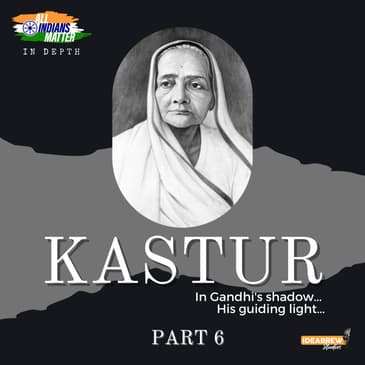

Kasturba, as we’ve seen, was an extraordinary woman, someone who drove Mahatma Gandhi to become what he did. In the concluding part of this series, we trace her final days and hours, and try to understand her better. This is the concluding part of the series ‘Kastur: In Gandhi’s Shadow, His Guiding Light’. All Indians Matter speaks to Tushar Gandhi, great grandson of the Mahatma, an author, a peace activist and someone who’s striving to keep Gandhi relevant in today’s India.
[00:00:00] Hello and welcome to this very special All-Indian's Matter In-Depth series, Kastur, In Gandhis Shadow,
[00:00:18] His Guiding Light on Kasturva, The Wife of the Mahatma. I am Ashraf Engineer. Kasturva
[00:00:23] as we have seen was an extraordinary woman, someone who drove Mahatma Gandhi to become
[00:00:28] what he did. In the concluding part of this series, we will try to understand her better.
[00:00:33] We are in conversation with Tushar Gandhi, Great-Ransom of the Mahatma and author a peace activist
[00:00:38] and someone who is striving to keep Gandhi relevant in today's India. Tushar is also writing
[00:00:43] a book on Kasturva called Kastur Nidairi. Welcome Tushar.
[00:00:47] Thank you Ashraf. Tushar Gandhi's family life was turbulent, especially
[00:00:51] his relationship with his sons. Hari Lal was estranged and became an alcoholic. Manilaal
[00:00:55] wanted to marry a Muslim woman, but Gandhi forbade it. How did Kasturva handle all this
[00:01:01] and would she have agreed to Manilaal marrying a Muslim?
[00:01:04] I consider that to be Bapu's Himalayan Blender. The refusal to allow the freedom of choice
[00:01:13] to his own son in a question that hardly mattered to Bapu. He had no business in it. As a
[00:01:21] grown-up, it was Manilaal's decision to marry for love and the religion of his partner.
[00:01:28] If it had any consideration, it was only to Manilaal. It shouldn't have been to anybody
[00:01:32] else. And I believe the way Bapu responded was uncalled for. And if Bapu has to be criticized
[00:01:40] for anything, I would loudly criticize him for what he did in that situation, forbidding
[00:01:48] Manilaal to marry. I am very happy because that opened the way for my grandmother to
[00:01:55] marry Manilaal Gandhi and that is that ensured that I am born.
[00:02:01] I was going to remind listeners that Manilaal is your grandfather. Was your grandfather?
[00:02:06] Yes, and so I am very happy about it because nobody could have been a better partner
[00:02:12] than my grandmother for my grandfather. But an injustice was done to both Manilaal and the woman
[00:02:22] he loved, who he kept as a friend for the rest of his life when my grandmother also accepted
[00:02:30] her as a sister. And even after my grandfather's passing, the two of them remained the best
[00:02:37] of friends, untitled. But I cannot justify Bapu's actions in this. As I said, if there was
[00:02:47] something for which I would criticize Bapu, it was his decision. And more than his decision,
[00:02:53] he made an excuse of the trauma it would cause to Bha. In writing to my grandfather and
[00:03:01] saying, you know, I don't have my blessings and I think you should not do that. He said,
[00:03:05] think of your mother. She will not be able to survive this trauma. And for her sake, you must
[00:03:13] give them a sacrifice which was wrong of him. He did not consult Bha. He did not consult Bha.
[00:03:21] He did not brief her about this before using her as an excuse to almost blackmail Manilaal
[00:03:28] into changing his decision. Of course, it was my grandfather's weakness also that he succumbed
[00:03:34] to his father. That he should have said to help with you, I love this woman and I'll marry her.
[00:03:40] And if you want me to want to disown me, disown me, I don't care. But so that was a fault of my
[00:03:48] grandfather also but having said all this again, I'm thankful that neither put their foot down
[00:03:54] and my grandmother became my grandmother. But do you think Kastur Bha would have agreed or she
[00:03:59] would also have disagreed? I think Bha would have been hurt. I think Bha would have raised the voice
[00:04:05] against it because she was orthodox. But you must remember that even after Harilal converted to
[00:04:13] Islam, after the initial heart-rending appeal she made to Harilal and to the Muslim community in
[00:04:21] general. She forgave Harilal and was ready to accept him back into the fold as her son. And she
[00:04:29] has written about it, she said no matter how hurt I am by your decision you will always remain
[00:04:37] being my son. And I will always love you for that. And so I think given in the case of Manilaal
[00:04:45] she may have been hurt. She may have taken time to accept the relationship but eventually she would
[00:04:53] have. So I think Bha was not justified in using her as an excuse to forbid Manilaal from marrying
[00:05:01] the woman of his choice. But thank God for it. There's a point of view that Kastur Bha was simply
[00:05:07] someone who had no choice but to go along with whatever has been decided. So if he decides to shift
[00:05:12] home repeatedly she has to go along. If he decides to go celibate she has no choice.
[00:05:18] If he decides to become a freedom fighter she has to play along. Do you buy this argument?
[00:05:25] First part of the question is second part given a choice. Do you think she'd have preferred a
[00:05:30] life less ordinary? To an extent I buy the argument because the times that time and the culture and
[00:05:39] tradition wives had a predefined role to play. Patipar Meshwar was still the dominant
[00:05:48] influence and accepted by Sveta. I just want to remind viewers we are talking about the
[00:05:53] mid to late 1800s. Yeah. And so it's not surprising that Bha to a certain extent was resigned
[00:06:02] to her fate. But at many points when she thought that Bha was actually going to go astray
[00:06:11] she becomes the studying influence on him brings him back and when he telling period was in the 20s
[00:06:18] when Bha was suffering from severe depression and breakdown because he was at Louza and he didn't
[00:06:25] know what was happening. He didn't know the way forward he was ill. He was critically ill very weak
[00:06:34] and suffering from depression he used to call meetings and dictate his final will to people saying
[00:06:42] I'm not surviving, I'm going to die. And that time Bha was the one who nurtured him back to help.
[00:06:51] Both physically and mentally showed him the way forward so they gave him an escape route.
[00:07:00] Bha was advised milk because he was very physically weakened and he needed a surgery for
[00:07:06] fistula and surgeons said I can't operate on you in the condition you are in you won't survive.
[00:07:13] So I need you to build up your health and the only way you can do it is start consuming dairy
[00:07:21] and Bha who had stopped consuming dairy. He said no I can't I have taken a pledge against dairy
[00:07:27] I won't accept it. The pledge was against the kind of inhuman treatment of cows and buffaloes
[00:07:37] indulged in the dairy producers and Bha who had sort of been revolted by that and he said no I
[00:07:45] won't use that. So bar steps in he says your pledge is against milk from cows and buffaloes
[00:07:52] but you haven't pledged against the milk of a goat and especially if we rear the goat in an
[00:07:59] ethical manner in a non exploitative manner you should not have a problem with consuming that milk
[00:08:07] and Bha who said maybe I'll consider this but I'll think about it.
[00:08:12] And he finally accepts that argument but throughout his life he keeps
[00:08:18] referring to it as a compromise with his ideals but that compromises also
[00:08:27] he's convinced to do that compromise by the wisdom of Bha who doesn't say oh my father my husband
[00:08:34] you are my pati perme shwar your agnea is final this that she did no
[00:08:40] this is your pledge no this is your way out. Accept it. Practical be practical so she is
[00:08:49] strong in her will and she is what we call street smart practical in her practices
[00:08:56] and she provides these kind of via medias for him when he's also in relationships
[00:09:03] when there are disagreements with associates and she steps in to you know
[00:09:09] smooth things over with people. If we witness that with parallel layers. parallel layers
[00:09:15] mother with others also with associates political associates with the English the colonial
[00:09:22] administration also she sits in and says no why why should we confront let's find a media
[00:09:29] via media. How different do you think Gandhi's life would have been had it not been for Kastur
[00:09:35] but had he not met in married Kastur? I don't know it's a very hypothetical question I don't know if
[00:09:42] Bapu's will would have forged another Kasturba out of somebody else or would Bapu have remained
[00:09:50] Mohan that's all his life. I don't know it's very difficult to understand but what is undeniable
[00:09:58] is that it was Bha who kept Mohan on the path to becoming the Mahatma. It was Bha's influence
[00:10:09] that kept him firmly on that path without any wavering from it. It was Kastur who was holding
[00:10:18] the hand whenever the feet threatened to go astray. Bha Bha was the and without Bha's influence
[00:10:28] Mohan thus would not have evolved into the versions of him that we saw publicly. That was because of
[00:10:36] Bha that was definitely because of Bha I don't know if he would have still become that without Bha
[00:10:43] but now that is hypothetical the reality is Bha was there and Bha was there throughout every
[00:10:51] critical movement of their lives she was the setting influence. Would the freedom movement have
[00:10:57] been different without her? Definitely definitely it would have been different definitely it
[00:11:04] would have been easy for Bha Bhu to convince the women raised in traditional orthodox families
[00:11:13] to take to the streets if it hadn't been for Bha taking to the streets on her own
[00:11:19] and sending out a message that I can do it I'm doing it why don't you.
[00:11:25] The freedom movement and to a large extent the Namak Satyagrahan, the Quitt India movement
[00:11:34] owe their success to the active participation of the women in those two Satyagras
[00:11:40] because that kept the Satyagras firmly on the path of nonviolence you see the non-cooperation movement
[00:11:48] before that it very easily derailed into violence because women were absent from that Satyagra
[00:11:57] but you look at Namak Satyagra you look at the Quitt India movement
[00:12:01] the women were equal partners in both the movements and the both the movements
[00:12:08] ran their course and kept to the ideal of nonviolence in the Satyagra unflinchingly
[00:12:17] and if you study the prison records of that thing you will realize that women were equal in number
[00:12:26] to the men who were imprisoned as Satyagrahan. Okay not something that's really talked about a lot.
[00:12:30] Yes and so the Satyagra also turned into a movement of women's emancipation
[00:12:39] it was the Satyagrahan who then emerged as the feminist early Indian feminists
[00:12:48] who talked about female independence who talked about equality for the genders who established
[00:12:56] their role as the leaders of the communities and the movements and things
[00:13:03] and in independent India they were prepared to take their places. You see the number of cabinet ministers,
[00:13:10] the number of governors, the number of administrators who were ready prepared at the time of independence
[00:13:18] to take on the responsibilities of independent India and you will realize that it was the Satyagra
[00:13:25] movement that prepared the women of that time to take on the role of administering independent
[00:13:34] India and that is where we had a qualified caterer of women emancipated women who stepped out
[00:13:44] till then confined to the family roles and assumed the responsibility of the nation. And that is
[00:13:52] due to the role Kasturbha played during the Satyagrahan. She became the example for women
[00:14:00] to break the fetters of tradition orthodoxy and become responsible components of society of that.
[00:14:10] And it was a revolutionary step and by did it without any dramatic public gestures
[00:14:18] just by simple day-to-day practice of what she believed in
[00:14:24] without any drama or tomasha, without any hysterical outbursts or things.
[00:14:32] Just normal ordinary actions but continuous actions, perseverance.
[00:14:41] And that is where the women of India were also inspired.
[00:14:46] If Bapu was the father of the nation but definitely is the mother of the modern Indian nation.
[00:14:53] So Chaudhary, I want to not talk about the final stage of their togetherness and this is during
[00:14:58] their imprisonment at the Agakhan Palace. That imprisonment actually served as possibly one of
[00:15:04] the longest times that they would have had spent continuously together. I am not referring to their days
[00:15:11] in South Africa for example but definitely after they returned to India.
[00:15:15] I want to talk specifically about the time when Gandhi undertook yet another fast. This is
[00:15:22] February 10, 1943 and Kasurba was at his side like a rock. Gandhi's condition worsened very
[00:15:30] quickly but he eventually recovered. However, Kasurba's health worsened. What happened after that?
[00:15:38] See, we must also understand that the final imprisonment again was because of
[00:15:45] Bhajone actions not to give big be a caregiver to Bapu. She was arrested because she
[00:15:51] defied the prohibitory orders of the colonial administration and addressed Raleigh in the absence
[00:15:58] of Bapu. And she was arrested for that defiance and imprisoned initially in the women's prison
[00:16:06] of the Bombay Central Prison at Bikala. And when her condition worsened over there when she
[00:16:13] fell ill and her condition worsened over there, to avoid the embarrassment of Mrs. Gandhi dying in
[00:16:20] prison. The colonial administration rushed her to the Agha Khan Palace where Bapu was detained.
[00:16:28] Today a lot of people say look, Savarkar was in cellular jail and Bapu was kept in Agha Khan Palace
[00:16:37] so he was a British too. But they failed to realize that Agha Khan Palace was just a name.
[00:16:46] It was actually just three stark barely furnished rooms in that palace that were utilized as
[00:16:53] cells for Bapu and his entire Raj to be detained. The rest of the palace was occupied by British
[00:17:02] officers and military and police to keep a watch and guard the prisoners and isolate them.
[00:17:12] And Bha and Bapu suffered a great tragedy immediately after imprisonment because on 15th August
[00:17:20] 42, barely a fortnight or 10 days after six days after their arrest.
[00:17:27] Now they have decided to pass away in the detention due to a massive cardiac arrest.
[00:17:35] Now they have decided that Bapu was a secretary for 25 years home, he had come to love as his own son
[00:17:42] and Bha had also accepted him as a son and for his passing was a great blow to Bha and Bapu.
[00:17:51] They grieved his passing tremendously. They never recovered from that tragedy,
[00:17:57] it's not that because in a way they felt responsible for his death, he had forsaken his family,
[00:18:05] his son, his wife and behind Bapu felt responsible for the eventual fate
[00:18:14] and then when Bapu went on his fast, although Bha showed a lot of courage and strength in becoming
[00:18:26] Bapu's inspiration because this time the fast took a toll on him very fast and he sank
[00:18:33] and on two occasions at that time the British prepared for his death.
[00:18:38] They even threw open the gates and said okay people are going to die let people see him die.
[00:18:44] The final darshan was there, you don't want to be blamed for having killed him
[00:18:49] so they opened it up and people started coming in they saw Bha standing by Bha Bapu.
[00:18:55] It's very touching scene of the time when he ends his fast, he is reaching a crisis
[00:19:02] he is sinking rapidly and Bha can't take it. Bha has this habit in her life
[00:19:08] that she always worships the Tulsi plant and it's a daily ritual wherever she goes she plants the
[00:19:15] Tulsi and takes care of her like a goddess and every day she will go and water the plant nurture it
[00:19:24] pray to it and that day also when it feels hopeless it feels as if now Bha Bapu's not going to survive
[00:19:32] because he is refused to add fruit or juice to his water for sustenance
[00:19:40] and Bha walks out and goes and stands next to the Tulsi plant she's watering it she's praying to it
[00:19:47] visitors see this tragic figure of the woman resigned to her fate watering the plant worshipping
[00:19:55] it praying to it and then they see Bha Bapu wasting away on his bed
[00:20:01] and they experienced the tragedy of the two people, the tragedy of losing Bha Bapu
[00:20:10] and the tragedy of the woman who is about to lose her husband they graphically see that
[00:20:17] and that is the time when Susheela and I heard asks Bha Bapu isn't it time that you started taking some
[00:20:25] fruit juice in your water and finally Bha Bapu said yes I think now I need that sustenance and so
[00:20:35] an ounce of orange juice is diluted with three ounces of water and fed to Bha Bapu
[00:20:43] and it works as an Alexial it suddenly energizes Bha Bapu when when Bha walks back into the room
[00:20:52] she sees the vitality on her husband's face and she realizes the crisis is over
[00:20:59] and she once again in her mind thanks her goddess for listening to her prayer I don't know
[00:21:06] whether dramatically when she was praying to the Tulsi she had told her take me instead of him
[00:21:15] but something like that happens
[00:21:21] Bha Bapu recovers but past that's it
[00:21:24] okay
[00:21:28] and then she doesn't recover it's one way down the hill from there not
[00:21:34] she has a series of infections pneumonia she has some heart ailments she suffers from a heart attack
[00:21:45] in January 1944 she takes to the bed the British have piled up wood for Bha Bapu's fudent
[00:22:02] and now suddenly it's Bha who's survival isn't out
[00:22:07] in Bha takes to the bed nobody knows it at that time but that's her death bed she's not going to recover
[00:22:19] when the final realization occurs the British allow access to the sons
[00:22:26] goddess and Ramdas start visiting their parents in prison regular but Bha is still feeling lonely
[00:22:37] Manilaal is away in South Africa he can't come it's too far he's too far away
[00:22:43] Bha Bapu ends for him but she pines for her less son the most and by then Harilaal is a complete
[00:22:53] destitute nobody knows about him he doesn't have an address after his conversion to Islam
[00:23:00] and then reconversion to Hinduism he has become a vagabond a destitute an alcoholic nobody knows
[00:23:08] where he is one day he's found committing a you know nuisance of himself under the influence
[00:23:16] of alcohol in one place then somewhere else the only track is the reportage of him of Gandhi's
[00:23:23] sons nuisance in the press and every time that happens it breaks Bha's heart and now when she's
[00:23:31] on her death bed she pines for her less son and she keeps asking for him finally the colonial
[00:23:41] administration relends and decides to join for the in the hunt for Harilaal because they realize
[00:23:48] that they're not going to be able to save Bha and they decide to let her at least die in peace
[00:23:56] and they start looking for
[00:24:06] they start looking for Harilaal he's nowhere to be found it's too far gone
[00:24:10] Bha's condition keeps deteriorating she gets another heart attack
[00:24:22] now there's no hope even Bha's keeping up
[00:24:27] Devdas is desperate there's a new drug penicillin
[00:24:33] he finally convinces the colonial administration to get some penicillin for Bha
[00:24:42] on 20th February Bha Poo is informed that they have managed to procure penicillin for Bha
[00:24:50] that's the only hope but they cannot guarantee that it'll cure her it'll prolong her life at the best
[00:24:57] because the damage is too much too extensive Bha Poo leaves the decision to Devdas but he says look
[00:25:06] once in South Africa when to save her life the doctor wanted to feed her beef broth
[00:25:14] and I asked her she made me promise that I would never allow any forbidden food or medicine
[00:25:24] even if that meant saving her life and at the moment penicillin the origins of penicillin are suspect
[00:25:32] so I cannot because I've promised Bha I cannot allow that but he tells Devdas that the decision is your
[00:25:41] she's your mother my only appeal is that if you can't cure her is it worth sustaining her
[00:25:49] her anguish her suffering for a few days more as you decide miraculously Harilal turns up at the gates
[00:26:02] of the prison that evening he's in a miserable condition he has been on one of his alcoholic
[00:26:10] benjazeekhan and can hardly stand but he turns up at the gates and he finally convinces the
[00:26:19] centuries that he is by and Bha Poo's son and a message is sent in that Harilal is at the gates
[00:26:28] and Bha Poo says bring him in fast but when they see him they shocked and Bha Poo is worried that if
[00:26:35] Bha sees him in this condition it'll have a traumatic effect on her heart and so Harilal is convinced
[00:26:44] to sober up and come back the next morning he does but he's still not completely sober and Bha
[00:26:52] realizes they have a very gentle talk Bha talks to him tries to convince him to come to Bha Poo
[00:27:02] and live with him she tells him this is my end but Bha Poo is your father and he will accept you
[00:27:10] he's always behind for you go back to him Harilal leaves goes back to one of his drinking benches
[00:27:21] Bha is pining away for Bha Hari she the whole of 21st
[00:27:26] she keeps pining for Haril a message is sent out find Haril they can't find him late in the night
[00:27:35] they find him dead drunk and the police in their wisdom field that you know Mrs Gandhi is not going
[00:27:43] to make it and they decide it's best to haul Harilal in his present condition and present him to
[00:27:51] and Harilal in his completely in that alcoholic days he stumbles into Bha's room
[00:27:59] Bha lits out of the whale seeing her her son I think that was the final nail
[00:28:07] Bha will Harilal had to be dragged away from her side
[00:28:19] and on 22nd Bha became critical when Bha Poo was leaving for his evening walk
[00:28:30] he came to Bha to tell her he was just going to step out for a walk and he was going to come back
[00:28:37] and she wanted him to wait for his return Bha holds his hand and doesn't let go
[00:28:46] Bha Poo realizes that this is the end
[00:28:54] can he sit still and he lifts Bha's head rest on his shoulder
[00:29:01] but tells everybody else to go away and he's standing sitting over there in communion with a partner of his life for more than six decades
[00:29:13] as life ends from her
[00:29:18] frankly somebody walks into the room
[00:29:24] discovers that Bha is no more
[00:29:31] and tears roll down Bha Poo's cheek as he realizes his soulmate is darling Kastur has left him forever
[00:29:48] and thus finally Kastur finds her final destination
[00:29:57] the one place from which her husband cannot approve her one ever
[00:30:04] and the nomad comes to rest
[00:30:09] unfortunately an ungrateful nation also decides that's the end of Mrs. Gandhi
[00:30:17] and we don't have to bother anymore but Bha Poo realizes the loss that he has suffered
[00:30:26] and for the rest of the years that he survives he never forgets Bha
[00:30:32] the promise he made to Bha in South Africa that you will live on in my heart
[00:30:39] he proved it to be true Bha continuously lived in his heart to that
[00:30:46] the wood that was gathered by the British to cremate Bha Poo
[00:30:53] and Agatha and Palace was finally used to cremate Bha
[00:30:59] the British came to Bha Poo and said
[00:31:03] you know we can't allow the people to participate in the Bha funeral of Bha
[00:31:08] either her body is carried away
[00:31:11] and we do her funeral in public which you can't attend
[00:31:17] all you do have funeral in the prison grounds which others can't attend
[00:31:23] but he said they said you know if you want we let them allow your sons to participate
[00:31:28] Bha Poo said what applies to the common Indians must also apply to my sons
[00:31:34] the common Indians can't participate in the funeral of Kasturbha then my sons
[00:31:39] also will not participate in her funeral
[00:31:44] finally the British relent and they said okay we will allow 200 people to attend the funeral
[00:31:53] in Bha's funeral is conducted in the same spot where Mahadev Desai was cremated
[00:32:01] Bha Poo refused to move from the spot the entire day of 23rd
[00:32:09] he walks with the body to the cremation spot
[00:32:13] he watches her cremation begin
[00:32:18] he stands vigil for the whole day under the name tree
[00:32:26] watching the flames consume the body of his beloved
[00:32:31] refuses to move from there till the last embers of the fire
[00:32:36] extinguished, consuming Bha's body
[00:32:42] on the Friday morning when the embers of Kooled and the ashes are Kooled
[00:32:48] Devdas and Ramdas go and collect Bha's Asthis from the funeral pyre for immersion
[00:32:57] because Bha Poo has expressed his desire Bha had always wanted her final
[00:33:04] ashes to be immersed in the Thirvani Sangam ital al-Habad
[00:33:09] and so Bha Poo has told his sons that you do the rituals
[00:33:15] when they go to collect the Asthis
[00:33:18] they discover that the green glass bangles at Bha always war on her wrists as a mark of her
[00:33:26] Suhaag have survived the fire intact they find the six bangles intact in her funeral for pire
[00:33:36] and she they carry them back to Bha Poo when Bha Poo said that she was a pious woman she was a
[00:33:43] sati and it is believed that a truly pious woman her bangles will not be destroyed by her
[00:33:50] funeral pyre and this is a proof that Bha was a saint those bangles were preserved for a long time
[00:34:00] some of them broke but some of them are even today preserved at the National Gandhi Museum
[00:34:06] and I know around display in Delhi in Delhi this was the remarkable woman who Kastur Bha was
[00:34:15] and this was the tragedy of her life that neither in life nor in death was she given the due
[00:34:26] acknowledgement of her own greatness her fate was to live in the shadows of a great
[00:34:35] human being who was her partner and she voluntarily merged into him
[00:34:43] Suha Shandrabhu's paid a glowing tribute to Bha it's people who want to read it can find it on
[00:34:53] Google if you if they treat a type Suha Shandrabhu's tribute to Kastur Bha it will come up in which
[00:35:03] he acknowledges her as the mother of the Indian nation and in acknowledges her as being a martyr
[00:35:11] to the freedom cause of freedom on her own in her own rights and also accuses the British of
[00:35:18] actually murdering her in an effort to break the will of Bha Bha. This is Suha Shandrabhu's
[00:35:26] who is estranged from Bha. And still he has sent this homage to Kastur Bha there is an
[00:35:35] acknowledgement of the condolences of the Visrawavevel and his wife Bha Bha Poo in which he writes
[00:35:43] about how Bha Bha was the real force behind his evolution and the true soulmate
[00:35:52] and acknowledges his debt to Bha who voluntarily merged her identity into his first public persona
[00:36:01] allowed him to grow. These are the things that we must remember and I hope this narrative sets history
[00:36:12] right and corrects the injustice that we have done to Bha and we acknowledge Kastur as an important
[00:36:25] freedom fighter Kastur Gokuldas Kapadia as a martyr of the freedom of India
[00:36:34] because Gastur Gokuldas Kapadia was much more important to Indian freedom than Kastur Mohandas
[00:36:43] Gandhi ever was and this is what the distinction between the two that we have to remember recognize
[00:36:52] in honor and I dedicate this talk to my Bha and proud as much as I am proud of the lineage I have
[00:37:03] inherited from my great-grandfather. I am proud of the lineage that I have inherited from my great
[00:37:10] grandmother as you should be. How did Gandhi change after Bha's death? Bha Poo himself has admitted
[00:37:18] that he found himself a drift after Bha. He felt that his anchor, he lost his anchor.
[00:37:28] He felt that in many a times he elicinated that Bha was with him at times of crisis in his life when
[00:37:37] he felt that his ideology was challenged, that his ideals were compromised. When he started
[00:37:46] suspecting himself to be a failure, he has written in his own words that he used to feel the
[00:37:55] presence of Bha sort of stabilizing him, assuring him, sort of making him feel peaceful again.
[00:38:07] That showed the loss he felt about the partner on whom he relied most without doubt because
[00:38:18] at various stages in his life he had outgrown his reliance and acceptance of several people
[00:38:29] but Bha had been the constant in her life, almost from the age of six
[00:38:35] till six decades later when they parted ways forever. And as you said, perhaps even after that
[00:38:42] in spiritual form, because after Brahmacharya the physical relationship had dissolved
[00:38:49] and it had been replaced by an even stronger spiritual relationship,
[00:38:56] a intercourse of souls instead of an intercourse of bodies.
[00:39:02] How would Bha have reacted to independence in the form that it came? I'm referring here to
[00:39:08] partition, the riots that followed etc. I think Bha would have accepted it more practically than
[00:39:15] what Bha, and I think the trauma that Bha, because of the partition and the riots and
[00:39:26] disintegration of the dream that he had seen for his country. And they fact it had on his
[00:39:34] final year, would have been much lessened if Bha was there to put it in its place,
[00:39:41] to explain why these things were happening. And to say that look,
[00:39:47] revolutions hardly happened in a smooth manner, there are always
[00:39:52] eruptions when revolutions. You gave birth to a revolution. Now don't blame yourself
[00:39:59] when the revolution has its effect on the people. She was practical enough to understand that
[00:40:04] Bha, who was too much of an idealist and he could not accept
[00:40:09] that this was a natural corollary to a revolution. He blamed himself.
[00:40:18] He kept accusing himself or for some corruption his own belief and practices.
[00:40:25] And he blamed himself for every transgression that happened after independence.
[00:40:31] Bha would have made him realize that he didn't have to blame himself for everything.
[00:40:37] He wasn't responsible for everything that happened. There were other influences also.
[00:40:44] She would have made it easy for him to accept it. But his tragedy was that that
[00:40:53] influence on him wasn't there at that crucial time in his life.
[00:40:58] What do you think is her legacy? Her legacy is very vague, a shuff. Bapu's legacy is defined.
[00:41:07] Her legacy is the legacy of a shadow which is never away from its subject. Never diminished
[00:41:17] always there, but always silent. I think her legacy is the acceptance that India lacks today.
[00:41:29] Everything of India, everything antagonizes India. Everything is irretent for India.
[00:41:39] Bapu, Bha's legacy would have been to make India understand that there is room for every
[00:41:47] thought, every ideal everybody if we decided to live with acceptance and not antagonism.
[00:41:55] I think India misses that the most today in not having had Bha as a stabilizing influence in their
[00:42:04] lives, in the life of the nation. What have been the conversations you've had about her within
[00:42:10] the family down the years? Most of the conversations have been of one to one interactions of people with Bha.
[00:42:17] I mean your father of course would still remember her. My father remembered her, my elder aunt remembered her.
[00:42:24] My grandmother remembered her a lot because she spent a lot of time. I spent some time in my childhood
[00:42:32] with the other daughters-in-law. I spent time with people who had lived with Bha in the Ashrams.
[00:42:42] So, I sort of had a first hand or second hand impression of Bha who she could have been and I was
[00:42:50] very fortunate that one of Bha's grand daughters, Harilal's youngest daughter Manu.
[00:42:58] I grew up with her and to me she was the personification of Bha because what I heard of Bha
[00:43:07] and then what I saw of Manu Fai Bha. I always used to picture her as Bha if Bha was alive that she would
[00:43:16] be Manu Fai Bha would be Bha and she Manu Fai Bha had this very affectionate habit of calling all
[00:43:23] of us Bha Choo. Whenever we were there, she would never refer to me as Tushar. She would always say Bha Choo
[00:43:31] Abhikar, Bha Choo Bhuk Lagishya, Bha Choo Akar, Bha Choo Take her. I was always Bha Choo to her and I
[00:43:39] think Bha for Bha also if I was there in her lifetime. I would have been Bha Choo.
[00:43:46] When you look back personally on Kastur Bha's life, how do you see her?
[00:43:51] Remarkable. I can't imagine a person like her in her time who even in her silence was so
[00:44:04] so vibrant, so vocal, so inspirational. That was her remarkable personality for me. I envy her because
[00:44:16] I've seen a lot of very strong feminist women but I haven't seen a mixture of feminism and
[00:44:29] strength living on equal power like that I see in Bha. It's it's it's undescribable. For me Bha
[00:44:39] epitomizes the mother like nothing else can ever epitomize the mother. The universal mother,
[00:44:47] I'm not talking about a biological mother but the universal mother, the concept of a mother.
[00:44:54] How do you think Bha would like to be remembered? I think Bha would be satisfied by just
[00:45:00] being acknowledged as the person she was. She wouldn't want any special treatment because
[00:45:06] you never in her life did she aspire for spatial treatment, never did she say I'm the wife of the
[00:45:14] Mahatma so treat me as Mrs Mahatma. She was content to be Mrs Gandhi. She was content to be
[00:45:23] dismissed as the inconsequential partner of a great person. She didn't mind that and I think
[00:45:30] she would be satisfied with just that I think the wrong that has been done is by completely
[00:45:38] forgetting her personality and I am also to be blamed for it as her descendant I have not and
[00:45:45] that is where today I find it. I feel it is my duty. Discovery of Bha that I have made.
[00:45:56] I think it is my duty to take that discovery to the people and present her finally as
[00:46:03] Kastudh Kokuldas Kapadiya. Tushar, last year we recorded a six part series on Mahatma Gandhi
[00:46:09] skilling the conspiracy, the people behind it and why Gandhi is so relevant today. It's only fitting
[00:46:15] then that we put together this series on someone Gandhi described as an indivisible part of himself.
[00:46:22] Like last year has been a privilege thank you for doing this. Thank you, Masha Fai.
[00:46:28] I hope I have been able to convey my devotion to Bha to your listeners and I hope they carry
[00:46:36] a bit of Bha with them for the rest of their lives. That's if that happens I think I'll have achieved
[00:46:42] my objective. Thank you very much once again. To all those listening, keep an eye out for Tushar's book
[00:46:48] on Kasturba titled Kastur Neh Dairi. With this we conclude this six part series on Kasturba Gandhi,
[00:46:54] the Mahatma's wife and her role in India's freedom movement.