
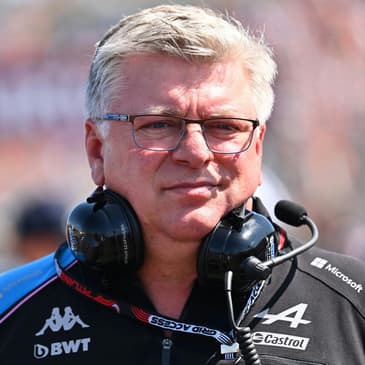

How does one get hired as a Team Principal? Is Otmar Szafnauer in touch with Andretti to lead their Formula 1 team? What was the Pink Mercedes saga all about and how painful was it to lose 3rd place in the World Constructors' Championship in 2020?
In our part 2 of the Otmar Szafnauer interview episode, the former Alpine, Aston Martin and Force India / Racing Point chief talks to Soumil Arora and Kunal Shah about several interesting topics on the Inside Line F1 Podcast.
How many teams are sufficient for Formula 1? Sergio Perez and Esteban Ocon - two solid midfield drivers that Otmar worked with, how was it with those two? Alpine's lack of a customer team, is that a competitive limitation in Formula 1? And of course, the many heads to Alpine - did that complicate decision making?
After a blockbuster Part 1, we're back with Part 2 of the Otmar Szafnauer interview. For those who missed Part 1, hear the episode "Otmar Szafnauer on Lawrence Stroll, Vijay Mallya, Force India, Alpine and more".
(Season 2024, Episode 06)
Follow our hosts: Soumil Arora, Kunal Shah and Otmar Szafnauer
Image courtesy: Formula 1
Learn more about your ad choices. Visit megaphone.fm/adchoices
[00:00:02] Before we begin, I wanted to give a huge shout out to the folks at Amazon Music for partnering with us on this episode of the Inside Line F1 Podcast.
[00:00:10] But more on this later, right then, let's get right into today's episode.
[00:00:35] Ladies and gentlemen, welcome to the second part of the Autmar Safnaware interview on the Inside Line F1 Podcast.
[00:00:42] I mentioned second part because part one was quite the bomb.
[00:00:46] Autmar revealed so much about Force India, about how they made the magic happen and you, Kunal, were there at that time.
[00:00:53] What was it like from your perspective? And what was Autmar's method of working like?
[00:00:58] I was actually there when the magic happened.
[00:01:00] You know, it's like being a part of the magician side rather than the audience, right?
[00:01:05] But frankly, you know, I explained a very human side to Autmar, but the more interesting side was also the efficient side.
[00:01:14] You know, you always walk into conversations and there'll always be that one person who knows exactly the question to ask.
[00:01:23] Like, what's the hook? As we say in the world of content marketing, two people who are really good at what's that hook in a conversation in real life for Autmar Safnaware,
[00:01:34] but even more so Dr. Vijay Malia.
[00:01:37] And I think that's why their partnership also worked so well with delivering on all the magic around the Force India Formula One team.
[00:01:46] And that's what we covered in part one.
[00:01:48] Folks, in this particular episode, we are going to be covering the other side to it.
[00:01:53] The time when Autmar almost got racing point to P3 in the Constructors Championship.
[00:01:58] The time when they were unofficially known as the Pink Mercedes.
[00:02:02] So much scrutiny around that time.
[00:02:04] How did Autmar and the team manage that entire period?
[00:02:07] And also, Kunal, best thing of all, we got to know some insights about Alpine and why even though they keep on changing names and management and liveries and drivers,
[00:02:18] it just never seemed to win a championship.
[00:02:20] That for me was my best part.
[00:02:22] What about you?
[00:02:23] I think my best part was also about Alpine because in this episode, we've sort of dug deeper into his current journey.
[00:02:30] In the previous one, it was about Force India, how we made things happen there.
[00:02:34] And now it's about Alpine and why things didn't work here.
[00:02:36] What were the difficulties in getting things work here?
[00:02:39] So during his version of the Alpine story is what is definitely the most exciting one talking about the number of people who've been in the team,
[00:02:50] talking of all the decision making or the slowness that hence is impacted.
[00:02:54] And the fact that Alpine, you know, one of the things that you and I have spoken about ever since Somil is Alpine's lack of a competitive reference in a customer team.
[00:03:04] How is that impacting the works team from France?
[00:03:08] So lots of in the moment talk with Autmar in this episode, that's what everyone should expect.
[00:03:15] Let's get right into it then.
[00:03:17] Ladies and gentlemen, here's Autmar Saafnau.
[00:03:20] Super.
[00:03:21] So Autmar, firstly, I wanted to talk to you about the Force India times, right?
[00:03:24] Because we spoke so much in depth about it earlier as well.
[00:03:27] But we didn't quite touch upon what was your personal favorite Force India moment out of all of those.
[00:03:32] If you had to pick one, would it be Bahrain 2014 or perhaps the win that he got in Sakir later or any other ones that come to mind as well?
[00:03:42] I see that's put you on the spot.
[00:03:44] Favorite Force India moment?
[00:03:52] Probably, probably one of Sergio's, maybe Sergio's monocle podium.
[00:04:01] And what makes it more interesting is at that point of time, you guys clearly weren't up there fighting with the rest of it as it became a thing in 2020.
[00:04:09] So I mean, can you talk us through that weekend as a whole?
[00:04:11] And normally with Checo, how was it that always whenever someone had some sort of error, Sergio was always there towards the podium, always bouncing on to get out?
[00:04:23] Sergio was a great racer and he often in the lower formulas wasn't in the best team.
[00:04:33] And because of it, he had to learn his race craft in the middle of the field.
[00:04:40] And when you don't always start at the front and you want to get to the front, you learn how to do that.
[00:04:50] And some of the competitors that he's raced against, Hulkamberd for example, he always started at the front and finished at the front in the lower formulas.
[00:05:00] But that wasn't the case with Sergio.
[00:05:03] He would start somewhere in the midfield and then try to work his way up to the front.
[00:05:09] And because of that, he developed a great race craft.
[00:05:14] And when he came to Force India, you know, we were, I can't remember how many pole positions we had if any.
[00:05:20] You know, we weren't qualifying up in pole or front row, but not far behind.
[00:05:27] So we're somewhere in the midfield and then he just did a great job at taking that position that he was in and moving forward.
[00:05:34] And he learned his race craft like that early on in his career.
[00:05:39] And he was brilliant at it.
[00:05:41] And because of it, he would score a lot of points, was very tenacious, would be on the podium every once in a while and did very well for us.
[00:05:49] Where Hulkamberd won everything in the lower formulas coming up.
[00:05:54] And they were pretty evenly matched.
[00:05:56] I think Nico beat Checo one year and Checo beat Nico the other year.
[00:06:00] So that's really good.
[00:06:02] And that actually brings me on to Esteban Ocon, because I remember you guys had such a special bond, not just in one team but two of them.
[00:06:10] I remember you once saying, Otmar, that he was a future world champion.
[00:06:14] What do you see in Esteban?
[00:06:16] What do you find as the most interesting or the most best quality about him?
[00:06:20] Well, early on, I mean, you could tell we tested a few young drivers and Esteban was probably the best of all those that we tested.
[00:06:30] And there's a few things.
[00:06:32] One, he had great car control, very skillful in the car, but also he wanted to learn.
[00:06:41] He was very keen to listen, very keen to do what the more experienced engineers were telling him to do, to get more performance out of the car.
[00:06:51] And he always tried things.
[00:06:54] So, you know, that's if you've got the talent and you've got the ambition and want to learn and follow direction and are easily taught.
[00:07:05] You need all those elements to become world champion, which is why I said it could be a future world champion.
[00:07:12] But how did that journey with him begin?
[00:07:14] So clearly you must have seen his work at Manor in 2016.
[00:07:17] And then at what point did he realize, OK, this is the guy I wanted my team next when Nico goes.
[00:07:22] At that point, he still had done not even a full season, right?
[00:07:25] It was only half a year.
[00:07:26] Yeah, we got to know him in testing really.
[00:07:30] And there's nothing like putting him in your own car, looking at the data, looking at his data overlaid with racing driver's data,
[00:07:41] whose quality you already know.
[00:07:43] And, you know, if he can match or get really close very quickly, then, you know, he's good.
[00:07:48] And it was that that did it much more so than looking at him in other cars.
[00:07:53] But that really brings me on to today because you folks have so little testing time in comparison to what you had previously.
[00:08:00] Just scouting and hunting drivers, do you feel it's more of a risk now because you can't quite put them in the car and figure it out?
[00:08:07] So is it more?
[00:08:08] Yeah, it's more of a risk now.
[00:08:10] But you can still these days, you can and not all teams do it.
[00:08:15] I think most by now do.
[00:08:17] You can put them in a two year old car and you can put them in a two year old car next to the racing driver or just overlay the data from what the racing car driver did.
[00:08:27] And then you have that basis of comparison.
[00:08:30] But yeah, you're right.
[00:08:31] In a new car or this season's car, it's very limited.
[00:08:37] Well, with Esteban, I love how it worked out.
[00:08:40] And we spoke earlier about Spa 2018, that big moment where both of your cars were doing so well and then Esteban also qualified so good too.
[00:08:47] What was your favorite moment with him?
[00:08:49] And clearly you have a very special bond with him.
[00:08:53] Do you know?
[00:08:54] Yeah, in Spa 2018, yeah, really well coming out of administration, you know, having the team unsure of its future and having him performed at that level was really good.
[00:09:09] It just shows, you know, their mental toughness and that's another element that you need to be world champion.
[00:09:18] You know, mental toughness is up there with driving skill.
[00:09:22] And then when you had to tell him that he wasn't part of the team for the next year, that must have hurt, right?
[00:09:27] What was that moment like of communicating to Esteban that he wouldn't be in the team next year?
[00:09:32] Yeah, so I was very confident that because of his skill level that he would find another driving formula on that, that wasn't going to be his last.
[00:09:44] So although, you know, never pleasant, I wasn't worried and eventually I was proven right.
[00:09:52] I think he spent a year as reserve at Mercedes and then after that he went to Albin.
[00:10:01] And that's because he deserves to be in the sport.
[00:10:05] Actually, I love that you brought this up because that brings me on to 2020.
[00:10:10] Now, can I just say, I really like to commend you for that incredible season that you folks had finally getting the team's first win in such crazy circumstances,
[00:10:18] but also having a car that was challenging for many podiums all throughout the season.
[00:10:23] But it was a tomato's ear, right?
[00:10:25] Leading up to which so many people were literally verbally throwing stones at your team.
[00:10:29] But how did you all manage it?
[00:10:31] Like, you all knew clearly that the car was legal, but fending off the others, that must have taken so much of your mental energy in 2020.
[00:10:38] Well, by the time we had to fend everybody off the car was what it was.
[00:10:43] We did follow the rules.
[00:10:47] So we weren't illegal.
[00:10:51] In the past, if I remember correctly, we always bought our gearboxes, powertrain and hydraulics from Mercedes.
[00:11:05] And Mercedes was the only team at the time running a low-rate concept.
[00:11:11] And so we would always buy gearboxes from them from a team that was running a low-rate concept.
[00:11:18] And because of that concept, we had constraints as to how much rear ride height we could run.
[00:11:25] We couldn't go any higher because of their gearbox design, because the pickup points for the rear suspension.
[00:11:32] And therefore, we were always compromised.
[00:11:34] You know, we would run a gearbox that was designed for a low-rate concept, but we were running a high-rate concept.
[00:11:40] And that gave us constraints and limitations as to how much we could develop that car dynamically.
[00:11:46] We could develop it to its full.
[00:11:48] So when we finally could afford to buy suspension from Mercedes, for example, then we could also run a low-rate concept.
[00:12:02] The first time ever we were able to run a low-rate concept with a gearbox that was designed for a low-rate.
[00:12:10] And lo and behold, we had a much more performant car.
[00:12:16] And that was the car that won.
[00:12:18] And that was also the car that finished on the podium more often.
[00:12:22] And had we not had, I think we had two engine failures in a row at the end,
[00:12:28] we would have finished third in the championship.
[00:12:30] I think we lost out to third by a few points.
[00:12:34] And we're in a very good point-scoring position in two races.
[00:12:38] I think one, we would have been on the podium either second or third, the penultimate race.
[00:12:42] And we had an engine failure with, I don't know, maybe six laps to go, something like that.
[00:12:49] And had that not happened, we would have finished third in the championship.
[00:12:52] But it did happen.
[00:12:53] And then the very next race, we again had to finish in the points in ahead of McLaren,
[00:13:01] if I remember right.
[00:13:03] And we were doing just that and brand new engine because the previous one had failed.
[00:13:11] And that one failed too.
[00:13:13] In the first, I don't know, quarter of the race, which is unusual from Mercedes,
[00:13:19] but it did happen and that cost us third in the championship.
[00:13:22] This actually leads me to a point about, you know,
[00:13:26] when did you know that your time was up at 4th India Racing Point of Mark?
[00:13:31] Because you were really leading the team so well.
[00:13:34] And there was a change of management as we spoke about earlier.
[00:13:38] You know, I didn't know until probably quite late in the year or in December,
[00:13:49] November, December that, you know, most of my job was taken by Martin Whitmarsh,
[00:13:58] who was just recently hired.
[00:14:00] And, you know, at that point where, you know, for 12 years I used to lead the team,
[00:14:08] run the management, all the management meetings, you know,
[00:14:12] help in significant and senior decision making process.
[00:14:17] Like I said, when 90% of that work was taken away from me,
[00:14:21] then it was, you know, the writing was on the wall that Lawrence wanted a different management team.
[00:14:29] And, you know, I had a very good run, but it was time to go,
[00:14:36] which is what happened and it's fact.
[00:14:45] But I look back at the times that I was there taking the team from last
[00:14:50] of significantly or to 4th and 4th, you know, 3 times if you include racing point towards the end there.
[00:15:02] And, you know, I wish all the people there that I hired that are good people,
[00:15:09] I wish them luck to be in being able to repeat that, but so far they haven't been able to.
[00:15:15] I'm sure they will in the future, but sitting here right now today,
[00:15:21] you know, I think they've been 7th and 5th.
[00:15:26] And it was really nice to, or it's really nice now to look back
[00:15:33] and remember those times and, you know, it's a bit nostalgic looking back at all those times where,
[00:15:40] like you say, we've won races, we're on the podium, we regularly finished 4th in the championship.
[00:15:47] Should have been 3rd one year, but, you know, everyone could say should or could have would have.
[00:15:52] But we did it. We did it. And I'm not there anymore and I wish them luck that,
[00:15:59] you know, there's a lot of good people there that they can repeat that and do even better, but only time will tell.
[00:16:05] I love how you just look at it in such a broader perspective about your time over there.
[00:16:10] But then immediately came Alpine and I'll be honest, Otmar, I found it to be quite a move
[00:16:16] because normally team principals tend to take some time between jobs,
[00:16:19] but you went there literally almost immediately.
[00:16:22] So what was the thought process like and how did that move actually come about?
[00:16:27] That's because there was a rare moment of my leaving Aston and Alpine needing a leader and team principal.
[00:16:40] They didn't have that structure before they had two directors but no team principal.
[00:16:48] They wanted to change that to move it into just having a team principal.
[00:16:54] I was available and then they started talking to me.
[00:16:58] So it was just fortuitous that the timing of their need and the timing of my departure was the same.
[00:17:07] But it is also the team you fought the most fiercely in your time at Force India.
[00:17:11] Was there any sort of animosity against you even a little bit?
[00:17:15] Or was there just respect about what you've done against them all the way through?
[00:17:18] No, no, no animosity.
[00:17:21] We used to beat them regularly to finish forth the only ones that we didn't beat.
[00:17:32] We're the big three, which was Mercedes Ferrari and Red Bull.
[00:17:37] So all those years we finished forth, we finished ahead of the folks at Endstone.
[00:17:44] So no animosity when I went there.
[00:17:47] I learned that many of the people that I had worked with in the past at other teams including at Honda and British American Racing
[00:17:57] and even Force India in the early days they were working there.
[00:18:02] So I knew a lot of the people already and they're a good group too.
[00:18:10] You know, almost well, most teams of Formula One if not all of them have outstanding people in them.
[00:18:18] One compared to say the rest of the society.
[00:18:22] It's a microcosm of the best engineers in the world and they had them there as well at Alpine.
[00:18:32] When I got there it was just a matter of adding some further resource that they didn't have.
[00:18:38] Not that the people that had weren't to the right level, it's just they had pockets of knowledge that was missing.
[00:18:47] And I started to populate those pockets of knowledge that they didn't have along with the rest of the technical team.
[00:18:57] In my year and a half we probably hired almost 80 people all in the technical areas, which was significant.
[00:19:06] And because we did that, you know, the team started getting better and my one year at Alpine I left mid-season 23 but 22
[00:19:18] although the car was already designed and developed or did not develop, the initial car was done by the time I got there.
[00:19:27] I think I made significant change in order to enable us to finish fourth.
[00:19:33] And you know, again we're fourth behind the big three teams again my one year at Alpine.
[00:19:43] And Atmar, I want to ask you when you came to Alpine just what did you find?
[00:19:48] Can you tell a lot about how the team has run from the outside as well being competitors?
[00:19:52] So when you came there what did you find was missing?
[00:19:55] There are some areas that for example Aston or Mercedes which I also knew well.
[00:20:04] They had much more capability in those areas.
[00:20:09] You know, deep knowledge of the tire, a good tire model for example.
[00:20:15] Although their tire engineers were very clever, you know, very well educated but they were junior in their experience.
[00:20:27] And you need both, you need really smart people and also experienced people to be able to get the most out of a subsystem.
[00:20:35] That you know there are other areas that they didn't have ahead of their aeropreformance group for example
[00:20:41] and needed to bolster their vehicle dynamics group.
[00:20:45] There are areas that needed improving and we embarked on it pretty much straight away
[00:20:51] but I always like to assess the situation before I start making changes.
[00:20:56] So you don't just make change and guess it, result or the outcome of the change.
[00:21:01] You have to do it methodically and strategically and with some knowledge.
[00:21:06] So I took some time gaining the knowledge with all the other seniors who were there at the time.
[00:21:13] Some of which have left, you know, Pat Fry's at Williams now
[00:21:19] and he was instrumental as well in making some of these changes
[00:21:23] and identifying areas that needed improving.
[00:21:27] By the time I got there, there was already a written plan in place as to areas that we needed to look at.
[00:21:34] And you know, I agreed with most of them and added to some of them.
[00:21:39] Actually, I like that you brought up the team structure because from the outside of Otmar it really confuses so many people.
[00:21:45] Like there's a CEO, there's a team principal, there's a racing director, then there's a racing consultant as well.
[00:21:51] Like who really runs Albin? What is the structure actually like there?
[00:21:56] Well, you know, the CEO's job is most of the time more strategic and medium to long term focused as opposed to day to day.
[00:22:08] But also, you know, the other thing a team principal must do is if there are short term issues,
[00:22:17] then you take a deep dive in those short term issues until they're fixed and you do your best to help that.
[00:22:25] And you've got to have a good introspective view of when you do take those deep dives,
[00:22:33] whether you're actually helping or hindering. Because if you as a team principal start delving into the minutiae of an engineering problem,
[00:22:45] it's probably the case that the engineer is working on that problem though, a better new do.
[00:22:52] And you should let him get on with solving it.
[00:22:56] You know, there's a leader of Boeing and also Ford Motor Company who is CEO at both
[00:23:05] and a great engineer Alan Mulally used to always say, you know, two things.
[00:23:11] One, you should always acknowledge your problems. And two, your team is a solution, never the problem.
[00:23:19] So even if you spend your time in a short term problem, you should always let your team come up with a solution.
[00:23:27] You just lead them to make sure that the focus is there and give them the resource they need to overcome the problem.
[00:23:33] So where do you find the gap, Otmar? Because I've seen that in the last decade or so, Alpine is the team.
[00:23:39] They've changed names many times. They've changed liveries many times, change management structures many times as well.
[00:23:45] But regardless of whatever the intent of the board is, for some reason Alpine is always stuck where they are.
[00:23:51] Why do you think that is the case? It's not like they've not committed money to it though.
[00:23:56] Yeah, it's not a matter of, I mean, I think Pat Fry said it earlier.
[00:24:05] It's not really a matter of money commitment these days, although it could have been money commitment in the past.
[00:24:13] But to have ambitions of winning world championships, you've got to do a lot of things right.
[00:24:20] And now it looks like one of those things that you had to do right was in the past invest in the tools and infrastructure that was required to win.
[00:24:33] So it's difficult as a team who didn't have that because of sales or different ownership and then come back and say,
[00:24:43] look, we're going to win in the short term. Well, you don't have the infrastructure that all the other teams have that invested over the last 10 years,
[00:24:53] for example, or 15 years. You didn't do that or the previous team owners did do that.
[00:24:59] You can't get that overnight. And now, especially with a cost gap, you can't get it overnight.
[00:25:05] And the other thing is getting the right people.
[00:25:08] So the tools are often designed, developed, specified by the people.
[00:25:16] So it's people first, but it's people and tools.
[00:25:19] And these days because of the way contracts are written, it doesn't change overnight.
[00:25:26] It takes time. And like you said, especially with the cost cap that's come into play now, it's more than just the cost cap for operational expenses.
[00:25:40] It's also cost cap for capital expenses. There's a capex cost cap and that capex cost cap can hold you back in improving infrastructure as quickly as you want,
[00:25:52] even if you have the money.
[00:25:53] But then why are we not able to get the best people if you feel that's the missing link between them getting upwards?
[00:26:00] Well, it takes time. First, you've got to identify who they are and other teams if that's where they are.
[00:26:08] And then two, you've got to have a compelling reason for them to leave that team and come to yours.
[00:26:16] And there are reasons for people to do that.
[00:26:19] And then three, they have to be available out of contract and that's a rare thing.
[00:26:25] You know, it's the probability that their out of contract right when you approach them and need them is low.
[00:26:34] The likelihood is more that they're, you know, have got a couple years left on their contract or at least one.
[00:26:42] So those are some of the hurdles that you have to overcome in getting people.
[00:26:48] But like I said, we hired 70 of them or 70, it was between 70 and 80 in a year and a half.
[00:26:55] And that's significant. And I think we did a good job in doing so.
[00:26:59] And do you feel the current management is taking a step in the right direction all the way through?
[00:27:04] Like the vision that you said?
[00:27:06] Yeah, it's hard to know what's happening there now.
[00:27:09] You know, I'm happily working in my garden and I haven't been back since.
[00:27:17] So I have no idea.
[00:27:19] And time will tell.
[00:27:22] You know, let's see how the car performs in just a few months' time.
[00:27:28] I think it's going to be a good start in March or maybe even end of February.
[00:27:34] Start testing in Bahrain and then you'll know.
[00:27:37] And Akbar, I want to talk about your personal experience because Alpine must have been your first proper time leading a customer, leading a works theme, right?
[00:27:46] And at Fosindy, obviously you folks were customers by gearboxes engines.
[00:27:50] But was it a change in approach and style for you now that you have the entire car with you?
[00:27:56] So there is, there's a lot more dialogue between the engine side or the powertrain side at Viri with Endstone.
[00:28:09] There's trade-off decisions that you talk about and make in order to optimize the entire package where we did that at Fosindy racing point Aston with Mercedes.
[00:28:23] However, their number one team that they're looking after or having those trade-off decision meetings with were their own team, you know, Mercedes-Groverie.
[00:28:38] So we were, although often, you know, both us and Mercedes and whoever other customer they had wanted similar things, they sometimes weren't exactly the same.
[00:28:52] And I don't blame them for, you know, taking the input from, you know, from their brothers down the road, so to speak, from, you know, from their teammates in Brackley.
[00:29:07] You know, that was their focus.
[00:29:10] That was, those were their objectives because they wanted to win as a team and I don't blame them.
[00:29:16] It's just, that's what happened.
[00:29:18] So there were times where, you know, we got what we were given and had to make the best of it.
[00:29:25] But having said all that, Mercedes did a great job for us with the powertrain.
[00:29:30] We're always confident we had one of the best powertrains in putting the Mercedes in the back of the car.
[00:29:36] I was about to ask you on the customer team, right?
[00:29:39] Because at that point, Mercedes obviously had, for Zindia, a racing point, of course, an Aston Martin eventually.
[00:29:45] But at Alpine, you had no other team to work with.
[00:29:48] Do you think that impacts Alpine as well?
[00:29:50] The fact that there's nobody else to share that much data and also build up the power you...
[00:29:54] Well, there's, you know, there's two sides to that coin.
[00:29:57] In an era of frozen engines, I guess, and the only opportunity you have to make changes is for reliability's sake.
[00:30:11] And it's, you know, it's often that if you're making reliability changes to improve reliability,
[00:30:21] you always have an eye on, okay, well, if I'm able to make this change, how can I do it such that,
[00:30:29] yeah, I improve reliability in the first instance, but in the second order, I get a little performance out of it too.
[00:30:35] Because I'm allowed.
[00:30:37] And I think the more teams you have and the more reliability issues that creep up because other teams will run the year powertrain in a different installation,
[00:30:48] that gives you a little bit more latitude on making those changes and hopefully improving performance a bit.
[00:30:55] Not much but a little bit.
[00:30:57] But on the other hand, it does help just to focus on one team.
[00:31:02] You've got less distractions and like I said, you don't have to listen to anybody else for their tradeoff decisions that they want.
[00:31:10] But you're right.
[00:31:12] If it's just one team you have, then the learning is a little bit more limited and ultimately it's about learning and getting better.
[00:31:20] And, Aukmar, you know, we also spoke of the structure of Alpine and so on.
[00:31:25] And you had a fairly large number of powerful people in the structure.
[00:31:30] There was Alan Frost, of course, Mr. Professor himself, there was Davideh, Brivio, Laurent Mekis, etc. You worked with.
[00:31:37] Did you believe and given how you had hands-on and hands-off approach with VJM and Lawrence Stroll,
[00:31:45] did you believe that having so many powerful people in management positions actually convolute your decision making processes at Alpine?
[00:31:54] So it was Laurent Rossi.
[00:31:56] It wasn't as efficient as other Formula One teams, that's for sure.
[00:32:04] And it also meant that the decision making process wasn't as direct as it needs to be for a high-performing Formula One team.
[00:32:16] It needed to be streamlined.
[00:32:18] And I think Pat Fry and his interview, I don't know who he did it with, talked about that significantly.
[00:32:25] So the second-last question is, are you in favor of more teams in Formula One, the 11th and the 12th team that everyone...
[00:32:33] Of course, 12th is not happening but the 11th team and Andretti, are you in favor of them?
[00:32:38] So me personally is...
[00:32:40] Look, I'm in favor of the right amount of teams to make sure that Formula One is healthy.
[00:32:52] All the teams can thrive and the fans get a good show.
[00:32:59] If we end up with an 11th team that isn't financially stable or doesn't add to the show and just takes away
[00:33:10] and the fans don't appreciate it or enjoy it, then we probably shouldn't do it.
[00:33:16] However, if there's 22 cars on the grid and they're all closely matched
[00:33:21] and the fans enjoy having another two cars and two more drivers, then that's what we should do.
[00:33:27] But if there was an 11th team, would you see yourself leading that team
[00:33:32] given that you have American roots yourself, Ortma?
[00:33:35] Well, it all depends on who that 11th team is and it also depends on whether they need somebody with my experience and my skill set.
[00:33:46] But first and foremost, there's got to be an 11th team with an entry and so far there isn't.
[00:33:54] Interesting. But how does one get hired as a team principal?
[00:33:58] If that's the last one we can go to?
[00:34:00] You apply.
[00:34:01] Okay.
[00:34:03] See you boys.
[00:34:05] Okay, we'll be in touch.
[00:34:06] Take care.
[00:34:07] See you.
[00:34:08] I made you laugh.
[00:34:12] Incredible to hear from someone like Ott Marsoff now who has given us so many insights on how Formula One today is working.
[00:34:19] And the point for me to really watch for is two, three years down the line, how do these smaller teams like Williams, like Haas, like Alpine, like Aston Martin,
[00:34:28] how do they react with new investment and can they over time actually catch up to the likes of Ferrari, Mercedes and of course the dominant force Red Bull Racing.
[00:34:37] But that's all we have from Ott Marsoff now folks.
[00:34:40] However, that's not all we have on the Inside Line F1 podcast.
[00:34:44] Make sure you subscribe to the podcast to listen to all of our previous special episodes.
[00:34:48] With the likes of guests such as Mika Hakkinen, Rave Shastri.
[00:34:52] Who else did we have? Helmut Marco as well.
[00:34:54] So many esteemed people from the Formula One barrack who came on here to share their stories.
[00:34:59] And by the way, a few really fun episodes on the upcoming season are also going to be coming up very, very shortly.
[00:35:05] Thank you so much for listening folks and we'll see you soon.
[00:35:07] So bye.
[00:35:20] Thank you so much for tuning in to this episode of the Inside Line F1 podcast.
[00:35:33] Before we end it, I just wanted to say a huge thank you to Amazon Music once again for partnering with us on this episode of the podcast.