
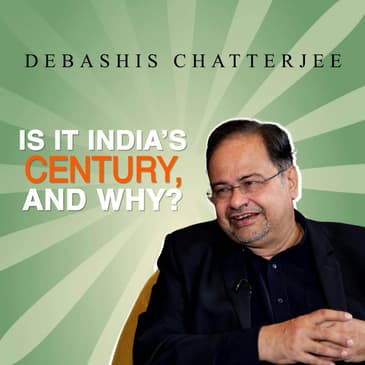
In a country still grappling with poverty and deprivation, where "chaos" is a way of life, sceptics might see this question as loaded. But for Professor Debashis Chatterjee, it’s an opportunity to rewrite the narrative.
Fresh from organizing a conference in London, titled Globalising Indian Thought, Professor Chatterjee brings a bold vision to the table—one that redefines what India can offer the world.
When we sat down for what was meant to be a 45-minute discussion, it turned into a deeply engrossing conversation that stretched over twice the time. His passion for Indian thought and its relevance today was infectious—and I hope you find as much value in it as I did.
A distinguished Professor and the longest-serving Director of an IIM, he leads one of India’s most iconic institutions—a product of Nehru’s vision to create a world-class educational ecosystem modelled on the likes of Harvard. Yet, he boldly questions, “What’s Indian about these Indian Institutes of Management?”—a question he is applying directly to IIM Kozhikode, the institution he leads.
This provocative question drives his mission to transform IIM Kozhikode into a modern-day Gurukul, blending ancient Indian wisdom with contemporary leadership.
And here’s why this matters: Did you know that more than 20 Indian-origin CEOs head billion-dollar companies globally? These leaders aren’t just products of great institutions—they’re rooted in a way of thinking that combines resilience, adaptability, and community-driven values.
As the author of books like Karma Sutra: Leadership and Wisdom in Uncertain Times and Timeless Leadership: 18 Leadership Sutras from the Bhagavad Gita, and 17 such books, Professor Chatterjee brings ancient philosophy into sharp focus for modern leadership challenges. For him, the world doesn’t need another technological revolution from the West. What it needs is a cognitive revolution, one that only India’s unique thought process can lead.
This episode isn’t just about India’s rise—it’s about understanding the mindset behind it. If you’re someone curious about what Indian thought really means, its relevance today, how to make sense of the “chaos” that India often brings, or simply want to learn what true leadership looks like, this conversation is for you.
Professor Chatterjee’s insights are profound yet practical, drawn from decades of experience and a deep belief that India is uniquely poised to lead the world—not by imitating, but by innovating and inspiring.
So, tune in to hear why he believes the 21st century belongs to India, how a cognitive revolution could reshape leadership, and what lessons this ancient yet modern nation holds for all of us navigating a rapidly changing world.
FULL VIDEO
You Tube:
https://www.youtube.com/@loveenatandonofficial
PODCAST SMART LINK
https://bingepods.com/podcast/podcast-rn7moe
Loveena Tandon: HOST: SOCIAL MEDIA HANDLES
https://www.linkedin.com/in/loveenatandon/
Twitter/X
https://twitter.com/loveenatandon
https://www.instagram.com/loveenatandonofficial/?igshid=OGQ5ZDc2ODk2ZA%3D%3D
https://www.instagram.com/tandonloveena/?igsh=MW5tOHdlc3cyMGJrOA%3D%3D&utm_source=qr
Learn more about your ad choices. Visit megaphone.fm/adchoices
[00:00:00] NASBIT's framework was Friends. My framework was Indian thought and its global impact. I have never looked back ever since.
[00:00:09] But the century does not belong to India, China or Russia. What has India got to offer? It is not about India. It is about a way of looking at the world.
[00:00:19] So am I going to be the best in the world or best for the world? You can see the pursuits of the world has taken us, brought us to this disaster.
[00:00:26] So how you apply knowledge contextually is wisdom. Unfortunately that wisdom is getting lost because we are not getting enough reflection time.
[00:00:35] Yes, it is better to have a brain drain than a brain in the drain. I am telling you this, AI is neither artificial nor is it intelligence.
[00:00:43] Behind every Chandragupta there has to be a Chanakya. Behind every Arjun there has to be a Krishna.
[00:00:48] Democracy of 1.4 people, a million people are jostling. To arrive at a certain consensus, there will be noise.
[00:00:55] And this is India's story.
[00:00:58] This is India, a story in the making. And I am your host, Laveena Tandon.
[00:01:04] Hello and welcome to India, a story in the making. My guest today is a man who harped various professions.
[00:01:11] Ultimately, to realize that his true calling is thought leadership. He has dedicated his life to globalizing Indian thought.
[00:01:23] And he very passionately argues that what the world needs today is not only the technological revolution of the West, but actually the cognitive revolution that India is brilliantly poised to provide.
[00:01:40] Professor Devashish Chatterjee, the first generation longest serving director of IIM.
[00:01:50] Thank you very, very much for your time. And I love him very much in the very true Indian spirit.
[00:01:56] He got this for me from India, one of his seven books and spiced up my life.
[00:02:02] I'm sitting in cinnamon club, the old Westminster library used to be.
[00:02:07] And now he's got me. This is what British went to India for.
[00:02:13] And still did not learn to cook.
[00:02:15] So thank you very much.
[00:02:18] And Professor Chatterjee is here to bring this bold vision of his to London, to argue on the Indian thought and how the Indian thought can be globalized.
[00:02:32] And today I want to explore the question of, is it India's century? And if so, why?
[00:02:38] So I'm going to pick your brain.
[00:02:41] Sure.
[00:02:41] First of all, thank you for this.
[00:02:43] Thank you for accepting it.
[00:02:45] No, my absolute pleasure.
[00:02:48] But I want to, before I explore any of these questions, I want to ask you your own.
[00:02:54] I have, I want to see you from the lens that you can provide me.
[00:02:59] And that is always most interesting for me to the journey of a person.
[00:03:03] Sure.
[00:03:03] So tell me about the Bardoan boy who ended up in a medical school, then in JNU where I come from and then to Harvard and now to IAM.
[00:03:18] Please tell me.
[00:03:19] Well, Bardoan is a small town, agrarian, where the dominant culture is agriculture.
[00:03:25] Yeah.
[00:03:26] And my biggest access to freedom in Bardoan town as a small boy was to get a bicycle for topping the class.
[00:03:34] And my father bought me and my brother two bicycles.
[00:03:38] And that liberated my vision.
[00:03:40] That was my envisioning a whole city.
[00:03:43] You could ride on the bicycle, move around from place to place.
[00:03:47] And it brought me a sense of expansion.
[00:03:53] And then, you know, Bardoan taught me something very, very magical.
[00:03:58] He taught me the answer to a motivational riddle.
[00:04:02] I'll cut this to my first visit to America.
[00:04:05] And I'm asking an all American audience from Harvard and MIT, Tubs.
[00:04:09] If you're asked this question, what does a half boiled egg mean?
[00:04:13] From your experience.
[00:04:15] They said half boiled egg means an egg boiled for half the time, half the usual time.
[00:04:20] I said, no, in my Bardoan habitat, half boiled egg meant a fully boiled egg cut in two halves by a fine string.
[00:04:30] So the two brothers, they would not be sibling rivalry around it.
[00:04:34] So the two brothers would get near equal halves.
[00:04:37] Fair.
[00:04:38] A fair halves because she couldn't afford a whole egg for us.
[00:04:42] So the motivational question was not how much do you need to be happy, but how much less can you have and still be equally happy?
[00:04:50] Ah.
[00:04:51] See, that gave me a perspective, which has never left me since then.
[00:04:56] So who gave you that perspective?
[00:04:58] Well, my grandmother, my mother was very, very austere in the way we were brought up.
[00:05:06] There's generosity of spirit, but austerity in goods and services.
[00:05:11] And so we had to sort of, my father had a government job and to get me to St. Xavier's school, which was the aspirational school.
[00:05:20] He had to sell off a piece of land.
[00:05:23] And you know, the strange story is that, you know, while taking admission to the school, I was asked to spell 100 words and I misspelled all of them.
[00:05:32] And so my notebook was, my answer sheet was stuck on a notice board with all red marks around it.
[00:05:38] So the headmaster told my father, sorry, he can't make it this year. He got it all wrong. He can't understand the English language.
[00:05:45] He came from a vernacular school to take admission there.
[00:05:47] Right.
[00:05:49] And my father said, he's an intelligent boy. Give him a month's time. He'll pick up pace and you can admit him.
[00:05:55] And so he struck a deal with the husband of the English teacher of St. Xavier's school.
[00:06:00] The deal was that the answers will be given to me ahead in time and I could just commit to memory and vomit those answers.
[00:06:07] But the tuition teacher had some pedigree. He would not admit just anyone.
[00:06:11] Yeah.
[00:06:11] His reputation was at stake.
[00:06:13] Yes.
[00:06:13] He said, I'm going to test this guy as well. If he's absolutely dull, I can't take him.
[00:06:19] Even for tuition class.
[00:06:20] So he asked me, do you know how to spell circus?
[00:06:23] And I said, circus is C-I-R-C-U-S.
[00:06:28] Yes.
[00:06:29] And he asked this question to the other boys in the tuition class. None of them could spell it right.
[00:06:33] I did not because I was more intelligent.
[00:06:36] But because he made a comment which said, look, this boy will go very far.
[00:06:41] He comes from a one rupee seventy-five person school.
[00:06:43] You're studying in forty-five rupee school.
[00:06:45] He'll go very far.
[00:06:46] I knew in my head that I was not that intelligent.
[00:06:49] But then I saw that Germany circus had come to town and there was the word circus.
[00:06:56] It had been inside the mouth of a hippopotamus.
[00:06:59] And I could figure out visually that this is what circus was spelled.
[00:07:07] And I was married to Sanzevius.
[00:07:12] And I wrote 17 books, not seven.
[00:07:15] By the way, seven are internationally published.
[00:07:18] But I wrote many more.
[00:07:20] But the fact is that it became an obsession to sort of get on the top of the English language
[00:07:26] and write it rather than sort of...
[00:07:27] So that was that little inflection point.
[00:07:31] Was that the making of that boy who just...
[00:07:35] Someone who takes a challenge and says...
[00:07:37] So you have the self-worth.
[00:07:39] The underdog syndrome.
[00:07:41] Ah.
[00:07:41] You see, the underdog has always got something to prove.
[00:07:45] Yes.
[00:07:46] It is not necessarily a good feeling to be an underdog all the time.
[00:07:50] But I have seen my leadership has always been a function of being an underdog in a system.
[00:07:57] Whether I got a scholarship in Harvard or I laid an IIM to stardom.
[00:08:03] It was an underdog IIM in an obscure space in Kerala.
[00:08:08] Yeah.
[00:08:08] And so the thing is that what happens is the underdog has yet got something to prove to the world.
[00:08:14] You retain that underdog?
[00:08:16] Oh yeah, always.
[00:08:17] Always.
[00:08:18] Is that your driving force?
[00:08:19] Always.
[00:08:19] You see, I wrote my first book of fiction because I thought...
[00:08:23] Somebody told me, sir, you are not known for fiction.
[00:08:25] Non-fiction sells all over the world but fiction we are not too sure.
[00:08:30] I said, no, I have to write it then.
[00:08:32] I know somebody like Sashi Tharoor did an endorsement and then Abhishtipati and all of that.
[00:08:38] When they read the book, they realized that I could also write fiction.
[00:08:42] I mean, I could always do that but the sense that it could be done by somebody who is well known for non-fiction writing.
[00:08:49] They are two different genres and if you are good in one, you cannot be equally good in another.
[00:08:53] So when you challenge those constructs that are thrown at you, you feel that you have yet to do something, yet something to live for.
[00:09:01] So you are disruptive powered by a lot of self-worth and the syndrome.
[00:09:06] But there is a lot of preparation that is required for that as well.
[00:09:09] Of course.
[00:09:10] And so it is never the talent, never just the hard work and it is never just luck.
[00:09:16] So what is the... how do you prepare to disrupt these constructs?
[00:09:21] First, you have to understand what the truth of the matter is.
[00:09:25] Most of us deal with perceptions that are borrowed.
[00:09:29] So you get to hear a comment about something that's good or not good, something that's best or not the best.
[00:09:35] These are all perceptions that are generated by majority opinions.
[00:09:40] Well, I have always challenged those because these perceptions are not equal to truth.
[00:09:45] So you have to see these are perceptions that are driven by mass minds.
[00:09:50] So when you go to the heart of what it is, then you realize that, well, the truth is something else.
[00:09:59] And just as Indian cricket took on the whole world and nobody believed.
[00:10:04] It's the Lagan syndrome playing out in reality.
[00:10:08] So the truth is that we are always great as a country.
[00:10:12] Just that we had to prove that we are great.
[00:10:15] Just to be who we actually are is the journey.
[00:10:18] And it's a beautiful thought and I think you have dedicated your life to it.
[00:10:23] But I want to still explore one more question for this Barthwan boy.
[00:10:29] Sure.
[00:10:30] Did you have that self-worth to challenge the constructs?
[00:10:36] And where did that self-worth come from?
[00:10:39] It came from love and affection of people who loved you.
[00:10:43] My grandmother, my father.
[00:10:46] And I can recall that, you know, my father always thought, he challenged perception that said I couldn't do this.
[00:10:52] He said, you have no idea what this boy can do.
[00:10:55] See, this one word, overheard, not intended for you.
[00:10:57] It was intended for a neighbor.
[00:10:59] It was not meant to be heard by me, but I overheard it.
[00:11:03] And it gives you a secret sense of worthiness.
[00:11:09] So, you have to stand tall in the eyes of somebody who believes you are that great.
[00:11:13] My grandmother equally, you know.
[00:11:15] I have never seen a woman who would slice mangoes, Alfonso-like mangoes.
[00:11:21] We call it Langrana.
[00:11:23] That's one of the best breed of mangoes.
[00:11:25] And not take a single slice for herself.
[00:11:28] She would distribute all of that.
[00:11:29] So I said, why didn't you eat mangoes?
[00:11:31] You cut them and you just...
[00:11:33] He said, because my husband loved mangoes after he passed away.
[00:11:37] I couldn't bear to eat it all by myself.
[00:11:42] And so, you live in a relational universe.
[00:11:47] Where people who identify you as worthy, they are the reason why you turn out to be so.
[00:11:55] Wow.
[00:11:56] And I think, if I forget the context which made me what I am.
[00:11:59] See, if you look at my trousers crafted in Mumbai.
[00:12:04] This jacket got stitched somewhere in the UK.
[00:12:07] My shirt comes from Singapore.
[00:12:08] Glasses crafted in China.
[00:12:10] My software called my brain.
[00:12:12] Accumulated gift of my students, teachers.
[00:12:15] My voice is a gift of my parents.
[00:12:17] So if I took away all those contributions to my life.
[00:12:20] Yes.
[00:12:23] Yes.
[00:12:24] My voice will be gone.
[00:12:26] Gone.
[00:12:27] And so, this voice is a cumulative gift.
[00:12:31] And to be able to acknowledge that in reality, to be able to live for that, I think is what makes life meaningful.
[00:12:38] How beautiful.
[00:12:40] Now I can understand the boy who becomes a man, gets steps in the world from Zavius, but first goes to medical and then leaves.
[00:12:54] I was not quite cut out for it.
[00:12:56] It is not an act of arrogance.
[00:12:58] So you gave the PMT or PETF?
[00:13:01] We used to call it joint entrance exam.
[00:13:04] Right.
[00:13:04] My father was hell-bent.
[00:13:06] I have to be an engineer or a doctor, or I could be a eunuch.
[00:13:11] Nothing wrong.
[00:13:12] I mean, in middle class Bengal, there was no other.
[00:13:15] No, in India at that time.
[00:13:17] And so my father said, you will go hungry, there will be nothing.
[00:13:20] Either of these two professional courses after plus two.
[00:13:24] So I got into, I didn't get too high a mark, but I got into a reasonably good medical school in my hometown, Berdwan.
[00:13:30] Yeah.
[00:13:31] But I was appalled at what I saw.
[00:13:34] I mean, it's like, I could as well be a butcher in a butcher shop.
[00:13:39] You didn't have it in there.
[00:13:40] Let's say that thing.
[00:13:41] I am the same.
[00:13:44] And so I said, no, that's not for me.
[00:13:45] I was cut out for something else.
[00:13:47] Yeah.
[00:13:47] So my parents stopped talking to me for a while.
[00:13:50] My food used to come from underneath the door.
[00:13:52] Because they felt shocked that I could step out and do something of my own.
[00:13:56] It was not the done thing those days.
[00:13:58] Now, of course, my own kids don't worry about it.
[00:14:00] Yes.
[00:14:01] So, I mean, he came to the same boy who he struggled to get into Xavier's.
[00:14:08] And your self-worth was a big contribution from him.
[00:14:12] And you actually, what's the word I am looking for?
[00:14:18] Not disobeyed, but you went against his wishes.
[00:14:22] Yes.
[00:14:23] That must have taken another level of courage.
[00:14:27] Yeah.
[00:14:27] But, you know, he had the last word eventually.
[00:14:30] I was in, I was in US and I was called by Motorola University in Shambagh, Chicago to deliver a talk.
[00:14:38] Because I had published my first book by then doing consciously.
[00:14:41] And they call an author who's like done some radical work.
[00:14:46] And so I was invited to Chicago.
[00:14:48] They said, we don't have a budget to pay your usual fees.
[00:14:50] And I had no fee at all.
[00:14:51] Forget about usual fees.
[00:14:53] But they said, we'll put you up in a good hotel.
[00:14:54] We'll fly you business class and we'll give you a modest honorarium.
[00:14:58] For me, the idea of a modest honorarium was Harvard Business School,
[00:15:01] where I taught a couple of classes and it was $100.
[00:15:04] So I flew in and at the end of the talk, the director of Motorola University gave me a little envelope.
[00:15:11] And I didn't open it, assuming this to be a small amount of money.
[00:15:16] After a week, when I opened it, it was $2,000 for 35 minutes of talking.
[00:15:21] So I immediately called up my father in Bharadwaj.
[00:15:23] And I said, look, you know how much my 30 minutes is worth in terms of money?
[00:15:29] And he said, how much?
[00:15:31] I converted dollars to rupees.
[00:15:34] I said, 70,000 Indian rupees.
[00:15:36] Please find out how many engineers or doctors make that kind of money.
[00:15:39] You know what he said?
[00:15:41] He said, please figure out how much of that money you're really worth.
[00:15:47] Or was this just one-off?
[00:15:48] So the fathers will always be fathers.
[00:15:51] And I don't blame him because he has seen deprivation.
[00:15:54] He has seen what it means to fend for oneself.
[00:15:58] What was he?
[00:15:59] He was a civil engineer.
[00:16:00] He worked for the government, always struggling to make ends meet.
[00:16:05] That was the reality of our lives.
[00:16:06] And so he wanted me to be a professional in my own right.
[00:16:10] So I have a secure income and all that stuff.
[00:16:14] I mean, for fathers, from his context, now he now understands him much better than we fought.
[00:16:20] But the fact of the matter is that there's always something to do
[00:16:25] because this is a grudge match with life.
[00:16:29] You have to sort of settle scores, not out of vengeance, but out of sheer joy of this euphoria that comes.
[00:16:38] You know, you surprise yourself.
[00:16:40] Today when I read seven, eight of my books, I said, did I write this or somebody else wrote it?
[00:16:46] I couldn't have done such good work.
[00:16:49] You know, it must be something else operating through me.
[00:16:52] So there's a sense of awe and disbelief about what was possible.
[00:16:58] So I want you to tell us all your trajectory of jumping from various professions and landing where.
[00:17:05] And while you do that, also, please, if you can tell me what was leading you?
[00:17:12] Was it courage? Was it, what was it that was making you take that decision?
[00:17:17] And then finally, the moment when you realize, yeah, this is what I want to do.
[00:17:22] You know, there's a discontent for every creative person will tell you the same thing.
[00:17:27] This is what you call a divine discontent.
[00:17:30] You are not, you're not okay with more of the same.
[00:17:34] So when you see everybody studying medicine, you feel, I don't know.
[00:17:40] I mean, I would just be one of the kind.
[00:17:42] And I still remember when I moved from medical school to study literature and professors of literature were telling me that,
[00:17:49] no, we wouldn't get employed.
[00:17:50] We wish we could change our horses mid-course.
[00:17:53] We do something called management.
[00:17:55] I said, well, if my gurus are telling me that this is not written, Kapil Kapoor and Jain, you know,
[00:18:01] and Akshay Mukherjee, they were stalwarts in their fields.
[00:18:04] And they seem to be unhappy with their own professional status.
[00:18:08] So I said, I said, look, if I take a subject I love as my profession or as my vocation,
[00:18:20] I destroyed the beauty of the process and the pursuit of knowledge or pursuit of truth.
[00:18:27] So if you, if you can move, so I went on hopping.
[00:18:32] I still remember chemistry honors in Scottish Church, geology in Presidency College,
[00:18:38] commerce in Sansevius, all in one year just to figure out which I was good in my score.
[00:18:43] So I got admission easily.
[00:18:45] But then it, then medical school, I realized that in all of a sudden that there's nothing wrong in being interested in the subject,
[00:18:53] but you're not pursuing a subject there.
[00:18:56] You're pursuing the subject here.
[00:18:57] In your heart.
[00:18:58] And this subject is very, very nebulous.
[00:19:01] It is not defined in cookie cutter silos.
[00:19:04] It is an, it is an energy that is welling up in you.
[00:19:08] And so once you find that, hit the purple patch.
[00:19:11] So even while I transitioned to management, I went to the best school of the world, Harvard University.
[00:19:18] And then I came back to the best school in India, I am Calcutta.
[00:19:22] People wouldn't believe that I had a background in English literature from JNU.
[00:19:26] I became the youngest director of an IIM without an IIT, an IIM education.
[00:19:32] That's amazing because you, from chemistry to medicine to then JNU doing English literature and then doing your insurance job.
[00:19:42] Right.
[00:19:43] And then going and doing your management and being in Harvard and coming back and writing all these 17 books.
[00:19:50] Yes.
[00:19:50] Good we are sitting in this Westminster, old Westminster library, thanks to Cinnamon Club and Vivek Singh for providing us this venue.
[00:19:59] Yeah.
[00:19:59] But wow, amazing.
[00:20:01] Yeah.
[00:20:02] Unbelievable.
[00:20:03] Right.
[00:20:03] So, so then you went to Harvard and then you tell me from there when you, where, where, what was that moment when you realized this is what I want to do?
[00:20:14] Yeah, there was, this was this interesting.
[00:20:16] And did money have anything to do with it?
[00:20:18] Well, yes and no.
[00:20:20] So I was on a scholarship.
[00:20:22] I got Fulbright scholarship twice, pre-doctoral and post-doctoral.
[00:20:25] Sure.
[00:20:26] My pre-doctoral work took me to MIT.
[00:20:28] Peter Senge was the reigning deity of MIT.
[00:20:31] He had published a book called Fifth Discipline and he had huge amount.
[00:20:36] He used to charge 70,000 to 80,000 USD for an hour's talk.
[00:20:41] So here his book, best-selling book called The Fifth Discipline talks about systems thinking.
[00:20:48] And his argument is that thinking systemic systemically systems thinking changes the world.
[00:20:57] I did a critique of his book in one of the well-known journals.
[00:21:00] And the critique was systems thinking hasn't changed anything in the world.
[00:21:04] What has changed the systems feeling?
[00:21:06] Unless there is a change in heart, there is no change.
[00:21:10] And he read that review and he called me to MIT to meet him.
[00:21:15] So he said, Devashish, if you can write a book based on your critique of my work,
[00:21:21] I'll be happy to write a forward.
[00:21:23] And if I do that, it will be picked up by any publisher.
[00:21:27] He got somebody from Silicon Valley without telling me.
[00:21:31] He said, you've mentored this guy.
[00:21:32] He has some spark.
[00:21:33] And so within a year of this event, and I wrote a book in 17 days,
[00:21:41] you know, you can't imagine how the 17 days panned out.
[00:21:44] I had gotten advance of 3,000 USD to write the book.
[00:21:47] And I had not written anything for nine months.
[00:21:49] So I get a little note from the publisher saying minus 3,000 USD,
[00:21:53] which means you have to return the money, which is unusual for a publisher.
[00:21:56] But then I had to finish this book.
[00:21:58] So I had this little computer, which was, which is, you know,
[00:22:03] there's shocks on all sides, there's sparks going off.
[00:22:05] So I had to type like this.
[00:22:07] And I finished this in 17 days, writing 3,000 to 4,000 words every day.
[00:22:12] And it was barely edited.
[00:22:14] And Peter Senge wrote a forward.
[00:22:16] It was published by Bhattu Rath-Heinman.
[00:22:19] And it got translated in Spanish, Portuguese, multiple languages.
[00:22:23] And it was voted the top five books in the world.
[00:22:26] Wow.
[00:22:26] I want to, I'm really digressing, but I really can't help but ask this question.
[00:22:33] A boy who wrote all the spellings wrong of English.
[00:22:37] Yeah.
[00:22:38] To writing in 17 days.
[00:22:41] Yes, that's right.
[00:22:42] And unedited.
[00:22:43] What did you do?
[00:22:44] You know, the thing is that it's not about writing.
[00:22:47] Ah.
[00:22:49] It's about the flow of thought.
[00:22:52] Like I said, you know, when you are seated in something, in a deep conviction,
[00:22:56] what comes out of you is unbelievable.
[00:22:59] Yeah.
[00:22:59] That is the, that's the truth.
[00:23:01] Yeah.
[00:23:01] And, and so when this book was published, I, within eight months of the book being published,
[00:23:06] I get a letter from John Cotter, the reigning deity of Harvard Business School.
[00:23:10] Oh yes.
[00:23:10] And Cotter sends me an invitation to join 15 thought leaders of the world.
[00:23:16] Among the 15 thought leaders, I mean, who's who?
[00:23:19] Charles Handy from England, David White, the poet.
[00:23:22] This was 2001.
[00:23:24] Peter Senge, Sikhy Pralad.
[00:23:27] I mean, you name it.
[00:23:28] All 15.
[00:23:29] I mean, I was the kid in the block.
[00:23:31] I mean, literally couldn't imagine that I would be sitting with these people in the first place.
[00:23:35] So I was asked to talk about my book, Nitin Noria, the subsequently became Dean of Harvard Business School, Margaret Whitley.
[00:23:42] I mean, this was star cast.
[00:23:44] For the first time, I recognized that I had something to say, which could move the world.
[00:23:50] And then something strange happens in this group was a person called John Masbitt.
[00:23:55] Masbitt was the advisor to four U.S. presidents.
[00:24:01] And he had an apartment in Harvard Square.
[00:24:04] So he said, Devashis, you have a heavy bag that you're carrying.
[00:24:07] I'll help you with the bag.
[00:24:08] Come spend some time in my apartment.
[00:24:10] So he actually, he's 78 years old and I was barely 29, 30.
[00:24:16] So he's pulling my bag.
[00:24:17] I was feeling ashamed.
[00:24:18] He said, no, no, I'll help you.
[00:24:19] I'm strong enough.
[00:24:20] So he's taking my bag.
[00:24:21] I go to the apartment.
[00:24:22] It's like a huge hall about twice the size of this room.
[00:24:26] And there are stickies all over.
[00:24:29] And John Masbitt was known for his book called Mega Trends.
[00:24:32] It had sold 18 million copies.
[00:24:34] He said, I had to divorce my wife because of my obsession for writing this book.
[00:24:37] All these are trends that I'm spotting on these different color codes.
[00:24:41] And I married my literary agent, but I'm still going to write this book.
[00:24:46] So he said, if you have a framework early on in life and it's a powerful framework, then everything that happens around you will be crystallized around that framework.
[00:25:00] And you'll have a very powerful body of knowledge because your framework is very clear.
[00:25:05] So Masbitt's framework was trends.
[00:25:09] My framework was Indian thought and its global impact.
[00:25:13] I've never looked back ever since.
[00:25:16] Through that frame, I could see from the lens of 1.4 billion people, how does the world look like?
[00:25:22] And it's not a small thing.
[00:25:24] So India going up the way it is, that frame has become bigger and bigger and bigger.
[00:25:28] What does it mean by a framework?
[00:25:30] Then I understood that it must be a crystallized view of the world.
[00:25:36] It's like, you know, like rock formation.
[00:25:39] You know, it doesn't fall overnight.
[00:25:41] There are many layers of...
[00:25:43] So it must have taken many million years to evolve what the Rishis of India did.
[00:25:51] To evolve this frame.
[00:25:53] And so if they have told us this many times over and over again, and they had nothing to sell.
[00:26:00] They were not sitting there and trying to sell an idea to an audience of 20 million people.
[00:26:08] They were simply telling the truth of their convictions.
[00:26:11] So I went to this place where Swami Vivekananda first entered America.
[00:26:16] This is a church that he spoke in in Aniskum, a village called Aniskum.
[00:26:20] So I went there and I meditated.
[00:26:21] And I said, look, if he had come here for something, what was it that he had come here for?
[00:26:26] Then he said...
[00:26:28] Then this voice spoke internally.
[00:26:30] And the voice said, it is the depth of that thought that says that I am the universe.
[00:26:43] I am the universe.
[00:26:46] I am not this skin encapsulated ego.
[00:26:50] I am something much bigger.
[00:26:52] I said, so look, if I could pursue this knowledge to its ultimate conclusion, realize I'm still work in progress.
[00:27:01] But if I pursue that path, which others have said is who you are, then your vocation and your avocation,
[00:27:10] what you do and what your conviction is come together.
[00:27:14] I like.
[00:27:16] Indeed.
[00:27:16] So where did you start your study of understanding this thought?
[00:27:21] Well, trust me, my first major book was Timeless Leadership based on 18 sutras of the Gita.
[00:27:31] So I went to people who lived the Gita, not who grew up.
[00:27:35] So I went to Rishikesh.
[00:27:37] I took leave of absence from Singapore where I was dean of a school.
[00:27:40] Just to spend one month in Rishikesh talking to people.
[00:27:43] So one of them advised me, so you take one chapter every day.
[00:27:47] And you have to have this austerity, no alcohol, no cigarettes, no sex.
[00:27:52] You have basic food, not trouble and you meditate on that chapter.
[00:27:58] So that book came about.
[00:27:59] It took me four years to write it.
[00:28:01] This is the longest ever I took to write a book.
[00:28:04] But then what came out of that, and that book is still in the stores in Harvard.
[00:28:09] So you followed all the rules?
[00:28:10] I followed the rules.
[00:28:11] Not for too long, but until I finished the book.
[00:28:13] And so the point I'm trying to make is this, that when you live something, it's not just cognizing it.
[00:28:24] It is living it in body, mind, spirit.
[00:28:27] Then the truth of what it is becomes evident to you.
[00:28:30] And then you see that book in the Gita has become a classic.
[00:28:33] It has stayed like a cockroach in bookstores and shelves for 25 years.
[00:28:37] And so that book is going to be my signature work.
[00:28:42] And it's not read by too many people because the truth is not always palatable.
[00:28:47] So publishers are asking me to write a more diluted version of that, which I haven't done.
[00:28:51] We'll begin now from the question that we started.
[00:28:54] Yeah.
[00:28:55] Is it India's century and why?
[00:28:58] Well, the century does not belong to India, China, Russia.
[00:29:01] The century belongs to the reality of what is.
[00:29:09] And what is, is frightening.
[00:29:14] You can see effects of climate change.
[00:29:18] The technological revolution that is taking away semblance of what you might call a human and human world.
[00:29:33] What has India got to offer?
[00:29:36] It is not about India.
[00:29:37] It is about a way of looking at the world.
[00:29:40] So am I going to be the best in the world or best for the world?
[00:29:44] So if I define India in terms of geographical boundaries alone,
[00:29:48] I'm going to have a very misleading view of India.
[00:29:51] The Rishis never thought in boundaries.
[00:29:53] They said, I'm brahmasmi.
[00:29:55] They also said,
[00:29:57] Masudhaiva kutumbakam.
[00:29:58] The entire world is a network of relationships.
[00:30:01] So there is nothing called geographical boundaries.
[00:30:05] So India is a thought.
[00:30:06] India is an idea.
[00:30:08] India is an energy body.
[00:30:10] India is a state of awareness.
[00:30:13] And for lack of a better expression,
[00:30:17] this is contained within some geopolitical barriers.
[00:30:21] But this idea that the Rishis produced in the caves of the Himalayas was for the whole world.
[00:30:28] And so Swami Vivekananda had to be believed that he would say that this quietly they meditated and they moved the world by their awareness.
[00:30:37] So if you see this awareness,
[00:30:39] it's something like this.
[00:30:41] Awareness is not thought.
[00:30:42] Awareness is not objects.
[00:30:45] Awareness is like if you have a compass and if you see the center of the compass,
[00:30:50] if you move a little at the center, the periphery moves a huge lot.
[00:30:54] Why?
[00:30:54] Because this awareness will differentiate between what is worth, what is not worth,
[00:30:59] what is valuable, what is not valuable.
[00:31:01] What is worth pursuing, what is not worth pursuing.
[00:31:04] So you can see the pursuits of the world has taken us, brought us to this disaster.
[00:31:09] This is the wrong pursuit.
[00:31:11] So we, India, Bharat, we had all this knowledge.
[00:31:19] But yet, we had people ruling over us.
[00:31:25] And we were not there and we still, still, I think we find a lot of us seeing to the West, the younger generation.
[00:31:35] Now it's coming out of it, but there was a, so what, where did we lose?
[00:31:41] And what did we lose to not have that confidence?
[00:31:45] You know, you have to understand that the domination of nature,
[00:31:49] including human nature, is not a one-sided process.
[00:31:56] The one that you're colonizing will colonize you in the future.
[00:32:01] Tagore had a beautiful expression for it.
[00:32:04] Jare tumi niche pheliacho, se tumare tani chheje niche.
[00:32:08] So loosely translated, this means the one that you have subjugated, is going to subjugate you.
[00:32:15] Because the relationship between the exploited and the exploited is not a one-way relationship.
[00:32:24] Because you can, that's what you're seeing, how history is playing out.
[00:32:31] Every, the moment, women are subjugated in a society.
[00:32:37] They come back with a vengeance.
[00:32:40] You have subjugation of people in the name of caste, creed, religion.
[00:32:47] They've all hid back.
[00:32:49] Why does it happen?
[00:32:50] Because there's a risk.
[00:32:51] Look at the performance of Afro-Americans in athletics.
[00:32:57] They were subjugated physically and they have come up with physical prowess that is incalculable.
[00:33:02] See, so what you subjugate will always spring up in another time, another space of history.
[00:33:11] So Western subjugation of India, Islamic subjugation of India was for a limited period of time.
[00:33:19] Now see what's happening.
[00:33:21] The Islamic republics are run by Indian talent.
[00:33:25] You know, Kerala runs 60% of United Arab Emirates.
[00:33:31] Look at what they have done.
[00:33:33] And so the question is in history, you have to see the larger range of history.
[00:33:36] To be able to understand that a civilization may subjugate another civilization.
[00:33:42] A culture may dominate another culture.
[00:33:45] But in that process, they are going to make themselves vulnerable.
[00:33:52] Because human nature cannot be demarcated in those strict lines.
[00:33:58] So even with the elements.
[00:34:00] So what brought the British down in India?
[00:34:01] People say Mahatma Gandhi brought down the British.
[00:34:03] How could an unarmed man bring down the British?
[00:34:07] It is the British sense of what is right brought themselves down.
[00:34:10] In the, you know, the people who are conscientious, who are looking at the exploits and said,
[00:34:15] No, this is not British.
[00:34:16] They couldn't look themselves in the eye.
[00:34:19] And so they left the country.
[00:34:21] And what happened?
[00:34:22] It is the best of British minds.
[00:34:24] The most refined consciousness of what it means to be educated, compassionate, competent human being.
[00:34:31] Was what brought down the empire.
[00:34:33] So within the context of the colonizers, there is this fault line.
[00:34:39] So coming back to your question.
[00:34:41] You know, you ask a question to a professor, you have to be prepared for a long answer.
[00:34:44] And so if you come back to this whole issue of what it means,
[00:34:49] why, if you are so good in terms of a knowledge system,
[00:34:53] why did you make, fail to make an impact?
[00:34:58] Then you have to see, you have to see India in the light of thousand years.
[00:35:04] Look at the relative wealth of India and China in 1820s, 25.
[00:35:09] We were now top three economies in the world.
[00:35:12] We were two, economy two after China.
[00:35:16] Then there was a hundred, a hundred years of hiatus.
[00:35:18] America went up, Japan went up, Britain went up, France went up.
[00:35:23] Look at the story now, 2024.
[00:35:26] So the whole cycle has come back within 150 years.
[00:35:30] You don't have to look too long to know what happens when you are deprived.
[00:35:34] You have an aspiration that you create.
[00:35:36] They have to go to Downing Street and become Prime Minister.
[00:35:39] This aspiration is what builds civilizations.
[00:35:42] Not power, not money.
[00:35:44] Like a great French said, if you have asked someone to build a ship,
[00:35:50] don't tell them about nuts and bolts.
[00:35:52] Give them an aspiration for the sea, hunger for the sea.
[00:35:56] That hunger. India is hungry.
[00:35:58] Now?
[00:36:00] I see it at the airports.
[00:36:02] Look at an Indigo flight, your luggage is going to come within five minutes.
[00:36:06] Look at British Airways airport.
[00:36:07] I don't want to say the rest.
[00:36:10] I'm not saying that one is bad or good, but there's no hunger.
[00:36:15] So India is hungry now.
[00:36:17] Of course.
[00:36:17] Is aspirational now.
[00:36:19] Of course.
[00:36:19] Where does it stem from?
[00:36:21] From visuals.
[00:36:22] We are seeing it in the streets of London, Paris, New York.
[00:36:26] We're seeing good life being lived.
[00:36:29] Constantly those images are getting bombarded to us.
[00:36:32] Do you think we are going to be immune from that aspiration?
[00:36:34] No.
[00:36:36] So it is coming from a sense of deprivation, underdog.
[00:36:41] Same.
[00:36:42] You hug back to the same issue.
[00:36:45] Underdog.
[00:36:45] So it comes back to a sense of aspiration.
[00:36:47] So what is the other side?
[00:36:48] That's human nature.
[00:36:50] We are curious to see what is in the other side of the world.
[00:36:53] And then we see that this is possible.
[00:36:57] So why do you say India is aspirational and hungry for the other side of the world?
[00:37:03] The other side of the world, on the other hand, is a lot of technology, a lot of things that you say is not what the world needs.
[00:37:14] How would one balance what India, the hungry India wants to what the world needs?
[00:37:20] Yeah.
[00:37:22] You see, the thing is, it's not against technology.
[00:37:28] Technology is not the problem.
[00:37:30] The problem is how you use technology.
[00:37:32] The use, the human use, that's why I'm calling it a cognitive revolution.
[00:37:38] How do I use the smartphone?
[00:37:42] Now there's a farmer in India.
[00:37:45] He bought a smartphone and it kept ringing in the middle of a conversation with a journalist.
[00:37:49] The journalist was urging him to pick up the phone.
[00:37:52] And he wouldn't even look at it.
[00:37:55] So at the end of the conversation, the journalist asked him,
[00:37:58] You have the phone to pick up the phone?
[00:38:02] He said, I bought the phone to serve me.
[00:38:06] I am not here to serve the phone.
[00:38:08] Yeah.
[00:38:08] So are your priorities clear?
[00:38:10] If you have the wisdom to know how to use knowledge, this is the problem.
[00:38:14] The problem is, knowledge is something like this.
[00:38:19] Knowledge is knowing that tomato is a fruit and not a vegetable, by definition, biological definition.
[00:38:27] But wisdom is to know, have the prudence not to put tomato in a fruit salad, although it is a fruit.
[00:38:35] So how you apply knowledge contextually is wisdom.
[00:38:39] But unfortunately that wisdom is getting lost because we are not getting enough reflection time.
[00:38:45] How to use technology appropriately.
[00:38:48] What are some of the things? So technology is pervasive.
[00:38:50] If it dominates your life in ways, then it's like another narcotic.
[00:38:57] As simple as that.
[00:38:58] I cannot agree more.
[00:39:01] And as you speak, I think of my son and sometimes myself as well.
[00:39:06] Right.
[00:39:07] The time to reflect, isn't it?
[00:39:09] Right.
[00:39:09] I do, before I go to the next, I do want to ask you after, I mean, you are an IAM director.
[00:39:15] You travel all over the world.
[00:39:17] You've written all these 17 books and writing much more.
[00:39:20] How do you get this time to, time and the management and the reflection and all that you speak about?
[00:39:28] And family, I'm sure.
[00:39:30] Yeah.
[00:39:31] You know, the thing is, it's not that there are no trade-offs.
[00:39:34] There are trade-offs.
[00:39:35] Before I, there was to be a time when I would not eat breakfast until I wrote 250 words.
[00:39:41] No breakfast.
[00:39:42] So you can imagine, I didn't write a book really.
[00:39:45] I wrote a few words and words became line, a line became, a few lines became a paragraph,
[00:39:50] a paragraph became a page, a page became a book, but it was an everyday discipline.
[00:39:55] But I think more than that, it is not time.
[00:39:58] There's nothing called chronological time.
[00:40:00] Chronological time is an invention.
[00:40:01] Before 14th century, there was no clock.
[00:40:03] So what you call time is nothing but flow of energy.
[00:40:06] So if you are one pointed in your awareness, then you get to do work much faster than if you were multi-pronged.
[00:40:17] The rishis called it Ekagrata.
[00:40:19] So Ekagrata creates a Virat Kohli in championship form.
[00:40:23] It creates a Lata Mangeshkar.
[00:40:25] Because they have this one pointedness of attention, which makes it easier for them to do things much more efficiently.
[00:40:34] So they have removed those distractors.
[00:40:39] We are getting better.
[00:40:40] How do you remove the distractors?
[00:40:42] No, see, we are getting better and better at getting distracted.
[00:40:44] Even the distractor is not out there anymore.
[00:40:47] If you think every 10 seconds you are looking at your blip on your phone,
[00:40:53] which means that now you've gotten into an addictive relationship with your own brain,
[00:40:59] which is looking for a little surge of dopamine every 10 seconds.
[00:41:03] So if it is not that phone, something else will distract you.
[00:41:06] Or you are seeking to be distracted.
[00:41:08] Let's put it this way.
[00:41:09] So you've gotten better not at concentrating, which is where success comes from.
[00:41:13] We are getting better at getting distracted.
[00:41:16] So I have to remove the barriers towards that.
[00:41:20] So I have this formula which is my potential is capital P, but my performance is small p.
[00:41:26] Why is my potential not translating as my performance?
[00:41:30] It's because of that I, called interference, minus I.
[00:41:34] So how many interfering barriers can I remove when I get to work?
[00:41:39] So when I get to work, I have to be doing solo tasking.
[00:41:43] So I'm eating, I'm drinking a cup of coffee.
[00:41:47] I'm not thinking of Aisharir Raya and Madhari Niksha.
[00:41:50] I'm only drinking coffee.
[00:41:51] I'm a coffee devotee at that point in time.
[00:41:54] So I have my coffee, I smell the aroma.
[00:41:58] And then I taste it.
[00:42:00] And so what happens is if my entirety of my attention goes into one thing at a time,
[00:42:07] then the depth of my awareness is able to grasp a thing a lot faster.
[00:42:13] Then if I had to do 20 times to figure out where did I keep the book,
[00:42:17] if my mind goes straight into where it is, then I save a lot of time trying to hunt for it somewhere else.
[00:42:24] So you're talking about focused.
[00:42:26] Well, focus is a shallow expression.
[00:42:30] It is not ek agrita alone.
[00:42:32] It is ek nishchata.
[00:42:35] Focus means only the mind going there.
[00:42:37] It is the mind and the heart.
[00:42:38] Mind and the heart going there.
[00:42:39] So it's both.
[00:42:40] You're emotional.
[00:42:41] You're present to it.
[00:42:42] Completely.
[00:42:43] You're emotionally present.
[00:42:44] You're cognitively present.
[00:42:46] You are at it.
[00:42:47] And there's nothing else that matters at that point in time.
[00:42:50] I think most of the great works.
[00:42:52] Bismillah Khan is playing the Sanai, looking at the Ganges.
[00:42:55] The Ganges was his teacher.
[00:42:57] He didn't have a teacher.
[00:42:58] And he used to play for eight hours, nine hours at a stretch.
[00:43:02] His rhythms would vary based on the waves, the sound of the waves.
[00:43:06] I mean, that's why he's world class.
[00:43:09] And so the same story everywhere.
[00:43:12] Tendulkar would drink two bottles of water.
[00:43:15] Previous night, he had to bat in Chennai and it is very hot.
[00:43:19] He knew he would be dehydrated.
[00:43:22] So he will prepare the organization of your life around the critical thing that you have to do.
[00:43:29] That organization is just as important.
[00:43:32] So you have to organize away the distractors.
[00:43:35] Because if you're still thirsty while you're batting, your energy is divided.
[00:43:39] Your heart and mind are not in caught.
[00:43:41] This is the Arjuna syndrome.
[00:43:43] His heart and mind are not working together.
[00:43:45] Therefore, it requires Krishna to integrate Arjuna.
[00:43:48] This is as clear as daylight to me today.
[00:43:52] How beautifully you have actually got me to this point.
[00:43:56] How you have written on the principles of leadership.
[00:44:00] Right.
[00:44:02] And karma sutra.
[00:44:03] Right.
[00:44:03] And you're inspired consistently by Gita.
[00:44:06] Talk me through how Gita or what else teaches us leadership and what is that.
[00:44:15] See, I don't talk about the Gita from the priests or a religious perspective.
[00:44:24] For me, Gita is a song.
[00:44:27] Gita means song.
[00:44:29] It's a celestial song.
[00:44:31] You look at a bird song.
[00:44:33] Bird is not trying to win a competition.
[00:44:35] It is singing from its heart.
[00:44:38] What it is singing, it is in sync with reality.
[00:44:41] The weather changes and the bird feels like singing, so it is singing.
[00:44:45] If it is hungry, it is calling out for food.
[00:44:48] So there is no difference between its intent and its action.
[00:44:53] Gita is just that.
[00:44:55] It's a song that tells us about reality.
[00:44:59] It's a song sung where in the middle of a battlefield,
[00:45:02] there is a performance breakdown and there is a, you know,
[00:45:06] there's a poet's imagination that there are two people.
[00:45:09] Let's forget Arjun and Krishna.
[00:45:11] You know, a lot of people ask me, were they real people?
[00:45:13] I say, how does it matter?
[00:45:14] They are in the hearts and minds of billions of people.
[00:45:17] They have mind shared and heart shared.
[00:45:18] So they exist there.
[00:45:20] So forget about historical Krishna.
[00:45:23] That's not what I'm quibbling about.
[00:45:25] I'm saying what they're saying, is it true or not?
[00:45:27] If it is not true, how has it survived 3,000, 4,000 years?
[00:45:30] There is something that the song is telling me.
[00:45:33] So what is the song telling me?
[00:45:34] It's telling me that please be involved in what you are,
[00:45:39] process of living.
[00:45:40] Results will follow.
[00:45:42] It does not mean that I will not look after results.
[00:45:45] Only an idiot can do work without looking at results.
[00:45:48] It is saying, please ensure that you look at results.
[00:45:53] But at the same time, results, looking at results will not deliver the results.
[00:45:58] I'll give you a simple example that will make the entire Gita clear to you.
[00:46:02] Most of our ancestors just repeat the Gita.
[00:46:04] Do your work.
[00:46:05] Don't look at the fruits.
[00:46:07] I can't imagine doing any work without thinking of the fruits.
[00:46:11] Of course, I will think of the fruits.
[00:46:13] Imagine you go to catch a bus.
[00:46:15] You go to catch the bus.
[00:46:17] You go there on time.
[00:46:18] The bus comes on time.
[00:46:19] Between effort and results, there is sync.
[00:46:24] Synchronization.
[00:46:25] You catch the bus on time.
[00:46:26] No problem with that.
[00:46:27] This is scenario one.
[00:46:29] Scenario two, you go to catch the bus.
[00:46:30] The bus just goes past you.
[00:46:33] And you stamp your feet and say, it cannot do that.
[00:46:36] How can it go away without taking me?
[00:46:38] It has gone early.
[00:46:39] Stuff like that.
[00:46:40] You try to rationalize.
[00:46:41] But the bus is already gone.
[00:46:43] So the results are less than expected.
[00:46:45] Here is the effort and the results are less than expected.
[00:46:48] And there is frustration.
[00:46:50] The third scenario, you go to catch the bus.
[00:46:53] The bus has gone past you.
[00:46:54] But a friend of yours has come over and gives you a ride.
[00:46:58] And reaches you to your office faster than the bus.
[00:47:02] The results are more than expected.
[00:47:05] Right?
[00:47:05] The fourth scenario, you go to catch the bus.
[00:47:08] You don't catch the bus.
[00:47:10] You run over via Yamaha and you are in the land of Yamaha.
[00:47:15] Totally unexpected.
[00:47:17] There is no relationship between efforts and results.
[00:47:20] Gita says that these four scenarios will happen to each one of us.
[00:47:24] We will get results less than expected, equal to expected, more than expected, and totally unexpected.
[00:47:31] Who believes he is going to or she is going to die?
[00:47:33] But all these will come in your life.
[00:47:36] All you have to do is to keep an equilibrium.
[00:47:38] It's called sthita pragya.
[00:47:40] Mental equilibrium to accept those results.
[00:47:43] Which has nothing to do with your effort.
[00:47:45] This is a non-linear relationship between your effort and the results.
[00:47:49] Because results are given by larger context.
[00:47:52] You don't give yourself results.
[00:47:55] You can work as hard as you want.
[00:47:57] But when results come, they will come in four formats.
[00:48:00] So be prepared for all the four.
[00:48:02] For that you need equilibrium of the mind.
[00:48:05] So Gita's solution is very clear.
[00:48:07] Don't be upset when things go down.
[00:48:09] Don't be too jumpy when they go up.
[00:48:12] Because they are going to even out in the long run.
[00:48:14] This is study of nature.
[00:48:15] This is Rishi's study of nature.
[00:48:16] But if everything is going to even out in the long run, then where is the point of karma and effort?
[00:48:22] This is what it is.
[00:48:24] When I am immersed in the work,
[00:48:28] the intrinsic value of the work,
[00:48:32] the value of being immersed gives me the kind of delight,
[00:48:36] the joy, the sense of accomplishment,
[00:48:38] which even results do not give.
[00:48:40] Because results are momentary.
[00:48:41] You can see, I wanted the results.
[00:48:44] The result has come.
[00:48:46] But the euphoria has gone in the next 10 minutes.
[00:48:51] So was I really pursuing the result or was I pursuing a
[00:48:56] completely engaged and involved process within me?
[00:48:59] What was the pursuit?
[00:49:01] Was it there or was it here?
[00:49:02] A lot of people go on vacation.
[00:49:04] And they go to the mountains, they go to the seashore.
[00:49:07] They think mountains is giving me happiness.
[00:49:10] Mountains are giving you happiness.
[00:49:11] These are just rocks.
[00:49:13] Sea is saline water.
[00:49:14] It can't give you happiness.
[00:49:16] What gives you happiness is your expanded self.
[00:49:19] In the company of the mountain,
[00:49:21] your selfish self expands to selflessness.
[00:49:25] Because in nature, you are not competing with nature.
[00:49:27] You are not telling the mountain,
[00:49:29] please move away.
[00:49:31] I have to, or don't grow so much.
[00:49:34] Right?
[00:49:34] You are not in competition.
[00:49:36] So your self, that is forever expanding.
[00:49:40] This expansion of self is happiness.
[00:49:42] And so when it expands, I attribute that expansion to the mountain.
[00:49:46] But that's not what it is.
[00:49:47] It's happening inside.
[00:49:49] So the results that come to you is a consequence of a deeply
[00:49:53] and perfectly carried out process.
[00:49:56] So Gita is very simple.
[00:49:57] It says, please follow process.
[00:49:59] Results will come.
[00:50:00] But they may not come according to your ego's desires.
[00:50:03] They will come according to reality.
[00:50:04] But there is a tendency, the process is right.
[00:50:07] The results will be unlikely to follow.
[00:50:09] So pay attention to the process.
[00:50:11] That's all it is saying.
[00:50:13] Yeah, that's all it is saying.
[00:50:14] There is nothing great.
[00:50:16] It's a song that we keep in mind constantly.
[00:50:20] It's not that you can follow everything.
[00:50:22] But if you keep this in mind,
[00:50:26] the accumulated wealth of what you get at the end of the day is phenomenal.
[00:50:31] Do you think India today that is hungry and aspirational
[00:50:36] is sitting on the foundation of this knowledge
[00:50:39] or they are running at and to the West
[00:50:43] and still aspiring from that point of view?
[00:50:46] It is but natural.
[00:50:48] I mean, if wherever there is light,
[00:50:50] moths will go there.
[00:50:52] It's human nature to be attracted to the sensory world.
[00:50:56] There's nothing wrong in it.
[00:50:58] You know, a cow cannot desire.
[00:50:59] Only a human being can desire.
[00:51:00] It's our privilege to be able to desire.
[00:51:02] To have a good life.
[00:51:03] Why would they not go?
[00:51:05] So people ask me a question about brain drain of India.
[00:51:07] I said, it's better to have a brain drain than a brain in the drain.
[00:51:11] You know, it makes no sense.
[00:51:13] You know, you are in a ghetto like...
[00:51:16] So opportunities come and Indians have gone out of India
[00:51:19] and have made their mark.
[00:51:21] Heads up to them.
[00:51:22] But having done so, have they lost their moorings?
[00:51:26] Have they understood that they have come here from the space of aspiration
[00:51:30] that they got there?
[00:51:32] Have they gone back and contributed something to the space from where they have grown?
[00:51:37] You see, it is this hunger that has given them this achievement.
[00:51:41] Are they going to do something to satiate the hunger that is still there?
[00:51:44] 200 million Indians still go hungry.
[00:51:46] Have they done something about it?
[00:51:48] Having accumulated this kind of wealth.
[00:51:50] If you haven't done anything about it,
[00:51:53] then you have not discharged your debt to your own self.
[00:51:56] This is my little story.
[00:51:58] And see, we are saying Indian center, India center in London,
[00:52:03] can be easily funded by so many people
[00:52:06] who have the debt worth of millions of pounds.
[00:52:11] I mean, if they did that,
[00:52:13] if you do a great service to the rishis,
[00:52:16] who were austere,
[00:52:17] they ate one meal, sometimes no meal a day,
[00:52:20] but they have left behind them a knowledge base
[00:52:25] that is now ruling the world.
[00:52:28] Now, out of service to them,
[00:52:30] we call it rishirin in India.
[00:52:32] Is it possible?
[00:52:33] That's why teachers were respected.
[00:52:35] Their creature comforts were taken care of.
[00:52:37] They could produce those kind of work
[00:52:38] because they didn't have to fend,
[00:52:40] do a 95 job or sell their knowledge for profits.
[00:52:44] That's why the purity of that knowledge was retained.
[00:52:48] And the society supported it.
[00:52:50] So the extended society of India and London
[00:52:52] can do a little bit
[00:52:54] to make that knowledge capital that we have,
[00:52:57] that we are, survive.
[00:53:00] And that is very important for us.
[00:53:02] For me at least, that's a very important thing.
[00:53:04] When you come with these kind of bold visions
[00:53:07] that India is providing the thought leadership to the world,
[00:53:10] we need cognitive revolution.
[00:53:13] To explain that first.
[00:53:16] How are you received, let's say in London?
[00:53:21] In London, in the city.
[00:53:24] Or anywhere in the world.
[00:53:27] You see, austerity is a way of life.
[00:53:29] I'll give you an example of, let's say Narayan Murthy
[00:53:32] and Sudha Murthy,
[00:53:34] the couple that has built huge wealth.
[00:53:37] But I heard Narayan Murthy say
[00:53:40] that I would not spend more than 5,000 rupees
[00:53:42] on my provisions in the whole month.
[00:53:45] I heard Sudha Murthy say
[00:53:47] that whenever I buy clothes for my,
[00:53:50] used to buy clothes for my children,
[00:53:53] if I buy a new clothes,
[00:53:54] one has to go out of the closet.
[00:53:57] So I'm not going to change the closet size.
[00:54:00] So when I buy something new,
[00:54:01] the old one has to be given away.
[00:54:02] That is what has given them the ability to see
[00:54:07] what wealth creation is all about.
[00:54:09] Wealth creation is not about
[00:54:11] just accumulating something,
[00:54:15] resources, money.
[00:54:16] Wealth creation is about the spirit of
[00:54:21] what you might call the other-centered universe.
[00:54:23] So when an entrepreneur makes money,
[00:54:26] he's actually making a sacrifice.
[00:54:27] He has to employ so many people,
[00:54:29] first pay their salaries,
[00:54:31] then if there is a profit,
[00:54:32] he can keep it for himself.
[00:54:34] But if you can't pay your salaries,
[00:54:36] this is what Tata's did.
[00:54:37] That's why they are an institution
[00:54:38] unto themselves.
[00:54:40] When there was a crunch,
[00:54:42] Jamshedji Tata,
[00:54:43] he pawned his own wife's gold ornament
[00:54:46] to be able to pay salaries in Jamshedpur.
[00:54:48] He said, they come first.
[00:54:50] I still remember, you know,
[00:54:52] J.R.D. was visiting Jamshedpur
[00:54:54] and people were shouting slogans.
[00:54:56] And he said,
[00:54:57] why are they shouting slogans?
[00:54:58] HR head said, they saw you,
[00:55:00] they want to extract some advantages.
[00:55:02] Please ignore them.
[00:55:03] He said, no, I can't ignore the fact.
[00:55:04] They can shout slogans.
[00:55:05] That's not a problem.
[00:55:06] But I can't ignore the fact
[00:55:08] they're shouting under the hot sun.
[00:55:10] And there is no water source there.
[00:55:12] So give them some lemon water
[00:55:14] and give them a shade.
[00:55:15] They can shout.
[00:55:16] So the point one is trying to make
[00:55:18] is this, that the sensitivity
[00:55:19] to see what you call wealth
[00:55:22] is what is coming from the efforts
[00:55:24] of a lot of other people
[00:55:27] to whom you now have an obligation
[00:55:30] to look after.
[00:55:32] That sensitivity,
[00:55:33] it's not just about paying a salary.
[00:55:35] It's about saying, you know,
[00:55:36] this human entity is
[00:55:39] is the process through which
[00:55:41] my wealth is getting created.
[00:55:43] And so the accumulated wealth I have
[00:55:44] is nothing but a trust
[00:55:47] that I have to hold in trust
[00:55:48] because there are so many people's efforts.
[00:55:50] that thinking itself originates in India.
[00:55:54] The whole trustorship principle
[00:55:57] Vasudeva Kutubbhagam
[00:55:58] is an ultimate expression of trustorship
[00:56:01] which the Tata's organizationally adopted.
[00:56:04] And you can see that the entity has become
[00:56:06] such a powerful entity all over.
[00:56:08] So in London, this is what I recognize.
[00:56:10] The people, one generation's austerity
[00:56:12] is another generation's opulence.
[00:56:15] So having a good life is not the problem.
[00:56:17] But you have to understand that life is not just yours.
[00:56:19] It's a seamless network of peoples and processes.
[00:56:23] Are you sensitive to that?
[00:56:25] If you're not, then
[00:56:27] your wealth creation comes at the cost.
[00:56:29] You're outsourcing the social and environmental cost
[00:56:32] of creating wealth.
[00:56:33] And it will get to you sooner or later.
[00:56:37] Okay.
[00:56:38] I'm going to move on to your IM
[00:56:41] and how you have decided to run it.
[00:56:49] So I wanted you to tell actually everybody about the IMs first.
[00:56:53] Because not everybody might know it.
[00:56:56] And tell me how this concept that was very much based on trying to compete with the West.
[00:57:04] And the institutions of the West.
[00:57:06] How are you indigenizing it as well?
[00:57:08] So take us through the journey.
[00:57:10] See, the first two IMs, IM Calcutta and IM Ahmedabad, were set up within one day.
[00:57:16] Indian Institute of Management.
[00:57:17] Indian Institute of Management.
[00:57:18] was set up by Harvard and MIT.
[00:57:22] Harvard set up in Ahmedabad,
[00:57:23] the MIT set up in Calcutta.
[00:57:25] There their professors come and teach.
[00:57:26] The idea was as India industrializes,
[00:57:29] it requires management talent to run the country's industry, its organizations.
[00:57:35] So they started a modest skill based on those models of Harvard and MIT.
[00:57:39] And then as we evolved, as we 100 years closer to independence,
[00:57:43] we recognized what is Indian about Indian Institute of Management.
[00:57:47] There's nothing Indian.
[00:57:48] So why call it Indian Institute of Management?
[00:57:50] It is a rhetorical question because there was nothing really Indian about it.
[00:57:54] So we said, okay, if India has to go to the global stage,
[00:57:58] how will we do things differently compared to the West?
[00:58:03] So I have a flight of steps leading to my campus
[00:58:07] and they used to be called Harvard steps.
[00:58:09] So I asked the question to my faculty and my students,
[00:58:12] do we want to be a second rate Harvard or a first rate Indian Institute?
[00:58:16] Why would I have to imitate in order to succeed?
[00:58:19] I may be inspired by Harvard, MIT, Oxford, Cambridge,
[00:58:25] but why would I have to imitate?
[00:58:26] Isn't there, we have begged for technology,
[00:58:29] we have begged for money in the past,
[00:58:32] but why should we make for ideas?
[00:58:34] Yes.
[00:58:34] In the 1.4 million people jostling for survival.
[00:58:37] They must have some pretty good ideas to be able to survive.
[00:58:40] So why do we take some of that?
[00:58:42] So we looked at Indian models of wherever we excel,
[00:58:46] looked at, you know, Narayan Vidhaya layer,
[00:58:49] where Devi Shetty is performing a surgery at a fraction of the cost of New Zealand.
[00:58:54] Better quality of service in Shankar Natural Eye.
[00:58:57] Eye surgery is done better than National Health Service
[00:59:00] in terms of volume and quality if you put this together.
[00:59:03] And so if you look at success of some of the Indian enterprises,
[00:59:07] creating value for money for many.
[00:59:10] This is the addition.
[00:59:12] Value for money everybody understands.
[00:59:14] So the more money I pay, the better product I get.
[00:59:17] This is a typical Western model.
[00:59:20] Japan challenged it for the first time by creating those cars,
[00:59:23] which was equally good but lower price.
[00:59:27] So moderate or lower price does not mean low value.
[00:59:31] It's a Japanese challenge that construct.
[00:59:33] But India had always had that in mind.
[00:59:35] So how do you create value for so many people,
[00:59:39] which will also perform?
[00:59:41] So if you look at shampoo sashes in India,
[00:59:44] you get sashes for two rupees.
[00:59:46] And the shampoo inside the sashes is the same quality as the original
[00:59:49] because these auto drivers and farmers can't afford to buy a whole bottle.
[00:59:54] So you take the same quality and put it in a price point that they can afford.
[00:59:58] Nigeria followed it.
[00:59:59] So every country that is more or less like India in terms of purchasing power
[01:00:04] has adopted that model.
[01:00:05] So there is a model.
[01:00:07] Fortune magazine was in,
[01:00:10] I did a talk for AOL, Time Warner in Hong Kong.
[01:00:16] So I said,
[01:00:17] how many copies of Fortune magazine do you sell in India?
[01:00:19] They said,
[01:00:20] 50,000.
[01:00:21] Our target is to go up to 75,000.
[01:00:25] I said,
[01:00:27] why is that so?
[01:00:28] You know how magazines are read in India?
[01:00:30] They're shared.
[01:00:32] So if I read one page,
[01:00:33] somebody is looking at another page from a crowded train.
[01:00:36] So if you make the price enticing enough for people to buy,
[01:00:40] and then they can share because the value of sharing exists in the middle class,
[01:00:45] lower middle class.
[01:00:46] As they go up,
[01:00:47] they will not share.
[01:00:49] On the planes,
[01:00:50] people don't talk to each other,
[01:00:51] but you go to an undeserved compartment in the train.
[01:00:53] They're constantly chatting away,
[01:00:55] sitting on each other's laps.
[01:00:56] And so I said,
[01:00:57] to be able to understand India's demographic advantage,
[01:01:02] you have to look at relational advantage.
[01:01:04] And you have to tie up a product or a service
[01:01:07] to how people think,
[01:01:08] how they behave.
[01:01:10] Because of circumstances,
[01:01:11] because sharing is a way of life.
[01:01:12] I remember,
[01:01:13] I used to commute
[01:01:15] from my local town,
[01:01:17] Burdwan, to Calcutta for my first job.
[01:01:19] And I can't afford to read a newspaper all by myself,
[01:01:22] although I bought it.
[01:01:24] Somebody would take care of the sports page,
[01:01:25] somebody would take the weather page.
[01:01:27] And if you did not give it,
[01:01:29] it would be considered a social offense.
[01:01:31] And so,
[01:01:32] it was okay,
[01:01:33] because that's how you shared.
[01:01:35] Yes.
[01:01:35] You know?
[01:01:37] It is hard for people to understand,
[01:01:41] to find hard to share food also.
[01:01:43] And trust me,
[01:01:43] just look at the contrast.
[01:01:44] I was in Pigalle station in France,
[01:01:47] in Paris.
[01:01:49] People had warned me there would be pickpockets.
[01:01:51] So I was very conscious about my wallet.
[01:01:55] This guy is literally picking my pocket.
[01:01:57] And the state is moving,
[01:01:59] and everybody else is reading a newspaper.
[01:02:01] And so nothing happened.
[01:02:02] They are seeing my pocket is being picked,
[01:02:03] and I am holding this guy's hand.
[01:02:05] He is in shame.
[01:02:06] He is putting his head down.
[01:02:08] And he wants me to let him go.
[01:02:10] And I am appealing to the silent multitude
[01:02:14] sitting on the train.
[01:02:16] Nobody responds.
[01:02:17] Because it is a way of life.
[01:02:18] His pocket is being picked.
[01:02:20] How does it matter to me?
[01:02:21] This indifference, social indifference.
[01:02:23] If this was in Calcutta,
[01:02:25] you would have been bitten to pulp.
[01:02:27] That is a different matter.
[01:02:28] Because there is something called a community,
[01:02:32] sense of community.
[01:02:34] Community together.
[01:02:34] We have to stand up for it.
[01:02:36] That is missing, completely missing.
[01:02:38] So you are getting this Gurukul system
[01:02:40] Yes.
[01:02:41] in your institute.
[01:02:45] Cozikur?
[01:02:45] Yeah, I have just about designed a classroom
[01:02:48] that are all the elements of nature.
[01:02:51] There is grass underneath,
[01:02:52] there will be a vertical garden,
[01:02:54] there will be huge ceilings with light coming in.
[01:02:56] The idea of a Gurukul is that you learn
[01:02:58] as much from nature
[01:03:00] as you learn from a book or a teacher
[01:03:02] or from each other.
[01:03:03] Because every learning
[01:03:05] is embedded in nature.
[01:03:06] Nature is teaching you.
[01:03:07] But if you don't have nature around you,
[01:03:09] if you only have a concrete block,
[01:03:12] you are not seeing the shifting seasons.
[01:03:15] You are not seeing light
[01:03:18] and shadow playing on the horizon.
[01:03:21] So you can see transience of life.
[01:03:23] And all of that.
[01:03:24] So nature gives you a lot of insights.
[01:03:27] And time for reflection.
[01:03:29] That is missing.
[01:03:30] So if I were to put this in a question,
[01:03:33] what is the difference between a Gurukul
[01:03:35] and a traditional institution?
[01:03:39] What would that be?
[01:03:40] See, Gurukul is about the whole of life.
[01:03:45] You learn with the teacher,
[01:03:47] stay with him,
[01:03:48] watch him, how he moves,
[01:03:50] how he eats,
[01:03:51] what he does.
[01:03:51] So by osmosis,
[01:03:53] some of that transfers to you.
[01:03:56] It's not cognitive transfer.
[01:03:58] It's not as one computer downloading data
[01:04:00] to another computer,
[01:04:01] which happens in classrooms typically.
[01:04:03] It is about learning together.
[01:04:06] You see,
[01:04:07] first when you teach in a Gurukul,
[01:04:09] you are supposedly teaching a particular subject,
[01:04:13] whether it is Naya or astrology
[01:04:15] or whatever it is that you're teaching.
[01:04:18] Then you realize that it's not a subject that you're teaching,
[01:04:20] you're teaching subjects.
[01:04:23] Each one is different.
[01:04:24] So you have to customize transmission knowledge based on the temperament of the learner.
[01:04:30] So from teaching a subject from your memory,
[01:04:33] you're teaching subjects who are sitting there.
[01:04:36] Then you realize it's neither the subject nor the subjects.
[01:04:39] It is the in-between space that you are maneuvering.
[01:04:43] So how do you deliver nine lectures at the same time?
[01:04:49] You see, nine students.
[01:04:51] So switch simply means that there has to be an expansion of awareness
[01:04:58] to be able to pick up cues.
[01:04:59] Somebody is not getting it in the class.
[01:05:02] That skill is unfortunately getting lost.
[01:05:04] It's like theater.
[01:05:06] You are performing, but you're also in tune with the audience
[01:05:10] and figure out the different parts of the audience some audiences getting.
[01:05:13] Shakespeare was a master.
[01:05:15] He had this nutcracker scene where people are settling down.
[01:05:19] There will be nothing serious.
[01:05:21] There will be some joker scene
[01:05:23] and people will be still cracking nuts, making noise, settling in.
[01:05:26] So he allows for that.
[01:05:28] So Gurukul is allowance for temperaments that are different,
[01:05:33] differently-abled students to pick up.
[01:05:36] So they were small classrooms and intimate conversation with the teacher,
[01:05:42] living with his family and learning through osmosis.
[01:05:48] This is in the West.
[01:05:49] This is called the apprenticeship model.
[01:05:51] So the master and the apprentice,
[01:05:53] the French and the Germans have perfected.
[01:05:55] Very expensive.
[01:05:57] That's true.
[01:05:58] But who has made it expensive?
[01:06:02] How expensive can it get?
[01:06:04] It depends on exclusive.
[01:06:06] If you're making it exclusive,
[01:06:08] then it will be expensive.
[01:06:09] But if you get teachers, they'll be teaching other people.
[01:06:12] So if you want to hold it on yourself,
[01:06:14] if you're an institution become excellent,
[01:06:17] but it is exclusively excellent,
[01:06:19] then it is not creating excellence as a way of life.
[01:06:23] It is preserving excellence as an ossified fortress,
[01:06:25] not a laboratory of experiment.
[01:06:27] Got it.
[01:06:29] That's where the change is.
[01:06:29] Now, this brings me to a point where I want to ask,
[01:06:33] and then we will go to our last in the next section is,
[01:06:38] we had this Gurukul system.
[01:06:41] We have all this knowledge.
[01:06:44] IAM is where a lot of the world are getting their CEOs.
[01:06:51] Why are the institutes still not in the top ten?
[01:06:55] What is it that is lacking?
[01:06:57] Or what is it that is not being recognized?
[01:07:00] Which one is the truth?
[01:07:02] Who decides that we are not in the top ten?
[01:07:05] And does it matter?
[01:07:06] No, it does matter.
[01:07:07] Just look at this.
[01:07:08] For instance, internationalization is a criteria for most rankings,
[01:07:14] financial times and all of that.
[01:07:18] Now, somebody who was born in Brussels, educated in Germany,
[01:07:23] now works in France.
[01:07:25] He is an international student.
[01:07:28] He is in three countries.
[01:07:29] Somebody who is born in Jammu and Kashmir,
[01:07:31] educated in Delhi, working in Bombay,
[01:07:33] is not international.
[01:07:35] I mean, how can that be?
[01:07:36] You see, if it's passport counting,
[01:07:38] then India would be,
[01:07:40] every state of India is a different culture,
[01:07:41] a different country.
[01:07:42] So there is a skewed version of what constitutes.
[01:07:45] This year in QS ranking and also financial time ranking,
[01:07:50] ten Indian institutions have surfaced in top hundred.
[01:07:52] Because you have cracked the code.
[01:07:54] You have cracked the code.
[01:07:55] We are still not internationalized,
[01:07:56] but we are saying 15% of our seats will be open to the world.
[01:08:00] In research and publication,
[01:08:02] we are catching up with the world.
[01:08:03] So the question is,
[01:08:05] these institutions are not global.
[01:08:06] It's only a skewed version.
[01:08:08] It's like Indian cricket.
[01:08:10] You give us level playing field.
[01:08:12] You give us the right stadiums.
[01:08:13] You give us equal opportunity spaces.
[01:08:17] And see, so the point is,
[01:08:19] IIMs are world famous in India.
[01:08:21] Why they are world famous in India?
[01:08:23] Because we are this Indian economy
[01:08:25] that's been shackled by, literally by,
[01:08:29] we have to have affirmative action.
[01:08:30] Which school of this stature has affirmative action?
[01:08:36] We have to restrict our fees to a point.
[01:08:42] We can't charge fees like hardware dividing.
[01:08:44] So given all the constraints, we have done fairly well.
[01:08:48] Now, what is India doing different today to have been put in the world map so high up?
[01:08:56] And there is a bus.
[01:08:58] Is that bus to stay?
[01:08:59] Or it's just bubble?
[01:09:05] It's a buzzing bubble.
[01:09:07] There is a bubble, but there is underneath, there is a simmering sense of possibility.
[01:09:13] There are some bubbles.
[01:09:14] I will not deny that.
[01:09:16] But there is simply, because we, we,
[01:09:19] we tend to talk in an exaggerated manner.
[01:09:22] The rhetoric of Indian economy sometimes may not match reality.
[01:09:27] But the fact is that there is, this is fireflies of India.
[01:09:33] Not the big names that you think of.
[01:09:34] There is a sense that somebody from IIM will go out and sell Idlis in a hygienic kind of package.
[01:09:45] That will be a huge empire, Idli empire.
[01:09:48] So we have such people coming out of the IIM system.
[01:09:53] There is a person who designed the, a component of the rock, the Indian rocket that went and landed on the moon.
[01:10:01] So there is a, there are those fireflies of India that are creating wealth.
[01:10:08] You'll be surprised 80% of India's wealth creation is happening to SMEs.
[01:10:13] Not so big businesses.
[01:10:15] So the entrepreneurial streak is a mass, it's a massification of that streak.
[01:10:21] Those fireflies, when they come together, you cannot imagine the, the light will dazzle.
[01:10:28] And this is what, this is India's story.
[01:10:31] The breaking ground. It's not the story of big businesses alone.
[01:10:34] Although they are doing really well.
[01:10:36] We are not just worried about unicorns.
[01:10:39] We are worried about dreamers.
[01:10:40] We have great engineers, we have great doctors, great technologists.
[01:10:43] The question is, where have the dreamers gone?
[01:10:45] They are coming back to dream of a career without reference to government jobs.
[01:10:52] And these unicorns are going to shape the nest of India.
[01:10:56] Not unicorns in the sense of big businesses.
[01:10:58] Yes.
[01:10:58] These fireflies.
[01:10:59] The dreamers who are unicorn dreamers.
[01:11:02] Yeah.
[01:11:02] Dreamers who dream of unicorns.
[01:11:04] Absolutely.
[01:11:05] So this, this, as long as this aspiration is intact.
[01:11:08] That today in IIM, IIT startup is a way of life.
[01:11:12] Each of us have a startup center where we incubate different,
[01:11:16] we incubate different kinds of businesses.
[01:11:18] Even the, even the robot landing on the moon is being done by a bunch of people
[01:11:22] in the anticipation that going to the moon will be as customary as going on a holiday in the Bahamas.
[01:11:28] So are we going to create the necessary thing well in time?
[01:11:31] And this, India is thinking of those things.
[01:11:34] I want to end up by asking, leading with compassion, purpose.
[01:11:41] So keeping that as the context, what is India offering to the world that the world doesn't have?
[01:11:47] Well, the world...
[01:11:49] The India thought leaders.
[01:11:51] Yeah.
[01:11:51] The world thinks human beings are resources.
[01:11:54] So you have a resource-based model of humans, which is completely erratic.
[01:11:59] Coal is a resource.
[01:12:01] Wood is a resource.
[01:12:03] Oil is a resource.
[01:12:04] Because once you take away, it is depleted.
[01:12:07] Resource diminishes in time.
[01:12:09] But human being is a source, not a resource.
[01:12:12] It replenishes itself.
[01:12:15] It can reproduce itself biologically.
[01:12:17] It can reproduce itself mentally.
[01:12:20] It can reproduce itself mythologically.
[01:12:22] You know, this is India's greatest contribution.
[01:12:25] You can imagine a reality which may not exist in the sensory world.
[01:12:32] But India is capable of injecting the vital imagination, which no resource can.
[01:12:39] A coal can't reimagine itself.
[01:12:41] Human being can.
[01:12:42] India has lived.
[01:12:44] It's a mythopoic civilization.
[01:12:46] India has lived its mythology in reality.
[01:12:49] You understand that?
[01:12:50] So it's not just about material resources.
[01:12:54] It's the sourcefulness of the human being.
[01:12:56] That can become a humongous resource.
[01:12:59] So if you ask me, what is India's biggest...
[01:13:03] Between India and China, this is the difference.
[01:13:05] Chinese would be more linear.
[01:13:07] So they will be able to...
[01:13:08] When you give them an opportunity, they will do more of the same.
[01:13:12] India will never do that.
[01:13:14] Because our whole orientation is each human being is different.
[01:13:17] Each one is unique.
[01:13:19] So he is going to...
[01:13:20] She is going to do things that are different.
[01:13:22] And that is what explains why India is going to be an innovative country.
[01:13:27] The economy of consumption is going to yield place to the economy of innovation.
[01:13:32] So unless you think of yourself as a source, you cannot be innovative.
[01:13:36] You are only going to be in the consumerist trap of more of the same.
[01:13:40] And then the demand will go down and the supply will be their way.
[01:13:44] And so it has happened to the Western.
[01:13:46] Look at your malls.
[01:13:47] Look at your...
[01:13:48] What's happening to this great shopping inventions?
[01:13:51] It's all declining curve.
[01:13:53] So if you are a source, then you will look at a washing machine in Punjab
[01:13:59] and use it to churn Lassi in the summer.
[01:14:04] That's how they...
[01:14:05] Now you say, why are you buying washing machines to churn Lassi?
[01:14:09] I mean, who has written there that it is only a washing machine?
[01:14:14] It is my imagination that makes use of it in the way I can.
[01:14:18] I can't get over this.
[01:14:20] No, but that's true.
[01:14:22] It has happened in Punjab.
[01:14:23] The sales of washing machines goes up all of a sudden.
[01:14:26] Because they churn Lassi?
[01:14:27] Yeah, absolutely.
[01:14:29] You know, there was this guy...
[01:14:31] Yeah, in summer, this company was trying to investigate why sales have gone up.
[01:14:36] And they found out that they were buying it to churn Lassi,
[01:14:38] which is the easiest thing to do.
[01:14:40] And they can sell, they can do it in a volume.
[01:14:42] And why wouldn't they not?
[01:14:45] And the thing is...
[01:14:46] They'll put dai and...
[01:14:47] No, but that's okay.
[01:14:48] Well, that's what the...
[01:14:51] No, but that's ingenuity for you.
[01:14:53] And it is very, very important.
[01:14:54] Oh, we are very imaginative.
[01:14:56] No, you see cutting chai in Mumbai.
[01:14:58] You can't afford to buy a whole cup of tea by cutting half cup.
[01:15:02] Good quality tea.
[01:15:04] You pay for half the cup.
[01:15:05] Shampoos and chai sachet.
[01:15:07] Shampoos and chai sachet.
[01:15:08] And...
[01:15:08] So, you cannot imagine the kind of ingenious solutions to problems that are coming up in India.
[01:15:14] These fireflies that I talked about are creating them.
[01:15:17] And these fireflies will tell you how to use natural resources a little more sensitively.
[01:15:24] Because the resourcefulness of the human being.
[01:15:26] Yeah, how...
[01:15:27] I can't get...
[01:15:29] It's unbelievable.
[01:15:30] This whole system of Jugaad and imagination.
[01:15:33] No, but Jugaad has gotten a pejorative as though it is a cheap thing.
[01:15:37] So, you have to take India out of this...
[01:15:39] It's not cheap.
[01:15:40] It is inexpensive.
[01:15:42] You know, it is not just because we do Jugaad doesn't mean that we are cheap people.
[01:15:46] We have to...
[01:15:47] The thing is, Jugaad requires imagination.
[01:15:50] What will you take?
[01:15:51] And what will you not take?
[01:15:53] Look at these markets in Delhi.
[01:15:54] Yeah.
[01:15:55] They will produce just about good enough versions of something, any global product and give it to you.
[01:16:02] See, I saw Indian businessmen.
[01:16:04] They know their tapes will be pirated, books will be pirated.
[01:16:07] So, they produce pirated versions of their own books.
[01:16:11] No way.
[01:16:12] No, but I'm not saying that this is ethical business.
[01:16:16] I'm simply saying there's an imagination at work.
[01:16:18] In the same imagination works in the context of proper ethical businesses.
[01:16:23] You can imagine.
[01:16:25] Nanocar was Tata, Ratan Tata's innovation.
[01:16:28] It may not have succeeded in the way he imagined it would be, but the imagination was intact.
[01:16:33] He was thinking about cheap enough, inexpensive enough car.
[01:16:36] Yeah, I remember.
[01:16:37] So, all these are because of the source that the human being is.
[01:16:43] And it all goes back to that.
[01:16:44] The source, not resource.
[01:16:46] Yes.
[01:16:47] Human beings are source, not resource.
[01:16:49] Absolutely.
[01:16:50] And innovation, not consumption.
[01:16:52] Because consumption is going to run you dry.
[01:16:55] So, what is the difference?
[01:16:56] The source can replenish, reproduce itself, recreate itself in multiple ways.
[01:17:02] A resource doesn't know how to do that.
[01:17:05] Resource is structured.
[01:17:07] Of course.
[01:17:08] You know, I asked in America, what does this, this egg question.
[01:17:12] In the US, you'll get easy eggs.
[01:17:14] What is easy eggs?
[01:17:15] You don't have to crack the egg.
[01:17:16] It's just done for you.
[01:17:18] Now, it may have eased your comfort, but it has taken away from you the precision with which you had to break an egg.
[01:17:26] That's that skill of separating the shells.
[01:17:28] Yeah.
[01:17:29] Yeah.
[01:17:29] It is.
[01:17:30] It is a skill.
[01:17:31] That is a skill.
[01:17:31] That is a skill.
[01:17:31] So, you're making things simpler and easier, but you know, see what you're taking away from us?
[01:17:35] You're taking away ingenuity, imagination, skills.
[01:17:38] Yeah, that's what ChatGPT is, isn't it?
[01:17:42] ChatGPT, and then this generative AI.
[01:17:48] I'm telling you this.
[01:17:49] AI is neither artificial nor is it intelligence.
[01:17:53] Why is it not artificial?
[01:17:54] It is the natural carbon brain that outsource its boring, stupid, dull work.
[01:18:00] Repetitive work that's available on the internet to the silicon brain called the computer.
[01:18:04] It is doing that work.
[01:18:07] And you see, you generate, who generates?
[01:18:09] It is not, it is a human being that has already generated that content is available.
[01:18:14] You're putting this together in a pattern.
[01:18:16] Second question is, it is not intelligence.
[01:18:19] What is intelligence?
[01:18:20] intelligence.
[01:18:20] To be able to look at a phenomenon in multiple ways.
[01:18:24] The computer's biggest problem, and this comes from Picasso.
[01:18:27] I was in Barcelona, and I saw a quotation from Picasso.
[01:18:31] The quote said, computers are very stupid things.
[01:18:35] They do not know how to ask a question.
[01:18:37] They only will give you answers.
[01:18:40] So, which simply means that you feed the program, the program will be fed back to you.
[01:18:45] But if you had to ask a question, if you had to reinvent this world, reimagine the world,
[01:18:51] the chat GPT will not be able to do it for you.
[01:18:54] It will reorganize something.
[01:18:56] But it is changing and impacting professions and people across the globe.
[01:19:01] Yes, because it's a productivity tool, just like electricity is.
[01:19:06] So, who's winning the race or is there already?
[01:19:08] Oh, there's no win or loss. Everybody will lose.
[01:19:11] It's not, everybody loses. Why do we lose? You understand this. Why are we losing?
[01:19:17] We are losing our non-linearity. We are losing our creativity.
[01:19:21] We are losing our humanness in a big way.
[01:19:23] You look at any person in a metro, in a tube, anywhere, these youngsters, they are only looking at this.
[01:19:30] What is the way out, Professor?
[01:19:32] No, that's what I'm saying. You have to understand the madness.
[01:19:35] The number one disease of this century, in my opinion, will be madness.
[01:19:41] It is not going to, you know, nothing will kill more people than madness.
[01:19:45] What is madness?
[01:19:46] To be stuck in this one little frame forever, assuming this to be reality.
[01:19:51] This is not reality. This is not reality. This is just simple.
[01:19:56] But this is that person's reality, you know? He has to work, work and then get a job.
[01:20:00] Curiosity is dying. What is replacing curiosity?
[01:20:05] Cookie cutter, cooked up structures. That's replacing curiosity.
[01:20:09] So, you look at children, they're not going to look out of the taxi, they're going to look at the phone.
[01:20:13] They're not looking at the passing spectacle of people.
[01:20:16] They're all...
[01:20:17] In this world full of technology, how are we cognitively going to revolutionize?
[01:20:25] And how do we bring an interest for a child to look out of the window rather than on his phone?
[01:20:33] Yeah. See, this enchantment with technology will run its course.
[01:20:37] You can't do anything to reverse this order overnight. There's no way.
[01:20:41] What you ask of Bill Gates, you ask of Steve Jobs, would they send their own children to the kind of schools where this technology is rampant?
[01:20:51] They have not because they know the consequence of this.
[01:20:55] They are aware of the consequence.
[01:20:58] So, what will happen is there will be a body of people who discover all of a sudden that the cost of using technology is not the technology.
[01:21:08] It is the usage of technology.
[01:21:11] Like when electricity came, it changed everything. Steam engine came, it changed everything.
[01:21:15] People are talking only of electricity.
[01:21:17] And so, that's the only thing that exists in the world.
[01:21:19] So, they're talking about it because this obsessive compulsive focus on technology is bound to happen because it has gotten a humongous impact in the world.
[01:21:28] Information rules the world and you cannot reverse it.
[01:21:32] But you will have to transcend it like human beings have transcended.
[01:21:35] So, electricity, we knew how to use electricity. We have insulated it.
[01:21:41] Now, electricity is safe. It's not going to kill us anymore.
[01:21:44] So, this technology which is on the verge of killing us will not kill us because we will find out ways to insulate, to move to the higher realm.
[01:21:52] So, it is freeing up my routine world. So, can I invest my mind in meditation?
[01:21:57] That's where the issue is coming.
[01:21:59] Can you look at your thought? Can you look at your emotions in the course of the day and figure out many of the thoughts never came true?
[01:22:09] Right? So, you will be, there's an awareness in me that's not co-opted by technology yet.
[01:22:15] The mind and the emotions and the thought structure is but the awareness behind it.
[01:22:21] So, technology cannot get into that because essentially it's a mind made design and it cannot go, it cannot transcend the mind.
[01:22:28] But how do I save my child from it? Or how do I equip my child to transcend this technology?
[01:22:37] By being a little alert and vigilant. You see, you do not substitute.
[01:22:43] You do not substitute your relationship time by just pushing technology in his way.
[01:22:50] See, this is where we are substituting genuine human connects.
[01:22:53] Yeah. So, how do you allow the child to discover?
[01:23:00] See, what is easily available, the child's mind will be curious. It's always curious.
[01:23:05] There's lots of movement images and all that.
[01:23:07] So, the child will naturally be drawn to something that is sensorily bright and shiny.
[01:23:13] It's possible.
[01:23:14] So, how do you teach delayed gratification to the kid?
[01:23:17] Say, I will give you this if you can provide for me.
[01:23:23] So, the joy that the child will find, the alternate, they will then start abandoning that kind of technology which will give them a sense of, they can make the difference.
[01:23:32] You see, when a kid is playing, let's say, kid is playing on the swing in a park and the father wants the kid to ride the horse, which is an alternate entertainment.
[01:23:42] When you take the kid away from the swing, the kid will pull you back because he's enjoying the swing.
[01:23:47] He's in this motion of enjoying it.
[01:23:49] And he'll cry for a little while and then you put him on the horse.
[01:23:54] And he's crying but he's still on the horse and the horse starts rocking and then he starts enjoying the horse.
[01:24:01] And he'll cry for a little while and then he'll cry for a little bit.
[01:24:06] And we have to give an alternative.
[01:24:11] And we have to sustain the angst of taking him away or her away from that space of instant gratification to delayed satisfaction.
[01:24:22] You know, that's why the reverse thing is happening.
[01:24:25] We are going back to the monkeys now.
[01:24:27] Instant gratification and little reflection.
[01:24:29] That's where the problem will happen.
[01:24:31] So, this is a dangerous curve.
[01:24:33] But I think we will, you see, even be...
[01:24:36] We'll transcend it.
[01:24:36] It's what you...
[01:24:37] This is my camera person's question.
[01:24:39] Sure.
[01:24:39] As to, we talk of India being so great and having such great traditions.
[01:24:45] Why are we still a lot of the population poor?
[01:24:50] And what do we make...
[01:24:51] What do we do to make it better?
[01:24:53] You have to understand there's a difference between poor and miserable.
[01:25:00] I can be economically poor.
[01:25:05] But my notion of wealth is slightly different from your notion of wealth.
[01:25:10] I'll give you an example, then you'll know how this can happen.
[01:25:13] So, there was a British professor who went.
[01:25:15] His name is Andrews.
[01:25:17] He came to visit me in Calcutta and he wanted me to take him to a slum.
[01:25:20] I was a reluctant guide because I don't want to see the...
[01:25:23] What's Calcutta?
[01:25:24] So many beautiful things to offer.
[01:25:27] But he insisted.
[01:25:28] So, he said, okay, you come.
[01:25:29] So, he bought quarter pound breads that you get in Calcutta alone.
[01:25:32] Quarter pound is this small.
[01:25:33] So, he bought few pieces because he knew the slum children would want it.
[01:25:37] So, as we were walking, you know, you have...
[01:25:41] As the taxi is moving through Calcutta and it's 0.01 kilometers per hour.
[01:25:47] There's somebody whose face looks like Charlie Chaplin and Karl Marx together.
[01:25:51] And he is shouting a slogan and the slogan says, White House must resign.
[01:25:55] So, you ask him, who's White House?
[01:25:57] He says, I don't know whosoever White House is, he has to resign.
[01:26:00] I said, White House is a house.
[01:26:01] So, this is the...
[01:26:03] And so, as we are going through that.
[01:26:05] So, this man is asking, why is Calcutta like that?
[01:26:11] You see, and I tell him, Calcutta is a very creative space.
[01:26:16] Because the rest of the world, you tend to drive on the left.
[01:26:19] In Calcutta, you drive on whatever is left.
[01:26:22] In those...
[01:26:23] And so, you have to be ingenious in driving.
[01:26:25] So, we are talking about Calcutta and I said, you know,
[01:26:27] Calcutta has as many leaders as there are lampposts.
[01:26:30] He said, you bet, you show me one.
[01:26:33] I said, okay, let's go to the slum.
[01:26:34] See where we went to the slum.
[01:26:36] So, he's taking one quarter pound bread and he's dangling like that.
[01:26:39] Three, four children come running to get that bread.
[01:26:43] And the girl whose eyes are sharp because of hunger.
[01:26:47] Okay.
[01:26:48] She jumps the highest.
[01:26:49] She takes that little quarter pound bread and runs away with her loot.
[01:26:53] Hmm.
[01:26:55] And the others are running behind her,
[01:26:56] with as a last piece.
[01:26:58] And you'd assume she runs away and eats it herself.
[01:27:02] She turns around and breaks the bread into five equal pieces.
[01:27:10] Distributes to four and the last one is hers.
[01:27:15] Andrew's eyes grow moist.
[01:27:17] And I don't have to explain to him why Calcutta has many leaders.
[01:27:23] To make use of a resource in the way that serves common good is a human requirement.
[01:27:33] Otherwise, you are not a human being.
[01:27:36] You are an automaton.
[01:27:37] You are a greedy aggrandizer.
[01:27:38] Yeah.
[01:27:40] And I have a sense that the poor of India are poor but they're not miserable.
[01:27:44] Because they have a good life.
[01:27:45] You should see their lives.
[01:27:47] Little things happen, they enjoy it.
[01:27:50] And so, yes, this poverty is a consequence of disparate distribution of wealth.
[01:27:57] But I think India is lifting a lot of people out of poverty.
[01:28:02] In a long time, it hasn't happened this kind of magnitude of people coming out of poverty.
[01:28:07] But I think the poor of India are much better off than what you think.
[01:28:11] I'm not defending poverty.
[01:28:13] All I'm saying is that they're not miserable yet.
[01:28:16] They have something to look forward to.
[01:28:20] Thank you.
[01:28:20] On that note, thank you so, so very much.
[01:28:24] Thank you.
[01:28:24] I have a high five section, Professor, where I will ask you five rapid fire questions and you have to give me the answer.
[01:28:33] Okay.
[01:28:33] And you end up with a high five with me.
[01:28:36] High five, like this.
[01:28:36] Like this.
[01:28:38] Like this.
[01:28:38] Okay, alright.
[01:28:45] India for you in one word.
[01:28:47] Invincible.
[01:28:49] Explain, please.
[01:28:51] How can you defeat something that is not fighting you?
[01:28:57] That's always embracing you.
[01:28:59] How can you beat somebody who is not opposing you?
[01:29:02] Who's taking you in?
[01:29:03] This country has assimilated everything.
[01:29:05] And we have driven resilient as one nation.
[01:29:08] United Europe is not a reality.
[01:29:10] United India is.
[01:29:12] What is the one thing about India that the world doesn't get?
[01:29:17] It's idiosyncrasies.
[01:29:20] There's a method in our madness.
[01:29:23] And that method one doesn't get.
[01:29:26] One only gets the CNN version of the madness.
[01:29:29] The method is that when a democracy of 1.4 people, billion people are jostling to arrive at a certain consensus, there will be noise.
[01:29:40] There will be fire.
[01:29:44] But we are doing it together.
[01:29:46] And so value for many and value for money are two different things.
[01:29:52] We are trying to build a consensus around so many different kinds of degrees of aspiration.
[01:29:58] And we are doing it for years and years.
[01:30:02] What is the one thing that India is doing right?
[01:30:04] And what is the one thing that it needs to still get?
[01:30:09] Is that to be sensitive to its ecocentric view of life, none other than egocentric view of life.
[01:30:17] We are not a nation built on arms and power and economies.
[01:30:23] We are a nation built on relationships.
[01:30:27] And we believe that this is one thing that the world has to learn from us.
[01:30:31] The multi-alignment of India's geopolitical with every power that there is.
[01:30:38] The ability to get along with everyone, including China and Russia and America.
[01:30:47] It's an incredible power.
[01:30:49] I think India is doing it right.
[01:30:51] Our foreign policy is incredibly ecocentric.
[01:30:57] Okay.
[01:30:58] You are a big exponent of thought leadership.
[01:31:04] From Gita or from all that you have read,
[01:31:07] what is it that the Indian ethos provides in terms of leadership thought to the world,
[01:31:15] which we don't have in the Western concept?
[01:31:19] When the work is done,
[01:31:24] the followers say that we have achieved it.
[01:31:27] And the leader remains invisible.
[01:31:33] A leader is like an ice cube.
[01:31:35] You put in a glass of water.
[01:31:39] It cools the water, but it vanishes itself.
[01:31:42] The Rishis of India were the real leaders.
[01:31:45] That's why the biggest leaders of India are called Rajashis.
[01:31:49] Raja is the executive.
[01:31:50] Rishi is the reflecting entity.
[01:31:54] Raja is hard power.
[01:31:56] Rishi is soft power.
[01:31:57] Raja is the real that's been the same question you have to do is that where,
[01:31:57] When they come together,
[01:32:00] that model of leadership is what the world needs.
[01:32:03] It needs reflective action people.
[01:32:06] Behind every Alexander there must be an Aristotle,
[01:32:12] behind every Chandrigupta
[01:32:13] there has to be a Chandrakya,
[01:32:14] behind every Arjun there has to be a Krishna.
[01:32:18] Without that you can't have leadership.
[01:32:20] It's reflection plus action.
[01:32:22] That is Indian model.
[01:32:26] What is the one thing that you have learned
[01:32:32] which you have imbibed in your life
[01:32:35] that has been your productive driving force?
[01:32:41] Small work with great love.
[01:32:44] One sentence.
[01:32:46] I learned it from an unlikely person, Mother Teresa,
[01:32:50] who embraced Vivekananda.
[01:32:52] And I asked her, what does small work in great love?
[01:32:55] I couldn't get it.
[01:32:57] She was trying to explain to me.
[01:32:59] So I was out in the street.
[01:33:01] I wanted to meet her along with an American friend.
[01:33:03] And she was a Nobel laureate.
[01:33:06] Thousands of people working for her.
[01:33:08] And she got all of these ideas from the Vedantic tradition,
[01:33:11] by the way.
[01:33:12] She's Mother Teresa, the prime name in Christianity,
[01:33:15] but Ethos is Indian.
[01:33:18] So I asked her, what does small work in great love mean?
[01:33:21] She was trying to explain, but I couldn't get this.
[01:33:23] So I'm out in the street.
[01:33:25] I'd forgotten my bag in the place where she was talking to me
[01:33:28] and my friend.
[01:33:31] What she does is she carries the bag in her hand
[01:33:33] and runs halfway across the street
[01:33:35] and nobel laureate with a pacemaker in her heart
[01:33:37] just to return the bag to me.
[01:33:39] And I recognized that was small work.
[01:33:41] And that was great love.
[01:33:43] And then she explained again.
[01:33:45] She said, your work is local,
[01:33:48] but love is universal.
[01:33:52] It expands.
[01:33:53] Any work that you do, the love will expand the work.
[01:33:56] So if you put your...
[01:33:57] What does love mean in this context?
[01:33:59] If you put the entirety of your energy,
[01:34:03] your attention,
[01:34:05] in whatever you're doing,
[01:34:07] that work will expand.
[01:34:09] It will transcend national geographical boundaries.
[01:34:12] I put that into practice
[01:34:14] because I've seen a lot of people
[01:34:16] and they bring that intensity to whatever they do.
[01:34:19] That intensity is what
[01:34:22] takes them to huge spaces
[01:34:24] that they never imagined they would reach.
[01:34:26] How wonderful.
[01:34:27] But I do want to ask you one more.
[01:34:29] Yeah.
[01:34:29] If you could go back in history
[01:34:33] or if you were standing
[01:34:34] on the field of Mahabharata,
[01:34:36] who would you want to be
[01:34:38] and what would you want to ask?
[01:34:39] Who would I want to be?
[01:34:42] Depends on which part of life
[01:34:44] I want to be Arjun.
[01:34:47] I want to be Krishna.
[01:34:50] And for me,
[01:34:51] these are not two different people.
[01:34:53] Like I said,
[01:34:53] one is Raja,
[01:34:54] the other is Rishi.
[01:34:56] One is the hardware,
[01:34:57] the other is software.
[01:34:58] I think one is incomplete
[01:34:59] without the other.
[01:35:00] So you want me to be Arjun?
[01:35:02] Yes.
[01:35:03] When action is required,
[01:35:03] I want to be that.
[01:35:05] I want to be brave.
[01:35:06] I want to be courageous.
[01:35:07] I want to be emphatic.
[01:35:08] I want to be a sharpshooter.
[01:35:11] I want to be aggressive,
[01:35:12] necessarily.
[01:35:14] But I would also like to be playful,
[01:35:19] compassionate.
[01:35:21] I would like to be reflective.
[01:35:25] And that's where Krishna comes.
[01:35:27] So for me,
[01:35:29] these two sums up
[01:35:30] pretty much
[01:35:31] what I would choose
[01:35:33] from that battlefield.
[01:35:36] Okay.
[01:35:37] All right.
[01:35:37] Thank you.
[01:35:39] Thank you so very much.
[01:35:40] I got so impressed
[01:35:42] in this whole...
[01:35:43] Thanks for this great question,
[01:35:44] which otherwise
[01:35:45] there's no conversation.
[01:35:47] No, no.
[01:35:48] Thank you so very much,
[01:35:49] Professor Devashish.
[01:35:51] Chachaji,
[01:35:52] this is just...
[01:35:53] I am actually flowing
[01:35:55] and floating
[01:35:56] in the realm
[01:35:58] of thoughtfulness.
[01:36:00] And I think
[01:36:01] if you can
[01:36:02] do that
[01:36:03] and if you are
[01:36:03] in that,
[01:36:04] in the space
[01:36:05] and we could get you
[01:36:06] to that space,
[01:36:07] do write in to us.
[01:36:08] Your feedback
[01:36:09] is most
[01:36:11] welcome.
[01:36:11] I love it.
[01:36:12] You'll be very gracious.
[01:36:14] I'll be grateful
[01:36:15] if you send it
[01:36:16] because this is what
[01:36:17] is our fuel.
[01:36:19] So,
[01:36:19] thank you for joining us
[01:36:21] on India,
[01:36:22] A Story in the Making.
[01:36:24] Of course,
[01:36:25] our YouTube channel.
[01:36:26] Please follow
[01:36:26] if you can.
[01:36:27] Subscribe if you can.
[01:36:28] Laveena Tandon Official
[01:36:29] and I can be found
[01:36:30] on Twitter
[01:36:31] and LinkedIn
[01:36:32] with the same name
[01:36:33] and elsewhere as well.
[01:36:35] So,
[01:36:35] please do subscribe
[01:36:37] and send your feedback.
[01:36:39] Thank you.
[01:36:39] Take care.
[01:36:40] A special thanks
[01:36:45] to the Cinnamon Club
[01:36:46] which is in the
[01:36:47] old Westminster Library
[01:36:49] that was
[01:36:50] once about
[01:36:52] to be demolished
[01:36:53] but was saved
[01:36:54] thankfully
[01:36:54] and here we are
[01:36:56] a beautiful
[01:36:57] grade 2 listed
[01:36:58] building
[01:36:58] and the ethos
[01:37:00] of this place
[01:37:01] is what
[01:37:01] is very,
[01:37:03] very amazing
[01:37:04] brought to you
[01:37:05] by Vivek Singh
[01:37:07] who is the
[01:37:07] founder
[01:37:08] and the chief
[01:37:08] executive chef
[01:37:10] of the Cinnamon Club
[01:37:11] which though serves
[01:37:13] Indian food,
[01:37:14] authentic Indian food
[01:37:15] but he uses
[01:37:16] the local produce.
[01:37:18] So,
[01:37:18] it is what
[01:37:19] really seamlessly
[01:37:21] goes into
[01:37:21] the ethos
[01:37:22] of our show
[01:37:23] as well
[01:37:23] of what we
[01:37:24] just spoke about
[01:37:25] Aham
[01:37:26] Brahmasmi
[01:37:27] Vasudeva
[01:37:28] Kutumbakam
[01:37:29] the best
[01:37:30] for all
[01:37:31] and that makes
[01:37:32] the world
[01:37:32] a better place
[01:37:33] and thank you.