
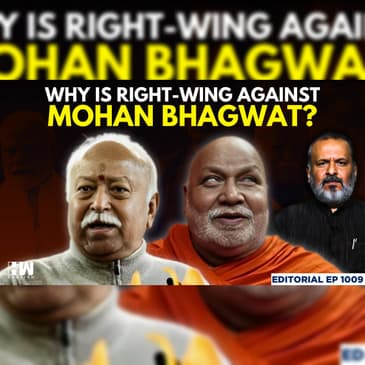
In this episode of Editorial, Mr. Sujit Nair discusses the recent events that unfolded following RSS chief Mohan Bhagwat’s statement on the Temple-Mosque dispute. After Mr. Bhagwat’s remark, the right-wing began criticizing him. In this episode, Mr. Nair delves into this conflict, presenting two key reasons: first, the changing mindset within the right-wing ecosystem; and second, the power struggle between the RSS and the BJP.
Learn more about your ad choices. Visit megaphone.fm/adchoices
[00:00:00] Namaskar! Welcome to another episode of Editorial. I have a very interesting topic for you today. Mohan Bhagwat seems to be coming under the line of fire and not from the left wing or not from the liberals but from right wing supporters.
[00:00:27] Right wing supporters are going against Mohan Bhagwat. What exactly went wrong? Why are they against Mohan Bhagwat? Is it because Mohan Bhagwat is doing something against the right wing or is the reason different?
[00:00:51] Is India being ushered into a new political dynamics? That's what I want to talk to you about. Let's get right into the show.
[00:01:06] So let's start from the beginning. This history is slightly important because I'm going to base my premises on the history of RSS before I come to my conclusion.
[00:01:17] So RSS was founded 27th September 1925. RSS was founded by this gentleman called Keshav Baliram Hedgevar.
[00:01:31] 1925, 27 September. He founded RSS. Keshav Baliram Hedgevar was the prodigy of a gentleman called B.S. Munje.
[00:01:42] B.S. Munje was a hardcore follower of Lokmanaya Balagangadhar Tilak. Now this is the some kind of a lineage.
[00:01:53] So Hedgevar formed RSS. Hedgevar was a prodigy of Mr. Munje. Munje was a follower of Lokmanaya Balagangadhar Tilak.
[00:02:02] Lokmanaya Balagangadhar Tilak was a congress leader.
[00:02:05] Okay, okay. Till here, fine. Let's move this aside.
[00:02:12] Now what was the basis? What was the basis of RSS? The basis of RSS is RSS wanted to establish a Hindu Rashtra and ensure that we still continue to practice Hindu traditions, Hindu beliefs and Hindu culture.
[00:02:32] This is what they wanted to re-establish or ensure it continues or ensure that they preserve the culture, heritage, traditions of Hinduism.
[00:02:45] Therefore, they wanted this to be Hindu Rashtra. They said this entire zone belong to Hindus.
[00:02:54] So they wanted to recapture it. Which means they believed not only that India should be Hindu Rashtra. They believed that Afghanistan, Pakistan,
[00:03:01] a lot of other countries should be part of the Hindu Rashtra. This is what they believed in.
[00:03:09] You see, what did Mohan Bhagwat say? Mohan Bhagwat said that we have been living in harmony for a long time.
[00:03:20] If we want to provide this harmony to the world, we need to create a model out of it.
[00:03:25] After constructing the Ramna Mandir, some people think that they have become leaders of Hindus by raking up similar issues in new places.
[00:03:32] This is not acceptable. Every day, a new matter that is dispute is being re-regged up. How can this be allowed? This cannot continue.
[00:03:42] India needs to show that we can live together. This is what Dr Mohan Bhagwat said a few weeks back.
[00:03:50] And the entire problem stemmed from this particular statement.
[00:03:54] Okay, now, Dr Mohan Bhagwat said it now and the issues parked up.
[00:04:02] But the surprising factor is Dr Mohan Bhagwat has been saying this from 2012, 2014, 2022.
[00:04:09] 2022, let me read out his statement. Now we will not be involved in any campaigns.
[00:04:14] If a solution cannot be found through negotiations, everyone should accept decision of the court.
[00:04:21] Meanwhile, he said, why create a conflict every day? This is what Mohan Bhagwat said.
[00:04:27] What did he say different now than what he didn't say before?
[00:04:34] He said before, but nobody questioned. He said many times, nobody questioned.
[00:04:38] Now it has become a national issue. You have Shankaracharyas and you have others questioning him.
[00:04:45] Why is all of a sudden the right wing questioning him?
[00:04:52] And to my mind, there are two reasons why the right wing today finds Mohan Bhagwat not very comfortable.
[00:05:02] Two reasons. Reason one, the mindset of the right wing India has changed. It has progressed.
[00:05:14] We will talk about that progress. That's point number one. Point number two is this particular conflict is not a cultural conflict.
[00:05:23] This particular conflict is not about the statement that a particular leader made.
[00:05:28] It is about a political conflict.
[00:05:31] Let's start with point one.
[00:05:35] You see, while RSS, when they started in 1925, they thought their ideology, their vision, their focus, it remains as is.
[00:05:46] And they are working towards it since 1925.
[00:05:49] 100 years, they are working towards it. Today, it seems to gather pace.
[00:05:54] It seems to gather moss. Today.
[00:05:57] But the fact remains that the right wing India has changed.
[00:06:05] They have progressed a lot in terms of their thinking and possibly even their radicalization.
[00:06:16] Because today, a right wing India wants a conflict. A right wing India likes people who stand in that podium and says that you see,
[00:06:24] Baga do, Nikal do, Tor do. These are things that right wing India today wants.
[00:06:30] And if they don't see their leader giving that kind of statement but says that,
[00:06:34] Bha, it's done. Let us have peace. Let us have brotherhood.
[00:06:38] This is what we want to achieve but we should also achieve it through dialogue.
[00:06:41] When somebody says that, when somebody talks about non-violence, when somebody talks about tolerance,
[00:06:47] today, right wing India doesn't want to take it. They don't want to take it because they want more aggression.
[00:06:55] And Bhagwat even then was not very aggressive when he spoke at least.
[00:07:00] And even today with his speeches, he is maintaining more or less the same narrative.
[00:07:07] He has not changed the narrative much. That's point number one. Let's keep that aside.
[00:07:11] Let's talk about point number two. Very important. Point number two is the Bharatiya Janata Party RSS conflict.
[00:07:25] The one-upmanship conflict. Round one. Round one of Bharatiya Janata Party and RSS conflict started when Bharatiya Janata Party in 2019-20 says,
[00:07:41] boss, my ministers will not report to you every day and all that.
[00:07:46] Do not be an extra constitutional power over the ministry.
[00:07:50] We are not going to completely be a subservient to the RSS.
[00:07:58] The first time Bharatiya Janata Party under the leadership of possibly a leader who believed he is absolutely powerful at that point in time,
[00:08:08] and Modi was in 2019-20, Mr. Modi said, boss, government, I will run, you run your cultural organization.
[00:08:18] That was the first, first call, the first call where the conflict began.
[00:08:26] It went on. It went on. It went on in 2023 when the president of Bharatiya Janata Party said that we needed RSS.
[00:08:36] This is round two where he said we needed RSS.
[00:08:40] At one point in time,
[00:08:43] We were not so capable then, but today we are absolutely capable. We don't need RSS.
[00:08:54] This was the statement made by the Bharatiya Janata Party president, Mr. J.P. Nadda.
[00:09:01] This was the statement he made. Round two. Round one, my ministers will not come and be at your call and all that.
[00:09:09] Round two was,
[00:09:11] We needed you. Now we are capable enough.
[00:09:15] Now round three.
[00:09:17] Round three was a return gift from RSS.
[00:09:22] And that was the Lok Sabha.
[00:09:25] Lok Sabha, a government leader who said,
[00:09:30] Meri Guarantee, Modi Ki Guarantee,
[00:09:33] That leader from 303 in the Lok Sabha came down to 240.
[00:09:39] 303 to 240.
[00:09:41] A lot of that is attributed to the lack of enthusiasm for political campaigning of RSS.
[00:09:52] Round three.
[00:09:55] The return fire from RSS.
[00:09:59] Where RSS didn't support and BJP almost crumpled down.
[00:10:06] Now RSS and Mohan Bhagwat asked the Paratyya Janata Party,
[00:10:13] Saksham the na? Kya huwa?
[00:10:16] What happened?
[00:10:18] Point three.
[00:10:20] Round four.
[00:10:21] Now RSS had to prove a point.
[00:10:24] And RSS did that.
[00:10:27] There was a compromise meeting in Palakkad in Kerala between RSS and BJP.
[00:10:33] And after that, RSS went out and actually showed that they can make a difference.
[00:10:38] At least four to six percent swing they can create in a particular constituency, in a particular state.
[00:10:45] And that four to six percent swing may make the difference between winning and losing.
[00:10:51] And they actually did it.
[00:10:54] Haryana which was almost written off, came back.
[00:10:59] Bharatiya Janata Party won.
[00:11:02] Maharashtra which was almost written off.
[00:11:04] Mahavikas Aghadi was doing well.
[00:11:06] They decimated Mahavikas Aghadi.
[00:11:08] It was those 60,000 campaign rallies that RSS had organized in Maharashtra that made a difference.
[00:11:17] A huge difference.
[00:11:19] Ladki Baina was there.
[00:11:21] But the real difference, the real people connect were those 60,000 rallies that RSS actually carried out in Maharashtra.
[00:11:30] So, this the RSS showed who's the boss.
[00:11:35] The RSS said, listen if you have to win, we have to be there backing you with our full force.
[00:11:42] Else, you are still Aksham and not Saksham.
[00:11:46] This is where it stood.
[00:11:48] After this came this latest Dr. Mohan Bhagwat wherein he said that, you know, after constructing the Ram Mandir,
[00:11:57] some people think that they have become leaders of Hindus by raking up similar issues in new places.
[00:12:02] This is not acceptable.
[00:12:04] This was something that he said.
[00:12:08] Again, it was seen as if targeting towards BJP and somewhere down the line.
[00:12:15] This was the time when BJP had to respond.
[00:12:19] BJP had to respond.
[00:12:20] And I am not saying BJP as a political party structurally responded it.
[00:12:25] BJP had nothing to do with any response.
[00:12:27] But the ecosystem that BJP is surrounded with, that ecosystem started reacting.
[00:12:34] Hindu seers, YouTubers who are hardcore right-wing commentators, right-wing thinkers, right-wing journalists, right-wing writers.
[00:12:44] These people started reacting to Mohan Bhagwat's statement saying that, listen, wrong time.
[00:12:50] Why is he saying all of this now?
[00:12:52] Why is he pussyfooting?
[00:12:54] Why can't we be aggressive as we were?
[00:12:56] Because at this point in time, it is imperative that we stick to the guns because those temples are there under the mosques.
[00:13:04] Why are we saying that we don't take claim to those temples?
[00:13:08] Now this is what the right-wing is asking him.
[00:13:12] My last point.
[00:13:14] You see, as far as what Mohan Bhagwat said, to a very major extent, I think that what he said was strategically crafted.
[00:13:25] Strategically crafted on two counts.
[00:13:27] One is he has to show that RSS is not a radical extremist Hindu organization.
[00:13:37] You see, a lot is happening in Bangladesh and that is happening between Hindus and Muslims.
[00:13:43] Between the Muslims are torturing Hindus there.
[00:13:47] The Muslims are literally troubling Hindus there.
[00:13:50] So, a lot of it is happening around this part of the world and there is a focus.
[00:13:56] There is a huge media glare, global media glare on that particular issue.
[00:14:00] This would be the right time for a Hindu cultural organization like RSS to give the right sound bites to media, to the world.
[00:14:09] And this was one of those sound bites where he said that, listen, you know what?
[00:14:13] We do not want conflict.
[00:14:15] We are not extremists.
[00:14:17] We are not radical.
[00:14:18] We have our point of view.
[00:14:20] That could be different to yours, but we are not radical.
[00:14:23] That is what I think he tried to communicate.
[00:14:26] I think the strategic need for that was to ensure that RSS is not viewed as a radical organization by world over.
[00:14:36] This, I think was a strategic reason why Dr. Bhagwat gave this statement now.
[00:14:41] So, end of the day, this is the point I wanted to make.
[00:14:44] This is why I believe that right wing today in some form is conflicted with what Dr. Mohan Bhagwat said and what Mohan Bhagwat is doing.
[00:15:00] That's the point I wanted to make.
[00:15:01] Till I see you next time.
[00:15:02] That's tomorrow at 10.
[00:15:04] Namaskar.
[00:15:05] Stay ahead with our cutting-edge news app.
[00:15:08] Instantly access the latest shots in just one minute and breaking news in just 50 words.
[00:15:14] Download now for a smarter, faster news experience.