
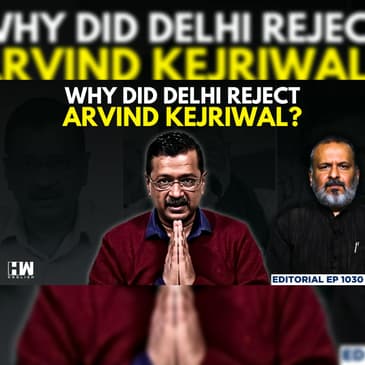
In this episode of 'Editorial', HW News' Managing Editor Mr. Sujit Nair discusses the Delhi election result where Bharatiya Janata Party ousted the incumbent Aam Aadmi Party headed by the anti-corruption crusader Mr. Arvind Kejriwal. Mr. Nair discusses the possible reasons why Kejriwal would've lost the Delhi poll.
Learn more about your ad choices. Visit megaphone.fm/adchoices
[00:00:00] Namaskar! Welcome to another episode of Editorial. Delhi elections, Bharatiya Janata Party 48, Aam Admi Party 22. Not even half of what Bharatiya Janata Party got. What happens to Arvind Kejriwal? What went wrong with AAP? Let's discuss that. Let's get right to the show.
[00:00:30] You see, though technically they are more or less the same words, but in politics, not accepting is very different to rejecting. Not accepting is very different to rejecting.
[00:00:56] What I mean by that is, not accepting Bharatiya Janata Party's ideology, not accepting Bharatiya Janata Party's offer-manifesto and therefore not voting for Bharatiya Janata Party is very different to rejecting the concept of
[00:01:26] AAP. Rejecting everything that AAP today stands for. That's the difference. In one place, you are not choosing what that particular political party had to offer. In the other place, you are throwing out a particular party.
[00:01:51] Because you are throwing out a particular party. Choosing or accepting is based on what a particular party is willing to do for you and rejecting is based on what a particular party has done to you. That is the core difference in politics. I will try and explain myself.
[00:02:20] You see, when Sonia Gandhi was leading Congress in 2004, I remember a majority of this country was looking forward to see Sonia Gandhi as the Prime Minister of India. A lot of this country felt that Sonia Gandhi as a leader of Congress would do good for this nation.
[00:02:47] Congress would, this time around, that is 2004, after the Bharatiya Janata Party rule, would do good for India. In 2010, 11, 12, 13, 14, what happened to Congress is people rejected Sonia Gandhi. One of the reasons why people rejected Sonia Gandhi is Arvind Kejriwal.
[00:03:14] Arvind Kejriwal showed the people that what you expected from Congress and Sonia Gandhi, you know, she is nowhere close to that expectation. She is not delivering anything close to that expectation. In fact, there is huge amount of corruption which was not expected from Sonia Gandhi in 2004. Which was not expected from Sonia Gandhi in 2004. So, rejection of Sonia Gandhi.
[00:03:43] And probably the reason for that was Arvind Kejriwal and his then boss, Anna Azare. These two gentlemen ensured that Sonia Gandhi's image was destroyed. These two gentlemen ensured that the perception that Sonia Gandhi let down my expectation, therefore I rejected her, happened.
[00:04:13] This is 2014. Now let's keep that story aside. Now let us come to our man, Mr. Arvind Kejriwal. Our man, Mr. Arvind Kejriwal, therefore from that platform started to create his own imagery, his own set of expectations that people could have from him.
[00:04:41] He went on to say that you know what? I am Aam Admi. He started off by saying that listen, I am not going to participate in politics. I am not going to take any position in this country. And in a few months, he was pitting himself to be the next chief minister of Delhi. And then later on, he wanted to be the next prime minister of India.
[00:05:11] So in 2014, he was dreaming to be the prime minister of India, got four seats in the entire country. Therefore, that prime minister, he packed and kept it aside. And he said, I am coming back and I will remain the chief minister. So he created a perception. He created a perception wherein he said, I am Aam Admi. Like I told you, I will wear a bush shirt. I will wear a whatever muffler.
[00:05:38] And I will only roam around in my wagon hour. I will not use anything better than wagon hour. Why should I use taxpayer money to roam around in luxury cars? Why? I will not do that. Aam Admi Baba. He made a statement that I will stay in my residence. Why should I waste government money and get a government bungalow? Why? My house is there, no?
[00:06:07] I will live there. There were expectations created. There were expectations created. These expectations were endorsed by people who had certain amount of credibility in the marketplace at that point in time. People like Yogendra Yadav. There was certain amount of credibility for Yogendra Yadav at that point in time. People like Prashant Bhushan.
[00:06:36] There was certain amount of credibility for Prashant Bhushan at that point in time. Kiran Bedi, Kumar Vishwas. These were people who were with him. And at least at that point in time, these people had a lot of credibility. Whether they have now or not is a different issue. But at that point in time, they had credibility. And the biggest person who was with him was that Anna Hazare. Who at that point in time, people would think that he is Gandhi and all of that.
[00:07:05] Today, of course, well, the story is completely different. I don't want to get into that. Let's keep him aside. But the fact remains that these were the people who were endorsing this man who said, I am Aam Admi. The people of India. You and I, we said, this is the real politician. The real thing. This is what a politician should be.
[00:07:32] This is what a politician will. This is the kind of politician that India needs. And this is the future of India. This man. That topi and all. He had this guy called Arvind Kejriwal. Now, there is a story of a wolf or a dog. I don't remember which. It is wolf or a dog. But you know, that wolf fell into the dye.
[00:08:02] Some blue color dye. And you know, he all of a sudden turned blue. He went and told the people that, listen, you know what? I am God now because I am blue in color. So, everybody believed he is blue in color. All the other wolves believed he is blue in color. And then, you know, it rained. And you know, the color got washed out. And they all realized he was just an other wolf like the rest of the clang. And then, something similar happened to this man.
[00:08:33] Arvind Kejriwal's ambition was to be a politician. Always. Day one. He was just searching for that stepping stone. Whose head will he put his head on and step? So, the first thing what he did is he threw that Anna Hazare out of his life.
[00:08:52] First thing that he did was he threw Anna Hazare out of his life for the simple reason that Anna Hazare was a bigger leader than he was in the clan that he was leading. Anna Hazare wouldn't allow him to make an Amadmi party. And if Anna Hazare ever allowed him to make that Amadmi party, Anna Hazare was a kind of person who would ask for his pound of flesh first.
[00:09:18] So, it was imperative for Arvind Kejriwal to cut out Anna Hazare which he did. Act 1. He, the person who said, I am not going to get into politics. I am not going to take any position. Started Amadmi party, a political party where he included all these wannabe politicians. All wannabe politicians. Yogendra Yadav, wannabe politicians.
[00:09:48] Kumar Vishwas, wannabe politicians. All these wannabe politicians, a lot of them came in, got rejected, went out also. All these wannabe politicians. But people who had a certain amount of credibility in the society that day, all of them they got together and he started, he made a party. Party happened. Arvind Kejriwal who said that, do not call me Mr. Kejriwal or do not call me sir and all that. I said, madhbulav, call me Arvind.
[00:10:15] I remember I had, I was there in one of the functions he was speaking and he said, hey, call me Arvind. Yeah, ji and all that, ji and all your calling. Arvind. Baba, very clear. This person who said, call me Arvind. Arvind. Okay. And who had this entire entourage of very young, dynamic team with him.
[00:10:39] This Arvind, he started putting his picture in almost every poster of ARP. So, ARP poster would be one Broom and one Arvind Kejriwal's photograph. Come to think of it, you know, very good combination, isn't it? Anyway, Broom and Arvind Kejriwal's photograph. Everywhere in the country. Nothing but Arvind Kejriwal's photograph. No Sisodia, no Bhushan, no Kumar Vishal.
[00:11:09] Nothing. Arvind, broom. Arvind, broom. Arvind, broom. That was it. Ah. The first indication that here, you have another that, you know, the rain started and the wolf blue color started changing to the original color. Arvind Kejriwal, broom. This was indication too. Then, he got Delhi.
[00:11:39] He got Delhi and when he got Delhi, he realized Delhi ka Raja kon. Maye, I am the king of Delhi. Aap kaisa ata hai? Mere naam pe ata hai? Why is this Bhushan asking me questions? Why is this Yogendra Yadav asking me questions? This poet, whatever unnecessarily asking questions. He told them, chal raha hai. Either my way or I way. Wait naga hai? Want to be here?
[00:12:09] Want to be part of the team? Want to be part of the party? My way. Or out. That's the door. So, all these wannabe politicians who thought that they could stick to him and also become big leaders, they realize big leader, big leader oega ne. This man is not going to allow anybody to be bigger than him like any other politician. By the way. Like any other politician. What is alleged of Modi? What is alleged of Gandhi?
[00:12:37] What is alleged of every politician? So, he was nothing but another Narendra Modi or another Rahul Gandhi or another Mamata Banerjee or another MK Stalin. So, the picture was very clear. Everybody realized that you can't be bigger than him. He is the ultimate leader. He is the owner of AP. Like Gandhi is the owner of Congress and today Modi is the owner of Bharatiya Janata Party and
[00:13:06] Stalin is the owner of DMK and Shalat Power is the owner of NCP. And of course now Ajit Power has new NCP. But all the same, the fact is he was just an other politician. Exactly like everybody else. Possibly, maybe a little more cunning and dangerous. This is what his colleagues realized and they all fled. They all went out. Chalo. Yaan tak sab thik hai.
[00:13:34] It's all internal story, his story. Now let us come to people. Arvind Kejriwal introduced this concept of freebie. The way he put it, which makes no economic sense. No economist will ever endorse what that man said. That if I don't take bribe, then I can put all that money and give things free to people.
[00:14:02] Ye aisa sab rarity mein hota nahi hai sab. You don't take bribe, so you get money and then that money I save and that I give. Ay sab nahi hota hai. It doesn't work that way. You take people's money and you mess with your priorities and you use that money to give freebies so that you can win elections. This entire freebie technique was invented by this man called Arvind Kejriwal. Then every single party took it up. Every single party.
[00:14:33] Baba. Let me not blame this man for that. Every single party. But he was the person who started it. Delhi bought it. Delhi bought it. And Delhi also thought that, look at this man. There is free electricity. There is free pani supply. There is all because this man is non-corrupt. All because he is saving all the money. All the corruption money and then, you know, trying to give us free electricity and free water and all that. Which was not the case.
[00:15:01] Which was not the case. Corruption, as it's now more or less being seen, was absolutely rampant in Delhi. As much as it was in any other place in this country with any other government. Absolutely rampant. But this man, this man was the person who came up in this country, who got himself voted in this country, saying that, boss, India against corruption.
[00:15:31] India against corruption. His basic offer, his USP unique selling proposition was, I stand against corruption. And he and his party men were seen as one of the most corrupt bunch of people. Now, a lot of people even then thought, hey, you're corrupted. That BJP, you know, BJP is trying to do all this. A lot of people said, BJP is trying to put people behind bars.
[00:15:58] Even I am still saying that putting somebody behind bars just before the election and all, was not really warranted. Because you are spoiling the democratic process. Now he is out. Everything is over. Now, if they have a problem, they could have put him behind bars right now. But that's a different issue. That being said, the fact remains that a lot of people said that, you know, it is all political. He also said, it's all political that they're alleging corruption against me.
[00:16:26] But then, then came in your screen. Watch out. This is the shishmail. This is the bungalow that he built for himself. A man who said that, you see, I have got a flat, no? Why should I stay in government house? I have got my own flat. I will stay in my own flat. I have got my own wagon. Why would I need government wagon? Why would I need government cars?
[00:16:51] This same man had two or three cars, entourage at his disposal. This is the same man who built this kind of a bungalow. This kind of a bungalow which, believe me you, believe me you can come and see Varsha in Maharashtra. You can go to any of the most of the GCM's bungalow. It's not this ostentatious. I believe me you. I mean, he made his bungalow like a palace. It actually looked like a palace.
[00:17:20] Bharatiya Janata Party very well exposed this particular bungalow and said, this is where your money is going. This is where your money is going. This is the bungalow that the chief minister who said that, I have no bungalow. I am not staying.
[00:17:36] And this absolutely arrogant, absolutely blatant breach of trust, breach of promises that Arvin Kejriwal actually made people reject him. Reject him.
[00:17:59] Arvin Kejriwal today stands in almost the same podium or maybe a little below than what Mrs. Sonia Gandhi was in 2014. When people almost rejected her and her party. That is almost the same position, possibly like I said, it is possibly the worst position that Mr. Kejriwal currently is.
[00:18:28] Because people rejected him. Whether he is going to come back, whether it is going to, whether he is going to gain his popularity back, we have to wait and watch. The chances, politics and public memory, both are dynamic. So, while he can come back, but that comeback will not be anytime soon. Let me also tell you that. He will come back. There is no doubt about it. He could. But it will not be anytime soon.
[00:18:57] Now, the last question I want to answer is a lot of people wrote to me asking me that was it prudent, intelligent for Congress to have stood against Arvin Kejriwal and AAP? Wasn't they helping Bharatiya Janata Party to win the election? Wasn't they responsible for breaking the concept of India Alliance?
[00:19:23] To answer that question, at the cost of making this video slightly longish, to answer that question, let me tell you. India Alliance was a vehicle made to fight Lok Sabha election. It was a union of convenience. It was not a union of like-minded people, people who are very friendly. I said, it's not something. It was a union of convenience.
[00:19:51] It came together to fight the Lok Sabha. And I think as much as possible, they will try to stick together in Lok Sabha. Because if they don't stick together, they will get dismantled. So, they will stick together. They will get decimated actually. Not dismantled. Wrong word. Decimated. So, they will stick together. In Lok Sabha. But, that doesn't mean that therefore, they will partner in every state elections. That's number one.
[00:20:19] It is imperative for Congress to ensure that AAP does not do well in Delhi. Is because till such time AAP dominates Delhi, Congress will never be able to come back in Delhi. So, it was important for AAP to fall. So, that at least there is one small ray of hope for Congress to come back to Delhi. And therefore, it was important for Congress to fight Delhi.
[00:20:45] Like, it was important for AAP to fight in Haryana. Because AAP had to establish itself as a national party. Had to establish itself at least in the area, that area of influence that they had, which was Punjab, was their state. They had to go to Haryana. Where they had to possibly eat into Congress votes in Haryana. And here, Congress ate into AAP's vote in Delhi.
[00:21:15] Now, technically speaking, what Congress did in Delhi to AAP, possibly maybe a little more damage than what AAP did to Congress in Haryana. Though, both didn't manage to win a single seat. Arvind Kejriwal never won a single seat in Haryana. Nor did Congress win a single seat in Delhi.
[00:21:37] But, the damage that Congress caused to AAP was slightly more significant than possibly what AAP caused to Congress in Haryana. Now, I will give you an example. In New Delhi, the margin in which BJP 1 bid AAP was 4089. And Congress votes. Congress had 4568 votes in New Delhi.
[00:22:00] So, possibly, had that Congress votes been, had Congress not been there, there could have been a chance that AAP would have possibly won that seat by around 400-500 votes. Jangpura. Jangpura, the margin in which BJP 1 was 675, Congress polled 7350 votes there.
[00:22:24] Greater Kailash, the margin 3188, Congress polled more than 6711 votes there. Malvianagar, margin 2131, Congress polled more than 6773 votes there. Badli, margin 15163 votes, Congress polled 41071 votes there.
[00:22:48] Timarpur, margin 1168 votes, Congress polled 8361 votes there. Nangalai Jat, margin 26251 votes, Congress polled 3228 votes there. Rajinder Nagar, 1231, Congress polled 4105 votes there. Margin in Chatharpur, margin was 6239 votes, Congress polled 6601 votes there. So on and so forth, lot more.
[00:23:18] In fact, Sangam Bihar, margin 344, Congress polled 15863 votes there. Trilogpuri, margin 392 votes, Congress polled 6147 votes. So, almost 12 seats could have gone the other way, could have gone the other way, had Congress not stood against AAP in Delhi. Possible, possible.
[00:23:45] These are not confirmed analysis where there's those 12 votes, therefore, therefore will go. There could be a possibility people won't go out and vote at all because if not Congress, they may not vote for AAP. People may, a lot of these people may not be, they may like I told you, may be rejecting AAP. So, there's a lot of possibility. But mathematically, if you look at it, statistically, if you look at it, Congress has taken away at least 12 seats, at least 12 seats from AAP. So, this is the concept. This is what AAP is.
[00:24:14] This is what AAP stands. Arvin K. Jival, at the moment, doesn't look good at all. AAP doesn't look good at all. Will they come back? Yeah, yeah. Their chances of them coming back is there. There is no question about it. But is that going to be shorter? No, no, no. It will take its own time, like Congress is taking its time to re-establish themselves in India, which they are still not able to.
[00:24:41] That same fate will happen to AAP. That's for sure. Till I see you next time. Namaskar. Stay ahead with our cutting-edge news app. Instantly access the latest shorts in just one minute. Unbreaking news in just 50 words. Download now for a smarter, faster news experience.