
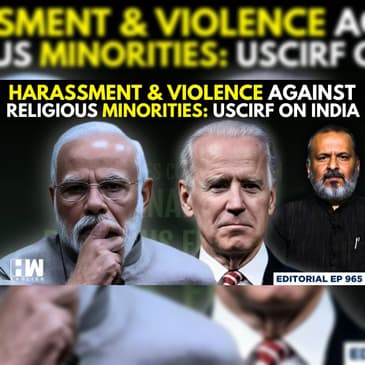
In this episode of the Editorial, Mr. Sujit Nair discusses the latest report by the U.S. Commission on International Religious Freedom, which flags ""increasing abuses"" against religious minorities in India. The Ministry of External Affairs (MEA) has dismissed the report, accusing the USCIRF of promoting a ""motivated narrative."" Mr. Nair addresses the report and explores how the U.S., before addressing its own issues, comments on the internal matters of other countries.
Learn more about your ad choices. Visit megaphone.fm/adchoices
[00:00:01] Namaskar, Welcome to another episode of Editorial.
[00:00:06] An organization in US of A that is United States of America that is USCIRF which means United States Commission on International Religious Freedom has said that there is increase in abuse against religious minority in India.
[00:00:27] They say that India is growing intolerant against their religious minorities.
[00:00:40] Ministry of External Affairs said, this is all malified. Let's talk about it. Let's get right to the show.
[00:00:51] Okay, so in this editorial, we will look at both sides because always we have seen that an international body comes and criticizes India.
[00:01:06] Predominantly when it comes to religious tolerance, predominantly when it comes to the way we handle our minorities.
[00:01:12] International body, especially United States body. No, actually even I think bodies from Australia has criticized us but, okay.
[00:01:19] International bodies comes and criticizes us. And our reaction is you have got malified interest.
[00:01:26] This is what our reaction normally is. Okay? So this time also situation is not very different. It is similar.
[00:01:34] But this time, this time let you and us, the both of us, let us sit and see both sides. Okay?
[00:01:43] And let us take a decision as to who is right and who is wrong. Okay? So let's go, let's do it that way.
[00:01:50] So first let us look at it from USCIRF perspective.
[00:01:55] USCIRF like I told you is the US Commission on International Religious Freedom.
[00:02:02] These guys say that there is increase in abuse against religious minority in India. That is what these people say.
[00:02:09] They also went out to say that they recommend that India is designated as a country of particular concern due to severe violation of religious freedom.
[00:02:20] By these allegations are very serious. They said, boss, the religious intolerance is increasing so we should be seeing India as a country of particular concern.
[00:02:36] Are they completely wrong? Let's first like I told you look at the USCIRF perspective.
[00:02:46] You see, there is two days back there was a case that happened in a court in Uttar Pradesh, Rai Bairi.
[00:02:53] In this particular case, a Muslim man, he got life imprisonment in a case of rape after finding that he had deceived the victim by presenting himself as a Hindu,
[00:03:03] got married to the girl presenting himself as a Hindu and then the girl found out that he was not a Hindu. He deceived.
[00:03:11] And he married her and obviously had conjugal relation with her. Does he deserve a life imprisonment? 100% he does. To my mind, he does.
[00:03:23] To my mind justice was served. But the problem is not that. The problem is what happens after that.
[00:03:33] You see, the edition session judge Ravi Kumar Diwakar commented on what he termed as love jihad and remarked that Muslim men systematically target Hindu women
[00:03:45] for conversion to Islam through marriage by pretending to love them. He says in simple words, love jihad is the practice of Muslim men
[00:03:55] to convert women from non-Muslim communities to Islam by pretending to love them and marrying them.
[00:04:03] Illegal conversion through love jihad are carried out by some anarchist elements of particular religion or are made to do so or are involved in a conspiracy.
[00:04:15] If the Indian government does not stop illegal conversion through love jihad in that time, then the country may have to face serious consequences in the future.
[00:04:23] This is what the court said. This is what a judge said.
[00:04:29] Now, the fact is the man lied to a woman, got married to her, lived with her and he was accused of rape.
[00:04:44] He was convicted of rape, was given life imprisonment. Absolutely correct. Absolutely correct.
[00:04:51] But the question of love jihad, where it comes from? Where does this question of love jihad come from?
[00:04:56] I'll tell you. You see, where does all this proof comes from that Muslim men wants to marry Hindu women and then they want to convert them
[00:05:07] and then they want to make them into Muslims? Where does all this come from?
[00:05:12] Because I know of a lot of cases where Hindu men have married Muslim women.
[00:05:20] Most of them are living very happily, no problem. Where does this question of love jihad come from?
[00:05:27] So if Muslim man marries a Hindu woman, it becomes love jihad.
[00:05:32] If Hindu man marries a Muslim woman, does it become any jihad? Does it become Hindutva jihad?
[00:05:39] Will it be something of that sort? So how can law be different to one particular community and law be different to another particular community?
[00:05:49] I am asking you a question. I am not even talking about law, I am talking about point of view.
[00:05:53] And when it comes from a judge, you see, it is taken very seriously, isn't it?
[00:05:59] Secondly, the parliament and the then Home Minister had told the Lok Sabha that the government is not aware of any love jihad.
[00:06:11] This happened in 2020. The parliament was told that we are not aware of any love jihad that is happening in our country.
[00:06:19] And there has been no corrective statements till 24 where they said, no, no, no, 20.
[00:06:24] We were wrong. There is no love jihad. So where is this concept of love jihad coming in?
[00:06:30] And how is this judge saying that this is love jihad?
[00:06:34] Again, I say the conviction absolutely bang on, justice delivered.
[00:06:40] But mixing it with a complete community, a complete community.
[00:06:46] But he let me also give you this thing to the judge, credit to the judge.
[00:06:52] The judge has said that, you see, due to some people the entire community gets blamed.
[00:06:56] That also he has mentioned but the point that I am trying to make is giving such terms as love jihad
[00:07:03] a stamp of endorsement by a judiciary doesn't that spread unrest, doesn't that spread
[00:07:14] the concept of Islamophobia amongst people? Doesn't that make a common man believe that,
[00:07:23] yes, Baba, love jihad is. So any Muslim marrying a Hindu woman is love jihad.
[00:07:31] Is that fair? Is that even legal for that matter of fact?
[00:07:35] Is there any law in India that says Muslim men cannot marry Hindu women?
[00:07:39] Likewise, Hindu men cannot marry Muslim women?
[00:07:42] And like I asked, how can we have different point of views for different religion?
[00:07:52] Hindu marrying a Muslim? Okay. Muslim men marrying a Hindu woman love jihad.
[00:07:58] I say, I guess it was like that. So that's my point.
[00:08:03] You know very recently the High Court of Karnataka and Justice Srisananda,
[00:08:08] the judge in the High Court of Karnataka had called a Muslim dominated locality in near Bangalore, Pakistan.
[00:08:20] He called that Muslim locality Pakistan and the Supreme Court took objection to it.
[00:08:26] The Supreme Court rebuked the High Court judge and say, can't call parts of India Pakistan?
[00:08:33] You can't do that. A judge is a person who ensure that they are the custodian of the constitution of India.
[00:08:40] If that judge starts calling Muslim dominated area Pakistan,
[00:08:47] starts saying that, hey, this man, Muslim man married Hindu woman love jihad.
[00:08:53] Tell me, isn't it obvious that religious intolerance has already spread in this country?
[00:09:00] Because the judge is saying so. The custodian of the constitution is saying so.
[00:09:06] So a normal person will think so.
[00:09:08] So if a body like C, whatever, what is that? USCIRF says that why there is growing religious intolerance,
[00:09:19] wouldn't that be fair? There are fringe elements.
[00:09:22] There are fringe elements from the, even most of them, from the ruling political party who goes and abuses,
[00:09:30] says I will catch Muslims and beat them. I will get into mosques and trouble Muslims.
[00:09:35] All this is happening but then chalo, I will say it is fringe elements puthae happening.
[00:09:41] But when judges, when people sitting in constitutional positions and that too such senior constitutional positions,
[00:09:48] such powerful constitutional positions acts like this, what do you say?
[00:09:52] How are you going to say that USCIRF is wrong?
[00:09:58] So this is one end of the story. This is the USCIRF story.
[00:10:02] Now let us look at it from the Ministry of External Affairs.
[00:10:06] You see the Ministry of External Affairs said that we would urge USCIRF to,
[00:10:11] from such agenda driven efforts. The USCIRF would be also well advised,
[00:10:18] to utilize its time more productively on addressing human rights issue in United States.
[00:10:26] So Ministry of External Affairs says look into your own state.
[00:10:31] Kutka deko yaar, gareba mein jaake deko. You are see what is happening in your own country and then talk out, talk to us.
[00:10:38] This is what Ministry of External Affairs India told the USCIRF.
[00:10:43] Is there a fact to that? Actually yes.
[00:10:51] You see there is a report again, let us all go with research report and all of that so that we do not talk based on our opinions.
[00:11:01] So there is a research done by Pew Research Center which says that after George Floyd's murder,
[00:11:08] you remember George Floyd Black Life Matters Movement, you remember that movement?
[00:11:14] Now after George Floyd's murder half of Americans expected policy change to address racial inequality.
[00:11:23] Because racial inequality in America is a fact. No doubt about it.
[00:11:31] If religious intolerance in India is a fact, racial inequality in America also is a fact.
[00:11:40] Now after George Floyd's murder they expected some change.
[00:11:43] Now lead to major policy changes to address racial inequality, 50% believed that they will bring policies that will bring changes
[00:11:51] and try and get some equality between the races.
[00:11:55] 56% believed that these changes that they will get will actually improve their lives.
[00:12:01] This was year 2020, they actually believed that things will change for them.
[00:12:07] They actually believed that their country will act, America will act.
[00:12:11] The blacks in America actually believed that their life may change.
[00:12:15] 56% hoped that their life will change.
[00:12:18] But you know in 2021 increased attention to racial inequality not led to change that are improving black life.
[00:12:29] 65% said next year after one year they said nothing, no difference.
[00:12:36] Things are as is. No difference.
[00:12:40] So the 56% people who are hoping that there could be a difference in their life,
[00:12:46] 65% people in the next year said that no difference. It is all the same.
[00:12:53] You see equality of black people in the US is a little or not at all likely is 44%.
[00:13:00] 44% of America says that boss equality and all doesn't exist.
[00:13:04] But it is not possible. It is either very little or not possible.
[00:13:09] 44% people said in America that equality is not possible.
[00:13:14] So when Ministry of External Affairs in India says that by Garevamaj Hake Deku you look at your own state,
[00:13:21] actually their state is not very good.
[00:13:24] They too are not in a good state of affairs.
[00:13:29] So while they have reports after reports and particular interest and particular tolerant and all that for other countries,
[00:13:35] they also need to understand they look at it.
[00:13:39] Their reports are worse.
[00:13:42] Their reports are worse.
[00:13:43] Now let us go to some more research.
[00:13:47] You see about 6 in 10 black adults says that racism and police brutality are extremely big problems for black people in US today.
[00:13:58] 6 in 10 blacks feel that they must be subjected to police brutality.
[00:14:05] 60%.
[00:14:08] So what are they talking about India? What are they talking about other countries?
[00:14:13] You see racism, they say 63% believe that there is racism in United States.
[00:14:19] 60% believe that there is police brutality in United States on blacks.
[00:14:25] 54% believe that there is economic inequality when it comes to blacks in United States.
[00:14:32] 47% believe that there is affordability problems for health care when it comes to black in United States.
[00:14:39] 46% believe that efforts of 46% believe that they limit the black voting and 40% believe that quality of K-12 schools are limited.
[00:14:54] And bad as far as blacks are concerned.
[00:14:57] Now you look check these parameters and check our Sachar report.
[00:15:04] Is there a cost difference?
[00:15:06] There is no much difference.
[00:15:09] Does too wrong make it right? No.
[00:15:13] Are we good with our minorities? No.
[00:15:16] Should we be taking care of our minority? Yes.
[00:15:19] Should we be looking after them? Yes.
[00:15:20] Should we be focusing on them? Yes.
[00:15:23] Should we be working on their welfare? Yes. All that is fine.
[00:15:27] Should we be stopping such people sitting in such authority and such constitutional authority making such kind of statements in India?
[00:15:36] Of course, yes.
[00:15:38] The fact also remains that United States selling us is also not very correct because they are selling in the same boat.
[00:15:47] We call it communalism. They call it racism.
[00:15:52] Boat is the same percentage, same almost.
[00:16:00] So what are they advising?
[00:16:02] Now little hope amongst black adults that changes to address racial inequality.
[00:16:09] The hope currently, the hope currently is very little for black people.
[00:16:13] For instance, reparations to descendants of people enslaved by US.
[00:16:18] Reparations means to right the wrong, to make amends for whatever the wrong has been done to the descendants of people enslaved in United States.
[00:16:27] 82% of the black feels that Kuchh reparation is not going to happen.
[00:16:32] No right, no doing right to the wrong and all that.
[00:16:36] You see, changes to the prison system to treat black people fairly.
[00:16:41] 67% people blacks feel that Kuchh nahi honevala.
[00:16:46] A black person will not be treated fairly in the prisons of United States.
[00:16:52] This is what 67 people say.
[00:16:54] Changes to treat black people fairly, 58%.
[00:16:59] Equality for black people in United States, 44% of the black will feel that it will never happen.
[00:17:06] Equality will never happen in United States for the black.
[00:17:10] So with this particular research, now see what the Ministry of External Affairs says.
[00:17:16] Makes sense, no? That they too make sense.
[00:17:19] They too make sense.
[00:17:21] You see, before I end let me take you through some last bit statistics.
[00:17:24] You see, COVID-19 pandemic helped to ease economic condition temporarily.
[00:17:31] But racial disparities persisted in access to adequate healthcare, water, education, employment and housing.
[00:17:40] In August 2022, the United Nations Committee of the Elimination of Racial Discrimination that is CERD which is another organization.
[00:17:49] This belongs to the United Nations concluded that US has failed to implement international anti-racism legal standards.
[00:17:59] We need to talk about this too.
[00:18:02] We need to talk about this to you.
[00:18:03] You are calling India a country of particular concern.
[00:18:07] What are you?
[00:18:08] You have failed the anti-racism legal standards.
[00:18:12] United Nations have said this.
[00:18:15] I will give you another statistics.
[00:18:17] Lawmakers in US states introduced more than 150 bills targeting transgender people.
[00:18:24] Particularly transgender children threatening their rights and health.
[00:18:30] Indiana, South Dakota and eight other states enacted laws prohibiting transgender children.
[00:18:47] They are participating in sports consistent with their gender identity.
[00:18:52] Children, transgender children were stopped from participating in sports.
[00:18:58] Today transgender in our country they have become police inspectors.
[00:19:04] They are becoming administrative officers.
[00:19:06] They are fighting elections and here these children are not allowed to participate in sports.
[00:19:13] So who is the progressive one now?
[00:19:18] Women and Girl Rights.
[00:19:20] In June, Supreme Court in DOPS versus Jackson Women Health Organization overturned the 50 year constitutional guarantee of abortion access.
[00:19:31] More than half of all US states are poised to ban abortion at the time of writing.
[00:19:38] 18 states have already criminalized and restricted abortion.
[00:19:43] So abortion is still not a girl, a woman cannot decide whether she wants to be a mother or not.
[00:19:51] She does not have the right is what United States say.
[00:19:55] Most of the states in the United States say a woman cannot decide whether she wants to keep her child or not.
[00:20:03] Now voting rights.
[00:20:05] Let's talk about voting rights.
[00:20:06] You see several states passed laws that sought to limit who may vote and which votes are counted.
[00:20:15] Open the door to the partisan actors interfering with elections.
[00:20:19] This restriction on the right to vote disproportionately impact black, indigenous and Latinx individuals.
[00:20:29] So what else is left?
[00:20:32] Your gender is questioned.
[00:20:34] Your race is questioned.
[00:20:37] There is a discrimination between men and women.
[00:20:41] Women rights are questioned.
[00:20:44] Your voting rights are questioned.
[00:20:46] Problem?
[00:20:47] Now this country questioning others is absolutely ridiculous to my mind.
[00:20:55] But that being said, let me also say.
[00:20:58] You see we therefore can hide, can't brush whatever happens in our country and hide it under the carpet and say,
[00:21:06] Tum kyu pusta, tum kyu pusta which is what we normally say.
[00:21:08] Whenever somebody points a finger at us, our reaction is not to justify that this is wrong or right or this is why it happened.
[00:21:15] Our justify saying that you have a malefic interest, you have got foreign hand, you have got selfish interest and all that.
[00:21:20] This is how we normally react.
[00:21:21] That is how we normally be done doing it.
[00:21:24] And this is especially post 2014, this has been a standard dialogue that you know there is malefic intention, there is international hand and all of that.
[00:21:32] That not only from outsiders even when insiders say that it happens but that being said, that being said,
[00:21:38] you can't ignore the fact that what the Ministry of External Affairs told America is correct.
[00:21:45] It is.
[00:21:46] There is a lot of fact in what the Ministry of External Affairs told America.
[00:21:52] Look at what is happening in your country first.
[00:21:55] Then you call others a country of particular concern.
[00:22:01] Till I see you next time, that's tomorrow at 10. Namaskar.
[00:22:53] Now as Maharashtra gets set for the 2024 Assembly elections,
[00:22:58] we believe that we have the infrastructure, we have the know how, we have the experience of covering Maharashtra.
[00:23:04] We want to cover the Maharashtra elections.
[00:23:06] Now for us to cover the Maharashtra elections, we need some funds, we need money.
[00:23:11] We need around 5-6 lakh rupees.
[00:23:13] I would urge you to contribute to this venture.
[00:23:17] Give us that 6 lakhs so that our journalists can go to the look and corner of Maharashtra.
[00:23:23] Find out exactly what the problem of Maharashtra is.
[00:23:46] Maharashtra's experience.