
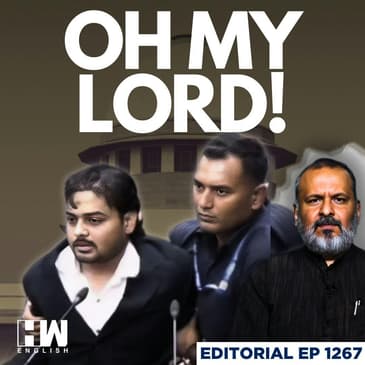

In this episode of Editorial, HW News Managing Editor Sujit Nair discusses the latest incident of a petitioner who abused CJI Suryakant in the Supreme Court and flung papers at the judges. Mr. Nair believes this is a red-flag for our democracy, and also opines on instances of 'entitled' judges.
Learn more about your ad choices. Visit megaphone.fm/adchoices
[00:00:00] People were jubilees, they were happy, a lot of people found it funny, a lot of people said that judiciary deserves it. This is possibly one of the most dangerous signs for a democracy. What we also need to understand is the system has been acting most entitled, much more than possibly even a politician.
[00:00:28] Namaskar, welcome to another episode of Editorial. Before I start this editorial, I want you to see this clip. This clip I am sure you must have seen a thousand times in the last two days. But I still urge you to see this clip. Are you the Patin person? Yes. Prabal Pratap? Yes.
[00:00:54] Mr. Jubileous Judicial Servant, I order you to order the registration of FIR against ACP Vikas Nagar Laknui. You are ordering me. I am the sovereign. I am the sovereign. And Duplex Technology Services for running Cybergram Syndicate across the country. That's all from my side. Everything is on record. And one of the pages of the file. And that's all from my side. And these are few papers I have. So I have this quote.
[00:01:30] The reason I wanted you to see this clip is because we too uploaded this clip as part of our news reporting. And the kind of response that we got for this clip was people were jubileous. They were happy. They were happy. A lot of people found it funny. A lot of people said that, you know, judiciary deserves it. The Chief Justice of India deserves it. All of that. And you know what?
[00:02:01] What I wanted to tell you and the reason I am doing this editorial is because this is possibly one of the most dangerous signs for a democracy. This is a red flag for our democracy. This is actually warning us of what things hold for us in the future. And that's why I thought we should talk about it.
[00:02:29] You see, democracy, of course, we all know is about judiciary, legislative, executive and media somewhere. We have problems with our legislature. We have people still talking about vote, vote chori, some serious allegations about the voting processes. We have problems with our executive. We have problems with our investigative agencies. We have problems with our central agencies.
[00:02:59] We have problems with our constitutional body. And now we also have problems with our judiciary. Not now it has been happening for quite some time. But now it is getting very, very frequent. So you have a problem with your judiciary, you have a problem with your executive, you have a problem with your legislature, you have a problem with the media. What is left in our democracy? Don't you see the danger? Don't you see the red flag?
[00:03:25] You see, judiciary is the last frontier to your democracy. Because if that's breached, end of story, no democracy left. Because if any of these media or legislature or executive goes wrong, you can run to the judiciary. Tell them that this, this is what's happening. And they take a decision. They judge. They correct things. That's what they're supposed to do. That's what we hope they do.
[00:03:54] But what happens if judiciary is breached? In this particular incident, the judiciary acted very matured. In fact, the judge, justice Vishwanathan remarked to senior advocate present in the room that he is very disturbed. It's all frustration. We have to have sympathies for him. Very good. He acted very matured.
[00:04:22] The justice, the bench acted very matured. And no action was taken against this man who flung the papers and who abused the chief justice. No action was taken against it. But somewhere down the line, have you ever thought, where does all this stem from? Of course, we've seen monies being burned in judges house.
[00:04:45] We've seen judges kind of, you know, almost acting second fiddle to political parties, ideologies and so on and so forth. I know we have known judges who sits on their own judgment table and judges themselves and then goes into Rajya Sabha and sits and becomes MP and all of that. We've seen all of that. We've seen this entire system degrading.
[00:05:09] But what we also need to understand is the system has been acting most entitled, much more than possibly even a politician over the decades. Absolute entitlement. These judges, some of them started believing that they are actually lords. They rule over people. And this has been building up. And this build up is what you're seeing.
[00:05:39] You saw somebody throwing shoes at a judge. You saw somebody abusing a judge. And God forbid, I am not very sure if he will not see more. You see, a judge should be seen as a person who is a moral example to the rest of the citizens. Let me, shh! Let me talk to you about some of the judges, some moral citizens in our country.
[00:06:08] In 2023, I had done an editorial on this, if you remember. There was a judge who lost his pet dog. He got angry! This judge got angry! And you know who he wrote to? He wrote to the Joint Commissioner of Police. Joint Commissioner of Police. Why? Because his pet dog ran away from that compound office. Joint Commissioner. Joint Commissioner is almost next to a Commissioner of Police. And that too in a city like Delhi. A Joint Commissioner is one of the senior most position in the police department of that particular city.
[00:06:37] And a Joint Commissioner was called because he lost his dog. That's how entitled he thought he was. That is how entitled he thought he was. And he is a judge. And that's our justice. I'll give you some more examples. You know, September 2025. Story of Madras High Court. A judge got transferred because he had improperly directed the food safety officer to raid a bakery owned by the father-in-law of his former PSO.
[00:07:06] The court described this as vindictive misuse of official power. This judge ordered a raid on a bakery because, you know, some vendetta he had. Bakery of the father-in-law of his PSO. This is how a judge operates. Another case where a judge went and parked this private vehicle in a complex and he said, You like it or not? Your rules doesn't matter. I am saying my car, it will be parked in your complex. Another judge.
[00:07:37] 2026 February. Supreme Court criticized a judicial officer from West Bengal for initiating a criminal case of forgery against his own brother through the magistrate route rather than opting for a police complaint. This is from West Bengal. I'll tell you some more. Dismissal of judge accused of making lawyers, cops do sit-ups. Murga Bana Diya. A judge. He made lawyers and cops do sit-ups.
[00:08:03] A Delhi traffic police takes a judge to court because this judge, the traffic police claims that the judge made him from a police. He got him to be a pun because this police went and gave Chalan to his brother, the judge's brother. So the judge got him, the judge got him thrown out of traffic police and got him to become an office pun. So he went to court filing against the judge. These are the stories.
[00:08:31] I just got these few stories for you is because this is how a judge is conducting himself. This is how our judiciary is conducting. We talk about Yashwan's, Verma's case and all that which is something that is blatant in front of us. But then there are cases like this also that happens every day. There are judges who get upset because he was not served good food. There are judges who get upset because he was not given great service. There are judges who get upset because he was not treated like God.
[00:09:00] He is used to or the judge gets used to this my lord business. I have been telling you this for last, I don't know how many months, how many years. The fact remains that judges to a very large extent are part of our system. They report to our democracy. They are not our democracy. The fact is somewhere down the line, our judges slowly but steadily is forgetting that fact.
[00:09:27] And that is the core reason why people are viewing them the way they are. And of course, the fact that even a judge today is seen as somebody who is very biased and for favors he may or he or she may want to kind of do favors in return. That is what a lot of people perceive. Right, wrong, otherwise that one doesn't know. So, this is what I wanted to talk to you about and this is why I wanted to have this short editorial.
[00:09:54] The reason I specifically say once again, if a judge is reprimanded, if a judge is humiliated, if a judge is attacked, it is an attack on our democracy. It is an attack on our democracy. Another fact remains that punishing the attacker is one end of solving the problem, but ensuring that the judge maintains his dignity, his respectability in the society is the most important factor that a judge should consider.
[00:10:23] That's the point I wanted to make till I see you next time. That's tomorrow at 10. Namaskar.