
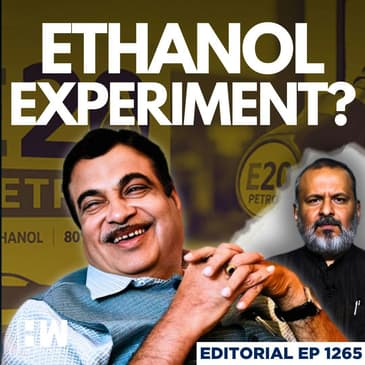
In this episode of Editorial, HW News Managing Editor Sujit Nair weighs in on the ethanol (E20) controversy. Customers have slammed Union Minister Nitin Gadkari, accusing him of harming their cars, while vehicle makers have backed the government's move. Mr. Nair believes that carmakers and the government need to assuage customer concerns by rolling out key measures.
Learn more about your ad choices. Visit megaphone.fm/adchoices
[00:00:00] Nitin Gadkari today doesn't command that kind of credibility that he used to once upon a time. When I buy a vehicle, the first thing I say is how much mileage is petrol and you are damaging my mileage is what the Indian consumer says. And finally we become the guinea pig of an experiment. It's time that the government becomes accountable for the kind of policies it's formulating. It's a government, they are not rulers that one fine day somebody gets up and says let's add ethylon, let's add ethylon. It cannot be that way.
[00:00:35] Namaskar! Welcome to another episode of Editorial. Let's talk about E20, Ethanol Blended Petrol. Now what I'm going to do is I'm going to present both the sides. I'm going to present what the government talks about or rather Nitin Gadkari speaks about ethanol E20 and what others talk about it, critics talk about it. I'll present both the cases in front of you and then we will do our small analysis.
[00:01:03] But finally, of course, the decision is yours because the vehicle is yours. Okay, let's go. You see, the government says that we should somehow curb our import of crude oil. We should have some kind of method where we restrict our import of crude oil. Fundamentally, absolutely correct. Because huge amount of our foreign exchange is spent on import of crude oil.
[00:01:33] So the government strategizing for that, planning for that is a perfect thing for any government to do. So that's the first point. The government came with a plan. The government says, why not use ethanol, blend it with petrol so that the actual consumption of petrol reduces. Thought, very good thought. But was it good?
[00:02:01] Not otherwise, it has to be experimented. The government says that, said that, listen, by 2030, we will plan this E20, that is ethanol blended petrol. 2030. But somewhere down the line, Nitin Gadkari was super efficient in this case.
[00:02:23] And with his super efficiency, he actually prepond the launch from 2030 to 2025 April, where he said that, listen, India is ready. India is ready to blend 20% ethanol into 80% petrol. So now the E20 fuel is 20% ethanol and 80% petrol. They were ready 2025.
[00:02:49] After the war and all of that, and you know, the austerity planned by the Prime Minister of India and all of that, ethanol was distributed almost in every RO. So E20 petrol is available in every RO. In fact, RO is retail outlets, your petrol pump. Okay, so incidentally, now if you go to a petrol pump, they will give you E20 petrol. You want it or not? You like it or not? They'll give you E20 petrol. That is the current circumstances.
[00:03:18] Has the price drastically come down? No, no, that has not come down either. But you are given E20 petrol. Like I said, fundamentally, the thought is right. Our consumption of petrol, diesel has to, and dependence on crude oil, imported crude oil, has to come down. There is no doubt about it. But the question is, is ethanol the answer? Is blending ethanol the answer?
[00:03:43] The first point is, government of India, in fact, the Attorney General Venkat Ramani had told the court hearing that E20 was an experiment whose results would only come out next year. This is what he said in the court a few weeks back. The government said no, no, no. The government denied the remark. It was ever made. But video of the court hearing shows Venkat Ramani saying the same. This is the video.
[00:04:11] One reason is, every year, there will be either a spot in demand or there will be a fall in demand. 20% ethanol petrol blending is something which the government is now trying to experiment. So, tomorrow, next year, October onwards, probably the demand will go up and it will go down. Therefore, that's why paragraph 6.8 of the agreement says, on best endeavour basis, we'll give you.
[00:04:32] Now, Venkat Ramani went down to say that, he told writers that the term experiment in the context of the volume of ethanol supplies, not the ethanol petrol policy itself. He says, listen, when I said experiment, it was not about the policy, the experiment was not policy, it was about the volume of ethanol supplies. That is what I meant by experiment and all that.
[00:04:55] So, long and short of it is, the country wondered, is the government experimenting on my vehicle? Because at the end of the day, would my vehicle suffer because of all this? And the government is unsure? This is what people think. Now, let us understand what the consumer feels about it. The normal consumers on the streets.
[00:05:19] The normal consumers on the street says that for most vehicle owners, mileage will remain the key factor while buying a vehicle. There have been numerous complaints that the mileage of vehicles has dropped since the full rollout of E20. An issue not just flagged on social media, rather a common talking point in workplace. And social gathering.
[00:05:44] Government and automobile companies have maintained that there is a 3-4% reduction of mileage due to E20 fuel in vehicles that are non-compliant. They refer to findings of a study conducted by Automotive Research Association of India, ARAI, Indian Oil Corporation and SIAM in 2021. It said fuel consumption of vehicles with E20 increasing 2-6% compared to E10 and percentage varies from vehicle to vehicle.
[00:06:12] So, end of the day, the consumer says that my mileage is coming down. This is one of the major complaints. The mileage of my vehicle. See, for me, I am a middle class Indian. I am not, I don't belong to that 1% of Indian society. I belong to the rest of the Indian society where my money is very, very limited. And therefore, when I buy a vehicle, the first thing I say, petrol is how much mileage is. That's a very regular question that any consumer, any Indian consumer asks.
[00:06:39] And you are damaging my mileage, is what the Indian consumer says. The government says, no, no, no. According to a lot of research that we have conducted, it is not, it is insignificant. The mileage, the loss of mileage is insignificant. This is what the government says. The Auto Bill Association in the last 11 months has met twice, twice to support the government.
[00:07:01] In fact, they say that amid some genuine concerns and some misinformation surrounding the adverse impact of E20 on vehicles that was manufactured before April 2023, they went on to say that they completely backed the government. They said the consumer and all, they said that they backed the government. They said that absolutely no problem. There is absolutely no problem. Whatever the government says is correct. This is what the vehicle manufacturer says. Okay, let me add one piece of information here.
[00:07:29] We spoke about CM when we spoke about government reports and why government feels that there is no loss of mileage with ethanol. I will also quote one CM report. CM basically stands for Society of Indian Auto Bill Manufacturers. Now CM said that, this was around 2021. CM said that to ensure fuel availability for existing vehicles and assurance to customers,
[00:07:55] parallel dispensing of a protection grade of E10 fuel is a must. Which means what they said is, while you go ahead, you have your E20, but parallelly, you should also have E10. Because that is a must. So if everything was fine, why did they make this kind of a statement? CM went on to say that retrofitting older vehicles to run optimally on higher ethanol blends would be an enormous challenge.
[00:08:24] Because of the large number of vehicles, variants and fuel system configuration already in use. In fact, they also warned that withdrawal of lower ethanol fuel could create compatibility, safety, fuel efficiency and drivability concerns for the vehicles that are already there in Indian roads. This is what CM said. So here we are.
[00:08:49] We understand that the government wants to reduce the consumption of fuel or the import of fuel rather. We are spending huge foreign currency. Understandable. Therefore, they decided to mix ethanol. Understandable. Now, the consumer says, this ethanol is bringing down their mileage and the manufacturer says, it's okay. What the government is doing is all correct. This is what has happened. This is what it stands.
[00:09:16] Now, I in this particular retort especially, I'm not going to talk much about Gadkari's son's involvement in ethylol and how they're profiting out of it. And you know, all that I will keep it for another discussion. As of now, let us understand the topic at hand very clearly. The petrol that I'm filling, will it spoil my vehicle or not? Let us understand that which I think is more important. So here we are. My first question.
[00:09:42] My first question is, this entire project has been launched by Nitin Gadkari. Nitin Gadkari today, today doesn't command that kind of credibility that he used to once upon a time in India. Because Nitin Gadkari like most of the other people, most of the other ministers have been talking too much but delivering almost not even 10% of what he spoke about.
[00:10:05] He was the one who said that the prince and the king and all wanted him in Dubai for six months and all of that. And this is the roads, the condition of the roads. Look at the condition of the roads. These are the things that he committed. These were the things that he promised this country and this is his final delivery. Now he's promising ethanol, E20, what could be the final delivery? That's my first question to you. That's my first question.
[00:10:32] This is the minister's promise and this was his delivery in the past. Why should I believe that E20 would be something spectacular and would be different from what he offered earlier on? Is it a valid question? Point number one. So I first question the credibility. Why should I believe you? Point number one. Point two. You see, the manufacturers came and told you that, you know, it's all fine. Government is all right. Everything is fine. Is the manufacturer, will the manufacturer give a commitment?
[00:11:01] All those manufacturers who came, will they give a commitment saying that, listen, if your mileage comes down beyond say 3% or 2% or whatever the government commits, I will ensure that my servicing centers will ensure we clean up your system. We repair your car. We repair your vehicle free of cost for you. Because I'll put my money where my mouth is. You're telling your own consumers that everything is fine. The ethanol is perfect. My car runs beautifully in this ethanol. No problem. If that is what your commitment is, then put your money where your mouth is.
[00:11:30] Ensure that you open your service centers for cars to come and service, repair, whatever requires to be done to ensure that their mileage doesn't come down. Or mileage comes down as per the recommendation or as per the whatever the government tells 2% 3% that it was supposed to come down. Ensure that it happens. Put where your money where your mouth is your consumer. My dear brands, they're much more important to you than the government.
[00:11:56] I understand the government is important and the government you have to be in their good books, but the consumer is equally important. So when you are committing something to the consumer, when you are endorsing a particular government project, please ensure that you put everything to ensure the consumer interest is taken care of. Isn't that fair too? So let that happen. If all of this happens, then fine. Like I said, the intention of reducing imports of crude oil is perfect.
[00:12:24] It's perfect and absolutely practical and a must. Nobody denies that. Finally, finally, if this is an experiment, if this is an experiment, can the government give a backup?
[00:12:41] If my vehicle is spoiled, if my vehicle doesn't function, if my vehicle has lost its mileage, my vehicle is not as efficient as what it used to be, can the government give me some kind of an insurance benefit? Can the government say that, okay, you come to me, I will, this is an X insurance amount that I keep aside for you and I will pay your vehicles. If my strategy, my policy boomerangs.
[00:13:08] It's time that the government becomes accountable for the kind of policies it's formulating. It's a government. They are not rulers. That one fine day, somebody gets up and says, I have to pay the amount of money. It cannot be that way. You are not ruler. You are the government. You need to be accountable for your policy. Can the government, again, like I said, like I spoke about the manufacturer, can the government put their money where their mouth is?
[00:13:36] If something goes wrong with the vehicle, can you ensure that that vehicle is repaired? Can you ensure that the vehicle is paid for or some kind of an insurance, a special scheme where these vehicles which, you know, they lost out their mileage or whatever are repaired or taken care of? Is that possible? Because if you are so sure nothing is wrong and everything is a conspiracy, then what of it? Do it. Anyway, nothing is going to happen. Nobody is going to come because ultimately you won't get that.
[00:14:05] Nobody, no mileage is going to come down. So make your policy clear. Commit to the consumers that we will take care of your vehicles because finally it is our policy and we stand by it. Now, the manufacturer doesn't want to stand by it. The government doesn't want to stand by it. And finally, we become the guinea pig of an experiment. Is that fair? That's the point that I want to end this conversation with. Till I see you next time. That's tomorrow at 10. Namaskar.