
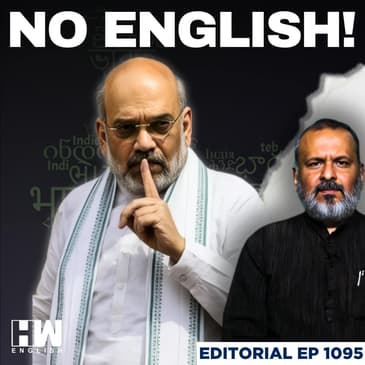

In this episode of Editorial, Mr. Sujit Nair discusses a remark made by Union Home Minister Amit Shah about English-speaking Indians. Amit Shah stated that English speakers in India would soon feel ashamed.
Learn more about your ad choices. Visit megaphone.fm/adchoices
[00:00:00] Namaskar! Welcome to another episode of Editorial. You see, in this country, those who speak English will soon be ashamed. This is what our Home Minister Mr. Amish Shah said day before yesterday.
[00:00:20] If you are speaking English, you will be ashamed. Now, I am very mindful of the fact that possibly this debate has been brought forward to divert attention from a lot of other issues that are happening across the globe. A lot of it is also affecting India and may not be in a very positive light for the Bharatiya Janata Party.
[00:00:43] So, I understand that this could be a discussion, debate or a topic that has been brought about so that you can divert attention. But that being said, I want to talk about this. And let's get right into the show. So Mr. Amish Shah, our Honourable Home Minister, says that in this country, those who speak English will soon feel ashamed.
[00:01:12] The creation of such a society is not far away. I believe that the language of our country are the jewels of our culture. Without our language, we cease to be truly Indian. This is what Mr. Amish Shah said.
[00:01:27] I say to the whole world, to the ends of the earth, India's spirit will never be broken by terrorism. Terrorism will not go.
[00:02:07] He will punish. Every effort will be made to ensure that justice is done. Now, I am not going to waste your time and mine asking Mr. Amish Shah whether he thinks that Mr. Narendra Modi, our good Prime Minister, will feel ashamed of what he said. Because he spoke in English. He attempted to. The point is, I will not ask that question because it's okay. He understood.
[00:02:35] But tell me, why do you think Mr. Narendra Modi spoke in English? Why do you think the Prime Minister spoke in English? He spoke in English because he wanted the world possibly to understand. At least that is what he thought. He wanted the world to know what he has in his mind. He wanted to communicate to the world. So, he spoke in English in Bihar. It is a Hindi speaking state. He spoke in Bihar and he spoke in English.
[00:03:05] So, the question I want to actually ask our Honorable Home Minister is, is the right to communicate to the world reserved for the Prime Minister of India alone? If a farmer wants to speak to the world and express what he is doing in his farm or try to sell his produce to the world, and if he speaks in English, should he be ashamed of himself?
[00:03:28] If a student wants to look at international options, work for global giants, multinational and he speaks in English, should he be ashamed of himself? If a housewife wants to sell her produce, her small scale, chota particular product to the world which she made from her kitchen and she wants to sell her pickles to the world for instance,
[00:03:54] and she spoke in English, should he be ashamed of herself? So, who should be ashamed of oneself? Who should be ashamed of oneself? If Hindi, according to Mr. Amisha in various forum, if Hindi, he believes is what connects India from Kashmir to Kanyakumari, English connects the globe. English connects the globe from end to end. So, if you know Hindi, it is also better you know English.
[00:04:25] Because you not only need to connect to your country at the moment, you need to connect to the world. When the Prime Minister says Startup India, Startup India is not just for India, Startup India is meant for the globe. You become big, you become a unicorn company when you start exporting your product, when you start dealing with the globe, when globe becomes your market and the reason why globe will become your market is because you need to communicate to the globe.
[00:04:54] When you communicate to the globe, that's when you get access to world markets. If you can't communicate to the globe, you cannot get access to world market. China is changing its trend. In fact, China changed its trend from a country that never went beyond Chinese language or Mandarin language.
[00:05:18] That particular country today is almost making it mandatory for their people to learn English. Because they know if they want to sell to the world, they need to understand English, they need to communicate in English. Today, they are taking efforts to ensure that their country, their children, their future learns English. And here, our home minister tells us, you know, people who speak English will feel ashamed of themselves.
[00:05:49] Progress and regress. There is progression when you see the world as your market. There is regression when you say that you see my borders are my market. My border is where I want to be. I am contained into my border. That is regression. You choose whether you want progression or regression. If you need to communicate to the world, you need to know English.
[00:06:17] The point that I am trying to make is, if our Indians are global corporate leaders today, our global corporate leaders, one of the major reasons for that, and you can ask them, you can read their interviews, you can see some of their communication. They are there because they are there because they could communicate. They understood and delivered themselves, delivered their thoughts in English.
[00:06:44] It was easier for them to grow the ladder in their particular corporate. So therefore, you have corporate leaders. Let me give you one other fact. Let me give you one other fact. If your son, your daughter, if they have to be CEOs like Nadella and Sundar Pichai, you know, it is very important they come out of a fantastic university.
[00:07:09] Because most of these gentlemen, they are from IIT, IIMs of our country. And you know what is the working language in our IITs or IIM? Indian Institute of Science, which is possibly one of the best engineering universities, is English. University of Delhi, English. IIM Ahmedabad, English. Anna University, Chennai, English. Jawaharlal Nehru University, English. IIT, Kharagpur, like I said, English. AIIMS, AIMS, New Delhi, English.
[00:07:39] If you are going to come out of these institutes, if you want to come out of these institutes, you want to pass these institutes, you want to get entry into this institute, you want to be graduates from these institutes, you have to understand and know English. If you don't know English, you will not get into these institutes. So it's imperative that your children understand English. It's imperative that your children learn English. While I am not propagating that your child should be in English medium.
[00:08:08] Your mother tongue for initial education, primary education is something that even I prefer. Studying in your mother tongue, especially in the primary level is a fantastic thought. But at some level, the child needs to understand, learn, study, say, talk English. Necessary. Necessary for growth.
[00:08:31] Today, when our external affairs minister goes across the globe, does he sit there and speak in Hindi? Does Mr. Jay Shankar speak in Hindi? So according to the home minister, our external affairs minister should also be very ashamed of himself. He will be ashamed of himself tomorrow. Oops! He spoke English everywhere. He should say, Ne, I will speak Hindi.
[00:08:59] My interpreter will answer you like some countries do. So why is it okay if the prime minister speaks English? Why is it okay if the external affairs minister speak English? Why is it okay when all our ministers, whoever understands and speaks English, speaks English whenever they go abroad? Why is it okay? And why is it okay if a common farmer's son would be ashamed if he or she knows English or speaks English tomorrow?
[00:09:29] Why does the government believe that? Why does the government believe that? Let me ask you my third question. How many of these ministers have their sons, daughters studying all across the globe? Most of their children are foreign educated. Why? Why couldn't they put them in Gurukul? Why couldn't they train them in Hindi?
[00:09:54] Why aren't they taking an oath that my grandson, my son, my great grandson, all of them will now only go to Hindi schools. Let them take an oath. Let Bharatiya Janata Party take an oath that if you want to be part of Bharatiya Janata Party, you have to send your children to Hindi school. Let them take an oath. That they won't. Your son, if he speaks English, then it is he will be ashamed of himself. But their children can study in London. Their children can study in Australia.
[00:10:24] Their children can study in US. No problem. US doesn't get a visa by the way. But all the same. No problem. I mean, what is this entire argument about? What is his entire argument about? Narendra Modi wrote a book called what? Exam Warriors. He wrote a book. That book is also printed in English. There is a version of that book in English. Why? Why is there a version of his book in English?
[00:10:53] The fact remains that I think language is something that is close to one's heart. A person should learn, speak, understand, experience, write, read the language of his or her preference. India is united. India doesn't need more and more ways and means suggested by political parties to say how we should be united. We are united anyways.
[00:11:21] India is a united force and our diversity is our unity. So under the garb of unity, let us not push language. Let us not push religion. Let us not push policies, please. It's not for the benefit of the country. It is for the benefit of a political dispensation. That's the point I wanted to make. Till I see you next time. That's tomorrow at 10. Namaskar. nh