
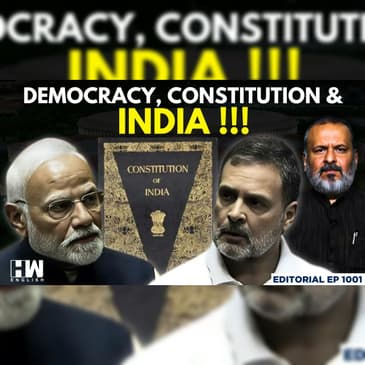
In this episode of Editorial, Mr. Sujit Nair discusses the Indian Constitution and examines how it has been degenerating over the years. He delves into history to highlight Dr. B.R. Ambedkar’s vision and warnings during the Constituent Assembly debates. Mr. Nair illustrates how, as early as 1948, Dr. Ambedkar forecasted the potential threats to India’s democracy.
Learn more about your ad choices. Visit megaphone.fm/adchoices
[00:00:00] Namaskar Welcome to my thousand and first episode of editorial.
[00:00:09] You know, today's topic is slightly different. 26 November was supposed to be our constitution
[00:00:19] day. But recently in parliament there was lot of discussion about constitution. Let us talk
[00:00:28] about constitution and most importantly let us discuss how our constitution has been degenerating.
[00:00:38] Let's get right into the show.
[00:00:43] You know when we talk about our constitution, a lot of things a lot of people say. A lot of
[00:00:50] rumors, a lot of debates, a lot of whatsapp university information are spread. In fact,
[00:00:58] the most talked about part of our constitution is that line which says we are secular federal
[00:01:06] socialist republic. A lot of people say, secular socialist kaan se hai? The original constitution
[00:01:16] didn't have these words. Ye kaan se hai gya bhai? Haan, that is a fact. On the 15th of November
[00:01:25] 1948 when the debate was on in our constituent assembly on our constitution, at that point in time, we didn't put
[00:01:35] the word secular and socialist. But let me tell you what exactly happened. Let me tell you the story of
[00:01:43] socialist secular republic. Let me tell you the story of that. You see, KT Shah who was an MP then in the
[00:01:53] constituent assembly did move an amendment to incorporate the word secular federal socialist
[00:02:01] in clause 1 of article 1 of our constitution. This was mooted by KT Shah. To which Dr. Ambedkar reacted.
[00:02:13] Dr. Ambedkar said, I regret that I cannot accept the amendment of Professor KT Shah. My objections
[00:02:24] stated briefly are two. In the first place, the constitution that I stated in my opening speech
[00:02:32] is in support of the motion I made before the house is merely a mechanism of purpose of regulating the work
[00:02:40] of various organs of the state. It is not a mechanism whereby particular member of particular parties
[00:02:48] are installed in office. What should be the policy of the state? How the society should be organized
[00:02:56] in its social and economical side or matter which must be decided by the people themselves and according to
[00:03:04] the time and circumstances. It cannot be laid down in the constitution itself because this is destroying
[00:03:11] democracy altogether. This, ladies and gentlemen, would be something that a lot of you must have heard
[00:03:21] for the first time. The response of Dr. Ambedkar to KT Shah's request of secular democratic republic.
[00:03:31] You see what Dr. Ambedkar said is, you see whether the society is secular or whether the society wants
[00:03:40] to choose socialism over capitalism or capitalism over communism is the society's choice. It is not what
[00:03:50] the constitution will guide you. It is not what the constitution tells you. You, the society, you decide.
[00:03:59] And whenever, according to your circumstances, according to the environment you are in and according to the
[00:04:05] time that you are in, you decide whether you want to be secular, you decide whether you want to choose
[00:04:12] socialism, you decide whether you want to choose capitalism or whatever, you decide that. The constitution
[00:04:19] will not be enforcing that on you. So this predominantly the reason why the word secular and socialist was
[00:04:28] not incorporated into our constitution. Unlike what is said that, you know, our founding fathers did not see this country as secular. Our founding fathers did not see this country belonging to every Indians. That is not a fact. That is not truth.
[00:04:49] That is not truth. The constitution, the way it was laid down and so beautifully laid down by Dr. Baba Saheb Ambedkar was a Puritan form of what a constitution, what a democracy could be.
[00:05:02] And that is the first thing I want a lot of us to know. That is point number one. You know, another point I want to take you through before we get into details. You know, Baba Saheb Ambedkar had made a very relevant observation.
[00:05:19] And I want to compare that observation. And I want to compare that observation. And I want to read this observation to you so that you compare that observation he made in 1948 to what's happening today. This observation too was made in the constituent assembly.
[00:05:33] Dr. Baba Saheb Ambedkar said, Our constitution must not be dictatorship, but must be a constitution in which there is a parliamentary democracy.
[00:05:44] Hear this very carefully.
[00:05:46] Our constitution must not be dictatorship, but must be a constitution in which there is parliamentary democracy, where government is all the time on the anvil, so to say, on its trial responsible to the people, responsible to the judiciary.
[00:06:07] Then I have no hesitation in saying that the principles embodied by the constitutions are good, as if not better than the principles embodied by any other constitution.
[00:06:21] The way our constitution and our country is designed is amazing.
[00:06:27] Dr. Baba Saheb Ambedkar and his team, the way they have designed our constitution and the way they envisaged our democracy is just amazing, like I said.
[00:06:40] You see, what Dr. Baba Saheb Ambedkar said, that the government should be on trial every time.
[00:06:50] Trial by whom? Trial by the people, trial by the opposition, trial by the judiciary.
[00:06:55] The government should be standing on trial.
[00:06:58] The meaning of that is, the government should be answering.
[00:07:01] Government should be justifying every step that the government takes.
[00:07:08] Not that an MP questions the government or questions the prime minister and the next day, the MP gets a CBI notice or an ED notice.
[00:07:17] That is not what our constitution was.
[00:07:20] That is not what our constitution is.
[00:07:22] That is not what our democracy was.
[00:07:23] And that's not what our democracy is.
[00:07:27] That's the point I wanted to make.
[00:07:30] When we talk about our democracy, when we keep that red book or green book on our head and we say we respect our democracy, we worship our democracy, all this is to some extent symbolic.
[00:07:42] Do we really bother about our democracy?
[00:07:44] Forget about bothering our democracy.
[00:07:46] Bothering about our democracy, do we even understand our democracy the way it was written by this great man called Dr. Baba Saheb Ambedkar?
[00:07:55] Because when you read the democracy and when you read the intrinsic values of the democracy, your respect for this great thinker would rise.
[00:08:07] And his team of course.
[00:08:09] He and his entire team.
[00:08:12] And the way our founding fathers thought of our democracy.
[00:08:16] This is one.
[00:08:19] Government should be always on trial.
[00:08:21] The government should be answerable to every person in this country.
[00:08:29] At times, the government and the prime minister should also be talking to the press.
[00:08:34] I am not saying that is what he said here.
[00:08:35] But that exactly is what you mean by the government should be on trial.
[00:08:39] Because the government is answerable.
[00:08:43] And compare that to what is happening today.
[00:08:47] Point number two.
[00:08:48] Now, let me talk about another few predictions or caution that Dr. Baba Saheb Ambedkar gave us.
[00:09:01] Let me read what he said and then I will try.
[00:09:04] It is self-explanatory but I will try and explain further.
[00:09:08] He said the purpose of a constitution is not merely to create the organs.
[00:09:13] When he says organs, it means the executive, the legislature and the judiciary.
[00:09:18] He says it is not merely to create the organs of the state but to limit their authority.
[00:09:25] Because if no limits are imposed upon the authority of the organs, there will be complete tyranny and complete oppression.
[00:09:35] The constitution is a fundamental document that defines the position and power of the three organs like I told you.
[00:09:43] The state, that is the executive, the judiciary and legislature.
[00:09:47] It also defines the power of the executive and the power of the legislature as against the citizens.
[00:09:55] As we have done in our chapter dealing with fundamental rights.
[00:09:59] The legislature may be free to frame any law.
[00:10:04] The executive may be free to take any decisions and the supreme court may be free to give any interpretation of law.
[00:10:12] It would result to utter chaos.
[00:10:15] Look at what he said in 1948.
[00:10:20] The founding father, the father of our constitution didn't speak about giving powers to people, to organs.
[00:10:28] Organs, like I said, legislature, judiciary and executive.
[00:10:32] He said you should be more concerned about how to limit it.
[00:10:38] Not create laws where you just pick up a person and put him behind bars.
[00:10:41] Question in trial, trial in trial, trial in trial.
[00:10:44] After one year, give powers to judiciary.
[00:10:47] Give powers to executive.
[00:10:49] ED can put you behind bars without question.
[00:10:51] Nothing.
[00:10:51] Two years, you are in.
[00:10:55] These kind of things he predicted in 1948 will create chaos.
[00:11:00] Because if power is given to legislature like it has, if one office holds the power to control your life, it will create tyranny.
[00:11:11] He said that in 1948.
[00:11:14] Today we are in 2024 and I ask you, and I ask you, has it happened?
[00:11:21] Has it happened?
[00:11:23] He says that the judiciary can make any decisions, make any calls.
[00:11:30] The judiciary can give emergency hearing to people saying that,
[00:11:34] Arrey, jail is an exception.
[00:11:36] Bail is the norm when it comes to one person.
[00:11:39] But when it comes to another, that person can be languishing in jail for five years.
[00:11:46] When it comes to somebody else, that person can be, could die in the jail without having a sipper to sip water.
[00:11:56] Because Parkinson's disease, he couldn't drink water.
[00:12:00] The judiciary saw that, the same judiciary.
[00:12:03] And the same judiciary calls important people, popular people, big people, people who are closer to the government.
[00:12:11] And ask for an emergency hearing.
[00:12:14] Why?
[00:12:14] Arrey, jail is exception.
[00:12:17] Bail is the norm.
[00:12:20] This is what's happening today.
[00:12:23] And this is what Baba Sai Bambaidkar told us in 1948.
[00:12:31] Now, why am I doing this editorial?
[00:12:33] I am doing this editorial because many a times I have come in front of you to speak to you about constitution.
[00:12:41] Many a times I have come to you and I have told you that the reason I sit in front and talk to you almost every night is because I believe that we should understand our constitution.
[00:12:53] Therefore, we should understand what is happening in our parliament.
[00:12:56] Therefore, we should understand how our constitutional bodies, our constitutional organs and our constitutional offices are performing.
[00:13:04] We should understand that because it is our duty to ensure that we protect our constitution.
[00:13:11] Therefore, act for our democracy.
[00:13:15] It is our job.
[00:13:17] And today, my intention of this editorial is to just prove to you a point that actually our founding fathers and the father of our constitution, that is Dr. Baba Sai Bambaidkar, had almost envisaged.
[00:13:34] It's as if he was reading the future.
[00:13:37] He had almost envisaged what could happen to our constitution.
[00:13:44] While he was writing it, he cautioned us.
[00:13:48] And that is what I wanted to bring to your notice.
[00:13:52] While a lot of political party may add a lot of political color to all of this, my intention to bring you this constitutional, these few points, I have not gone in detail, these few points in this 15 minutes.
[00:14:05] And I promise you, I will do more of this is to ensure you to just think, just think that how important whether we belong to the right wing, left wing, center wing, upper wing, lower wing, whatever wing we belong to.
[00:14:20] How important it is for us to ensure that we protect the tenets of our constitution so that we protect our democracy the way it is.
[00:14:33] That's the point I wanted to make through this editorial.
[00:14:37] Till I see you next time, that's tomorrow at ten.
[00:14:41] Namaskar.