
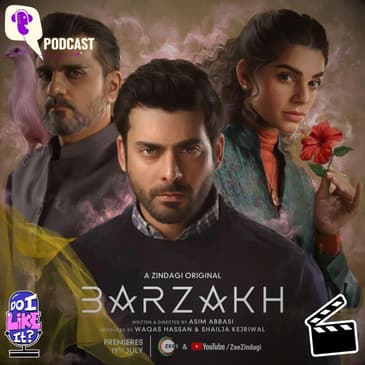

In this episode of 'Do I Like It', we dive into the enigmatic world of 'Barzakh', the new web series starring Fawad Khan, Sanam Saeed, and Salman Shahid. We explore the themes, religious imagery, and intricate storytelling that make this Indo-Pakistani co-production a unique viewing experience. From spiritual metaphors to complex world-building, find out why this series demands more than just casual watching. Tune in for a spoiler-free guide to this intense narrative. Leave a comment if you'd like a full spoiler deep dive—12 chosen buzurgs might just make it happen!
Learn more about your ad choices. Visit megaphone.fm/adchoices
[00:00:00] You can find where the action is, when gaming anyway.
[00:00:04] Now dive deep into your gameplay.
[00:00:06] On the big main display of the new foldable Samsung Galaxy Z Fold 6 with adaptive 120Hz image recovery device.
[00:00:13] Your skills will make the opponent look blabber.
[00:00:15] While the strong Snapdragon HN3 for Galaxy processor keeps your back free with a smooth gaming experience.
[00:00:22] That's how you are in the middle and in front.
[00:00:24] Now learn more about the new Galaxy Z Fold 6 on Samsung.de
[00:00:54] It's a nice guide and it'll give you some hacks on what to expect from this Indian and Pakistani co-production.
[00:00:59] I have always said that film is a director's medium and it's the web series where the writer is the one who truly shines and runs the show.
[00:01:08] Simply put, series are about the what and films are about the how.
[00:01:11] A usual web series is very story or plot heavy because if you want to show the viewer an hour or five episodes,
[00:01:18] something interesting needs to happen every now and then.
[00:01:20] But in film, things like mood, world building and subtext takes interstage.
[00:01:25] Because there's not much time to explore a lot of plots.
[00:01:28] By the way, there's a very surface level distinction.
[00:01:30] It's not that the writer is not important in the film and the web series can't have subtexts.
[00:01:34] So tell me how to kill it.
[00:01:36] Nowadays, genre-wonders are mixed.
[00:01:38] But yeah, in Barzakh, the show is being led by director Asim Abbasi who's also the writer.
[00:01:44] The first episode starts with this Wes Anderson meets Achal Mishra style boxy frame
[00:01:48] that shows the longing and relationship of two lovers Mehtaab and Jafar.
[00:01:52] Jafar decides to go to the big city to make some money while Mehtaab wants him to stay.
[00:01:56] Within cut to some years later, where an old Jafar has called his sons for his third wedding with, guess who, Mehtaab.
[00:02:03] And now, till this time, you feel like it's going to be a normal hooded knit.
[00:02:08] There are five or six cast members, an unknown palace, an old man.
[00:02:11] So I was like, someone will definitely die in this.
[00:02:13] But the show takes a complete left turn from there.
[00:02:16] Every episode is book-ended with a quote from the Book of Nowhere and a flashback in the same square frame.
[00:02:23] If I had to explain Barzakh in one word, it would be demanding and like pilgrimage.
[00:02:28] Don't worry, I'll explain what it means.
[00:02:30] If anyone asks you how Barzakh looks, don't say pilgrimage.
[00:02:32] It's very stupid.
[00:02:34] But I use these words because just like a Yatra, it takes so much from you.
[00:02:39] And by the end, you feel drained.
[00:02:40] Nothing is laid out in front of you like this easily.
[00:02:43] So you have to work a little bit.
[00:02:44] It's like when I started taking therapy four to five years ago,
[00:02:47] I thought I just had to talk to someone for an hour or so and lessen the pain of life.
[00:02:52] But the deeper I go into my mind, the more I realize that something else is happening here.
[00:02:57] I was starting this show thinking that it's a Pakistani show,
[00:03:01] Kashaf and Zarun are coming back.
[00:03:02] Let's see.
[00:03:04] But in the middle of the second episode, we find out that everything is not going so smoothly.
[00:03:08] Things start getting confusing and you as a viewer and a pilgrim start getting tested.
[00:03:14] So that's it.
[00:03:14] Then I turned off my 9 o'clock alarm, popcorn and Pepsi and just started walking on this hill.
[00:03:19] Now I'm not making up all of these religious themes out of thin air.
[00:03:23] The show itself uses some intricate spiritual and religious imagery to get its point across.
[00:03:29] It's not a coincidence that the first shot of the show is a man eating a fruit.
[00:03:32] There are references to a serpent, a central tree, rebirth, the 12 Buzurghs or the 12 Apostles of Jesus.
[00:03:40] By Puri Easter pole tree.
[00:03:42] And in some heavenly ideas, the director is trying to tell this simple story of longing, desire and suffering.
[00:03:49] And at the same time, he's using these religious signifiers and re-interpreting them.
[00:03:53] Something which requires a very keen understanding of theology and mythology.
[00:03:57] It's not some newly deconstructed atheist making fun of religion by flipping its symbols.
[00:04:02] It's almost like a Satanist who uses Biblical language to create conservative Christian thought.
[00:04:08] These people aren't actually Devil worshippers, they're just contextualizing their ideas to keep things in mind.
[00:04:15] Watching Barzakh is like solving a huge jigsaw puzzle.
[00:04:18] I don't know if you've ever done such a big adult puzzle with like 1000 pieces.
[00:04:22] For the first one hour, you just look at the individual pieces and try to make some sense out of it.
[00:04:26] It's just endless sifting through random figures.
[00:04:29] Then slowly, a pattern starts to fill up.
[00:04:32] You start noticing that there's a branch of a tree, or a corner somewhere.
[00:04:37] So you make those 3-4 parts and then you go sideways.
[00:04:40] Then something comes up and you go sideways again.
[00:04:42] That's it, this show has to look like this.
[00:04:44] First three episodes, just keep your eyes open and observe.
[00:04:48] Make mental notes.
[00:04:49] Is it good that every episode has a painting, some people walk with stones,
[00:04:54] there are fairies, there's a lumberjack.
[00:04:56] Just keep watching and keep talking in your mind.
[00:04:58] You don't have to try to understand.
[00:04:59] But for the fourth episode, some things will start making sense and patterns will start emerging.
[00:05:04] But that will also happen partially.
[00:05:06] Just like a jigsaw puzzle.
[00:05:07] You'll understand one or two things here, one or two there.
[00:05:09] But the big picture won't be there.
[00:05:11] That guy will be on the second or third rewatch.
[00:05:14] And the one who hits the show, insane.
[00:05:17] So in that sense, Barzakh's funda is kind of like the graph of e-race to the far-ex.
[00:05:22] It's just a very slow start and then everything goes together.
[00:05:27] So take regular breaks, write down your thoughts and as a fellow confused watcher,
[00:05:31] whatever you're thinking is happening, it's happening.
[00:05:33] You don't have to doubt yourself.
[00:05:35] Talking about some movies is like a pretentious art connoisseur.
[00:05:40] Big things are not that one.
[00:05:42] Everything's subtext, everything's metaphor, all of that.
[00:05:45] But you know what?
[00:05:46] Sometimes art is not supposed to make sense.
[00:05:49] At least not in the first glance.
[00:05:50] It is totally fine to rely on the emotional feedback that the piece gives you
[00:05:54] without having broken down every single piece of it.
[00:05:58] Sometimes you can only feel it.
[00:05:59] You can't logically and rationally explain it to others,
[00:06:02] why did I like this?
[00:06:04] Just let this love be love, don't give me any names.
[00:06:07] Barzakh also reminded me of Lars Wontraer's Antichrist in some ways.
[00:06:11] Where they talk about the different ways the two sexes interact with nature.
[00:06:15] And it uses grief to show how over time men and women have found such distinct ways to cope.
[00:06:21] Antichrist also goes heavy on biblical imagery, there is a tree and all.
[00:06:25] So yeah.
[00:06:26] And talking about imagery, Barzakh has loads of it.
[00:06:29] The fallen souls carrying weights, which I think hints at the whole idea of Mukti.
[00:06:33] You're in a purgatory until a decision about your soul is made.
[00:06:37] And that weight is being imagined as a literal stone.
[00:06:40] Or the idea of sacrifice.
[00:06:41] How sometimes to fulfill our desires,
[00:06:43] we have to let go of things that are closest to us.
[00:06:46] Or the snake biting its own tail.
[00:06:48] Which talks about the cycle of rebirth, the cycle of fall and spring with that tree.
[00:06:52] By the way, that snake is also what inspired the benzine structure.
[00:06:56] Yeah, the organic chemistry, kekul structure.
[00:06:59] Now this might get into spoiler territory, so bear with me.
[00:07:02] But the ending really reminded me of Greta Garwigs Barbie.
[00:07:06] Where the mountain babies given a choice to go with the fairies into the perfect world.
[00:07:10] But she chooses to stay with the humans to join them in their struggle.
[00:07:14] Just like Barbie chooses to live in the real world and not return back to the perfect Barbie land.
[00:07:19] And just like Barbie, the chosen one refuses to go back to the Chaman where life is without a fault.
[00:07:25] But she stays back with the men who are imperfect.
[00:07:28] The men who have sinned because only then we can start any process of healing.
[00:07:33] Another thing I want to commend this series for is its world building.
[00:07:36] Because trust me, original world building and lower building is so so difficult.
[00:07:41] In the name of magic and mythology, people cannot move ahead with the Lord of the Rings or Game of Thrones.
[00:07:46] But this is contemporary yet mystical.
[00:07:49] There is talk of pariya and masiha, but there's also mental health and psychedelics.
[00:07:53] There are grand ideas of love and loss, but there's also this sharp analysis of the city life versus the hills.
[00:07:59] And in that aspect, the show kind of reminds me of Ritvik Pariks Dug-Dug.
[00:08:03] Which by the way, wherever I meet, I miss the mark.
[00:08:05] But overall, the show really made me sit up and think about my relationship with guilt, grief and death.
[00:08:11] Which is a bit weird anyway.
[00:08:12] So I am very happy.
[00:08:14] But tell me how you felt about the show.
[00:08:17] And by the way, when you watch this show, then watch the Pakistani reviews of the show.
[00:08:22] They are not happy.
[00:08:23] There's this rabbit hole of videos that I went into yesterday that starts from the show's stand-down homosexuality.
[00:08:30] And it goes as deep as Illuminati, Devilship and Freemasonry.
[00:08:34] It's another show in itself.
[00:08:36] Watch the show and then just go on YouTube.
[00:08:39] And yes, these are some of my thoughts on Barzakh and some themes it talks about.
[00:08:43] I wanted to keep this one spoiler-free because the last episode is just aired.
[00:08:47] But if 12 people said that they want a full spoiler deep dive with theories and all, I'll make another video.
[00:08:53] Let's see who will be the 12 chosen Buzurgs.
[00:08:56] This was Pratik and I'll see you in the next one.