
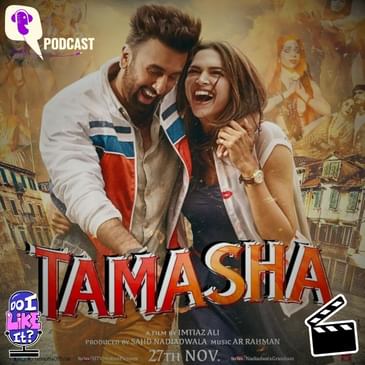

Join us for a fun revisit of Imtiaz Ali's classic, 'Tamasha.' In this episode of 'Do I Like It', Prateek Lidhoo dives deep into the most misunderstood scene of the film and uncover its hidden layers.
Whether you're a longtime fan or a curious newcomer, this breakdown is sure to entertain and enlighten. Listen till the end, and tell us in the comments, 'Why did the film end in Tokyo?'
Learn more about your ad choices. Visit megaphone.fm/adchoices
[00:00:00] Hello and welcome to Do I Like It, Ashroja harbath par Bhatkar. And Bhai, this is a pure haftadho hafta election and it's about the politics. I haven't seen this picture yet. So, I thought that there is no one who can revisit this.
[00:00:14] I recently re-watched one of my favorite films in the theatre, India Lalis Tamasha. And while I was in the middle of the theatrical experience, I was reminded of the first time I saw the film.
[00:00:24] My life was very different back then, the world was very different, but some things about the film stay the same. So, today I will revisit this picture. I can't tell you about your life details.
[00:00:34] So, in this episode, I can tell you about my life and the way I am. Now, look at this. Tamasha is a very close film for me. When I was in the first place in the theatre, I met a totally saw myself in the character of Wade.
[00:00:48] There's a scene in the film that was in my life when I was in the theatre, He cries and he takes his book from the book. He takes his book from the book and then he realizes that there is no one to be in the theatre.
[00:01:01] So, I am not exaggerating when I say Tamasha was based on my life. And Wade is a very close film for me today. He is a part of this podcast. He is a live actor. He is a real actor.
[00:01:13] So, if I am a film with my life and today I will be a film with my life and today I will be a film with my life. And I will be a part of this podcast.
[00:01:20] And as I said, I want to specifically talk about one scene that I think is the most important film of the film. The scene where Wade is getting fired from his job. Everything from the acting to the blocking and the music conveys a very different idea.
[00:01:33] But, in the second theatre, whenever I watched the film with any friend, he has a response from me. So, I just had to talk about it. Let's start with the show. By this time in the film, Tara has made Wade a project for us.
[00:01:47] He has shared his first two look himself in the mirror literally and decided to do it. He is a kind of a kid, a kind of a kid. And he is also a way of making this switch from a product manager and MCM telecom to Don.
[00:02:01] And one way this film shows this is the office montage. In the starting, we saw Wade's adventure in the same time. So, we had to rush out and get a job, get a job, get a traffic on the traffic and get a job and a life.
[00:02:14] One of the normal suki vani Lalife. But when Tara shakes him, this mundane nest gets the first hit. The idea is to take a little change in routine. He sleeps for some extra time, he gets a little more energy.
[00:02:28] And he gets a lot of time and he gets a lot of time. A cardinal scene in this corporate environment. And through this montage, the film segues into Wade's mind space. And this doesn't happen directly. Levels are there.
[00:02:40] And we get ideas about these levels through the performance blocking and the music. The first time this montage and presentations scenes happens, Now you can see music. It's vibrant, it's dynamic. Just a new start on our life. It's not happy exactly, but a headbaw is very groovy.
[00:02:55] It has these cell phone like bells which get you moving. It's intense but within underlying darkness. So mentally we are being primed for something that's about to come. And here, the level of level should be the same. The sense get louder, get more unsettling, get there and say,
[00:03:09] Bum, Bum, Bum, Heartbeat. And even runbeads performance gets more free. First of all, when the presentation was made in Jav Jharganvayara, he said it was a game-side ball, but then he was nervous. But now he's saying gibberish, hello Charlie, but then he said,
[00:03:24] Everything is saying, but confidence is there. Smile is a game-side ball. If you look at runbeads performance between the two times he gives the presentation, He's constantly looking at his boss for validation. He said, I told him, and now he doesn't give a damn,
[00:03:40] that I'm beating me in the beaten car. Try to imagine yourself in this place. Under the same age, you're going to be going to the kids, but you're going to have to take the phone with you.
[00:03:49] And after that, he has this final encounter with Tara when the song, if you're with him, the final meal in this coffin. He had given Tara one last chance, last time he was in the hospital. But his mind is just feeling him.
[00:04:03] And when he comes to the social side, he goes all in. When he's in the hospital, he's getting a lot of trouble. Electronic toothbrushes are using this gis-gis-gis-gis-gives. And he gives the ring that's when he realized that he's going to get a spa.
[00:04:16] Now, see how much blood he has to show him. When he sees that, he's going to get a lot of thrombling in the background. And the tone is so grungy, so metal which is a cue for us to embrace yourself towards coming.
[00:04:31] And a chanaq say the scene gets transported to this mosh pit drums. So, we're going to bangar. And my new. Up-tuck, this kind of score hasn't been used in the film. Korsikamite was very dreamy and orchestral. Delhi used to come here to get a little more cure.
[00:04:45] So, when he's in the first row, he's in the film. And all of this culminates in the office scene. The emotional flip happens when the way it closes the lift in the face of that auntie. Now, look, on its own, it's a very funny scene.
[00:04:57] If you're in the front mirror, when he closes the lift, his face is all goofy and his performance is very hammy. But if you're in background, you'll know why he's rocked. So, clearly, comedy is not over yet. The visuals and music are fighting to dictate the scene stone.
[00:05:12] Just like, wets, brain and heart are fighting with each other. But, the comedy is like, but under a dumb fight. Even the shot taking changes into a more tarantino-like free-form style. Before the meeting was seen, they were shot on a static camera with wights and closed-ups
[00:05:28] that showed us around the pav and the surroundings around him. But now, there's a crash zoom on his face. Way the same gibberish but he's having fun. And just like him, the camera is having fun. Dynamic shaky shots, hand-held, totally opposite to the film's visual grammar.
[00:05:43] And when was the last time we saw hand-held in the matcha? Yes, you're right. We were in court. Delhi realized that the show was on a static shot with minimal movement. And the movement was on a static camera. So, in this scene, we are getting a clue.
[00:05:57] We are getting a big beat in the beat in the beat of the beat. When he does the robot impression, alpha, beta etc., it is shot handheld as if even the camera is like, it's like, it's so disorienting. And BJM, I'm Roktho Chali Ra.
[00:06:11] Now cut to the calm before the storm. Way the setting with his boss in his cabin and this scene starts with pure silence. So, we are going to absorb the dance of the dance. But the characters' performance is a bit scary. Pico-characting. It's a bad guy.
[00:06:26] It's almost brekhti and another way. But we get confused because of this silence. Koyasar, putting voila, funny music, Bini Bajra which would give us a cute laugh. But clearly what's happening on screen is humorous. To hide coffee awkward.
[00:06:41] The blocking of the camera even breaks the 180 degree rule to visually disorient us. And now that I think of it, in this picture, it's a bit like 180 degree. And for the first time, it was done to break convention, no rules, like them free stuff.
[00:06:54] And in some of the darker parts, it was done to visually shake the viewer. So, this touch milk is a good idea. But Bajra is enjoying silence. And as soon as Ranveer says, nothing is going to be a joke. All hell breaks loose.
[00:07:06] The boss is looking at him like crazy. And even I'm like, this is a little bad. And the music plays this cool guitar riff, confirming my doubt, that I actually have a funny thing. Coffee is dark. And the rhythmic bass from level 1 comes back as way is continuing.
[00:07:23] You can see that nothing about the filmmaking of this scene says comedy. It is dealt with very dark and autonomously ambiguous stroke. If you want to make a funny thing, then you have to make a wrong treatment. But by theatre, I could hear people laughing, then and now.
[00:07:39] But today, I feel like I'm not even a crack smile in this scene. Like, it was awkward but by Hassanag, I don't know. And that gets me thinking, by public actually funny like this. I think I'm going to make a thought loop. And hence, this episode.
[00:07:56] When I first heard the high ball, I've seen people say, I'm like, you don't understand the background, it's not intense guitar, it's not Hassanani, it's empathised. With every laughable beat of Ranveer's performance, the music becomes even more hardcore. Almost descending into darkness with every section.
[00:08:16] And the scene ends with the same greeny look from before, with the boss being replaced with a ramaing. Just as it would happen with wades, but when the life characters are like story, the characters say,
[00:08:27] I think it seems like these that make Tamasha a better film than what we see on screen. Just like anything in Paya Delhi does, there are layers to it. On the surface, it is a love story, but on some levels it works as a film about mental health.
[00:08:42] In another way, Tamasha is kind of like Thareza Meanper, advocating for an alternate lifestyle and even an alternate education system. Where kids who learn differently kids who learn through stories, they can thrive. Whether don't feel like they have to butcher their
[00:08:55] butch pun in order to fit in this machine called society. And on another level, it's also a sharp critique of late stage capitalism and corporate culture. It's not a coincidence that the best part of wades life happens in Korsika. There are all these free nature,
[00:09:10] everyone is dancing, drinking, eating, roaming around. Because that's what life is. In thange of knockery, job, it's not a joke, it's a joke. These are things that make us human. But Delhi becomes gloomy, neatly divided into cubicles. Everything has a mechanized depth.
[00:09:26] And it's even gloomier with the fact that all of this happens in the Delhi of the winders, just starkly different from the Delhi in the summers. The only place where wade find solace in this corporate city, is hot cast. The last remaining remnants of a free hippie culture.
[00:09:41] And at that late night paratha stall, which I think is in the Monday house where there are some theatre groups and there are practice over here. So Korsika and this part of Delhi represents a pre-industrial pre-modern human who existed for the smaller pleasures of life backpacking nature,
[00:09:58] and the film ends in a cautionary tale of sorts in Tokyo, which is mechanization or technology. There are shots of LED lights, brands and hordes of people crossing a road like sheep. Korsika is a big opposite. It's almost like in India the least head
[00:10:15] there is a spectrum with Korsika on one end and Tokyo on the other. Korsika is Delhi and Tokyo dunya and Delhi is somewhere in the middle. Here, there is a house here. Telecom companies and theatre groups. And India's subtly pushing us to be more like Korsika
[00:10:31] and less like Tokyo. Like the dialogue in deck puts aside these head, medicine, law, business engineering, these things are noble pursuits but poetry beauty romance, these are things what we stay right for. And yes, this was me rambling about Tamasha and how I saw the film,
[00:10:46] you know what I saw, you know what I saw, you know how I saw it, you know how I saw it, you know how I saw it, you know how I saw it, because if you did, I want to have a conversation with you.
[00:10:53] So I think it's a very Tokyo and Tokyo and I am very proud of it. And in this movie, there is a film called The Original Screenplay of the film had Ranveer Kapoor doing stand-up comedy. Yes, if you want me to make another episode about this film,
[00:11:06] do let me know in the comments below. I am very proud of this film. So yes, this was Pratik and I will see you in the next one, Dil or The New York at Beach, making.