
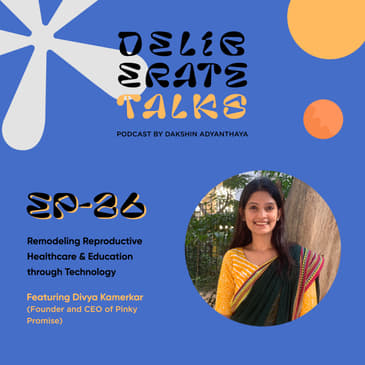

Watch how Divya Kamerkar is reshaping the landscape of reproductive health education, with her venture, Pinky Promise, that aims to transform women's healthcare in India and make it judgment-free and accessible.
Watch the full episode on youtube.com/@pixelatedegg
Follow Divya Kamerkar:
LinkedIn: https://www.linkedin.com/in/divya-balaji-kamerkar/
Instagram: https://www.instagram.com/divyabalajikamerkar/
Instagram: https://www.instagram.com/askpinkypromise/
Website: https://askpinkypromise.com/
Follow Dakshin Adyanthaya:
LinkedIn: https://www.linkedin.com/in/dakshin-adyanthaya/
Instagram: https://www.instagram.com/dakshinadyanthaya/
Twitter: https://twitter.com/upsidedakshin/
Follow Pixelated Egg:
LinkedIn: https://www.linkedin.com/company/pixelated-egg/
Website: www.pixelatedegg.com/
#Health #reproductivehealth #podcast #technology #womenintech #podcasting #marketing #entrepreneur #womenleaders
See omnystudio.com/listener for privacy information.
[00:00:00] Welcome to the Table for 2 edition of the Deliberate Talks podcast and I am your host Dakshin Adyantaya
[00:00:04] Turing you into the world of impact
[00:00:07] And today we probe into one of the most crucial aspects of personal health
[00:00:11] So join me as I unravel the fabric of reproductive health education with a remarkable guest Divya Kamaykar
[00:00:18] Divya is a visionary in the realm of digital health education and is the founder and CEO of Pinky Promise
[00:00:24] A venture that aims to transform women's healthcare in India and make it judgment free and accessible
[00:00:30] Apart from this, Divya has a strong experience in healthcare, public policy and politics
[00:00:36] And has previously worked at Britspan Group where she helped provide management consulting services
[00:00:42] To government, non-profit organizations and Delhi Commission for Women where she focused on making Delhi safer for women
[00:00:49] Today we sit down with Divya to discuss how she is reshaping the landscape of reproductive health education with Pinky Promise
[00:00:57] All this and more right after the short intro
[00:01:03] This is the Deliberate Talks Weekly Podcast powered by the Pixelated Egg Digital Ventures
[00:01:15] And we are back! Hello Divya, welcome to the Deliberate Talks podcast. How are you doing today?
[00:01:20] Hi Dakshin, pleasure to be here and I am doing really well. Thank you. Hope you are too
[00:01:25] Yes, absolutely. Super excited to host you and looking forward to a lot of interesting conversations with the things that you are building up
[00:01:34] But before that we have a ritual in the show and that's a very quick icebreaker question
[00:01:40] And let me start with asking you what's that one Pinky promise that you have broken in life?
[00:01:47] Oh my gosh! With my son I break it every single day because he is a naughty little toddler
[00:01:56] And I think every time he is up to something and he is the necessity to confess to me
[00:02:01] And he tells me don't tell anyone okay, don't tell papa okay
[00:02:05] But of course like you know at night it's like the funniest conversation that I could possibly have with my husband
[00:02:11] Where I am like do you know what Kiya did today?
[00:02:14] So I feel like I break Pinky promises with him on an almost daily basis unfortunately
[00:02:21] Wow! Yeah but he doesn't know it as yet. He will find out soon enough
[00:02:26] Adorable, that's awesome. Great now that we are all set for the round of questions Divya
[00:02:32] Firstly I am very curious to know Pinky promise lovely name who came up with the name what was the thought behind it?
[00:02:38] So we actually wanted a name that fixed something that's really easy has no problems when it comes to recall
[00:02:45] But honestly the idea for Pinky promise actually originated out of my apartment in Philadelphia
[00:02:51] When I was doing my MBA and I was like you know this is what we want to build
[00:02:55] And it needs to be something that is confidential that seems like a companion for women
[00:03:01] Something that they would trust even if their best friends weren't there for them
[00:03:06] And so essentially the you know we had a few names and the good thing about doing an MBA is they ask you to test everything
[00:03:13] So we then ran through some focus group discussions very quickly
[00:03:18] And realized that even in a non-English speaking population in India especially with the English speaking population
[00:03:24] Pinky promise that like it's feminine it is something to do with protecting my privacy and confidentiality
[00:03:30] It makes sense and even women who are not English speaking they really like the name Pinky promise
[00:03:36] It seemed to be something that caused a lot of brand recall and so we went with it
[00:03:41] Lovely and whose idea was?
[00:03:43] Well originally mine but my co-founders everybody loved it so we all went with it
[00:03:49] Lovely okay so I'm going to touch upon the obvious question which a lot of people must have already asked you
[00:03:58] In terms of you know why you started this and stuff like that
[00:04:02] But I'm also going to get much deeper into asking in with the views around the people that weren't sure about this concept
[00:04:11] There are people who will also have opinions about it and I'm keen on knowing were people not sure of the idea
[00:04:17] What were the doubts that you faced when you pitched in the idea and stuff like that
[00:04:21] Yeah so I think the origin story of Pinky promise was inspired more because of a personal incident
[00:04:28] In the second year of my MBA I was also expecting my child had no plans to start up at all and COVID hit
[00:04:34] So I was on one of these evacuation flights back to India and after reaching I still hadn't figured out who my gynaecologist year was going to be
[00:04:42] Because it was quite a sudden decision to actually come back
[00:04:45] I started developing some complications luckily being somebody who was from the city from Bombay who's otherwise well connected
[00:04:52] Within a couple of weeks with multiple consultations I was able to get it completely cleared out
[00:04:58] But in my head I was like why did it take a couple of weeks why did it take multiple consultations
[00:05:03] If my data actually had traveled with me if people did not require contact every single time there was a consultation
[00:05:12] And if for example we were able to actually use a lot of these clinical decision making tools that exist for the general population towards women
[00:05:21] The number of repeat visits and the accuracy of the diagnosis could be drastically improved
[00:05:26] So I think honestly that really what got me started on the journey of solving for this particular problem after having felt it
[00:05:33] I realized that wait a minute there are only 70,000 registered gynaecologists a little bit up and down
[00:05:39] According to the FOXIE which is a regulatory body for gynaecology in India
[00:05:44] And there are 360 million women of reproductive age in India
[00:05:48] So apart from the fact that in general reproductive healthcare is very very limited to just the delivery of a baby
[00:05:55] And the other elements of it are kind of not yet prioritized in India
[00:05:59] I realized that there's so much that we could do if we have an AI ML led solution to it
[00:06:05] And this was before generative AI really became a big boom
[00:06:09] It was very different like it was when Bayesian probabilistic systems were actually more used than anything else
[00:06:17] And so that's when we started building, so that's the story of Pinky Promise
[00:06:21] My co-founder Akanksha discovered Pinky Promise as a beta tester when she had a urinary tract infection
[00:06:27] And she was being a busy woman really hard for her to for something like this step out of her house
[00:06:33] Also hard to step out of your house when you're in so much pain
[00:06:36] So she actually tried out the app and in a minute she knew what medicines to take
[00:06:42] What to do, the gynaecologist was super nice, very friendly
[00:06:46] And she said she actually wanted all her healthcare to feel like this
[00:06:49] So she actually came in as a tech genius behind what we've built today
[00:06:54] And joined forces and that's kind of the story of Pinky Promise
[00:06:57] With respect to sort of the skepticism and everything
[00:07:02] Honestly, this is a very very new space
[00:07:05] Before this Metpalm and all of these other products have now come out
[00:07:10] We said we're going to eliminate all frictions, right?
[00:07:13] So we felt like any way healthcare shouldn't be a frictioned experience
[00:07:16] I come from a healthcare background
[00:07:18] And so for me, when I saw the kind of democratization that was happening in the field of education
[00:07:23] Where you could actually just learn anything anytime, anywhere, right?
[00:07:27] Number one, number two, financial services in India, right?
[00:07:30] Like it's almost instant for me to actually get a loan approval
[00:07:35] For me to actually get money transferred to me
[00:07:38] And for so many other savings instruments to be made available to me
[00:07:41] Whereas healthcare which is so fundamental to my life and death
[00:07:45] Is still a completely frictioned experience
[00:07:47] So I think the big dream honestly for us is let's just make healthcare completely frictionless
[00:07:52] And we started off with women's health
[00:07:54] And I think people were like wait a minute, we understand the bigger objective
[00:07:58] But why have you started with women's health?
[00:08:00] And so there were a lot of assumptions that we needed to test out
[00:08:03] We realized that women just don't go to a doctor
[00:08:06] Especially when it comes to their reproductive health, right?
[00:08:09] So of course one of this is the access barriers that I spoke to you about
[00:08:13] Which is that there's nobody close by who could be of good quality to go to
[00:08:17] And the second is even if I knew that there was someone next to me
[00:08:20] Next door, I might hesitate to go to a provider
[00:08:23] Because I'm worried about the experience I may have
[00:08:26] Like if I'm unmarried women would I be asked are you married?
[00:08:29] If I'm a married woman
[00:08:31] Would I be asked about my contraceptive usage and things like that
[00:08:35] Which is a little bit embarrassing for me to get into all of these things, right?
[00:08:38] So we essentially realized that women actually were going online to search for their symptoms
[00:08:45] And that gave us a lot of hope, we realized that in a given month in English alone
[00:08:49] Reproductive healthcare keywords were searched more than a hundred million times
[00:08:52] And what we did was the first thing we realized is we're asking women who don't go to a doctor
[00:08:57] So actually now come online, come to Pinky Promise
[00:09:00] Come online, you've never paid for healthcare services online
[00:09:04] But we want you to come to us and pay for your healthcare service online
[00:09:07] And we want you to trust the fact that instantly you're going to get connected to a gynaecologist
[00:09:12] Who's going to instantly give you a prescription for your care
[00:09:15] All of this is going to be AI ML based
[00:09:17] And then you're going to stick to your medication and you're going to feel better
[00:09:20] So as you can see that entire chain of events has so many assumptions that we needed to test out
[00:09:26] So there was obviously a lot of natural skepticism
[00:09:28] No one had seen this happen before
[00:09:30] And even people who generally were supportive of reproductive healthcare
[00:09:35] The requirement for disruption in the industry
[00:09:37] I think they were like, okay let's actually make sure that there's enough evidence to back what you're saying and what you're doing
[00:09:43] Although it was more of a gut feel for us
[00:09:45] We did everything that's required
[00:09:47] So the first thing we did was even before we built out an app
[00:09:51] We actually built out a diagnostic algorithm on XS
[00:09:54] And we then sort of essentially went and did an AB test where we mimicked a chatbot
[00:10:01] Copy-pasting responses, you know, we would say what is your problem
[00:10:04] They would tell their problem
[00:10:06] Then they'd ask the questions
[00:10:08] We would do that and we realized that women were actually significantly more truthful
[00:10:12] When I was chatting and asking these questions
[00:10:14] As opposed to even when I was calling up and being very very non-judgmental and asking these questions
[00:10:19] So I realized that like a purely digital bot based approach is actually going to work
[00:10:24] The second thing is we then built it all out
[00:10:27] Right? And for the past nine months from March to like now essentially
[00:10:32] We've been on an extended MVP sort of a system where for like a very limited number of frequently occurring issues
[00:10:38] We offered end-to-end care that is AI enabled
[00:10:41] And we wanted to understand number one, like are people paying for this?
[00:10:44] Are they getting value out of it?
[00:10:46] So what is the feedback looking like?
[00:10:48] Are we missing out on something important?
[00:10:50] And then we wanted to scale it up to everything
[00:10:52] So I think in the past these nine months more than 200,000 women have actually used our services
[00:10:57] Because we also have a few free things available on our app
[00:11:00] More than 10,000 women have paid for consultations without almost any marketing spend from RM
[00:11:06] And the interesting thing is despite the fact that only three or four main issues that we were covering
[00:11:11] And despite the fact that reproductive health care conditions like this
[00:11:15] Because we were not focusing on chronic conditions
[00:11:17] Like acute short-term infections and stuff for what we were focusing on
[00:11:21] They occur maybe once in a year for a woman
[00:11:24] Still for those who had it more than once
[00:11:27] 25% of people who actually paid came back to us to Kalsa
[00:11:30] So we realized that okay this is working very well for us
[00:11:34] The third thing we realized just even after women get their medicines right
[00:11:38] They have thousands of questions that they want to ask the doctor
[00:11:42] This is actually their first point of contact
[00:11:44] They're like I got my medicines wow
[00:11:46] Now I want to ask about like every single thing under the planet
[00:11:49] We did not have a mechanism for that
[00:11:51] We were doing it manually in the beginning we were just arranging calls
[00:11:53] And it was overwhelming us
[00:11:55] So we actually built a chat GPT based co-pilot for our gynecologist
[00:11:59] So that even after the medicine goes out
[00:12:01] The gynecologist can continue to provide real-time responses
[00:12:04] And they would be assisted by a really nice system
[00:12:07] For you know empathetic, accurate and proper responses
[00:12:10] That we would train based on our data
[00:12:12] So honestly like we had to test out all of this
[00:12:14] And finally I feel like we're in a point where we're like
[00:12:17] All of this is working let's scale
[00:12:19] Because 91% of women who have actually taken consultations with us
[00:12:23] Have reported feeling better and have come back within
[00:12:26] Sort of that adherence period to report to us that yeah we started our medication
[00:12:30] So that's what matters right
[00:12:32] Like if you're eventually building a healthcare platform
[00:12:34] You want to make sure that the outcomes are improved
[00:12:36] So that's the whole chain of events
[00:12:38] And obviously there's going to be a lot of skepticism
[00:12:40] But I feel like it's up to us to
[00:12:42] Especially as category defining or as first movers
[00:12:46] It's up to us to actually disprove that and say that
[00:12:48] We understand that there are a lot of questions
[00:12:50] But here's how we're tackling that
[00:12:53] You know this amazing thing that you touched upon
[00:12:56] When you have this conversation of skepticism with
[00:12:59] Say a school level program or someone
[00:13:02] This is required in a school level program I'm assuming
[00:13:05] And when you go to schools, when you go to education systems
[00:13:09] I think schools are also very skeptical
[00:13:12] About having a conversation like this
[00:13:14] Do you face such skepticism also or is it like they're welcome
[00:13:19] Because it's technology now being integrated to it
[00:13:23] Yeah I think it's a trickle down effect
[00:13:25] I feel like what we are noticing is that individuals themselves
[00:13:29] Young women, they are proactively seeking out these kind of services
[00:13:33] Correct
[00:13:34] So we thought about like what is the best way to go to market
[00:13:37] Do we go to institutions and schools and companies
[00:13:40] Or do we just go D2C
[00:13:42] And for us the D2C has just been like crazy good for us
[00:13:46] Right? Like our customer acquisition costs are like incredibly low
[00:13:51] Because what we realise is women are already searching for their symptoms
[00:13:55] Like if a young girl has just gotten her period
[00:13:58] And her school is not providing her the right resources
[00:14:01] Of course in areas which are internet enabled
[00:14:03] She's online, she's searching for what to do to manage my menstrual cycle
[00:14:08] And the good thing is because Pinkie Promise is the only platform
[00:14:13] That is providing you an instant answer that is provider driven
[00:14:16] It's a very easy way for us to acquire people
[00:14:19] By just being there when people are searching for their symptoms
[00:14:22] So what we realise is then it's like
[00:14:25] Oh can you come to my college and do this workshop for my college
[00:14:28] Because people from certain colleges have actually used Pinkie Promise
[00:14:32] Right? And so we get invited into colleges to actually like
[00:14:36] Then talk more about our product and spread it further
[00:14:39] But it's interestingly largely not been institution driven this initiative
[00:14:43] Only because I feel like people who are studying in these institutions
[00:14:47] Are becoming super proactive and are doing things themselves
[00:14:50] And want to take care of themselves
[00:14:52] There's a very interesting study by the Pew Research Centre
[00:14:54] In Internet and Society in America
[00:14:56] And it actually shows that women are more likely to read long form health articles
[00:15:01] About themselves and about health issues more than men
[00:15:04] And so I think that desire to actually care for ourselves
[00:15:08] And get better is certainly improving over generations
[00:15:12] We didn't see that in our mothers and all that
[00:15:14] Because unfortunately what we would see was
[00:15:16] Our mothers would for example always de-prioritise their health
[00:15:20] Like they would always have this one headache
[00:15:22] One backache, my feet are hurting
[00:15:24] And they would take all of us to the hospital
[00:15:27] Including the pets but not themselves
[00:15:29] But I think we're now seeing a growing generation of women
[00:15:32] Who are prioritising their healthcare and their well-being first
[00:15:35] And they're leading the adoption of things like Pinkie Promise
[00:15:38] To society
[00:15:40] Lovely, lovely
[00:15:41] Okay just continuing the conversation of skepticism again
[00:15:43] Now coming from a user perspective right
[00:15:46] They are very very sceptic about privacy
[00:15:50] And conversation within the app
[00:15:52] The data, right?
[00:15:54] Building trust is very crucial
[00:15:56] How are you dealing with this side of skepticism?
[00:15:59] I mean rightfully so
[00:16:01] People are sceptical, people are scared about their data
[00:16:04] I think there are two ways to do it
[00:16:06] From a theoretical standpoint
[00:16:08] There's a top-down approach and a bottom-up approach
[00:16:10] That's how I like to think about it
[00:16:12] So the top-down approach is
[00:16:14] Spend a lot of budget on building trust
[00:16:18] You basically have people who are trustworthy to serve
[00:16:21] With your brand ambassadors
[00:16:23] You go to every online and offline marketing source
[00:16:26] You plaster everything available with
[00:16:29] You know company Pinkie Promise
[00:16:31] Make it really attractive and people
[00:16:33] And as long as the product is good
[00:16:35] It spreads really good to you
[00:16:37] That's one way of doing it
[00:16:38] But what we chose was actually the bottom-up approach
[00:16:40] To building trust
[00:16:41] It's much harder but I think it's fundamentally required
[00:16:45] For you to then be able to scale
[00:16:47] And what we did was
[00:16:48] We said that every single step of the way
[00:16:51] We need to reinforce trust
[00:16:53] And the person who has a healthcare issue
[00:16:55] Would rather not have a healthcare issue
[00:16:57] So they're also not only not trusting your platform
[00:17:00] But they're also let's say disenchanted customers
[00:17:03] Of the outset because they don't want to be consulting a doctor
[00:17:07] They don't want to have a healthcare problem
[00:17:09] They don't want to say they have an issue
[00:17:11] So it's actually a really hard problem to crack
[00:17:14] So the first thing we did is
[00:17:16] We made sure that the way we were acquiring people
[00:17:18] Which was through our information was extremely trustworthy
[00:17:21] That was the first step on the way
[00:17:23] So we have, we write a lot of articles on our website
[00:17:26] That are all provider written
[00:17:28] And it's all done in-house
[00:17:30] So it's very cost effective
[00:17:32] The second thing is if you can see our social media
[00:17:35] Full of really informative content
[00:17:37] That's very relevant to the target audience
[00:17:39] And so that way people are like
[00:17:40] Okay I trust this information
[00:17:42] Maybe I'll click on the link
[00:17:43] But once we click on the link
[00:17:45] And use our app and platform
[00:17:47] We focus on making sure that every single thing
[00:17:50] In a way is clear, transparent and friendly
[00:17:53] Everything from the choice of colors
[00:17:55] To illustrations of brown women on our app
[00:17:58] That are actually like seeking healthcare
[00:18:01] Right?
[00:18:02] And to the way that we ask questions
[00:18:04] We make sure that we are reinforcing very subtly
[00:18:08] That this is a non-judgmental and safe platform
[00:18:11] And where we are asking for information
[00:18:13] There are a lot of disclaimers to make people understand
[00:18:15] Why are we asking this in the first place
[00:18:17] So for example according to Indian
[00:18:19] Telemedicine Practice Guidelines
[00:18:21] We do need to verify identification
[00:18:23] Right?
[00:18:24] So obviously like why are you asking me for my identity
[00:18:27] Are you going to tell my parents about
[00:18:28] Interestingly it's not a question of
[00:18:29] Is the data stored securely
[00:18:31] But it's like if my family is going to know about it
[00:18:33] Like that's actually unfortunately the bigger problem
[00:18:36] That we are facing
[00:18:37] So we make sure we clarify how we deal with your data
[00:18:40] How is it securely stored
[00:18:42] How is it maintained all of that stuff right
[00:18:44] And so we are very very clear
[00:18:46] The best part is the payment actually comes after
[00:18:48] You answer your question to the doctor
[00:18:50] So it's only when we know you have a problem
[00:18:53] You do require a medicine for it
[00:18:55] Or a prescription for it that you end up paying
[00:18:57] And why then the trust is reinforced
[00:18:59] We actually have a 2% drop off
[00:19:01] Between people who fill our questions and base
[00:19:03] And the only way we are able to do that
[00:19:04] Is to all of these UI, UX
[00:19:07] Repeat prototyping and testing
[00:19:09] And improving the product to make sure that
[00:19:11] It's a trustworthy platform
[00:19:13] And of course I think we also have to put
[00:19:15] Some money where our mouth is
[00:19:17] So we do and Akash has really responsible for this
[00:19:20] But we do a prioritized heavily the data security
[00:19:23] And our data architecture to make sure that
[00:19:26] The vulnerability is as minimal as possible
[00:19:30] There's no risk of breach
[00:19:32] People's data is safe with us
[00:19:34] So these are all things that we do focus on
[00:19:36] Right, you know there's an interesting article I read
[00:19:39] Where there's an instance where you have mentioned
[00:19:41] That there's a small percentage of
[00:19:43] Dropout in terms of or uninstallments
[00:19:46] Of the app, right
[00:19:48] How are you catering to this problem in terms of
[00:19:50] Regaining because obviously it must be a shared device
[00:19:53] Or you know they're not sure after the first service
[00:19:56] Or they for now don't want to use the service
[00:19:59] How do you ensure that this kind of thing
[00:20:02] Is bridged together
[00:20:04] I think two ways it was an interesting thing
[00:20:06] For us to realize and what we were concerned about
[00:20:08] Was it because of poor quality of service
[00:20:10] Good thing is that it was not
[00:20:12] Because we actually called all of these women
[00:20:14] And we were like we just want to know what happened
[00:20:17] In fact in the course of this nine month period
[00:20:19] We must have spoken about 50, 60 thousand women
[00:20:21] So we want to make sure that we actually understand
[00:20:24] What's going on as opposed to just relying on
[00:20:27] Of course we use the numbers to figure out
[00:20:29] What the problem is and then we try to diagnose it
[00:20:31] But all the women that we spoke to said
[00:20:33] That no thank you this was a fantastic service
[00:20:36] But I don't want someone to find out
[00:20:39] That I'm on pinky promise
[00:20:41] We're like are you on any dating apps
[00:20:43] Do you do the same with dating apps
[00:20:45] They're like yeah yeah yeah we do the same
[00:20:47] It was an interesting question to ask guys
[00:20:50] So what we realized was because we were focusing
[00:20:53] On one of conditions
[00:20:55] The minute that the woman is like okay
[00:20:58] I now know my medicines I have already
[00:21:00] Chatted with the doctor all my questions
[00:21:02] Have been resolved I feel better
[00:21:04] There is a likelihood of an uninstall happening
[00:21:06] At that point
[00:21:08] So there are two ways that we have fixed it
[00:21:10] You know 40% upwards of women
[00:21:13] Who actually come with one of conditions
[00:21:15] Also discover chronic conditions on our platform
[00:21:18] I mean polycystic ovaries is of course
[00:21:20] Something that is very prominent in the
[00:21:23] Indian genome The second thing of course
[00:21:26] Are issues like thyroid concerns
[00:21:28] Menopause, pregnancy journeys, postpartum journeys
[00:21:32] And in general like it may not be
[00:21:34] Polycystic ovaries but it could be
[00:21:36] Hormonal disruptions, cycle disruptions
[00:21:38] Seema Shah who is our medical director
[00:21:40] Has about 15 years of experience exclusively
[00:21:42] Focusing on these issues because
[00:21:44] Well before polycystic ovaries became like a buzz word
[00:21:47] A decade ago she actually set up her own practice
[00:21:50] Focusing on VZOS
[00:21:52] So she has that experience of actually
[00:21:54] Working on reversing the condition
[00:21:56] In thousands and thousands of women
[00:21:58] And now we're actually scaling that up on our plan
[00:22:00] We're using AI to actually make you
[00:22:02] Feel like you're constantly connected
[00:22:04] To your provider and your nutritionist
[00:22:06] We're using a lot of background data
[00:22:08] So that you know it's very seamless
[00:22:10] You don't have to come every day and tell us
[00:22:12] Okay what did you eat, what did you do
[00:22:14] All that stuff is if we detect something
[00:22:16] Is wrong we reach out to you
[00:22:18] But that way like women with chronic conditions
[00:22:20] Will continue to actually remain on our platform
[00:22:22] On a subscription based system
[00:22:24] So that we are able to effectively retain them
[00:22:27] And the second thing is we actually
[00:22:29] Built out and released a period track
[00:22:31] Which is being used by about
[00:22:35] If I'm not mistaken
[00:22:37] Today there are about 35,000 women
[00:22:39] Using our period tracking service
[00:22:41] And we only launched it a few months ago
[00:22:43] Now in fact we have learned
[00:22:45] That to get even more women
[00:22:47] It's important to move away
[00:22:49] From the standard format of the period tracker
[00:22:51] That we are also used to
[00:22:53] Seeing and use something that's
[00:22:55] A little bit more intuitive in chat wave
[00:22:57] To get the information
[00:22:59] So we're hoping that with these two things
[00:23:01] We'll be able to significantly
[00:23:03] Increase the retention and the repeat visit rates
[00:23:06] So that people don't uninstall
[00:23:08] Interestingly the action even women who
[00:23:10] Uninstall the platform
[00:23:12] They are actually able to come back to us
[00:23:14] The minute they have a reproductive health issue
[00:23:17] And we're also launching a web app
[00:23:19] Which means that uninstall and needing to install
[00:23:22] Something to be able to access it
[00:23:24] Is no longer going to be a fiction
[00:23:26] Or a requirement for you
[00:23:28] Right, right, super
[00:23:29] You know you also mentioned a small part
[00:23:31] Of subscription as well
[00:23:32] And I'm very keen on knowing this
[00:23:34] There's a 50 rupees basic charge
[00:23:36] If I'm not wrong as well right
[00:23:38] Yeah, so considering the demographic challenges
[00:23:41] The cultural curiosities
[00:23:43] And also considering
[00:23:45] You know they're already skeptical about
[00:23:47] Whether going on an app and you know
[00:23:49] Is this genuine or building that kind of trust
[00:23:51] For the very first time right
[00:23:53] Would you think of free app like you did mention
[00:23:55] There are certain services which are for free
[00:23:57] In the app but would you think
[00:23:59] The free aspect of it would pull in more
[00:24:01] Accessibility or do you think
[00:24:04] This is to restrict the number of spams
[00:24:06] Or for the sake of people coming in
[00:24:08] And asking questions, what was your thought?
[00:24:10] I think there were two things
[00:24:12] So we've actually interestingly increased
[00:24:15] Updizing so it's not 50 anymore
[00:24:17] It's 99 rupees because
[00:24:19] We did a lot of studies on
[00:24:21] What is the level to which people
[00:24:23] Actually consider the same and to be
[00:24:25] Something that's worthwhile but also
[00:24:27] Reduces drop off significantly
[00:24:29] And we were able to arrive at this number
[00:24:31] And before I think one of the reasons
[00:24:33] Why we're able to impact price
[00:24:35] It's so low on average if you're in a big city
[00:24:38] In person gynaecologist Kamsal
[00:24:40] Is about 1000 rupees at least
[00:24:42] With a good one and the kind of
[00:24:44] Gynaecologists we have on our platform
[00:24:46] Are those gynaecologists they're like
[00:24:48] Actually if you go to one of their clinics
[00:24:50] You're gonna have to pay that much money anyway
[00:24:52] And we make sure that we bring on
[00:24:54] Really quality providers onto our platform
[00:24:57] But at the same time we're able to price it
[00:24:59] So low because at the end of the day
[00:25:01] Our technology does most of the work
[00:25:03] And it disrupts and enables
[00:25:06] Our gynaecologists to then focus on
[00:25:08] Curing that patient, focus on the care part
[00:25:11] As opposed to the investigative development
[00:25:13] And that really really reduces the cost
[00:25:15] And it causes and we've built
[00:25:17] Such a light back end that almost
[00:25:19] Costs us nothing to run that
[00:25:21] Number of times for our customers
[00:25:23] And so the in fact more than
[00:25:26] Any other telemedicine platform where
[00:25:28] You have to share revenue for each and every
[00:25:31] Consult with gynaecologists we don't actually do that
[00:25:33] And that enables us to retain all our
[00:25:36] Ones. The second thing is
[00:25:38] We decided to price as opposed to
[00:25:41] To be very honest with you with a lot
[00:25:43] Of the income streams that are now
[00:25:45] Going to be launched and you'll see
[00:25:47] That soon something like one off
[00:25:49] One time payments for a healthcare service
[00:25:51] Is not going to be what five years down the line
[00:25:54] Contributes in a large manner to our bottom line
[00:25:57] For the business. So sure in the future
[00:25:59] Maybe we could have thought about a reality
[00:26:01] Where all of this is free. The reason
[00:26:03] Why we didn't do that is twofold
[00:26:05] The first is if you look at the psychology
[00:26:07] Of a customer right, this is healthcare
[00:26:09] We're talking about and we eventually
[00:26:11] Want people to actually take this very seriously
[00:26:13] We want to make sure that you realize
[00:26:15] That what you're getting is an actual
[00:26:17] Gynaecologist's time and actual gynaecologists
[00:26:20] Thoughts that have gone into figuring out
[00:26:22] What medication you need to take
[00:26:24] And what you need to do to get a better
[00:26:26] And so and you're getting better is valuable
[00:26:29] For us for you to come back to our platform
[00:26:31] Right and so we priced it at 99 rupees
[00:26:34] Because we realized that it's low enough
[00:26:36] That women who answer these questions
[00:26:38] And have come onto our platform are like
[00:26:40] Yeah okay yeah this makes sense I'll test it out
[00:26:42] I'll try it's not a big deal I can take
[00:26:44] That leap of faith but at the same time
[00:26:46] It's meaningful enough that they don't
[00:26:48] Consider this to be, could be
[00:26:50] Like it's a free thing and so
[00:26:52] Interestingly there's a lot of public health
[00:26:55] Literature out there in terms of
[00:26:57] Malarial net so as you know
[00:26:59] Soap or hand washing and stuff like that
[00:27:02] Which actually say that giving something out for free
[00:27:04] Is more effective in terms of
[00:27:06] Update but what we've actually seen
[00:27:08] Is when women are able to value
[00:27:10] What the fact that they're paying for something
[00:27:12] They take it far more seriously
[00:27:14] Like the amount of you know
[00:27:16] Because we guarantee instant responses
[00:27:18] If there's a technological issue and a delay
[00:27:20] The amount of women who call us immediately
[00:27:23] And tell us that I've paid and this is delayed
[00:27:26] Is very very high
[00:27:29] Not a good situation for us to be in
[00:27:31] But it's basically
[00:27:34] Reaffirms what we thought of
[00:27:36] The second thing is we are a disruptive player
[00:27:39] Right like the reason that we have priced it so low
[00:27:41] Is because we don't think fundamentally
[00:27:44] That as a business we don't think that
[00:27:47] Out of pocket payments by individual women
[00:27:50] For their healthcare should be what drives the healthcare industry
[00:27:53] And by people right
[00:27:55] That's what's happening in India today
[00:27:57] The private healthcare industry
[00:27:59] So if you're actually going to be a business
[00:28:01] That completely disrupted like this is the way to go
[00:28:03] And so that's how we thought about it as well
[00:28:06] And we want people to be like
[00:28:08] Did you know that for 99 rupees only
[00:28:10] You actually get the best care
[00:28:12] And it's better than anywhere else that you could go to
[00:28:14] That's the mindset that we want
[00:28:16] And as I mentioned you were at that point
[00:28:18] Where the bottom up stuff has worked really well
[00:28:20] And we want to scale the top down approach
[00:28:22] So I think now is when we are expecting
[00:28:25] In a few moments that people start really talking about this
[00:28:28] And if you look at our Google Play reviews also
[00:28:30] A lot of women have mentioned this
[00:28:32] They're like I cannot believe that
[00:28:34] I got such an amazing service
[00:28:36] Like and now I'm going to tell everybody about it
[00:28:38] And these are all completely organic
[00:28:40] Like loads of people have just gone there
[00:28:42] And written all of these things
[00:28:44] So yeah that's honestly why we chose this sort of a price and strategy
[00:28:48] Great and your app also has content in Tamil, Hindi
[00:28:53] And Marathi besides English right
[00:28:56] So what was the thought behind it
[00:28:58] Why did you come up with multiple languages
[00:29:01] Obviously because of the cultural
[00:29:03] And demographic representation of your TG
[00:29:06] And what other languages are in process also
[00:29:09] In you know your future timelines
[00:29:12] You know this question on languages is very very interesting
[00:29:15] And I think the way that we thought about this
[00:29:18] Was we knew for a fact that if you want to be
[00:29:21] A mass market driven solution for healthcare in India
[00:29:24] For women you can't stick to English alone
[00:29:27] Two reasons number one of course the population that speaks it
[00:29:30] They could be like your starting market
[00:29:32] But they're definitely not going to be the market
[00:29:34] That eventually drives the millions and millions right
[00:29:37] Number two is just from a real reality check standpoint
[00:29:42] We are women in the cities building something right
[00:29:46] And the way people act with healthcare outside of cities
[00:29:49] Is so different like I've actually lived and worked in Bihar
[00:29:52] In rural areas in Tamil Nadu, New P
[00:29:55] And what I realized was when it comes to reproductive
[00:29:59] Healthcare terms using English to ask these questions
[00:30:02] Just doesn't make any sense
[00:30:04] But at the same time it was complicated
[00:30:06] Because women don't use proper words to describe
[00:30:09] Their reproductive healthcare body parts
[00:30:11] Or describe their reproductive healthcare cycles
[00:30:13] Nothing right there are so many euphemisms
[00:30:15] My monthly dose is what a lot of people say
[00:30:19] What does that mean your periods are coming right
[00:30:22] If you use a word like menstruation
[00:30:24] Most of India is not going to understand what that means right
[00:30:27] So I think it was a big challenge
[00:30:30] And we were a bit hesitant to step into it
[00:30:32] We thought English is working the fidelity of the responses
[00:30:35] Is high let's scale this up and then focus on other things
[00:30:38] But what we realized is like as we scaled 70%
[00:30:42] Of our audience was coming from tier to tier 3
[00:30:44] And smaller demographics and they were all chatting in English
[00:30:48] And so we first translated the app into English
[00:30:51] And not Hindi and not you know not any pure language
[00:30:54] We actually use English and we translated the app
[00:30:57] This was done internally and then USAID
[00:30:59] So we are actually a part of this program
[00:31:02] Where the momentum of global partnership of USAID
[00:31:05] With Jaffego and Wilgo they actually have funded us
[00:31:08] And they support us
[00:31:09] They insisted they said you know what this is actually
[00:31:11] Going to be very important for you as a business
[00:31:13] We help you provide technical assistance
[00:31:16] We'll actually sponsor the whole effort to translate the app
[00:31:20] And so we got a really good organization
[00:31:22] To work on translating into Tamil and Marathi
[00:31:25] In addition to English because these were two large pockets
[00:31:28] Where our users were coming from in addition to the Hindi belt
[00:31:31] So we did that we piloted it and everything
[00:31:34] And now we've actually learned a lot from it
[00:31:37] Like user generated feedback on how this process is working
[00:31:41] We are actually in the process of just launching
[00:31:43] A completely revamped and complete version of our app
[00:31:46] In that interesting it's only going to be starting with English
[00:31:49] Because we've learned so much over the process of translation
[00:31:52] That we want to actually build a very scalable framework
[00:31:55] For translation
[00:31:56] Going language by language by language is not scalable
[00:31:59] And so we have a few tricks up our sleeve
[00:32:03] To make sure that it's scalable but also medically relevant
[00:32:06] Medically understandable
[00:32:07] And in a couple of months it should be available
[00:32:11] Not just these three languages
[00:32:13] But in a whole host of vernacular languages
[00:32:16] Just curious again when say someone from Tamil Nadu
[00:32:21] Types in English or types in Tamil
[00:32:24] But in English
[00:32:25] Tamil words in English
[00:32:27] Or even short forms of each word
[00:32:31] How do you really try to understand the language and perceive
[00:32:36] So there are two things that we have done
[00:32:38] So we only match people speaking certain regional languages
[00:32:42] If they've actually chosen that platform
[00:32:44] We match them to the providers that know those languages
[00:32:46] So that also constrained our choice of language obviously
[00:32:50] But luckily like the you know
[00:32:52] Thanks to India being such a diverse landscape
[00:32:55] We were able to find quality providers in all of languages
[00:32:58] But I think what we did was that was one constraint
[00:33:01] Second thing that we did was
[00:33:02] When it came to the initial intake of symptoms and medical history
[00:33:06] We constrained the responses because of this problem
[00:33:09] Even people who start out saying English is my language
[00:33:12] They will break off into a regional thing in the middle
[00:33:15] Of describing their problems
[00:33:17] Because I had a free flow chart system
[00:33:19] Where it's like please describe what issue you're paving
[00:33:22] You will get paragraphs from women and we've actually tested this out
[00:33:26] And we have so much data which we're actually now using to train a bot
[00:33:30] To understand that intent really well
[00:33:32] We first wanted to focus on the medical components right
[00:33:35] So we constrained response and we enabled
[00:33:38] But we also made sure that the choices available were as
[00:33:41] Easy as possible right
[00:33:43] So there were as many choices available over there
[00:33:45] And we went through an extensive pilot with more than 10,000 women
[00:33:49] To make sure that that was the key
[00:33:51] And continued to iterate it so like
[00:33:53] Thanks to Akansha we
[00:33:55] The minute we know that we need to change a question we changed it life
[00:33:57] Like it's very easy and it's carried forward
[00:33:59] It's just very easy that way
[00:34:01] But we did all of that to make sure that initially
[00:34:03] Your symptom and medical history intake is constrained
[00:34:06] And that confusion doesn't creep in
[00:34:08] But when it comes to the chat
[00:34:10] The free flow chat with the doctor
[00:34:12] Once you get your prescription
[00:34:14] We did not constrain that at all
[00:34:16] Purposely to Lord
[00:34:17] And so that's how we've been training our system
[00:34:20] With a lot of the way that people actually described
[00:34:22] But the good thing is these LLMs are actually really good with Indian regional languages
[00:34:26] So we're actually not
[00:34:28] As long as we train with the right
[00:34:31] So do we do the right amount of training and fine tuning
[00:34:35] We should soon be able to learn something where instead of
[00:34:38] These constrained responses
[00:34:40] Women can just actually have a natural experience
[00:34:42] Of their problems in great detail
[00:34:44] And only what's missing
[00:34:45] The intent will be understood and confirmed
[00:34:47] And only what's missing
[00:34:48] Will actually be asked in terms of what else is required
[00:34:51] In the medical protocol to be able to diagnose you
[00:34:53] That's a much more effective system
[00:34:55] Absolutely wonderful stuff that Divya
[00:34:57] That brings us to the end of the first round of questions
[00:35:00] And now I'm going to move into the last round of questions
[00:35:08] This is the last round of questions
[00:35:10] This is the rapid fire round
[00:35:12] And this is the time to pace up our conversation
[00:35:15] So ready for some fast-paced questions coming at you?
[00:35:19] Alright, I'll try my best
[00:35:21] Let me see a cup of coffee
[00:35:25] Alright, I'm ready, let's go for this
[00:35:28] Lovely
[00:35:29] In 60 seconds, give me three reasons why one should download the Pinky Promise app now
[00:35:35] It's extremely convenient
[00:35:37] It's completely judgment free
[00:35:39] And it works really well at a very low cost
[00:35:42] Superb
[00:35:43] In 50 seconds, three advices for women in STEM
[00:35:47] Aspiring to be health entrepreneurs
[00:35:50] I think the first advices do not limit yourself
[00:35:53] You know, STEM is honestly the best field that I've had
[00:35:57] The joy of sort of studying
[00:35:59] And it's just there's so much you can do
[00:36:02] The possibilities in STEM today are just limitless
[00:36:04] That's always been
[00:36:05] So don't limit yourself
[00:36:06] Number two, find the right mentor
[00:36:08] Especially women in STEM
[00:36:10] Make sure that you have senior women in STEM
[00:36:12] Who are advocates for you
[00:36:14] Who are the right mentors
[00:36:15] And number three, keep learning
[00:36:17] STEM is a field that's constantly advancing
[00:36:19] That's constantly improving
[00:36:21] There's so many research papers of high relevance
[00:36:23] That are being pushed out every single day
[00:36:25] Take time in the morning
[00:36:27] Where you can actually do that learning and reading
[00:36:29] Which is completely unstructured
[00:36:31] Not necessarily pertaining to your work
[00:36:33] But pertaining to what you're interested in
[00:36:35] Super
[00:36:36] I had to learn how to code
[00:36:37] So yeah, that's something that
[00:36:39] Yeah, I had to learn AI, I had to learn how to code
[00:36:41] I had to learn math, I had to learn probability
[00:36:43] All of that for Pinky Promise
[00:36:45] And it's been very helpful
[00:36:46] I feel like in the future
[00:36:47] That's where the world is headed to
[00:36:49] And women in STEM should recognize and do that
[00:36:51] Super
[00:36:52] Okay
[00:36:53] In 40 seconds
[00:36:54] Three most amazing feedback from Pinky Promise users
[00:36:57] That you have received
[00:36:58] I think the first was
[00:37:00] Wow, this is the best ever
[00:37:02] I am telling my entire family about it
[00:37:04] And her mom actually did consult with us
[00:37:06] For her menopause problems
[00:37:08] The second thing was
[00:37:09] This description is so neat and clean
[00:37:11] I can't believe I understand it
[00:37:15] Which is nice
[00:37:16] I did a five-chart script with
[00:37:18] And the third one was
[00:37:20] Thank you for asking me more questions
[00:37:23] And easier questions
[00:37:25] That I've ever been asked in my life
[00:37:27] I was really ashamed to go anywhere and consult
[00:37:29] But Pinky Promise has made it easy for them
[00:37:31] Okay
[00:37:32] In 30 seconds
[00:37:33] Three reproductive health myths
[00:37:35] You wish to debunk
[00:37:36] The first is that
[00:37:38] There's no specific food
[00:37:40] That actually causes you to
[00:37:42] Either get your periods early
[00:37:43] Or get your periods late
[00:37:44] Like that doesn't work that way
[00:37:46] And a lot of women have that question
[00:37:48] Actually they wonder if
[00:37:50] I ate cucumber
[00:37:51] Now I'm not getting my periods
[00:37:53] I got my periods
[00:37:55] But I want to change my cycle
[00:37:56] So can I have ginger water
[00:37:58] I mean there's no scientifically proven study
[00:38:00] That actually demonstrates causality
[00:38:02] The second thing is
[00:38:04] Vaginal discharge is normal
[00:38:06] A lot of women actually think that it's not normal
[00:38:08] It's only when the texture, the color, the smell
[00:38:11] The feel changes
[00:38:12] That you need to actually come
[00:38:13] And consult somebody about it
[00:38:15] I think the third thing is
[00:38:17] A 28 day cycle is not for everybody
[00:38:20] The minute that a woman actually
[00:38:22] Some people can have genetically shorter
[00:38:24] Or genetically longer cycles
[00:38:26] And that's just okay
[00:38:28] The fourth thing is a lot of women
[00:38:30] Actually feel that the oral contraceptive pill
[00:38:32] The birth control pill causes infertility
[00:38:35] As long as your medical history is cleared
[00:38:38] For taking the oral contraceptive pill
[00:38:40] There's no such thing
[00:38:42] There is a return to fertility that happens
[00:38:44] In a few months after the birth control pill
[00:38:47] It's helpful for long term preservation
[00:38:50] Of your own birth control plan
[00:38:52] And stuff like that
[00:38:54] Okay, great
[00:38:55] In 20 seconds, biggest challenge while developing the pinky pot
[00:39:00] Oh God, this is a hard one for rapid fire
[00:39:03] That's very effective
[00:39:06] I think for us it was the technology at first
[00:39:09] We were trying to ensure that our AIML
[00:39:13] Was based off of the right medical protocols
[00:39:17] And we trained on 250 plus medical protocols
[00:39:20] So fine tuning that and making sure that it's proper
[00:39:22] For somebody to actually use
[00:39:24] Is important and even to date
[00:39:26] Nothing goes out to the customer
[00:39:28] Without the doctor verifying the information
[00:39:30] The second thing I just wanted to say is
[00:39:32] More than the technology, honestly
[00:39:34] Getting people to use the platform and trust it
[00:39:36] Is honestly a bigger challenge
[00:39:38] So that's also something that we face initially
[00:39:41] But I feel like we've figured out ways
[00:39:44] And means to completely tackle that now
[00:39:46] Lovely
[00:39:47] And finally in 10 seconds
[00:39:48] Your favorite health app besides pinky promise
[00:39:51] I really like Health if I Need
[00:39:54] I love what they've built
[00:39:55] It's a really nice app
[00:39:56] And who knows to them for actually being super tech first
[00:39:59] I'm glad to see that there are such big companies
[00:40:03] That are well above us
[00:40:04] Before us there are so tech first
[00:40:06] When it comes to their healthcare
[00:40:07] It helps the industry, it helps investors
[00:40:10] Sort of have faith in other applications that do that
[00:40:13] Fabulous stuff that brings us to the end of today's show
[00:40:18] It's just amazing to hear your journey
[00:40:21] And how you're revolutionizing this entire space
[00:40:24] Of conversation around reproductive health
[00:40:26] Thank you so much for this valuable conversation
[00:40:29] I thoroughly enjoyed hosting you
[00:40:30] I hope you had a good time on the show too
[00:40:32] Oh I had a great time
[00:40:33] Thank you so much
[00:40:34] It's lovely to actually go and answer these questions
[00:40:37] When we were so focused on building
[00:40:39] To actually like think back at
[00:40:40] Oh wow what was that like
[00:40:42] Was very helpful
[00:40:43] So thank you so much
[00:40:45] And pleasure to be on your platform
[00:40:47] Thank you, thank you Divya
[00:40:49] Thank you and wishing you
[00:40:51] And Pinkyprom is nothing but the best for the future
[00:40:53] Thank you so much and likewise
[00:40:56] Thank you take care, bye bye
[00:40:58] Bye