
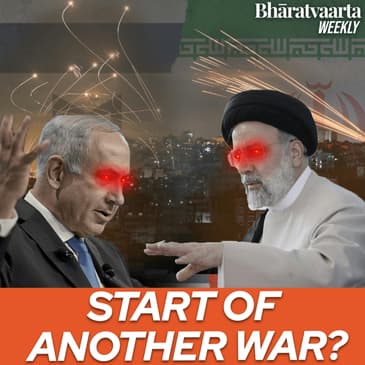
This episode of Bharatvaarta Weekly, hosted by Roshan Cariappa with Abhishek Paul and Nirav Kanodra, discusses a range of topics starting with the escalation of conflict between Iran and Israel following Iran's missile and drone attacks. The conversation then shifts to India's achievements, including a significant reduction in urea imports, the acquisition of rights to operate Sittwe port in Myanmar, Prime Minister Modi's engagement with top Indian gamers to promote games based on Indian culture, and updates from the chess candidates tournament showcasing Indian talents.
Topics:
00:00 Opening Remarks and Geopolitical Tensions
01:16 Iran-Israel Conflict Deep Dive
03:59 Economic Implications of the Conflict
05:47 India's Strategic Position and Potential Impacts
08:19 Advancements in India's Agriculture: Urea Imports Reduction
11:38 India's Overseas Port Rights in Myanmar
15:53 Prime Minister Modi's Engagement with India's Gaming Community
20:20 Chess Candidates Tournament 2024: India's Prospects
25:33 Closing Thoughts and Invitations
[00:00:00] Is this the start of a third world war?
[00:00:03] At the time of this recording, Iran has launched more than 300 drones and missiles at Israel
[00:00:09] and tensions are rife. Things are being discussed right now.
[00:00:13] We have all this and more coming up in this Bharatvaarta weekly.
[00:00:17] Namaste and welcome to another weekly. I am Horshikariyappa.
[00:00:21] I have with me Abhishek Paul and Nirav Kanodra to run you through the news and events of the week that was.
[00:00:26] As I mentioned, we will talk about the Iran-Israel conflict that seems to have escalated.
[00:00:31] We'll talk about the reduction of Uriah imports in the country which is very positive for us.
[00:00:37] And India gets the rights to the Sitve Port in Myanmar.
[00:00:42] And then we had Prime Minister Modi engaging with some of India's top gamers last week
[00:00:50] and finally we'll bring you updates from the chess candidates tournament as well which is afoot.
[00:00:56] All of this and more on this Bharatvaarta weekly.
[00:00:59] If this is your first time joining us, we publish content on politics, policy and culture.
[00:01:04] Do follow or subscribe to us on whatever platform you listen to and stay updated.
[00:01:11] All right, Abhishek and Nirav. This seems to be a very, very interesting time I should say from a geopolitical perspective.
[00:01:24] The attack late Saturday is a major escalation of the long running covert war between the regional force Israel and Iran.
[00:01:34] Almost all the missiles and drones were intercepted mid-air with the help of the US and its allies while Israeli Prime Minister Benjamin Netanyahu
[00:01:43] has once again vowed to harm their attackers. Iran has admitted that their retaliation had concluded and warned the Israeli Prime Minister not to respond.
[00:01:53] Nirav, this has been in the making for a while but I don't think anybody would have expected a hot war.
[00:02:03] An explicit launch of these kind of missile or drone attacks.
[00:02:07] We were discussing prior to recording as well that all of these drones and missiles have been intercepted already.
[00:02:14] So is this just a costly signaling exercise or is there real intent to do harm?
[00:02:22] Your thoughts on this?
[00:02:23] First I would like to reiterate that all of these users mine and drone reflect on the employee.
[00:02:30] So that is one thing and it is pure speculation on my end that what it could be or I can think about various scenarios.
[00:02:39] So if you think this all started October 7th with the attacks of Hamas on Israeli citizens.
[00:02:47] So that was there which led to retaliation by Israel attacking Gaza and trying to like get rid of all the Hamas leadership and Hamas leaders
[00:03:01] and get control over Gaza so to maintain its own security.
[00:03:05] Also as per reports Israel attacked the Iranian embassy in Damascus Syria because they felt that they were the ones who were behind the actual attack by Hamas.
[00:03:18] So now Iran has retaliated by sending a lot of drones and ballistic missiles which Israel has like an iron dome where it sees the heat sensors tracks them aside and shoots them down.
[00:03:32] It got help from the UK and the US Air Force as well.
[00:03:36] So this is like a defense strategy.
[00:03:39] Now A it could be that this is something where Iran has shown to its domestic audience that they have retaliated and Israel has safely intercepted all these missiles.
[00:03:54] So probably it is done and maybe de-escalates we don't know or we only know over time.
[00:04:00] If you look at it over the weekend the only asset class has been trading and been Bitcoin.
[00:04:06] And then Bitcoin according to me is not a safe asset but a very risky asset a very speculative risky asset correlated with the NASDAQ.
[00:04:16] So Bitcoin fell first and then it has bounced back a bit.
[00:04:20] So which tells you how like maybe some part of the financial market thinks about it or maybe it doesn't end it but we don't know.
[00:04:28] So you know what I mean.
[00:04:30] No one would have predicted in Feb 2022 that about a little bit over two years later the Russia-Ukrainian war is still going on.
[00:04:39] Right? So we really don't know.
[00:04:43] Again how the World War I and the World War II happened.
[00:04:47] There's very different circumstances now you have nuclear weapons and advanced drones.
[00:04:52] It's really like a very different type of war.
[00:04:55] Maybe it is in certain pockets we don't know and we don't know how the escalation happens and here if like the US is not aligned with its allies then you will have to see that how do they actually how do the other allies respond.
[00:05:16] Right?
[00:05:17] So I think that is also key thing to watch.
[00:05:20] We'll see what happens and how does Israel respond to this?
[00:05:26] Like they've safely intercepted everything.
[00:05:28] One close parallel you could draw was Saddam Hussein actually attacked Israel in the 90s just before he attacked Kuwait and that time Israel did not retaliate back and then there was like the Gulf War happened later
[00:05:44] and that was dead within the ground forces in Iraq.
[00:05:48] So I don't know how this would play out but it is interesting from an Indian perspective.
[00:05:55] Israel is an Indian island.
[00:05:57] India is aligned with Iran as well on multiple things.
[00:06:01] India had been buying oil from Iran oil.
[00:06:04] There are a lot of Indians who work in Israel.
[00:06:06] There are a lot of Indians who work in Iran.
[00:06:10] So I think India has to be careful about both.
[00:06:13] For India, pretty much rest of the world, I think a big escalation in the Middle East probably leads to either the trade routes blocked already the Red Sea route has been blocked by the Houthis.
[00:06:25] If Iran blockades the state of Hormuz then there could be a spike in oil prices with all the oil from Saudi, Iraq, Kuwait etc.
[00:06:36] Most of it has to go through the Gulf War before being exported out.
[00:06:41] So that would create a problem.
[00:06:43] So hopefully, Sainer heads prevail and this could be de-escalated and some through back challenge diplomacy etc.
[00:06:51] Hopefully this is sorted out soon.
[00:06:54] And yeah, let's see.
[00:06:57] Any predictions here come out to be foolish.
[00:07:02] Could not have predicted how long the Russian war has lasted.
[00:07:06] So we can't really predict how this will go on.
[00:07:09] And maybe this also has kind of distracted the world from like Gaza to like other overall regional problems in the Middle East.
[00:07:18] So let us read and watch how this thing overall develops.
[00:07:22] I think the Indian Foreign Ministry has actually called for de-escalation and for both sides.
[00:07:29] So let's see what happens.
[00:07:32] Yeah, this throws a macroeconomy in a bit of a funk again.
[00:07:36] Because as you mentioned, oil going upwards of $100 will again be very difficult for India for sure.
[00:07:46] And also the US having to commit money to this will mean again more inflation and so on and so forth.
[00:07:57] So I think for the rest of the year at least up until the US elections and whatnot, we're going to have this kind of instability as well.
[00:08:06] I mean gold has been rallying as well along with Bitcoin.
[00:08:10] Gold has been rallying at about 10% over the last month or so I should say.
[00:08:15] So interesting times for sure.
[00:08:19] Close a home over the past week.
[00:08:22] Chemicals and fertilizer minister, Mr. Mansukh Mandveer said that India is on track to end the import of Urea by the end of 2025.
[00:08:30] Now this is very big.
[00:08:32] This he said was in line with the government's goal of reducing chemical fertilizers and promoting more alternatives for better crop and soil health.
[00:08:39] Over the past five years, Urea imports have dropped from 98 lakh tons to 74 lakh tons, a steady decline of nearly 25%.
[00:08:48] This development comes as a breath of fresh air considering that India's Urea production plants and fertilizer production in general were on the verge of shutting down and massively increasing dependency on other countries just a decade ago.
[00:09:01] Abhishek, this is a massive positive trend.
[00:09:05] Right?
[00:09:06] What are the larger consequences of this?
[00:09:09] Yeah, I think this is like one of those silent success stories that have played out in the background where India was able to turn around its domestic production of Urea which as you said was on a declining trend under the previous government.
[00:09:29] So I think very quickly after 2014 the government decided that they need to restart and upgrade the domestic production capacity of Urea number one.
[00:09:44] So they decided to with various other techniques and utilizing different things other than Urea as substitutes.
[00:09:56] The government has tried to reduce the demand as well, right?
[00:10:01] So increased capacity as well as reduced demand internally over time with substitutes.
[00:10:07] So this has meant that our Urea imports have gone down as you said by 25%.
[00:10:14] I am not very certain, let's say that this 2025 timeline will actually play out.
[00:10:22] It may take one or two maybe three or more years but I think we are in the right direction for that.
[00:10:30] And in terms of so geopolitically also this helps us out, right?
[00:10:37] Because one of the largest exporters of Urea or in fact the largest exporter of Urea is Russia, right?
[00:10:44] And so with ongoing conflict Russia, Ukraine, right?
[00:10:52] There's always the risk that our imports could be under stress, right?
[00:10:57] Or their price could shoot up.
[00:10:59] So India actually reducing their import quantity actually brings down the price of Urea globally as well, right?
[00:11:10] Because there is now less demand for Urea globally.
[00:11:14] India was the largest importer of Urea even though we are probably the biggest producer as well, right?
[00:11:21] Because that's the scale of agriculture in our country.
[00:11:25] So yeah, I think overall it's a pretty positive step or pretty positive development for our country.
[00:11:35] Alright, awesome and more positive developments.
[00:11:38] India has gained the rights to operate an overseas port in Sitve Myanmar, the country's second after Iran's Chabahar.
[00:11:46] The development is a part of the Kaladan River multimodal transit transport project aimed at improving and developing alternate connectivity to the northeastern states of the country.
[00:11:58] It bypasses the chicken's neck, Siliguri corridor.
[00:12:01] This will link Sitve port to Paletwa in Myanmar via Kaladan river waterway and connect Paletwa to Zorin Pui in Mizoram through a road component.
[00:12:14] This link will not only offer an alternate route for shipping goods to the northeastern states but will also significantly reduce the cost and distance from Kolkata to Mizoram and beyond.
[00:12:25] Well, need of more positive news on the infrastructure development side of things always welcome.
[00:12:31] Can you talk about this a little more?
[00:12:33] Absolutely.
[00:12:34] So, see this whole project was actually first envisioned during the Vajpayee government.
[00:12:39] At that time Bangladesh wasn't too friendly with India so to get connectivity with northeast via sea.
[00:12:47] So you go from say Kolkata port to Sitve port which is on the Kaladan river basin and from there you go a little bit inland and then there's a 109 kilometer highway which is being built by India's assistance
[00:13:03] which is to build it to the Mizoram border with Myanmar.
[00:13:08] So here you are bypassing Bangladesh as such and now this port which India is operating has multiple benefits.
[00:13:17] So one is obviously we get Myanmar as a closer ally and we need to be friendly with all our neighbors.
[00:13:22] You've seen like China actually tried to build a string of ports and invested in other ports in Myanmar like Sri Lanka etc.
[00:13:29] So we need to get like and this also helps to increase trade with Myanmar.
[00:13:35] So from India's eastern coast Kolkata or Nishakhapattam or Chennai we can like ship a lot of things.
[00:13:41] So it need not just happen from Kolkata right, things which are being manufactured somewhere else can be shipped in to Myanmar to be sold to Myanmar.
[00:13:49] So that helps trade with Myanmar as well which usually happens in Indian rupees.
[00:13:53] So that is there. So India can export some manufactured goods.
[00:13:57] India can import like stuff like rice or rubber or teak etc which Myanmar exports and this connectivity to the northeast.
[00:14:07] See what this does is that in the northeast it is a little bit backward because of like hilly terrain and lack of connectivity with the rest of India
[00:14:17] I am ability to trade etc kind of reduces which increases up the cost everywhere.
[00:14:22] So this kind of like logistics investment infrastructure investment reduces the friction.
[00:14:28] So it gets through like Mizoram which is like that tip state there but like slowly like through Mizoram through internal roads then all of the northeast gets connected.
[00:14:39] So I think that is also beneficial. India-Bangladesh relationship has improved a lot.
[00:14:45] So like we are also talking about trade of northeast from Tripura etc with via Bangladesh as well.
[00:14:52] So having multiple parallel routes that is good so that you are not reliant on any one country or any one route.
[00:15:01] So that is good and lastly it actually helps geopolitically and India has this a treaty called BIMSTEC which is like putting India, Bangladesh, Burma and like in the northeastern region
[00:15:17] and like this kind of trade will actually be beneficial for all involved around there.
[00:15:23] So definitely helps northeast of India and helps India geopolitically so it is absolutely great.
[00:15:32] Also now this shows that India's logistics capability and like being able to run a port in another country this like gives signal like India achievements right.
[00:15:44] So hopefully that gets all our neighbors the friendly neighbors closer to India.
[00:15:51] Right, absolutely.
[00:15:53] Alright recently Prime Minister Narendra Modi met with top gamers and streamers in the country to talk about the future of gaming in India.
[00:16:01] He spoke to popular gamer slash influencers like Animesh Agarwal, Mithilesh Patankar, Payal Dahre, Naman Mathur and Anshu Bishth.
[00:16:10] The videos and images released showed that Prime Minister Modi spoke to them about increasing games based on Indian stories and mythology, perception of gaming as a career in India and the women's participation in this.
[00:16:22] Reports also suggested that the Prime Minister was interested in learning and understanding the differences between skill-based games and chance-based games and their ability to offer a steady source of income.
[00:16:34] Modi was also seen the trying the PC console mobile and VR gaming.
[00:16:40] Well, the number one influencer in the country no doubt is Prime Minister Modi and it was a fun interaction.
[00:16:47] It's a 30 minute something video I encourage all of you guys to go check it out.
[00:16:51] His ability to sort of connect with people irrespective of what generation they belong to is tremendous and especially with a younger generation.
[00:17:01] These gamers dubbed them Namo OP. OP is GameSpeak for overpowered basically.
[00:17:09] And look, the gaming industry has had some tough times recently.
[00:17:17] There's a constant debate about this whole game of skill versus game of chance.
[00:17:24] The various state governments seek to sort of ban these games every once in a while.
[00:17:29] So that kind of an arbitration keeps happening. Then there was the GST hike on the games and then there were these retrospective taxes and so on and so forth.
[00:17:39] So it's not been a very, you know, it's not been a great time to be in the gaming industry I would say over the last, you know, seven or the last seven, eight months for sure.
[00:17:50] Look, the gaming industry overall worldwide is huge. Like it's really huge and growing and with VR and AI is going to go to the next level.
[00:17:58] So it's a very nice outreach and also I think part of this is also to sort of reach out to the younger generation, you know, given that the elections are almost here, right?
[00:18:10] So overall, I think very fun interaction. Go check out the video. Yeah, any comments Abhishek?
[00:18:18] So one interesting point is that perhaps there is a perception that Modi is not the most popular among, let's say, the young urban, let's say the under 25 urban crowd, right?
[00:18:38] Or let's say the elite urban 20, under 25 urban crowd. And so this was an interesting sort of venture by the Prime Minister into this demographic, right?
[00:18:51] Which may not be his biggest fan as of now. So yeah, I guess the BJP is one party which does not believe in leaving anything to chance, right?
[00:19:04] It definitely tries to target all possible demographics and corners.
[00:19:10] You know, I will contest that, you know, because I think it was the case earlier maybe five years back or something that the urban young person was maybe not very warm to Prime Minister Modi, but I've seen like a, you know, key shift in these attitudes, especially over the last two, three years, right?
[00:19:30] And I think here someone like Dr. Jai Shankar, right? With all of his zingers on the international stage has played a huge part as well, right?
[00:19:39] And to a great extent the Ram Mandir as well, Ram Mandir Pran Pradesh that happened and so on.
[00:19:46] So I think young people do recognize that, you know, there's a lot more optimism here in India and that is not a common element.
[00:19:54] I mean, it's not the same in the US or Europe elsewhere, right? There's a lot of doom and gloom there.
[00:20:00] And they're way more aspirational, right? So when the Prime Minister speaks, he speaks in that aspirational tone very, very much in contrast with the other political alternatives, right?
[00:20:12] So yeah, very nice interaction. Go check out the video guys.
[00:20:17] Alright, we'll end with some news from the world of sports.
[00:20:20] Over the past week, the Fidea and women's chess candidates 2024 in a first start off together simultaneously in Toronto, Canada.
[00:20:28] With this, Indian chess also entered a new era with the candidates boasting three Indians among the elite eight.
[00:20:36] This is a first since inception and a far cry from the times when Vishwanath Naanan, the five-time world champion was the solo entrant.
[00:20:44] Doman Raju Gokesh, Ar Pragnananda, Vidit Gujarati are the three Indian grandmasters in the open section and Konero Hampi and Vaishali Ramesh Babu featured in the women's section.
[00:20:56] Neelav, we know that you're a chess fan, right? What's been happening?
[00:21:01] Yeah, so okay this candidate tournament is a tournament where eight people complete or they play each other twice.
[00:21:10] So there are 14 games each player has to play. To go play against the world champion, Gu Rahta is Ding Lirain of China.
[00:21:18] So Magnus Carlsen has said that he doesn't want to play in this world championship anymore.
[00:21:23] He has the highest points, the highest elo rating. That is still Magnus Carlsen.
[00:21:28] He doesn't take part in this world championship. He says that takes too much time, there's too much preparation and he has nothing to prove because he's been winning it comfortably.
[00:21:38] So last world championship was Ding Lirain beat Ian Nepom Machi of Russia.
[00:21:46] And now, so the world champion remains in the finals. This is the tournament to go into the finals.
[00:21:54] So it's a very exhausting tournament. You've got seven days of continuous games and then a rest day and then another seven days of continuous games.
[00:22:02] So we've reached game eight right now. So the eight players in the open section is Ian Nepom Machi of Russia, Fabiano Caruana and Hikaru Nakamura of the US.
[00:22:17] Ali Reza Firucia, he's Iranian descent but plays for France. I think he grew up in Iran.
[00:22:25] There is Abbasov from Azerbaijan who's the lowest ranked player in the world, three Indians as you mentioned.
[00:22:31] Gukesh, Pragyananda and Vidit, Vidit Gujarati. So these three, as of game eight which is done, these Gukesh is joined first with Nepom Machi
[00:22:44] and Pragyananda is joined whatever third fourth because half a point behind with Fabiano Caruana.
[00:22:51] Vidit is sixth so whoever wins this will get a chance to play later in the year against Ding Lirain of China.
[00:23:02] In the women's section, you've got Vaishali who's incidentally Pragyananda's sister and Konir Ruhampi who's India's women number one.
[00:23:12] Devodhar there but they are in the bottom half so far. So it seems unlikely that they will win.
[00:23:19] I think Gukesh or Pragyananda have a decent shot at it but amongst the top four I think right now anybody can.
[00:23:27] There are six more games, it is quite interesting. You can follow it or the results.
[00:23:34] The commentary I think I would recommend Chess Base India is one portal where your Sagar Shah and his wife commenting on the games.
[00:23:42] They walk you through even at a beginner level or chess.com the app. That is where you can follow the scores, you can follow the game if you are interested.
[00:23:51] You can follow the games move by move with some analysis as well. You also have on the feed-a website I think Vishwanathan Anand is commenting live.
[00:24:00] I would encourage people to at least keep a track of it and hopefully hope to see an Indian go in the finals.
[00:24:08] It will be like an India vs China kind of showdown. Maybe it might sound like a bit like Bobby Fisher vs Spassky in the 70s which was taken as USA vs USSR.
[00:24:19] So yeah, it will be interesting.
[00:24:22] I was just looking up Konero Hampi. She is the oldest and she is 37 which is not very old by chess standards at least.
[00:24:34] Kasperov played well into the 50s I think. We have got tremendous bench strength for sure with all these 17-18 year olds coming up through the ranks.
[00:24:48] We did record a podcast way back when maybe a couple of years back with coach Ramesh Babu and he spoke about the chess culture in India and what they are doing to cultivate these international masters and grandmasters.
[00:25:02] We will link to that in the description. Do check it out.
[00:25:06] Also, have you guys checked out the amazing episode we put out with Abbas Maldiar the historian on his new book, Babar the Chessport King.
[00:25:17] We have been getting very good reviews on that. Do check it out. It is a fascinating one hour 40 minute something conversation.
[00:25:24] Really challenging various historical narratives that have been fed to us. Do check that out as well.
[00:25:32] Alright, we come to the end of this Bharat Varta Weekly. Thank you so much for joining us again. If you like the content, don't forget to share, subscribe, also rate and review.
[00:25:42] It will really help the algorithm suggest us to more people from Abhishek, Neeraj and myself. Thank you for joining us. Do stay safe. Take care and Jai Hind.