
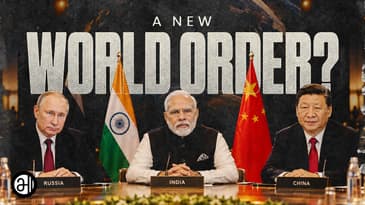
The world is changing - and India is being forced to make choices.
China has transformed itself into an economic and strategic superpower. The United States is still the world's dominant power, but its relationship with China is changing. Russia remains a major geopolitical force. And the Global South is demanding a greater say in how the world is governed.
So where does India stand?
In the run-up to India's BRICS 2026 Summit, Bharatvaarta brings together perspectives from three of India's leading thinkers and practitioners to examine India's position in this emerging world order.
From India's economic race with China to the future of US-China relations, from BRICS and the Global South to strategic autonomy and India's ability to become a power that can choose its own path — this is a conversation about the choices that will shape India's next chapter.
⏱️ TIMESTAMPS
(00:00) — India, China & the changing world order
(00:36) — Why did China pull so far ahead of India?
(02:43) — The policy risks that powered China's rise
(03:41) — Why India's size can become a weakness
(05:21) — How can India become export competitive?
(06:23) — What China did differently
(10:34) — Can India reach 9–10% growth?
(10:53) — How should India deal with China?
(11:54) — The future of US-China relations
(13:17) — Why India cannot afford a confrontation with China
(16:09) — China's rise and the challenge to American power
(16:38) — Can the West accept a powerful India and China?
(18:07) — India, Russia & China: a new geopolitical equation
(18:35) — Who are the real hegemons?
(19:43) — Is the West trying to keep India down?
(20:06) — Was bringing China into the WTO America's biggest strategic mistake?
(21:41) — The Thucydides Trap: Is US-China conflict inevitable?
(24:12) — Is American power declining?
(24:26) — India between the US and China
(24:40) — Where does India go from here?
(25:00) — The difficulty of strategic policy in a democracy
(26:35) — India's battle-tested military advantage.
(27:06) — What India needs to get right.
ABOUT THE GUESTS
👤 MANISH SABHARWAL- Economist, entrepreneur and public-policy thinker. Co-founder of TeamLease Services, economist and public policy thinker. He has served on multiple government and policy bodies, including the RBI Board, and writes extensively on employment, education, economic growth and India's reform agenda.
Connect:
LinkedIn → https://www.linkedin.com/in/manish-sabharwal-187827176
👤 NEELKANTH MISHRA
Chief Economist, Axis Bank and Head of Global Research, Axis Capital. A prominent economist and policy thinker, Mishra has spent over two decades working across Indian and global markets, with a particular focus on India's growth, capital formation, productivity and economic policy.
Connect:
X → https://x.com/neelkanthmishra
LinkedIn → https://www.linkedin.com/in/neelkanth-mishra-46629b
👤 AMBASSADOR DR. MOHAN KUMAR
A veteran Indian diplomat with 36 years in the Indian Foreign Service, Ambassador Dr. Mohan Kumar served as India's Ambassador to France and Bahrain. He was also India's lead negotiator at GATT and the WTO, dealing with issues including trade, intellectual property, services and dispute settlement. He brings the perspective of a practitioner who has spent decades negotiating India's interests in a changing international system, and examines the choices confronting India between the world's major powers.
Connect:
X → https://x.com/AmbMoKumar
LinkedIn → https://www.linkedin.com/in/dr-mohan-kumar-76027834
Website → https://ambmokumar.com
👤 VIKRAM SOOD
Former Secretary of India's Research and Analysis Wing (R&AW), where he served from 2000–2003. He is currently an adviser at the Observer Research Foundation and the author of The Unending Game and The Ultimate Goal. His work focuses on intelligence, geopolitics, national security and strategic affairs.
Connect:
X → https://x.com/Vikram_Sood
LinkedIn → https://www.linkedin.com/in/vikram-sood-1b009715
FULL EPISODE LINKS:
1. Manish Sabharwal: Deregulation, Civil Service Reform & India's Growth Story (https://youtu.be/f1hRTb6MIZ8)
2. Neelkanth Mishra: India vs China: What's Holding Us Back? (https://youtu.be/d4ouuGUv6mQ)
3. Ambassador Dr. Mohan Kumar: Former Ambassador Reveals What Happens Inside India's Toughest Global Negotiations (https://youtu.be/Ys99H7_WjcM)
4. VIKRAM SOOD: Understanding the Deep State | Former R&AW Chief Vikram Sood (https://youtu.be/TomnFVq3Bt4)
ABOUT BHARATVAARTA
Bharatvaarta is a long-form podcast focused on politics, policy and culture in India. We bring together policymakers, founders, officers, technologists, writers and thinkers for honest, in-depth conversations about what is happening around us — and what it means for India's future.
If this conversation made you think, subscribe to Bharatvaarta.
Join this channel to get access to perks:
https://www.youtube.com/channel/UCfBfBd-1kvCOPxVll8tBJ9Q/join
Learn more about your ad choices. Visit megaphone.fm/adchoices
[00:00:00] In just a few days, the leaders of India, China and Russia will be in the same room in New Delhi for the BRICS Summit. India and China are talking again, but the border question remains unresolved. China is an economic giant, a strategic rival, and one of India's most important neighbors. So where exactly does India stand?
[00:00:22] We went back to conversations with some of India's most experienced diplomats, economists, and intelligence professionals to understand that question. If you eliminate culture, if you eliminate skills, if you eliminate infrastructure, the only possible explanation for why China and India, who started with the same per capita income in 1990,
[00:00:49] and they are now five times more than us, is how do land, labor, capital combine? Right? What economists call total factor productivity. You can call it entrepreneurship. You can call it innovation. So we don't have a shortage of land. You can give every Indian household half an acre. They would fit into Rajasthan and Maharashtra. You don't have a shortage of capital. 50% of India's FDI since 1990, 47 has come in the last six years. Because you don't have a shortage of labor, 40% of our labor forces, Vela.
[00:01:19] So why is this not combining in the same way that it is combining in China or combining in other places? And the only explanation is that the premature load bearing on entrepreneurs, which was created by the thousands of acts, by the thousands of rules, compliances, notifications,
[00:01:41] but more importantly, by a toxic regulatory mentality, which sort of thinks about things prohibited till permitted. Right? I have been asked more than 100 times in my life by a bureaucrat, who allowed you to do this? Now, that's a profound question from a theory of knowledge perspective, because how will you possibly know innovation by definition has to be permissionless? China's rise is no longer a distant geopolitical story.
[00:02:10] It affects India's economy, its diplomacy, its security, and the choices it makes in a changing world. As India prepares to host the BRICS summit, perhaps the most important question isn't simply what China wants. It's this. What does India want? And how will it use its growing power?
[00:02:43] The reason why, say, for example, China has managed to do what it has is by taking significant amount of policy risk. That it was like, you know, it is very comfortable to drive a car at 20 kilometers an hour, because even if you by mistake turn it one way, you can actually turn it the other way very quickly. If you're driving at 80 or 100 kilometers an hour on a bumpy road, the Chinese have been sort of taking those risks like one after another.
[00:03:12] And in a democracy, I think to have that level of risk taking is very hard. It's almost like, you know, a politician who has worked very hard to gain power. We are asking them to sacrifice that, sacrifice his own hard work or her own hard work in the interest of the nation, which some people are willing to do, but many aren't very understandably. So this slows down change.
[00:03:41] Excellent point that a foreign leader made. They said that, you know, India's tragedy is its large size and its glorious history. So most of us in that room are saying, okay, so how is that tragic? And then he explained it to a very insightful comment. He said that, look, there is never an existential threat to the country.
[00:04:07] People accept big change and potentially risky change only when the alternative is worse. In India, you know, we have reasonably good weather all throughout the year. We get lots of water, soil is fertile. There is never this risk that India as a country is going to. And it is only when those things happen that big changes happen.
[00:04:31] So like, you know, when the Chinese incursions in Ladakh happened was when I think the bureaucracy woke up and realized that by viewing the private sector as a competitor, we were slowing down the economy. And the reason why China was so powerful was its economic growth. And therefore, we need growth at all costs. So you will see that some of the brightest bureaucrats in the government today, and there are many of them now. So the joint secretaries and secretaries of today are night and day different in their approach.
[00:05:00] Not in the brilliance, because the earlier ones were quite smart and intelligent as well. But in their approach and their acceptance of private sector as a necessary partner, and that the government role is of an enabler and not a doer. I think those changes have been accelerated by the potential threat of China. You know, China came up a couple of times. And of course, the tariffs were mentioned as well. How do we become export competitive, right?
[00:05:27] In this world where, you know, one visit to China, you realize that everything that has to be built is already built, right? They have entire bazaars full of, you know, things that you can, you know, you can go in from one end, come out with a product, the finished product at the other end. With all of those, you know, 50 or 60 different parts that go into it at really dirt cheap prices, right? And with the speed of execution as well, right? So how do we become export competitive? So we have to do a lot more of what we discussed.
[00:05:54] See, it is not that, see, 40, 50 years back, the Chinese were actually comparable to us, even behind. There are certain things they have done, which we cannot do and should not do as well. Like the concept of socialized losses and privatized gains. Because, you know, when you want to accelerate growth, you want to accelerate capital formation.
[00:06:22] Now, GDP is wages plus profits. Now, what China has done is, it's a remarkable, I would say, policy innovation that they put a lot of directed capital. So state directs that this industry, this sector will get a lot of capital. But they don't go after one company because then that company becomes slow and monolithic.
[00:06:46] And therefore, you know, tries to, in fact, it becomes inefficient and it tries to exploit the system. You instead allow, as I say, a thousand flowers bloom. So in one sector, you fund many companies. And then they compete. There's a brutal fight. And so the whole point is that profits are needed to attract more capital in a company. Basically, if you show you have EBITDA profits, you get debt. If you show your profits, you get equity capital.
[00:07:17] The state says in China that I can give you capital today. So you don't need to have profits. It's effectively like that. I mean, they don't state it like that. But that's how it's because profit. That's also because they're managing the currency also, right? And of course, that equation with the US and so on. We'll come to the US thing. But see, but within the, the biggest innovations have been inside the country. That their, you know, local governments get more than 50% of the resources. In India, it is less than 5%.
[00:07:45] So they have wonderfully managed decentralization. That because unless you had, as I said, you know, the infrastructure improvements that are happening in Hyderabad or Mumbai or to large extent Delhi. If they can be done in say, forget about 1000, 100 cities. I think India will be on a very different road trajectory. So they have managed to improve infrastructure, bring down cost of capital. That's of course state intervention.
[00:08:17] And, you know, use this model that you will give a lot of loans so that capital formation happens. But you don't need to show profits. Now, this part we can't do, but what we should do and we are doing and we should be doing faster is bring down the cost of capital. We should also improve ground level infrastructure. So the fact that you can travel from point A to point B in 20 minutes instead of one hour means that you can do more meetings.
[00:08:46] You can, you know, provide better services. And then the rest of the things start happening. So you think about like Tamil Nadu. The fact that five of the biggest shoe manufacturers in the world are now setting up factories in Tamil Nadu is that they have given land. They have given connectivity to the port, which are all two critical things. And they are willing to collaborate with the investors, the investing companies, which have global linkages.
[00:09:17] And if they want dormitories to be built, say for electronics manufacturers, the state government is willing to build them. So this level of partnership where the state is willing to give you land clearance and all of that is, once you start doing that in, say, five or seven different states, you don't need to do it in all 30. I think India will start accelerating. So the solutions are not that complicated, meaning in terms of knowing what needs to be done.
[00:09:45] I think the challenge is in executing that. And that and you would, you know, when I see how different say Tamil Nadu is or even Kannadaka, despite that the fiscal larges that we talk about. But I think in terms of trying to attract foreign manufacturers and foreign service providers, I think Kannadaka is doing a very, very good job. I think Andhra is not doing well. Now, Maharashtra is finally, you know, after five years of political uncertainty, starting to hit again.
[00:10:14] So UP is doing an excellent job. But why isn't Bihar doing it? Why isn't Chhattisgarh doing it? Chhattisgarh is also trying to do a lot of things. But I think it will take a lot of time for the state machinery to gear up to becoming a facilitator instead of a doer. So I would say that, you know, the pace of change, the political acceptability, the change in cost of capital is happening at a certain level.
[00:10:43] So we can keep growing at about 7%. I think to get to 9% to 10%, you need a level of policy risk, which, while I would like it to be there, I don't think it will be there. Economic power changes the equation. When one country has a much larger economic base, negotiating with it becomes a very different proposition.
[00:11:02] So if China is going to remain one of India's most important and most difficult relationships, the question becomes, how does India actually deal with a power like China? Not on television, not through slogans, but across the negotiating table. You know, you have mentioned that the U.S.-China relationship will get a lot worse before it gets better.
[00:11:29] And I feel that this will perhaps have the most bearing on the world we live in and particularly us, right? So how do you sort of see this panning out over the next, you know, few months coming and perhaps the next year or so? If you were to, you know, do some crystal gazing for us, right? What do you foresee for us?
[00:11:52] No, I would begin by saying that the U.S.-China relationship is undergoing important shifts. I do not see the possibility of a complete entente cordiale, as they say in French. You know, I don't see a situation where U.S.-China kiss and make up.
[00:12:16] But there is a very important development in the current context and in the recent summit meeting between President Trump and President Xi Jinping. They have agreed to a framework which is they have chosen to call bilateral strategic stability, a relationship of bilateral strategic stability.
[00:12:42] So this mutual interest in strategic stability means they may not resolve all the problems between themselves, but they will freeze the problems and allow each country the space to do what they want. This is my simple interpretation of the summit meeting between Trump and Xi Jinping.
[00:13:07] If this interpretation is correct, then it has implications for India because hitherto U.S. has seen India as a counterweight to China. But if U.S. and China decide, okay, this is the grand framework, you do your thing, I do my thing, we are not going to unnecessarily get into a conflict-like situation. It suits China, it suits America.
[00:13:37] If that is the case, then it will have some implications for India as well. India will then have to recalibrate its own relationship with U.S. and China. With the United States, I have no doubt at all that it is one of the most important relationships for India when it comes to tech, when it comes to defense, when it comes to AI, when it comes to people-to-people ties and so on.
[00:14:06] So we will have to make sure that our relationship is free of unnecessary disturbance or vicissitudes. With China, the power differential between China and India is so big that we cannot afford to have a confrontational relationship with China at this stage. We need time to develop ourselves.
[00:14:32] So the best way to go forward with China would be to try and create our own pathway for a development which is mutually beneficial. And I think the external affairs minister, Dr. Jay Shankar, has been saying relations with China should take place on the basis of three mutuals, he calls it, mutual interest, mutual respect and mutual sensitivity.
[00:15:01] This is the only way forward with China. So, Roshan, you have actually hit the nail on the head. The two most important relationships for India are U.S. and China.
[00:15:16] And Indian foreign policy going forward, whether we succeed or not, will depend largely to the extent or it will depend largely in the way in which we are able to manage our relationship with China and whether India and the U.S. can find mutually advantageous areas of cooperation and take the relationship to the next level.
[00:15:46] And even the best negotiation happens within a larger balance of power. India isn't negotiating with China in isolation. There is Russia. There is the United States. There is the Indo-Pacific. There is the Global South. And there is a much bigger question emerging behind all of this. What kind of world is India preparing for? The Chinese have been clever and smarter so far. They borrowed all the technology.
[00:16:20] And they did, what is it called? The reverse engineering and put it to use. Now they do their original work also. So they are a big, big opposition to the United States. So I want to back up a little bit and perhaps talk about the nature of the hegemon itself, right? Is it in the nature of a hegemon to just be all-powerful at the cost of everyone else?
[00:16:49] That they cannot exist or coexist with other powerful states or even other assertive states? Yeah. Our fault is that we want to be a power that matters and that we have set ourselves a date by which we will be that. And how can the United States or even the West accept two countries in Asia
[00:17:16] who are number two and three or maybe number one and three by 2047 economically by terms of GDP with nuclear weapons, with strongest militaries around, huge markets? And do you think that they will find that acceptable?
[00:17:44] We become competitors instead of being client markets and providers. Add to that, add to that, and I think I've mentioned it in the book, I've hinted, that what about an RIC, India, Russia, China, Russia, India, China, from the North Sea to,
[00:18:14] from the Arctic Ocean to the Indian Ocean, all that land in between. If you look at geography and if you have three wise men aided by other wise men at the same point in history, can you work that out? But Russia is a hegemon as well, right? Yeah, Russia is a hegemon. The Chinese are a hegemon, though they don't control much territory beyond their own borders.
[00:18:42] If you think that, you can say that there are hegemons in Tibet, if that's a statement you want to make, all they want is Taiwan. But Americans are hegemons, the biggest. And they have hangers on from Europe and Canada and Australia.
[00:19:11] That's why they've been encouraging things like, you know, movements within their countries against India. Canada did the Khalistan thing. These fellows have been using the JKLF and other malcontents to campaign against India, hoping to keep India quiet and down. We've been all through that.
[00:19:38] And it's not working for them. It's not, we're not Haiti or Granada that you can declare victory one day. It won't happen. It just won't happen. So they want to keep you under control. And they will create obstacles.
[00:20:06] You have a chapter called The Challenge from a Would-Be Global Power. And you describe China's rise and how it was aided by the US. You also have this quote by Deng Xiaoping who said, you know, hide your strength, bide your time. But China is long past that. As soon as it's come out again out in the open and has clearly made no bones about being a world-dominating power.
[00:20:35] But the truth is that the US cannot decouple itself completely from China. And so you see these things of, you know, Trump raises the tariff to 245% and Xi raises the tariff to 125% and so on and so forth. They're, you know, they're subsisting with some kind of a dance between the two. Right. Do you think that was the greatest strategic mistake ever made? Yeah, I think when they met in Pusan, I think in South Korea they met Beijing.
[00:21:05] And Trump and Xi Jinping met recently. I mean bringing China into the WTO and all of those things. The military was their biggest mistake because the Chinese just played into it and enjoyed themselves, became a superpower, economic superpower. They helped them become that. And that's the lesson they learned. They don't want India to become another China economically.
[00:21:34] We like to keep us down. And they were, they're trying. You referenced this Thucydides trap where, you know, there's a conflict between the, even the conflict, there is an inevitability to the conflict between a established power and a rising power. So in this case, if you look at US as the established power and China as the rising power, we're counting days to when, you know, there will be an actual showdown.
[00:22:04] Is all of this economic back and forth just a precursor to that or this is the finality of it? That's a good question. Because the Chinese, the American economy is not doing too well. Now, I read conflicting reports about how the Chinese economy is doing. It depends on the source of the information. If it's an American right wing, it's saying they've had it, they've finished, they're no good.
[00:22:34] And the others say, no, there's still a strong power. And the Chinese themselves say we're doing well. So the clash, I doubt if the clash will be between aircraft carriers and battlefields. China is just too far away from America for them to do it. They will want to use a surrogate. Okay. Okay. Now find the surrogate for me.
[00:23:05] Surely not Mexico. No, it has to be on this subcontinent, in this continent. Ours. Will it be Japan? Korea? South Korea? Taiwan? Who? Who is going to be their surrogate? Do you think that they think we can be their surrogate? But that'll be the worst, right?
[00:23:27] I mean, if they think we are the surrogate, in which case we are, I mean, it's not like the US is best friends with us either. No, no, no. Then? I think the level of trust between India and US is rather low these days. Yeah. It's rather low. I think it's completely reset. I think that one thing that he did is finished it. Yeah. Cease fire thing. Claiming credit for Operation Sindhu. Yeah.
[00:23:53] And after that, instead of saying that I support you and all that, he said, I'll be glad to see it's fire. And that went down very badly. And then the tariffs and all that. So it's a bit of a doldrum. I don't know which way they're going to play. But one thing is sure that America has not got that kind of power anymore. It is number one in many ways for history.
[00:24:22] But it can't stay there forever like this. Do you see that we are stuck in the middle between the US and the China now, right? Neither of them are our friends by any stretch. Both of them distrust us. Both of them want to destabilize us. So where do we go from here, you know? You can't move in geography. We have to stay and fight it. We have to stay.
[00:24:52] You know, I always feel that for a democracy, it is very difficult to run a policy if your opposition does not support you. A dictator can do what he likes. Autocracies can run on their own for years, months, forever.
[00:25:20] But how does a democracy run and take up policy, hard policy, when all the opposition can do is to pull you down? And not let you do or try and not let you do what you should be doing. That is our problem today. A strong government must have a strong opposition that has ideas to throw at you.
[00:25:51] That gives you things to discuss in parliament. That is where our whole heart is. Now if you are just going to walk out every other day and throw leaflets into… Where are we getting? What is the point?
[00:26:16] We have all the other assets we have got. We are brainy, we are innovative, we are… Armed forces are high quality. Tested, battle tested. Battle tested. Battle tested. I think our army is perhaps one of the most battle tested armies. The Chinese are not battle tested. The Russians are now being tested.
[00:26:46] All of Europe is not tested really. Americans also lost interest in fighting wars after 2021. So we are the fellows who are still carrying on. We have been carrying on for years and years now. So on that day we are okay. If we get our economics, fine. If I get our…
[00:27:11] You know all the ancillary systems that we think are not important but they are. If I get those right, education is one of them. And health is the other one. We have to… We have to have a healthy nation. We have to have an educated nation. Which sees the… Which sees issues the way they should be seen.
[00:27:37] And is strong enough not to demand all the time being medicated by imported medicines. So a healthy nation, an educated nation… The rest is all there for you to use. The rest is all there for you to use.