
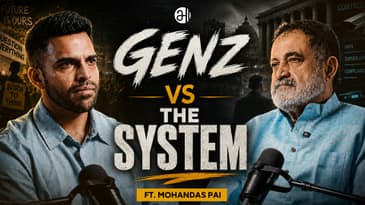

22 lakh students wrote NEET this year. There were about 1.35 lakh seats. That gap is where the protests came from — but Mohandas Pai's argument is that NEET was only the trigger. The real story is a generation that did everything it was told to do, and found nothing waiting on the other side. In this conversation, the former Infosys CFO lays out why the anger erupted in the Hindi belt and not the South, why a student clearing 80% watches a 45% score take the seat, what medical education actually costs once you strip out the policy distortions, and why he believes reservation must continue — but cannot keep serving the same families for three generations. Then he turns to the fix. A jobs incentive across the 400 poorest districts. Five thousand census towns built out so industry has somewhere to go. Why he thinks "India lives in her villages" is one of the most expensive ideas in Indian politics. Why AI will create more jobs here than anywhere else on earth. And a blunt account of what he thinks the political class, the bureaucracy and the courts are getting wrong. Sharp, specific, and backed by numbers throughout. Watch to the end. ⏱️ CHAPTERS (00:00) 22 lakh applicants, 1.35 lakh seats (00:52) Welcome to Bharatvaarta (01:05) Why the scale of the protests caught India off guard (01:40) The youth bulge: 2.5 crore entering the job market each year (02:20) Why the anger is loudest in the Hindi belt, not the South (03:20) Parents selling land to pay coaching centres (04:00) The cutoff gap driving the reservation anger (05:20) Why Karnataka and Tamil Nadu stayed quiet (07:50) What medical education actually costs — and why (10:50) One medical college per district: the faculty problem (12:00) The brownfield fix nobody attempted (13:10) A scholarship proposal for the non-reserved category (14:20) 1.5 crore jobs a year, and why 80% don't pay enough (16:00) 17,000 IIT graduates, 7,000 without offers (17:00) Reservation must stay — but become more inclusive (19:30) The privileged class inside the reserved category (22:00) Reservation as an exception to Article 14 (24:00) Why the IITs must expand to one lakh seats (25:20) Jobs plan 1: the 400 poorest districts (26:30) Jobs plan 2: developing 5,000 census towns (28:00) Why "India lives in her villages" is a costly myth (29:40) Dignity of labour, and what a housemaid earns (33:00) Why industry must train: the L&T story (35:40) The internship programme India actually needs (37:20) What four years of college is really for (40:20) Why 10 lakh students leave India every year (44:40) How Karnataka won Toyota (46:40) Why AI will create more jobs in India than it takes (49:00) Foreign funding of NGOs and the new law (55:30) Bots, platforms and manufactured outrage (57:50) Deprivation vs poverty: what has actually changed (59:00) Freebies vs permanent jobs (01:03:00) A jobs idea hiding in plain sight (01:06:30) "Politicians are our representatives, not our masters" (01:08:00) India needs 50 judges per million 🎙️ ABOUT THE GUEST T.V. Mohandas Pai is Chairman of Aarin Capital and 3one4 Capital, and Chairman of Manipal Global Education. He was CFO and a board member at Infosys, where he helped take the company to NASDAQ and instituted India's first broad-based employee stock option plan. He has served on the boards of SEBI and the NSE, co-founded the Akshaya Patra Foundation, and was awarded the Padma Shri in 2015. He remains one of India's most outspoken voices on education, employment and public policy. 🔗 CONNECT WITH MOHANDAS PAI X: https://x.com/TVMohandasPai LinkedIn: https://in.linkedin.com/in/mohandaspai 🇮🇳 ABOUT BHARATVAARTA Bharatvaarta is a platform for long-form conversations on India's politics, policy, economy and culture — the arguments that shape the country, heard in full and without the shouting. New episodes every week. Subscribe and hit 🔔 so you don't miss one. 💬 Where do you land on reservation reform? Tell us in the comments. #MohandasPai #NEET #NEETProtest #GenZ #EducationReform #Reservation #IndianEconomy #JobCreation #IndianPolitics #Bharatvaarta #IITAdmissions #HigherEducation #YouthUnemployment #PublicPolicy #India Join this channel to get access to perks: https://www.youtube.com/channel/UCfBfBd-1kvCOPxVll8tBJ9Q/join
Learn more about your ad choices. Visit megaphone.fm/adchoices
[00:00:00] 22 lakh people entered NEET, the total number of seats this year was about 1 lakh 35 thousand. But this wasn't just about an examination, NEET was only the trigger. There's anger because between the expectation and reality there's a big gap. No, the recipe for chaos is to have the younger people who are dissatisfied and frustrated. Study, compete, graduate and then where are the opportunities? Everybody feels things are happening they say what about me?
[00:00:26] But when you talk to employers, they're saying that hey I mean we're not able to find talented people. They have to train people, the industry must do that. NEET lit the spark but the anger was much bigger. So I think this is a much bigger issue than a mere examination issue. Namaste sir, welcome to Bharatvaarta again. Thank you so much for making the time. Thank you.
[00:00:53] Sir, I want to begin with the NEET protests that happened. They call it the Gen Z protests. What did you make of it? Well, I think the NEET protest was a surprise to many people in this country. A surprise because of the depth of the anger and the large number of people who came on. It is as if a lot of people are waiting for an opportunity to express themselves and to
[00:01:19] win their anger at the perceived failure of a society to do things for them. So I look at it very differently. For the last 25 years, India has been producing two and a half crore babies a year. So we have a youth bulge, the largest youth bulge in our history who are coming out into the labor markets, who are wanting jobs. That means every year for the next maybe 20 years, two and a half crore young people
[00:01:46] are coming into the market for jobs. Out of them, maybe 1.6, 1.8 crore people want jobs. But the number of job seekers is very large. That's point number one. Point number two, very importantly, we have about 4.5 crore young people in college and universities. As per 23, 24 data, 1.15 crore graduate every year. And when they graduate every year, there's no way they're going to get jobs in two months.
[00:02:15] Because they graduate over a period of two months. So no society, no country ever in human history has ever had such large numbers come out. So it's very difficult for all of them to get jobs. And so they face joblessness. And I think that is becoming a source of anger. Third, importantly, the largest number of graduates are coming in the poorest states in India. That is Uttar Pradesh, Bihar, Madhya Pradesh, Rajasthan, Bengal, etc.
[00:02:42] And the Hindi belt is where the anger is the highest. Not in South India. In South India, there are enough jobs for people who come into the market after education. And, you know, about 49% of people in the age group of 18-23 go to college in Tamil Nadu, 42% in Karnataka. There are enough jobs in the richer part of India. But there are not enough jobs there. And people are getting very upset that they have graduated, they don't have enough jobs.
[00:03:11] And many of them get a very bad indifferent education. Right. And they're not fit for the labor market. But firstly, there are not enough jobs. And the men graduate. The boys, when they graduate, they migrate. And the girls cannot graduate. But, you know, girls have a different issue. The next thing what you're seeing is, the aspiration of this group is very high. Parents are selling their property, land and everything they have to go send them to the coaching mondays,
[00:03:38] in the hope that they will be able to go to IIT, they'll be able to go pass NEET and get a seat in the medical college. And then they'll be able to become a doctor and uply follow them. And so many people fail. 22 lakh people enter NEET. The total number of seats this year was about 1,35,000. So not all of them are going to come. So if you're poor and much lower middle class, and your parents have put all your hopes on you,
[00:04:04] and they sell land, jewelry, everything, and you fail, you do it again, you fail. And you go to the coaching mondays, because they promise you spend 3-4 lakhs a year, and try to do it again, you are a failure, because the approaches are not enough, then you get very upset. And that anger is there. And especially remember that young man who came out and said, I tried three-4 times, you don't understand my pain, I'm part of the reserve category. Now, another point which is happening is, the great degree of anger among people, that the reserve category are able to get seized,
[00:04:33] with very less marks. For example, in IIT, the last reserve category in ST, we used to get to the 45% marks. ST with 60% marks, general category was 92% or 93%, EWS was about 92-93%. They're all saying, what crime have I done that I can't get into IIT, when a person with 45% gets into IIT, 60% gets into IIT. And that anger is there. Because what has happened, the number of seats are expanded. While the reserve category,
[00:05:03] people are not able to do well in sufficient numbers to get the seats. So since they have to fill up the quota seats, they go downstream and take very lesser qualified and they get anger. I got 80%, I did not get it, he got 45%, he got it, why should I suffer? That's the true anger. It shouldn't happen. It is very important to address that issue. That look, for a quota seats, you can have a cut off 10% less than GC, general category, but not going to 45% ridiculous.
[00:05:30] In medicine, same thing. And they read in the papers for MD, people with negative marks have got into and they have not got into. And this anger is there. So it was the outburst of anger at the failure and this neat exam going away was a perfect thing. And the cockroaches came out and tried to create a platform. And I think, and then of course, there's a lot of unemployment in the north for young people. They all gathered there to Hira Piri, beat the police and all that.
[00:05:56] So I think it's the perfect storm. And the many lessons that we have to draw, that this is not about need, trust and education. This is about the anger of the generation at the failure of society to give them enough economic opportunities. We must think about it and you must make sure economic opportunities rise and reorient our policies so that more and more people are able to get jobs in and around the areas from where they graduate. Because we can't have a situation where jobs are in one part, which is happening because south is growing and north there are no jobs.
[00:06:26] We have to invest more. So I think this is a much bigger issue than a mere examination issue. It's the anger of a particular generation of people whose aspirations have risen because the Prime Minister Modi is good work and wants to see good things. Yeah. Now, the recipe for chaos is to have a section of your demographic, especially the younger people who are dissatisfied and frustrated and more importantly, without any gainful occupation or employment.
[00:06:51] Yes, it is there. But it didn't happen in Karnataka, right? We are some leftist students with all kind of going jumping up and down in Freedom Park. In Tamil Nadu, we didn't see much of that. Andhra, we didn't see much of that. Hyderabad, we didn't see much of that. Kerala, the leftists, they'll always go marching for everything. We saw some of them, but not much. Correct. Why is it didn't happen in Maharashtra? Bombay, the film stars go because they want to get publicity. They're a failed class. They all go there.
[00:07:14] Why did it happen in those areas? And all of them, most of them spoke Hindi. Right. Remember that, right? And local Hindi, not Hindi like we speak. So, it is a particular function of Northern India belt. Right. Where, you know, they're not, you know, the opportunities are very less. And that's where the youth bulges. That's where the great majority of voters are going to come. So, there's a wake-up call for the government of India that you need to have program for job, which I got some suggestions.
[00:07:42] You need to create large-scale jobs. You need to create opportunities for more and more people. And you got to make sure that the seats available to them expand. And you got to lower the cost of education. See, if you're not part of the reserved category, and you know, you have an high aspiration, and you're poor, your parents sell out the land, everything, they're on the streets, and you don't get it, what happens to you?
[00:08:08] No, even though almost 1.4 lakh medical seats that are available, I think around 70,000 or so are government seats, right, which could be affordable. The rest of it is, again, you know, exorbitantly priced and perhaps… No, it's not exorbitantly priced. I won't say that. It reflects the cost of education largely. Maybe 20-25% of price is very high because there's great demand. I won't make that. See, we don't have the cost of education of a government seat because the government doesn't give debt. Yeah, subsidizes, yeah.
[00:08:36] I mean, so you can't say that is the cost of education. You paid 30,000 fees or 60,000 fees. That's the cost. Here, you got to pay 5 lakh fees. Come on, give me a break. That's the cost. You can check up the cost. Cost is very high because of bad policy again. Too much unnecessary infrastructure, too much unnecessary thing they put, the burden they put, and too many small… For example, a medical college should have 5 beds for one seat. And who has to pay for it? The cost of that should be almost free because the medical treatment is almost free.
[00:09:04] A very low cost. All that is loaded into the fees. So, the fees you pay, subsidize the beds. You understand? Instead of the government should build hospitals and give them free of cost to run so they can train students and run it and manage it. So, there's a lot of policy mistakes the government has done to vastly increase the cost of medical education. Yeah, because the argument about 10 years back was that the MCI was, you know, artificially controlling the supply. MCI was corrupt. Yes. MCI was corrupt. They used to take money. Right.
[00:09:34] The person who ran it was extremely corrupt. They used to do it. Now, that is all gone away. There's no corruption. Seats are available. But the problem is costs are high. Earlier when MCI was there, the fees were not transparent. Please remember, they used to sell seats. Yes. What they said, these are the fees, but not the real fees. They had to pay cash. Immediately after the MCI went, when NEET came, if you check up the fees before NEET, after NEET,
[00:09:58] you find out the true cost of education. Even charitable organization, you know, puts short the fees, which are much higher. That means they're all taking money in cash. Now, why is there a NEET problem in Tamil Nadu? Because most of the medical calls, the private sector, run by politicians, they used to take cash money, black money. They used to sell the seats to the highest bidder. Now, with NEET, you can't do that. You can't do that. So, they're all passing resolutions in their assembly to say, oh, NEET should be abolished, NEET should go away and all that.
[00:10:28] Supreme Court did that. It's good for the students. It's very good for the students. Now, everybody knows what is this transparency. There is merit in whatever is available, even though the reserve class get a higher quota. Yeah. No, I mean, despite the constraints that medical colleges have, that they need to have beds, as you mentioned, they need to have patients, cadavers, all of those things, medical colleges have almost doubled in the last, more than doubled in the last. They doubled more capacity. But please remember one thing. I again want to tell government that you're making a mistake.
[00:10:58] Prime Minister Modi has said, we must have one medical college for district, which is very good. Because the medical college comes up and then there'll be a big hospital. So, there'll be one big tertiary hospital in every district. That is very good. I think that will help people. But for the medical college to really give good education, it takes 10, 12 years. Where are the faculty? There's not enough faculty. There's no brand for the medical college. You go to some college in some remote district and say, I come from there, who will give you a job? They don't even know whether you've got good education. Am I right or wrong?
[00:11:28] So, I think it's very important. So, along with that, what they should have done is to say, any medical college, government or private, which is more than 20 years, double capacity. Over three years. Because they got faculty, they got infrastructure, they got everything. They only have to add incrementally. They probably have more hospital beds than required. And they will give good education. So, people who come become doctors get good education. Now, with all the new ones, the education will be very pathetic.
[00:11:58] Because you don't have enough faculty. Faculty can't be produced just like that. Correct? You don't have enough faculty. You don't have enough facilities. You don't have enough process. Management is not there. You expanded capacity. But most of the new expansion is poor quality. That's another problem. So, why didn't you do brownfield expansion? And government and private, there are more than 350 medical colleges, more than 20 years old. What then? If you've been around 20 years, you're pretty good. We've gone through all the changes.
[00:12:27] And you allow them to double capacity. The cost will be lower. The fees will be lower for the entire cohort. And that will be much better. So, before we talk about examinations in particular and what that means and how it will change in this AI era, I want to take a small tangent and talk about this movement that we saw. You think it's a genuine political, like a youth movement that we saw with this Cockroach Janta Party and so on? Or do you think it was hijacked by some lumpen elements of the society?
[00:12:56] Look, there is anger among the so-called Janzi. There is anger because between the expectation and reality, there's a big gap. Reality is much tougher than this thing. Expectation too. And the cost of education has gone up. So, maybe government of India should, for the non-reserve category, have a 10 lakh number scholarship,
[00:13:19] giving each student 1 lakh rupees annual scholarship to study in private, in the top 300 colleges, which are non-government. 300 universities, which are non-government. So, at least they can go there and reduce the cost of education. Cost of education is short up. Why is this short up? Seventh pay commission. You got to pay faculty. Faculty, you can't underpay. They'll go away. You want good education, you have to pay good people. You got to pay more. The cost has gone up. And many people cannot afford the cost. It's like a medical hospital.
[00:13:49] You want good treatment, you have to pay more. You don't have the money. You understand? So, cost has gone up. And for a section of society, maybe 40, 50 society, the cost is too much. Their incomes have not gone up in the same pace. The cost has gone up. So, there's a lot of anger, the mismatch between expectation and reality, plus the youth bulb that is coming. And that anger requires a spark to manifest. And the anger is the greatest in the north of this country. Because a lot of things have happened. Yogi's government has done wonderfully.
[00:14:19] And BR also is developing now. But a lot more has to be done. The backlog is so huge. The Prime Minister Modi has built good infrastructure, built everything. Everybody feels things are happening. They say, what about me? You understand? And we must produce more jobs. We are producing 1.5 crore jobs as per EPFO. But 80% of jobs don't pay more than 25,000 rupees. Right. We should have 80% job paying more than at least 50,000 rupees. With 25,000 rupees, how can you maintain a family? How can you educate your children?
[00:14:50] You understand? And there's a failure of the government school system. 50% of children are studying in private schools. Why are they leaving government schools where the government spends so much money? 65% of young people are studying in private colleges where they have to pay the full fees. But government subsidizes the reserved category in government colleges and makes sure they don't pay money. I mean, the rest of them are made to fend for themselves. And it's becoming very expensive. So what do they do? You understand? And their large numbers.
[00:15:19] Earlier, the numbers were small. When the numbers are small, you can manage. Now the large numbers are coming. 30% of young people in 1823 go to college. They'll go to 50% in the next 10 years. Right. Yeah. That's the stated goal. So what do you do? So government must think of how to create jobs, how to develop the smaller north of this country, and how to make sure that they expand the number of seats, how to make sure the equity.
[00:15:41] You can't have equity when ST gets a seat in IIT at 45% and a young person, the GC, doesn't get a seat even though it scores 80%. People will not understand that. You've got to have a cutoff reasonably. Because if somebody gets 45%, goes to a university where the average is more than 80%, how will they do well? Remember, you read a news report that 17,000 people graduated from IIT, 7,000 did not get jobs. Remember? Yeah, I mean routinely it comes out of...
[00:16:10] Yeah, because 7,000 reserve category. Why will employers go and get somebody who has not done very well a job? They go to IIT to get top talent. Am I right? Yeah. So when the entry becomes very lax and you go in, you're destroying the life of young people. Right. Just because you want to fill a quota, you get a person who's not qualified for that post and push him inside, you're destroying the lives. Because you'll be judged for the result. You're not judged by who you are.
[00:16:38] Once you enter IIT, you'll be judged by what you achieved in IIT after four years. If achievement is very poor, you're not passed, you're failed, your life is ruined. Instead, they can go to your other college and do reasonably well and not go there. Am I right? Here, you'll be a failure because you'll be compared with the top 0.001% of society and you're not up to the mark. And we have to accept that they have to study harder, they have to work harder.
[00:17:04] Sir, but when you talk about reservations, no political party will touch it or revoke it. No, look, I'm happy you spoke about reservation. India requires reservation right now till at least the end of the 10 years for which it has been extended by parliament. So let's not talk about doing away with reservation. But reservation has to be made more inclusive. What does it mean? Reservation has worked very well in many sectors.
[00:17:29] If you look at the entire educational system, almost all child, whether you come from any category, are in school. And in school, the school children composition reflects the composition of society. Whatever your share in society is, your equal number of kids are in school. So school problem is solved. The quality problem in school is still there, but there's a different issue. In colleges today, 62% of students come from SC, ST, OBC. You understand?
[00:18:00] OBC is 40%, SC, ST is 25%, 65%, 62% are coming from that category. So schools and colleges have got reflecting the composition of society. As for 4.5 crore young people. Okay. And two, government employment reflects the reservation. All the reservation quota is filled. People may complain in a secretary level, we don't have enough reserved people and all that. But that's because you've got to spend 25 years going up the ladder.
[00:18:28] So next five years, they will fill up. So that is not the problem. So you have seen benefit. The key thing now is, the reservation came about because people said at the time of independence and later 1950, that many people in, some people in this country have been privileged socially and they have come up. Others have not come up because they suffer from a lack of privilege and lack of access, which is true. So what did the founding fathers do?
[00:18:55] Dr. Ambedkar said that for reservation, you must have 10 years and everybody approved. Now what many of these people who complained against so-called upper class don't understand is, the 1950 council assembly consisted largely of people from the upper classes. They said, we must do it for the country. They want to include society. Next 30 years, parliament went on, you know, expanding, expanding it and extending it.
[00:19:23] And majority of members were from the upper class. For next 30 years, 40 years. So it's not that people did not encourage people from lower communities to come. They all said we should have reservations. That is the consensus. So let us not say people are against it. The people against whom you complain of caste operation are the people who said we must have reservations. You understand what I am saying? So let us not have any hatred towards people, so-called upper class and all. That is not acceptable. That is point number.
[00:19:50] Point number two, reservation has created a privileged class within the reserved category. How can you go on giving reservation to children of an IAS family for 3-4 generations? So you became an IAS officer, you know, 40-50 years back. Your children got reservation. You then become an IAS officer. The grandchildren become. Why should you continue that in the same family? So we need to make sure reservation should remain.
[00:20:16] In the order of priority, push the people who have benefited in class C, D, A and IAS category, government servants all across India, to a lower category of preference. And their children for education to a lower category and for job to a lower category. You understand? You understand? So open it up to others.
[00:20:41] And then if they don't fill up the seats, this so-called creamy layer, remove the creamy layer. If others don't fill up the seats, include the creamy layer in the order of priority. Don't give them first priority. You understand what I am saying? So lower the priority. So lower the priority and fill it quota with other people who are not benefited. So more and more people benefit. If you benefit in a class C or B or A category, government job, all India government and job,
[00:21:10] and your children have got reservation for one generation, don't give to the next generation. Put them lower down the category. Don't deny them. That's fine. And if you have got it for two generations, remove them. Just now I read that the Meena community as a tribe are 4% of the ST, but get 40% of government jobs. That's too much. They're monopolizing. Remove these communities for monopolizing would done very well. Give it to others. You understand? For example, Nitish Kumar had somebody called Mahadalit.
[00:21:40] There are Dalit, there is Mahadalit. He cut off the entire Dalit community, Mahadalit, and I'll do something like that. So like Sidramaya also did that, right? Left hand, right hand, something he did before he left, right? Because some category were benefiting, some category not benefiting. And this is meant for everybody to benefit. Don't create an elite privileged class within the reserved category. But don't remove the total reservation quota for some time till parliament debates it, till we get data. Okay.
[00:22:06] And two, when there's a cutoff marks for top institutions like IIT, NEET, medicine and all that, which are very specialized, the cutoff mark should not be for reserved category more than 10% below the last GC rate. General category cutoff. If general category cutoff is 92, don't give people who are below 82 for the reserved category. 10% is okay. You understand?
[00:22:31] Because if you check up the people who came from the reserved category were 10 to 15% lower than the cutoff for the general category, whether they passed or failed, you will find out the data. Check up the data. And you study for the last five years data, the people who have come with much lower marks. Who are the people in that category with much lower marks who have passed? And keep that at the bare minimum. So that the seats are released. You say that you have gone out of the way, don't do it.
[00:23:01] Don't lower the qualification. And give it to others. Put all of the rest who have not got in the first list, in the second list, in the order of priority. So that people feel there is fairness and justice. There has to be fairness and justice. Because reservation is an exception to Article 14. Our conscience says all are equal. Irrespective of gender, irrespective of background, everything else. We are all equal. But then reservation says we are unequal. Some people are more equal than others. That is an exception. It is not a rule. It cannot go on and on and on. That is not what it is.
[00:23:31] And they all become privileged. And there are so many IAS officers who got it. Their children, why should they do? Remember, we had a lady who was a minister, who was a daughter of a big cabinet minister. She got reservation. Then the children got reservation. She became... How can it happen? You can't be permanently part of the reserve cadre. It is not there. Because it is an exception. I think we should do all this reform. But don't remove reservation. Till, you know, we give all the data to say that you have suffered. Go on cutting it down.
[00:24:01] There were people who are eligible for that. So that more and more people in the category get in. Till they reflect the status of the general category. Which will happen in the next 10 years. Sir, also, I mean, these exams itself, whether it is JE or NEET or UPSC exams, they have assumed a level of importance where, you know, it's just... Short supply. There are 17,000 or 20,000 seats in IIT and about 20 lakh people apply. What do you do? So you have to expand.
[00:24:30] The IIT system, IIT, NIT and others should expand to at least 100,000 seats. You have to expand. I don't agree with these professors who say, if you expand, you... Quality will get their own students. Total rubbish. Don't tell me the top 1% of our youth are not bright enough. You understand? Every year, 1.2 crore people join college or more. Don't tell me 10 lakhs are not bright enough. Don't tell me all the stupidity. Correct. They say, we don't have faculty. Yeah, they don't have faculty.
[00:25:00] Let them take larger classes. It's okay. You understand? We have to compromise somewhere. Yeah, maybe, I mean, we don't have the luxury of having a certain student-teacher ratio at this point of time. Yeah, we don't have. We must work at it. Today, we can use technology to have a larger number, larger ratio. So more and more people get in. Right. But don't reduce the cut-off marks to our upset levels. But also, I mean, if you look at it, right? I mean, over the last, let's say, 30 years or even 50 years, the aspiration seems to remain the same.
[00:25:30] The aspiration has gone up. See, we should have a proper job policy. This is what I tell government. Pick up the 400 poorest districts of the country. There are maybe 800 districts now. I don't know. And in this poorest districts, come get an incentive program to say, anybody who hires anybody and pays ESIPF, we will give you 3,000 rupees a month for that employee for 24 months as an incentive. And we will pay your contribution to ESIPF.
[00:25:59] In the 400 poorest districts. So create jobs in the 400 poorest districts where labor-intensive jobs go. They'll also get people to formalize as well. Yeah. So we have jobs created for people. They can be educated, semi-educated, doesn't matter. They will develop. Point number one. So more jobs have to be created where people are rather than force people to come. For example, Bangalore has got 5 lakh people working in governments. Yeah. I mean, there are no Bangaloreans or Kandarigas working in government.
[00:26:28] They get people from Biyargia and all the other places. They get all the girls to come here and work and all the things. I mean, government should be in a rural area. And today, the whole of India has got good roads, good connectivity, good power, water, infrastructure is there. 10-15 years back, we could say there's no infrastructure. We can't go. Now everything is there. Railways, everything is there. We got highways, everything is there. So they can be in the poorest district. That's point number one. Second, we must develop the 5,000 small towns called census towns.
[00:26:57] 2011 census, we had some 5,300 towns called census towns. Develop the small towns with a population up to 5 lakhs. And give them money. Give them 20, 30, 40 crores every year to build roads, sewage water. So once you have those small towns developing, you can have industry next to the small towns. Labor intense, other industry. There will be some good infrastructure. And people in the next 25, 30 kilometers from that area can come there and commute and work there.
[00:27:27] And there if they get 14,000, 15,000 is a good salary. So once you create that urban infrastructure, more and more jobs will come. See, urbanization is the key. Villages are not the key to progress. The utopia that India lives in villages, Jala village is rubbish. 70% of farmers' children don't want to live in villages. They want to come to the small towns. Create the small towns with good infrastructure. So people can leave there. They can go to the big towns of work and come back. Or they get jobs there. And create jobs there.
[00:27:55] You see, urbanization is important because urbanization creates concentration of human activity. Concentration of human activity creates specialization. Specialization improves productivity. Improved productivity leads to larger income. But why do you think it... I mean, even though as a concept it's existed for quite a while. The mindset. All the politicians need to think India lives in villages. We must give rural people all that rubbish. See, once you classify them all over rural, classify many of the small towns as urban, then the mindset will change.
[00:28:25] And also there is a political reason. The representation of people in parliament and the state legislature is based upon the 2011 census. In which urban area is about 31%. 2001 census. Urban area is 31%. Now today urban area could be 40-45%. So more voters come from so-called rural areas. So politicians will take money from urban areas, give them a subsidy.
[00:28:55] 10 lakh crore is given a subsidy. Largely to rural areas. It's politics. Now when the new census comes, there's delimitation. More power will go to urban areas. More rapid urban areas. They'll demand their share. Then it'll be set right. You understand? Right. You understand? Right. You understand? Politicians respond to the electorate, right? Yeah. So that's the problem. We are not reformed. Our electoral politics. Right. So talking about aspirations itself.
[00:29:23] I mean, do you think that we should look beyond this aspiration of, hey, I want my son or daughter to be an engineer, doctor or chartered accountant? See, you must create opportunities. But what beyond that? Because... See, if you create a lot of jobs, a lot of opportunities, people will take advantage. So you're saying that people might aspire to become a machinist or some kind of a medical practitioner. There's a shortage of welders, shortage of machines, shortage of everything. There needs to be dignity of labor. You must promote dignity.
[00:29:52] See, today a software engineer gets 25,000, 30,000 rupees after becoming an engineer. Becoming an engineer. Or spending money through their nose. Right? A housemate gets 25,000, 30,000 rupees. Today. It's a software engineer has got a chance of getting 3 lakhs, 4 lakhs monthly in 10 years. Housemate has no such chance. But starting, they get more money. You understand? Starting is different. So you must create more high quality jobs so more and more people are able to earn better.
[00:30:22] That is the key. Job creation. So do this job for the rural areas. Do urbanization. And promote, you know, value added industry. And promote exports. Promote tourism. More jobs will come. When more jobs come, people get jobs. They get jobs in smaller towns. They get jobs near their villages. They will not migrate. And if they don't migrate to bigger towns, wages will rise. Recently, the government of Karnataka expanded the minimum wages in Bangalore. Right? It went up.
[00:30:52] 20-25%. Good. So all low value jobs should leave Bangalore and go outside because it's too expensive. Let them go 100 kilometers from Bangalore. Where labor costs are less. Correct? Why should they be in Bangalore? Why should so many people leave in slums and earn such low money in Bombay? Because there were no opportunities when they came there. 100 kilometers from Bombay created industrial cities so people can go. You understand? People can go and earn more money. Create better infrastructure. So you have to promote urbanization. Yeah.
[00:31:22] No, all salaries cannot support the same cost of living in a... Correct. You must promote urbanization. See, why don't you promote Bangalore? Yes. Promote Bangalore for IT. But ask government how much money they're spending to promote Bangalore peanuts. 3 crores, 4 crores, 5 crores. Other than spend money to promote Bangalore, build infrastructure, promote Mysore, promote Hubli Darwad, promote Belgavi, promote Karwar. You understand? Promote Kalburgi. Promote all those towns. Give them 500 crores. Give them 100-200 crores a year to develop.
[00:31:52] And incentivize industries to go there. They will go there. And once jobs come there, people from there will not come here. People don't come here. Wages will go up. You understand? Right. And then more jobs will go there. See, why are the IT jobs come to India? Because cost of people is less. And quality is very good. Same thing will happen in our cities also. It should happen. So you must have a very... India requires a focus on creating jobs.
[00:32:19] Number one priority for India should be creating jobs. What should we do to create jobs? We must create jobs for people in smaller towns, smaller villages, bigger towns. For that, we require this incentive program in the 400 poorest districts. Then we need to have urbanization for all the small towns. So more good infrastructure comes up. And then we need incentive for people to do more export. We need to promote tourism. Because most of the tourists are in smaller towns, not in Bangalore. Correct?
[00:32:47] So tourism will create local jobs. Then we have to expand our export so we can export more and expand the market. Correct? And then we need policies like PLI for high value added jobs. We got PLI right. We don't have a PLI for labor intensive jobs in rural areas. We need that. And we got to focus more on north of this country. Yeah. For sure. So when you talk to employers, they tell you a different story.
[00:33:17] They are saying that, hey, I mean, we are not able to find talented people. Because they are growing so fast. See, please understand. No society can create people with those kind of skills when you are growing so fast. You can't do that. They have to train people. What does the IT industry do? They hide raw graduates and train them. They spend three to four billion dollars a year on training every year. The industry must do that. They must train. I had a fight with A.M. Nike, the CEO of L&T many years back when I was at Infosys. He complained.
[00:33:47] Oh, these IT fellows are taking away all your engineers and paying them more. We can't hire engineers. I told him, why don't you pay more and hire them, man? Why are you complaining against us? You pay more, no? You're making money. You pay them more. You don't want. You want them for peanuts. And you're complaining you're not able to get people. You pay more. They will come. Am I right? And give them good career prospect. They will come. When I was in college, I finished college doing my CA. Some of my friends who were toppers in IIT used to come and work in the shop floor in my co. Supervisors.
[00:34:16] They're the misuse of talent. You want them to be supervisors? Like four men. Because they used to be available. Now they're not available because they'll do a better hire, higher quality work. Correct? So I think it's important for India to focus on human development, to focus on creating jobs, have better policies. So why do you think other industries haven't done what, let's say, the ITS? No, because they must invest more. They must invest more in hiring people and they must do it.
[00:34:46] They're making a lot of profits. They're highly profitable. They must do it. Because I think there was an implicit understanding. See, they were getting people at very low cost. They were exploiting labor. Like the IT industry now is exploiting labor. They're not paying software engineers more money. They should pay them at least five, six lakhs a year instead of paying three and a half, four lakhs. Pay more. They're making enough profit. They're not paying. Why? There's almost endless supply of bright young people coming. And the skill requirement for the entry job has come down because of technology and AI. You require people of a lower skill.
[00:35:15] So they're saying they're happy. You understand? The profits have not come down so much. So it's very important for employers to train more people. See, India requires a large scale internship program. Government of India runs a stupid internship program which has failed. I think it's run by the finance ministry as somebody who don't have the foggiest idea what to do. Internship program should be run through employers. What do they do? Come to the portal. You apply. Then you should go to the portal and hire those people. It doesn't work.
[00:35:45] You incentivize employers to get interns and train them for six to eight months. And pay them well. I mean, why should people get interns and incur a huge cost on them more in time and money when they're not going to hire them fully? They'll only get people whom they want to hire. Why should they invest? So incentivize them. Work with them. Design the policy better. Government thinks, oh, I'm giving 5,000, 8,000 people will come and queue up. They will not come. One crore people will do. It's a total failure.
[00:36:14] Because they're not designed properly. And they don't want to listen. They don't want to listen to people. They think all the wisdom in the world is available with Nithi Aayog and the bureaucrats in Delhi, which is wrong. Right. Yeah, this concept of apprenticeship itself is not as prevalent as it should be. It's not prevalent because apprenticeship means you're creating surplus capacity among young people. If I'm running a large industry, I need 100 people a year. I have to train 500 people and the apprentice of internship.
[00:36:44] Why will I spend that kind of money? It's not about the money that I pay them. The time, the space, the work, supervision. That's expensive. I'll focus on my work. No, but surely, sir. I mean, a second-year engineering student and a, let's say, third or fourth-year engineering student, there can't be that much of a difference between them that you're waiting an additional two or three years to... No, no. See, no, no. Please. See, I think that is the wrong premise. See, that four years of engineering is the time you grow up. What does college give you?
[00:37:15] Information, knowledge, socialization, growing up, problem-solving. It takes time. It's just not mugging up something and vomiting. You grow up, no? When you enter first year, you leave fourth year, you are a different human being. See, that is the most critical aspect of your life. Don't rush it. Let them allow them space to grow up. They must come to college. They must learn how to talk to people, negotiate with people, create camaraderie, create a network,
[00:37:44] go out, do programs, learn. Am I right? Play sports. Create. Do all the things for four years. He's growing up. So, you must look at college education very differently. On that note, you know, every parent who's listening to this podcast is wondering, you know, what skills are going to be relevant in this era? See, the biggest skills a person requires is problem-solving skills. How do you develop problem-solving skills? You develop problem-solving skills by having certain amount of curiosity.
[00:38:13] What is curiosity? How do people... How do things work? What is happening? Look around. Observe. Curiosity. Why do things happen? They're curious. So, when you work, you're solving a problem. You're doing a podcast with me. To do the podcast, you must be curious. What kind of equipment is required? How to record? How to do that? You can learn it. Very easy to do. If you apply your mind. Then you must think, I'm going to talk to this fellow, this person. How do I ask him questions? I do research.
[00:38:43] I find out his background. I found out his interest. I check up the topic. I do that. That's curiosity. Teach them those skills. That's what is required, no? If you are running a vocation during podcast, does all your engineering education, whatever you learned help you? No. What helps you is problem solving. Your social skills. Ability to think. Ability to understand. Am I right? Right. That's what you learn in college first.
[00:39:11] And the information that you get is good. You learn how to get information. Before, the information was in books. So, you have to read the books. The information is not in books. It's on Google. It's on AI. You can ask the question. If you know what questions to ask, you will get the answer. Then you read it. You understand it very well. Right. You don't have to memorize it. Keep it in your hard disk. Am I right? So, what is important is that curiosity to learn. Problem solving skills. So, how do we develop these institutions that offer these kind of skills?
[00:39:40] See, the new education policy does that. Because classroom work has been reduced. Project work has been enhanced. Group discussion has been enhanced. Etc. See, I will tell all faculty members in college. Every day when you have a 60 minute class. First 20 minutes, you have to teach. Explain. Next, you know, 10-15 minutes, you have a group discussion. Ask questions. Let people discuss. Then balance time.
[00:40:09] You get five or six people to come and present their views on the topic or something else. Or on a project. Correct? So, what happens? You learn from the teacher. You discuss and you learn more. Then you see somebody presenting and you get a lot of answers. And you understand it your own way. Yes. Yes. As well. Yes. So, it should not be a one-way broadcast. And why is it a one-way broadcast? Because too much of content is being given. Too many topics. Too much of content.
[00:40:38] You study history in class 9 and 10. 11 and 12, you study the same history. Again, you go to college, you study the same history. What is the point? Right. Sir, there was this idea that, you know, we should probably encourage foreign universities to come and set up, you know, their universities here and probably collaborate with our own institutions and so on and so forth. 2023, I think there was the UGC Act also to that extent. But, you know, has it panned out? Yeah, it's panned out.
[00:41:08] Maybe 25, 30 foreign universities have come. Maybe 5,000 to 6,000 students are joining. We'll go to 10,000, 15,000. See, why do you need foreign? 10 lakh young people, 10 lakh plus young people leave the country and go overseas. They spend a lot of money. 80, 90% of them go overseas to immigrate, not to learn. Let's be honest. Maybe 10% go there to learn and to come back or to have job skills. Only 10% go to the top university. Rest of them go to pedestrian.
[00:41:38] They go there to immigrate. Let's be honest. Farmers, children go, they sell the land. Somebody bought us money, they go there. They said, my son is abroad. The son is foreign. The son is gone foreign. You will get a job and I will go there. That's the aspiration. Now, that is being shut off. Right. So, why don't you give them good education here with the same foreign universities? So, they're allowing foreigners to come, which is very good. It's very expensive. But, only thing is, they must give the same degree that they give in their foreign land.
[00:42:07] So, let them come. What does it matter? There are 45 lakh people in college. I'm sorry, not 40, 45 million. 4.5 crores. 4.5 crores. If they come, how many students will be there in India? 1 lakh. What does it matter, man? Right. Yeah, there was a recent survey that said about 81% of the Indian students are planning to come back. There are no jobs. That route is shut off now. Well, getting shut off. Yes. Right.
[00:42:35] See, how many of them went to the top 20% colleges in New York City? Check up. Limited. Ah, because they will not get seats. Correct. Right. So, where are they studying? They do some silly calls. Like all this Punjabi youth Sikhs go to Canada to drive trucks. They go to some unknown places. They do some college gillage and all that. Right? Then they create some violence. Jump up and down. Get a certificate. They're prosecuted. Go there as refugees. It's all a racket. Right. It's a racket because there are no opportunities.
[00:43:03] See, we must expand job creation in India. We must create opportunities in many large places. The state government and others should do it. For example, in Karnataka, where is the opportunity in North Karnataka? Where is the opportunity? Government has failed. Only 20% of young people go to college. Where are the opportunities? What investment has gone there? Why can't the government have its own offices there? Give money to improve Hubli Darwad. Give money to improve Belgavi. Make better infrastructure. Promote industry there. Why not?
[00:43:33] They should do focus work for 10 years. We set up Infosys in Mangalore. We went to a place called Mudipu. Opposite, after the Netavati River. They didn't even build the damn road. We had to force them to build the damn road. And they said others are going to come. They had a 500-acre industrial estate. We took some land. The balanced land they allowed to somebody. Nothing has come up. Who is bothered? Who is bothered? You understand what I am saying? They should do their work.
[00:44:03] They should develop large areas. We keep telling them, why can't you develop Hubli Darwad at the automotive center? Give them cheap land. They give them very expensive land. Then there is corruption. Make them run around. Why will they come? Incentivize industry to come. Give them cheap land. Long repayment. Give them low power cost. Once they come and invest, they will be stuck. And give them training grants. Overwhelm them. When Toyota came to Bangalore, to Bidadi,
[00:44:31] Harvi Deshpande spent 60 crores leveling the land, giving them everything to come. Today, look at the asset we got. Look at the asset we got because of Harvi Deshpande. You understand? MB Patil and others should go to Hubli Darwad, take over 5,000 acres, call all these people, give them land at a low cost, give them whatever they want and give them to start. Do that. State has to develop. Some of these places have good institutions as well. Hubli has BVB, SDM, Darwar, They all want to take IT to Hubli and others.
[00:45:01] Where is the workplace in Hubli? Somebody goes and says, I want 500 seats in Hubli. Is there a good building in Hubli? No good building. In Mangalore, we have been pushing people to go there. People are saying, go there. Where is the building? Only now because Roit, but when local entrepreneurs come and started something, papers, things have come up. You go to Mysore, where are the office buildings? Industry will say, oh, there's no demand. So government should create an office building and invest and come. There's a 2,500 CETER GTC,
[00:45:30] Global Technology Center, when building has been taken up and redone, it has been inaugurated. DK Kushikuman should go to inaugurate. He's still getting delayed. He's not gone there. See, job creation should be number one priority. Infrastructure has to be built up in smaller terms, then people will go. So as we are talking about jobs, in this AI era, people say that it will not scale proportionately, right? We will not, we will require less and less people to do the same jobs. We're already seeing some of this in white collar jobs in the IT industry,
[00:46:00] especially, right? With all these kinds of coding assistants and so on and so forth. What do you think happens in that kind of a situation? Because I think it's a simultaneously bad situation. See, first of all, till June quarter, attrition, people leaving companies for the IT service industry, where 60 lakh people are working, was 13%. And 13% of 60 lakh, 7 lakh, 20,000 leave jobs to shit every year. What does that mean? There are enough jobs. Somebody is removing something,
[00:46:29] somebody is adding the enough job. Now, the attrition may come down in future. Two, I believe personally, AI will create more and more jobs for people. Because globally, all the big enterprises want to use AI. Who's going to help them use AI? They don't have trained talent. And AI is very expensive. They don't know what will happen. They need better supervision. They'll come to these companies only and hire. Right now, they're spending more money on tokens.
[00:46:59] And very soon, they will start giving out projects. People will come and hire. Right. Then more and more people will come. You understand? Yes, there is a fear because a lot of the work can be done. So, I believe AI will make people more productive, will make enterprises more productive. It'll take some time and it'll create more jobs for India in more than any other country in the world because India has got the largest number of tech AI ready people for the rest of the world. And also, I think there's a fundamental misunderstanding when people talk about this.
[00:47:29] It's not like enterprises will just buy it off the shelf. Too many loose stock is there by people. Oh, why didn't this company set up LLM? Why did this company do that? Oh, they're all getting beaten. Too much of loose stock by too many people with no stuff in their head. Forget it. But this is absolutely important because when we talk about a demographic dividend and so on. please tell me one thing. You think all our big companies don't know this? They know better than you and me. They're facing the clients. They're running the business. They know better than you and me. They're worrying.
[00:47:59] Are you worrying more than them? Their life is a stake. Am I right? Are you worrying? Are they worrying more than all the jokers who make loose comments in the media and other places? Come on. I mean, respect industry. Industry knows what is happening. They're all bright people. They work with their clients. They're all global businesses. They know what they're doing. Right. So, taking a small divergence from what we were talking about, which is broadly education and employability, these protests coincided with the monsoon session in the parliament.
[00:48:29] And there were a couple of things in that, in this parliament season that were under discussion. One is FCRA bill and delimitation. Delimitation we've already referenced in terms of increasing our MPs to about 850 and so on. It is overwhelmingly a net positive in my opinion because I think it gives adequate representation to everyone, right? Especially the urban folks who have been neglected. But why do you think there is opposition for something like this? See, the opposition is there for opposition
[00:48:58] because they want to beat the government down. FCRA, why is there an opposition? What are the FCRA new act saying? They're saying the money that you raise from overseas should be used for the purpose for which it's legally allowed. Pro-salletization must not be allowed. It's illegal. They put it into the act. Why should anybody object? Then they said the overheads, the money you spend on yourself compared to the money should not be more than 20%. Earlier it was 50%. So all the people are using foreign money to live very well
[00:49:28] are getting affected. So they're creating trouble. Then they say anti-monitor. What is anti-monitor? It applies to everybody. What is minority and majority in that? It applies to everybody who gets anything. And why should all these minority institutions go after foreign money? When somebody abroad gives you money, they command what you do. There's so much misuse of this money. Look at all the evangelicals, conversion, vultures and all that. They openly try to convert people using foreign money. And you see many of the foreign organizations send money saying we'll plant churches in India. We'll do this. We're converting people.
[00:49:58] This is our target. This is happening. The Catholic Bishop Conference should understand all this and support this. Why are they protesting? And then, you know, then the law is saying that if you, the property which is used from this foreign money can be taken over by government if you lose a license for FCNRA, that are there in the earlier act, except in this act, they created an institution which can do that. So why are they all bothered? Oh, they say it'll be misused. Government will not take over. Government pass the order to take over.
[00:50:28] Go to court. Court will protect you. Go to court. The right to go to court is always there. Whatever the law says, you can always go to court. Article 32 or 226, constitutional remedies are there. Do that. You understand? There is the political issue. Many of these church organizations find that they're getting hit because now they need transparency. They have to give full accounts. It's very lax earlier. They don't want accountability. They don't want the luxurious life and the real spending
[00:50:58] to be visible. Why are they hankering about foreign money? Why should George Soros send money to all the, many of the NGOs in this country? Why should they do that? We should not allow foreign money to come for advocacy. We should not allow foreign money to come for politics. We should not allow foreign money to come to promote democracy. What are they got to do with our democracy? All these NGOs, if they want to do advocacy, let them raise money from Indians. Enough money in Indians. Indians spend one lakh crore plus as charity every year.
[00:51:28] They give a one lakh crore. They have a lot of money. Go to them and raise money. Persuade them to give the money. Many people are successful. Go do that. Why do you want to go beyond these foreigners? Why do you want to get foreign money? Because they control you and you are selling your soul. Many of them are selling their soul to foreigners for a few dollars and the system has been corrupted. Many of the NGOs in Delhi are run by wives of bureaucrats. It has become a business. Many of the bureaucrats of retirement
[00:51:57] run NGOs. They all become a business. And remember, one judge's wife staying in the judge's quarter in Delhi was running an NGO and the judge was very fond of opening the courts at 11 o'clock, 12 o'clock in the night to deliver some judgments to act as a hero. So much of misuse of all this. Correct? So much of misuse. And whenever this action is taken against some of these NGOs, who is opposing them? Highly paid lawyers. Who is paying money for that?
[00:52:27] You understand? Look at the extent of misuse. Misuse should stop. Why should foreign money come? You have no right to getting foreign money. There is no fundamental right. Let's understand it. It is a law that allows you. You have no right. Without the law, you have no right. You can't get foreign money. The law has been created by Parliament to allow you to get. And this law was brought by Indira Gandhi. It was stiffened by Indira Gandhi. It was made tougher by Indira Gandhi. And no money should come for Indian politics. All countries control that.
[00:52:57] You must see the interview of Harish Salve with Annabh Goswami which is very revealing. He says the people who write the check control you. So all the churches are being controlled by foreigners. Why are they protesting? I don't understand. The Catholic bishops should support this because they are at the mercy of the evangelicals and radical organization who are trying to convert people. Much of the people that take away are from the Catholics only. They don't understand. They are under attack by this evangelical church.
[00:53:26] The Catholic church has lost out heavily in South America. They are lost out in other countries because the evangelicals are taking away all their followers. You understand? But people are also asking where do we draw the line between let's say a genuine civilized dissent and something Exactly. Because the opposition has lost all hope of coming to power. They take extreme steps and the government should be tougher. The government is very afraid of being called undemocratic, fascist and all that
[00:53:55] because the leftist media and the leftist have got a large voice in the media so they buckle down. Right. But the opposition also says that you can't have the same template answer to everything saying that everything is under foreign influence or everything is perverse. Are you in parliament? No. Right. Go argue in parliament. Why do you prevent parliament from functioning? Parliament is the place for you to argue. What do these opposition say? It's anti-minority. That's stupid. How can you be anti-minority? It's applicable to everybody.
[00:54:26] It's not targeted to everybody. It's applicable to everybody. Correct. Hindu organization, Christian organization, Islamic organization. How can it be anti-minority? Oh, government will take away property. How can anybody take away anybody's property in this country? There's a court. You can go to court and these organizations have access to the best lawyers. You've seen them. So what is the fear? Oh, we have to give information. Give information. That's the obligation under the law. Correct. It has to be tightened up. We should not get foreign money especially from people like George Soros
[00:54:56] Evangelical Church coming into this country to ruin our polity. Remember some four, five years back there were advertisement on billboards. I converted to Christianity. I converted here. I am this. I saw the Lord coming in my dream. All kinds of stupid things were there. Remember? You saw that, no? Where is the money coming from here? Can we allow that? Let's be honest about it. No. And then they abuse other religions. All these conversion agents go abuse other religions. How can they abuse other religions? You understand? Right. So I think
[00:55:26] there's so much a misuse. It must be stopped and it's a good law to come. So what do you make of the influence of these platforms, these tech platforms like Meta and Google and so on? See, all these tech platforms sell their soul for a few dollars more. The global left and people of the Soros organization have mastered the art of pumping in money through bots and others on these tech platforms to amplify everything. Anything that happens, they can amplify it through bots. Don't tell me this cockroach just got 25 million for how can it happen in five days?
[00:55:56] How can it happen? Yeah. Please tell me. They're all bots. They pump money into bot farms and they're all bots and they say, oh, suddenly 25 people following this and that following. Give me a break. They're all bots. They're all falling in money. That's why I keep telling me publicly, Government of India should see where did the money come for one year for the farmer's agitation? Where did the money come for the cockroaches? Some guy, some caterer used to give biryani, giryani, free food every day. Where did he get the money?
[00:56:26] They must find out. Track the money and prosecute them. Remember in the US, that Singham organization, that guy who sold that ThoughtWorks or something who's now in Shanghai, he's been pumping money giving to organizations. Congress is holding an inquiry. They'll go after him. FBI is holding an inquiry. FBI will go after him. That's what it should do. You can't allow foreign capital to come and spoil your politics or create chaos in the country. But you know, final question, sir. Do you think that these kind of things
[00:56:56] will intensify as we... It will intensify. It's a battle for power. the Congress has lost out. See, why has the Congress lost out? You tell me. What is the alternative the Congress is giving? Not offering a positive alternative. There's no alternative. I don't see Rahul Gandhi telling us what will he do for this country except say, except say, Jitni, this thing and all that. That makes no sense. That makes no sense. He's already there in education. He's already there in government jobs. What is he offering?
[00:57:26] He's not very clear what is he going to offer. So, why should people vote for him as against Modi who has done so much? See, Modi has tackled the biggest challenge India has since independence. What is that? The poverty and deprivation of our people. We are a poor country. A lot of poverty and deprivation. All prime ministers in India's history tried to remove that. All of them. Inevitably. Because all politicians are disembarking good people. But they failed because they could not execute. Modi has been able to execute. Modi has made sure almost every person has a roof over the head,
[00:57:55] water in the tap, power in the switch, power in the switch, a gas stove, a bank account, money in the bank, a mobile phone, an internet connection, food on the table, education for children, a health insurance, etc. Correct? A toilet in the house. He made sure. He succeeded. So the great majority of people don't have deprivation. They are still poor but deprivation is gone. Now the education and the children doing when the aspirations have gone up. They should do that. They should offer.
[00:58:25] You understand? But I suppose the biggest risk is that there is an entire generation which is growing up with this as the baseline. They don't know what it was like earlier. But that's the right thing. Why are you saying the biggest risk? We must have better policy. Give them what they want. And explain to them. Is there right? Look, I was part of the deprived generation. When I was growing up, there was no tap water. Enough tap water. Water. We should go to the well in the house and draw the water. There was no milk. Enough milk. The power is to shut off.
[00:58:55] Ration shops. Ration shops. No food. Give me a break. Not enough schools. Not enough colleges. Come on. All that is gone. It came too late. Why didn't the congress do that? They are so corrupt. Modi did it. Now they are losing power. Nobody is voting for them. They want to disrupt parliament. Do all kind of dialogue. Create hatred. You know, go after Islamic appeasement. All kind of mess they are doing. But why will people vote for them? There is no reason why people should vote for them. They must give an agenda. this is what we will do for you.
[00:59:25] Agenda is not doing khatta cut, khatta cut, 7,000 rupees a month, 8,000 rupees. There is no money for that. That is not agenda. That do what? You talk to them. What will they do? Oh, it is only for 1 lakh people. Give me a break. Give me a break. 1 lakh people will do. The real poor. And then everybody's account will get khatta cut, khatta cut. Remember in Bangalore, so many Muslim women from the slums went to GPO to open account saying that if elections happen, Rajiv, Rahul Gandhi will do khatta cut, khatta cut, will get money. Remember that? I used to see it when I used to walk to office.
[00:59:55] See, they must have an agenda, a positive agenda what they will do. Right. Right, sir. And the agenda should be how are you going to create jobs? Not give subsidies. Jobs. Because jobs are permanent subsidies. This government is spending 60,000 crores on giving subsidies to people. Many of them would not deserve it. You think 1.3, 1.4 crore women need 2,000 rupees per month in the bank? They are not poor. You need, you need, you think 1 crore, 1.5 crore people
[01:00:25] require free power? I mean, Malishra, so many people are taking free power. I asked them, why are you taking free power? He said, we pay so much of tax, what do we get in return? At least this we are getting. Why should they get free power? Restricted to poor people, what is the percent of poor in Kandantaka? 10%, 20%, 15% is 5%. Give it to 20%. Give them. It's okay. You understand? Why are you giving the rest? As for the rest, invest in higher education. In Kandantaka, 60 to 70%
[01:00:54] of the faculty position in government calls are vacant. There's no faculty. They got guest lecturers of very bad quality, most of them. Remember some 250 people were sacked for having a forged PhD. Remember? It came in the media in Kandantaka. Come on, you can't do that. You're playing with the future of children. Future, what kind of education will those people get? And then you say, they don't get jobs. They're not qualified. They don't have skills. Run the state properly, no?
[01:01:24] Invest in high education. Invest in people. Invest in industry. Invest in infrastructure. Create jobs. So, if you don't have the agenda, you disturb parliament, create all kinds of aggrieved. They're saying, create cash hatred. Create communal hatred. Why are you supporting these jihadi elements and others who are against this country? I don't understand. Why are you supporting that? Do you think Karnataka is especially at a risk considering that it's one of the last few states that the Congress has.
[01:01:54] It treats it as a cash cow of sorts and so on. Yes. Because in that three years of Sidiramaya, we did not see much progress. He only spoke about guarantee, guarantee. It's not his personal money. Very easy to give away money. Guarantee, guarantee. People got that money. Now, you think they'll vote for him? They say, what is next? That's all I want. Swaham. Correct. What is permanent is a job. Not these small things. You understand? So, has he created jobs? No. He said, I'll give government jobs. How many government jobs
[01:02:23] will you give? Every year in Karnataka, 9 to 10 lakh people come up working age. We need 5 to 6 lakh jobs every year. In 5 years, we'll require 5 into 5, 25, 30 lakh jobs. And what is he saying? I'll give 30,000 jobs. Is it enough? What are they talking? What is Sidiramaya talking? Giving away free money. How many jobs has he created? That's what I keep telling our Chief Minister D.K. Shukumar, focus on job creation.
[01:02:52] There are many good policies you can do. They don't cost too much of money. Talk about jobs. See, when Kata Subraman Naidu was the IT minister and others, he had called us for jobs. I told him, one of the biggest jobs is in security. Private security. There are 90 lakh people working as private security guards all across India. 90 lakhs. Police are 22 lakhs. Can you believe it? 90 lakhs every year.
[01:03:23] 78 lakh people get jobs. I said, get young, good, strong people, semi-educated from North Karnataka. Put them in the police training academy for 45 days. Police have got training. Have a 45 days program for them. Give them food, give them everything. Give them a certificate and call all the agencies. Security agencies and hire these people. They'll hire them. They want people. They get 20, 25,000 rupees a month. Not bad. Instead of being on the street. Correct? Right. And then, because you train them and all that, they will be an addition to the police
[01:03:53] in case of any need. We need security. Halwa. Do that. They don't want it to. Nobody is applying their mind. They do some skill thing. They do some fashion gation. Knock off a lot of the money. Give it to all kind of people. What is the output? They don't track all the skill to industry. Do they ever talk about how many jobs they created by the skill? No, Allah. They don't care. They put a politician leader there. They put some secretary there who doesn't want the job. Too focused on inputs and not so much focused on outcomes. Yes. So they all keep talking
[01:04:22] about seminars, schemes, all of this. I want our chief minister to tell us how many jobs he has created every three months. How many jobs have been created? Whether, not government alone. By his work, how many jobs have been created? How many people got employment? Right. That's the biggest thing. What else you need? Nobody talks about that. Well, hopefully, post delimitation, we have adequate representation and it becomes politically... See,
[01:04:52] political leadership... Because that political incentive is necessary. Political leadership have to be better. They must have better policy and execute better. See, MB Partill is doing a good job. Even DK Shukumar is doing a decent job. Look at Krishna today. Krishna Bairagoda. What a good job he's doing. We had so many ministers of Bangalore. What did they do? I used to meet them and tell them, please clean up the city. How the... Clean Marbekah. Ayatun Norana. They're nothing. They forget. Look, Krishna is doing it. He's become very popular. Krishna Bairagoda
[01:05:22] is cleaning up the city. He's become very popular. He's communicating. He's telling, we'll make Bangalore a walking city. We'll build good infrastructure, quality of life. We'll open parks. And now, for 15th August, he's opening up Vidhan Soda. He's saying that the people come, enjoy Vidhan Soda. They shut down Vidhan Soda. When we were younger people, we used to go to Vidhan Soda for the weekend. We used to walk in. Now, you can't walk in. I remember when I used to go to Vidhan Soda after the shutdown, I used to go in my chapel in the kurta. The police said, why are you coming? Who are you? Next to me,
[01:05:51] one corrupt contractor will come in the merciless, bend the suit. They'll salute him and allow him. They won't allow me. Then I see some dogs going inside. I'm worse than a dog. They treated me worse than a dog. The dog will go inside because central court, the other 20 dogs living there. I'm telling you, it's not a joke. That's how they treat people. The police treat you as if everybody is a criminal. They're big people. They don't think they're there to protect people and do service. They treat you like a futile thing.
[01:06:21] You understand? The attitude should change. The same colonial mindset is there. Yes, that should change. The politicians should change that attitude. Right. See, our politicians should understand they're our representative, not our masters. We elect them to power, to rule on our behalf. They must meet us, listen to us, ask us what we want and try to see whether it takes society forward and enact the laws and make it work. They have to have good programs and talk to the bureaucrats
[01:06:51] to implement it. They can't ask bureaucrats to decide what the priorities and programs are because they have to decide. They are the rulers, not the bureaucrats. The bureaucrats have to do the work and the agenda decided by the political. They don't do it. They're the massive bureaucrats. The bureaucrats are the agala. How the? Agala. What is agala? You got to make it happen, man. You got to make it happen. You got to work at it like Krishna is doing. Krishna Bairagoda is a great leader. Look at the work he's doing. One man changed Bangalore in 30 days.
[01:07:21] Look at the metro five years behind schedule. We had bad CEOs there. Now a new CEO, C.K. Jafar, has come. He will transform it. Look at that peripheral road. We got Atik there. Atik is brilliant, good man. He'll make the road happen in one and a half, two years because DK is giving him all authority, all powers. So we need good leaders focusing on the right things. Then their society will develop. And for the politicians to understand, they are elected by us. They must talk to us, listen to us,
[01:07:50] make it happen and they must rule, not be ruled. Even in Delhi, they're getting ruled. Bureaucrats decide the rules in many, many other things, not in many other ministries. See, I'll use the justice system. It takes 15, 20 years for the course to decide. Why? India has got 20 judges for million population. We need 50. America has got more than 100. We don't have enough judges. Expand the judiciary.
[01:08:20] Let the central government have a scheme to give money to the state to expand the judiciary. I once told a chief minister, justice is very bad. You know what she told me? Move on. They all decide against the government. Why should I increase capacity? You understand? So it's very important for us to understand, expand judiciary. Don't appeal for every small case. Half the cases are government cases in appeal. Give justice.
[01:08:49] If you're caught for corruption, it takes 20 years. No punishment. Lallu is out on bail. For how many years now he's out on bail? How can he be out on bail when he's supposed to be sentenced? Who's asking the questions? Where is justice? Right. Right, sir. Thank you so much for this interview. As always, very candid conversation. Thank you. Hope to have you back again soon. Thank you very much. Thank you so much. Good to be here. Thank you. Thank you.