
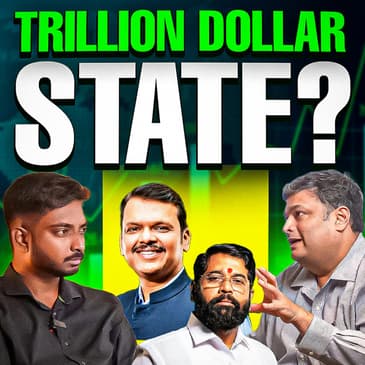

In this episode of Bharatvaarta, Sharan hosts Mr. Kaustubh Dhavse, the joint secretary to Maharashtra's deputy chief minister Shri Devendra Fadnavis, to discuss Maharashtra's goal of becoming a $1 Trillion economy. The conversation delves into Maharashtra's significant contributions to India's economy, infrastructural projects, and the government's strategies for achieving a $1 trillion economy by 2028. Mr. Dhavse highlights the role of visionary leadership under DyCM Devendra Fadnavis and CM Eknath Shinde. He highlights the infrastructural advancements in maharashtra including the Samruddhi Expressway, the new airport in mumbai, underground metro among others. The conversation also covers the innovative approach taken to solving bureaucratic challenges, balancing economic growth with political stability and addressing regional disparities in development.Sharan Setty is a journalist covering politics, society and security for a magazine based in New Delhi.
00:00 Introduction
00:50 Conversation with Kaustubh Dhavse
02:15 Mumbai's Infrastructure Transformation
04:11 Challenges and Leadership in Development
10:08 Regional Imbalance in Maharashtra
15:10 Investment Strategies and Emerging Hubs
21:31 Balancing Development and Welfare
27:42 Personal Insights and Political Complexities
32:31 Navigating Government Challenges
33:12 Advice for Aspiring Civil Servants
36:14 Addressing Corruption in Government
40:18 Tendering and Vendor Selection
46:11 Maharashtra's Growth Strategy
53:28 Political Challenges and Optimism
58:35 Future Vision for Mumbai and Maharashtra
01:01:12 Conclusion and Final Thoughts
[00:00:00] What is the whole success story of Maharashtra? What is the growth story that's grown beyond Mumbai?
[00:00:30] You are already blessed with so many things of this nature, you tend to become a little bit more complacent.
[00:00:39] Over a period of time what you have realized is developmental work alone does not necessarily get you back in power.
[00:01:03] The Minister's office with Mr. Devendra Fadnawis in Maharashtra, his had a stint with him for 5 years when he was the Chief Minister of Maharashtra from 2014 to 2019.
[00:01:15] And before this, his had a diverse role, his been in policy consulting, his been in entrepreneurship and to be able to shift to a role where you're advising the government, your driving growth,
[00:01:27] your overseeing infrastructure investments in the city, that to a city like Mumbai is a very massive role to play.
[00:01:35] And it is being done like you're in a war like urgency and that is what is essentially required for all the cities in India.
[00:01:43] And today we requested him to take out some time to reflect on what has been happening and what can happen in the future as far as policy, infrastructure, investments,
[00:01:53] and how finally Maharashtra can achieve the dream of one trillion dollar economy by another four years which is 28.
[00:02:04] So thank you so much, Namaste.
[00:02:06] Namaste.
[00:02:07] Thank you very much.
[00:02:07] Thank you, it's such a pleasure to be on your platform.
[00:02:10] It's such a pleasure to be in Mumbai after a long time actually and to meet you finally.
[00:02:15] Yes, Mumbai is very different now.
[00:02:17] I don't know when the last time you came but Mumbai has literally transformed in the last year.
[00:02:22] I was in the last year in 2008 so that's 15 years of my government.
[00:02:26] So city has changed a lot.
[00:02:29] I mean there has been, you will see everywhere there is a huge infrastructure push.
[00:02:33] Large bridges are being made, roads are being created.
[00:02:39] Overall there is a push to get people faster on the road.
[00:02:45] And while we continue to struggle with a very good problem of immense growth,
[00:02:56] we are still grappling with making sure that we provide the necessary infrastructure.
[00:03:01] And I believe that this is a continuous story.
[00:03:04] It's not something that you do one project and you forget about it.
[00:03:08] You really need to build cities for the future.
[00:03:11] And we are hoping that we have set the motion in the right direction when Devendra Fadnawis was the chief finister in 2014.
[00:03:19] He laid the huge foundation of doing $30 billion worth of projects.
[00:03:26] And they are all under execution.
[00:03:28] Some of them have been delivered.
[00:03:30] Some of them will now eventually get delivered.
[00:03:33] We were hit by the COVID blip a little bit but now everything is back on track.
[00:03:38] And hopefully we will be able to see a very different Mumbai in the years to come.
[00:03:46] I think resilience is the word that resonates more with Mumbai right?
[00:03:50] Despite all the problems that you know may come naturally or artificially to Mumbai,
[00:03:56] there is that spirit and Mumbai that you need to move on.
[00:03:59] You need to get on with life and you need to make the city better.
[00:04:01] And we are seeing that with the kind of projects that we see in Mumbai as well with all the sea lanes,
[00:04:07] with the metro being expanded, with you know the world class roads being built.
[00:04:11] How has the difference been?
[00:04:13] You know in terms of you are in a very comfortable job and I'm sure there were challenges there too.
[00:04:17] But it's a very different thing as you make the role of a joint director in a government.
[00:04:22] And all of a sudden in five years pushing one point eight lakh crore worth of projects all of a sudden.
[00:04:27] So there is that infrastructure bottleneck that you're dealing with but there's also that political bottleneck.
[00:04:33] Yeah, no it's a very I would say it's a very it's it's it's stuff.
[00:04:40] Yeah, there are so many different things that are required to come into play.
[00:04:48] In order for you to execute any large project.
[00:04:52] There has to obviously be remarkable leadership.
[00:04:55] So thankfully by the grace of God and by the blessings of people of Marashra we had a remarkable leader in Mr. Fundamentalist.
[00:05:01] But most importantly he should have the vision to see all this through.
[00:05:07] And what I mean by vision to really kind of articulate it, he should be able to see the larger picture as to whether he will be able to put the necessary weight behind it.
[00:05:17] Be a very sincere sponsor to this project.
[00:05:22] Motivate and drive the entire bureaucratic machinery and also align every single political.
[00:05:31] What we say protest.
[00:05:35] And address it in such a way that it shows that we are moving in the right direction.
[00:05:40] So these are multiple different set of issues which needed to be handled.
[00:05:45] I would say that he was very very clear from day one.
[00:05:50] So clarity of thought.
[00:05:52] Great quality for a leader.
[00:05:54] Second thing is that he knew the complexity of the project.
[00:05:57] So he was very.
[00:06:00] It at a very early stage he set up something called as a chief minister's baroo because he realized that for a single project like let's say the coastal road.
[00:06:09] If we have to execute the coastal road there are more than 20 agencies involved.
[00:06:15] There is the state agency involved like PWD and BMC and then there are central agencies involved like empty NL, BSNL all the utilities.
[00:06:24] Then there are you know various different authorities involved.
[00:06:28] Some are state, some are center.
[00:06:30] Each of these agencies and authorities have a very senior officer.
[00:06:33] Either he is a civil servant or he is from that particular service.
[00:06:37] And many of times they don't talk to each other.
[00:06:41] And many of the times you know simple simple issues take too long the time to kind of get address and that eventually causes the delay.
[00:06:50] So he set up this war room with the primary objective of making sure that all the officers come on the table at the same time.
[00:06:59] The issue is defined and immediately in front of the chief minister you can say yes no or what the problem is.
[00:07:06] This is better coordination.
[00:07:07] Far better coordination.
[00:07:08] So the beauty of this model is that you get immediate impactful results.
[00:07:16] One second is that people cannot give you stories.
[00:07:21] Whether it's a bureaucrat or it's a whoever it is the head of the project he can't give you stories.
[00:07:27] Because everything is transparent, everything is case basis, everything is issue based.
[00:07:31] Third most important thing is that the chief minister fully comprehends what is the necessity permission issue involved in order to get it done.
[00:07:42] So you have a 360 degree view and then you had a team who was constantly breathing down people's neck which will nightly.
[00:07:50] The chief minister's war room to get stuff done.
[00:07:53] So eventually what this delivered was what you can see today.
[00:07:57] Whether it is the coastal road which was stuck for more than 25 years, whether it's the new Mumbai airport which was stuck for more than 30 years.
[00:08:04] Whether it was the underground metro, whether it was the Atal Seetu discussion about which was started in 1970s.
[00:08:11] That there should be a bridge connecting Mumbai to Nave Mumbai.
[00:08:14] So all of these were only conversations and discussions and that's the difference between a door and a talker.
[00:08:22] And that's why we have these things that you know, we walk the talk and so on and so forth.
[00:08:27] They went to Fandervis delivered, he promised and he got it done.
[00:08:32] And he backed it into the hill, he backed the officers, he backed, he went to Delhi to fight with the central government on permissions.
[00:08:40] Irrespective of whoever's government it was although it was little bit favorable because it was a BGP government but the fact of the matter is that even Congress in the early regime had the same leadership,
[00:08:49] the same party at the state and the same party centre but they couldn't do it.
[00:08:53] So you needed a leader who fully comprehended the issue and in Devendra Fund we got that and that is the reason why we were able to execute.
[00:09:01] So the Mumbai that you see today, in fact I would say that the Mumbai you will see in 2028 when our coastal road is fully done,
[00:09:07] when the underground metro is fully operational, when the Namim airport is fully started, fully in full capacity,
[00:09:13] when our all the overhead metros are executed, when all of this kicks in, you will see that Mumbai car will go from point A to point B in less than 60 minutes.
[00:09:25] One second he will have far better quality of life at home and at the same time he will be far more productive to the economy.
[00:09:34] So that also eventually helps us in not really in dollar goal.
[00:09:38] So this entire thing is to make sure to improve the speed of travel and that's what Parked we have said in and now it's in motion.
[00:09:47] Mumbai has been a success story for India but what is the whole success story of Maharashtra?
[00:09:54] You know, what is the growth story that's grown beyond Mumbai?
[00:09:58] There are many other cities there are aspirations, there are millions of people living outside the city of Mumbai.
[00:10:03] So how do you observe the changes that are happening outside of the city?
[00:10:08] So that's a great question actually because we have been observing that there has been immense regional imbalance as far as Maharashtra is concerned.
[00:10:16] Almost all the states.
[00:10:19] Yes, but in Maharashtra a little bit more because most of our growth is concentrated in certain sectors and a large portion of Maharashtra was neglected for very long time.
[00:10:29] And there are reasons obviously.
[00:10:31] So first things first, Maharashtra is the largest contributor to India's economy.
[00:10:36] It's considered as a growth engine.
[00:10:38] It's considered as a gateway to India's vital and dollar goal.
[00:10:43] Maharashtra also has a largest GDP contribution in the sense that the number we have more than $500 billion as GDP.
[00:10:51] Maharashtra also is known as the financial economic entertainment and commercial capital of the country.
[00:11:01] So because it has Mumbai, now when you are already blessed with so many things of this nature, you tend to become a little bit more complacent.
[00:11:15] So what happened with Maharashtra, I would say that it went off very well in the 70s and 80s.
[00:11:23] And later on, I think there was immense amount of complacency that crept in.
[00:11:28] So between 2000 and 2014, if you see, because of the non-performance or non-inshaved taking of Maharashtra, other states benefited.
[00:11:39] And it's good for the country but I'm just talking from perspective of Maharashtra.
[00:11:44] So what probably, what Bangalorew became was at the loss of Pune Mumbai and Thani.
[00:11:51] Because bureaucracy and political leadership was so busy in not attending that they found a far better ground of people willing to listen to them and giving them time and understanding their issues.
[00:12:05] So, and plus we did not have enough focus on infrastructure.
[00:12:13] If you look at Maharashtra between 2014, you will notice that only one metro be constructed 11 kilometers between Ghatkobal to Warsaw.
[00:12:25] And it took 11 years for 11 kilometers.
[00:12:27] It's absolutely a very pathetic statistic to look at.
[00:12:30] If you tell anybody from the infrastructure site that you took 11 kilometers to construct 11 kilometers, which meant that there was no solid vision and focus on infrastructure.
[00:12:41] What that led to was that immense amount of consolidation of Mumbai, prices going high, real estate going very, very high, commercial rates going high.
[00:12:52] So, start-up, send tech companies started looking at cheaper options, cheaper means cost savings and they moved to Hyderabad, they moved to Bangalorew and those zones then developed.
[00:13:03] We didn't take the opportunity to build up and create growth centers outside Mumbai.
[00:13:10] Pune developed very well because of one simple reason because we had this amazing connectivity between Mumbai and Pune which is 105 kilometers expressway which was constructed way back to between 1995-99 in 2000.
[00:13:22] And that helped Pune connect to Mumbai and then the commerce and trade increase significantly.
[00:13:29] So, the so Maharashtra has seen immense amount of growth and development in and around Mumbai.
[00:13:34] So, Mumbai, Pune, Thane, Navi Mumbai, exceptionally high growth.
[00:13:40] But then if you go to Vidharbain, Bharatwada, their contribution to Maharashtra's economy is there but it does not grow in the pace at which it should have.
[00:13:48] That's why the idea of the sumbruth, the expressway was conceived by the then chief minister for Navi's.
[00:13:55] He built a 7-in-and-drain 5 kilometer green field, access control, flyover or highway, sorry from Mumbai to Nakhpur.
[00:14:05] Connecting almost 18 districts and most of the backward districts, backward basically means economically backward and they bringing them to the main economic stream.
[00:14:16] Because if a company wants to put up a factory, it needs access to the port.
[00:14:22] It needs access to transportation.
[00:14:24] If it does not have the necessary infrastructure, it is not going to invest in your state.
[00:14:29] So, thankfully that has happened now and it's connected.
[00:14:33] So, my sense is that Maharashtra has seen a long period of growth imbalance, regional growth imbalance.
[00:14:39] And slowly and steadily that is changing, with the sumbruth, the expressway coming in, you will see a lot of commerce coming in, areas like Aurangabad,
[00:14:51] areas like Nakhpur, areas like Gachiroli, Hingoli, Parbani, etc.
[00:14:56] And things will start to change slowly because investors are very clear.
[00:15:00] They want good infrastructure.
[00:15:04] They want very, very good support on power utilities.
[00:15:08] Let me interrupt you.
[00:15:10] As somebody who drives investments to infrastructure and other areas, if somebody is potentially investing as coming to you,
[00:15:19] would your priority or your buyers naturally be towards Mumbai because you are in the city and the growth has already here.
[00:15:26] Because if we look at the last one month of developments in Bangalore or like you were telling,
[00:15:30] Foxcon came there, they went to Telangana as well but they eventually chose Bangalore to further unit.
[00:15:37] Several other units that have come up in the last one week alone.
[00:15:41] And that's ridiculous because you have an industry's minister and I mean this very well because he is a hardworking man who is from Northern part of Karnataka,
[00:15:50] which is really deprived of all the wealth.
[00:15:53] And then why don't you develop the other regions and drive your investments there?
[00:15:58] Where are we really lagging behind?
[00:16:02] Is it the political will because obviously there is some politics behind not driving growth in certain regions.
[00:16:10] If it's not favoring you.
[00:16:11] No, I don't think it's got anything to do with political will.
[00:16:14] I think I can resonate with that very clearly because I deal with investments in the state of Maharashtra especially after I have D.I.
[00:16:22] So the investors are extremely knowledgeable.
[00:16:29] They work for six, eight, nine months across the length and breadth of the country and two states first.
[00:16:35] Their first choice is the state.
[00:16:37] So they shot list.
[00:16:39] First they will look at 10 states then they will shot list to three states.
[00:16:43] After short listing the three states they look at the incentive packages that the state offers.
[00:16:48] And their consultants or their senior management or their board has specifically told them which are the areas which has a good ecosystem.
[00:17:00] Like for example an automaker naturally will choose Chakan in Pune because the auto-hop of the country.
[00:17:08] The reason being is very simple it's economical, it's called TCO total cost of ownership.
[00:17:13] What is my cost of making one vehicle there?
[00:17:15] If you have the necessary ecosystem of suppliers, you have the necessary supply of human resources.
[00:17:23] You have great connectivity to the ports or your logistic cost are taken care of everything because economy is off scale.
[00:17:29] Then automatically your cost per vehicle comes down and then your margins improve.
[00:17:33] So people have a very natural bent towards that but having said that you must have recently heard of a Japanese automaker who probably kind of
[00:17:47] Research for more than eight, nine months and eventually chose Chatrapati Sambhaji Nagar.
[00:17:54] Instead of Pune they chose Chatrapati Sambhaji Nagar and they are in the process of obviously I can't talk a lot about it because they are in the process of
[00:18:02] We are in the process of finalizing their package and so on and so forth.
[00:18:05] So they went through a detailed exercise.
[00:18:07] So now they have started to realize that there are these new emerging hubs that are coming.
[00:18:11] Now how do you proposition those hubs? You have to sell a story.
[00:18:16] You have to give them the confidence that you will be able to deliver on all the soft infrastructure for them.
[00:18:25] You will be able to develop the necessary, you will at least assist them in developing the necessary ecosystem.
[00:18:31] Then they are willing to take that leap.
[00:18:33] And then because it is becoming increasingly more difficult as areas become overpopulated and what we say that the word is basically it becomes
[00:18:49] Too crowded.
[00:18:51] Then they look for better avenues to go to and that's how Aurangabad or the new name is Chatrapati Sambhaji Nagar is emerging.
[00:19:00] And that's where the new investments are going in the auto sector.
[00:19:05] So I would say to answer your question in short, it is completely dependent on how you develop your zones and regions
[00:19:14] and how attractive you make it for investors.
[00:19:18] Investors have a very simple and fundamental philosophy.
[00:19:22] They want to do investment to keep their costs low
[00:19:28] to derive better profitability for their shareholders, to make it extremely competitive, to make it export oriented and so on and so forth.
[00:19:38] And India is a great consumer market for them.
[00:19:41] So we will not always have investors coming to us across sectors.
[00:19:46] You just need to position a particular region in a particular way. In your case, the honorable minister, you know you mentioned he's from North Kannata.
[00:19:55] He will have to put a strategic plan to declare North Kannata as let's say an ex-cluster.
[00:20:04] And define a strategy that we will be doing this classarization, we will be a lot in land in the shortest possible time.
[00:20:11] We will be providing necessary additional incentives.
[00:20:14] We are connecting it to the port.
[00:20:15] We are providing railway connectivity and so on and so forth.
[00:20:19] Once he does that comprehensive plan, investors are not going to say no.
[00:20:22] Investors want everything ready so that they can keep their cost low and that's why they choose where everybody goes.
[00:20:28] It's a, I wouldn't say it's a herd mentality but it is more from a cost conscious standpoint.
[00:20:35] You have a very unique, we are at a unique cross road in India's history that all the states are competing with each other
[00:20:44] in terms of who will become the first trillion dollar economy.
[00:20:48] The further he is already feeling a little competitive with Maharashtra.
[00:20:53] Kannata is catching up and Tamil Nadu is also slightly behind, but we are going to eventually get there.
[00:20:59] While on the one hand you have these really high expectations, people want better roads, people want better people want bullet trains and these sort of things.
[00:21:07] You also have, you know, populist politics slowly coming back once more.
[00:21:10] Yes, you know because there is not equitable growth across all the states and all the regions in the country.
[00:21:18] So when we are seeing that that's sort of a dice situation where you have to balance economics with your capics numbers and everything with the sort of numbers that you need to keep aside for socialist and welfareist programs.
[00:21:31] How do you, you know, sort of navigate yourself through this diplomatic situation?
[00:21:36] So it's a tough not to crack.
[00:21:41] The reason being is that over a period of time what you have realized is developmental work alone,
[00:21:51] that does not necessarily get you back in power.
[00:21:56] We have seen that right from what Chandrababha and I do did in Andra, remarkable the way he kind of
[00:22:06] transformed Thelan, Hyderabad.
[00:22:09] And I would because I was very, very early days of my career and we used to look at look up to Hyderabad from an IT innovation and services standpoint.
[00:22:21] But he didn't, he never, he didn't get the election, he didn't come back.
[00:22:27] Well, it comes down to identity.
[00:22:28] Yeah, so sometimes what happens is you have to have a sense of balance because we are a capitalist economy.
[00:22:38] There is a set of people who will always end up making money because of the various resources that they have.
[00:22:44] Whether it's the stock exchange, whether it's access to capital, whether it's manufacturing because they have the necessary momentum.
[00:22:51] Maybe, you know, their father was legacy or getting access to loan quickly and so on and so forth.
[00:22:59] So at that point in time what happens is that for the, from a, from a standard governance standpoint,
[00:23:08] government of the day has a responsibility to make sure that they bring maximum people in the positive economic cycle.
[00:23:16] And this is very tough to do.
[00:23:18] So the levers for that are you create jobs, you create skill jobs.
[00:23:25] You create very high level advanced training institutions which can be accessed by normal people at a lower cost.
[00:23:35] You create skills institute across the length and breadth of the country.
[00:23:40] So these are various levers that they do you have to use.
[00:23:43] But then is always a feeling that certain section of society gets left out.
[00:23:48] Primarily because they don't, the benefits that we propose are generally claimed by people who show the necessary aspiration to get it.
[00:24:03] But a large section gets left out.
[00:24:05] Now how do you address that?
[00:24:09] There are two three important categories of people in our society.
[00:24:12] One is the farmers.
[00:24:15] We are very, very fortunate that we have, we have an agranion economy and we have in Maharashtra,
[00:24:22] we have about 1.6 crore farmers who toil day and night so that food is on our plate.
[00:24:27] And thankfully India has been blessed with the fact that food is not a problem for our country.
[00:24:33] But then when they are faced with bakeries of nature because they have to toil for such a long time and suddenly implement weather
[00:24:40] and their whole crop is destroyed, government has to stand with them.
[00:24:45] Government and banks have to stand with them to wave of their loan.
[00:24:49] Waving of loan is not the solution.
[00:24:53] Their ability to take credit is the solution.
[00:24:57] So we should empower them so that it doesn't become like a norm for them.
[00:25:01] And people don't go into that mentality that anyway we will take a loan, government is going to clear it.
[00:25:07] That mentality is very detrimental to the economy.
[00:25:11] But I would say that 20% of the farmers may be of that, but most of the farmers work with a very positive.
[00:25:20] So that's one section. The other section is very, very highly marginalized people in society.
[00:25:27] For them we need schemes because we need them to feel a sense of positivity and how do you create that positivity?
[00:25:36] If we are able to deliver some amount of money to them as part of any scheme, whether it's the SEST scheme, whether it's Ladly Bihana scheme, whether it's various different schemes under the social justice department or women and child department.
[00:25:52] That money eventually is going to come back to the economy right?
[00:25:55] Because when they get money, they have the ability to, let's say, you know, fulfill some of the aspiration.
[00:26:02] We are not giving them like humongous amount of money.
[00:26:04] So I'm saying that this is a balancing act that has to be done. Now who pays for this? Obviously taxpayer's pay for it.
[00:26:11] So how do you balance that taxpayers are expecting you to deliver world class cities?
[00:26:15] And then you say you don't have funds and then you're using your funds to deliver the schemes.
[00:26:20] So there has to be a sense of balance.
[00:26:22] And I think political leaders with a sense of understanding of finance, no for a matter of fact that getting people in the larger economic cycle will eventually only help the economy.
[00:26:39] So this is like, you know, it's like seed capital.
[00:26:45] It's like, you know, we are giving you some money. You use it wisely.
[00:26:50] And see how you can grow it or spend it as you desire and start getting involved in the larger cycle of the economics of Marashra.
[00:27:03] That's the reason why these schemes are necessary. They're important.
[00:27:07] We have a very narrow view of how society is. Society is very, very tough.
[00:27:12] Yeah. It's very difficult. Very, very promising students don't have access to scholarship capital.
[00:27:20] They desire, they come from extremely, extremely poor backgrounds.
[00:27:24] And it is the responsibility of the government to do something in that regard.
[00:27:30] And that is the reason why we constantly keep on working and ensuring that we can provide a governance which is equitable.
[00:27:37] So that inclusion is an important aspect of that.
[00:27:43] Let me bring you to some personal bits of your life where suddenly you're working with the government.
[00:27:50] And what is lateral entry like? Because everybody appears, there's no particular process.
[00:27:57] Yeah, I know.
[00:27:57] A lot of mystery around it as well.
[00:27:59] So what happened was that I was in the private sector for almost 12 years.
[00:28:06] And obviously, I had known Devindaji from before.
[00:28:13] And when he became the chief minister of the state.
[00:28:18] And because he knew my skills on analytical skills and my consulting skills and my ability to think through problems.
[00:28:27] He called on me and said that he would like me to work for the government.
[00:28:32] It was a very tough decision because my life was in a completely different direction than having spent a lot of money on education.
[00:28:41] And then, obviously, you know, my entrepreneurial streak to leave all of that and joining the government was a tough call.
[00:28:48] But I realized that it's an opportunity and a canvas that is very rare to get.
[00:28:53] Unless an until you're a civil servant or you have gone through the tough civil services examination.
[00:29:00] Getting into work with the chief minister or any of the ministers on the government was always going to be tough.
[00:29:05] So I took it up with the challenge and it has been quite a journey.
[00:29:12] It's, I have seen everything that is possible you one can see in last 10 years in government.
[00:29:17] I have seen the highs and the lows.
[00:29:21] And I have seen extremely difficult times.
[00:29:25] I've never had a moment of ease if I may use that word because government is constantly working and the way Mr. Fadnavis works is 24 by 7 available.
[00:29:38] So his team has to be there 24 by 7 but it's been, it's been a very good learning journey for me.
[00:29:46] I had the ability to work with very senior members of the bureaucracy.
[00:29:51] I have not worked a lot on the political side, but mostly on the administrative side.
[00:29:58] And been part of every single large project that has been executed under the leadership of Mr. Fadnavis.
[00:30:05] I've had some role to play or the other.
[00:30:08] So I would say that it has been quite a journey and I am still loving it.
[00:30:12] When you observe the political complexities and the developments, there may be thoughts of uncertainty.
[00:30:19] There may be thoughts about how are we going to get through this.
[00:30:23] So especially because Maharashtra has been quite the news for the last one year.
[00:30:27] And everybody's curious as to what will happen in the upcoming elections.
[00:30:32] So how do you tie your work and with politics?
[00:30:34] And obviously there'll be some sort of calculation that you may also have when you're undertaking work of this nature.
[00:30:41] I mean, I would say rather than calculation it is more related to concern.
[00:30:48] No, I think it'll little differently.
[00:30:51] I feel that am I useful to the government?
[00:30:55] I keep on asking this question a lot.
[00:30:58] Is my contribution really meaningful?
[00:31:01] Am I able to solve a major issue for Mr. Fadnavis?
[00:31:06] Is my work contributing to the growth trajectory of Maharashtra?
[00:31:09] These are the questions I generally ask myself.
[00:31:12] And if I find good, comprehending answers in this, then I continue my journey.
[00:31:18] At any given point of time, if there is doubt in my mind that I'm not able to answer any of these questions,
[00:31:23] then I would be very honest to admit that I have reached the high point of what I've been doing and then perhaps I need to kind of change.
[00:31:36] But as I've said before, I have been very fortunate to work with somebody like Mr. Fadnavis.
[00:31:44] His leadership is inspirational and contagious.
[00:31:50] He constantly is thinking about new ideas to solve conventional problems.
[00:31:57] And the beauty of his relationship is that he empowers you.
[00:32:02] And that is the reason why I have this strong desire to continue till the time I feel that I can deliver.
[00:32:08] Because when you have the ability to create large impact, solidly backed by your boss, then really, I mean it's up to you.
[00:32:18] You will only mess it up.
[00:32:21] By your inaction or your procrastination or your attitude or your arrogance, you can only mess it up.
[00:32:27] System is already there for you to deliver.
[00:32:31] But I would say that in that process of delivery, there are various challenges.
[00:32:37] I was a baby.
[00:32:38] Then here's a go.
[00:32:41] Trading through challenges.
[00:32:42] But now I think I have gained enough experience.
[00:32:45] In the last 10 years, I've evolved. I've learnt a lot. I've made a lot of mistakes.
[00:32:49] I have.
[00:32:50] So in fact, policy is such a lucrative career option right now.
[00:32:54] And even I was tempted at looking at MPP for a while and then I had to drop it because I was deviating from the service pool.
[00:33:01] Yes, that okay.
[00:33:03] LKY as well.
[00:33:04] Oh that also creates pool here.
[00:33:06] But it's very tempting and a lot of youngsters want to work in these positions without having to apply for the civil services.
[00:33:13] Having you know, at least a decade of experience directly working in the common.
[00:33:18] What advice would you give youngsters who are aspiring to, you know, as lateral entrance or otherwise?
[00:33:23] So what would be your dos and don'ts with the common?
[00:33:27] I would say that if you have a strong desire to really dedicate yourself to making an impact in society, then absolutely this is it.
[00:33:39] But you can earn enough money in this.
[00:33:42] So there are so this is a very important question.
[00:33:45] Depending on what age or at what level of career you are, your decisions are supposed to be based on that.
[00:33:56] That's why we started something called the CM Fellowship Program.
[00:33:59] And we started picking up extremely young guys less than 25 years of age.
[00:34:03] And we make them work with us.
[00:34:06] Give them the necessary background.
[00:34:08] We pay them handsomely and suddenly in the sense that about 70, 80,000 to please a month.
[00:34:12] That's quite high.
[00:34:13] Yeah, that age is very handsome.
[00:34:15] And then that completely changes their mindset about government.
[00:34:20] They no longer complain about government.
[00:34:22] They understand it a little bit more better.
[00:34:25] And they realize that there are certain things that work in a certain way.
[00:34:29] As far as, you know, remediation for normal officials in government has concerned, it is pathetically low.
[00:34:35] But if you look at the whole 360 degree picture,
[00:34:39] there are anybody working in the government about a certain level gets great accommodation.
[00:34:47] Has a car and it is disposal.
[00:34:50] Most of his expenses are paid by the government.
[00:34:53] So I would still say that it is less compared to, let's say, that particular person being in the private sector
[00:35:00] or that particular level with that experiences, I mean there is no comparison at all.
[00:35:05] But this is a very contentious topic about salaries being drawn by bureaucracy.
[00:35:12] So I will refrain from because I am not a career bureaucrat.
[00:35:15] So it's not appropriate for me to comment but I'm a firm believer that there is a necessary,
[00:35:20] there is a necessity for reform in that space so that people do not get drifted.
[00:35:30] By the attraction of making money inappropriately, rather than creating a strong system based on rewards and incentives for bureaucracy
[00:35:42] so that they can feel fulfilled.
[00:35:46] Especially, a large part of bureaucracy who contacts themselves with a great level of sincerity,
[00:35:51] get a sense of fulfillment and at the same time, can afford the luxuries of sending their children abroad for education
[00:35:59] and having the desire to maybe take foreign vacations and so on and so forth.
[00:36:06] If they are illuminated appropriately, in the current state of mind it is tough.
[00:36:11] You know I want to ask you one question.
[00:36:13] One perpetual problem whether it is with the rural folks in India or with the university going youngster
[00:36:20] is that there is too much corruption.
[00:36:22] Or at least there is that feeling that the entire system is corrupt.
[00:36:26] You go to an RTO first it was even more impossible for you to get a license without grabbing the guy.
[00:36:32] Today there's a website through which you can do that but you can't run the, you can't access the website yourself.
[00:36:38] So you need to pay the cyber guy who knows how to access that website.
[00:36:42] So corruption is adapting itself in many different forms.
[00:36:46] It's reduced certainly and India came close to a revolution a few years ago because of that.
[00:36:51] But especially in executing such big projects you know it's you are dealing with players at all levels.
[00:36:58] So what positives and negatives have you seen with regards to that?
[00:37:01] No so what I would say is that I have for the last 10 years I've seen this issue.
[00:37:07] Crop up many times being discussed.
[00:37:11] In fact working in the government is not viewed favorably, not just in India but globally.
[00:37:18] It's not viewed favorably.
[00:37:22] You are considered to be associated.
[00:37:28] You're considered to be associated with something or the other that you are benefiting in a, in appropriate way.
[00:37:36] Like for example, you know if we clear the coastal road people many times say that oh yeah the coastal road there has been a this and that and etc.
[00:37:45] So people so I'm saying that there's a there's one this perception issue about about people working in the government.
[00:37:53] Having said that I would not say that corruption is not a problem my only thing is that it's a mindset issue.
[00:38:03] And it is a two way traffic.
[00:38:05] I think people from the corporate world need to understand that they need to play by the rule.
[00:38:13] And people from bureaucracy need to understand that they need to deliver on time.
[00:38:19] And when there is a gap in this between expectation and delivery that's where the issue triggers.
[00:38:25] And that's where how the corruption handshake happens or what we say speed money or whatever it's called different ways.
[00:38:35] My solution to that is that use technology.
[00:38:41] In areas where you know for a matter of fact that people are getting, especially people are getting little erupt.
[00:38:48] At the lowest level or middle level or whichever level use technology to kind of re-engineer the process.
[00:38:56] Okay. Let's say for example if services you want to certificate.
[00:39:01] Make it completely online. Make it faceless. That's what we did with the app.
[00:39:05] That's what we did with the app.
[00:39:05] In 2015 a program we launched where every single service that we delivered was online.
[00:39:12] The submission was online, the deliver of the certificate was online and there was at 21 day period in which the service had to be delivered.
[00:39:19] So you have to use tools and technologies and techniques to make sure that you find ways which are transparent.
[00:39:25] So that there is no thickness left.
[00:39:29] But this is again I'm said that this is something that is a mindset issue and needs to be addressed systematically or a period of time.
[00:39:37] The various things that you need to do in order to make sure that you reduce the level and the quantum of what is happening.
[00:39:46] If it is happening inappropriately and that is the only way that you can solve the problem.
[00:39:51] Eventually I'm hoping that the future generation comes into bureaucracy or in political leadership.
[00:39:56] Realize that bureaucracy and political leadership is not about making money. It's about serving society.
[00:40:02] And both generation of these leadership should know that if they want to make money they should join the corporate sector.
[00:40:08] And build businesses and build companies and do things that you wish to do.
[00:40:14] One more debate that is going on is about the whole tender process.
[00:40:17] How do you choose your vendors because the whole L1L2 system that has been going on in India has a lot of, you know it does not have a lot of take-ers.
[00:40:27] Today people feel that there is inefficiency more than corruption in that process of choosing the best vendor because there's no clearly defined way.
[00:40:35] Is this going with one that offers the cheapest service?
[00:40:38] So I think there is definitely a method in this entire tendering madness.
[00:40:45] You have to be so for example if you look at the tendering system that we followed for large infrastructure projects in Mumbai from 2014 to 19.
[00:40:55] We were very clear about what kind of companies we wanted.
[00:41:00] So that is fundamentally as to be very clear in your mind.
[00:41:04] Second thing is that you cannot compromise on the criteria.
[00:41:08] If you allow compromising the criteria then obviously you will allow entry of people that are seeking those kind of compromises.
[00:41:17] And then that will eventually lead to disaster in delivery.
[00:41:21] So you have to be very clear about what you want and that is the reason why and that is how good projects get delivered.
[00:41:28] So whether it's the coastal road, whether it's so coastal road is ln t and
[00:41:33] Atl say to a start-in ln t,
[00:41:36] Navimumba is ln t again and Adhani is obviously the operator but the main executor of that is ln t.
[00:41:44] So these are companies of repute and who know what execution of large projects means.
[00:41:51] So you should be it is the incumbent on you to choose the right partner for your state.
[00:41:57] And at that point in time if you allow compromises in tender conditions then you do it at your own peril.
[00:42:05] Because eventually if you are allowing somebody who is not qualified to get through,
[00:42:11] then it's a problem.
[00:42:11] The second question you ask about is why is it l1, l2, l3?
[00:42:15] See when you do projects of nature where generally the dimension of the project is commoditized to a large extent.
[00:42:25] Then you don't need, you basically need somebody to give you a good price because at the end of the day I am spending your money.
[00:42:33] So I need the best price but I should get the best price from the best guys.
[00:42:39] That's very important.
[00:42:41] If you just focus on lowest price by putting a wrong set of people who are competing then it's a disaster.
[00:42:49] So I would say that good companies who are profitable do not compromise and code immensely low.
[00:42:57] Secondly that era of very low budgeting and all has gone away because now more or less things are standardized like for example.
[00:43:07] In Marashra if I ever do a tunneling project, I exactly know how much money it takes for 1 kilometer of tunneling to be done through a tunneling building machine.
[00:43:17] I know the right now it has been discovered by the best tunneling boring machine in the company in the world.
[00:43:24] So I know that if I have a 10 kilometer tunnel then it's going to cost let's say 300 crores into 10.
[00:43:29] So that's going to be my project plus all the other peripherals in around it.
[00:43:33] So most of these prices are now standardized.
[00:43:36] So you will see a scam happening.
[00:43:39] If you see that suddenly in one kilometer tunnel the price discovered is about 300 350 crores and suddenly it is showing 700 crores.
[00:43:47] And that's a red flag for you.
[00:43:49] And if being government you're not able to see these red flags, that's when scam happened.
[00:43:55] And at least under the nose of Mr. Fadnavis he will never allow such arbit waverings to happen ever.
[00:44:03] And we also keep a very close eye on what is getting delivered.
[00:44:07] Is that one of the reasons that we're seeing reduce corruption at least at a ministerial level now?
[00:44:11] Usually.
[00:44:13] I would say that if you ask anybody don't ask me ask anybody from the industry especially when it comes to Delhi.
[00:44:21] The way the honorable Prime Minister Mr. Modi runs the government in Delhi, it's remarkable.
[00:44:26] It's changed 360 degrees.
[00:44:28] People's perception about government governance has completely changed.
[00:44:33] And they keep a hawk eye on what is going on in every single ministry which is very necessary.
[00:44:38] So that everybody see the whole point is that every student who comes to a school is good.
[00:44:45] But you need a solid principle to keep everybody under discipline.
[00:44:49] And I would say that the Prime Minister's office is doing a remarkable job to make sure that everybody is delivering is within the compliance.
[00:44:57] This is within the pricing is helping grow the economy and so on and so forth.
[00:45:03] Similar structure we had when the honorable chief minister, the developer Fadnavis was a chief minister.
[00:45:08] And we also had a very strong view on everything.
[00:45:11] And even in the current government under the able leadership of the dynamic Shri Ikna Chindaji, it's also very similar because
[00:45:19] Mr. Shindae and Mr. Fadnavis and obviously the other deputy chief minister, Mr. Pavar.
[00:45:24] They all work together. They're all three of them are extremely seasoned politicians.
[00:45:28] They realize the importance of delivering goods to the people and they also realize the importance that people remember good work.
[00:45:36] And they come back and back you only when you deliver the goods to the people.
[00:45:40] So I don't think in India, I would say with the great sense of confidence that's slowly and steadily because of social media, because of media, because of knowledge, because of information that is available to everyone.
[00:45:54] You will not be able to fool people with things anymore. Even if you try, you will be caught.
[00:46:01] I had a sector-by sector question but that'll take us too long. So I'll ask you this instead.
[00:46:08] In retrospect, what do you think are the five hits and misses in the growth story of Maharashtra?
[00:46:14] And what do you think can be done as correct images to make sure that we reach the goal of $1.28.
[00:46:21] See the $1.00 growth trajectory has been set.
[00:46:28] Maharashtra between 2000 in the last seven years, CIGR, we have grown at any way, we have grown at I think barring co-ideers,
[00:46:38] we have grown at about 10.2%.
[00:46:39] Right.
[00:46:42] And in order for us to lay the vision and the pathway for a trillion dollar economy,
[00:46:49] we had set up a special economic advisory council under the leadership of Enchandra Shikaran, the chairman of Tata.
[00:46:57] And he along with 20 top CEOs of companies who are invested in Maharashtra,
[00:47:04] together, worked for almost six months and delivered a report in July of last year to the government on how can we set into motion a trillion dollar economy pathway?
[00:47:18] That report is now being implemented by our institution called MITRA, which is like the equivalent to Nithiyao of the state,
[00:47:27] which is led by my earlier senior colleague from the Chief Minister of his Mr. Pravind Pathesi.
[00:47:32] And he is now executing that plan to make sure.
[00:47:35] So I would say that there are a few things that you have to do right in order to take your state to a trillion dollar economy.
[00:47:44] One is speed of travel, which I have explained in detail earlier. That is very important to move people faster so that you save time you add back to the second speed of technology, speed of data.
[00:47:56] The wise speed of data is necessity is because if you don't have high data speed and established fiber networks in your state,
[00:48:03] you will never be able to scale, help or educational activities in remote areas.
[00:48:10] It is going to become impossible for us to have those many doctors and to have those many teachers.
[00:48:16] So you need that infrastructure so that is number two.
[00:48:19] Number three, you need to have ease of doing business fundamentally ingrained in your governance.
[00:48:27] There is no if and but in that. If you do not have ease of business in your state, people will look the other way.
[00:48:36] What we are not realizing is that companies are looking at India, then they're looking at states.
[00:48:44] Let's say China plus one. And then they also have an option of looking at countries from Vietnam,
[00:48:49] or Malaysia, or Indonesia. There are a plethora of countries across the land of Britain.
[00:48:58] So they are directly competing with us for China plus one that they want to kind of de-risk and move.
[00:49:03] So you're not just competing locally with states. You're also competing with countries.
[00:49:07] And those countries have limitations because they don't have the human resource like we do. They don't have the necessary capital, human capital like we have.
[00:49:15] So that's you know number two. Number three, I believe that it is very, very crucial for us to have a cluster based approach when we are dealing with growth.
[00:49:27] That cluster is not necessary only for industry. That cluster can be for social infrastructure, for healthcare services.
[00:49:35] It can be for skill, skilling. It can be for let's say you are focusing on a particular sector.
[00:49:43] Sectoral focus is very crucial. You have to understand the dynamics of your state for you to get the necessary growth. I'll give you a small example.
[00:49:55] You already have, let's say for example, 30% off your contribution from textiles.
[00:50:00] Nothing against textile companies. I'm just giving a hypothetical example because I don't want to be kind of, you know.
[00:50:06] You have to be politically. No, not politically. I'm just saying, Sectorally. So you already have 30%.
[00:50:11] You know that the textile industry is contributing X to your GDP.
[00:50:17] Now you have to shift your focus and focus on industries which have a slightly higher turnaround in terms of contribution to GDP.
[00:50:28] So then you select your investments in such a way that you do a proper mix because your incentive resources are the same.
[00:50:38] So whether you're going to give the necessary incentive to with Sector will determine your growth story of Maraestra.
[00:50:44] So for the state of Maraestra, selecting the right industry, selecting the right region, selecting the right incentive plan is very crucial.
[00:50:56] Last and the most important factor is your fiscal health without taking names of any states in the country.
[00:51:07] When I started looking at FDI in the state in July of 2022, the first exercise I did was I looked at balance sheets of top 3 and 4 states of the country.
[00:51:19] Because I was constantly being budget by investors saying that this particular state has offered us 100% incentive, this particular state has offered us 80% incentive, this particular state has offered us this.
[00:51:31] And I was before I see me to me to in the sense that I will also kind of match it.
[00:51:37] I took one leaf out of each of their balance sheet and studied their balance sheet in detail.
[00:51:43] And I realized that the way they are promising investors, they will not be able to deliver the incentive checks to them in a few years.
[00:51:53] Because in the process of over promising and in order to beat other states in competition, they are telling the investor that they will deliver but they will not have the necessary revenue.
[00:52:07] To deliver that, so when the incentive checks, let's say hits them in 2022, unless and until the central government supports them with the necessary funds, they will not be able to deliver.
[00:52:17] So I am advised to all the states as always like this and including my state that we have to maintain such a solid fiscal health that if I am promising a very large company, a particular incentive package, against which I have to deliver certain checks every year.
[00:52:32] Then I need to have the strength of the balance sheet and my cash flow to deliver that check without any delays.
[00:52:40] And that's the responsibility of every state.
[00:52:42] So I feel that's also a very crucial factor and that's why I feel very confident, and this is something that Mr. Padnavis identified very early.
[00:52:50] And that's the reason why if you see our fiscal health between 14 to 19, it was remarkable despite doing 30 billion dollar worth of projects.
[00:52:56] So there is a way to balance this and it comes with strong understanding and strong techniques to manage growth.
[00:53:04] And I would say that these are the, and I mean see in the process of ups, there are many down so it's very difficult for me to list down five misses.
[00:53:13] But I would say that, I would say that I would say that the politics has become very ugly.
[00:53:27] And one of the dangers of an imbalance in appropriate politics in your state, it damages your state's reputation to a very large extent.
[00:53:45] Investors and people tend to take a very negative view about you.
[00:53:50] What happened in 2019 despite having a resounding mandate to the incumbent government?
[00:53:59] For whatever reasons and I'm not going to go into the details of politics, you sent a very wrong message to the world and the country at large and also to every single person who is invested in Marasra.
[00:54:11] That, oh that makes me curious.
[00:54:13] This can happen.
[00:54:14] You've done excellent work for five years between 14 to 19 and you've been out of power for two or three years.
[00:54:21] How do you come back to power and then you know how do you stitch the work back?
[00:54:25] Oh that's a, okay. So let me, I wanted to complete the first part so that is it's a very big negative.
[00:54:33] So while you serve your political points and score your brownie points on people by breaking them on the lines of caste and creed and culture and so on and so forth,
[00:54:44] you forget the fundamental philosophy is to the impression that you're giving about the most urbanized progressive promising state of the country to the world largely.
[00:54:54] And every single person who hates India or hates Marasra is extremely happy because he's saying that, okay, they are done.
[00:55:04] They are on their, dead bed. There is chaos on caste in this state.
[00:55:10] It is going to become, it does not inspire anybody's confidence and these are all puppets being used by political leaders to drive certain political gains.
[00:55:23] Your issue is important. The issue that they might be fighting is very crucial, but the method and the means that they use in order to target people in our target institutions that I think is inappropriate.
[00:55:37] While I have to admit that I don't have a kind of a solid understanding of politics, but as a common citizen,
[00:55:45] I'm very, very disappointed with the politics that is going on in Marasra.
[00:55:51] I would say that as an urbanized state, as a leader of the economy in the country, we need to be in the forefront of development and growth for the country and for that everybody has to come together.
[00:56:06] So what is encouraging is that private citizens like us are getting involved with the government and we're pushing them to perform by that is very important.
[00:56:13] That is very important.
[00:56:14] So I'll remind you of the question that I asked you last year, when there is that, a lot of period in between when different government comes to power and they have a completely different vision
[00:56:25] And you've already laid the pathway to progress. How do you bring that progress back?
[00:56:31] It's very difficult. It's very, very difficult and we have faced that when we came back in 2022 because a lot of what we started was called for reasons known to them.
[00:56:44] A lot of policy programs were discontinued. In fact the chiefness of warmen was discontinued.
[00:56:50] I mean the chiefness of warmen was like a boom to the state to get projects done faster.
[00:56:54] But just because some regime started it and they failed or no, it is not something that we want to do. The whole point is that it is just to expedite government work.
[00:57:03] It's like government improving government efficiency. But they did away with that.
[00:57:08] They did away with a place or a program. They did away with a jalukti shwar program.
[00:57:12] They did away with so many the stalls, so many of the infrastructure projects.
[00:57:15] And then we came back, we it took us time because this is a large machinery. When you stop it, it takes a lot of time to kind of restart.
[00:57:23] But we thankfully restarted all of that and that's why we delivered a total say two we delivered the coastal road.
[00:57:28] We are now delivering the underground metro. Now we were put work per stall. It was now getting delivered. So lot of these projects got stalled.
[00:57:36] But I see I am in eternal optimist.
[00:57:40] I always believe that no individual is really bad. It's just the circumstances and the way he's brainwashed that he ends up doing something wrong.
[00:57:49] So my sense is that if there is somebody who is like anti government, anti something then I would meet them and I would try my best to convince them debate with them.
[00:57:59] And if we disagree, then we just you know we depart amicably and say that we agree to disagree.
[00:58:05] And that's I think that's a very healthy way of our debate rather than just you know casting aspirations, throwing names, calling people names.
[00:58:13] It's you know the level of politics that has dropped in Maharashtra every single day somebody is calling a name to someone else and you know,
[00:58:21] making personal attacks going against the family. This is not politics of this country once.
[00:58:26] And I think that at least Maharashtra should not demonstrate that.
[00:58:30] Let's end on a positive note. How do you envision Mumbai and Maharashtra in the next five years? Very quickly.
[00:58:36] So I would say that Mumbai will be the largest growth center of the country in the next five years. It is already is it will maintain its number of own opposition.
[00:58:45] Okay. It's right now delivering about $270 billion to the Maharashtra's economy.
[00:58:51] I would say that in the last five years it will double.
[00:58:55] And when I say Mumbai, I say the Mumbai metropolitan region not just Mumbai. So this is Thane, Namib Mumbai, Raiga, Palgar, all of these areas consolidated.
[00:59:05] But more importantly, I believe that along with Mumbai, Maharashtra will also develop significantly.
[00:59:11] See there are two reasons why development happens. One is that there is a great opportunity out there.
[00:59:15] It is on you how you utilize it to the best of your state. So my sense is that people are coming to your state.
[00:59:20] They want to invest in your state. You give them a red carpet. You give them the necessary clearances.
[00:59:25] You give them a sense that they can invest here without the fear of ever being troubled and they will deliver to you.
[00:59:33] And if they are successful, you are successful your work is done.
[00:59:37] There was a joke that used to happen in the government many times. I mean it's like you know pun intended because at a single point in time,
[00:59:44] the LNTA as a company had an exposure of more than 60, 65,000 crores.
[00:59:50] And I have said this in debates and conversations before that if
[00:59:54] if LNTA failed the government would have failed it to leave.
[00:59:57] But LNTA delivered on every single large project and I am happy and proud of the fact that they have delivered remarkably.
[01:00:03] Not just I mean there are various companies that this is just one example. So I would say that companies deliver
[01:00:09] when they see great transparent leadership. Companies deliver to the goods and that's the reason why we grow.
[01:00:16] So my sense is both Marashan Mumbai are on a very, very important point in their history.
[01:00:24] Marashan has to lead India's fight-relined dollar economy goal.
[01:00:28] Marashan will become a trillion dollar economy by 2028. We are already, we have the necessary growth numbers.
[01:00:35] The biggest challenge is going to be having good governance.
[01:00:41] And before I end, I will tell you a quote that Devendra Fernway is many, many times says,
[01:00:49] that good governance is like air. You don't realize it,
[01:00:56] but in his absence you suffocate.
[01:01:00] So if you don't want to suffocate, get good guys in government. That's my only message.
[01:01:08] Thank you so much for joining us. And since I live in Delhi, the joke is on me.
[01:01:12] Both the air is bad and the trouble is the same thing.
[01:01:16] I'm not going to make any comment on the lead but I love you, Robby Zabli.
[01:01:19] Thank you so much. Thank you.
[01:01:20] Thank you so much sir.
[01:01:21] Of course, giving us your time and it's been an absolute pleasure and it's always very interesting to know what happens behind the scenes
[01:01:28] in the comment and how the sludge just moved and how things get done.
[01:01:31] And it's an absolute inspiration and I hope youngsters take this as a cue.
[01:01:36] And take this as a serious career option that they get inspired from the likes of you
[01:01:40] to do this more and more so that our politics is also represented by such talented people.
[01:01:48] Thank you so much. It's a pleasure speaking to you.
[01:01:50] Thank you to you and your team for reaching out to us and it's an absolute pleasure and please stay connected.
[01:01:55] Thank you so much.