
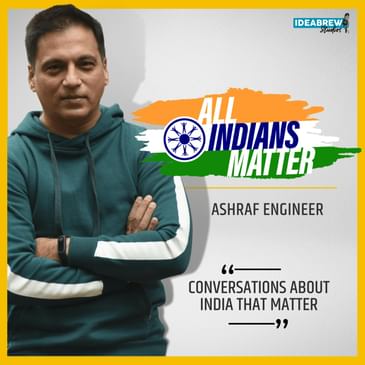


You may not know it but Muslim poets writing in Urdu about Hindu epics have had a great impact on popular culture. There exists a vast body of shayari on Lord Ram, the Mahabarata was brought alive on the screen through the writing of Dr Rahi Masoom Raza, there are Ram Leelas performed in Urdu and even qawwali often refers to Hindu deities and epics. This is just one embodiment of India’s syncretic culture, a vast confluence of faith and traditions. This episode was more personal and emotional than usual, a somewhat late reaction to the inauguration of the Ram temple in Ayodhya. Do listen and share the latest episode of All Indians Matter.
Main Samay Hoon: https://www.youtube.com/watch?v=7A-9Rwt8iMI_
Krishna Aayega, from Yugandhar: https://www.youtube.com/watch?v=7hc2OiCGUhw
Mukhtiyar Ali’s Man Kunto Maula: https://www.youtube.com/watch?v=vP9Zmx5diVY
Learn more about your ad choices. Visit megaphone.fm/adchoices
[00:00:00] Hello and welcome to All Indians Matter, I am Ashraf Engineer.
[00:00:16] Did you know that the screenplay and dialogues of the iconic television series Mahabharata
[00:00:20] were written by Muslim Dr. Rahim Asum Raza?
[00:00:23] The story goes that when B.R. Chopra who made the series approached him, Raza declined because
[00:00:28] of time constraints. Chopra, however, announced Raza's name as the writer anyway. That sparked
[00:00:33] a reaction from the so-called protectors of Hinduism who asked why a Hindu was not asked
[00:00:38] to write the series. Chopra passed on these objections to Raza who then immediately agreed
[00:00:43] to write this screenplay and dialogue. Raza exclaimed, and I quote, I am a son of the
[00:00:48] Ganga, who knows the civilization and culture of India better than I do.
[00:00:53] Later Raza said and I quote, I am hurt and amazed at the few words created about a Muslim writing
[00:00:58] the script. Am I not an Indian? Stop quote. Raza incidentally identified himself as a Ganga
[00:01:05] Putra or a Ganga Kinaryevala. This incident comes to mind because I am trying hard to focus on
[00:01:11] the intermingling of faiths and cultures in India, express through art and culture at a time when
[00:01:15] it is being tested severely. I guess it's a somewhat late reaction to the inauguration of the
[00:01:20] Ram temple in Ayodhya on what used to be the site of the Babri Masjid. I didn't quite know
[00:01:25] what to think or how to articulate my sense of hurt. It wasn't a matter of faith because I'm not
[00:01:31] religious but more of worry about how India is evolving, how in such a short time it has transformed
[00:01:36] so dramatically from the country I grew up in. So reminding myself and you that India is a
[00:01:42] confluence of beliefs, values and traditions I want to talk about the expressiveness of old
[00:01:47] poets and writers about Lord Ram, Dharamayana, Krishna and the Mahabharata. And I should say these are
[00:01:54] Muslim poets writing in Urdu. I choose this theme also because Urdu has been the other great target
[00:02:00] of Hindu Toadis who label it as the language of the other. Anyone with a rational mind understands
[00:02:06] that language is an expression of geography not religion. So Muslims in Tamil Nadu speak Tamil
[00:02:11] and Hindus in Punjab speak Punjabi. But returning to the theme Muslim poets writing in Urdu
[00:02:17] about Hindu epics have had a greater impact on popular culture than you might imagine.
[00:02:31] Back to Dr. Rahim Masrum Raza and the Mahabharata TV series, it was he who came up with the idea of
[00:02:36] time as the narrator of the epic. BR Chopra had earlier attempted something similar in his TV
[00:02:41] series Bahadur Shah Zafar for which the Red Fort was the narrator. For the voice of time among those
[00:02:47] considered was Dilip Kumar another Muslim but eventually voice over artist Harish Bomani was chosen.
[00:02:52] It was under Raza's tutelage that Bomani perfected the legendary line,
[00:02:56] May Samayhu or I am Time. It was and remains one of the greatest narrations on Indian television.
[00:03:03] Making time the narrator was a stroke of genius that not only made the tale relatable but also
[00:03:08] allowed the makers to introduce analyses and interpretations. Let's turn to Urdu Shairi now.
[00:03:14] A story is an epic for various reasons among those as timelessness and the fact that can mean
[00:03:19] different things to different people. Its timelessness and appeal across generations and geographies
[00:03:25] also means that the epic will be told and interpreted in various languages. Among the many languages
[00:03:31] the Ramayana friends expression in Isurdu. In fact there exists a vast body of Urdu Shairi and literature
[00:03:37] around the epic. Among the poems is Ram by Dr. Muhammad Ikbal. It's a work of remarkable
[00:03:43] respect and affection addressing the deity as Ramahind. Among the verses is Labraez HaSharabe Hakiqat
[00:03:49] Say Jamahind. Subfalsafi hai Khitay Maghrib Ke Ramahind which translates as The Cup of Hind is
[00:03:56] brimming with the wine of reality all the philosophers of the West are taken in by Ramahind.
[00:04:02] Another poem titled Ram was written by Rahebar John Purie. In it the poet raises Ram for striving
[00:04:08] for peace and truth. Rasmo Rivash a Ram se Arya hai Sharpa Sandh. Raavan ki Nithio ke pujari hai Sharpa
[00:04:15] Sandh. This translates as Those who prefer evil are far removed from the traditions of Ram,
[00:04:21] they are worshippers of what raavan did. A third poem titled Ram this one by Sagar Nizami
[00:04:27] Honours the lessons in love of the deity. Zindagi ki Ruhta, Ruhanyat ki Shamtha,
[00:04:32] Mo Mujas Samrupa mein Insan Keir Fandha. This means he was the soul of life and the light of
[00:04:38] spirituality. He was the knowledge in the form of a man. Let's look at an Urdu poem written by
[00:04:44] Hindu too. Ramayana ka ekseem by Bridge Naraen Chakbas is about Lord Ram saying goodbye to his
[00:04:50] parents as he goes into exile. This poem is important because it is inspired by the Islamic
[00:04:56] and mercy attrition of Awad. Ayodhya is part of the Awad region. Among the verses of the poem is
[00:05:02] Ushka Karam Sharik hai to gum nahi. Damane dashd, damane madar se kam nahi. This means if you are
[00:05:09] blessed by him you will not experience sorrow. The hem of the jungle is no less than a mother's hem.
[00:05:15] The jungle here of course refers to the banwas that Ram is said to have undertaken.
[00:05:19] Let's move now to Ram Lila, the enactment of the Ramayana by performers on a stage. In Faridabad
[00:05:25] there has been a long standing tradition of the show being performed in Urdu. It is said that
[00:05:30] the Urdu script for the Ram Lila was spent in 1976 by Nandal Batra who wrote primarily in that
[00:05:35] language. The background score is often given by Muslims from Madhura for the performances and
[00:05:41] in some instances on the day of the Aarti, no religious song is sung. Instead they sing
[00:05:45] Amalik Therabandeham which is a secular hymn because the organizers want people from every religion
[00:05:52] Here's one verse from the Ram Lila in Faridabad.
[00:06:07] These lines said by the actor who plays Lord Ram and Lakshman, lies injured in battle,
[00:06:11] translate as even knew my brother left home with me, spurned every comfort when I return to
[00:06:17] Abad without you. What shall I say that he died in Lanka without as much as a shroud?
[00:06:23] Let's turn our attention to films now to a story often told by script writer Lira Sistan
[00:06:28] poet Javed Akhtar. In 1993 director N. Chandra was making a film named Yugandhar and he signed
[00:06:34] Akhtar to write the songs. At a sitting to discuss the songs Lakshman Ghar Peralal who had been
[00:06:39] signed to score the music seemed very awkward. When Akhtar asked why they said hesitantly that there
[00:06:44] was a situation in the script where an Aarti and honor of Lord Krishna seemed like a perfect fit.
[00:06:51] They were skeptical that Akhtar and Aithyas but born in a Muslim family could write an Aarti.
[00:06:56] Akhtar asked for the tune and returned the next day with the lyrics. He told Lakshmikanth and Peralal
[00:07:01] that an Aarti always ends in a crescendo which was missing from that tune. However he had written
[00:07:06] for it any asked him to compose it. The entire crescendo comprised names of Lord Krishna.
[00:07:12] Lakshmikanth and Peralal were stunned because they as Hindus did not know as many names of Krishna
[00:07:17] and they said as much. They asked Akhtar how he knew so many and he replied that it was because he
[00:07:23] reads Urdu. Incidentally Yugandhar means someone who will change an era and is one of the names of Krishna.
[00:08:42] In case you are interested, the song is named Krishna Aayga and can be found online and I
[00:08:49] will also hyperlink it in the episode transcript on the podcast website www.allindiansmatter.in
[00:08:56] and put the link in the show notes. Let's balance the euphoria of the Aarti with a lament by
[00:09:01] the great Urdu poet Kaffir Azmi, the late father-in-law of Akhtar and the father of Akhtar Shabana Azmi.
[00:09:08] When the Babri Masjid was demolished in 1992, Kaffir Azmi wrote the poignant and very political poem
[00:09:14] Dusra Banwas. It was an energy for the India that was and could have been through the eyes of Ram
[00:09:20] himself whose temple was sought to be constructed on the side. The verses talk about Ram returning
[00:09:25] from exile only to find Raksidhivangi or dance of madness in his home and blood on the banks of the
[00:09:33] Sarayur River. Ram would have used this, said Azmi as his second management from the city
[00:09:37] and Dusra Banwas. He was an excerpt from the gnazm. Ram Banwas,
[00:09:44] when he came to the house of a lot or a jungle that came in the river.
[00:09:48] Raksidhivangi, the one who saw in the Angan, thought that Ram would be in the sixth December
[00:09:54] and how did he come to my house? This translates as when Ram returned from exile and
[00:10:00] entered his home. He longed for the jungle upon seeing the city as he would have viewed the dance
[00:10:05] of madness in his courtyard on December 6th. Lord Ram would have thought how did so many madmen
[00:10:11] get into my home? As I said this is a lament but I want to end with something more uplifting.
[00:10:18] I am deeply passionate about Kavali, a musical format invented by Amir Khusro or devotee of Nizamuddin
[00:10:23] Alia, whose dharga is a sanctuary for people of all faiths in Delhi even today. Mankunthomala,
[00:10:30] which is thought by many to be the first Kavali composed by Khusro is often preceded by a Kalduram.
[00:10:35] Although Khusro did not compose that Kalduram it is not surprising that it happens because Kavali is
[00:10:41] at its core a Kaldur to the divine and is the embodiment of India's syncretic soul. Take one of the Kavali's
[00:10:47] many versions this one sung by Mukhtiar Ali he starts like this.
[00:10:59] This means in voice lies the power of God, Ram resides in every musical note when the singer sings
[00:11:06] a melody the ailing fine relief.
[00:11:47] I am in every musical note when the singer sings a melody the ailing fine relief.
[00:12:17] Ram,
[00:12:20] in every musical note when the singer sings a melody the ailing fine relief.
[00:12:47] Suri,
[00:12:51] Innsan,
[00:12:55] Suri,
[00:12:59] Innsan,
[00:13:03] Surbha,
[00:13:07] Suri,
[00:13:11] Innsan,
[00:13:15] Suri,
[00:13:19] Suri,
[00:13:23] Suri,
[00:13:27] Suri,
[00:13:29] Suri,
[00:13:31] Suri,
[00:13:33] Suri,
[00:13:35] Kavali,
[00:14:05] Suri,
[00:14:09] Suri,
[00:14:13] Suri,
[00:14:17] This particular version is interspersed with calls of Hari Om too.
[00:14:21] This is a Kavali sung in honor of Imam Ali considered by many to be the spiritual successor of Prophet Muhammad.
[00:14:27] The words Mankun Tomola is part of a Hadith or statement of the Prophet
[00:14:31] that said to have been uttered when he returned from his last pilgrimage in 632 AD
[00:14:35] just a few months before he passed away. It means whoever accepts me as their spiritual guide Ali is his spiritual guide as well.
[00:14:43] The Kavali can be interpreted as being in the state of union with love for the divine
[00:14:47] and when sung well often induces a state of ecstasy or spiritual rapture.
[00:14:53] If you are interested in listening to it, I have hyperlinked it in the transcript of this episode on the podcast website
[00:14:57] and put the link in the show notes. As I said Kavali is not about Islam alone
[00:15:01] and so it's no surprise that Lord Ram often finds mention in it.
[00:15:05] In the days to come, I will do more episodes on other religions and their role in India's synchritic soul.
[00:15:11] In the meantime, I hope this episode doesn't come across as a rambul but instead what is meant to be.
[00:15:17] A tribute to what India is at its core and should be on the outside too.
[00:15:21] I hope it under scores how India embodies synchritism and that it is a convergence of faiths and cultures
[00:15:29] and art and poetry and everything that is beautiful in this world.
[00:15:33] And I hope that this episode exudes hope because without it, where would India be especially in times like these?
[00:15:41] Thank you all for listening. Please visit all Indians matter.in. That's A. W. L.
[00:15:49] A. N. S. M. A. W. T. E. R. . I. N. For more columns and audio podcasts, you can follow me on Twitter.
[00:15:55] At astraFengineer, that's A. S. H. R. A. F. E. N. G. I. N. W. R. And all Indians count. That's A. W. L. I. N. D. I. A. N. S. C. O. U. N. T.
[00:16:03] Search for the All Indians Matter page on Facebook. On Instagram, the handle is All Indians Matter.
[00:16:08] Email me at editor at all Indians matter.in. Catch you again soon.