
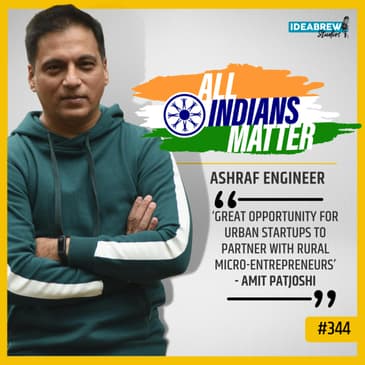


Micro-entrepreneurship can be one of the solutions to poverty and a means of sustainable income generation in developing countries like India.
Central and state governments have launched several programmes to aid micro-entrepreneurship but has enough been done and what more is needed to raise income and employment levels, especially in rural India?
Amit Patjoshi, CEO of Palladium India, which runs micro-entrepreneurship programmes, speaks to All Indians Matter.
Learn more about your ad choices. Visit megaphone.fm/adchoices
[00:00:00] Hello and welcome to All Indians Matter, I am Ashraf Engenia.
[00:00:03] Micro-entrepreneurship has been recognized as one of the leading solutions of poverty
[00:00:08] and as a means of sustainable income generation in developing countries like India.
[00:00:12] It has several benefits from reducing the burden of job creation on government
[00:00:16] to self-sufficiency and optimal resource use.
[00:00:19] In India there is a wide variety of micro-entrepreneurs in fields as diverse
[00:00:23] as agriculture to services. Central and state governments have over the years
[00:00:28] launched several programs to aid micro-entrepreneurship but has enough been done
[00:00:32] and what more is needed to raise income and employment levels especially in rural India.
[00:00:45] We are on the show Amit Badjoshi CEO of Palladium India.
[00:00:49] Amit has more than two decades of experience in government advisory, collaborating with prestigious
[00:00:53] entities such as the foreign commonwealth and development office, international finance
[00:00:57] corporation, United Nations Development Program, the world bank, the Asian Development Bank, USAID
[00:01:02] and several state governments. At Palladium India Amit drives the design, development and
[00:01:07] implementation of the projects. The focus is on agriculture, economic growth, climate,
[00:01:12] health and disaster risk management. Among these programs is Swakalpa which fosters the
[00:01:17] micro-entrepreneur ecosystem in Odisha. The objective is to empower individuals and uplift
[00:01:22] communities creating a more inclusive economic landscape. Welcome Amit.
[00:01:28] What is the official definition of a micro-entrepreneur?
[00:01:35] As per the recent update from Ministry of MSME which is micro-small, medium enterprises
[00:01:41] coming to Finland, micro-entrepreneurs is anyone who is running an enterprise
[00:01:46] or business that has a turnover of 2-5 crore or have an investment of 1 crore.
[00:01:51] That is the official definition of micro-entreprise. However within micro-entreprise there
[00:01:56] are a segment of nano-entreprise which is not officially defined what is the size of a nano-entreprise
[00:02:02] but somebody who is having a 25,000 to 50,000 kind of a turnover is what has been
[00:02:09] broadly as an understanding by the industries called a nano-entreprise.
[00:02:15] And Amit, why are micro-entrepreneurs crucial to the Indian economy especially in the rural
[00:02:20] context? MSME as a sector as a whole is contributing 30% to the GDP of the government
[00:02:30] contributing to 45% of the terms of value in terms of export.
[00:02:35] Now when we structure this economy, micro-entrepreneurs from 97% of those MSME registered in Udhya
[00:02:42] Madhara. Udhya Madhara is a portal of government of India MSME department which registers all
[00:02:48] MSMEs and out of that 97% micro-entreprise or nano-entreprises sorry nano-entreprises roughly
[00:02:55] around 50% of it. So that is one. Second this segment of micro-entreprise being that 90% registered
[00:03:04] contribute significantly to the rural economy out of which near about 50%, near about 20%
[00:03:11] are covering women 65% from the backward sections and that's where it's very,
[00:03:17] very important segment which actually is the footprint or that the root of
[00:03:21] the overall structured MSME ecosystem and hence it is very important for rural business.
[00:03:28] Yeah Amit, I think most people actually don't understand that and especially in the context
[00:03:32] of job creation which has been a serious worry in India and the COVID-19 pandemic only added
[00:03:38] to that problem decisions like demonetization also negatively affected employment in the
[00:03:42] rural economy. Now I understand that any solution to all of this will be multi-pronged but what role
[00:03:48] can micro-entrepreneurship play in this scenario? In fact COVID is a black swan event everybody
[00:03:55] every other aspect of the economy has been impacted to it however when it comes to rural
[00:04:01] economy it has not just impacted livelihoods but also impacted the supply chain constraints
[00:04:06] also impacted how the business would operate in the rural environment. In fact the opportunity
[00:04:11] for rural citizens has also constrained because of COVID. Now what exactly micro-entreprise does
[00:04:16] it not only helps individual to which greatly impacts an urban and rural world but also employs
[00:04:22] more than what it provides. For example one of five employees would positively affect in fact 25
[00:04:30] employees life when it comes to a micro-entreprise ecosystem thus building such an ecosystem with
[00:04:35] not just their livelihoods generators but also it would help in moving up the value
[00:04:40] chain of upstream and downstream chains and that's where micro-entreprise would help in creating
[00:04:46] jobs for the overall ecosystem around it. Absolutely now in rural areas Amit what are
[00:04:56] the greatest challenges to micro-entrepreneurship and how can these be addressed?
[00:05:00] One access to information definitely is one biggest problem for micro-entrepreneurship especially
[00:05:06] rural areas however as the internet penetration is growing that is slowly and steadily diminishing
[00:05:12] but the biggest challenge which comes is access to finance and primarily because lack of
[00:05:19] credit history of those micro-entrepreneurs and thanks to various schemes of government
[00:05:25] whether it is Jam, the Jam Trinity which is Chandan, Adhar and mobile penetration that
[00:05:31] credit history is being made but still access to finance is one challenge and I'm glad there are
[00:05:36] various products which are deployed by government as well as privateers trying to address this
[00:05:41] access to finance problem. Similarly there are of course new regime of GST and other
[00:05:48] complaints coming in so awareness of what exactly GST talks about how exactly I can
[00:05:54] benefit it or how exactly I would ensure that the complaints is maintained that definitely
[00:05:58] becomes a challenge and this is not that there is a study but during our program in Sokallpur
[00:06:04] we could gauge from the rural business hey we definitely want to do business but how would I
[00:06:09] manage the GST compliances so these challenges are there. Third while the dreams of rural
[00:06:14] business are localized but then definitely there is a scale of challenge how exactly they can scale
[00:06:19] up how exactly they can go beyond the boundaries of their own village or own area of geography
[00:06:25] that's exactly is a problem and scale up is not just a factor of they going beyond boundaries
[00:06:31] but also whether there is effective supply chain support for them or not so that definitely
[00:06:35] is there. And lastly most of the government programs are supporting this
[00:06:42] rural enterprise and so on so but one biggest challenge is that is there enough
[00:06:46] hand-holding and mentoring for them to support such kind of the road which they are planning to take
[00:06:53] so these are couple of challenges of the cough I can definitely think of which is for the
[00:06:59] rural business in a much more significant problem. And Amit in which fields are we
[00:07:05] seeing micro entrepreneurship success and which fields do you think have great potential
[00:07:10] but have not yet been fully tapped? In fact COVID while it is a black swan event it also
[00:07:16] has I would say from a positive standpoint it has opened immense possibilities for rural business
[00:07:22] or business at large and one thing every other rural business or for that matter semi urban
[00:07:28] urban businesses realize that the sector which makes them sustainable is which is
[00:07:33] indigenously available which is around their value chain so for example whether it is handicraft
[00:07:41] whether it is going for local products or whether it is their own ways of beauty saloons, hand blooms,
[00:07:49] trailering restaurants which are within their indigenous capability within their value chain
[00:07:53] that is thriving very hand. In fact in our Sokalpur program which you mentioned
[00:07:59] Astraf most of our entrepreneurs are moving around their own value chain supporting the
[00:08:04] value chain supporting the forward linkages in the value chain and so on so forth so
[00:08:09] that is very much coming in. The second segment which is coming in very strongly is enablement of
[00:08:16] tech making it more the business most sustainable using tech whether it is a drone based solution
[00:08:21] or whether it is some sustainable packaging which is improved or for that matter organic
[00:08:26] solution to the same food value chain so these are some of the areas which are
[00:08:31] coming up very prominently. Amit when we talk about inclusion especially in the gender
[00:08:37] context it is very important of course for women's development which has links to gender rights and
[00:08:42] overall social development and so on and so forth but specifically coming to women micro
[00:08:46] entrepreneurs how do you see their role and how can they be helped in particular?
[00:08:52] Because there is a study done which highlights that urban entrepreneurs are inherently better
[00:08:58] managers of finance and time and these are the two most important aspect of any business
[00:09:03] leave aside rural business or macro entrepreneurial business and I'm sure with this COVID it has
[00:09:10] opened up multiple opportunities for our women entrepreneurs to be a support system to make
[00:09:16] their overall household sustainable and I see they play a strong enabling role to ensure that
[00:09:24] there is an enabled ecosystem and there are various government schemes focused on that so
[00:09:30] they are one of the prime mover in the overall ecosystem and I'm sure it is going to play a major
[00:09:35] role in transforming the ecosystem. But where do you think they need the greatest help? Is it
[00:09:41] marketing, is it distribution? Look as in while you run a business it's not a challenge of just
[00:09:46] marketing or access to finance or for that market distribution as in I recall in one of
[00:09:53] the meetings with MSME secretary of India I was discussing and proposing a solution
[00:09:59] he simply said that look what exactly is MSME, leave aside micro or medium they are like mushrooms
[00:10:06] you don't try to curate them we just water them they have to grow on their own.
[00:10:10] So what exactly is the curation? Is the mentoring and handholding part?
[00:10:14] Yes there would be challenges in marketing, distribution, finding the demand and so on so
[00:10:19] far as the overall ecosystem we have to be an enabler rather than trying to give them a
[00:10:25] direction to certain things as a microenter minute they have to run on their own we have to just
[00:10:29] provide enough handholding and support so that they understand the complicity of this environment
[00:10:34] and gel-alive back. Amit I want to just kind of return to the point of finance and you know
[00:10:43] you said that's one of the major challenges now do you think there's enough credit
[00:10:46] available to micro entrepreneurs especially in rural areas and you already answered that you
[00:10:51] said that's all that's a challenge what should be done to solve this problem you think it's a
[00:10:56] question of banks not being with you know willing or maybe NBFCs to step in what should
[00:11:02] be the what is the answer to this issue? Look absolutely as in without saying goes that the
[00:11:09] MSME credit gap is upward to 25 million to a trillion for that matter and this is one thing
[00:11:16] which is the need of the R not just government but also private sectors need to check in to address this
[00:11:24] in fact highlighting one of the government program which is OCEEN open credit enabler
[00:11:31] and credit network which is a platform wherein multiple financial institutions come in across
[00:11:36] so that there is a bookie of service can be given to the MSME or to the industry for that
[00:11:40] matter similar there are private sectors and I can name one which we had a discussion couple of
[00:11:46] days back is Gurdwidge Capital who have designed a forum wherein small micro entrepreneurs can
[00:11:53] take in or lend money from those required channel partners as they're applicable so the
[00:11:58] ecosystem is revolving or rather I would say transforming from the traditional micro finance
[00:12:05] or lender based to micro finance to such multiple options to the rural business yes we need these
[00:12:11] such solutions to come to the rural business and also educate our entrepreneurs how exactly
[00:12:16] could utilize them into that best ability now I mean there have been several programs launched
[00:12:21] to help micro entrepreneurs you also mentioned that these include the prime minister employment
[00:12:26] generation program scheme that promotes rural industry and entrepreneurship there's
[00:12:30] furtiy of the scheme of fund for regeneration of traditional industries the koyal Udyamiyojna
[00:12:36] and the credit guarantee fund scheme now have they worked if yes what impact are you seeing on the
[00:12:41] ground if and if no what changes would you like to see I must candidly admit that
[00:12:49] over past several years with the effort of government and the overall ecosystem part
[00:12:53] in the private the appetite of entrepreneurship has distinctly improved
[00:12:58] and it is because of such programs with all the ones which you name they're definitely working for
[00:13:04] PMG a EGP on an average they see 2000 applications per day it means that 2000 entrepreneurs are
[00:13:11] trying to attempt to take access to finance or the services to thrive their business make
[00:13:16] the successful successful similarly Spruti in a calendar last calendar year they had
[00:13:22] disbursed roughly around 40 crore across 15 clusters 8000 odd artisans was helped on that
[00:13:28] so deaf significantly they are working in fact there is a recent announcement of government
[00:13:33] of India regarding PMB ishwakarma scheme which is supporting the local artisans giving them
[00:13:37] impetus with with with the budget and in this recent budget interim budget the budget was
[00:13:43] increased by four times so definitely there is a demand for such kind of schemes and
[00:13:48] government is responding very well which is enabling a stronger appetite for entrepreneurship
[00:13:53] in this segment having said that one thing which needs to ingrained across all this cream or maybe
[00:14:01] supported by external stakeholders like private sector or foundations or or or media
[00:14:07] intermediary organization is attaching a mentorship and handling part of it so that whatever funding
[00:14:12] support entrepreneurs are getting that can be utilized in effective manner by themselves
[00:14:17] creating a sustainable ecosystem around it you keep returning to the theme of mentoring and
[00:14:23] hand-holding and you know one part is what the government can do but is there a way for startups
[00:14:29] headquartered in urban areas to work with micro entrepreneurs in rural areas for a mutually
[00:14:35] beneficial partnership and this would of course include mentoring in hand-holding absolutely in
[00:14:40] fact it's a it's a very conducive ecosystem which being built right now start-off are coming up with
[00:14:48] innovative solutions to the problem statement we have and the micro entrepreneurs are able to
[00:14:54] feed them for example I can give one example in our own program as in we had one small
[00:15:01] micro entrepreneur I would say nano entrepreneur doing a television business we connected to
[00:15:05] to a startup which is innovating in a hand-loom business he in turn connected to a local
[00:15:12] manufacturer which is a leading manufacturer then value chain connectivity has helped not just my
[00:15:17] nano entrepreneur to the startup which is innovating as well as to the larger manufacturer
[00:15:22] and such kind of examples are many for example all our all our entrepreneurs who are running a
[00:15:29] kirana shop in our so called program are connected to the hul sikhar app which provides
[00:15:36] them a platform for effective grocery ecosystem and so on so forth so definitely this is this
[00:15:43] is going to change if both the startup as well as our micro or nano entrepreneurs are
[00:15:48] gelled well together and one of one of the outcome of it is technology adoption
[00:15:54] when startups are looking for overcoming challenges with effective technology
[00:15:58] the biggest beneficiary would be my nano entrepreneurs who are gelled with that so I'm
[00:16:03] sure investment in a good micro entrepreneurs can micro enterprise by the startup can provide them
[00:16:09] good returns as well as serve them various options of alternate financing and all other so
[00:16:16] this is a win-win game for both on ecosystem place what about technology how can it be used
[00:16:21] to help micro entrepreneurs now we've already seen UPI being a great enabler because then
[00:16:28] UPI is a game changer as an I think yesterday Sri Lanka and as the another country comment
[00:16:35] of India has announced the UPI's adaptability of UPI ecosystem is approved there it is a game
[00:16:43] changer one other day is very many are thinking that whether a vegetable seller can
[00:16:49] would receive only cash or can actually receive money in UPI it is a game changer for all
[00:16:54] the nano enterprise to go ahead with the hassles of cash management or go ahead with the hassles of
[00:16:59] actual ensuring ensuring how exactly we can transform to digital payments so that the
[00:17:05] customer acquisition can be more so UPI definitely is the one there are a paging in
[00:17:10] the bar of pay phone pay coming all into the picture who are now innovating not just providing
[00:17:16] UPI as a platform to receivers and money but also monitoring the credit history of the
[00:17:21] entrepreneur and providing loan based on that without any collateral so yes that is a transformation
[00:17:27] that they are checking the credit history the transaction history of the entrepreneur and saying
[00:17:31] hey this particular entrepreneur is having 100 transactions each let's say 100 rupees so it's
[00:17:35] worth of this kind of credit I can give aside collateral so this is this the access to credit
[00:17:41] is also getting transformed with this technology and fusion secondly as I said ONDC OECNR
[00:17:48] platforms prepared by government back platforms which provides a network platform ONDC is kind of a
[00:17:54] I would say aggregator of amazon center flipkat realize that my small micro entrepreneur coming
[00:18:01] into a meso environment or on a flipkat and again in ONDC it catapult the reach of suppliers
[00:18:08] and reach of customers so definitely that technology is helping as I already highlighted
[00:18:15] about OECN it is create it is enabling a credit network wherein it is up to the
[00:18:19] derivative of the micro entrepreneur to choose from whom they want to lend so this platforms
[00:18:26] are creating fantastic opportunity for my entrepreneurs to whether it is access to
[00:18:32] credit and all others and in fact I can highlight one example of our socalco program
[00:18:39] we had trained certain traditional artisans in handloom now they are embedding our technology
[00:18:46] within their handloom sarees so that the traceability of that saree is how it is made is
[00:18:51] it authentic or not can be captured kochia is one startup and that is where you asked a previous
[00:18:57] question how startup can link the technology adoption with my micro entrepreneur is changing
[00:19:01] the landscape the same artisan which was receiving x amount of money is now getting x plus
[00:19:08] for the same product just by adding a technology which helps to traceability which helps in ensuring
[00:19:13] that authenticity of the product so these are the technology enable which is changing the landscape
[00:19:18] of the overall ecosystem here absolutely and just for listeners the other country other than
[00:19:24] Sri Lanka that Amit was referring to is Mauritius which recently has started accepting UPI and
[00:19:30] France a few months ago was the first country to do so and the ONDC is the open network
[00:19:35] for digital commerce it's a private non-profit section 8 company which was set up by the department
[00:19:40] for promotion of industry and internal trade to develop open e-commerce as the name suggests so
[00:19:46] that that's what Amit was referring to Amit tell us about socalp and the impact you have
[00:19:51] witnessed in Mauritius when we got this program we were little I would not we were excited as
[00:19:58] well as skeptical how would you achieve the target the target given by socalp was to train
[00:20:03] 10,000 youth make entrepreneurs out of 1000 10000 entrepreneurs so we thought of can we make a
[00:20:10] machine wherein we would train 10000 automatically 1000 coming I believe we have not built a machine
[00:20:15] but actually the process is there we know the processes how exactly what are the requirements
[00:20:20] of a micro business in what way we can hand hold them so that we can achieve those objective
[00:20:27] socalp program is one of the flagship program of ORISA scale development authority
[00:20:31] along with world skill center which is undertaking of the metaphor as the program is supported by ADP
[00:20:38] wherein we are targeting the beneficiaries from the age of 15 to 45 providing a 100 hour training
[00:20:46] and then providing a six month of personalized mentorship when I was highlighting what is the
[00:20:52] need of mentorship while the training is not about any domain specific but about business
[00:20:56] skills and then asking them to test to the market so that in the next six months we would curate them
[00:21:03] in various cohorts and check okay test the market again come back curate their marketing and branding
[00:21:09] strategies again they would go to the market so this is a continuous to and fro from a market
[00:21:14] perspective and guiding in that six month of journey not just not just in terms of access
[00:21:19] to finance but in terms of how exactly we can provide effective branding aspect and so on.
[00:21:28] So far it's almost one and half not one and half year or one year two months after the program we
[00:21:34] have achieved almost 8000 candidates enrolled against a 10,000 target we have registered roughly
[00:21:43] around 3,000 entrepreneurs enterprise under Vidya Mada it means that business has already
[00:21:48] started we are yet to achieve the 700 coincidentally the target given to us was to achieve 25% of
[00:21:56] human penetration we are running at 80% of human penetration in the program so it's completely
[00:22:01] opposite what we in this one that was the second part whether we'll be able to do that so
[00:22:06] it has completely changed and most of the business as are in that indigenous value chain
[00:22:13] paper plate making, garment, groceries, cosmetics or acrylic work,
[00:22:17] patachitra painting because they belong to Morissa that's their traditional
[00:22:23] way of working also we are trying to start some interesting cohorts on drone entrepreneurs,
[00:22:29] interesting cohorts on home entrepreneurs, interesting cohorts on sub-igrass entrepreneurs
[00:22:34] so there are some niche cohorts being prepared and there are some traditional indigenous cohorts
[00:22:39] and it's a fantastic journey so far in the sub-colonial program and I'm glad to highlight that
[00:22:46] India Social Impact Award has nominated this program as the best entrepreneurship program of
[00:22:51] the year on 23rd of this month those processes through then the government would get an award from them.
[00:22:59] Congratulations Amit also congratulations on you know the footprint across women
[00:23:05] entrepreneurs because I think that's important and it also speaks volumes about their own drive and
[00:23:12] proactiveness and you know just the motivations that they have to uplift themselves quite amazing to
[00:23:16] watch Amit tell us about Pallavi Amit the work it does. We are a global impact firm
[00:23:24] it's been almost 60 years of operations across the globe we have offices across
[00:23:32] 90 countries with a with a prime objective of driving convergence of social and commercial
[00:23:38] progress which we call positive impact so I would say we are a global impact firm working in the
[00:23:45] conference of social and commercial progress to achieve positive impact. In India it's almost
[00:23:51] close to 20 years wherein without diverse global expertise and local experience we are executing
[00:23:57] successfully programs in health agriculture economy growth urban governance disaster management
[00:24:03] and we proudly can say that our approach in India at least is completely different with the approach of
[00:24:10] impact oriented approach of outcome oriented and of large implementation project so far in
[00:24:17] India we have almost completed and also ongoing projects included around 40 odd impact
[00:24:24] oriented programs and we're championing some of the key solutions like
[00:24:30] IPO strengthening like the Sokalpa program like city transformation unit or like doing some
[00:24:37] fantastic in saving lives in road safety program and there are many such examples around it.
[00:24:42] So Amit here's a question I asked all my guests at the end of the show why do you do this work?
[00:24:47] In fact I would be little personal it's been 22 decades of my experience almost with all the big
[00:24:56] four and I got this opportunity to lead for the four years back and I asked the same question
[00:25:01] to myself why I need to do this jump and one thing intrigued me about the approach of this
[00:25:08] firm and I'm so proud to be attached to it is that the vision of the firm
[00:25:13] to be the most impactful business in the planet if I can make an impact probably this is the
[00:25:19] firm to look for so happy that we are making a small attempt on our own to achieve that positive
[00:25:27] impact and achieve to the overall vision of the leading globally is to be the impactful business
[00:25:33] in the planet. Amit thanks so much for being on the show thank you thank you very much Astrup
[00:25:38] and look look forward to be connected and to all the viewers please look at our work
[00:25:45] anywhere you want us to contribute we're happy to contribute in any form we can.
[00:25:51] Thank you all for listening please visit allindiansmatter.in that's a double l
[00:25:55] i n d i a n s m a w t e r dot i n for more columns and audio podcasts you can follow me on
[00:26:01] twitter at astraf engineer that's a s h r a f e n g i n w r and all indians count that's a
[00:26:06] double l i n d i a n s c o u n t search for the all indians matter page on facebook on instagram
[00:26:13] the handle is allindiansmatter email me at editor at allindiansmatter.in catch you again soon