
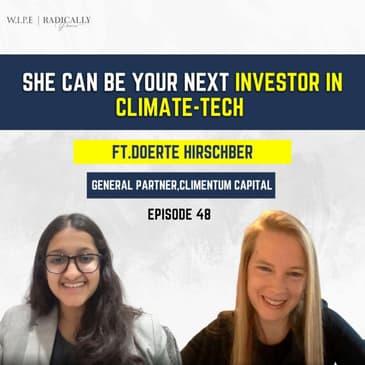
“𝑰 𝒘𝒂𝒔 𝒊𝒏 𝒂𝒏 𝒊𝒏𝒕𝒆𝒓𝒗𝒊𝒆𝒘 𝒓𝒐𝒖𝒏𝒅 𝒇𝒐𝒓 𝒂 𝒇𝒖𝒏𝒅, 𝒂𝒏𝒅 𝒕𝒉𝒆𝒚 𝒕𝒐𝒍𝒅 𝒎𝒆 𝒂𝒕 𝒕𝒉𝒆 𝒆𝒏𝒅 𝒐𝒇 𝒕𝒉𝒆 𝒊𝒏𝒕𝒆𝒓𝒗𝒊𝒆𝒘, 𝒕𝒉𝒂𝒕 𝒕𝒉𝒆𝒚 𝒅𝒊𝒅 𝒏𝒐𝒕 𝒃𝒆𝒍𝒊𝒆𝒗𝒆 𝒕𝒉𝒂𝒕 𝑰, 𝒃𝒆𝒊𝒏𝒈 𝒂 𝒎𝒐𝒕𝒉𝒆𝒓 𝒘𝒊𝒕𝒉 𝒕𝒘𝒐 𝒔𝒎𝒂𝒍𝒍 𝒌𝒊𝒅𝒔 𝒄𝒐𝒖𝒍𝒅 𝒎𝒂𝒏𝒂𝒈𝒆 𝒕𝒉𝒆 𝒘𝒐𝒓𝒌”.
Her experience underscores the urgent need to address the outdated mindsets that hold women back, especially in male-dominated fields.
Meet, Doerte Hirschberg, an investor and advisor for climate tech companies at Climentum Capital, encouraging innovation and advancements toward sustainability and climate change mitigation.
In the conversation, Doerte shared her journey in the field of investing, her experiences, along with many other interesting insights
She started her career as a consultant at McKinsey, and later led the global HR team as well as the incubation program at ‘Rocket Internet’ and started her journey in investing.
“𝑾𝒉𝒆𝒏 𝑰 𝒔𝒕𝒂𝒓𝒕𝒆𝒅 𝒘𝒐𝒓𝒌𝒊𝒏𝒈, 𝑰 𝒓𝒆𝒂𝒍𝒊𝒛𝒆𝒅 𝒕𝒉𝒂𝒕 𝒏𝒐𝒕 𝒋𝒖𝒔𝒕 𝒕𝒉𝒆 𝒐𝒑𝒆𝒓𝒂𝒕𝒊𝒐𝒏𝒂𝒍 𝒃𝒖𝒕 𝒕𝒉𝒆 𝒇𝒊𝒏𝒂𝒏𝒄𝒊𝒂𝒍 𝒔𝒊𝒅𝒆 𝒐𝒇 𝒕𝒉𝒆 𝒃𝒖𝒔𝒊𝒏𝒆𝒔𝒔 𝒊𝒔 𝒂𝒍𝒔𝒐 𝒗𝒆𝒓𝒚 𝒎𝒂𝒍𝒆 𝒅𝒐𝒎𝒊𝒏𝒂𝒏𝒕”.
She started her climate impact-based fund called Climentum Capital, which has a team of 2 female and 3 male members.
In the conversation, she shared the challenges she faced while navigating the investment world as a woman. From juggling travel, meetings, and managing workload, to maintaining crucial networking channels, while shouldering the invisible burden of family and childcare.
It's a marathon with endless hurdles, further magnified by the stark underrepresentation of women in a historically male-dominated field.
Despite increasing efforts, the number of women founders and investors remains low in the startup and investing scene, alongside the capital they secure. While sectoral choices play a role, underlying factors like unconscious bias and limited access to networks likely contribute more significantly.
Through her conversation, she shared her journey navigating the climate tech funding landscape. Her fund invests in impactful startups across various sectors, including food tech, energy, and mobility, each playing a crucial role in her mission to mitigate climate change.
The fund plays a pivotal role in amplifying the voices of climate warriors like Continuum, who are revolutionizing wind turbine recycling. With their support, One. Five is another startup developing sustainable paper-based solutions to replace plastic packaging. These are just a few examples of how the fund empowers startups across sectors to make a measurable difference in curbing climate change.
Investing is a field with less female representation, but women like Doerte are paving a path toward gender inclusion and are role models for other women to look up to.
Watch the full video-
https://lnkd.in/dgj9Ahs6
[00:00:00] Thanks a lot for being on our show and very excited to learn about how you have started
[00:00:11] a fund of your own being a woman. And since we know that the world is not so receptive
[00:00:17] to women in private equity and venture capital, and that's not me saying that's the number
[00:00:22] stating it. We see very few representation of women at the leadership level in, you know, Right. So starting with how your journey has been, if you could just give us some instances of how did you start your career right after education and till date, how do you manage your work? Yeah, so I studied in Munich business and right after that I went to McKinsey, which was at that
[00:01:40] point in time also a very male place, but build a big and high value company. And it's a lot about networking and this combination of course data and you, but for those who are just starting about, you know, raising funds for them, any advice that you'd like
[00:04:22] to give?
[00:04:24] Yeah. while you were wanting to join other funds? Yes, I think the most extreme for me was that I was, with one fund, I was really in an interview round, and at the end they told me, we do not believe that you as a young mother with two small kids can do this job. And I was like, what?
[00:05:41] I mean, this is not just me, hey, I don't get enough coaching support. I don't have any role models and I don't know how this should work if I
[00:07:03] ever get kids. And that's very, very sad flexible and people know that you sometimes you work then and sometimes you maybe work late in the evening when the kids are in bed. And it's just it's just a total whole different thinking and here i know of many fans who say hey we start our weekly i see meetings at four pm because then we have the whole evening to sit together and do the stuff and of course.
[00:09:27] the whole system and that is not so easy for many. Yeah. Yeah, but how do you think can we bring about this change? Like you said, even men should take up the onus of doing the same responsibilities
[00:09:35] as a woman does for their child. So that's not the case though. So how can we bring about this
[00:09:41] kind of a change where there's an equal to ten hours that are not productive and that you could cut away relatively easily. And the question is much more that when you have kids that you know relatively well which are these hours that you
[00:11:03] maybe don't need and just feel you should do the call or whatsoever. often you travel to London, that's bullshit. You need to find your own ways and maybe you find the best female founders from London in remote sessions because they also love it that they can meet their investors remote. So I think that's what you need to change. Right, yeah, that's so wonderfully put across.
[00:12:23] And I think just thinking about a big revolutionary change So corporate Germany is better by now. Also on the political side, most parties, not all, have you again are in a very male pond. But my hope is that more women also in these backgrounds and education
[00:15:01] join this climate tech movement and build their own companies.
[00:15:05] And on the investor side, I think there were positives and negatives, but at that point in time, McKinsey was already trying to support women, so I felt overall well supported and that was all good, I would say. I think at McKinsey, the problem still is there. So especially in Germany, there not able to reach to the top because they lack certain things, maybe family support or lack of opportunities or is it the lack of skill sets? No, I wouldn't say the lack of skill sets. So the education is very well and women are better educated than men. I also don't think it's the family support and all, for everyone. And I know quite some women who at some point and say, OK, then I'll go a bit to the sideline. I still do my job well and all that stuff. But I'm, yeah, and either I start to look for a new job or whatsoever. I think you need to be a bit more sticky.
[00:20:20] And also, I was always very rigorous to myself
[00:20:24] and continue that stuff. So which makes it much harder because you will have some years without good sleep and then it's even harder to say I'll get up and have this call and I do it very well. You can of course ask for some time with your kids and for some compromises and
[00:21:43] certain things everybody will understand but the core things, the most important things in your job I think there are some studies on motivations of people and in general you see that this pure money and the quantitative stuff is something that incentivizes men way more. Also hierarchy and titles and stuff like that, that the male world that we live in is made of we actually were all on a similar mission. We wanted to start an own fund and we wanted to do that in a sustainable and tech-focused area. And this was during COVID and we were spread throughout Europe. So we were introduced through mutual friends and contacts and we actually really
[00:24:22] met on video calls. And I had the first video call with my two Danish colleagues who were a bit the cities that were based and yeah, how it started. Oh, that's so cool. So what is it that you look in a found out before investing in their company? What are some of the key metrics that really catch your attention? So typically, so we do climate tech.
[00:25:41] So we do a lot of technical things,
[00:25:43] hardware or software that has a relatively
[00:25:46] strong technical component. Then the other thing is the team dynamics. So in these kind of settings, you have typically more diverse teams. With diverse, I don't only mean gender, I also mean education background and sometimes age and so on. I really like diverse teams and I think that's
[00:27:00] what's required in many of the climate tech things.
[00:27:03] But it's always harder to work in diverse teams because if
[00:27:05] you know each other for 10 years,
[00:27:07] you went to college together and all that stuff, to do that just with investor interviews and stuff like that. But I think a core thing is to meet the team jointly, ideally in person actually. I a due diligence, typically. Times are back to normal, so deals making takes a bit longer, so you also have time to do reference calls and all that stuff. Yeah, since you've highlighted both the men and women found out, what difference do you all realize when they're pitching? Is there some difference
[00:29:41] which comes as a part of your biological gender difference as well? Cool. or people who don't have this went to this classical business and you also have that with women. Yeah, so yeah, and yeah, that I would say that's probably the biggest difference. Yeah, you got it. And if you could just also explain us about what kind of businesses do you back up?
[00:31:03] What's your check size? And at what stage would you like to come in? blades of wind turbines. So wind turbines have a lifespan of 20 to 25 years and here in the north of Europe you have a lot of them and a lot will come down now. And this is the first recycling technology that exists. And the second investment that I did was in a company called 1.5 and they are developing ago when the company was just founded. And I met the two founders, Martin and Claire, and I found out in the first call that Martin comes from exactly the same village that I come from. Yeah. So, and it's like a 3000 people village in the, and it's, yeah, it's really small and it's really not a place.
[00:33:41] It's not close to Berlin.
[00:34:45] board on the board and in the company. Yeah and do you have any anti-portfolios where you've missed out investing in some of the companies and then later on you realized oh shit I should have
[00:34:51] you know looked at the company more closely and might have made an investment.
[00:34:57] Yeah not with the fund yet. In my angel times, got it. All right. So, and when we speak of the seed rounds, how do you source the deals at such an early stage? Because they're not so widely known in the market and you're still figuring out, unfortunately. I find that very tough, yeah, but we have to decline many very quickly. And I'm very sure that we do some unfair things there, but I can only advise all great female founders to try to use their network and try to look up at LinkedIn who knows this fan,
[00:37:42] who knows someone, and can they intro me and so on. is one way to get there. Yeah. Yeah. But when we speak of network, women usually feel a little bit awkward to socialize, at least when there are men in the room and not many women. And, you know, in the private equity or VC, it's all about your network.
[00:39:00] And it also requires you to sometimes go for a coffee or bring, make it something with three people or so, but I would just do it.
[00:40:20] And of course, make it in a bit older and more settled. And I think that's even more rare. Of course, it also happens that a 50-year-old gets strange, but it's even less so. And I think sometimes they will be more open to have a coffee with you as a woman than
[00:41:45] with men.
[00:41:46] So just try it out and do it. people don't want to trust women with their money. Especially if you look at women founders, they're usually between this sweet spot of 25 to 35, where they are either getting married or raising kids while running their business. So is that what holds investors back from putting the money? Or why is it that we have such lesser opportunities
[00:43:01] available for women founders?
[00:43:04] I think it's all of this, yeah.
[00:43:05] So I think if you look at the numbers,
[00:44:07] I can only hear it from stories and so on. So, no, I can't say that in this dimension.
[00:44:13] So, I mean, I was in committees where we hired people and stuff like that.
[00:44:17] And I think there it was already always very much focused on reducing these biases.
[00:44:25] So, very professional and so on. women are there in it. Yeah so we're currently hiring the full team. We are five partners and two of them women and the rest we are hiring and we're definitely aiming a balanced team. So all great women, we will soon put job posts out but yeah please reach out to us.
[00:45:48] And are y'all okay with women from any geography to join y'all or only specifically Germany based? I will definitely reach out to you. Who knows? Yeah but in terms of hiring, do you believe in this model of merit principle, if a, if someone outperforms in the first year, she should get all the support and the bonuses to quickly grow and
[00:48:22] quickly get promoted and so on. Yeah.
[00:48:25] And of course she can to say no. Yeah, so I think that's the biggest risk if you come To a certain point you spoke three four times with the founder the rest of the team likes the case that you just say Okay, we just go. I think you you should still
[00:49:42] be open to say no if you really realize something is not so good and
[00:50:46] a partner, Stefan, who knows how to measure climate, how to report on it, and how to also use it to get other additional funding. And other funds also do that, but I think we do
[00:50:51] that especially well. We also, we are a diverse team, so we have people who know the VC industry
[00:51:00] very well, who know complex financing structures health tech, biotech, robotics, or even climate tech, we are doing shorter, shorter courses for these women to understand the practical aspects of how funds actually work.
[00:52:20] Because universities, even when we consider Harvard or Oxford,
[00:52:24] they don't teach all of these things.
[00:52:25] They just come and talk about the case studies. hopeful to see more such women leaders in the future who have piped up the norm. If you loved this episode, please share it with your friends who might be fundraising or building a business. Also, tell us if you have any questions that you would like us to ask our women leaders. Till then, stay tuned for our episodes where we speak with global women leaders from countries like Palestine, Argentina, Mexico, America, India and others.