
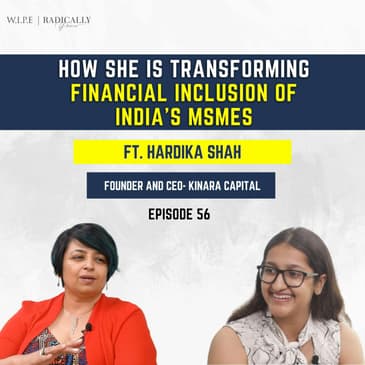
In our latest episode of 'Wiping out the Norm', show host Radhika Bajoria sits down with Hardika Shah, Founder & CEO of Kinara Capital, a trailblazer in MSME fintech driving financial inclusion for small business entrepreneurs in India.
Kinara Capital is ranked among 'Top High-Growth Companies in Asia-Pacific' by The Financial Times and as 'India's Growth Champions' by The Economic Times. They've won the Gold award as 'Bank of the Year-Asia' by the IFC/SME Finance Forum for their impact on SME Financing.
Prior to Kinara Capital, Hardika spent two decades as a management consultant with Accenture, working on billion-dollar projects globally. Her passion for social impact led her to mentorship roles with prestigious institutions like Stanford University and the Acumen Fund.
"I saw the divide happening in India... I wanted to study what and why was that case and what and why was the things not reaching to a certain people." Hardika shares her journey and mission, highlighting her MBA from Columbia Business School & Haas School of Business.
Founded in 2011, Kinara Capital fills the MSME credit gap with collateral-free business loans, using AI/ML for fast decisions. The myKinara App offers a 1-minute eligibility check and 24-hour loan process.
Committed to gender parity, Hardika leads with a women-majority team and drives inclusivity in company culture. The HerVikas program supports women entrepreneurs, while CSR initiatives aid women micro-entrepreneurs.
Kinara Capital has disbursed $300M+ to 40,000+ entrepreneurs, creating 250,000+ jobs and generating $100M+ in income. Based in Bangalore, they serve MSMEs in 100+ cities across India.
Under Hardika’s vision, Kinara Capital is recognized for innovation, ranked among ‘Top 500 High-Growth Companies in Asia-Pacific’ by the Financial Times for three consecutive years (2020, 2021, 2022).
Watch the full episode to dive into Hardika's inspiring journey and Kinara Capital's impactful mission!
Link-https://youtu.be/ZgbvziGaC-A
[00:00:00] Thanks, Sarthika for doing this interview with us. As our series is named as Wiping Out The
[00:00:11] Norm, you've clearly been an example in that not just in your personal journey but also
[00:00:15] while serving the journeys for others by providing financial capital to them and these
[00:00:20] are people who were not discovered as such by big financial institutions like banks and
[00:00:26] even other startups. So in the first place before I ask you about how did the idea of
[00:00:30] Kinara Capital come in, let me ask you as to how did the idea of doing an MBA come
[00:00:34] in after you were studying computer science because that's completely different and it's
[00:00:42] very very different from what you have learnt in finance.
[00:00:46] Yeah indeed very different from computer science altogether and I think my journey to MBA
[00:00:51] wasn't a straight line as it seems at the moment when you look in the rear view mirror
[00:00:56] but I studied computer science, I loved it. I loved building systems, I loved understanding
[00:01:04] the customer requirements, the user requirements, what was not working figuring out how to fix
[00:01:09] that. Building my first job was actually writing code so it was literally like writing code
[00:01:15] that we could see would turn into something and I really did enjoy that and I was a consulting
[00:01:21] role with the client facing role. I did that for many years, I traveled the world and
[00:01:27] one of the things that happened along the way was I had the opportunity to come to Hyderabad
[00:01:32] and at that point I'd been away from India for over 10 years and not visited actually which
[00:01:37] was a critical period between liberalization happening 93 ish and I had come in 2003 and I came
[00:01:45] to Hyderabad and you know my client was a large, very large software company which we all
[00:01:52] use in products and our computers today as well and I was here to set up a delivery center
[00:01:58] that to support that. And as I was doing all of that work two things happened one I recognized
[00:02:06] that I really saw this big divide happening in India this transformation as a country
[00:02:13] that was going on from liberalization and yet there as you as you draw in Hyderabad back then
[00:02:19] which were really just two cities in cyber city there were two buildings in cyber city there was
[00:02:25] this noticeable difference on the streets as to what was not reaching to most people. So I went
[00:02:32] back, part of me wanted to understand what I could do. India as they see you're always a
[00:02:41] busy wherever you are. So how could I contribute and that led me to a variety of different things I
[00:02:47] did in a mentoring and support capacity as programs that were in the Bay Area and that prompted me
[00:02:55] to think about what about my own learning and growth and at that point in my life and career an
[00:03:02] executive MBA was a better fit for me rather than a you know MBA that you would do few years into
[00:03:09] your career. So at that point I'd been here in my career for probably about 12 10 12 15 years
[00:03:16] something like that right and so I went into the into this executive MBA program and the idea was
[00:03:23] to fill the gap computer science is great and one capacity it's you know it's a it's one it's one
[00:03:30] cut but MBA does give you a much more broader perspective and then I had the opportunity to do this
[00:03:38] MBA which was a joint program between UC Berkeley and Columbia Business School so you had East Coast
[00:03:44] to West Coast you know you had New York and and hippie dippy California so you couldn't you couldn't
[00:03:51] pass it up you had to take that and just be able to go out and and and just soak it all in and learn
[00:03:56] as much as you can. So in terms of learning what were your top three learnings from your time at MBA
[00:04:02] because you said that you could learn from the spectives of people from both the East Coast and
[00:04:06] West Coast as well. Yeah yeah. The the well three things you know I think the number one
[00:04:15] thing that I learned is that you need to be able to multitask and and have many different
[00:04:24] areas of understanding in order to actually operate a business whether it's a small business or
[00:04:30] a large business right it you cannot just be a good HR person you cannot be just a good strategist
[00:04:36] you cannot just be a good ops person you have to have enough and more perspectives around all of
[00:04:43] these areas to be able to know what your core strengths are but and therefore where you would need
[00:04:49] to complement but know that each of those skills and each of those areas are key to running any good
[00:04:54] business. The second thing I learned was the importance of relationships relationships matter how
[00:05:00] you develop that in your class along with your other classmates how you develop that with other
[00:05:05] people how you built on that how you kept in touch how you networked that matters and the third
[00:05:12] I would say the most important thing I learned and this was at Edith time back in 2007 where we talk a
[00:05:20] lot about globalization to that you know globalization today of course everything is global everything
[00:05:25] is connected everything is is so same and yet you know not the importance of localization
[00:05:34] that not all things translate you cannot just take something out of place say put it in place be
[00:05:40] and have it work the same way because the local elements the local nuances the local understanding
[00:05:47] is critical for everything like you came to Bangalore today for the first time understanding traffic
[00:05:53] you would say it's just another city we have Uber we have all others and airport you're coming to
[00:05:57] a central location but there is local understanding that is critical to navigating that as well.
[00:06:02] Yeah I know I mean the people here are also so different I get to know about their behaviour
[00:06:09] as well you know how different cities and how different cultures operate so I'm sure that
[00:06:13] MBA must have given you that exposure but then what after MBA how did you decide what to do next?
[00:06:20] Yeah now I think an MBA does a lot for for all of us you know who go into it because
[00:06:26] from a perspective of you're you're trying to understand where you are in your life in career
[00:06:32] and and what is it that you want to shift to sometimes you come out of an MBA saying you know what
[00:06:38] I've done it now I realize that I am is the right place for me and I'm very happy
[00:06:43] and that completes that conversation for me I think the the bug of an entrepreneur was always in play
[00:06:51] I did several things even while I was at Accenture more like an entrepreneur I come from a family
[00:06:59] where one half of my family is very entrepreneur the other half is very professional
[00:07:04] and so perhaps you know having that that backdrop made me rethink what I was what I wanted to do
[00:07:12] and and a lot of that led into exploring thinking of what's next and here we are at Canara
[00:07:21] right they became next. So what was the triggering point for you where one day you decided that okay
[00:07:27] I've spent two decades at Accenture doing so much now it's time for me to move on and where did
[00:07:33] you take that decision do you remember that day. I wish it was so simple as an aha moment and it
[00:07:40] all happened in a flash you know but the truth is these decisions don't come like that it's
[00:07:46] at least it did not come like that for me I didn't just wake up one morning and say I quit it was
[00:07:51] actually a lot more gradual it was more calibrated and and really what happened was
[00:07:59] it happened you know it would say it happened in parts right so part one I think you hit upon
[00:08:05] the first nail which was the you know doing the EPA it makes you soul search you know what
[00:08:10] what makes you happy what do you want to do that was part one part two was coming at to a milestone
[00:08:19] birthday that makes you think right where are you in your life what is it you wish to do for the next
[00:08:27] you know few decades what do you want to feel like you accomplished and you know so that was part two
[00:08:37] and then I think part three just happened a little bit organically which was and that in the
[00:08:43] organic part was I was already working with social enterprises I was already supporting them
[00:08:47] and mentoring and advising capacity and the one question or one challenge that kept coming up
[00:08:55] was about lack of access and this was a time when I'm thinking microfinance is going gangbusters
[00:09:01] SKS had just IPOed the only ever second microfinance to IPO in the world at that point in time
[00:09:08] why is there's a challenge in India right I couldn't compute so I spent some time two years I'm sorry
[00:09:15] two months three months coming out to India talking to all kinds of individuals bankers you know
[00:09:21] entrepreneurs small businesses large businesses and and it took me back to my own childhood I grew up
[00:09:29] in a very middle-aged me where I grew up I grew up in Bombay in a very middle class Gujarati family
[00:09:35] my mom's the entrepreneur my mom's side of the family is the entrepreneurial side
[00:09:39] and I remember her running a small business she ran us you know many little small businesses but
[00:09:44] what are the ones that I remember most because it was through my teenage years was a a provision store
[00:09:50] and and I remember that there was always this thing you know she knew what the customer demand was
[00:09:55] in the area but to stock up to that demand there was always a working capital gap yeah
[00:10:01] and so here I have this situation where I'm you know introspecting what I would like to do next
[00:10:08] I am spending damn in India trying to understand what is this financial access issue
[00:10:13] I am then you know talking to my mom saying hey can you remind me why was you know what was some
[00:10:18] of the challenges what was happening well how did you solve for it and realizing was really really
[00:10:22] tough and I expected that post liberalization that this would not be the case for small business in
[00:10:29] India but I was wrong and and so all these things aligned to say look you know how can I prove
[00:10:37] that there is a way for us to fund the missing middle and so you know I ran a pilot actually in
[00:10:43] Bangalore I ran a pilot to see how we could you know essentially establish that
[00:10:51] A small businesses needed capital but most importantly that they were risk worthy
[00:10:57] and while doing that I was also pitching my idea for funding to a lot of investors in the
[00:11:03] area and you know because again networking right like networks important and networks can be
[00:11:10] very good and honest at times and as I worked through my networks to talk to individuals they would
[00:11:17] turn around and say oh that sounds like a really good idea that's great are you going to go to
[00:11:22] India and run it and when the 10th person asks you that question you have to stop and take stock
[00:11:28] as you know what am I missing what is the message here and the message was actually quite simple
[00:11:35] we can we will back you but we don't think this is an enterprise or an idea you can run by sitting
[00:11:41] in Silicon Valley you know and perhaps the undertone of that question was how passionate are
[00:11:51] you about this idea yeah that are you willing to move halfway across the globe to run it
[00:11:57] and and that was a question that I had to challenge myself it's right that is this just like a
[00:12:04] new thing I'm exploring or is this something I truly believe in is this something that I am
[00:12:10] willing to pack my life in a 40-foot container and move across the globe and and the answer was yes
[00:12:20] it really was something that meant something more than just you know just an idea it meant something
[00:12:25] that I felt had tremendous opportunity for impact and for which I was willing to move
[00:12:30] out across the globe again and still wow that's quite a story but how did you choose Bangalore as your
[00:12:36] pilot city you know that was a very business decision in all honesty Bombay would have made a lot
[00:12:43] of sense yeah grew up there I have family there I could have I'd been away for you know 20 plus
[00:12:49] years so you know coming into a city knowing the city being able to slide into a working system
[00:12:58] would have gone a long way yeah but I raised very little money it came at the back of the global
[00:13:04] financial crisis it came at the back of the microfinance crisis in India because that happened 2009
[00:13:10] 2010 and and let's be honest it is very hard for female founders solo female founders to raise money
[00:13:17] and harder still because you know I had not worked in India for a long time I have never
[00:13:25] really you know booked in a regulatory environment to build something so it is hard to get people
[00:13:32] across the line to to fund the first seed capital actually came and you were asking about a
[00:13:38] business school class the first seed capital of the five six hundred thousand I raised
[00:13:45] a third of that came from my business school class okay so you know when your classmates are
[00:13:50] putting their money in your idea that you better you blab blab blab blab blab blab blab blab blab blab
[00:14:00] but most importantly I think it became a practical question of you know it is there's a huge
[00:14:06] differential in hiring cost in Bombay because of the cost of living expectations understandably
[00:14:13] Hyderabad would have made sense I did some work there I love the city but we were still coming
[00:14:17] out of the Andra crisis and there was still a lot of lack of clarity of where all of that was
[00:14:23] going to settle and Bangalore has good talent tech which was going to be core to my idea so tech
[00:14:31] and talent financial services talent we have some very large NFIs at the time now small finance
[00:14:36] banks here also other banks here so it made sense to be in a major metro that allowed me to
[00:14:42] bring tech and BFSI together and what was among the key learnings that you got from the pilot
[00:14:50] on which you built the business model going forward yeah I mean I think one of the things that
[00:14:56] will that came out of the pilot for me most importantly was that we had to center our decisioning
[00:15:03] underwriting on on cash flow based analysis understanding the business cash flow look let me
[00:15:11] just step back for a minute at the end what I started was Kinnara Kaparo essentially gives
[00:15:15] unsecured business loans in the in the range of 1 to 30 lakhs our average ticket size is around
[00:15:21] 8 to 9 lakhs when we started it was smaller it was more 3 to 4 lakhs you know and then of course
[00:15:25] over time as customers mature we mature we have increased that ticket size but fundamentally it is
[00:15:31] small business lending and it's unsecured and so what was important for us is that to be able to
[00:15:36] understand not only the character of the customer who is borrowing but in but the cash flows of
[00:15:42] the customer who is borrowing because the cash flows is what they would use to pay back the loan
[00:15:48] so how did how do we get to that that was a big learning for for me the second big learning was
[00:15:55] that we cannot outsource origination we cannot outsource underwriting and we cannot outsource collections
[00:16:05] right the whole model rest fundamentally on us owning the customer end to end knowing
[00:16:12] owning and understanding and being able to build the right products with the right features
[00:16:17] being able to you know work with the customer through through their difficult times and frankly
[00:16:24] last few years we have all had very difficult times so to be able to have that deep understanding
[00:16:29] of that customer customer segment and their challenges has really helped Kinarra be a better lender
[00:16:36] right and so what were the few steps that you took while setting up Kinarra in the first place
[00:16:42] I'm sure talent is the most challenging yet difficult part to begin with and to hire right people
[00:16:48] it takes a lot of time so how did you set that up for yourself yeah I mean well when I as
[00:16:55] far as setting up Kinarra from a talent perspective I took I took two things to heart one is that
[00:17:02] you know I wanted to make sure that we as an organization were a very inclusive organization
[00:17:07] and that had to be there from day one it had to start at the top so it was you know it's it was
[00:17:13] and is and continues to remain a core mandate of everything we do and so even early on my goal was
[00:17:20] let's bring in the right people and right did not mean that they had done this before they have
[00:17:28] the perfect skill set they have done it at a larger organization they're going to come and
[00:17:32] replicate it for me it was not that at all the right people means people with the right attitude
[00:17:38] the right hunger to build something the right focus on what we are trying to achieve whether it's
[00:17:43] to for the customer or whether it's the organization and so you know very early on I mean my CEO I met
[00:17:50] literally within the first six eight months of being here and and he had a lot of field experience
[00:17:56] from having done microfinance but here was someone who was who are the right attitude he was willing
[00:18:03] to take a chance on Kinarah because he believed in the idea you know by when when he when we first
[00:18:09] were working we were working from my third bedroom so we were literally a garage set up right and
[00:18:15] to get someone in India to think in those terms is not always easy so that was like one of my first
[00:18:21] big hires the next big hire was my CFO she came with not as many years of experience not as
[00:18:27] many white hair still not as many white hair right no financial services background but she was
[00:18:38] very interested in what we're trying to do and why we're trying to do and she was passionate about
[00:18:43] what you're building and to this day that passion continues and you know to me learning on the job
[00:18:49] I was learning on the job I'd never worked in an as in a regulatory environment and that was not
[00:18:54] constrained in fact to me that was actually our secret sauce that we were not encumbered by all
[00:19:02] of these things about you know small businesses or or how things operate we were just looking at each
[00:19:08] of each of the challenges in front of us as just a problem that we have to solve today and if
[00:19:16] there's a problem we have to solve today we just go about it you know bit by bit till we get to
[00:19:20] the other end of it and that has really served as well but tell me after talent what was the
[00:19:26] other step in setting this up how did you recharge your customers yeah so so and so customer
[00:19:33] outreach when we decided that we were going to do everything in house it meant that we would
[00:19:37] pound the pavement that there was you know 10 11 years ago when Kinarra first got started there
[00:19:43] was no shortcut to this there you know Facebook was barely there right so that that digital era
[00:19:50] that we see now and that we experience now and that our MSME customers are now getting comfortable
[00:19:55] with did not exist smart phones but also not something our customers carry back then so it really
[00:20:01] was just going to you know to to manufacturing so we spent a lot of time in with well our customers
[00:20:11] our micro manufacturing and trading and services you know a good chunk of a portfolio 40 50%
[00:20:16] is in manufacturing so manufacturing tends to happen very urban you know outskirts of big cities
[00:20:22] in clusters or in industrial clusters and we started there you were a small team we knew that
[00:20:30] you know there was a good way for an outreach into an area and frankly I did some research when I
[00:20:36] first moved out here actually you know commissioned research in a primary research to understand where
[00:20:42] the biggest gap was and manufacturing turned out to be the biggest gap for unsecured business lending
[00:20:48] because if you think about it you're a small business owner you know machine manufacturer machine
[00:20:54] components or or textiles or furniture whatever it is you're building you're typically in urban areas
[00:21:02] in tier one tier two cities but more on the outskirts where property prices are very high and so
[00:21:10] the affordability for that small business owner to ever buy a property is you know it's a it's an
[00:21:16] aspirational dream then yet that person still needs to operate the business so found that that gap
[00:21:22] was very large the second big gap was also around machine finance and not just working capital
[00:21:28] and you need machinery to you know to operate a business when you're a manufacturing in those
[00:21:32] machines cost money and not a lot of businesses were financing or not a lot of bankers were
[00:21:38] financing that so our initial outreach was all around these machine manufacturing small
[00:21:47] business clusters of manufacturing in around cities and even today we are very tier one tier two
[00:21:54] tier three operating you know business rather than than rural and and the other part of that
[00:22:03] was path to profitability I mean for me it was clear from day one that I needed to build a
[00:22:09] business that reached profitability I needed to build a business that that you know could sustain
[00:22:17] the long run yeah so in three years itself you will you turn profitability did shorted how did that
[00:22:24] happen painstaking so I think it's just really about focus it is about focus on the fundamentals at
[00:22:33] the every business has a well understood unit level economics or unit level economics of
[00:22:40] a pretty straightforward it doesn't take long to understand you know there is there is
[00:22:45] you earn revenue by by by charging interest on capital you're given to the customer you have cost
[00:22:52] of that capital that comes when you borrow from another entity you have operational expenses with
[00:22:58] field resources or technology or what have you and then the rest is your profit right so how do
[00:23:03] optimize across all of these elements to get to that number I mean we turn profitable at a book
[00:23:10] of 72 crores which was you know very aspirational for us and I'm really glad we did that now we've
[00:23:18] been in you know eight years of profitability seen all the cycles we've all gone through the last
[00:23:23] several years of industry and and and pandemic and can essentially demonstrate that you know
[00:23:30] focus on the fundamentals of unit level economics yeah and profitability is not something unachievable
[00:23:37] as people think it's a way yeah you said you've seen a lot of market cycles in the past eight to
[00:23:42] 10 years so can you tell us what were some of the key changes that it got about in the fundamentals
[00:23:47] of the business that you are operating yeah absolutely well first of all I mean we're you know
[00:23:52] we saw market cycles in India with demonetization then we saw GST which impacted our customers
[00:23:58] tremendously because our customers were doing manufacturing or even trading for that matter when
[00:24:03] you have you know payment cycles that go out that were 90 days that all of a sudden become 180 days
[00:24:08] you're working capital need has just you know quadrupled right so there was huge impact small businesses
[00:24:15] were feeling that you know that gap of capital then we had the financial services industry crisis
[00:24:22] with ILSS followed by DHFL the next year economy was starting to sort of show some signs and then
[00:24:29] pandemic so so many of these cycles that happened and in between they were like all the many things
[00:24:36] that so I think you know what I would say maybe the thing that three things that we one learning
[00:24:43] around you know just having that profitability really helps to cushion to cushion these externalities
[00:24:51] that you don't know what it is where it is when they might come focusing and remaining focused on
[00:24:56] the customer we have not favored from our customer segment this whole decade plus and what that
[00:25:02] gave us and gives us every day is tremendous insights into what are their challenges what are
[00:25:10] their opportunities and how we can support that and and it would have it would have it would be so
[00:25:16] easy to just flip and sort of say well this is not working let's go there let's oh this looks
[00:25:22] exciting let's go there it's much harder to stay with the customer segment for this span of time
[00:25:29] through these large events because it requires us to you know continually remind ourselves of our
[00:25:36] mission of why we do this what we do as an organization you know the third thing what it did was
[00:25:43] because we are so close to the customer we understand how they were transforming and certainly during
[00:25:48] COVID we saw that the digitization that is happening in the country and how they have sort of
[00:25:56] leapfrogged that all of a sudden recognizing that our customer is ready he may or she maybe new
[00:26:04] to digital but is ready to to participate in the digital economy and so one of the shifts that
[00:26:13] we made internally while we have always been up you know our tech driven tech focused
[00:26:21] tech enabled organization paperless from day one through our entire origination underwriting
[00:26:27] collections process we completely revamped our tech during this during the first wave of COVID
[00:26:34] and what that did for our customers is we were able to compress our
[00:26:39] tat or turn around time to make a loan decision which used to be seven to 10 days we were
[00:26:44] able to get that down to 24 to 48 hours so here is a customer all of a sudden in need of who needs
[00:26:51] capital all of a sudden knows within 24 hours that there will be money in the bank that afternoon
[00:26:57] and that goes a long way in building customer loyalty and stickiness yeah right i'm also curious
[00:27:04] to know that since y'all are into the business of unsecured loans how do you really measure
[00:27:10] up the person's character and their history if they will be able to repay their loans or know what
[00:27:17] are the pack of meters basis what you do to check out yeah yeah i mean look we we collect over
[00:27:25] 100 to 200 variables of information one of the things that i think we are very fortunate to be
[00:27:33] in a country that is highly regulated sometimes i you know i wouldn't say that i always feel that
[00:27:39] when as a as a provider of information to the rbi but i do understand what the rbi has been
[00:27:45] trying to do and they are trying to make sure that there is an you know financial ecosystem that
[00:27:50] works right so when we talk about one of the things that we started way back a decade ago was
[00:27:56] making sure that all loans are reported to credit bureaus and it was the non-negotiable right so
[00:28:02] rbi i made it a mandate so i would say back then most of my customers had no credit histories
[00:28:10] today most of my customers have some personal credit history but we are often the first
[00:28:19] business loan that they are taking and what that does is it allows us to see right we said
[00:28:26] character of a person you know if you're taking a personal loan for a bike or a fridge or a tv
[00:28:33] or whatever it is and you are demonstrating that you're paying that on time it does demonstrate your
[00:28:39] intention to pay right the rest of it i mean so that's you know that's just one element of it so
[00:28:45] across what we're looking at is obviously information about the individual their histories
[00:28:51] or partaking the loan information about the business does the business have the ability to pay and
[00:28:58] that we use a variety of techniques to calculate that information certainly we are looking at cash flow
[00:29:05] based analysis of the business we work across 300 sub-sectors across manufacturing trading and
[00:29:11] services so we have a deep understanding of what profit margins look like in local geos that can be
[00:29:19] applied and then how that overlays into what our calculations then tell us what is their capacity to
[00:29:28] pay and then of course all of the other past history that we have with similar size similar type
[00:29:33] customers allows us to then predict the risk which is the third element of it.
[00:29:38] So which sector is the most risky based on your past record?
[00:29:41] I would say no sector is risky and yet every sector is risky at different points in time for
[00:29:46] different reasons yeah if you think about what was happening during COVID right i mean people would
[00:29:53] say oh you know small business stores provision stores or the risky you know I have so much
[00:29:59] competition every there's a there's a little you know store and every corner and now amazon's
[00:30:04] coming or whatever but look at what happened during COVID they were the businesses that were
[00:30:11] considered essential services they were the ones operating they were the ones over the least risky
[00:30:16] yeah so I don't I don't believe that there is a risky sector in particular that said there are
[00:30:24] things that we will not fund we will not fund you know tobacco based businesses or businesses
[00:30:34] that have a negative environment effect like mining or forestry or businesses that you know are
[00:30:43] on the brink of ethics right so those we will not fund but but then beyond that right as far as day
[00:30:51] today small business owners sectors are considered all sectors are good sectors all customers
[00:30:56] are good customers and you start with them yeah on on that do you think women customers are more
[00:31:02] loyal and better in terms of their repement I would say women customers are more capital starved
[00:31:08] and and and hence the ability to fund them allows that bridge to be built that trust to be built
[00:31:18] of of capital and and and outcome we have a harbicast program by the way yeah this is a program
[00:31:26] a program that we have for women own women operated small businesses that that we give a discount
[00:31:34] to and then we support that with a variety of add on you know add on services or give away some
[00:31:41] I mean not I wouldn't say it's a chargeable service it's really just a our way to try to move small
[00:31:47] business women own small businesses forward so as a group with skin out of series we have done
[00:31:52] business killing with them we so we work with River down to Purnolous and we are very passionate
[00:31:57] about this I'll give you some stats you know while we talked about 60 to 65 million MSMEs in India only
[00:32:05] about 10 12 percent are women MSMEs and that's that's a problem the 50 percent women in the country
[00:32:12] right and and what is also the other stat is that 40 percent of employees in these small
[00:32:19] businesses are women so you know women are there in business in in these small businesses they
[00:32:24] are supporting but but the small business but they're not getting support to start or run
[00:32:31] and operate a small business and so we have we committed just to give you a sense we have
[00:32:36] dispersed over 400 crores in the last four years to small businesses that are women owned
[00:32:42] on businesses and this year we've committed 400 crores for one year alone and and hopefully
[00:32:47] that gets us you know to do more with women owned business we're very very very much yeah this also
[00:32:55] brings me to that question no you know where you we all know that women contribute to about 30 percent
[00:33:01] of the GDP they take most of the consumer decisions at the core in the households but yet they are
[00:33:07] the most underserved you know capital access it's not given to them why do you think is that the case
[00:33:12] and how how are we changing it yeah I mean look this the issue is so deprooted and systemic I think
[00:33:21] that the change will have to come at multiple levels often women end up being entrepreneurs
[00:33:33] by necessity especially micro businesses because either they need to support their family with
[00:33:42] an additional source of income so they start something often home-based often
[00:33:49] informal and very much you know not in the free of the ecosystem right and so that makes it
[00:33:57] difficult to find women businesses formalize them in some capacity and then help them with capital
[00:34:06] and other services to help them grow so that's that's the that's one and then of course the women
[00:34:12] and there has to be systemic support right so unless that systemic support exists it is not possible
[00:34:20] for any one institution or any one idea to really move that forward so I think there are multiple
[00:34:26] forces you know the individual the woman herself needs to want it needs to be passionate about it
[00:34:32] needs to want to face whatever challenges that come with it the systemic support around her whether
[00:34:38] it's family whether it's community needs to be there to push that forward and then what we can do
[00:34:44] and what we are trying to do is make sure the capital is there if you have these two things ready
[00:34:49] and ready go that is the capital now available to make that last you know mile happen and that's
[00:34:55] what we are pushing for on on our way to support but really the problem is multi-level deep right
[00:35:03] yeah it all starts from home and I think that's where the issue looks to be sorted first
[00:35:09] and the person has to really want to face all of that right yeah and have the support to do it
[00:35:14] right but why we are we are the powerhouse of capital for other women entrepreneurs how was it for you
[00:35:20] when you were raising money did you face any biases oh of course the world wouldn't be the world without them
[00:35:29] absolutely you know the worldwide stacked on on on private equity capital going to women founders
[00:35:39] is very low 3 percent so that then compounds for somebody who has been away from India for so long
[00:35:47] is starting a business in an industry that I've really never worked in that is highly regulated
[00:35:54] so I understand the the stack that makes it difficult for for a person I mean grazing capital for any
[00:36:03] for any startup is hard and it becomes that much harder when you have these other challenges in
[00:36:10] terms of regulatory you know and and of course the experience no experience and so on
[00:36:17] so yeah but I mean I don't think that saying is that changes anything right
[00:36:24] I think that we've all faced it I don't think there's a single woman that who is going to listen
[00:36:30] to your podcast who will will not be able to reflect on their own personal experience and that has
[00:36:35] come to them in different formats in different places so I don't think that the comment is important
[00:36:40] I think what is important is that it happens what is important that it will happen and and what
[00:36:47] to me what we have to do is we have to take control of the room we have to change the narrative
[00:36:52] we have to you know when when they're speaking only to the men in the room we have to bring that
[00:36:57] conversation back to the person who is running the company or the person who's running the finance
[00:37:02] of the business or the person is running all of the people in the business right I have 50%
[00:37:06] of my management team is women and so we are often in rooms where there is a very high number
[00:37:11] of women sitting at the table having these conversations with other people and we have constantly
[00:37:17] learning practicing how to take that control back of the conversation so that our voice is there
[00:37:23] our voice is heard and we are driving the outcomes yeah I mean I asked for the comments because
[00:37:31] you know when people you're someone inspirational talk about it they feel that okay this
[00:37:36] this person has also faced it so it's fine even if it's happening to me it's just fine it's not
[00:37:41] something different it is not fine and that is the point right so it is not fine I think that every
[00:37:46] one of us knows what it feels to be you know in that position feel a little uncomfortable you know
[00:37:52] you know there was a it was a off-comment you know it you sense it you feel it so and and it is
[00:37:59] it is the first thing is we all have to say it is not fine only then can we start saying now how do
[00:38:05] we change you know change that right yeah that's a better way to look at it but and then how did
[00:38:11] you raise your first check which was the investor tell us about that weekend oh sure yeah my first
[00:38:20] so I you know I mentioned that I raised a third of my my seed drawn from my business school
[00:38:25] classmates my first non-friendly check actually came from Panama capital
[00:38:36] Chester runs that fund and lives in the Bay Area someone made made an introduction
[00:38:42] and I ended up meeting him in his office and and I was literally talking about this idea I was
[00:38:50] you know what I wanted to do and Chester somebody who has been coming to India for 20 years he
[00:38:55] was one of the early investors in microfinance he understands how you know small business finance
[00:39:01] works and in fact parallel to what I was telling him in his mind as he saw that microfinance was
[00:39:06] becoming institutionalized and and gaining skill he was all about how do I take capital
[00:39:13] and make it catalytic so his goal was what is the next frontier yeah and what the next frontier
[00:39:20] happens to be is is this missing middle unsecured business lending so he was thinking of the idea I
[00:39:26] was talking about the idea here we were both saying the same things at the same time and it was
[00:39:31] meant to be and to this day he's on my board still after a decade still a great friend and an
[00:39:38] an an an amazing advisor and how does the gender diversity on your board look like oh it's just as
[00:39:45] strong as it is in my organization I have about 40 percent women on my board that are representing
[00:39:52] other funds and independent directors as well well that's actually a good example to be set
[00:39:59] for all the companies I hope so I do think it changes the context I do think that the conversations
[00:40:06] are deeper I do think that there is more compassion in in those poor conversations we have and I
[00:40:14] think those are really required for anybody to be successful yeah and do you remember the most
[00:40:20] challenging fundraising time for you keeping aside the biases technically speaking where it was
[00:40:26] difficult to convince the investor and he got convinced he or she at the end of it yeah you know
[00:40:32] I would say that I mean we raised $55 million last year yeah and while it seems like oh that
[00:40:38] sounds great you raised that capital last year the process to raise that capital actually started
[00:40:42] in the middle of COVID and so it was a long process and just as we got started delta happened
[00:40:50] India shut down the world started looking at India as to what is happening and wondering is this
[00:40:55] the time to take this risk great should we write this check you know we don't know how it's all
[00:41:00] going to pan out on the other side of this so it was a very difficult time because here we were
[00:41:08] trying to grow our business here we were we had all our fundamentals right from unit level
[00:41:13] economics tech people process and yet we were in a environment in a in a funding environment that
[00:41:24] was not conducive to India to fund being FinTechs and small business lending in India yeah
[00:41:34] sometimes again hindsight is everything sometimes what it does is it narrows your choices
[00:41:39] and there is so much value to that right it brought the right investors to us right we
[00:41:46] we raised this capital from Newvene triple jump and British international investments and
[00:41:53] they came together and to fund us because they were passionate about the same things we were
[00:41:59] passionate about which is the small business entrepreneur they saw that we would work with this group
[00:42:04] during COVID we had a back to business product we were supporting them with the emergency credit
[00:42:10] guarantee line product we were working with them to re plan how they were you know operating the
[00:42:15] business so that we could still continue to fund them even though they might have had to head to
[00:42:19] restructure their loan in the first COVID wave and they saw all of those elements that in the end
[00:42:26] create impact right we have been what we do in the end creates new jobs yeah sustains existing jobs
[00:42:32] the entrepreneur grows his business he or business and is able to take more income out of that
[00:42:40] to increase his household income to then and you know the benefits of that are as we we can see
[00:42:46] right especially women owned businesses with health and education are all fundamental so when
[00:42:54] when we see that what we ended up with is stellar investors who are so aligned with our mission
[00:43:00] that I'm sure it's just glad that we were able to do it but I can tell you through the process there
[00:43:05] was some very long insomniac nights trying to figure out if we will see sunshine again
[00:43:17] yeah but there is a term called as founders depression I mean it's a very strong word but people
[00:43:24] do have unfortunately at the early stages did you ever face some challenging times when you were
[00:43:31] panicking or when you were in stress and I know at this time the team comes at the rescue you know
[00:43:37] that they are standing as a support for you but how did you otherwise navigate those such you know
[00:43:42] heavy time intense yeah yeah you know one of the the things about being a founder I feel and this
[00:43:51] is something that no business school or not even 20 years at a you know at a stressful job and
[00:43:58] a management consulting organization can ever get you ready for look the highs in everything
[00:44:05] I've done so far have been incredible you meet a customer they tell you this story the impact you
[00:44:14] had you know they were able to send their daughter to be a doctor they were able to survive because
[00:44:20] the brothers who were looking at this individual to to support them now all have their own small
[00:44:26] businesses whatever it is look I've got goose bumps even now as I talk about it right now they
[00:44:30] are just incredible and there is just no substitute for that feeling whatsoever but the
[00:44:37] lowest are the worst lows because you have to feel them you have to embrace them alone and I you
[00:44:46] know I'm not only a female founder but I'm a solo female founder and so you know well I have a
[00:44:51] great team and thank God that I have this fabulous team and I can and do lean on them but some of
[00:44:57] those battles are my own and I own my own alone and in those times really we talked about systemic
[00:45:04] support for anybody and thus those times the systemic support that was you know required came from
[00:45:11] my own circle of friends and family who were just there they were there sometimes to listen they
[00:45:18] were there sometimes to you know offer words of of advice they were there at times just to open a
[00:45:26] bottle of wine and you know and be and I think that really went a long way to and I hope it continues
[00:45:35] because I'm sure there will be very more stressful stressful days ahead even if I don't plan for
[00:45:40] it yeah I mean you are a Suni Korn now so it's coming yeah and who will be your mentors in your
[00:45:48] life when you were studying for MBA at Accenture and now at Canara yeah look I mean when I was going
[00:45:55] through Accenture you know I had a lot of different mentors people I worked four we've worked with
[00:46:02] one person since we were talking about my time in Hyderabad and Microsoft was the partner who
[00:46:07] was running that particular project Ali Piar Ali who understood he is Pakistani but lives and works
[00:46:15] in the US who understood the complexity of building something in India while we were trying to do this
[00:46:21] in the early days of outsourcing so it helped a lot to have someone who understood the context
[00:46:27] and not just how do we apply Accenture values and move the project forward and be able to you know
[00:46:33] to be able to curate for that and that I learned that from him I saw that in recognizing
[00:46:40] that things need to be contextualized really well so that would be somebody at Accenture that I
[00:46:47] looked up to in my MBA while you sat there and talked about large global companies corporate strategies
[00:46:55] problems etc the one class that you know was all around value based investing and professor
[00:47:01] Bruce Greenwald from Columbia kept harping on localization localization and I cannot
[00:47:08] begin to tell you how much of that message has stayed with me every time we built in our every time
[00:47:14] even when we build the my Canara app the first thing we did was make sure that it was in vernacular
[00:47:19] because we recognize that our customers need the comfort of vernacular to be able to
[00:47:25] to start their digital journeys and and so needing understanding that so it's still an app
[00:47:30] it's still digital it's still new tech and yet it is very localized right yeah that was the the
[00:47:35] big inspiration for me from my MBA interesting and at Canara who is your mentor you know what my
[00:47:41] customers yeah my customers teach me every day they drive me every minute to think about
[00:47:50] what we need to do different bigger better and and remain focused on solutioning for them yeah actually
[00:47:59] it's a very unique answer you know that for an entrepreneur their customers are they're only mentors
[00:48:04] to start with at least and there's a lot of debate around people being type-a personalities
[00:48:10] in finance specifically you know do you think that that's a requisite for you to stay longer in this
[00:48:16] domain I don't I don't think it is you know that there is such a requisite I really just think that
[00:48:24] what for me being type-a means you're constantly juggling you're you know multitasking you're
[00:48:31] solving tough problems you are moving the ball right and and and and and you're focused on moving
[00:48:38] the ball so that and that helps and what I'm building what I'm doing it really helps because we are
[00:48:44] in uncharted territory we are building the largest unsecured lending platform there will be in India
[00:48:50] if we continue on the growth path we are on and so from that perspective it really helps to have
[00:48:55] that that energy to keep going right and this space since you said that it offers a billion dollar
[00:49:03] plus opportunity that I'm sure there might be many other players also so how do you make yourself
[00:49:09] differentiated and how do you think this space will emerge with more players coming in yeah yeah
[00:49:15] I mean look the the the opportunities tremendous and I do hope that many many more players come into
[00:49:21] the picture it hasn't happened that way the last several years maybe because of the complexity
[00:49:27] maybe because of the the external elements or or externalities we have all faced the fundamental
[00:49:36] well uh way I think about it is that you know the way it will evolve really is on the digital side our
[00:49:44] customers will become more discerning they will want more capital when they need it at the point of
[00:49:50] need and not be chasing people like banks to you know for two months three months to get you know
[00:49:56] even basic capital to operate the business and that I think will be a significant shift in how
[00:50:02] financial services will have to evolve to provide embedded finance at the point of need and not
[00:50:11] chase capital or chase customers that are looking for capital maybe later yeah and I'm sure what you've
[00:50:17] created takes years and years to build I mean it's a legacy in itself to get your people to trust
[00:50:24] you for borrowing capital but how do you see digitalization changing this because a lot of people
[00:50:29] will try to do the same stuff as you are doing but do you think that there are some entry barriers
[00:50:34] that are there which will take some time yeah I mean look it's a regulated environment right you're
[00:50:40] highly regulated environment and RBI increasingly is is getting clearer on a lot of positions around
[00:50:48] digital lending around digitization around integration around data privacy data security and so
[00:50:56] that builds its own barrier to entry for new businesses that doesn't mean it's not you know
[00:51:05] new businesses will not come they should come but at least it will come in a very similar regulated
[00:51:10] environment what's the best and the worst piece of advice you've ever received
[00:51:14] yeah
[00:51:19] best piece of advice is don't give up
[00:51:26] came in many it came in many places from many sources and like I said right you need that
[00:51:32] you need that support structure and those lonely nights for somebody to say don't give up right
[00:51:39] you're doing something you know why you're doing this stay the chorus you know keep the passion
[00:51:45] alive and and so that is you know that I think is the best piece of advice anything is a much needed
[00:51:52] piece of advice because there are many a days when you were like you know is this really
[00:51:58] so hard it was so hard today do I want to keep doing this and and you need someone to tell you
[00:52:04] don't forget you know you started this for a reason you started this for the impact you want to make
[00:52:09] you have this passion so don't give up yeah not so good piece of advice
[00:52:13] yeah it was just being the question not so good piece of advice I got was you know
[00:52:24] chase growth at all cost and get the valuation get high valuation by by telling everybody
[00:52:31] all of these great things that you will do you don't have to deliver it you just have to sell the
[00:52:35] story and I feel that that is really not in all honesty not how I operate so you know terms of
[00:52:45] values you carry those middle class values of sincerity and doing the right thing even for
[00:52:53] even if it is with investors who are putting capital at risk the fundamental reason why
[00:52:59] I don't think that's good advice it's very short lived and we're certainly seeing that now in so
[00:53:04] many in so many ways so I'm glad I didn't take that one yeah and I'm sure that after hearing
[00:53:12] you many others will also take a white decision lastly what's the last thing that you did for the first
[00:53:18] time in your life what is the last thing I did for the first time in my life oh we got to go to the
[00:53:29] Royal Garden Party a couple of weeks ago actually we had a special invite from Buckingham Palace
[00:53:36] to the Royal Garden Party and what well I mean other than it probably is the first time I did that
[00:53:44] was the first time ever I got to wear one of those fancy fascinators you know the hats
[00:53:50] the the hats because it was a requirement that didn't have them in had to wear those hats so I had
[00:53:55] to get myself another fancy British hats and that was the first time I've ever done that we need
[00:54:00] to see a picture of that they're all over on Insta on LinkedIn they're everywhere I posted
[00:54:08] they're also on my WhatsApp if you how did you get the invite just very quickly it was it was an
[00:54:14] invitation from the from the palace I think that because British International Investors
[00:54:20] investments as an investor that someone from the organization forwarded our names or consideration
[00:54:28] for the for an invitation because what we do here is very much service to the nation
[00:54:34] wow that's quite a good thing yeah but on that great note we'll end the interview and I really
[00:54:42] thank you for sharing all your insights so deeply and being patient throughout the questions
[00:54:49] Radhika for having this conversation it was delightful I enjoyed our time together it was great
[00:54:55] to see you in Bangalore and I hope to see you more yes so thank you so much Hardika and the team
[00:55:01] for having me here really enjoyed the conversation and the insights that I got to year with Hardika
[00:55:07] spending almost an hour so really appreciate the team effort for making this happen thank you very much
[00:55:21] thank you for listening to this conversation I hope it allowed you to dive deep into the mind of
[00:55:26] a senior woman leader we are hopeful to see more such women leaders in the future who have
[00:55:31] piped out the norm if you love this episode please share it with your friends who might be fundraising
[00:55:36] or building a business also tell us if you have any questions that you would like us to ask our
[00:55:41] women leaders till then stay tuned for our episodes where we speak with global women leaders from
[00:55:46] countries like Palestine, Argentina, Mexico, America, India and others
[00:55:56] you
[00:56:01] thank you for listening why we hope this conversation was helpful and allowed you to deep dive into the
[00:56:07] mind of a senior woman investor we are certain that we will soon see more women wiping out the norm
[00:56:12] I am becoming senior leaders in investing if you think you did I great learnings from us in
[00:56:17] this podcast please share it with your friends who might be fundraising or I just wanted to get
[00:56:22] that push to get started also tell us if there's any questions you would want us to ask our
[00:56:28] transnational women leaders in our next interviews till then stay tuned for our other episodes where
[00:56:34] we speak with women investors from places like Palestine, Brazil or Argentina, Mexico and others