
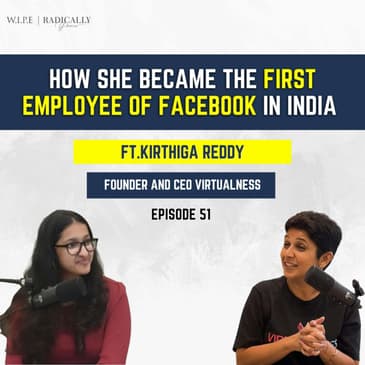
“𝑰 𝒓𝒂𝒏 𝒕𝒉𝒆 𝒐𝒑𝒆𝒏𝒊𝒏𝒈 𝒃𝒆𝒍𝒍 𝒇𝒐𝒓 𝑨𝒕𝒉𝒆𝒏𝒂 𝑻𝒆𝒄𝒉 II 𝒂𝒕 𝒕𝒉𝒆 𝑵𝒆𝒘 𝒀𝒐𝒓𝒌 𝑺𝒕𝒐𝒄𝒌 𝑬𝒙𝒄𝒉𝒂𝒏𝒈𝒆. M𝒚 𝒎𝒐𝒎 𝒋𝒐𝒊𝒏𝒆𝒅 𝒐𝒗𝒆𝒓 𝒁𝒐𝒐𝒎. 𝑺𝒐 𝒉𝒆𝒓𝒆 𝒘𝒆 𝒘𝒆𝒓𝒆, 𝒎𝒚 𝒎𝒐𝒎 𝒘𝒉𝒐 𝒄𝒐𝒖𝒍𝒅 𝒏𝒐𝒕 𝒇𝒊𝒏𝒊𝒔𝒉 her 𝒉𝒊𝒈𝒉 𝒔𝒄𝒉𝒐𝒐𝒍 education, 𝒂𝒍𝒐𝒏𝒈 𝒘𝒊𝒕𝒉 𝒉𝒆𝒓 𝒅𝒂𝒖𝒈𝒉𝒕𝒆𝒓 𝒂𝒏𝒅 𝒈𝒓𝒂𝒏𝒅𝒄𝒉𝒊𝒍𝒅𝒓𝒆𝒏 𝒘𝒉𝒐 𝒘𝒆𝒓𝒆 𝒐𝒏 𝒕𝒉𝒆 𝒑𝒐𝒅𝒊𝒖𝒎. T𝒉𝒊𝒔 𝒘𝒂𝒔 𝒐𝒏𝒆 𝒐𝒇 𝒕𝒉𝒆 𝒑𝒓𝒐𝒖𝒅𝒆𝒔𝒕 𝒎𝒐𝒎𝒆𝒏𝒕𝒔 𝒇𝒐𝒓 𝒎𝒆.”
Meet Kirthiga Reddy, founder of Virtualness, and former Managing Director of Facebook in India. She has been featured in Fortune's "Most Powerful Women'' list from 2011 to 2016 and as Fast Company’s Most Creative People in Business in 2013..
In this interview episode of ‘Wiping Out the Norm’, Kirthiga shares with us her inspiring journey from a small town called Nanded, to working at top US-based tech companies, leading the Facebook India team as their first employee and Managing Director and being the First Female Investment Partner at SoftBank Vision Fund, one of the largest tech funds in the world with $130B under management
After completing her Engineering in Computer Science in Nanded, Kirthiga climbed the academic and career ladder by pursuing further education in the US, completing an M.S. in Computer Engineering from Syracuse University and an MBA at Stanford, where she graduated as an Arjay Miller Scholar.
From a student at Stanford, with her exceptional technical expertise and leadership skills, she went on to serve as Chair of the Stanford Business Management Board.
Balancing ambition with familial dedication, Kirthiga spoke about the pause she took in her career to prioritize her daughters and how it helped her to connect with new opportunities. In our conversation, Kirthiga highlighted
“𝑴𝒚 𝒎𝒐𝒕𝒉𝒆𝒓 𝒄𝒐𝒖𝒍𝒅𝒏’𝒕 𝒄𝒐𝒎𝒑𝒍𝒆𝒕𝒆 𝒉𝒆𝒓 𝒉𝒊𝒈𝒉 𝒔𝒄𝒉𝒐𝒐𝒍. She𝒘𝒂𝒔 𝒕𝒐𝒍𝒅 𝒕𝒉𝒂𝒕 𝒕𝒉𝒆 𝒐𝒏𝒍𝒚 𝒕𝒉𝒊𝒏𝒈 𝒚𝒐𝒖 𝒏𝒆𝒆𝒅 𝒕𝒐 𝒌𝒏𝒐𝒘 𝒊𝒔 𝒃𝒂𝒔𝒊𝒄 𝒎𝒂𝒕𝒉 𝒕𝒐 𝒅𝒐 𝒕𝒉𝒆 𝒈𝒓𝒐𝒄𝒆𝒓𝒚 𝒃𝒊𝒍𝒍𝒔”. Despite coming from a background where her mother couldn’t finish her education, Kirthiga shattered glass ceilings and redefined what's possible for women in tech.
Watch our full conversation with Kirthiga as she shared with us many more learnings from her career.
Youtube: https://youtu.be/sC40BkqPPYE
[00:00:00] Kirtika, for joining in today for our show Wiping Out the Norm.
[00:00:09] You've clearly been a woman of many firsts and I'm sure that you're leading still by
[00:00:14] example now with your startup virtualness.
[00:00:17] But tell me that the news and the media and everyone around you has defined you as one
[00:00:22] of the most powerful and influential business women so far. Has this definition really changed from the time that you were in your 20s building your career to now? I want to know that transition. How did it happen? 100%. You know, when I was... Actually, someone asked me when I was first listed in these, you know, top 25 women in power list, I went back to the office. And, you know. And even at that time, when this, you know, I was listed for the first time in the Stop Women in Power, if you had asked me my definition of power, that would have been very different than what I think of my power.
[00:03:03] So I think what will be fascinating to see is how this definition continues to evolve.
[00:04:07] I know. Totally, right? It's one of those, you know, someone said, when you're in the 20s, you're all worried about what everyone else thinks of you. When you're 40, you say,
[00:04:11] I'm going to stop worrying about what everyone thinks of me. And when you're 60, you realize
[00:04:15] that no one thought of you like me this, you know? So just get through that realization
[00:04:19] and just be who you are. And I'm then I think about her pride as she sees me in these top women in PowerList that it makes me reflect on the change
[00:05:40] that one generation can make.
[00:05:42] And one gives me a whole sense of optimism,
[00:05:44] but two also gives me a huge sense of responsibility to abroad to study further, why not just explore in India? Because that's one triggering point that it really takes to make that shift. And it's not easy to go leaving your parents into another country, although now it's very much possible with so many people doing it. But how is it back then? So I will be honest and say that my journey to engineering
[00:07:03] was one that was driven more by an ultra, I would say, competitive space in if not for his support. Yeah. Wow. all both through fertility treatment. So both of them, they're IVF induced babies. So I feel very grateful for technology, for the gift of motherhood. And my takeaway from that is, you know, one, there never will be a perfect time to have kids. And so if you really want to have kids, it's always a perfect time, it's a corollary of that.
[00:11:00] And so, you know, have them and the universe conspires
[00:11:03] to make it happen.
[00:11:04] And my last advice is this what people talk about? When they say you have to make a choice between your personal and your professional lives. But then one day it struck me as I was having these sleepless nights, I don't have to. So for the first year I actually traveled with her. And everywhere I went, some arrangement came together to take care of her.
[00:12:20] And it's unbelievable how once you make
[00:12:22] a decision to do something,
[00:12:24] nature conspires to make things happen for you.
[00:12:26] And so think about the superpower of And this goes back to your early question of Kirika, why did you go to the US for your master's, right? I think we went there to our master's and through my work, I had to come back to India every quarter and I could see how much India was opening up and how much India was changing and India was clearly on the growth trajectory. And I kept thinking to myself, you know, we went to the United States for those opportunities
[00:13:44] that learning, but there is so much opportunity right here in this country. thrill to get the role. I also then called my mom and I said, you know, my husband got a six month relocation. So I was going to come first with the girls and then he would follow me. So I called my parents and I said, I'm going to come with the girls. You know, if you are able to come and help me with the girls, then I can do this. If not, I don't know whether I'll
[00:15:00] be able to do it. And God bless my parents. They said sure. And at that time we explored a few different roles with Facebook and we said, let's keep in touch for the right role. And it was almost a year later that Facebook announced its intention to open its office in India. So I picked back up on the conversation. And as you said, the interview process was brutal.
[00:16:21] I think I met with maybe like 14 people
[00:16:26] and maybe most of that like in one day. that you can find children that much faster. And so she said, what will you do in India using the power of the platform? And for me, that moment, it suddenly, you know, this was much more than just a job and a career. It was a confluence of everything that I wanted to do on the community
[00:17:40] side and what I would want to do on my job. And so again, I was so grateful and thrilled and excited policy similarly, HR similarly, finance similarly. But you still have to have a very cohesive voice as a team in the region. So one of the first questions Cheryl asked me was, Kirtika, how do you lead in an environment where you have a lot of responsibility, but not the reporting structure authority, right?
[00:19:00] And I think that's a really important question and something that a lot of courage and that sense of ownership that, okay, it's fine and I will take it up. And that's the reason why probably you rose up to this level. So how did that happen if you could tell us little nitty-gritty of it? Sure. So I started as the first employee for Facebook in India and they're head of online
[00:20:21] operations because operations is what the initial charter was. And this cross-functional probably a 100 year vision statement like SoftBank used to have for 300 years and the other 100 could be employees the whole year 100 cross. So it was actually a 100 million people on the platform okay and at that point we didn't even have 100 million people on the internet
[00:22:43] That was the goal that we set. On your question of what was the nitty gritty behind that goal, so 100-100-100 was a four-year
[00:22:50] vision.
[00:22:51] It was a be-hag of all sorts of the hairy audacious goal.
[00:22:55] But give or take one or two quarters, we hit each one of those in that four-year mark.
[00:23:01] Huge cross-functional effort is to know that it was the strengths that you bring that made you right for this role. So your ability to really put
[00:24:22] yourself in the client's shoes, understand their operations in Hyderabad. And then coming to Mumbai, and our first offices were exactly where we were sitting in one BKC. We had a business center first, and then we moved into a bigger space.
[00:25:43] And each of the offices, by the way't, I would point to things like the first time the online operations office came and started working and we saw the turnaround
[00:27:03] times on the queries go down.
[00:27:05] I would call that as a highlight moment that I still remember.
[00:28:12] So the biggest pivot to me is that focus on culture, focus on hiring people and results will come. That is probably, I would say, with having discussions, that's one. Two, you know, my HR partner said, you know, with India being such a hierarchical culture, it's going to be very difficult to build a be open culture. And we took that as a challenge.
[00:29:40] So we actually did coaching on constructive criticism on how one could deliver constructive to build the culture that we want, I would say that is the biggest shift. The focus on people and the focus on culture as a way to driving results and performance is the biggest shift. By the way, sometimes people ask the question, they say, what might be the most,
[00:31:01] maybe the word maybe misunderstood,
[00:31:06] might not be the wrong word, those people actually will try more in a different place with a different culture. Yeah. And so again, the kindest thing then is to make sure that they are each at places where they can thrive. So that is to me where those three pillars come together. We all know that you are someone who likes to never settle and always get out of your comfort zone and do different things.
[00:32:20] That is one more reason that you stepped down from Facebook for discovering more opportunities. And I knew I would thrive in either locations. So just if you optimize for preferences across the family, it made sense for us to go back to the United States. And then that timing that the girls starting high school and middle school was also the trigger for us. So I told Facebook probably a year ago saying that this is what is coming up.
[00:33:41] And we had a very strong transition plan and also led global partnerships for the FinTech verticals or work with clients like Visa, who also I think have visited the Visa India offices as well when I was here. And spent two incredible years with Facebook and headquarters doing that. At the end of that, two things happened.
[00:35:03] One, I just started missing the startup ecosystem.
[00:35:06] The building, the growing, the scaling I did my second Everest Base Camp trek, actually with my oldest daughter, and we made memories for a lifetime. And I will tell you Radhika, I had the best well-wishers tell me, do not do this. Do not just take, do not just leave and take a break and then figure out what's next. Find another job, otherwise you're gonna lose
[00:36:20] all of your negotiating leverage,
[00:36:23] to which I said, one, I don't think I'm gonna lose
[00:36:25] all of my career highs. $2 billion highly profitable company. I went from there to being an individual product manager in an early stage startup in the mobile space. One would imagine that one graduates from one of the best business schools in the world, gets a pay raise, a title raise,
[00:37:42] and here I was stepping back in my titles.
[00:37:45] I also took a 40 percent pay card because when you go to a startup, in what you're doing. And sure enough, so if you look at my LinkedIn resume, it's very easy to see Director of Engineering, Director of Product Management, but what you will miss is seeing the individual contributor and the group product manager to go back up to talking to SoftBank. As I mentioned, I thought I was going to go be a CEO of an early-stage startup. So I was talking to different venture funds about their portfolio companies. Yeah. And a few of the venture firms asked me whether I would consider investing full-time with them.
[00:41:26] opportunity to learn from the was very compelling. Softbank was of course making very big whole moves. Yeah. And so to me it was just the right
[00:41:31] next once in a lifetime opportunity to be with Softbank. Right. And before that Softbank never had a female partner, right?
[00:41:39] You were one of their first female investment partner. Yeah. Yeah. Yeah. Yeah. Yeah. And now
[00:41:46] was the interview process you're also very
[00:42:45] come up and how did you hire your first set of team members if you have some interesting stories to share? Yeah, no totally. So I owe credit to my co-founder Sara for the name and all of the brand colors,
[00:42:54] this design, huge credit to him. We divide and conquer our different spaces. So that's the name
[00:43:02] and you know, virtualness rhymes with happiness, awesomeness and the world is going virtual.
[00:44:06] We got really lucky with the blockchain winter, if you may. In that our core team, actually, people have worked together for over five years on the
[00:44:14] engineering side.
[00:44:15] They'd seen a FinTech exit before in a company that all started to work on a blockchain company.
[00:44:21] Given the market environment, they said, they're bringing them all together in Dubai. Wow. I'm sure it'll be a great time for all of you and we'll enjoy it through the pictures you share on social media. But which set of departments did you create to begin with for your team members when you started the company? Yeah. So the first quote-unquote department, if you're very flat organization, this is a startup.
[00:45:44] So I wouldn't even say that there are departments even now. Basketball Association. Basketball is religion in the Philippines, just like cricket is in India. Also, close with Leaks and Teams in Indonesia. So it was a product team, and within product engineering design, front end, back end, we are on iOS, Android, mobile web. So we have O person or two in each of these different areas,
[00:47:03] followed by the Go to Market Teams.
[00:47:05] Yeah.
[00:47:06] And tell me about your investing journey were the first people that I went to with the idea and I said, Sarubh and I are planning to do this. And they said, if you do this, we want to be your first check-in. Okay. And that was really, really important. I would say conversation endorsement. And they continue to be my first call for
[00:48:22] all the strategy hiring related aspects. world's best influencer and education award. So, yeah, amazing folks on the creator side, amazing folks on the institutional side, like F7 Ventures. Blockchain Ventures was eventually our lead for our seed round. They are early into blockchain,
[00:49:40] and K-Log Day is my lead investment partner.
[00:49:43] Phenomenal.
[00:49:45] Each of these people are true partners, are like, how does one get into that role? Like how does one get it's such a like important role for the school. And if I reflect back Radhika, you know where it all started? It started with me raising my hand to be the alumni chapter chair in Bangalore when I was in Bangalore for Stanford
[00:51:00] Business School alumni. And while that might sound because you mentioned about this, I'm curious to ask, how did that transition happen from being a board member to the chair of the board? Yeah. So that to me, I would say, you asked me, Kietika, how did you feel when you became the
[00:52:20] managing director?
[00:52:21] Yeah.
[00:52:22] To me, there was a big, the managing you think, the dean, to invite you to the board when you had a conversation with him in India? And do you think that conversation, if that wouldn't have happened, this wouldn't have ever happened? I do think that if I hadn't already spoken with the dean
[00:53:41] and the dean did not know of my work, because a lot of time,
[00:53:45] later, of course, I've to build a base in Silicon Valley. We want to establish deeper connects. We would love for you to be on the board. And so that was another journey by the Dean's Leadership Council.
[00:55:00] Yeah.
[00:55:00] It also brings me to a question that what kind of a person
[00:55:03] are you in boardrooms for educational sector remain the same. But the output of what is required in each one, whereas in an academic institution, there's things that are on academic excellence that is core. When it comes to a company, it's around the running of the company's
[00:56:20] shareholder value that is most important. So there are different things,
[00:56:25] different hats that you need to one in my investing role. I was introduced by the CEO as one of two partners who were making a decision on a particular deal.
[00:57:42] It was myself and another male partner. that probably is probably going to call up the CEO and said, who is this person? Why did she write a note to me like this? But I knew I just had to do it. Short enough, a few hours later, I got a message back saying, thank you for highlighting this. My apologies. And I look forward to working with you. Oh, nice. And by the way, any time after that, when I write to him,
[00:59:00] I get responses in 30 seconds.
[00:59:03] That's the change you created.
[00:59:06] And so genuinely, I think the next generation does it that much better than we did. I mean, it took me these many years. I don't know whether 10 years ago I would have been able to do that. I would have just solved and gone away and I don't know what I would have done.
[01:00:22] But I do think that these days, of course, Certainly, if I reflect on our conversation, I think unconventional career choices is one where I've not done the second norm that I would like to call out. And I have my own social impact initiative called Lifterie. It was previously called Nader, which is focused on the cost of working women. So the reason I need virtualness to be a $10 million company is so that I can find more social impact in this place like Lifterie.
[01:03:00] Wow.
[01:03:02] I'm sure it'll happen very soon.
[01:03:08] And I want to ask you that what I told you of my mom not having the opportunities, and I feel very conscious every moment about the opportunity, the responsibility. And so I think that responsibility stays with me all the time. And sometimes my girl asks me,
[01:04:21] you know, is there any time that you just relax us and we'll pay you for it? But at that time, entrepreneurship was such a foreign concept. All that I knew was you should get a job. And I did not really engage in that conversation because I was not exposed to other things
[01:05:44] than get an education and get a job. who are just right out of college. I used to come out from performance sessions. Every six months we used to do our performance evaluations. And the level one individuals in the organization and what they were doing, I would say, oh my God, they inspire me more than maybe my peers. If they are doing all of that, then what should I be doing?
[01:07:03] And I'm also a big advocate of finding mentors
[01:07:07] for different aspects in your journey. felt we could not wait any longer. I posted on my Facebook page saying I'm relocating back and I'm going to have a six-month transition. I woke up the next day and the headlines were, Kirtika Reddy steps down because of Free Basic. Oh my god. So that was an interesting time to navigate those intersections.
[01:08:25] And I think, so at that moment, it felt hard. investment from SoftBank. And the entrepreneur and the founders, the initial founders brought on a CEO. Such a strong team based most on the technical strength as well as the business acumen,
[01:09:45] which was very different from what we were seeing with the other in the center. And so if a company has one of their tools, it will surface roles for you that are the right match versus you going to have to do a keyword match and it's an AI first platform. One of the consequences of their tools is that, you know, it surfaces roles to candidates. And what we find is some of the companies
[01:11:01] were finding almost a 50% increase in diverse candidates.
[01:11:04] Why?
[01:11:05] Because there's this whole research that says Ashutosh is visiting. Next, I'm sure, and Peter and Shrove will be coming as well. Yes, definitely. And one last story around a boardroom dilemma that you faced. You know, let me actually take Stanford Business School. And one of the big top three to five agenda items for the Dean is, of in their religion, and how is it that they address that within themselves, and how is it that society can do to support you? So just thinking then about, fine, we fixed diversity.
[01:13:42] What is it that we need to do to really of the Athena SPAC, Judith Rodin is on the board of the Athena SPAC. She was the first female president of any Ivy League University of Pennsylvania, first female president of
[01:15:02] Rockefeller Foundation. And again, it's been an extraordinary privilege to learn from her.
[01:16:08] soon so there you go. All right. Check it out. And so by the way the lyrics go, my friendship is like Indian drink so she thought it was very appropriate for friendship.