
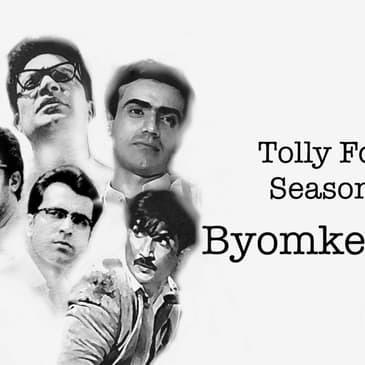
In Episode One we discuss Satyajit Ray's Chiriyakhana (1967) starring podcast favorite Uttam Kumar. The first cinematic adaptation of the popular series, this is an uneven film that requires multiple viewings to make sense. Join us as we dive deep into the history of this controversial film.
Subscribe to our Upodcast: Bollywood Edition feed so you don’t miss Amrita, Sujoy and Beth’s new limited Podcast series by clicking here. Follow and subscribe to Amrita's new Youtube Book channel by going here!
Find us on Apple Podcasts! and Stitcher! and AudioBoom! and iHeartRadio! and Spotify! and CastBox! Follow us on Twitter! Like us on Facebook!
You can follow all of us on @AmritaIQ, Sujoy on @9e3k and @bethlovesbolly
Sujoy’s instagram which has amazing shots can be found here, we strongly recommend you follow him!
[00:00:00] BINGOLLY FILM Hello and welcome to the brand new second season of TOLLY FOLLY, a podcast about Bengali film with Beth from Beth Love's Bollywood. Hi Beth! Hello! Sujoy, whom you know from the Khandan podcast. Hi Sujoy! Hello everyone! And myself, that's Amrita also from the Khandan podcast.
[00:00:35] The second season is again about three episodes long and this time we are focusing on a beloved Bengali classic character of Broomkesh Bakshi. Originally written by Sarabeyan Dubandupathyaay, Broomkesh is an amateur detective in the tradition
[00:00:54] of Sherlock Holmes which is something that everyone mentions at least once in pretty much every adaptation. So if you're a fan of cozy murder mysteries then this is the Bengali series for you because there are a ton of Broomkesh Bakshi movies.
[00:01:11] We have sort of whittled it down to a few that we really want to discuss and we will discuss the rationale for our selection in each episode as we go along and we're also going to go in chronological order based on our selections.
[00:01:28] Broomkesh is one of the most successful Bengali exports. He's been adapted into Hindi most famously on TV in the 1980s and it continues to be a fan favorite and we'll discuss that. It was also most recently adapted by Bhebaka Banerjee with the late Sushant Singh Rajput
[00:01:48] in the starring role and that was controversial for many reasons but is also a favorite of this particular podcast and we will be talking about that at a later date. However today we are going to talk about our oldest pick which is 1967 Satyajat Ray
[00:02:04] adaptation starring Uttam Kumar a very big favorite of ours if you've listened to the first series of Tolly Folly. This is a movie called Churya Khanna. Okay guys before we go into Churya Khanna I just wanted to talk about detective fiction
[00:02:23] in Bengali culture because it seems to me that this is something that Bengalis really enjoy the murder mystery and like just detective fiction in general. Am I correct Sujoy? Yeah I would think so. I mean it's enjoyable and yet it's also seen as I think like
[00:02:47] the purist people who enjoy literature would still consider it as a cheaper form of entertainment like pulp entertainment like James Hadley case and stuff like that. But also it's also part of a lot of children magazines it would feature
[00:03:10] Feludo was created with the prime objective of filling Satyajat Ray's children's magazine which was Sundesh and yeah it's part of that growing up reading comic books and reading children stories which were all about adventure and finding you know treasure islands and scavenger hunts and all of that.
[00:03:34] So the whole genre of detective and thrillers and finding mysteries and solving puzzles is definitely part of Bengali literature and obviously Pyeongkesh is a big part of that. And Beth you and I are big fans of the English detective fiction and we mainline
[00:03:55] Poirot for example and then we watch pretty much every murder mystery series going on in England and do you see parallels between you know the English tradition of murder mysteries and detective fiction and the Bengali ones because you watch a lot of both I think.
[00:04:13] I do I should say first off that I watch a lot more than I read for whatever reason of detective things but yeah there have to be lines of connection and even if it's just because for again for whatever reasons that I have yet
[00:04:26] to figure out maybe English British mysteries took greater root in Bengal than perhaps they did in other parts of India that seems to be the case. There are Christie adaptations in Bengali cinema that are you know from the
[00:04:38] 50s if not earlier and I was thinking about how at least in the films Pyeongkesh goes off into the countryside a lot so it's not quite everyone's locked in a mansion but it's pretty close at least in the ones
[00:04:48] I've seen obviously this the sidekick aspect of Ajit and the things he you know can figure out or not on his own helping us poor readers to follow along the role of the city as well I think is really important but
[00:05:02] that also is a thing from American crime fiction. I personally feel that Bengali films also have their own kind of noir that you maybe don't see in other at least I haven't seen it in Hindi when you talk about detectives now obviously the gangster noir is a
[00:05:15] different issue and Bombay has a lot of those but in terms of detective noir I think Bengal really has some strong entries in that area which we could talk about more in a later episode of People Want to but I think
[00:05:25] there have to be international connections whether deliberate or not but I'm sure especially from the texts which I can't read there are many many many homegrown completely native to India aspects of Bengali detective fiction and detective films.
[00:05:39] And Sujai do you have a sense of whether those stories and those you know not just the films but the literature do you think those are still as prevalent and as famous and popular in Bengal today as they used to be?
[00:05:56] I think the only benchmark or the parameter by which we can measure popularity is whether they get adapted into more popular movies and by that I think a lot of Hollywood is definitely adapting you have the Swabya Sachi Feluda movies and then you have Prasoonji playing Kakababu
[00:06:18] which is another detective character if you guys have seen Mishor Rosh or the Yeti Obijan movies. The Egypt one is fun but the Yeti one is stupid. And then Shashrotha Mukherjee who plays Ojit in the Anjandatta Bhunkeshbhokshi movies he plays another like a police investigator as Shabur Dasgut
[00:06:46] he's another detective character. So yeah I mean there are multiple adaptations of the many detectives that exist in Bengali literature but yet none as repeatedly adapted as Bhunkeshbhokshi. One thing I think is really interesting about that is that the film we're going to discuss today
[00:07:07] from 1967 is the first Bhunkesh film and that's 30 some years after the story started appearing so somehow they weren't seen as maybe audiences didn't want them on film they seemed unfilmable or something like that it seems really strange to me that
[00:07:25] given that they're now making two a year on average if you look at Wikipedia and you've got like an actor who starts in one director series of as Bhunkesh and then he jumps to another director series still playing Bhunkesh
[00:07:39] like they're currently really really popular and they've you know they've been on radio there have been web series there have been TV series there have been these films some of which are standalone and some of which are series I suspect there are
[00:07:51] comic versions too I don't actually know that but this character since the what the 80s has just kind of exploded as source material but it's also kind of interesting about the films that so there's one in 1967 there's one in 1974 and then there's not another film until 2009
[00:08:09] yeah so again the sort of like the idea of Bhunkesh taking root as a film character is not fast at all there's also like a lot of history around Chiriyakana and the difficulties that went into making this film and again post release there was a lot
[00:08:27] of backlash regarding how it is the worst dream movie ever and how it's the worst uttungumar movie ever and and neither which is true IMO yeah I mean Ray was kind of you know forced into making this
[00:08:43] because he was more interested in raising funds and he was trying to create Gupegan Baga Vaan when his assistant bought the rights for the book and then you know Ray was pushed into making this and he half asked into
[00:08:59] this into a final product and he also ran it ran into a lot of production troubles and all of that but we'll talk about that later okay so then let's just start talking about Chiriyakana which is our feature for today
[00:09:11] Beth do you think you could do a little summary for those of our listeners who haven't seen the film I recommend if anyone watches this film who doesn't already know this story that you might want to have a pen and paper handy to write down who all the
[00:09:23] characters are because there are an awful lot of them I've seen both these films before but rewatching for this podcast I was taking copious notes which I'll try to whittle down here what I'm going to say are the basics of the story is I understand them
[00:09:35] from these two adaptations and they put different emphasis on different elements in the two films and they tweak certain aspects so it's not exactly the same by any means yeah so the basic gist is there's Judge Sen
[00:09:48] he was a Bombay session court judge who retired ten years ago and since then he has run a flower and dairy farm staffed by people he knew of from his work who he's realized needed a safe home and an income because they've been in
[00:10:03] prison or something like that so they need a hand up and he's helping them out and the residents include his wife and his nephew a woman his nephew brought to the colony because he found her crying in
[00:10:15] Newmarket in Calcutta a doctor a driver and his wife a professor who's a chemist and does the fertilizers and his daughter someone who takes care of the animals a delivery guy and then also I don't know how to describe this person
[00:10:32] the films kind of run amok with him but there's a character named Panu who has some kind of impairment that means he can't speak properly but he does read and write which becomes important okay so that's the colony the story
[00:10:43] kind of kicks off when the judge contacts Bunkesh because auto parts keep being left on his property mysteriously and he also wants to know about a film actress named Sunaina who seems to have vanished he doesn't know her but he's
[00:10:56] intrigued that she seems to be untraceable so Bunkesh and Ajit talked to a film producer who leads on the actress and he says that Sunaina was never really fully famous which is why it's hard to find her in film fare
[00:11:07] and things like that and that she was often hard to recognize because the makeup they used in the films was really good for her they then go to the colony with one of them in disguise at the invitation of the judge
[00:11:20] both times it's as a journalist who doesn't speak Bengali we can talk more about these disguises they make the rounds and meet everybody they go back to Calcutta Sen is killed that night while on the phone with Bunkesh Bunkesh and Ajit return not in disguise they question everybody
[00:11:39] and you're gonna hear variations at the same two questions over and over which are for the women did you ever want to act in films because they've assumed that the judge was interested in this actress because he thought she
[00:11:49] was somehow related to his colony and for the men do you know about auto mechanics to try to get at the motor parts another person is killed our superhero duo go back and forth between Calcutta and the colony a few
[00:12:01] times Bunkesh follows one of the characters in the city secret connections are of course revealed and in both film versions there's a very poor style drawing room speech at the end you know kind of saying
[00:12:13] leading in one direction that it was this person and oh no something else is revealed and then the killer is identified and just quickly speaking of Agatha Christie this story really reminds me in a few ways of and then
[00:12:24] there were none because you have a judge who makes all these decisions to assemble people in a semi remote location because of his view on them based on his interactions with them in his professional experience so
[00:12:36] that was pretty interesting so Sujoy this is the first time you saw this film right in a very very long time yes okay so bet you and I watched it I can't remember how many years ago but we watched it once before and we were not
[00:12:53] big fans of it were we no we weren't and I was so happy to see it again because my opinion went upwards quite a bit yeah I think I was surprised about that as well but before we get to that I want I just want to ask Sujoy
[00:13:06] about his opinion about it I found it like it's very typical of some scenes just come across as very typical of how Ray films scenes where he is much better with this the scenes and the screenplay rather than the overall
[00:13:27] theme and mood of this film and so it it doesn't come together in a more cohesive way because there are many jarring elements in this in this film right especially the the the Chotuvesh the where he becomes the Japanese
[00:13:48] horticulturist or where he is trying to break into the doctor's house so those two scenes just stand out as absolutely jarring from the the the remaining narrative of the movie what it does come across one of the stronger parts of
[00:14:03] the movies definitely the parts where characters are talking and the camera zooms in on them one after another as as the conversation goes on almost like it's inviting the audience to you know you know come closer and
[00:14:20] and listen to their conversation and be a part of it and it's really immersive and how the camera almost tempts us into the story and I think that's really masterful and the story by itself because we are in 2020 and we have been
[00:14:38] exposed to more cynical and more evil things on popular culture in media in real life it is still a very 1930s 1940s I don't know when exactly this is set in India but the crime by itself are we have seen this sort of murder
[00:14:58] mystery elsewhere but it's very it's very of its time. I was watching this and I was trying to think why I didn't like it in the first place and why so I think I appreciated it a lot more this time
[00:15:18] around but I still felt the disconnect from the film from the central murder mystery like I didn't really care about any of these people and I think that's really the thing you know like if you're talking about Poirot
[00:15:33] because those you know like Beth said there are some very obvious nods to the convention and if you think about that you know the person who dies is never sympathetic in the Christie mysteries but you always feel a little
[00:15:50] bit invested in the cast as they show up and I think that's where this film falters a little bit because it's such a giant cast and they're so interesting and Ray wants to show you all these interesting characters in all their
[00:16:06] texture and I think he forgets a little bit to just hold steady on certain aspects of the story and let the viewer engage emotionally with them so that you know when the ending comes and the murderer is revealed I honestly didn't
[00:16:24] feel anything like there was no you know like it didn't affect me emotionally at all when I heard her story and so on and so forth but Beth tell me about you like what struck you as different this time?
[00:16:38] The number one thing honestly for me I think is I was so confused when I saw it the first time there were so many characters and I had a very hard time keeping them straight and my when I watched it again last week I watched
[00:16:51] with my friend Carol for runs the website the cultural gutter she'd never seen this either and she kept asking me which woman is that because and there's a good reason for that right like the story needs for us to not understand
[00:17:05] who is who exactly facially and some things like that but also I think having seen these two adaptations pretty much back to back the newer one does a much better job at unfolding bits of information in a way that builds
[00:17:19] the suspense better yeah it's a longer film by a little bit and I don't of course know which one is more like the book but the point at which you find out who people are is very different in the two films and I think
[00:17:32] the later one is more successful at building interest in the characters because I was much much more moved by the reveal in the newer one than I was in the Ray one and I will say like I I don't think this is the
[00:17:46] worst ray film by a long shot I you know in rewatching and even texted you guys I was like hey surprise this films pretty good you know like Ray knows what he's doing what a guest I really do think it has to do
[00:17:57] with the script and how the how the information is laid out twisted and then revealed which obviously for a mystery is incredibly important so we've been talking about the giant cast of characters and I really want
[00:18:11] to discuss them at some length but first I just want to talk about the main relationship in this film which is the relationship between Kesh and his best mate Ajit so Joy yeah have you ever had a friend as
[00:18:29] good as Ajit? No I wish. So is it just me or is there homo-avancular relationship a little bit weird? Oh the bongs are coming for us. I don't know the male friendship thing is a mystery to me explain it to me
[00:18:53] so Joy as our resident male. It's just good bros making omelette together. I mean it's kind of just sleeping next to each other and cuddling on a cold night. I mean there has been quite a bit of backlash
[00:19:16] of how Reyes Chiriyakana is totally different from what sure then this actual text is in terms of how it characterizes the dynamic of what Bium Kesh is and what Ajit is. Ajit is in the books as well as
[00:19:36] in the Anjan Dutta movies with Jishu and Auber is totally narrated by Ajit's perspective. So all the stories are basically what Ajit experienced in this case when he's thrown into what you know what
[00:19:51] Bium Kesh is up today you know today this happened and all of that so he he's the narrator it's also his bread and butter because he makes money out of the literature that he sells to publisher the Misadventures of
[00:20:04] Bium Kesh Bakshi is his text and that's why they are good friends which is completely lost if somebody watches Chiriyakana and that's all the information about Bium Kesh Bakshi and Ajit that one receives then that information is totally lost in Chiriyakana. And what else?
[00:20:26] Oh another thing is obviously we were talking about why Bium Kesh is the way in this movie where he thinks love is fake and all of that and Ajit is the one who is married instead in the books and in other
[00:20:40] adaptations Bium Kesh is the one who is the family guy and Ajit is the bachelor. I don't love this Paris relationship which I'm sure is established by Conan Doyle of the detective being mean if not flat out abusive to the
[00:20:56] sidekick character and that's really tiresome and it's really it's mean and one of the things I love so much about elementary is that Watson is a whole person with a ton of competencies it does not take any crap from Sherlock.
[00:21:12] Again these two adaptations handled this kind of differently but that basis of a relationship is at this point quite played out and it would be great to see someone do something different with that in some of the
[00:21:24] upcoming adaptations and maybe they have and ones I haven't been able to see yet. So I think this was Ray's take on that where he wanted Bium Kesh to be more Sherlock so he drinks he is the guy who behaves erratically as
[00:21:38] he wants to and Ajit is the one taking crap. I didn't pick up that he was quite as bumbling as Watson sometimes is he's put upon and he puts up with it and as you point out because you don't understand that he
[00:21:51] makes money from these and builds his author reputation you don't really know why he puts up with this. In the other ones you're like oh because and then we can talk about this too but Ajit in the later one is clearly
[00:22:05] having a blast some of the time. Oh yeah absolutely and like in the other adaptations as well like where Bium Kesh gains from being with Ajit like he bounces off his ideas and Ajit is the one feeding him with all the permutations and combinations all the possibilities of
[00:22:24] the case and Bium Kesh collates all those information and comes up with the possible solution and that is kind of not the case here. Right I was really put off by Ray just turning Ajit into a total and utter
[00:22:40] de hati like he you know like he basically walks an hour and half dressed through most of this film and then he looks like he's older than Uttam and it's always going to be a bit unfair to pair anybody
[00:22:54] in like a supporting role too Uttam because this is the 1960s and Uttam is basically beautiful at this point and he's got the you know the Ray shine to him so he's got the glasses which are amazing
[00:23:10] and he's dressed in these dohthis that are just beautiful and he is beautiful and in his prime and then you have Ajit who's just basically you know a bumbler and he just doesn't have much to contribute to anything that's happening and I thought like that was
[00:23:29] really mean and also like Bium Kesh is a bit of a bully to be honest. He taunts him with his snake. Yeah what is that about? I think most detectives kind of are a bit of a bully with the
[00:23:42] exception of Miss Marple who you know is manipulative rather than a bully necessarily but that kind of comes with the territory apparently and it's not pleasant. It is incredibly not pleasant I didn't appreciate that at all but also can we talk about the character that is missing because
[00:24:00] it's Satyavati like you know. Right, where's your wife buddy? And it's funny because I usually when I watch the adaptations of Bium Kesh with Satyavati in them I don't feel like she's contributing much to it but then because she's not in this I really felt her
[00:24:19] absence and I began to sort of reconsider my previous Bium Kesh experiences in that light and maybe she does you know work on him at a character level. Did you guys miss Satyavati? Now in the other adaptation of the Jishu and Onjundottomovie of Chiriakana kind of addresses that.
[00:24:43] So they make at the end of Chiriakana where they are again talking about the whole case and they are laying out all the cards and how Bium Kesh went about solving this. They are talking to the film producer who you know introduced them
[00:24:56] about the story of Sunaina and then in the producer is very much impressed by the story and he's like I will buy the rights to this and make it into a bioscope and Satyavati comes into the scene
[00:25:09] and she suggests that you know that you should make the movie but in the movie version of this story Ajit should be the one who is married and not Bium Kesh and the producer suggests that Uttam Kumar should play Bium Kesh which is funny.
[00:25:28] In the Jishu version again Satyavati is actually contributing to the final crime solving. And he treats her badly too. He's not nice to his wife. In any of the versions. And Satyavati is like why are you all of a sudden getting so worked up on me?
[00:25:48] But also like the kind of things that various characters say about women in this film. It's just like one thing after another. And I don't know if it's supposed to be a commentary on like society in general
[00:26:03] or whether it's just a collection of like the worst men on the planet because it's relentless. And I actually had to laugh at that one point where the judge meets his would-be wife, living partner, mistress, whatever.
[00:26:19] He's so full of letchery in that moment that his servant is literally like I couldn't be in that room and like look at that expression on his face. I had to leave. I mean that is some next level of letchery. Ew.
[00:26:35] I think that Ray for all the films where he creates or is part of creating these female characters who are glorious. Charu, Lattu, Devi, Mahanagar, some of these. He's not always great with women and the Gooby films are the standout for me. A little bit the Feluda films.
[00:26:50] But the first Gooby film only has one woman and I'm not even sure she speaks in it for certain kinds of films and it maybe is these more adventurey ones. That's the theme among these three. It's like he can't even conceive of a woman being involved. Yeah.
[00:27:06] It's pretty frustrating. This one is less so than the other two, I would say, since there are the four women who are all important in various ways and mystery. But even again, the later film does a better job with them. Yeah, very true.
[00:27:18] So now we've talked about Ajit and Bhaum Keesh and we've talked about Satyavati and how she doesn't exist and like all that kind of stuff. But what about the other characters? Do either of you have like one other character that you thought was great
[00:27:32] or like really appeal to you on an emotional level? I think for me, Damayanti, the wife of the judge in the Ray version was much more emotional of how she went from being homeless to become a part of the judge's life.
[00:27:55] And then when she's lost her husband on the morning when Bhaum Keesh visits the house and she's trying to, like Bhaum Keesh is interrogating her. And when Bhaum Keesh asks her, when did you discover that your husband was dead?
[00:28:13] And she was like, every morning he wakes up early. Today he didn't wake up at all. Like the camera zooms on her and Bhaum Keesh is in the background. That scene is so beautiful. And I think that that captured the grief
[00:28:27] and the sorrow of that character so well. And I think that stood out for me. How about you, Beth? I think it's the professor and it's because they are so different in the two adaptations. I thought that was fascinating.
[00:28:42] So in the Ray version, the professor is, if I remember right, is kind of chipper and jolly and trying to be helpful. And in the later one, he's very antagonistic all the time. He's always yelling about people, how don't you spread rumors about my daughter? How dare you?
[00:29:02] I'll kill you. I'll come for you. Any issues? Lots of dire warnings. It was interesting that they chose to take the same source material and do something so radically different with it. I enjoyed both of those performances a lot.
[00:29:14] I think for me, I didn't particularly connect to any of the supporting cast of characters as I've said before. But I found them all interesting in various different ways. And I think the professor's daughter Mukul, I think I just saw her as such a wasted opportunity because
[00:29:34] there is a wealth of emotional stuff to be mined in that little love triangle. And the things that she chooses to say and not to say and the way she responds to the interrogation and also Bejoy's reaction to her when she refuses to incriminate him
[00:29:55] or to serve as his character witness. She chooses the middle path. And I feel like that's the kind of thing that I was thinking about when I thought Ray could have just spent a few more minutes
[00:30:11] on certain characters and sort of let them play out a little bit. It doesn't need to be a full-fledged subplot, but maybe just a little bit more. And I really felt like that was a wasted opportunity.
[00:30:25] Yeah, there is a sense of like a rushed flow to how the film pans out. Like it's more interested in actually solving the murder rather than investing these characters, supporting characters even though they are quite crucial to creating the confusion
[00:30:43] to the audience and not serve as an emotional connect. Which again comes back to even the culprit we are not emotionally invested in whether he is or not because when we find out there's nothing really bizarre or exciting about it. So let's come back to like Satyajit Ray
[00:31:04] who is basically the man upon whom all of this rests. For me I think the reason this movie didn't entirely work is because of Ray and it's funny because the reason why I like the movie so much more is also because of Ray
[00:31:20] but I'll come to that in a minute. I think what happened with this film is that we are used to certain movie making conventions when it comes to detective fiction or to murder mysteries, you know, the pace of the action and the...
[00:31:38] Just the rate of shots especially as like a modern audience and this is a film where Ray seems to have just taken his time in sort of telling us the most bizarre things that have nothing to do with anything, you know.
[00:31:56] Like I really enjoyed that part where the judge is showing them through the colony and like introducing them to people but it has this leisurely pace to it where you're just like what is happening? Like, you know what? Like the setup just goes on forever
[00:32:17] and then some of the things like it's really great like when the servant comes to bomb creation like gives him background information about the judge and his wife. Like that kind of stuff just goes on really well but like there's also just tons of things that happen
[00:32:34] where you're just like has Satyajit Ray never seen a detective movie before like the part where he finds out Dr. Das's secret building and he... why does he kidnap that woman? Like I didn't understand why he kidnapped her and like why is she just sitting there
[00:32:55] and like letting him do whatever he wants like I don't get it. And then like he ties him up but in the most inefficient way, just a map and nothing else. What even is happening in that scene? I don't know.
[00:33:08] And then she's like tapping a foot along to some music and he's just like, lady what the hell? Do you think there's some other scene with her that got cut? Like she really does seem to be going somewhere and then he leaves and you never see her again.
[00:33:26] And they don't even refer to her again I don't think right? No. And yet she gets a name. So it's very odd. She's wearing quote-unquote western clothes she has a knee length skirt on. Is that why she's there? To show leg? Oh, maybe.
[00:33:42] It's supposed to be set in like an Anglo-Indian community in Calcutta. Right, right. But why? But what does that have to do with anything? Because that's where the doctor's chamber is. I guess we're just seeing how debauched the doctor is because he sublets to Anglo-Indian women
[00:34:01] who wear skirts. I feel like we're missing some sort of like cultural information from the 1960s that you know it's not accessible to us. Maybe they're supposed to be working women? Like I don't know. As is so often the case in these detective adaptations,
[00:34:20] you know we're looking at the 1940s through the lens of the 1960s through the lens of 2020. So yeah I'm sure there's stuff in the remove that would provide at least some little bit of context for us even if it's not super important.
[00:34:35] It would be interesting to know what this, how you know like that character was received by audiences at the time. Again we come back to Bengali friends, please get your parents and grandparents to talk to us about what they know about films. We're always saying that.
[00:34:50] Because I've been completely obsessed since we came up with this idea of doing a podcast. I've been completely obsessed about reading stuff online and watching everything that is possible. And I came up with this article on Mint and it apparently was talking about you know the curious case
[00:35:09] of Bhamkesh Bakshi and how Ray half-assed through this movie. He has been on record to biographer Andrew Robinson. He basically said, I accept it really nearly and he also said that who done it, who done it don't make very good films
[00:35:25] because of the very long explanation at the end where the film becomes very static and he himself does not regard Chiri Akana as a true Ray film. He then said to film critic Mary Seton that you'll be tickled to know
[00:35:42] that I won the state award for the best director for Chiri Akana. Which is back to our statement, that for best actor first ever given and best director this was really for Nayak. This is not for this film. Yeah.
[00:35:56] So okay, I've told you why it didn't work for me but let me tell you a few things that did work for me and it refers back to some of the camera angles that Sujoy was talking about. I really, really liked
[00:36:11] the way this film introduces its various characters. Especially I think that scene where the train carrying Bhamkesha Najith for the first time in their disguised version. And the train pulls into the platform and for some reason it's infested with little children
[00:36:33] who are just hanging off that train for no good reason and they all get off at this one little station in the middle of nowhere. But it begins with like that entire scene begins with a close up shot of one of the people that live in the colony
[00:36:50] and he is sort of dragging on this beady and it is a gorgeous shot. And then later on like what they do is because he's pretending to be Japanese, Bhamkesh in the history of the worst disguises ever devised by man.
[00:37:12] I think you can actually see the cellotape over his eyes and like a couple of scenes. You can! Yup, because Japanese people love taking photos of everyone. He was taking, so that's how he gets photos of all the inmates
[00:37:26] and he's able to do his wall of crime thing that pretty much everybody that watches a murder mystery or a piece of detective fiction knows is necessary to the genre. The pictures that he takes are and I kept thinking like these are pictures that would appear
[00:37:44] in Life Magazine back in the day. Yeah, right. Because they're so beautiful like they're just gorgeous portraits of all these people and you can just see the texture of their skin and you can see their eyes and you can really see the personality shining through. I loved that.
[00:38:02] What about you guys? Were there like bits in the film that like really stood out to you? Uttem nails it, I have to say. Like again, I don't know what film cash is supposed to be like based on the books but as a sort of arrogant detective type
[00:38:17] who's competent but also frustrated at times like I thought he was great and the idea of he sort of, what do I want to say? He's got a commandingness to him that you believe that people would... Because basically like who is this guy
[00:38:30] who shows up and the person who brings him to the colony is quickly dead. So you believe that he can project some kind of authority that people will in the typical way say something that's true but also not everything that's true
[00:38:42] and obviously they've heard of him in some cases. As a detective, I thought he was quite good and even when the material he has is not the best he's so good. He's just so good. So I would, you know, I'd watch him do basically anything
[00:38:57] and this film is better than that to me but it's... I very much enjoyed watching him in the role. Just going off by what you're saying and Sujoy, you can correct me if I'm wrong but I've always had the impression that Brahm Kesh is supposed to be
[00:39:12] the perfect Bengali man. He's principled and he's noble and he's athletic and he is an intellectual And he's also a family guy. And he's also a family guy. There you go. And I always thought that even though this movie was not the best
[00:39:32] I always thought that Uttam Kumar was obviously the choice to play Brahm Kesh because Uttam Kumar is also the perfect Bengali man. The hype around Chirayakana was like Ray and Uttam Kumar after the success and the hype of Nayok coming together to make Bionkish
[00:39:51] a very loved literature, you know, that exists for Bengalis into the cinema form. That was the hype I think Bengalis definitely don't love when their loved piece of literature gets distorted or gets adapted in a way and it's not, how do you say, loyal to the literature.
[00:40:16] They get really angry about it and there was a backlash to Ray's Chirayakana. And we will talk about the Bengali backlash further when we talk about the version made by Debaka Banerjee because there is so much to say.
[00:40:33] I also want to talk about the set direction in this film because it is fantastic. It really is, isn't it? Yeah, I love that the opening shot is basically set up like Brahm Kesh's house like you know it's introducing us to Brahm Kesh's living quarters
[00:40:49] and it's sort of filmed like a villain's lair. You know, like the snake and the skeleton. Yeah, it's like a really menacing camera angle too, you know? Like you'll be like terrible things for you to see. And there's a scene later on where Ajit is there by himself
[00:41:09] and he's clearly freaked out to be in there. Remember he's bleeding and then he's kind of looking at the board and then looking at the skeleton and it's very effective. I'm looking up the set director and their name is Bansi Chandragupta, who did Nayak,
[00:41:23] who did Akash Kusum which is a fabulous movie, who did Charulata, who did Mahanagar. So there's clearly this is a long time Ray collaborator and nails it. Yeah, he knows his job. And the cinematographer for this movie is Shomen Duruoy who is not as regular Ray collaborator
[00:41:46] because Shubh Rathamitra who's done other Ray movies including Nayak is actually the Ray's preferred cinematographer but Shomen Duruoy is his Shubh Rathamitra's student and Shubh Rathamitra was going through eye problems and that's why Shomen Duruoy had to work on this movie.
[00:42:06] The cinematographer did, who's done a lot of Ray films as well. Some of my favorites are in here. This is really interesting. He did the Calcutta trilogy for example and those are all pretty fabulous in my opinion. Well done everyone except maybe the script.
[00:42:22] And the music is great, right? Yeah. The reason behind Ray doing the music is not because he wanted to but because he had to. There was no money and he had to lock himself up in a hotel room
[00:42:36] and try to figure out with all the musical instruments that he had at his disposal and he just came up with the background music. I'm not an expert in background music but I, for both of these adaptations in my notes I have,
[00:42:48] I really like the music in this. Amrita you will get to eventually watch the Anjundatta movies but the Byanker's theme in those movies is really really great. It's got a really distinct dramatic operatic quality to it. It's really good.
[00:43:06] Okay so let's talk about the other adaptation of Jurya Khanna. I also watched the Rajit Kapoor one because that's the most simplistic version of it. So which one was your favorite joy of the three that you watched? I think, I don't know.
[00:43:23] I mean the story is so the Anjundatta and Jishu version of Jurya Khanna is very loyal to the text. Ray's version is more able to explain the reasons why characters are doing what they are.
[00:43:38] And it also differs from the text in how the resolution of the story is. So basically when the judge says to Uttam, to Byanker that he wants them to investigate about this film actress called Shunaina because she heard the song that was somebody was singing in the compound.
[00:44:03] That is not there in the text. That is not there in the new movie as well. So how did the judge know of Shunaina's existence? That is totally unknown. Whereas in the Ray's version he comes to know of this song first
[00:44:20] and then he wants Byanker to investigate about it. And that's how we come to know Shunaina and all of the events just unfold from there. So the beginning of the story is quite unclear if you go by the text.
[00:44:33] And also towards the end of the movie when the doctor is eventually caught we come to know that the doctor and Bono-Loki, the actors who are actually Shunaina they are together and they are in on this entire scandal.
[00:44:50] And they kiss and they die because of Potashin cyanide poisoning. Whereas in the Ray version obviously the actress says that she is a subject of abuse from the doctor and the doctor is the villain and he gets caught.
[00:45:08] So in a lot of ways I think an amalgamation of the two stories works for me. I can't really pick a favorite. I mean there are clearly some things that Ray's version does really well
[00:45:19] whereas the newer version does a lot of other things much better than Ray's version. And the Dudeshwin version is a very, very simplified version of both. It's very charming as a very retro piece of entertainment but doesn't come close to any of the other two.
[00:45:37] Beth did you watch any of the other adaptations? Just the Undeandert one with Dishu which I love. I think I would say I prefer that one to the Ray one. I'm sorry. Partly because we haven't talked about this yet. Saswata Chatterjee is hilarious. Yeah, he's fabulous.
[00:45:59] Sujoy, you and I were both like he's so funny. Who's he supposed to be when he goes in disguise as the journalist? So he plays as a journalist. I don't exactly know if that is actually a real character but he plays like the comic timing in that scene.
[00:46:16] So in Ray's version like, Byomkesh goes as Okakura right? The Japanese horticulturist. Which is, I don't know where Ray came up with that but in the newer version it's Ojiit who goes as the disguised version and he plays it absolutely hilariously and Saswata is so good.
[00:46:41] Is it less racist? He's a Hindi speaker who's hard of hearing and so that means that all these Bengali actors are shouting at him in Hindi. So funny!
[00:46:54] There's also a scene when they go to meet the film producer and the film producer has someone bring out snacks for them and Byomkesh is like, oh this isn't necessary and Ajit is like, hmmm snack. He reaches in and grabs one and just shoots him.
[00:47:08] Shoots him this look like, I can't believe you're eating that. How, you know like, come on. So I'm re-round it to watch. Really really funny. It's so good and so then seeing the richness of their relationship compared to what I understood of the relationship in Ray.
[00:47:24] It's much richer in the newer one. They're so good together. So I guess we will come back to this question when we discuss further movies of Byomkesh but between Obir and Jishu as Byomkesh, which one is a better Byomkesh for you, Beth?
[00:47:42] I have not watched them kind of in close proximity with this question in mind but I think maybe it's Jishu. But I'm not sure. So I reserve the right to change my mind after I re-watch one of the Abir ones
[00:47:55] because I've seen all but one of those I think and I do really enjoy them. I enjoy him in general but and he also has the same Ajit with him. So I need to, I want to go re-look at their relationship and all too.
[00:48:06] But I suspect, I mean based on this one it's the Jishu one but I don't know. There's a lot of drama to talk about the Onjendetal movies by the way so we will come to that. Yeah I can't wait to know why the actor changed.
[00:48:19] Yeah so much drama. A scandal. But I do like Jishu a lot. So I think that's pretty much most of it. Do either of you have any last thoughts that you'd like to contribute? I love detective movies. Everybody make more. That's what I want to say. They're great.
[00:48:39] I agree, I agree. I'm just very sad that we couldn't have like a truly great version of Byomkesh with Utam Kumar because I think he would have been really good in that role. Maybe he could have even done a series, same as Half the Bengali film industry today.
[00:48:57] I have an additional comment slash question. We had asked a couple weeks ago for friends and listeners. If anyone has any specific comments on Byomkesh in general or what the character means to them
[00:49:08] we would love to know it and we'd love to include audio of that in the last episode of this series. So if you would like to record us a little voice note about your feelings about Byomkesh and adaptations and you can email me at BethLovesBollywood at gmail.com
[00:49:23] and we will include your little clip. And also I want to ask another question that I'm sure comes up all the time and we will say something that will offend somebody. Feluda or Byomkesh? Who do you prefer? So for me definitely Byomkesh.
[00:49:36] Like Feluda is definitely a children's comic strip compared to what Byomkesh deals with like from cocaine to prostitution to adultery and murder and all of that. I mean it may be a children's classic but Byomkesh for me. Amrita?
[00:49:53] I have to admit like I've never actually seen any of the Feluda things. So I would recommend that you watch Joy Baba, Feluna. That one's really good. I don't like the... Shona Kela? I don't like that one quite as much but I do really like the second one.
[00:50:10] Now that we're saying it... Yeah, you've seen it right? I feel like yeah I've seen it with you. What am I saying? Yeah, he's gonna say, Surely I made you watch this. And then the ones made by Ray's son are not good
[00:50:23] but it's not the fault of the actor who plays him. So by the way when we were coming up with the podcast we did talk about the Byomkesh and Feluda crossover movie which was called Durbin which Omitra is Byomkesh and Chobashachi is Feluda
[00:50:39] and I watched the trailer and it looks like TV trash. Oh yeah, it looks terrible. Yeah, yeah, yeah. Is it a case of this is our one idea, this gimmick and then we're gonna make a film? It's just like one of those Diwali crossover episodes
[00:50:56] where the daily soaps come together. It's kind of like that. Please direct all your pitchforks to Sujoy. I don't care. Durbin is terrible. By the way, so we were talking like briefly about how many Bengali adaptations of Byomkesh is there.
[00:51:18] There is also a web series on a streaming platform called Hoi Choy and they have actually done quite a good job compared to the Colors TV daily soap series on Byomkesh which has 135 episodes or something. What? I watched a few minutes of that segment you linked for me
[00:51:39] and it's unwatchable and it's really bad. It's just like 60% reaction shots, isn't it? Can you solve a murder from your living room? Okay, good. Okay, so that was the first episode of our Byomkesh Bakshi series of Tolly Folly. Thank you all for joining.
[00:52:01] Beth, where can people find you? Twitter at BethLovesBolly. And Sujoy. I'm on Twitter and Instagram at 9e3k. And you can find me, Amrita on Twitter at AmritaIQ or on YouTube at Amrita by the Book. Thank you all for listening and join us next time for...
[00:52:21] Episode 2 is on Sushant Singh Rajput and Divakar Banerjee's Byomkesh Bakshi and we will also be talking about Rajat Kapoor's TV adaptation of the 90s Byomkesh Bakshi on Durudarshan. So you know you don't want to miss that. Thank you for listening.