
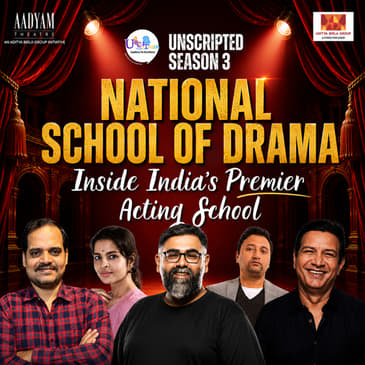

Aadyam Theatre Group’s Unscripted with Akarsh Khurana is back!! And this time, we’re starting with a bang!
With what is basically every desi theatre kid’s dream — NSD (National School of Drama). So get your ears ready, your theatre nostalgia activated, and your inner actor slightly triggered.
Joining us are Kumud Mishra, Gopal Datt, Ipshita Chakraborty Singh, and Durgesh Kumar, as they take us inside those three years — where sleep is optional, hostel beds are mostly decorative, and your sense of self is… negotiable.
From “Home Image” to “Lens of Status,” from Mandi House addas to full-blown existential spirals — this isn’t just training, it’s a personality overhaul.So if you’ve ever thought, “NSD try karu kya?” — or just want to witness what goes into becoming an actor — stay tuned.
This one’s not just an episode. It’s a rite of passage.
Lights. Stage. Chaos.Welcome to NSD.
Presented by Aadyam Theatre, An Aditya Birla Group Initiative
Executive Producers & Promoters: Hyperlink Brand Solutions
Aadyam Theatre Artistic Directors: Nadir Khan & Akarsh Khurana Podcast
Host: Akarsh Khurana
Podcast Partner: MnM Talkies
Video Production: behindthesteve
Social Media: Kern Culture PR: The Other Circle
Unscripted with Akarsh Khurana, Aadyam Theatre, NSD, National School of Drama, Akarsh Khurana, Kumud Mishra, Gopal Datt, Ipshita Chakraborty Singh, Durgesh Kumar, NSD podcast, theatre podcast india, hindi podcast,NSD life, mandi house, delhi theatre, indian theatre, actor training, drama school india, theatre actors, bollywood actors, acting school, theatre culture, stage actors, actor journey, acting career, theatre community, mumbai theatre, delhi actors, NSD stories, kumud mishra interview, gopal datt interview, durgesh kumar interview, ipshita chakraborty singh interview, panchaayat, meta
[00:00:00] National School of Drama is the most premier theater training institute of India. NSD is almost a brand. NSD I don't ask anyone to ask 500 rupees, and I'm talking about so many people in front of me, this is the one that I have done. I thought this is a school, it's a different school in the world, and here comes one day. In my work, I really give credit to NSD.
[00:00:30] You have to know that you are sitting in India, you know that you are sitting in a very small business. Bank balance may be zero, but you will be a hero. How? The world will understand better and better yourself. That's why do you do it, and do it.
[00:00:56] Ladies and gentlemen, please welcome your host, Akash Khura.
[00:01:37] So, today our four guests, they come to work. So, I will talk about NSD's talk, because they are more comfortable. But I am talking one by one. So, our first guest is the darling of Darbhanga. And he has the most popular line from a very popular show called Panchayat, which most of you will know. So, when he comes out, please say the line.
[00:02:06] Because that will be a great welcome for him. So, our first guest is Durgesh Kumar. Popularity, NSD. Our next guest, actually, besides being a wonderful actress, was also on the curation committee of Aadhyam this year. Every year, Aadhyam has a committee that comes together of theatre people
[00:02:33] that go through all the applications of the plays that come and help choosing those. And then they get shortlisted. A lot of people don't make it, don't be upset. There is a process. There is no bias. But she was on the curation committee and she has just won the Meta Award for her performance in a play called Kadambari. Ipshita Chakrabarti Singh.
[00:02:53] The next guest I will call the other guests. So, I am a English theatre fan. I always have done English theatre. I didn't understand that I am a little uncle-sir type of guy. But in the theatre, my first dad and first kaka were these. Gopal Dada and Kumud Kaka.
[00:03:31] The next guest I have done is a great guest. He is going to be here. He is a great guest. I am a great guest. Thank you, we are done for today. Thank you, we are done for today. because NSD is a very important question.
[00:04:00] I think many people have a lot of information about it, but what is happening in there, that is probably not sure. And they must know it. Actually, I want to start with a very simple question. I mean, there are two questions, but you decide how to do it. When you were here, how was your first day? And I want to ask another question, is that what was your name for your NSD? When you got admission, how was your first day?
[00:04:29] Can we start with you? I have a new memory, one minute memory, so I'm going to tell you about it. My big big memory was that if I will do NSD, then I will get my work in a film. My big memory was that I will get my work in a film. Yes. My big memory was clear, because I had research it on 98, after that, and I had research it on 98. So, after that, I went to the admission,
[00:04:59] but it was the second time. So, I understood that when the admission was done, I would take some books from Gajal Vajal, and people would say, that they are a singer-a-actor. I was reading a book, and I was reading a book, and I was reading a book. Everyone saw that. There was a girl from Bombay, and she also saw that. Everyone saw that. Everyone saw that. But, I was reading a book,
[00:05:27] and I felt like, that I would not be able to sleep here. You will not be able to sleep for 8 hours. And the way you learn, you learn. And that is, the orientation of the whole Delhi has been filled. I felt a tough job. And that was the first day I felt. That was the first day I felt. That was the first day I felt? No, I felt like I was asleep.
[00:05:56] I was asleep now. So, there was no one to take the N.A.S.D. for the day? No, no, no. There was a lot of good things. You don't have to sleep. Actually, yes. I would like to act on this. We also had a joke about the boys hostel. It's a place where there are very many people, but there are no one to sleep. Because there was no time. There was no time to sleep. You told me that you all sleep in N.A.S.D. You told me that you all sleep in N.A.S.D. You told me that I was doing rehearsal. I was sleeping in the auditorium.
[00:06:26] No, you can sleep in school. Library. But boys hostel, where you feel like sleeping, I don't have to sleep. I'm not going to be a location. I'll come back with you. Okay. Ipshita, how was your first day? Honestly, I don't remember the first day. I don't remember the first day. I remember your first day. I remember the first day. I remember the first day. Because my first day was not the last day.
[00:06:55] So, we were all back with the man-bios. Look, this is what happened. This is the Jhaipur Rajasthan. Oh, He's so talented. These people were watching films. They were watching films. They were watching films. No, no. You observed them. After that, you were watching the show. You were watching the show. This year, the 20 actors of India came out. We were watching this. We were watching this. I was watching this.
[00:07:25] Thank you, Durgesh. I don't remember the first day. Honestly, I don't remember the first day. I didn't remember the first day. I was happy. But I was happy. But first impressions, first week, getting into it, what did it feel like? It was very fun. It was very fun. It was a young batch. It was very fun. I was happy. I was very happy. I was happy. When I was in the 12th class, we played a show in NSD.
[00:07:55] And then I thought, what is the school? It's a different school. And one day, I was happy to come here. So, I was happy. I don't remember anything. This is a very old thing. Do you know your story? People told you how the first day was your first day. It's a joke. What was the fact that I was a play? My selection was that, I had a play for first year. I was playing with Bhopal for a play.
[00:08:26] I was playing with Bhopal for a play. I was playing with Bhopal for a play. I thought that I would play in the next year. I was going to play. And when the play was done, it was all seniors. The first year and the drama. When I was ragging, when I came to my first year, I was playing with Bhopal for a play. I had a little bit of a play. A man came to my first year and I was playing with a ragging. He was a senior.
[00:08:57] I was a senior. He was a senior. I saw Ashish brother. I saw Ashish brother. I don't know if he was a play. I don't know if he was a play. But I was playing Ashish Vidyarthi. I saw him playing with a play. I was playing? I was thinking about it. I was just playing. Come on. Yes. He told me something. There were many things that didn't happen. He told me something. He told me something. Ashish brother, listen to me. I was doing something.
[00:09:27] He told me something. I told him something. He told me something. He told me something. But I couldn't imagine it. I think, he realised that he's been kind of a play so much. It's been very exciting. But we were very excited. Having come out there. But the first year was traumatic. It was both traumatic. So, we started something new and started looking at that game.
[00:09:57] And I think it was better. As the fact, for some years it was been going on and saying it was kind of a disease. We started to have a career in which case we started to have a language and it was very dark. When we started this interview, we had a break. Our director was Anuradha Kapoor. He had a UGC notice and stopped. But this time, the teacher took us a ragging. We felt like that. No, I was the last batch when we were ragging.
[00:10:25] When you were watching this, then we were ragging. In the first year, we were able to speak a lot of girls. We were able to speak a lot of juniors. And they always have the reason to say, if you were a Sakharam binder, how would you say it? It seems that we would only do Sakharam binder and do anything. It was happening with girls. But I heard that the ragging is more than girls.
[00:10:54] The course of the NHD, I think it's been three years. And the equation of seniors, over the three years, is that a good equation? Does it get better? Are they helpful? Or is it always a senior junior game?
[00:11:41] Does it get better policy on that issue? I think that every batch will be the same. But my experience is the same with my three batches. I think it's where I come from. And the projects that are coming together, do you work with seniors? Is that how it works? Yes, yes. It's not that we don't work. It's a very good job. First year and third year, because in first year, there's no way of acting. It's theoretical. So, the plays in third year,
[00:12:10] the small roles are normally from first year. For example, when we had a kingly year, there's a very big cast in the third year. So, the small duke of these, all small roles, we're all working on. And seniors who had diploma projects, who wanted to be a part of first year. So, we've done a lot of projects. And within NSD, we have to go for three years. Do you have specialised or do you all learn? No.
[00:12:41] First year is common. Then in second year, you have to choose either design or acting. So, for design, there were six seats in our time. In our time, in the last year. Maximum, six people can take a course. And if you're director, they're also going to design. Yes, yes. In the theatre, you design a scene. So, six people are maximum. But, more than acting. Like in our batch, no one has done design course. Everyone has done acting course.
[00:13:11] So, someone eventually directs from that? Correct. And you all have done acting? Yes. Yes, all have done acting. You're not not done design? No. I did not. I didn't have done design. What is the criteria? Yes, I am going to select the criteria. But, yes, there are three places. You have to design a set design. You have to design a costume palette. And, you have to design a whole description. It has to be a way of a way. It has to be a Q&A. And then,
[00:13:40] the committee decides that you will give it or not. So, yes, no. This time, that was the one thing. When I got to the award, I got to the award of Mithya Surk, I actually gave my speech Ajit. And, he was also the one who made it. So, the speech was the one who made it. And then, the director of the stage, Ajit told me that I got to the second year that I got to the second year. I got to the design project. When I got to the design project, I said, no, you will not be with me. So, you don't do this design project.
[00:14:11] And, I am standing here and I got to the award for Mithya Surk. So, this is what he said. You have to have a system to break down, Ajit. Nice. I have to ask a broad question. But, like, the NSD and the Mandi House area in Delhi, I think, when you were all in the Shridam Center, Kamani, all of them were there. And, the Triveni Kala Sangam, all of them. So,
[00:14:40] this is a area, the Mandi House, where there are so many theatres. And, if you go there, it's a place that lives there. I actually didn't see it in India. So, when you were there, what was the place? How was that place? That's the place where you are going? Do you know, all of them have been with a common vision? What kind of people? What was the place? What was the place? That's the place of my life.
[00:15:08] That's the place of my life. It was the place of my life. Before the NSD, Bhopal, Bharat Bhaun. After that, when I was in Drama School, I was in Drama School. It's a different story where everything is found. But, above all, the Mandi House, was a very good place. It was a great place. you're in the day, you're in the Shriram, in the Kamani, in the LTE, in the LTE, in the film,
[00:15:38] in the Kathak, in the Kala Kendra. There is a place where there is, there is a place where there is. There are more classical dance, music, singing. That's the place where the moment I was in National-Pacal and Smalls like I had mentioned. We've seen, and
[00:16:18] school of school, I think that it is not a sustainable. There is so much exposure, so much exposure with art forms. How much you take it is to your own. How much you take it. Some people who don't leave the hostel for three years, that can be a sustainable. But the one that has opened up for you, the one that has been a very good experience.
[00:16:47] And the most interesting experience of NSD, the people who were in the theater, the church was in the campus. They were sitting there. So the kids who were studying, there was a very direct interaction with seniors. So the work outside, the church was being in the inside, the work outside, the people who do經estart tours
[00:17:16] and think about this. So the rest of the film that you are in theabondies have found close attention to. It was a very enriching experience. For me, this is a very good experience. The last time you had seen that that the theater were also in the last episode about NSD, which worked for the types of theater, and the you worked on directors, and the exposure that you have affected. How has that affected you?
[00:17:47] That's the same thing, as I was saying before, that it was a center, a whole area. And since you are an NSD student, you were a little privileged that you would get an entry anywhere. I remember that the film came from the Royal Shakespeare Company, his comedy of errors. So, there was a lot of violence.
[00:18:16] People were looking at the line. But because we were NSD, the director gave us something, so we got an entry. So, there was such a big center at the time that whoever is playing anywhere, he is coming from the same place. And you have easy access to it. You are seeing. The thing is that the one who has to see, the one who has to not see, you cannot forget anything.
[00:18:43] But if you are interested in things, it was just like that everything is concentrated in one place. And did you have also made a benefit of such things that you have to be able to do? Yes, it was a very useful. I have also made a benefit of such things. And for me, the festival of Bharat Rang was a big part of the festival. It was such a thing that, if you don't even have to step outside the hostel, I think there are also some things
[00:19:12] that you get to the plate in NSD. So, I mean, on one campus, you leave an Indian play, you have Polish play, you have German play, you have everything you are watching. At the beginning, we were very negative. And we didn't even know this thing, that we have to do with Natak and subtitle. Because, after coming to Jaipur, the subtitling of Natak is not a concept of Natak. It is like Natak, you have to understand.
[00:19:40] But when you see Bharangam, you are coming to the world, and you are studying in first year, and you are watching Dolls House, you are watching 10 of the 10 of the 10th century, and you think that Baap Re is a very important thing that you have to understand without the syllabus. So definitely, NSD for 3 years, and then, we have to close our seats, there are things that get into you.
[00:20:08] And you also have to see the opportunities and the available opportunities. You have also seen a lot of foreign theatre. Yes, we have seen a lot of foreign theatre. look at this, we have to understand, that language is not a matter of anything. I have to understand, but I have seen a German, and he was just taking a seat and taking a seat. Ankur Ji told us, that the story of the story is the same. He has to relate to that. He has to say that.
[00:20:38] He has to say that. He has to say that. this kind of thing, that you want to learn, I want to learn, but you have to say so much, and then, you will go out and go out and go out and go out. You will start to change. I am here, I do not want to ask anyone here. And so many people, I can speak in front of you, that is the thing. This is the theatre.
[00:21:08] Actually, there are two questions related to this. And now, you have been quite a bit of time, and some places you have done theatre, performed, shoot, so there are two things. One, I do not know, I do not know. we are going to be the place. So, today, we are going to be the place. The other question, is that, why do we have not achieved this? And, why do we feel like this? you are going to be the place,
[00:21:38] that we are going to be the place, and we are going to get this, which we will get the place, which we will get the place? I think we must be the place. It is also the place. I think, the question is, why do we not achieve this? I think, the answer is, the NSD, is a cocoon, and, and, I think, that, we will keep on the mind, that, that, that, I am going to study and learn. So I have to take all these things inside.
[00:22:05] But in Bombay, no one can only learn. That is a laboratory. And here is, I have to apply it. I have to give it to someone in audition. So that is a little bit of a problem. So, no definitely not. Because everything has changed. The system has changed. The education pattern has changed. Student-teacher relationship has changed.
[00:22:36] So, I don't think that it is the same thing there. No. How do you think? Sir, I have to say that the thing happens, that admission is that there is a name for 80 children. They are named for three years. Now, I have to say that the age is also changed. Now, I have to say that the person will be NHD.
[00:23:03] So, that is a pattern that we have heard. And that is the person who has ever heard. And that is the person who has tried three times. That is not the person who has tried three times. So, I have to say that the person who has tried three times. So, the person who has tried three times a day should be a teacher. And that is the person who has tried three times. That is the person who has tried three times a day. You are now, Gopal, you have also gone.
[00:23:29] You have also made music for a role in NSD. So, I have to say that the person who has tried three times a day should be a teacher. And that is the person who has tried three times a day should be a teacher.
[00:23:56] Because the person who has come to the students, they are new. Because we have seen it all out. We are now seeing it from another perspective. But I think that the person who has come to the students, is that they are all things. If someone is in a small town, they are also very overwhelming. But, Ipshita said that the number of students has increased.
[00:24:23] So, the attention was one of our batch. There were 20 people in our batch. There were 20 people from the batch. There were also people who had gone through 20. For health reasons or anything. So, the attention span was very much. The teacher was continuously watching your progress, your process, everything. I think that was divided. But otherwise, it was the same feeling. And, as I said, the government has a very big role in this.
[00:24:52] You are saying that, why did not become a person? That is a place where you go to the 3 years, then everything is taken care. You have no question of survival. You have got a scholarship, food, everything is sorted. So, now, you have to learn only. Although, there is a generalization for a total month. You have to learn only. You have to learn more. You have to learn more. You have to learn more. You have to learn more.
[00:25:22] I can say more. Where will I be again? What will I eat? That's why the government's role is very important. The important role of how to establish such art institutes. Otherwise, Otherwise, it is a very generous company. Because it will be patternizing. It will not happen without that. That is a big difference. As you said, like Ipishida, I'm talking about NSD. Maybe it would have been a matter of saying that it wasn't.
[00:25:52] Or like in Japan, or like in Bharat Bawad, where you worked a lot. Maybe it wasn't that matter when you were there. We were gone, but it is not a place that happened in a while. Again, there are two questions. Why do you feel like all our society that had been a lot of great things, and now they are not doing that? And secondly,
[00:26:20] you have a lot of time in Mumbai. You have a theatre company that is very successful. Almost like that. It is a lot of time. It means that people give a lot of money, but in Mumbai is a very very very theatre capital. And people say that Delhi is a little bit of time warp. But Bombay is maybe the frontrunner right now. Maybe after that Bangalore. I don't know. So why do you feel like this? Why did it happen? You have a very great question. But it is not easy. I have a very good question.
[00:26:50] You have a lot of time. You have to think about it. I think that the idea of art has changed. It has changed. It has changed. It has changed. It has changed. It has changed. It has changed. You have to think about it.
[00:27:19] You have to think that the way we were going to Delhi or in Bhopal and we were going to see theatre, cinema, dance performances, we were going to see all those things, the way we were going to see it, it was only good and bad experiences. There was good, good, bad experiences. There was no mistake. was the thing that we are saying and how much the difference is on our own
[00:27:49] the reason that we have to keep our own now we have cinema or theatre or any art form that doesn't mean we go to entertain for our two things if cinema is so much money we can make it better if the theatre is good or bad, then we can't do it.
[00:28:14] We can't do it. We can't do it. We can't do it. If it's not, it's very low. For some kind of work, some kind of work, some kind of work, some kind of work, is the society. Is it not? And how much is it? Because if we listen to our children from the Marathi and the Bengal, the society, we listen to them because it was the society
[00:28:41] of the society. That's why we have so much rich. If the government is now surviving, then it is the society of the society. If the government is surviving, it is the society because of the society. I think it is the society where it comes from. If we have the society, we can't. The second question is how the society begins. We are at work. The second question is that the institutions are going to become
[00:29:08] because they are not. We have some foreign people who have been by the Rehman, the Rehman, the Rehman, the Rehman, the Rehman, and the foreign foreign foreign foreign foreign foreign foreign foreign foreign
[00:29:34] and we need to be in school. We all need to do this, but because we need to do this in a society, we need to do this. And any other society, which is the most important thing is that it is very important to us. If we look at Hindi, we see more than Hindi, we are also the people of the country. So, there is a way to see a theater, look at that. It is not a luxury.
[00:30:04] It is not a luxury. In the city, it is a luxury. There are people in Bengal. They are one of their own pieces. In the city, it is a luxury. In the city, it is a luxury.
[00:30:26] perform card is a good thing to go to work with a big major problem I am not saying that today the world is not going to happen it will not happen to the generation has changed their language and their language change the language and we are not connected to that. Let them figure out their own theatre,
[00:30:55] whatever they do, they will understand. They will figure out their own language, and they will be able to get back to it. Because when you give time to your life, you give a form of your life for 35 years. Whether you are a Rattanthiam, or a Panikar, or a B.M. Shah, someone who was a director of the theatre, he would have to put a whole life on his own. Then, Rattanthiam,
[00:31:25] or Panikar, or Panikar, or Panikar, or Panikar, or Panikar. Now, we are all together. We are together. One and the other, there is no connection between one and the other. If I am a comedy, I am a comedy, and I am a comedy. If I am a comedy, I am a comedy. This is not an ideology. We are only together. Because it is my need. The only need I am, I am not a non-nirdeshak.
[00:31:54] This is a very long answer. I am sorry. Sorry. It is a good job. I have been so happy. I don't even know my ideology. After getting the PhD and PhD, there is another thing that you learned in PhD that you can use today. In your work.
[00:32:23] There is a way that has been left. or any process or exercise or any idea of an ideology. Is there something that you give credit to NSD? I think there are many things. I think that the way I am trying to get a job of doing this, is that the drama school is going to be a big part of the drama school.
[00:32:52] We are going to our teachers, Anwadha Kapoor, Ankur Ji, Kiriti Jain, Khalid Taib Ji, faculty. We were not going to do anything, because we were not going to do anything good. We were going to dismiss it. We are going to say that we are going to do everything. But if we are going to see it very practical, Anamika Ji, when we had exercises in the class,
[00:33:22] and the students who had exercises, their theatre, if you can see it, it is an extension of that exercise. I always say that it was a home image. It was an exercise. What is your home? I was giving it a week. When you were looking at it,
[00:33:52] you just want to see it visually. What is your home? You would have to describe it. No. You would have to present it. You would have to present it. No. You would have to exercise. I would know what is your home. Now, as we are, they have given exercise. We have to give exercise. We have listened to it. And we forgot. Now, we have not done anything. And,
[00:34:22] one night before the day, we have to say that, we are going to exercise. What do we do? So, my batchment, I went to exercise. I went to exercise. I thought, I thought, I thought, what do we do? I thought, what do we do? what is your home? I said, I don't know. I am going to study on boarding. I said, I am going to study on the board. I said, I said, you have to do the letters? I said, yes, I said, you have to do the letters.
[00:34:53] Now, there is a letter. There is an image. What do you do? What do you do? I said, I did a exercise on the floor. I will tell you, the problem will be higher. But, I did something there. And, the great teacher, he saw it. And, he had to do the things that I didn't know. I didn't know. He had to do the meaning.
[00:35:24] And, after class, we also said, we didn't think so. This is about 10 years later, that nobody ever realized everything you did. It was that you had to do it. The crisis was the most dalek. In order for you, the Grit teacher, the picture, the expression. But, if not,
[00:35:54] the result is, we are a hundred years later, when you are working, you will show 10 years later. So that is the greatness of NSD. And you don't have to do anything in that day. You don't have to meet any moments, sometimes you'll be ashamed of yourself. I think in drama school is a shame of ashamed. I think you are saying that
[00:36:24] Our teacher Robin Das, he said before class that I will tell you what I will tell you after seeing the world. I will tell you that the person will change the perception. I think it is important to me today that it is a very important tool. He said that the status is the status of the truth.
[00:36:48] If you are seeing this status in life, you are always looking for the struggle. You are always looking for the struggle. If you are seeing this status, you will develop a different understanding through the lens of status. I think it is an important tool for me today. You are thinking about this.
[00:37:18] You are doing this. You have to have pressure on you. You have to have pressure on you. You will have pressure on you. You will have pressure on you. Now it is changed. Now the form has changed. Now the view has changed. He has changed my mind. He has gone. Now it is changed. Now it is changed. Definitely. It is changed. I am very proud of my work.
[00:37:47] I really give credit to NSD. Never mind. I am not even coming from school. I am not coming from school. And so, after talking to people, people will be angry. They will say that they will come from school. Now it is changed. Now it is changed. Now it is changed. Now it is changed. Now it is changed. You have just changed. It is changed.
[00:38:12] Now it is changed. Now it was changed. Now this, if we change the political class of this morning, we are having the coloring in the night and we are doing some contemporary styles and we are doing a lunchtime. So there is used to be teachers and directors who used to say that why do you change the language class and how do you change the classes? how much of this portion you are now in your art
[00:38:42] and in your character building that is what will make you a complete actor that you can reflect on what you are teaching in classes class has been closed for half hours so that's why the classes are not there so I just feel like now there are teachers not just because I know how students are struggling
[00:39:10] and without any grudges against the student I am always working on this job there is always Anuradha Mam and Adil sir there with me I remember that Adil sir was saying that you always perform for your secret partner so I was saying
[00:39:39] so I asked him I asked him that secret partner I said yes, it is not and he said that the partner can change every time just for him to perform so people said that he was not here to see him today and I thought that my secret partner is watching I said that it is a secret that you are performing for that person so every time I go on stage there is always that secret partner that he is performing for me I think
[00:40:09] so it is always there he is always there that is not I was like this one is always on stage with me how can he be there he is not a secret also
[00:40:53] I am Radha Kapoor, Adil Hussain he is working on this mission for 12 hours for 8 hours were hard he was working on this mission his own body he was sitting on one mission and the other he has stopped thinking and here he has started thinking that day I thought that is something that is happening I have to think about thinking before I have written a book on the screen. This was one of the things. What was written in the face? We will write in the script.
[00:41:23] Why did you say this? We learned this in your story. We have written one dialogue, and why is it the other dialogue? What? You are saying it. You are saying it. I said, did you do your own acting? Why did I say that? I'm asking myself. Without this, my existential crisis will start.
[00:41:53] I mean, make a big script, authentic writer, authentic publication, everything. Checkup or anyone else. After one line, the other line is the only one that you want to say. You say what you want to say. You say what you want to say. You say something. You should say something. You should say that line. How many research. This is taught by me from a very early, but I'm just sitting here. I'm sitting here,
[00:42:24] I'm thinking of doing this. So do it. Who did it? I'm thinking of doing this. I mean, it was so long. I observed that your body will say what you want to say. How to say it? Dadapannaam. Dadapannaam. I will do it. Do it. And then edit it. Make a note. And this is what you think. When you approach your work, do you think like this? Yes. I think that's the only thing I want to say.
[00:42:53] I don't want to say much about it. I think that's the Amazon. I think that's the only thing I want to say. Now, I'm not saying anything. I'm not saying anything. I'm not saying anything. I think it would go and use your iPhone. You won't say anything.
[00:43:24] Don't say anything. Come on. You can't hear anything. You can't speak, but you will say anything. So in this challenge, I'm doing the same thing. That's all I think. I'll be using the same thing.
[00:43:49] I have a question after NSD, how strong your alumni network is in touch? Is there a system that has different communication? How is the alumni of the alumni? The people who work with work, do they work? The people who don't do it, do they work? No, when you do it, see what you do.
[00:44:14] I have a question, if someone says that I am from NSD, then I have a question. Is it? Of course. Repulsion? No. Because I think that they have given their three years, they have given their own, they have given their own, and many people also give their own. Just because you are from NSD, you can become an actor, you can make a guarantee.
[00:44:43] You are going to go to training. And this is not the case, three years later you are gone and become an actor. You become an actor, you become an actor, and you are going to have to try to keep it long. The people who are 15 years after you try to keep it. But yes, NSD, there are groups of batch mates, we have to be groups of batch mates, and among those who are seniors, Some people have become a very senior. They have become a very senior. But they don't have to die. They have to go out of their lives.
[00:45:14] But when you work, when you see a senior who has seen a job, they come and give you a surprise. When you see a job, they get a lot of joy. Like our senior, Ravik Hanwilkar, who saw him in the Rappetree. They had to go out of school. At that time, we were going to see three dancers. I think that
[00:45:41] about NSD is the same thing. People don't have to see their dancers. The very old band, the Dubeji, the Kandis Satyad-Dubeji, that NSD doesn't have to see their dancers. And this is a gap between NSD. They feel like that I think we have to do a lot of work in cinema, so I gave it to me for the theatre. That's a good thing.
[00:46:09] But I think I should have seen a lot of music. You've been talking a lot about the film. No, it's not right. Have you done some work with seniors? Have you had experience with them? What are you doing with alumni? Yes, I have worked with seniors. Actually, that's the thing that my dad said. I saw my work and they saw me. They are so good.
[00:46:41] But I am never on any such WhatsApp group that says NSDLV is a 15-year-old group. Is there any group? Yes, yes, there are groups. Do you guys have that? I don't. You are? No sir, I was there but I didn't. Did you leave it or did you leave it? No, I left it alone. Actually, I said a very good thing.
[00:47:10] I wanted to ask this. You are saying that NSDLV is a training for the theatre. There is no guarantee that you will get a job. That is what happens. That is what we will get to work in acting. We are learning in retrospect. But when we are out of NSDLV, we are out of the world. What is the expectation that I have learned this that I will get a job? And if it is not a job, and it is not a job for people,
[00:47:39] then what do we feel? What is the experience immediately after NSD? You are working for the theatre. If you have to work in theatre, If you have to work in theatre, then it is always for you. So, from NSDLV, that is a benefit, that will be a benefit? No, it is a benefit, I don't know. But it will be a job. You will create your work. That is why you have to work in theatre. NSDLV has done this for you.
[00:48:07] You will go outside and you will give a job. You will create your work. Like the rest of the people have done. And the people are doing it. When you came to NSDLV, did you know that you would get a privilege? No, I didn't think that I had a privilege. It was not. It was not. It was not. It was not. And it was never been a privilege. If it was a privilege, then it was not a privilege. Because NSDLV was not allowed to be a privilege. You did not have to be a privilege. You did not have to be a privilege. And that is the privilege of being a privilege. And it is still going to be a privilege. So,
[00:48:37] if it is cinema or theatre, it was a family theatre. So, when I was here to the theatre, when I was here to Bombay, I was here to the theatre. I was not here to do cinema. I was not here to do cinema. I was here to do cinema, but I was also doing theatre. I don't think that that was not. And what was your expectation? No, expectation is that you have been in theatre. Yes. You have to be discouraged. Actually,
[00:49:06] when you have a final interview, if you say that I will go to cinema, then you will not have to be a selection. It is that. Because it is the focus of theatre. Correct. And when you go out there, I think NSD has a confidence that you can create theatre yourself. It is so much of its work. It is the focus of the theatre. But the thing is that
[00:49:34] you want to do it or not. And when you are in cinema, when you come to the theatre, you realize that it is different. So, you must feel that you have confidence. The confidence of the theatre that you have to keep the confidence to keep the confidence. But you know that there is a different form, different world, different people, and different people. So, you have to be a little bit of a time.
[00:50:05] But, it is a little bit of confidence that theatre has to be the confidence that NSD has to be. There is no expectation that I will not have to be in the film. But, you know that you are from NSD. I will not have to be in the film. It is a different behaviour. Yes, I have to be in the film.
[00:50:26] I have to be in the film. I have to be in the film. I have to be in the film.
[00:50:52] I have to be in the film.
[00:51:27] I have to be in the film. I have to be in the film. I have to be in the film.
[00:51:44] I have to be in the film.
[00:52:30] I have to be in the film. You have to be in the film. Exactly. there is a lot of research in a film. So, who have been and alsofoods which are about the top three months and the second one.. Aau? Of course.
[00:53:00] that's just a bit of a time. I will have to be in the film. The film has been in the film. these training programs are acting coaching which is which is valuable system which is useful system and which is what we have to say that our society is that we have to be acting or acting or if you have so popular and if you have enough time to be
[00:53:30] limited So what is your advantage? The society that we always want is not always right. No, absolutely not. The society is thinking about it and there is a minority that thinks about it in another country. I think that the society of the society is to ask questions about those things. People who are worried about the issues, they are not afraid of it.
[00:53:58] The society of the society is not very far from us. The society is not very far from us. Even if you're not trained in the society, there is no harm to us. It's a very bad thing.
[00:54:23] Even drama school, even if you know what acting is, it doesn't mean that it's not possible. So, this is the way to teach acting, unless someone is really trained or who knows his job, it's a little bit of a problem. It's a business. Mumbai is a business, a business share, it's a business. But I think that there are good people who take seriously workshops and study seriously.
[00:54:57] What are your thoughts, Gopal? I think that as Kaka said, it is a business. I think that we have taught three years, we don't think that we have learned everything. We also thought that this is an introduction to certain concepts. Then you think that you have learned that concept correctly and apply it.
[00:55:26] I think that it is easy to listen to the status. But when you apply it, you think that it is complex. So if you need a basic introduction, it may be okay. It depends on what you are taking in the workshop. It may be basic concepts, but otherwise it is a very time-taking thing. Actually, I think that there is no other answer.
[00:55:55] I think that… I think that you are taking a lot of young actors training. Right? So, what kind of young actors are you doing? What process do you follow? No, Ujagar has not come to any module. So, it is… We do plays. And for the plays, we do audition. And then…
[00:56:24] Audition doesn't mean that it is not like audition. We share our scripts with new people who want to join. And then we start talking about scripts. And then the end of the play is that… If you are watching these people like this, then we act on stage, we will see how they make the product. So, the people who can live, they will stay. And then they work together. And then they work together. Yes. Right.
[00:56:54] Which is, I think, the process that even we follow. Because I have no formal training. Right. But when someone asks me, that the system was going to be able to join a group. Now, that group is a little old thought. Because that group is going to be a little old thought. Because that group is going to be able to do a day. And then we work together. And then we work together. And then we work together. And then we work together. And then we work together. And many people who come to meet me,
[00:57:23] I always say that our group is not a system. So, they feel like I'm joking. And I don't say that. But actually the system has changed. Because there is no time for this. So, for such a reason, you started acting as an actor's gym. Yes. Tell us about what actor's gym is. How big of your actor's gym is. You are doing something. But if you don't practice yourself 2 hours, you don't have to practice yourself. You don't have to do your own self-reliance. You don't have to do your voice,
[00:57:52] your mind, your exercise, your improvisation. You don't have to do all these things. So, you don't have to do a good shooting. Or you don't have to do a good shooting in the theater. So, all of this, we have told you, that only you have to do 100 rupees.
[00:58:38] I will do a good shooting in the theater. So, you don't have to do a good shooting. You don't have to do a good shooting. You don't have to do a good shooting in the theater. So,
[00:59:29] you don't have to do a good shooting.
[00:59:59] So, I will do a good shooting in the theater. So, you don't have to do a good shooting and you don't have to do a good shooting. So, you are doing the best. You don't have to do a good shooting. So, you don't have to do a good shooting.
[01:00:33] So, you don't have to do a good shooting. So, you do a good shooting. you don't have to do a good shooting. So,
[01:01:00] you don't have to do a good shooting. in the past, there is no time and no need. How do you think about this? There are many different ways. Some of them are very important. Some of them are very important.
[01:01:27] You think that the background is necessary to get a platform. Because there will not be a chance to get a place to sit. So that is a platform. We have a platform. We have a group that are part-time jobs. They are delivering food for the night. They are doing theater in the night. They are doing 4 hours.
[01:01:57] Now, the training is going on one side. The passion is always going to be the need. You don't see the amount of the amount of the amount of the amount. They are going to be side. They are going to be on the side. They are going to be a good profit. So many people are going on to get back. I think that a lot of the younger people are very talented. But the thing is just that they are so much distracted. Because it's not so much, it's not an distraction. They are not focused on their focus.
[01:02:24] I think that you need to do theatre, that is even more than it. I have said that you have producers, you have a team, a drama team, you have made a song, we will produce and prepare. In the past 10-15 years, I have never been ready for a song, because it's not needed. We are giving you the opportunity, you do it. But what is your need?
[01:02:54] The thing is only your need. The question of talent is not the lack of talent. They are very talented, I think that now people have made a team that they have met themselves, and they are playing a big role in their own. But what do you do to do? I think that they are doing this every year, and they are doing it for themselves.
[01:03:20] But they are waiting for somebody who is a elder and who has helped us, and they have all their major needs for their fields. We all have the affected purpose for that. They are not the only economic change in the field and they have such an important role. But they will not buy substitutes. They are being punished for making this business. They are not the most decent people. They are being punished. The oral media. They are not the most decent people.
[01:04:05] ھائنٹی نائن پسند لوگ آیاں سینیما کرنے کے لئے اور ایم ریسپیک ڈا مجھے لگتا ہے کہ وہ ان کی پہلی پاتھی مکتا ہے پر جتنے سے وہ چیٹ کر رہے ہیں ہمارے ساتھ ہمارے گروپ کے ساتھ theater we keep this attention that they do it as much as much and any work that doesn't do it because it will not judge because it is the choice
[01:04:36] my choice can be different but I respect that I think you also you also are what is your role with the younger actors with their intentions and what is your role I think people who are in my group are very hard-working they are very focused
[01:05:05] they are is Ujagar is very very hard-working
[01:05:35] and they are very hard-working
[01:06:08] and they are there they are there changed if I would go to the 15 minutes you will go to the 187 next the coming in Mumbai has not such not
[01:06:36] in the theater I am talking about theatre. Definitely. Yes. But in theatre, the people are doing so much. The people are doing their own. If they work with Ekviras, Ujagar, D4Drama, or Makran Deshpande, they are doing so. They are doing so, because they are doing so. They are not doing so,
[01:07:05] if they will grant or pay, they will grant. They are all doing their own. And the people are doing their passion. How many grants are there? How many grants are there? How many grants are there? How many grants are they? Gopalda? Yes, I am. I am a good answer.
[01:07:32] I have a few questions before the audience that we have sent. We have filtered a few things. We have not filtered the audience. We have not filtered the audience. So, they are coming up. But we will filter them with their questions. We will filter them. So, Palaash had a question for Durgeesh. Hello, Durgeesh. I am Palaash. I am going to ask you, what you have received fame in the panchat movie.
[01:07:59] Now, what you have received photos and selfies. How did you feel about your experience? Before you have experienced the experience, how did you feel about it? How are you handling popularity? Yes, that's how are you handling popularity. Yes, that's how I am. I didn't think I am doing that. I am so sorry. I have something like Rabindasy. I have applied a little bit of Rohindas. He was doing something like Rabindas, but I'm doing something like that. I am doing it.
[01:08:28] But he came to the Amazon, he went to the TVF and said, I don't think I'm a big man, I'm a very normal man. What was the mantra of Robin Das? Robin Das is a very hardcore. When he came to Oscar, he gave me a mantra. He thought that I'm giving a reply.
[01:08:57] There's a shoot at 21 days. He did it there. I will tell you. I will tell you. Yes, I will tell you. I will tell you. Tell us. We have a lot of people here. But after the panchayat, memes made, you were all about your Instagram. You are all commenting on everything. You are getting much love for you. What should you say to the audience?
[01:09:26] I would like to say this. I am very grateful. I am very grateful. Yes, I was very grateful for acting. I was very grateful for the first time I was at the stage. Thank you. Thank you sir. I am speaking in the middle of the night. Namami is here. Namami, you had a question. This is actually for everybody. But ask your question and we will see who feels like answering.
[01:09:56] Basically, the question was that how can you deal with senior and junior tension? Do not understand that there is no senior or junior. You are coming to work. Please take your dialogue. Please take your attention to their dialogue. And as I have done the latest scene of Kumut sir, I did not believe that it was Kumut sir. I was watching the character. I was watching the character. And I was scared.
[01:10:24] And I said, sir, do not do this work. I said, I was scared from my inside. Just, it was. I was thinking, The first thing was I thought, The rock star. The 94. The last pill is a batch mate. He was a dean. Everything comes to my mind, I will not do acting. Please do not stop acting in your mind. The first thing is I think that I am talking about theatre.
[01:10:54] If there is a seniority and juniority role, I think it is not very healthy. You are colleagues, actors, and work together. You will do good, bad, wrong, and share your own roles. I don't know what the name is about the name. If you are from the drama school, if you are from the training institute, then you are all together.
[01:11:23] You are all together. You are professional actors. You are 18 years old, a girl, a girl, a couple of years old, whatever age you can be, but you can not be reduced. I don't think it is worth it. You should have to do your work with the whole world. You should have to do it. If you are in your own life, you should have to do it. What will happen? That will not happen.
[01:11:52] But otherwise, that's fine. This is a question for everyone. Do you ever feel creatively unsatisfied even after a good performance? And how do you deal with that? Yes, I have felt many a times. But I think that is the beauty of life theatre. That you always have a next chance. Yes, I have felt many a times. There are some stories that you can share, if you remember.
[01:12:23] No, no. There are many stories. There are many stories. There are many stories. And it is not so much that, I mean, you have to forget something in the dance. It is evident to the audience. It is for yourself. It is for yourself. What I hate the most is, it happened once long back,
[01:12:50] that I was in a moment in a trance. When I was performing. And my director told me, that is the worst thing an actor can go through. Because he would say that, I didn't know what happened in that moment. Because I was in some other moments. But at that moment, you never need to know an actor. You don't need to know anything. You feel like it is good. But at the end of the day,
[01:13:19] you are performing for us. So, you stay for us at that moment. You can't hold it. It is your job. And act means to do. It is just so. So, just do it. Don't go ahead and do it. So, that day I realized, okay. So, that is it. Secret partner was happy in his performance. It is not a secret partner. It is not a secret partner. It is not a secret partner.
[01:13:47] It is not a secret partner. It is not a secret partner. You are creatively unsatisfied. When you are not satisfied with your performance, then how do you deal with it? Now, tell me. Do you have any fun? My. That is, Gopal. Yes, that is. Gopal is unsatisfied. He is not dissatisfied. He is not satisfied. He is not satisfied. I can't wait for them to get out. I will get back and talk to him. I will get back and get back. It is not a secret partner. It is not a secret partner. It is not a secret partner.
[01:14:17] It is long. It is on the way in a routine. And, you know, it is a secret partner. It is good to do. It is also a secret partner. It is actually the same thing. You are happy to do. There are many people. I don't know what the director is. What did he do? And we feel like today is a great show. And the show is also very bad. That's when he comes to the show.
[01:14:46] What did he do? But when you have to do some shows, you don't do the show. You can do it yourself. You know that today is a bad show. You regret it. You think how to do it. It's a continuous struggle with you. In the show, your hands are more difficult.
[01:15:19] It's very small. You have to go to the whole life. You have to go to the whole life. So, it's not a bad job. It's not a bad job. Because it's not happening. It's a very small thing. It's a good job. It's a good job. That's it. That's it. That's it. That's why I feel like it's not happening. Why it's not happening?
[01:15:49] You can't do it. You can do it. And you can do it. And you're lucky that you know this. Many people don't know. I don't know. It's a bad job. It's a bad job. It's a bad job.
[01:16:04] It's a bad job. It's a bad job. And why do you know it? Hey, I'm so mad! I'm so mad!
[01:16:33] I'm so mad! Hey, I'm so mad. So, I also don't judge. In Bombay, two places. But, but our acting is that the truth is the truth is that I will give you all of this is going to be a good life so if you look at the truth and you can't identify
[01:17:03] you will identify that my child is going to be my child is going to be so this is our last section slow burn section oh simple simple 4 questions and you will give them a good answer no, you will give them a good answer just to say what are you doing so the first question is
[01:17:33] when you were 3 years old what was your favorite class teacher or subject what was your favorite NSD that was the first one Pauline Theatre Group Pauline Theatre Group you were very surprised who are the most favorite who are the most favorite the last class that was my favorite why? because I think my brain is average
[01:18:02] so the body was thinking and I thought I would set it and I would be a good actor I would have to ask production process production process we had done Abhilash Pillai and in that what they said home image there were very little exercises like home image music image news image so that was a good because that was the first time we were doing
[01:18:31] in the first year we had a theory class but at the end of the first year there was a class that had to be actively involved with actors light set and creating your own self in tiny bits production process who was taking this? Abhilash Pillai in the first year there were acting classes but I think that was fun in that time it was aesthetics because
[01:19:00] one was in the library there was AC and Nibha Joshi was a teacher who was very amazing aesthetic amazing amazing an adbut teacher an adbut teacher an adbut teacher and that was said 80% of kids thought they were that he was not and he was doing rehearsal so that was a fun class so I was
[01:19:30] a small story once rehearsal went 3-4 then girls complained that we didn't have dinner break and rehearsing and then Nibha Joshi I will read you World War 2 stories that people have so people
[01:19:59] have done not done nothing nothing nothing acting class but it's a difficult to do to do to do
[01:20:40] to do to do to do to do And the first time in drama school, actors used to make a story of a story. They used to be a few days and just started to do it. The rest of them did it. It was a very good thing. And it was very dangerous. You were doing it alone? No, it was a group. In a group, in a group, in a group, in a group. And they read their stories and read it. They were doing it.
[01:21:11] They were doing it. And they were doing it. And they were doing it. And they were doing it. And they were doing it. But they were doing it. And they were doing it. And we couldn't appreciate it. Because we didn't understand that. When we started to see the theater in Bombay, we realized how big a role is. And we started to see the things. And we started to see the things. And we started to see the things.
[01:21:41] And we started to make things. That was a very good thing. As with our batch, Divinder Raj Angkor, we were doing a story of a strange story. So Angkorji distributed stories and said, I will come to the first draft. So this is what they were doing. And they came to the next 15 days. And we said, We are ready. And we came back.
[01:22:09] And we were sitting in front of the house. And we were sitting in front of the house. And we were sitting there. And we didn't remember the story. We were taking the paper. And so we said, Sir, can you tell us? Or how can we? And the writer came in front of the house. So the second time, when he came back, I came to see the second draft 10 days. So I was scared. That the whole story was prepared. Because we were all together. And we were all together. With props, costumes,
[01:22:39] all. And all actors. All. Next question. And this is, You can also be a role of stage, or a role of film, or an OTT role. Any role. Is it your least favorite or embarrassing? Which one? The least favorite. The least favorite. I was giving Macbeth. I gave him Macduff. I was giving Macbeth. I was giving Macbeth. So,
[01:23:09] I was giving Macbeth. But, I also gave him a good job. when I was giving him a good job, I said, Sorry, ma'am. Then they said, What are you doing? Macduff. I'm doing Macduff. And then, I did Macduff with my heart. So, I did Macduff. In the NSD. It was good. How much role of role you have? How much role you have? Macduff. Macduff. Macduff. I didn't have fun. That's right. I had a song with Ayn.
[01:23:43] Ayn? You can't say it. Say it, brother. It's called Ayn. It's called Ayn. It means constitution. Yes. So, I did a song with a song. I really liked it. What role of a song is a song? I was like, I'm sorry. I'm sorry. Nice. Can you say it? Why? Because they had to do Macduff. I think they had to do Atul's too.
[01:24:13] That's right. That's right. That's right. That's right. My name is a very long list. It's a very long list. It's a very long list. Say it. No, no. Whatever I'm thinking, it doesn't seem safe. In my mind. That's right. Yes. That's right. Yes. There are many things. Your name was a very big name. Yes. That's right. I don't know all of them. Are you telling me?
[01:24:41] No, I'll tell you differently. Off camera. What's your name? It's a very long list. But if it's a very long list, in the art of art, Royston has a very good diploma production. Merchant of Venice. Brilliant production. It's a very genius. It's a very beautiful art. We were in second year, so we got the opportunity. I gave him a great job. I don't know. I don't know.
[01:25:12] I don't know. I think he was a little humor. The character. Yes. And I'm going to take it as a joke. I mean, as a production, it was brilliant. But I was very bad in that. Very bad. I mean, it's a very long list. But why do we go to it? It's a different podcast. Yes. This is a simple question. And today,
[01:25:43] the plays are running, not in the past, but today, the plays are running, in our past, what's your favorite? What have you recently seen? What have you seen them? What have you seen them? Mithyasur. Mithyasur. Is this a promotion? Mithyasur and Ajitesh's Joduba Sopar. Mithyasur and Joduba Sopar. Mithyasur. And if you come and tell me,
[01:26:12] I'll tell you. Mithyasur will you speak? No. I'll tell you, one is Amdabuta. Amdabuta. Yes. And one is Ehem Murakami. Yes, that's what I've seen. Ehem Murakami. Einstein and Ehem Murakami. He's all. These are good recommendations. And last, very simple, fill in the blanks type. NSD gave me a dash, but
[01:26:41] Mumbai gave me a dash. Diyah. Diyah can be a dash. But NSD's dash and Mumbai's dash. Both of them. No, no. No. How much better? They've come. They've said the mantra of Robin Das. They've come. They've come. Dugesh Ji. NSD gave me an admission.
[01:27:13] I love you. He's a genius. I love you. And Mumbai's gave me a house. What a matter. What a matter. What a matter. What a matter. You have to beat this. Beat this. Beat this. Now you? Are you doing it? You're doing it? You've spoken.
[01:27:43] You've spoken. You've spoken with the truth. You've spoken the truth. You've spoken the truth. And Mumbai's got money. Yeah.
[01:28:20] Okay. Six. You've spoken to me. Dream 11. Let's go. What are you doing? You've got to finish it. If you don't finish it, then we'll do it again. We'll do it again. So, I'll say this as a Gandhi Kavita type. I'll say that. I'll say that. That's the most important thing. That's the most important thing. NSD gave me I'm just a man. I know. He's got a bit of labor. I've been on my own for money.
[01:28:54] I've got a lot of labor. Very nice. Very nice. This is good. You don't need any theater anymore. Who's there? This is an active military? What is it? He's a great man. I've got a good man, right? You're a great man. You want to listen to another theater or not? Come on. So, here is the podcast mostly It's a surprise for senior and junior Kumbut Jr. is also a question Kumbut Jr. is dedicated to this and dangerous
[01:29:22] Because today I don't normally sing the theater So, today I'm playing the theater that's what I have said.
[01:30:20] I am a dadap Oh my I am a My My My My My
[01:31:05] My My My My My My My My My My My My My My My we may not be a part of a a whole my person up not just start my person up not just a story man on the app for a two-hour man on
[01:31:31] the app for a two-hour my person up not this house through my current up I'm your father Guruji You're my father Guruji You're my father Guruji You're my father I'm my father
[01:32:04] It's so internal Now we're going to finish the theater We're going to shoot Let's go To do When he was met When you were children What is the pain? 30 years It's been in 30 years
[01:32:33] 20 is reduced The poverty and poverty The poverty and poverty The poverty and poverty Our poverty and poverty We've got these There are lots of living
[01:33:30] do is or not to be do what you do to be or not to be do Shakespeare Hamlet will die do do noida do do do do
[01:34:02] friends I'm telling you why do do do do bank balance zero will fit bank balance zero will be
[01:34:30] but you will be a hero bank balance will be a hero will be better the world will be better and the for the the
[01:34:51] thanks to shantanu and to the the the the the the the Thank you.