
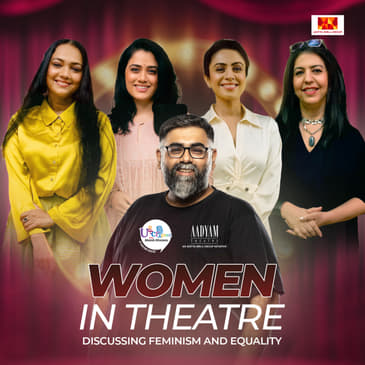

In this episode of Unscripted with Akarsh Khurana - Season 2, we celebrate the fierce, fearless, and fabulous women of Indian theatre — Anahita Uberoi, Purva Naresh, Girija Godbole, and Manasi Parekh.
With decades of experience on stage and screen, these powerhouse performers and storytellers take us behind the curtain to explore the craft, chaos, and courage it takes to thrive in the performing arts.
What does it mean to hold space as a woman in this industry? What are the disparities they face? How is it to be a Women Director in the Theatre Circle? And many more such questions!
Expect honest reflections, humorous anecdotes, and a whole lot of wisdom as they share the joys and heartbreaks of a life in storytelling.
Whether you're a theatre buff, an aspiring actor, or just curious about the magic behind the scenes this conversation is rich with insight, inspiration, and sisterhood.
00:00 -01:03 - Episode Introduction
01:04-01:59 - Guest Introduction
02:00-07:47 - Does Disparity Exist in Theatre?
07:48-12:50 - What's it like to be a Women Director?
12:51-13:39 - Supporting Women is not Feminism!
13:40-20:06 - Difference working with Female & Male Directors
20:07-21:38 - The Change after MeToo Movement
21:39-23:20 - The Disparity in the Technical Department
23:21-24:54 - Less Female Representation in Writing?
24:55-28:23 - Does Female Centric work sell?
28:24-30:44 - The Perspective Of Commercial Theatre
30:45-33:55 - An Advent of Female Driven Content in Theatre?
33:56-38:40 - The Women that Inspired you in Theatre
40:18-43:11 - Projects that you Regretted
43:12-45:17 - Recent Plays Recommendation
Watch the episode now!
📱 Listen on other platforms:
Apple: https://podcasts.apple.com/us/podcast...
Spotify: https://open.spotify.com/episode/32Mt...
Amazon Music: https://music.amazon.in/podcasts/a3e5...
🔔 Don’t forget to subscribe and stay tuned for more incredible episodes this season!
[00:00:02] My room wouldn't lock and then they changed my room and one random man walked into my room, shut the door and bolted it. And my heart stopped for a second but then he unbolted it. He opened it and he says, let's go. He thought it was the other room. Female narratives are like, oh my god, really? You're doing a Gujarati room with two female leads? Like, who's going to come to watch it? Who's going to pay tickets?
[00:00:26] There's this pressure of being the mother of the group and this motherhood is expected from women, right? One thing is constantly on your mind that you have to make sure you're safe. The man-woman work relationship has been completely deconstructed and redefined. And the men feel insecure. They're expecting a bias.
[00:00:50] Hello and welcome to another episode of Unscripted with Akarsh Khurana, an Aadyam podcast produced by M&M Talkies. In today's episode, we talk about women in theatre, both in terms of content and the workplace.
[00:01:15] We have an interesting and urgent discussion about both the female experience and the female gaze. And for that, we have four immensely talented and vastly productive ladies with us. Anahita Oberoi, a stalwart of English theatre from a legacy of female stalwarts. Anahita Oberoi, a multilingual actress, singer and producer. Girija Godbole, another established and popular actor across languages with a strong theatre background.
[00:01:42] And Poorva Naresh, an important theatre voice and a prolific playwright, producer and director and an Aadyam favourite. Welcome to the show. Anahita, Girija, Mansi, Poorva. Thank you for coming on this episode of Unscripted with Akarsh Khurana, an Aadyam podcast. The topic of this was supposed to be the theatre feminine. It's not necessarily a very agenda-based chat. But I actually want to start with something that happened at an Aadyam event and inspired by Poorva. I want to start with that conversation.
[00:02:11] And there was a launch event where... So, I was talking to Anahita about it earlier. Where, you know, we are under the impression that say, of course, you know, in terms of say disparity that exists that we talk about, you know, in working conditions when we are doing cinema and stuff like that. And one has always assumed that in the theatre, it's quite a, you know, level playing field. And Poorva made a very good point where she was talking about, you know, working with Aadyam, which she's done a couple of times now.
[00:02:40] And she said that one thing that Aadyam has provided is rehearsal spaces with better toilets for women. And it was a very eye-opening for us as well while we were talking about it. Like, yeah, okay. And then we realized, oh, we English theatre people, you know. Perhaps we don't see the world in that manner. So, that was one point. And it was very interesting that I was recently doing a show in Delhi where I had gone with my lighting designer, Yael Krishna, who's done a lot of work.
[00:03:08] And she actually at one point at a time told me that they don't listen to a female lighting designer. So, I just wanted to open the conversation with a little bit of perhaps what we are not aware of. But particularly in the theatre and English theatre and the theatre and you all have done some regional theatre as well. So, does that disparity exist in this workplace, in the theatre space that we sometimes foolishly believe is a safe space? So, is that something you all have experienced, all of you? Maybe you start since you brought it up. Everywhere.
[00:03:38] So, the disparity does exist and definitely does exist in theatre as well. And have you all seen it more in, say, when you all are doing regional theatre? As a producer, producing regional films and working with a lot of theatre actors now who do film work, female narratives are like, oh my god, really? You're doing a Kujrati film with two female leads? Who's going to come to watch it? Who's going to pay tickets? That happened when we produced Kach Express.
[00:04:03] So, definitely there is disparity and the fact that I also produce and I am active. So, when I'm producing, I'm talking to maybe an investor or I'm talking to somebody else. They're not used to having a woman producer, you know. But this is purely, you're talking about the cinema experience. I'm talking about cinema. And theatre, if I had to say commercial theatre, for example, Gujarati theatre is commercial, right? Most of it is commercial. Most of it is male-centric, if you think about it. Like, it's the males, you know, like the guys who get the audiences are the men.
[00:04:32] As compared to Gujarati theatre, I think Marathi theatre has a few women who also draw in audiences. But then again, very few in number. And coming back to the first point where we started from, I have travelled, I have done a lot of Gujarati commercial theatre and Marathi commercial theatre also. And I've travelled to smallest of cities in Gujarat, right from Bilimura, Porbandar to, I don't know, some godforsaken small towns on the Kach border and really, like really gone into the interiors.
[00:05:02] And yeah, it's horrible. There are no washrooms, there are no changing spaces. There are some places where there's not even like an enclosure to change. And something as simple as, so when I was doing this one plane, which I had a lot of changes. And they would literally happen while I would walk from one wing to the other. So I would walk out taking clothes off and halfway through put some on and come back. And I had to really be careful of who's around and who's not.
[00:05:31] And it's only slowly that people in my team started to realise that they will all have to come together to make this a safe space for me. I, in fact, was performing at a very fun theatre in Ahmedabad, the Tagore Hall, which is a good, big, really nice theatre. I was the only girl travelling with that show. It was Dear Father, which I'm not seeing this part. I've done the film version of that. So I used to play the woman in the play. And I had this, my room wouldn't lock.
[00:05:58] So I had asked somebody to check it and then they changed my room because it wouldn't lock. So I was sitting in a separate room and one random man walked into my room, shut the door and bolted it. And my heart stopped for a second. But then he unbolted it. He opened it and he says, He thought it was the other room. But for a second I thought, over. What do I find to poke him? You know, so you've had these kind of...
[00:06:26] And it's a constant worry and it's what upsets me is that it's that one thing is constantly on your mind. That you have to make sure you're safe, which is a very basic requirement. And you should do away with that at a workspace and then be able to do more creatively. So I did feel very protected. And I have to say that I do know that things like this do exist.
[00:06:50] But I also feel in whatever my personal experiences are, I've been fortunate because I know it does exist. But I've been fortunate where I feel I've either worked with very empowered women who have made sure that things are okay. I grew up backstage in Marathi Theatre and the same thing in all these dauras. And, you know, you go to the tiniest villages.
[00:07:18] But because I was traveling with the head of the production or the play was my mother, say, who was a woman, very strong woman. So made sure that all the women were fine. So, but I don't know what it would have been like if it was not a play run by a woman. I don't know. Yeah, I mean, I do want to come to the content part of it in terms of, I mean, after the, say, the workplace and the environment. Certainly, I mean, that is another conversation.
[00:07:46] But since you were saying and now you do run a theater company of your own in that sense of what she's talking about, women in charge. Are you finding that you are being able to facilitate any change or are you facing resistance? Or do you think that some headway has been made now that, you know, when you take charge of a situation? When I do make a new play or run my productions, I am faced with this whole thing of this question.
[00:08:15] I'm working with a woman director. Are things going to be any different? And are things going to be and they don't know what different means? Because nobody is unsafe as such. When we travel, they're all friends. We travel via flights or at least, you know, AC compartments. Nobody's traveling second class where you can get poured and, you know, roughed up or whatever. So, and we're taken care of. There's hospitality.
[00:08:41] There is pickup from airports or railway stations and drops and stuff like that. So, there's no question of safety. But yet there is this question of there is a woman director, there is a woman producer. Are things going to be different? And then there is this pressure of being the mother of the group. And this motherhood is expected from women, right? So, I also find myself second guessing myself that am I being a mother?
[00:09:11] Because I definitely don't want to be a mother or a father. I just want to be a director or a producer. But I also find myself questioning myself that am I becoming too relaxed or am I being too lenient? Because a lot of times people come up to me and they say that you're being too lenient. You know, your room is not that disciplined. Like, you know, I mean, if it was a male director, it would be a little different, you know.
[00:09:37] And then a couple of times when it's a gender thing, women are definitely expecting a sharper response because you're a female director. And they're like, I'll do this right now. And the men feel insecure. They're like, this will take the girl's side. Wow, they're expecting a bias. Yeah, they're expecting a bias.
[00:09:58] But you know what, also, from what you were saying, I think one of the biggest struggles I find is that this whole notion of not walking into a room and screaming the place down. You know, people have this notion of what directors need to do. That they, male or female, you know, that there's a certain power with which you come and that there's some ego there and then you have to shout and scream.
[00:10:27] And, you know, I feel that something that I do now, I've realized when I was young and directing, it used to unnerve me exactly for what you were saying. Because I felt I would, my, what I would call kindness or what I would call just professional speak would not be appreciated.
[00:10:51] And I would find that people, and sometimes it was actresses who would really try to push me because I wasn't shouting, because I wasn't saying not this and no more. I found I used to get really thrown when I was much younger. Now, before I start a process, I tell people that, guys, this is my style.
[00:11:14] I'm not that screaming, shouting type because I actually respect your intellect. What I'm saying, I understand that you understand what I want you to do. So I don't need to shout. So don't push me. You know, I'm not a, I'm calm. I'm whatever. I'll problem solve in my way. But this is a way.
[00:11:41] It is a, and I don't know if that's male or female, Akash. Maybe there are male directors as well who have this way of not necessarily having the pressure of mothering or fathering. But that you, I, to me, I feel this is one thing that a lot of women directors feel at some point.
[00:12:08] When I've spoken to them, they seem to have this similar thing where people feel they can push more than what is needed. So your approach or your style or your kindness is being kind of, not misused, but it's being kind of misunderstood. Yeah. And I think kindness is also a very silly word. I feel it's just professional. I don't think, it's not some big thing that I'm doing.
[00:12:38] It's also compartmentalization. Like woman director, certain kind of an expectation. Like she's going to be kinder, warmer, gentler. Yeah. More pro-women. And supporting women for me is not feminism. Supporting human beings is. No, supporting gender balance. Supporting, creating a balance. Creating a safe space. Creating equality. All the time.
[00:13:06] Also, what do you do with people? Like you said, you know, about me too. So there have been accusations that have been made. But your personal experience with the said accused has been great. Now what to do? That's the thumb rule. You go with the version of the woman. Right? Because, I mean, women generally would not. To start with. Yeah. But then how do you go ahead with it? Do you believe in, you know, vindication? Do you believe in punishment? Or do you believe in sorting it out?
[00:13:35] So, yeah, there are no set rules. Yeah, it's confusing. I wanted to ask actually both of you because you're predominantly actors. Besides, of course, your take on this. That you all must have worked with both male and female directors. Yes. And do you see a difference in the experience? The first play that I did was directed by Lilette Dubé called Brief Candle. And then the second was Sunil Shanbagh. And in fact, I thought Lilette was much more aggressive.
[00:14:05] When I say use the word aggressive, it's very clear about what she wanted. And Sunil, in fact, had a very open way of working with the actors. So I realize it isn't gender-based. Yeah, it is. So I thought, you know, I mean, you know, the fact that I'm an artist, I'm also a producer, female producer. It'll be great to have that female narrative where you do not have the mother-in-law and the daughter-in-law against each other, pitied against you. But actually on the same side, you know, together. And so we explored that narrative in the film. And it was shocking because then we showed this film across Gujarat.
[00:14:34] And of course, we took it abroad. We, you know, we released and it was great to watch it with the audiences. And we realized that the audiences loved the fact that these two women were together. And interestingly, these women characters were written by men in this film that we did. Right. So I'm just realizing that, you know, we do have this one perspective, but we also have the other perspective where you have the male who are enabling women to go out there and do their parts. Like, for example, in the film, it was written, all the women characters were written by the males. Men, yes.
[00:15:04] So that was interesting. That is what I'm trying to say. That gender awareness is not a function of biologically what gender you're saying, you know. Men can also be gender sensitive and women can be totally gender insensitive. Absolutely. And it looks like the, it seems like the onus is on women. You know, when you say this is a surprising revelation that these beautiful women were not pitted against each other, were written by men, is going to raise eyebrows. Yeah.
[00:15:31] The fact that that raises eyebrows itself goes to say that the onus of making sure that women characters are not cardboard cutouts and they're more lived in characters and experiences. The onus is on women to do that. So it's almost like if it's a woman writing a script, then it needs to be more well-rounded and balanced. But men are sort of men twice-high looking. And in fact, sometimes what happens is the women sometimes have it easier than the men. The men have to sometimes struggle more. Yeah.
[00:16:00] I see a lot of my male actor friends, they're like, yeah, because you know, women, y'all have more opportunity. And have you felt any kind of difference when you're working with like a male or a female director? In terms of just not necessarily their directing styles, but in terms of say the work that came out of it, the relationship that was formed, the, you know, your mental space in that home.
[00:16:26] I've always had, fortunately, some amazing directors that I've worked with, all very different people, very different styles. I am working with a woman director right now. But I don't, so many times there's this conversation about a woman directing, a woman. And I have never been able to see her like that, a woman directing. She has a style of directing and she is my director. She's also a woman, happens to be.
[00:16:56] But those are attributes that just don't come to me first as somebody who's approaching the person with a problem. I would go to her with something related to the script, just as I would go to my male director. And he would have a completely different way of resolving it. So, so far, in terms of my director, my producer, people calling shots, I have always had a very interesting experience. All of them different.
[00:17:24] Coming back to where I was, circling back to that topic, the team usually finds its balance with the genders. Because in theater, you also land up spending so much time together. For a film, you group for a little while and then you function together and you split. For theater, you rehearse and you're with each other day and then day and then you travel. And that really brings out people's personality. So, finally, people find their safe spaces with each other. For better or worse. For better or worse. Absolutely.
[00:17:52] And then the group has its own way of, it's like a family, you know. It's dysfunctional in its own ways, but it's also functional. So, that's what's exciting about theater, that you start taking care of each other. My complaint is a little bit more with the system around us. So, I have had places where, you know, I've had to travel to a certain place just to use a washroom. And I've had people from my team offer, you know, a ride on the bike for me. They didn't have to do that. But, so you take care of each other.
[00:18:20] My problem is with how things, and Gujarati and Marathi Theater, commercial theater, with the volume of shows that we do. There was a point when I used to do 35 shows a month. That's a lot of shows. We used to do three shows a day on Sundays. So, the theaters are in use. It's not like, you know, with Hindi and English, the frequency of shows is also less. With Marathi-Gujrathi theaters, there are three shows every day in the same auditorium. What is the problem with the upkeep then?
[00:18:48] Why wouldn't somebody… Because it's scary that the economics should make sense. Absolutely should make sense. No, but then the upkeep again, you know, sorry I'm going to this, is that the upkeep is for the theater as a whole. It's not necessarily that the women are being sidelined in that. Right? I'm just asking. No, no. Basically, changing places, washroom spaces, those kind of… I think the awareness, perhaps there are different requirements. Absolutely. Correct.
[00:19:19] I think that the thing is that like, you know, I mean, there's a slightly casual approach to… Like, you know, it's not like, we're not actually being cognizant of the fact that the needs may be different. Absolutely. Which is, I think, something that is not being looked into when people are even making those efforts. And then the team comes together to help you. To save the situation. Correct. But why does it have to, is my question. Why does that need to happen? That is great.
[00:19:42] I've always been around fantastic people who will go out on a limb to do things for all the women and the boys and everybody in the group. But if we're doing the kind of theater that we are doing, which is churning so much volume, then… And so many women. So women have been doing Marathi and Gujarati theater for years. Absolutely, yeah. And I mean, then why not? Yes.
[00:20:07] But you know, also what I've noticed is that after the whole Me Too thing happened, I feel, and this is across the world, and not just theater, not just film, just everywhere. I think now what has happened is that the man-woman work relationship has been completely deconstructed and redefined. You know, and I think that everyone has a lot of thinking to do.
[00:20:37] These are all fine lines that one is constantly… There was a mandate for having a committee at every workplace to prevent workplace harassment. And then they also had mandatory workshops for everybody. So I have a friend who got a workshop at his production company.
[00:20:56] And this person had come to explain to them the kind of boundaries that he was speaking about and what are the do's and don'ts according to the mandatory syllabus of sorts that was part of the workshop. So this one boy asked the exact same question. He said, all these years, I have casually placed my hand on my colleague's shoulder while smoking a cigarette or making a point. And now am I not supposed to do that?
[00:21:21] So this man had a very interesting answer, which is what I told my son when he asked me questions about this. He said, if you're thinking twice, don't. If it just never strikes you, it has never been a problem. If you're thinking about it, whether or not, then just know. That's the answer. So I think also that since we're talking about theatre and where do we see these inequalities and stuff.
[00:21:45] And because you said it earlier, Akash, one of the things that I did feel, if we look at whether it's directing, we've got a fair share of women directors. We've got a good share of women writers. The rehearsal room doesn't seem that out of whack. But where it's very evident is in the technical department. You know, with what Yael said, it's true.
[00:22:11] You know, and I remember even specifically with Yael, when we'd go for deli shows, we had to arm her. So there would be either the sound guy would go with her or whatever. If like she would say, if say I was directing, she would say, can you come? You know, whoever, there was a male director. But it would be that work just doesn't happen.
[00:22:35] They're not taken seriously because they feel that the technical area is male dominated. There are many more men there than women. So there I do feel it's very clear. We were in Jaipur right now. And I have, my producer is Satvika, who's a very established producer. And she had gone for set up. And I came in 20 minutes after. And when I came in, like the people kind of all came and said hello and namaste and all that.
[00:23:03] And she said, you know, they've not done a thing since I've been here. They've only got up because you've shown up. And I'm technically in charge. I am doing everything over here. I'm putting the set up. But it's like I don't exist. So, you know, it was, I mean, yeah. So we have seen that and it's unfortunate. There was an interesting article that Vikram Phukhan wrote, which was, where is the female gaze? Because he was in a bookshop, which was a theater bookshop. And he couldn't find any female playwrights.
[00:23:30] So he was like, I'm in a bookshop, which is actually a well-stocked bookshop. But at most there was like a Manjula Padmanaman play. But there was a lot of Karnad and there was a lot of other stuff. And that this kind of opened up this discussion that is there a dearth of female playwrights? And is there a dearth of, you know, that kind of representation in the content that we are doing? So what do you guys think about that? What is the, is that, is that something that you all feel? Because I mean, maybe I'm wrong, but I've always seen, you know, lots of really good work out there.
[00:23:59] And lots of good parts out there. And also good plays written by women. And one is present here who's done a large body of work and a very successful body of work, which is performed both here and abroad. I have, I have not felt that. In fact, I think all the work that I have done, either as an actor or director, either there's been a really, it's woman-centric or it's been written by a woman.
[00:24:28] So I, or maybe I'm just drawn to that. I don't know. So I don't know percentage-wise. I don't know what the deal is percentage-wise. And Poova, maybe you will know about contemporary playwrights. Are the numbers going up? No, the numbers are definitely going up, but they're not at par, for sure. It's not like an equal room, but numbers are going up. But that's in Delhi. But then it's not quantity, it's quality.
[00:24:54] You mentioned that there was a producer telling you that female-centric work won't sell, which is something even being faced, like, you know, commercially. But as an actor, have you struggled to find, you know, parts to sink your teeth into in either theater or in film? No. You've always had a… I've gotten really good parts. But have you had to work hard for it or it's out there? There is that material being… There is that material out there and I think there is a great way, for example, I'm doing a lot of Gujarati films right now. Right.
[00:25:23] And there's suddenly so many parts that I'm getting where it's the female that's leading the narrative. And it's not the quintessential romantic female. It's a woman who is married or is a single mother. So, I'm getting all these interesting parts in Gujarati cinema, which is… I haven't seen films like that, you know, in Gujarati. So, I think if that happens on the regional level… Because I think in Hindi, there's definitely all… You have the massive crews that are raking in money. So, you have definitely more female parts in Hindi.
[00:25:50] But in regional, especially in Gujarati, if you see that happening, then you feel like, okay, great. But yes, coming to the writers, as a producer, in the last four films that I've produced and the films that I'm producing right now, all the writers are male. Right. They are all male writers. I'm not finding those women writers who I can collaborate with for a Gujarati film, you know. Right. So, that is an equation definitely that is very skewed.
[00:26:16] For this, in particular, this argument that we get from producers in general, because even I'm a woman, I'm also, you know, trying to make a film or put my scripts out there. So, Hindi television has always been a woman-centric work. It's always been in a woman's focus. And it was always called to write a dialogue for other people. I was called to say that you're a dialogue writer. We want it. It's a female-centric. Of course, TV serial, because women are watching television. Because of the demographic.
[00:26:46] Yes, absolutely. So, women are watching television more. So, we want to do, you know, whatever. And we want to do progressive stuff. Right. But has, I mean, women have been watching television in India for ages. Has it made them more progressive? Or has it made them more regressive? Because it is appropriated by patriarchy again. So, no matter, even if you're doing women-centric stories, if you're going to put them in the mold of profit and loss, which is coming from patriarchal formula, then it will subvert itself and it will collapse.
[00:27:15] And then it will become a tool of patriarchy, which is going to, again, make women more of a victim. Because then that whole glorification of motherhood and, you know, marriage and being sanskari and all that will come into play. So, women also telling stories, women-centric stories, sometimes through the formula, through the popular market,
[00:27:42] through the market is always going to not benefit women. Because the power dynamic cannot, the status quo cannot be disturbed. Right. So, that is why I find that theatre is a far more sacred space. Why? Because the economics are so small. Yes. Absolutely. Because profit is not ruling the story. And so, we need to find sections of the, or we need to make market understand that it is appropriating.
[00:28:11] No matter how much they might say posh and they might say stories by women directors and stories for women. No, as long as profit only money kicks in as the only single player, it collapses. So, just kind of limiting ourselves a little bit to the theatre environment. And of course, as we know that it's not lucrative. But there is the concept of Gujarati and Marathi theatre, commercial theatre, which is by its name, making a little bit more money than the other stuff that's happening.
[00:28:40] It's actually right now making more money than the films. There we have it. So, in that, for example, is, do you feel, because I mean, I'm aware to say, I don't know so much about the Gujarati commercial plays. But in terms of the Marathi commercial plays, I know that, for example, recently, I knew people who were acting in a play called Chaar Sao Ghee. Which is for women, I believe. And it's an old play and it was, Rwiniya Thangri was in it and there were a couple of others. And that did phenomenal business, right?
[00:29:09] So, in that sense, do you feel like that's a limitation in the commercial theatre space where, you know, because women were kind of bringing in the houses and raking in the money. And how do you feel about that? Oh, my God. Okay. That smile. It's exactly like Purva said, it's a play with four women that's written by a man and looks at women through a gaze that I have a severe problem with. Two things I have a big problem with.
[00:29:39] It's a fabulous play. The drama in it is great on the level of a play. But what it talks about and the stand that it takes, two things. One is, it was written several years ago. We are still there. Okay. At the same place. Right. When these questions were big, they are still big. At no point do you feel like this play takes us back to a time where, oh my God, this used to be a problem back then. It is still a problem. It's still a problem.
[00:30:08] The second is, again, a lot of things about that play are complicated at a very basic level where discussion is difficult. A lot of things that that play talks about are innately not empowering about women and they are decoys. And that play is celebrated like it is. And people celebrate it for the reason that it's an empowering play.
[00:30:33] So it's all very difficult to, you cannot have a conversation with a person who believes thoroughly in that scene being empowering. In not necessarily only Gujarati commercial theatre, but in the theatre that you have either been a part of or have consumed. Do you feel that there is any kind of advent of progressive female content, whatever it might mean? Yeah.
[00:31:00] Like the, you know, with Sunil, we collaborated on this play Club Desire. Club Desire. Yes. And that was an adaptation of Carmen's Bizet. Yes. And it talks about this really, you know, autonomous woman who is completely in charge of her sexuality. And, you know, this poet falls in love with her. And it's just that she's so bold for the society that she is in that finally she, you know, is killed. Not so bold after all. Exactly. So this was Bizet.
[00:31:30] That went south quite fast. Exactly. I thought there was going to be a conflicting answer. No, but that's what I'm saying. So Sunil, of course, kind of made it more, you know, like he raised all the relevant questions and all of that. But because it was an adaptation of that, he kind of, you know, was true to the story in that sense. But I did, then we did Maropi Yoga Rangoon, which is Gujarati. It was all as well that ends well. Yes. So basically, it's about this girl who deceives the man into sleeping with her.
[00:31:59] And then conceives his child to kind of, you know. So that was deception. And she was the lead. And there was no morality thrown there. So I thought that was interesting. So in that sense, and of course, a lot of the plays that we see, you know, in Prithvi. And there's so much experimentation that happens with sex morality. Censorship, with vagina monologues. All these plays that kind of have that dialogue. I think there is more experimentation. In my 20s, I was a… Not so long ago. Not so long ago.
[00:32:25] I was a very different kind of feminist. I was a very, I was a hardcore feminist, okay, at that time. I think maybe as time has gone up, maybe I could start calling myself a humanist. I don't know. But at that time, I was like… So my play that I had… Speaking of monologues and stuff like that, I had done a… It was the first time we had attempted a run of 21 shows. And it was only women. There were monologues. And we had…
[00:32:55] So Rahul Dekuna had directed one act. Vikram Kapade had done the other. And I had done the third. And it was only women. So there were, I think, about, say, a cast of 15 women. All monologues. And strangely, it wasn't like we had got any big stars or anything. But we ran to full houses even going through the week. So we, like, we pushed the marketing and all. This play made you a humanist. It was very violent.
[00:33:23] But it was also feminism of that time. You know, and I think a lot has changed. I keep thinking that what's going on right now is such a highly complicated time in the world. Speaking of AI, speaking of social media, speaking of all the turmoil in the world. It's such a complicated time that it's…
[00:33:51] For as awful and boring as it is, it's also very exciting. Oh, no. So we kind of move to… It's supposed to be like a rapid fire section. But I'm not a rapid person. I was told you don't do those. No, I'm not rapid. So it's a slow burn. I was told you don't do slow burn. Slow burn. It's just hopefully shorter answers. Hopefully. Like, that's the only thing that we try and call the slow burn section. So we kind of keep that a little… Yeah, so our version of the rapid fire. And there's no hamper or anything. It's not… I'm not interested. There are no prizes there.
[00:34:21] So just a couple of those. So one actually, which was a bigger discussion, but we can make it a slightly smaller discussion. And this is a little bit about… So, Ana, like your mother, Vijaya Mehta, your grandmother, Durga Khote, stalwarts in the industry. And so the question really is in terms of… And not necessarily legacy. It could also be work that you've seen. But who are the women that have inspired you in your theatre work?
[00:34:49] So I would say definitely my mother because she was my mother. Right. And because I grew up backstage, I traveled. I used to do all their dauras with them, which would be long. Whenever it was my holiday, I would tag along and go and travel on that bus. And so that was a huge part and influence. And actually, I wanted to do Marathi theatre. Okay.
[00:35:14] But my mother said, you know, no one will accept you on Marathi stage because at the end of it all, you're half Parse. And you cannot speak the language the way you would be expected to. Then when I moved to New York, when I finished my studies, I actually got a fantastic opportunity to work as an assistant director on a project produced by a company called Women's Project and Productions,
[00:35:43] which was at Off-Broadway Theatre run by this amazing woman called Julia Miles. And she basically had plays only written by women. She did a lot for American theatre where women wrote plays and she would get women directors to direct them. So Julia Miles and I worked with this director who was young and lovely called Gloria Mazio.
[00:36:09] So I did 13 productions with her in New York. Growing up, I have seen all the leading ladies in my father's plays, right from Vandana Gupte to Neena Kulkarni, whom I absolutely adore. Writes well, would do a show with my father. I remember seeing a few pictures of Sumukhi Painsse, who used to do a lot of theatre at the time, who had gotten braids done from Africa.
[00:36:39] And I used to look at all of these women and feel like this is how I would want to eventually be able to express myself freely without being. And I'm talking about 80s and 90s. And this was the time when it wasn't such a regular thing. Now theatre groups are safer spaces. I have really been inspired by performers like Pooja Swaroop and Foyze and Sheena and the kind of work that they do. And that's very inspiring.
[00:37:08] I love Poorva and like all the work that, you know, whatever I have seen of what she does and I've had the opportunity to work with her. Incredible performers both. I love them too. Ratna Bain. Ratna Pathak Shah is amazing. Whatever she does on stage. Gita Anjali Kulkarni. All these are women that, you know, I've seen their performances and been blown by that. And I love Lilette Dubé, Lilette Anjali for the kind of zeal she brings, you know.
[00:37:34] She's there, out there producing the kind of stuff that she wants to and she's also commercially trying to make it work. I think it's very inspiring to see that. I second that too. Yeah, I mean she's amazing. What a woman. Yeah, and I've worked with her. Is there a cultural background? Is the family? No, nothing. I come from a simple Gujarati family. My mom is a tuition teacher. My dad is a diamond jeweler. No cultural background whatsoever. I'm the only artist. So, yeah. Yeah.
[00:38:03] My grandmother. Beni Kumar Bhai. Who was an artist but also known as Tawaif in her times. My mother. A film school graduate. And responsible for taking me to plays and concerts and introducing me to the world of dance and music.
[00:38:30] In current times, oh, Gulab Bhai from UP. So, a female performer of a folk genre. A play that you may have seen or which you were not a part of, which you wish you had been a part of. Or any play that you think that you would have loved to have been associated with.
[00:38:56] All the Atul Kumar productions, I wish like PR Behrupiah was a great production. Yes. And Noises Off. Sex Morality Censorship was, I think, an incredible production. I would love to have been a part of that. So, yeah. Any play I watch that I enjoy, I keep thinking, shit, I wish I could have been part of it. So, yours is a general problem. You have an air in there. I have like an issue. Basically, everything that you like.
[00:39:26] I have an issue. Okay. So, one play that I would have liked to be part of and in a strange way I did get to be a part of eventually was all about women. I saw it and I loved it. And then Hida adapted it to Hindi called What Women Want. And I was part of that. As a playwright, when I read or when I saw Eid Gaha Kitchenaat, I really wanted to write something that was that powerful.
[00:39:56] As a director, I think I saw Raj Darpan by Anamika Haksar or Anuradha Kapoor, I'm not sure, very early on. And I was like, I would love to create such large scapes on stage and tell such complicated and complex stories. And with like so many bodies on stage. I have two more. One is not controversial at all. A play that you did that you wish you hadn't.
[00:40:29] I mean, it was a medical drama. Medical drama? Yeah. It was set in a hospice. And hospice. Sorry. That play. I mean, I'm glad I did it because it was the first ever play I did in my life. So, it gave me great experience. We can find this out on Google. But, as a play, I mean, it wasn't really the best of plays. So, yeah. You loved everything you did. No. So, you know what?
[00:40:56] Now, if I look back, I wonder what I was doing with some plays. Oh, that is okay. There is more than one. There is more than one. Yeah, yeah. But there was one. But I still had the best time doing it. But now, if you look at it, it's so politically incorrect. And it was… And I love the man. It was Bharat Dabolkar's… He did Last Tango in Heaven. I think. Gosh, Bharat will kill me if he ever saw what I'm saying. But no, we had the… I don't know how to explain it.
[00:41:24] We had the best time doing it. But it's not what I would do today. Looking back, yeah. I mean, sure. Well, I did do this one play, which was… I don't remember the name. That's… Very smart. I really don't. And I'll tell you everything about it. You can look it up. It was… You can look it up. I will also have to look it up. For the name. It was…
[00:41:52] Again, I had a great time doing it. Yeah. Fun people. And I loved touring with them. But it's not a nice play at all. It was an adaptation of Father of the Bride. Secondly, it was Lady Sangeet's show in Indoor. Where same thing happened. That we, as a producer. And then one of the characters. That home ministry character. Who's also the event manager. We had to go outside. And actually call people who were enjoying their Raj Bhog.
[00:42:22] And whatever they were eating in that big store. Saying, Nattak abhi baakhi hai. Please aajahi, andar aaji. Amdei bhoat achha natak binaaya hai. And who unko bulaya. Andar. Because they were all interested. And bhoat loog toh khaa ke ghar chale gae the. Because thand ki rate thi. Toh khaa pi ke ghar. Kuch log andar aage. And then after that, the next day. The organizer is sending me forward. Saying ki. Kaisi ghatia asans kaari ladki hai. Jis na aasa natak likha.
[00:42:51] Iske maa baap ko. Kya isko kehte honge. Ya ye kaise apna moon dikhhaate ho. Wo aapna moon kise dikhate honge. And really like one after the. Aasa ghatia natak apna amko kyo dikhha ya. And then somewhere I realized ki. Ye aasi audience ki liye impact karna hi. Issho ka maksat tha. Toh maybe not such a bad idea. This is actually a very easy question. And we do it just so that people who are listening. Can actually maybe go and watch something. The last play that you saw that you really liked.
[00:43:19] It's actually plugs for plays that you've seen. But preferably not your own. She's done some of that already. So we won't promote ourselves anymore. But like yeah. Anything that you've seen recently. That you really liked and you would recommend. So it's the last section where we just recommend good work. That people can keep an eye out for. Tekpen I loved one. And then I came and saw two. And I was a bit skeptical of it. Because I said how will they sustain it. You know another whole show. But I really really loved it.
[00:43:49] And I think that you know there's just everything wonderful about the show. And that's I'm just putting it out there. Thank you. I it's not really a play. It's a performance piece by it's called Abhipsa. It's an Odyssey dance performance piece. And I was blown by it. I performed it. And I haven't seen anything more beautiful in a while. Nice. And a special mention.
[00:44:18] I also saw Mass by Jyoti. And I think everybody should watch it. For all that play is about. I think it's a very interesting piece. I saw this play by this young director Amathya Guradz. 1876. And I really liked it. I thought they did a great job with it. Thematically in terms of production direction. Performances. Everything came together really well.
[00:44:48] Yeah. So that was really. That's the last piece I saw in Prithvi. And then I saw Matilda. Which well. At NMACC. Yeah. Actually I think I saw 1876 and Mass the same week. Bagyal Bele. I just recently saw a show in Rangshila. That I mean I had seen it in Bandra. And then I saw it in Rangshila. And I really enjoyed that. Bagyal Bele. The show I really enjoyed. Lovely. And Bagyal Bele was an Adyam production. And with that wonderful plug.
[00:45:17] We will come to the end of this episode. And thank you so much Anna and Girija. And Mansi and Poodwa. This has been wonderful. And see you in the next episode. Thank you.