
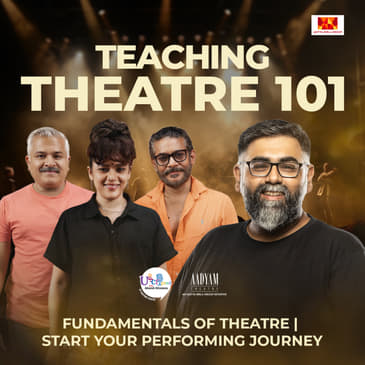
This episode of Unscripted with Akarsh Khurana covers some very interesting aspects of the teaching methodology of theatre in India. Our esteemed guests and forerunners of Adishakti Vinay Kumar and Nimmy Raphel along with the visionary director Atul Kumar talk of the various approaches that might help budding thespians.
This episode can act as a guide to learning theatre, while the main question that was posed to them was “Can acting be learned?” The conversation covers all aspects, ranging from personal anecdotes to research, methodology and the teachings of Veenapani Chawla. A beautiful, insightful conversation opens up multiple perspectives toward the depths of theatre as a discipline, medium of expression and an art form!
Listen to the exclusive cut of the episode now!
[00:00:01] Hello and welcome to another episode of Unscripted with Akarsh Khurana, an Aadyam podcast produced by M&M Talkies. Today, our guests, we have two people who are the force behind Adi Shakti and a gentleman who is a theatrical force to reckon with. So please welcome Vinay Kumar, Nimmy Raphel and Atul Kumar. Seated between two Kumars.
[00:00:26] Unscripted with Akarsh Khurana, an Aadyam podcast produced by M&M Talkies. So actually to start off with, of course, the topic we do want to cover is about teaching and methodology in theatre. But I wanted to actually start talking about whether your paths have crossed over the number of years that you have been doing theatre. So what is the association if at all that has happened between these two Kumars and Nimmy?
[00:00:56] So yeah. You want to take that? No, no, no. Please go. So, I'll start with an anecdote. So, I've left Delhi and I've come to Bombay searching for this dream of creating a theatre space where artists can live together and create together and research and sort of a laboratory. It's like a slightly faint idea. When on one of my tours, I was a
[00:01:26] of this group Chingari to Pondicherry, I discovered there is already a space like that. And I visited and it's like a barren space with just one little structure there and some Hindustani classical music is being rehearsed. So, I meet them. I meet Veena and I meet him. And that, it was a brief sort of a thing. Cut to Bombay where I come and there is this Prithvi Theatre Festival and there's been some years. And Veena's brought her play Bhima.
[00:01:55] And I remember seeing the play. I think I saw two shows and this, I don't know if Veena knows this, but I came out of the theatre and I was walking down the Jaan Ki Katir thinking and sort of looking at the trajectory of my life and what I have done. And I started, I broke down. I broke down and I was crying and I was thinking, what the hell am I doing with my life? This is what I wanted to do all my life.
[00:02:20] So, it was a very, very strong sort of a reaction and I felt miserable. I said, this is what I wanted to do all my life. But I think what happened was that subsequent meetings with Veena, a lot of encouragement came to go and follow my dream and to create my own space. And so, luckily I then went to Aryan Mushkin's place in France, Peter Brook's place in Paris, a couple of other places in India like Nittagram.
[00:02:48] And so, that's where the inspiration came from. But yeah, then consequent meetings with Veena, highly, highly educative for me. And both these wonderful artists looking at their work, always an inspiration, even today. So, it's a great learning school for me all the time. So, you've made him cry, clearly. Do you have any anecdotes that have to do with his work and how your paths crossed at any point?
[00:03:17] No, always. I think pretty much we are all, there's a bunch of people in the early 90s migrated to Mumbai. I think Adul is there at the time. Anirad is there. So, there is a kind of buzzing activities and we all closely follow each other's work. Particularly at that time, Srivan and Adul is doing chairs. Yeah. And that's a kind of, that's a play we look forward and then, especially when you came and performed in Oroville. Remember that shows.
[00:03:44] So, it's not some, it's something we followed each other's work. We're looking at each other's work, closely trying to look, sometimes challenge ourselves, sometimes get inspired. So, it's something that is constant, I can say, last 20 years, 25 years. We are looking at work and then when he decided to create Kamshert. Yes. And when she saw, he's shown us the lake and said, what?
[00:04:11] So, but then, yes, I felt like, oh, I want to be next to that lake. But then that's, that's the beauty of it. That moment of creating one sort of space, like we started maybe, then Adul started. Now, it's catching up and it's not in a domain of any more government funded. People are creating spaces, multiple spaces in different proportion. And that allow multiple kind of storytelling. Yes. And even theatre groups are learning to adapt to multiple spaces.
[00:04:41] So, it's not like I'm rigidly saying that I'm going to perform A structure. I'm flexible enough to shrink it to B structure, C structure. And it's not stopped the storytelling. So, I'm saying it's very significant, maybe the moment in terms of creating a performance space, your dream you created or we created. But it may be our paths that cross, may be inspired or maybe created a kind of movement, I say, in creating space.
[00:05:09] Up to then, people only thought about creating a work only. Yes. Creating spaces have become a very important factor for people. And there have been other engagements as well. Adi Shakti has organized festivals where we have gone as performers to perform. They've organized seminars, conferences concerning, you know, different aspects of theatre. So, we've been a part of that. I have personally, as an actor, attended their famous workshop. Yes, yes.
[00:05:39] Yeah. And I think practically everyone that I work in Bombay goes to Adi Shakti to attend that workshop. So, there are many different influences other than the teachings of Veena itself, which go beyond theatre. Of course, it's a way of living. It's a philosophy of life. And those brief interactions with her and soares with Scotch whiskey. Yes. Wonderful. Nice.
[00:06:06] And Nimi, what is your early interactions with the two Kumars? Meaning, when I was studying in Kerala Kalamala, which is the State Academy of Arts in Kerala, I heard of Veena Pani and Vinay through my English teacher. Right. So, I heard of them first and then I joined Adi Shakti without knowing what theatre was. Right.
[00:06:30] So, there was a lot for me to learn and imbibe and see if it is a medium that I would be inspired enough to be there. And I also was very young. You know, one is trying to see which direction one's life has to go. So, that was my first interaction. And I remember Vinay and Vinapani rehearsing Brihan Nala.
[00:06:57] And I told myself this is how I want to work because there is no constraints of time. You know, you just, the time just stops as they rehearse. And there is this endless possibility that exists in front of you to go at something without really looking at a result. So, that is my first real interaction with them. And I can't differentiate Atul and Sheba.
[00:07:26] For me, they exist together in my head. I don't know. I always felt like I knew them before. I don't know how to explain it. I felt like I knew them before. It's like, you know, Ramanujan says, you know, nobody hears Ramayana for the first time. You are born with it. So, I feel like that. I knew them somehow. But I don't remember meeting first time. But I felt I knew them.
[00:07:55] And I know I can only think about them as a unit. That's lovely. Yes. Like, for the one moment of that play. Chairs you are talking about? No, not chairs. Hamlet the Clown. The Hamlet the Clown play. Yes, yes. There is a moment he heightened the text, text, text, text, text, text, text, text, text, text, drop in a silence.
[00:08:21] I thought for any spectator, that may be a goosebump moment in theatre. As people who participate in discipline. And it may have a ripple effect in what a performer can do it. And it may inspire hundreds of people who watched it. So, for me, that is what one of kick-ass performances I see. That is true. That is such a compliment coming from Vene. Oh my God.
[00:08:44] I wanted to, before getting into talking about more research and training. I wanted to discuss something which is prevalent in theatre per se. And of course, you all have that. Which is mentorship. Clearly, Vena Pani Chawla has been a great mentor for a lot of people. Including perhaps Atul and others. But it would be really nice if the two of you could talk a little bit about her. And what she stood for. And what the main takeaway. Of course, there is everything.
[00:09:14] But what the main takeaway from someone like her was for you. And just as mentors, I am assuming she is a mentor figure to both of you in a very big way. So, if you could talk a little bit about her. And then Atul will have to think of a mentor that he wants to talk about. Yes. So, yeah. So, why can't you go? I think, right now, I hear this. We use the term mentor very loosely. Right.
[00:09:43] And I think for me, it... I want to say guru. Yes. And I think that has more depth into it. And I think for me, Veenapani, as my guru, is someone who sees a possibility beyond who you are. And that requires time.
[00:10:07] And I think mentorship can only happen through a consistent amount of time that you spend with your guru. To your guru, yes. And that would mean that you are allowing your mentor to shape yourself.
[00:10:52] Right. And that's what you are saying. So, the mentor who sees that spark, she holds it in her head. And uses that possibility to further yourself. And therefore, I think that's what Veenapani did for me. To show me a space where things can exist. And to approach it without being scared. And I think what I learned from that is that one doesn't have to be scared of failure. Right.
[00:11:21] I think, you know, we are living in a world where perfection we have kept at a pedestal. And we all suffer from it. And I think as artists, the capability and the understanding that one can fail and fail beautifully and fail multiple times. Right. And I think that can only happen in front of a mentor who you can trust. Yes. And I think that requires time. So, a mentorship, you can only, I feel, I only have two mentors in my life.
[00:11:50] One is Veenai and one is Veenapani. And I think they took me through a time period. Right. They handheld me. They pushed me to a space where I knew that was, that wouldn't have been the case if I just decided to work on my own. Right. So, I think mentorship is also time. Yes. Time and space. And I can't differentiate the both. If you have to have a mentor, it goes synonymous with having time.
[00:12:20] So, I think that's what they provided for me. That's a very valid point. Oh, my time is a life changing one because I came, I met Veenapani in Kerala because my teacher at that time working with her in her play called Savitri. And then he has some family issues. He couldn't come. So, Veenapani asked, can I cast me? And he said, happily, he said, go away. So, I came here and worked till, we are staying here in Santa Cruz and working till… In Bombay.
[00:12:49] Ninety-one to ninety-six we are here. But by ninety-five once Savitri leg is over, Veenapani decided that she's done with theatre and she wants to shift back to Ashram. That is in Pondicherry. Okay. So, she said, I am winding up here. I am going to… I said, what the hell am I going to do? I just taken everything from Kerala. So, then there is this possibility that you study for MA courses in theatre because we have a theatre department.
[00:13:18] So, I said, okay, I will also tag along. I will join the MA courses. Already I completed the BTA. So, let's try… At that time, if you take a PhD, then you can be getting lots of jobs in National School of Drama and allied places. So, okay, that may be my destiny. So, in Vinnapani, I tagged along and I joined the theatre course. And Veenapani started slowly shifting and shutting herself to the Ashram and doing Ashram work once in a while we meet.
[00:13:44] But after four months, I realized that what I learned from my degree course is what exactly I am learning from me. I mean, nothing new. It's very frustrating. So, I just went back to Veenapani and said, Veenapani, this is not on. You need to do a play for me. I came all along trusting you can't do that. And that's why she decided to step back from the Ashram journey one. And I think she is also not yet ready for that. But because she realized that without doing theatre, she don't survive. So, that's the correct moment we…
[00:14:14] Synergy happened. We decided and then… Our first place born, absolutely an accident. And we used to get this annual massage, martial art massage. So, we went to this deep, like a very remote village in Kerala. We carried like six, seven books and we thought that we will… It will last till the 15 days. But fourth day, Veenapani's talk is over. And she used to stare at you reading a very famous Mariam book. And I relish and literally am reading it.
[00:14:43] She jealously looked at it. And third day, she said, okay, translate for me because I have nothing left. So, it's a very famous book called Second Chance by a well-known writer who just recently died. It's about looking at the entire Mahabharata from Bhima's perspective. Okay. And that, my own broken English, I translated 200 pages of Malayalam. I don't know what she perceived it. Whichever way it's inspired her to create a script that's our first place.
[00:15:13] So, actually that process, what I'm trying to say is like, I had a four-year training in theatre. But at the end of it, quite confused and disillusion is not there because these are… Most of the methods that we are hearing is hearsay. It's not a first-hand experience or parcel, like a bit from here, bit from here, bit from here. And it can get confusing. And my fourth semester was European theatre. And then I finished like 15 plays.
[00:15:40] I'm just absolutely like drained in a sense that as a performer, I'm not start enjoying it. But then when I go to my village and see a folk performer who can do a whole performance all night, he can sit around, smoke a cigarette, have one pack, come back and do next two hours. And they are having a blast. I'm saying what? Is the content is killing us? Is the intellectuality is the content is what is killing us? Why aren't we enjoying our own performance?
[00:16:08] Yes, of course, the thali, we enjoy it. We enjoy the clap. So, that's where I'm also in a look out for an alternative way of thinking, looking at performance. Not taking like this pedestal, serial world, series one rather. Let me have a blast. Let me have a performance energy at the same time I have the ability to think about the cinema I'm going to watch tomorrow. I'm saying that's not the process but as an example. And that's where Chan Sapoon, I met Veena Pani.
[00:16:36] And till she dies, that's what she done with me and the rest of the team is to create a space, create an understanding of what is performance. And it's not an end possibility. It's a possibility constantly opening up year after year, performance after performance. So, it's just not anymore a performance alone. It's an altogether research on the methodology, on research on yourself, your psychological growth, your emotional growth.
[00:17:04] So, it's become a journey. It's become like a... We don't even know sometime two years past, we don't know. We may not even create a play then. But the amount of research we could do it on human emotion, performances, permutations. And I am so glad I met her. Wow. That's one way I can describe. That's amazing. Yeah. Inspiring.
[00:17:29] And so, yes, speaking about mentors, Atul, who's been an important influence in your theatrical life? Very difficult to answer that. I realized the worth of what both Nimi and Vinay just said about time, space and singularity, you know, the kind of groundedness which Adi Shakti has had.
[00:17:57] With me, in spite of me even imagining a place like Kamsheath, that has never happened. I don't know the reason, though I understand the worth of being grounded in something and then going deeper. Yes. I have not able to... I've never been able to do that. My earlier influences were, of course, City Theatre of Delhi, where my mentor was K. Madhavan, a wonderful gentleman who had worked with French theatre.
[00:18:27] And that is the reason why I took on to study French because I wanted to go to France and study the literature in its original language. Which you did. Yes. I studied French, culture, civilization and language. And then I, in JNU. And then I went to France where I worked with Philippe Jonti. He is a wonderful... he originally an architect and engineer who made larger than life puppets visual theatre. So for three years I worked with him.
[00:18:57] I closely followed Peter Brooks journey and his writings. I never met him in my life. So he was a sort of a drone for me. And then coming back, I realized that I need to search in my own country for, you know, to find a mentor, to find a direction. I tried getting into NSD, but those were the days when Ratanthiam Sahib was the director and there were more strikes than classes. Right.
[00:19:27] So I got disillusioned. I found myself in Kerala from Delhi. I took a Kerala Express which ran for three days, two nights and got me there. I met a wonderful gentleman called Kavalam Narayan Panikkar and he took me in his theatre group. And I started working with him. I started translating. He wanted to do one of his Malayalam plays in Hindi for some strange reason. So I started translating with him. I was with him for six months.
[00:19:55] And again, it didn't work out with him very well. But in the process, I discovered Kathakali and Kallari Payet. Right. So I stayed back in Kerala for about three and a half years. And in Trivandrum, I had two Ashans, two teachers who I could call probably the biggest influence of my, you know, theatre learning. So one used to specialize in Streevesham. And one was, what would you say, Blackbeard? What would you call him?
[00:20:25] Kathi. Kathi. Kathi. Yeah. So, yeah. So, two different kinds of characters they used to play. And, of course, Kallari. So those were really strong years of my formation. Then there was a lot of travel again to France, to America, to different parts of the country. Finally landing up in Bombay, making my own theatre group.
[00:20:50] My biggest stint of theatre making was with this fantastic man called Rajat Kapoor, whose friendship I, valued right from my initial days, because he's the one who brought me into Chingari. In Delhi, that was. In Delhi, I was 15 years old. Oh, that was. And he made me, yeah, do a Marx Frisch play, which is an absurd play in a language which I didn't know very well, English. Because I'm a Hindi speaker. I come from old Delhi. So, I just learnt my dialogues.
[00:21:19] I didn't even know what the play meant. And I performed it at Shiram Center. So, with him, I mean, no wonder we've created plays in gibberish post that. So, yeah. With him, it was a long journey exploring Shakespeare in clown format. So, as you can see, there's been a huge number of mentors and influences.
[00:21:43] Veena Pani was huge because her teachings, her theories, the workshop that I attended, whatever little time that I, and as Vinay said, the work that I kept learning from. And then, of course, there is a huge influence of Comedia and Chaplin and Keaton and the silent era of cinema, the circus clown.
[00:22:07] And so, I mean, clearly, all of you are people that have kind of, you know, I don't want to use the word formal, but have been trained in various. There has been a choice of getting training, which is something that, you know, a lot of actors do look for, but perhaps don't know where to look for or don't know how to go. For example, how were you managing to, you know, go to France and what were you doing that was making all that possible for you?
[00:22:32] I think it, all these travels abroad are possible, actually even more today. Because we didn't have internet then and mobility was not so cheap and easy. Right. But the French embassy in Delhi, they had the Department of Culture sort of a thing, Cultural Embassy, they call it. And they had, they had grants and scholarships. One, now everything is online and you can see and apply and you can get them.
[00:23:02] At that time they existed, but one had to sort of search a little more. I saw Philippe Jean-Thi perform. Right. And then there was something you wanted to follow. 1989. They came to Delhi. Yeah. And so I wrote to them, I wrote a letter, which took about 20 days to reach Paris. Then they replied, took another month to come to me. So yeah, it was like not an email. Yeah. But it was now possible. Yeah. Wow. But as in y'all, all three of you would very strongly stand by the fact that training is absolutely necessary.
[00:23:32] Like some sort of formal training instead of, because there's a whole lot of actors who just join theatre companies and are thrown on the stage. Or are led to believe that doing backstage is training. Sometimes they're asked to pay for it, but that sweep the floors, get us tea, one day you will be an actor. But clearly that's one way of thinking.
[00:23:54] But y'all would recommend as people who would be listening, young theatre enthusiasts, that they should go find some sort of formal system? I think I can only talk about myself. Sure. Because it's a very subjective process. I think what training does is it shows you discipline. And I think discipline is necessary. I feel it's necessary because it's like doing housework.
[00:24:23] You know, you have to do your housework every day and nobody really sees it. You know. You have to clean it. You have to clean the surface every day. And I think what it does, training does is cleaning that surface, which is the body. And at some point, the imagination just frees. It just frees itself to make some things possible. Right. So I think that's what discipline and training does. When you do...
[00:24:50] This is what my understanding of tradition is. That you want to become a performer in a very traditional sense until and unless you have gone through a rigorous training of eight to nine years. And then you are going on stage. It's very different right now. Yes. But then, you know, you required that kind of time. And that what it does is in the repetition, you're repeating the same movement over and over and over again. And in the repetition, something happens.
[00:25:19] And then, because we keep saying mind and body, that's what acting is. So where does the mind come from? Mind really does the first work. And it prepares the body. And at some point, the body frees itself. So then it becomes... It allows the imagination to flow in a certain way. So I believe training is necessary for that taking off to happen.
[00:25:46] Because we keep saying a performer is born in their forties. So what are they doing before that? They're training. They're training to go through the failures. They're training to see what the brokenness of the body, what and all the instrument. It has to go through certain changes in order for it to get somewhere. And I think training shows you discipline. Discipline tells you that there is failure.
[00:26:13] And then from the failure of repetitions and going on about it, you'll see that something transformative happened. And it works for me. I don't know about others, but that's how I would be. Do you feel similarly, Vinay? No, I'm saying... I'm all for saying that. If I say training is not needed, I will be run out of my business and production. So I will vouch for it. No, but I'm saying what kind of training.
[00:26:40] Because anybody wants to be an actor, we tend to look at a very formalized training as a first step. I would say my formative years of using my body has not even come from theatre. It's play... I will say my body is shaped because I used to play cricket. And we used to have two wicket keepers. Okay. And we are constantly in competition.
[00:27:07] So my ideal at that time is a person called Jeff Dujon, for anybody who remembers. So even a simple catch, he will do a somersault and take it. And I just started copying it. Even though he is very good, the other one is very good in collecting spin. Fast bowling, he sucks. And people used to... when we go for tournaments, they used to love all the jumping around. Performance. It's an absolute performance. So even like a simple catch, you take a somersault and stand up. It's like...
[00:27:36] And best we can give a award is that. And I really played into the gallery to get that. Three consecutive years I got... But what later I realized my entire physical body at that time, I employed in something way. I think I pushed it in every corner possible. Like we, every Saturday, Sunday, we used to have a tournament. So endurance is morning to evening, standing under the sun and playing is...
[00:28:05] But maybe shaped my body. Right. Now, if I go into a formal training person, that's what you don't agree with me. But as a trainer, I can tell you, that's what helped me into subsequently opening up myself to learn other forms. So even like we had a show in New York and there's one very famous art historian studying person called Richard Schreiner.
[00:28:28] And Schreiner asked what inspired this play for your work in order to create Bruganara. And in my sincerity, I told Tom and Jerry. He is expecting Hyphanda like a calvified and other things, but that's actually... So I'll tell you an anecdote or a story that we used to do it in. Because every play before we start, Veenapani takes a stack of Tom and Jerry and shows the particular visual.
[00:28:56] Remember, Jerry is chasing... Jerry vanishes, Tom reaches an intersection of three roads and suddenly one head goes here, one body, one leg goes and comes back. And then Veenapani said, you, I want your body to be like this. We know that is impossibility. But the moment you keep that image, you start creating images closer to that and it comes... It's manifest in a different way.
[00:29:24] So what training allow you to have that visual images of your director, you will have a vessel to translate. And that need a kind of agility of the mind, agility of the physicality is very important because... Remember, we are copy paste people. We see visuals all over. We are trained and at a kind of time we are living in, we don't even... Mind is reaching a saturation point. You don't want to create a stimulative visual script because everything is available.
[00:29:54] All I just need to cut and paste it. That itself is affecting a lot of qualitative performances of a lot of people. You can see, oh, I have seen it in hundreds of people. What is new? That's true. That's very true. Okay, so the training is something that is important. What kind of training? Don't restrict. Yes. Any formative where we can... Play badminton. Badminton is one of the best training you can have as an actor. If you can do a single against two doubles and you have made your body. I am saying it's very important but to look at the body because that body is what translates.
[00:30:24] You are not performing your context. You are performing a context and reality not yours. You are trying to create a hypothesis of that context and presenting. That means you should be able to break your body from existing one to something else. That's what maybe a lot of people call transformativeness. Not a mentally transforming into a character but our ability to lend to a hypothesis. And that's what I am saying. Training is a must. Any kind of training is there. Luckily, my...
[00:30:53] That period, everything is an excitement. Bruce Lee is there. So everybody wants to be a karate player. So we go to all karate classes. So this plethora of physical activity is planned because we get out of the home around 7 o'clock. And we only land back 5 o'clock. Our parents need to come and pick up. They will search in every bushes and open ground. Finally, we'll find us in some ground. I think that liberty is not there anymore. For the entire generation of people. How to use the body.
[00:31:22] And I will explain to you much later in if this comes up. Wow. Yeah. That's very important. What do you think? What's your take on this? Couple of things actually. To begin with, just to wear the black hat. There are so many performers in Bombay that you and I have worked with. Akashu have had no training. Yeah, that was... Absolutely no training.
[00:31:49] They were mentioning Shiva for example. What a fantastic performer. But she's never had any formal training. Right. I mean, she danced to Odyssey for a very few years. But very early in her life. And then after that, there was just simply getting... Namit Das, Neil Bhopalam. I mean, there are so many actors who have not had serious, sustained theatre training.
[00:32:18] And we've seen them perform brilliantly on stage. But obviously, what they are talking about is something else. It's more of a spiritual journey, mind and body within the space. And I think just rigour and discipline. Yes. And I'm sure they also have their own rigour because Namit for example, sings. Sings, yes. I remember him singing. We were in north of England performing the same play, Hamlet the Clown Prince. And every morning he would do his riyas for two hours and wake all of us up.
[00:32:47] But yeah, I think all these are various ways of arriving at the same point. I missed it. I wanted a sustained training for myself. But as I said, I never got. But you had a fair amount of... As I said, it was varied. It wasn't one thing. I kept jumping and skipping. I could never do the deep dive in my life, which I thoroughly missed. I still miss.
[00:33:16] And I would, since you're talking about youngsters, I would say, yeah, I mean, be aware of that. It's to latch on to something and to stay with it. And two, to have that patience to see how deep it can take you and not spread yourself thin, as I think I would have in my life. I wish I had stuck on to certain things. The other thing I wanted to say is we talk of craft.
[00:33:44] We talk of our tool sets. There is also another mentorship, training, education that goes on. And that is simply life. Right. As how open are we to what's happening around in the world, what's happening in our country, in the community, literally in our theatre community, in ourselves.
[00:34:07] And to tell you the truth, it's now that I'm 56 years old and going through a very important phase of my life as an artist, as a person. In the last three years, I discover the real reasons why I do theatre have appeared to me only now. And till now, I was just going with the breeze, you know, with the wind, wherever it was taking me.
[00:34:33] And I was really concerned about only techniques and, you know, tools and all that. So one never really looked inward, which I think with a journey like theirs with Veena starts, as she said, it goes in tandem, which is what did not happen with a, with a, with a urban theatre maker like me. Correct. I was just, I was running too fast.
[00:35:01] And I was running away from things which I was not even aware of. And in the interim, I found this art form, this, this job theatre that happened. And you called me force to reckon with, but I don't even know what that force was. Because, no, seriously, I, I, in the last three years, I've gotten into psychotherapy, which it's something that I completely kept away.
[00:35:28] And I thought I know myself as a person, as an artist, as a father, as a, as a partner, as a community members, as a director to so many artists who've worked with me in this city. It's to re-evaluate all of that. That is probably the biggest learning and education that I'm having in my entire career, I would say. It's been a complete re-awakening. So, it's only a beginning and we don't have much time left. I'm 56 years old.
[00:35:59] I hope this can now sort of evolve and it can influence my work in the future, in time to come. So that's something which I think all youngsters have to just completely keep themselves open. Open to that. Yeah, yeah. No, I mean, it's, it's all a rite of passage at the end of the day and it will take its, but like speaking of that, like, like this, what this may impact, say, the work you do now. Yeah.
[00:36:23] Uh, because we were talking about reading, I mean, you mentioned that for about three years, you were doing, uh, Kathakali and, uh, Kalari Payotu. Do you find that that influences or affects your work as an actor? Does it still come in handy? Absolutely. In terms of physicality? Absolutely. Physicality, more than that discipline, as she said. Right. It was actually the first time that I got into the whole act of, I was, I was on the floor, uh, two hours of Kalari, of course, early in the morning.
[00:36:51] And then, uh, six hours of doing, uh, Kathakali nonstop, uh, with one of my ashaans at least. Uh, so, I mean, and every day. Right. So it was, it was the first time that I felt that I was, I had a purpose, that I, I had to look forward to a routine and that I had to, like, step up to it. Um, so my, so during, during Udichal? Uh-huh.
[00:37:18] During Udichal, during the monsoons, the massage that my ashaan would give, he would obviously ask us to eat certain way, uh, not sleep in the afternoon. I remember he told me, and it was be torturous. And then, uh, the most torturous thing would be, he would say, no contact with your wife. That too. So, I mean, that's, that's discipline. So, yeah. Sure. So things like that. Abstinence, yeah.
[00:37:43] So, uh, I, uh, I wanted to ask, and I think that it, it's, uh, it's moving a little bit away from the training aspect of it.
[00:37:53] But in terms of what you all create, you and, and you all, I mean, uh, there's a very different, uh, approach in terms of like, my awareness of whatever I have seen or heard of is that you all kind of, uh, go quite like a deep dive into an Indian context or an Indian culture to kind of come up with, you know, work and stories that you want to tell. And is that a, a very conscious decision? Yes. It is. Is that, is that something that you all? Right.
[00:38:21] So, uh, so how do you go about selecting that? I, I understand there was the broken English translation that led to one play, which is a great story. But now, like for example, uh, how do you choose what inspires you to tell a, uh, a story and, and do you ever kind of look beyond that and want to, you know, uh, not necessarily tell a story from say the, which is connected to my mythology in some manner? Right. Okay. Any, whatever I'm going to say is very subjective.
[00:38:51] Yeah. Sure. Of course. Yeah. All artists that are. People want to know that it takes all these history of history in themselves. So, uh, Vina Pani and me, all our early career is steeped in, uh, creating either great tragedies or, uh, uh, Janae or, uh, Anirana's goal. So these are the place we done it. We done to a point. And after a point, you feel that disconnect. Because you reach in a context that is so different.
[00:39:20] Your problems are different. And you reach in a place where we started seeing that exactly the pluralistic narrative of our myth that forms our past pretty much what we function on it. Every single thing, if you go to this end of the street, to that end of the street, works on myth. Not on now. From an auto driver to a hotel person to every 20 people you street is seeped in the mythological stories.
[00:39:47] Now these stories are created a kind of multiple narratives and freedom to interpret exactly like the way we interpret the God. What we saw in this is that depletion of this engagement. And we are not, I felt, Vinapani, when we discussed, we are not anymore interested in a story, but rather looking at concepts we can interconnect with now. Or better, it has a long history from the past. So we started looking at concepts,
[00:40:16] our first place, like looking at Brihanala, for example, looking at polarities. That's where the discussion starts. What is polarity? Gender polarities. And how do you look at it? Okay, I can talk about A and B's life, but it may look beyond a point, you can't unpack it. So that's why we started looking at Arjuna. And particularly, why do Arjuna decide to be a woman? Suddenly this two point comes,
[00:40:43] the entire discussion is gone from the past to the present. Right. There suddenly you see Arjuna discover a selfish femininity and he decided, Mahabharata ended there. He said, I'm not going to fight. Then Krishna needed to come up all the way with the Gita to prop him to fight. But in that fight, he never killed anyone with his own powers. He's as powerless as possible. All killing that happened afterwards is done by somebody else. He's an absolute failure
[00:41:12] in a very male heroic point of view. But within himself, he may discover something. So I'm allowing, what excited us looking at myth is to have a possibility to unpack it in different, different ways that had become very contemporary. If I'm just talking a story that is conceptually, I can't connect it. It stays as like a story of the past. Suddenly it hits you in the face. Oh my God, this is what I'm still grappling. And it have a hundred thousand years of history
[00:41:41] of the same problem. So that it's not a conscious decision or I'm only going to deal with the new play we are going to do. It may not be from a myth at all. But every time we said, okay, we may be myth addicts. Let's try to do something else. We take it out and we try it. After two months, we get bored. So we come back and look at it and suddenly a small idea will pop up from the myth and suddenly we thought that the preoccupation of that society
[00:42:10] with the ethical debate may be much more higher than 2024. Right. In our ethical debate is just this much. We pretend. And we think that we are very sane and modern and we are not. And so that's what we started looking at mythology as a kind of source of inspiration but not staying within that milieu. and we felt that that's what we built Adi Shakti's exercise and thankfully when Nimi become a writer
[00:42:41] she continued that work. Take that forward. Continued that work forward and that's what make us very happy in that sense. But I'm saying it's not like oh, we're not pointing create you stick with that something. We all have our paths to explore. If I do a work my last work is very political because I'm very political in nature. So it's bound to happen gender politics need to come into it. But the aesthetics or the concepts what the myth of you can build it up. Actually if you look at it the post-Brahannala was Ganapati, right? Yeah.
[00:43:11] The Ganapati have you seen the performance? I haven't seen Ganapati. So Ganapati actually a lot of people reacted very strongly to Ganapati saying that it's not theatre it's more like a music concert. I mean for me it was purifying their form to an extreme because for the first I don't remember the show very clearly now but for the longest time when the play starts
[00:43:41] it's a play of light and sound it just goes on and on and on and on and without even mentioning or obviously meant presenting about Ganapati it was evident what it was all about. So there was there was a purification of form that happened so it was not just you know the usual thing yeah they were hugely inspirational. And I also think you know emotions are very universal
[00:44:10] meaning like we and we say those emotions through words which are familiar to our language and I think that's the only difference. so I think in Europe or in West wherever they have talked about or created a mythology which was familiar to them which they've just lended their emotion to those particular stories and I think we also are doing the same. So when we are
[00:44:40] creating a play we are talking about the universality of this emotion the concerns are similar everywhere it's just the stories as to what is familiar to me and myth is only a peg you just only hang hang on it so that there is already a framework and you're playing against something you're just not shooting it in the dark so there's always a dialogue that's possible and I think that's how
[00:45:09] I also see it. that's what I was saying like because you're now an independent creator also and you're writing and you're directing do you find yourself also drawn to using that peg is that a starting point for you is that usually see the thing is I get very easily bored by realism I feel there's enough to look at in life already it doesn't excite me as much so I am I like things which would
[00:45:40] make me depressed I don't know what to do lovely line for the trailer I can't watch anything because most darkest and depressing thing I like it when there is lots of uncertainty when I create something and I don't know I have absolutely no idea what I'm going to do so I like to be there
[00:46:08] and when I finish something I feel like I've crossed a bridge and I like to take that big breath and I think only mythology allows me to do that nothing else it could be the limitation of my own mind but right now only mythology allows me that possibility of getting into a place where I don't know where I go Atul I think that a lot
[00:46:38] of your work and mine as well I think that perhaps the influence of the global time that you spend is quite evident in terms of the choices that we make do you is that conscious is that something that you're drawn more to say international texts that then of late and I have seen not of late actually for a while you do kind of recontextualize it very well there's a lot of adaptation that happens
[00:47:08] to make it very accessible to us and including folk forms and other things but the root is there's Shakespeare or there's the West and do you find that that's something that you are drawn towards how does that work for you I think it's yeah I think I am drawn towards that accessibility I think it could just be also laziness to not pick up some texts from Marathi literature or Gujarati or Punjabi literature
[00:47:38] there's so I've acted acted a few and we've also devised no we've also done a lot of devising work like C4 clown or the blue mug blue mug is entirely one of my most favourite productions of mine and it's all about us
[00:48:07] about memory and memory but then again it was inspired by a book by Oliver Sacks the man who mistook his wife for a hat but then we but we took that trigger from there and went straight in our own personal memories and memory losses so it's a it's not a conscious decision but I frankly I let myself float whatever comes my way for the longest time I've been wanting to work with the sound of Saraj something
[00:48:36] that I started with Nimrat actually oh okay yeah and I told her we'll keep it when you stop being a film star we'll pick it up again so yeah so things like that there are many things which one has my biggest dream project I keep telling Mantra is is addressing Mahabharat which I think probably everybody I'm hugely influenced by Carrier's Mahabharat which broke it I think it was a great interpretation and I would again see my first instinct
[00:49:06] is to go even for Mahabharat to Carrier so yeah I think it's the education I've had it's where I studied where I had my most influences of theatre which are global yes from around the world so even in form these days what is really exciting me I'm talking of training I've been looking at possibilities to go to Germany and study AI and
[00:49:36] to figure what artificial intelligence is doing in the world of performing arts it's and visual arts of course so it's very exciting for me so yeah I would if I'm not lazy I'll go to learn no but I do think that a lot of your the work does kind of borrow heavily even from like Indian folk spaces I've seen you bring like there is a very Punjabiat to Bhagiyal I grew up in
[00:50:05] Mathura in Vrandavan with my great grandfather taking me to watch Raas I grew up performing in Ramdeela myself in North India so yeah the roots I'm from old Delhi I grew up around those areas of Chani Chowk and Kinari Bazaar and Nahi Salak so the first 20 years was just that so those are the strongest formative years and those were the art forms around me so yeah those influences stay
[00:50:35] we have something like a rapid fire section but I'm not a very rapid person so we call it slow burn but before that as I will but no before that there's just one last kind of broad question that I want to kind of open to you all before we go into those specifics which is of course I mean Adi Shakti itself is a training space and you all are doing a lot of this holistic work
[00:51:04] but what is according to you and in all your travels around the country what is the state of theatre education in our country and is there anything institute or course that you barring barring Adi Shakti of course because we will promote ourselves shamelessly but I'm saying what are the avenues that are open to young theatre people who might be looking to
[00:51:34] not just be born onto stage and go and kind of get some work done what is the state of theatre education in our country actually as it stands silence no you did train I mean you did your MA right in theatre my BTA okay yes at an extent that institution after a batch it's gone downhill but now one of my bachelor studies in
[00:52:03] NSD and then he become an assistant professor he shifted back to that institution and whatever our collective dreams now he's pushing it back which institute is this it's called Trishud Drama School okay he's talking of Abhilash Pillai Abhilash Royston we all at the same time studied so he's what he's making is not anymore a regional training institution rather he's looking at a pan Indian students to come so students from all over the
[00:52:33] other states is going there it's the only word there is a degree course is offered all others are diploma okay one but point it's all an institution is depend on who is heading it yes and that person need to have a vision and that vision need to go beyond themselves we are lucky when that institution started it's a dream of a collective group of writers musicians filmmakers and that's how they created that institution it's not a university made it but at that
[00:53:03] who are the think tank of that time and like award winning filmmakers but back then it was Kerala century in Kerala century but they want to create a space where all these forms like a theater people and cinema people and painters can all come together and to talk about performance and that's I think all institution starts like that at the end of the day theater is a practiced one it's not a degree place you don't pump in practitioners and if you look at it from an academic perspective it goes into a course so I
[00:53:33] can take loka and give you a dissertation and talk for next eight hours but that's not going to make you a fantastic performer it can be stimulate your academic intelligence and I think most institutions problem is you don't pump in practitioners and that practitioner may not have even a language a linguistic language to explain to you institution pumps in this diverse group of people then you are just offering an academic level
[00:54:02] of interest only so first we need to decide what are you looking for to get a job or to be a therapist theater can be learned in two ways one you can go to an institution or just go and grind and perform even a small so I can only tell from my perspective I started when I am 14 years old my theater performance my mother and some other people are working in a play she's writing and I just went with that group and it's just around 30 actors
[00:54:32] are performing that play and I suddenly heard that young boy's role doing somebody who is not coming and they are looking for a young boy so I start next to three days I'll whistle sing and I walk around nobody noticed me fourth day the director turned oh we can use him would you like to perform I said that's what I'm trying to tell you the next day so I'm saying once that interest comes after a point you need to institutions can provide up to a point of stimuli only a particularly
[00:55:02] structured institution but if you can get a team like if you can be with him like join with the adhul or somebody like who can who they're not only creating a play they're looking at the possibility of your growth also that's another way of learning or opening yourself as an actor to and that's a little secure place in my experience it can be tricky also so that's the structure there are hundreds of places that
[00:55:31] offer not a comprehensive knowledge system but a specific knowledge system in different fields I think it's mushrooming all over India in different places like Kerala have this one in Bangalore have multiple teaching centres are coming up but I don't know how to shop around it's all depending on what you are looking for nice am I too diplomatic no not at all no no I don't think diplomatic at all actually I think that it
[00:56:01] is eventually going to be led by the choice of what the person wants to achieve and of course it's always up for debate as to how much the academics is going to really help you but exposure is always great even NSD I've had people on the podcast from NSD who may not be happy with the state of affairs there right now but they said in their time there at least what they were exposed to change
[00:56:34] one point I just said the problem with most of us when we enter into a performance we bring certain tools that is part of our mannerism and it's very appealing the point is how to break that in time and that's where all this knowledge system come into otherwise you become predictable after a point I know what you are going to do and you are less interesting to me and that's why actors need to look at every possible I am saying don't restrict a structured institution anything learn now earlier my
[00:57:03] preoccupation is to learn traditional forms but now I am learning something that is completely opposite from mathematics to neurobiology to like you want to learn because we are talking to a spectator who are all this you can't just artists can't be just talk about acting alone and that's not going to expand your horizon and your horizon means you need to start learning anything that is available that's also a good way of understanding how as a performer you can grow also
[00:57:33] that's what my everything that Vinay says but I think there's also Nadarnaka Irilli in Irinyalakuda they also offer Venuji course but just adding to what Vinay is saying I feel again it's one soon pursuit as to what you want to really become and if you really want to become a performer that is
[00:58:03] also about making your body a living archive of some sort that would mean that you start at a point and then you continue to accumulate certain things and we are things out from our constant engagement with multiple things that we have done in the past and what we do right now so I think a performer should be a living archive when we say archive we
[00:58:33] feel that it's a dead space but we constantly talk about I become a character and I am not a propagator of that or at least it has not happened to me let me just say that I have not become nothing
[00:59:03] even when I play a character but there exists a possibility that you can make the audience become something right so the audience would become the character that you are playing and that is only possible when you become that archive so in the archival process you are using all your tools in order to make the audience feel what you feel right otherwise it's just a radio play right so I feel it
[00:59:33] really is about what you want to become where your direction of your journey you want to take and for that apprenticeship is very good you know to surrender oneself and say that it's tough to do right now because there are hundred things that are happening just saying that if I want to become a performer I'm just going to take out that four years of my time and I follow something and not get diverted in hundred different things because that becomes like
[01:00:02] you know how you put coconut oil when you put coconut oil it just spreads on you have to just do one thing and then find you know I think that's how that's so the thing was can acting be learned I think it can be learned the craft can be learned
[01:00:33] but what makes it tangible is a cultivated it it is a cultivated it so when the imagination has to happen then I think we have to give it that time and I don't know learn music or storytelling or painting or just surrender
[01:01:03] yourself in sing and dance and you are getting your little platters use it so I think it's not the number of schools that you would be aware of it's as to what do you want to do out of that because everybody every school would
[01:01:43] anything to add to that yeah actually just this morning a very established film actor friend called up and this morning as I was going to work she calls up and she says she's feeling stagnant she's feeling like her instrument is rotten she's repeating herself it's not aren't you
[01:02:15] so she said yeah so I said well Adi Shakti it's the first thing you need to go and apply there whenever they're having their next workshop also because it's always short lived this excitement and they can only give this much time because then they feel insecure so nobody is really wanting to put in time and of course we are not talking to just Bombay you know listeners or audiences here we're talking to everyone there is a lot happening in northeast
[01:02:44] now I mean if you look at all these major competitions that happen of theater like Meta and all so much exciting work I've been teaching in NSD Delhi for some time I teach them farce and I'm noticing that after some of the most exciting teachers have actually shifted to Abhilash's school in South India NSD still has students who come
[01:03:14] who are very hungry for knowledge and they actually push teachers they source teachers they try and convince the admin to bring people in so they are hungry for knowledge and to learn not to forget the drama school Bombay my goodness Jehan has done an amazing work creating this place I mean I have used so many actors who come out of yes but as you
[01:03:44] said these are places where you can perhaps taste a door can open up for you it's only a beginning then you have to figure what you want to do with that craft yeah but yes from my time to now we didn't have internet as I said mobility was not there but so many of our young theatre enthusiasts are able to travel around the world
[01:04:14] it's easier now and just the are open to us so many cultural embassies that are giving so many grants I keep telling this to students especially students who are coming out of DSM and NSD that please explore Pro Helvetia please explore Max Miller British Council
[01:04:44] French Cultural Centre I mean travel around the world and it's easier now which was much more difficult I think when they're in their 20s early 30s it's a time when you can try I mean if you look at all these greats who I was influenced by be it you know Kavalam Narayan Panikar or Ratan Dhyam Sahab or Habib Sahab they all had a stint which was international so there were influences that
[01:05:14] were there of course they found their own voice locally when they came back here but I think it's something that young can do it's available now much more to just cap it all there is also just so that people know there are young theatre people and we are sitting in a place which has some 50,000 theatre spaces now there are so many places over here they're all
[01:05:47] now is there one today I think the board cast has booked the place till the evening so we've killed one theatre performance the fact is that they're there and Indian government has grants that many people are not very aware of and of course you have to go through some red tapers I was surprised you said that with a straight face both Adi Shakti and the company theater we've been receiving government grants and
[01:06:17] their public knowledge and they're all on their website and there are possibilities for young theater makers to create theater spaces so we have to dream questions we ask sustainability is something us this is a very romantic concept of learning how to sustain is a beast all together so that will be the next topic I'll move to our slow burn section we'll have very few questions there and we'll see if there any questions from the
[01:06:47] audience that are here very simple questions for each one of you to answer the first one is that not your own work but a recent Indian production that you have watched in the theater that you have two
[01:07:18] two two one got to see them recently one is Mezok by Jyoti Dogra it was immensely stunning performance and the other is Mohit's new play that he's done with Nether both absolutely stunning performances for me lovely see the one thing with us is we go for festivals and then festival will call you you land up you set up you do your show you meet the last group
[01:07:48] at night when they are exiting and you are entering so you're not watching anyone's work and we are also in South India it becomes very difficult but people come to you to perform yes I think last year I watched the show from Kattai Kote which is not Kattai Kote the show from Palani show which is
[01:08:18] about Abhimanyu Abhimanyu trying to come out of the of the Chakra view and it was mind blowing it was mind happy and exhilarated and I very rarely gave up food for anything and I couldn't eat I was so full and it just stayed with me so that that's something that stayed with me for a very long time but then any traditional performance
[01:08:48] that I watch I'm immensely happy so that's the recent theater work that left you very impressed right I recently means like last one within one year there's a play called Molagapodi it's called Chili Powder done by a group of trans women it's one of the kickass play I saw it on orientation play gender play last year they performed it and some of the actors
[01:09:17] shipped it but it's amazing it's in what language Tamil but with lots of songs and that place energy is like a zap to me the way they done it I hope they will revive that play we requested last year for them to where are they from Chennai only director called Mangay is there and the other one is director is he got into that so Mangay is involved in it yeah Mangay is writing also it's amazing play
[01:09:47] we should look out for it my next question for you all you'll have had all of you have actually had an opportunity to perform your work all over the world you'll have all you know within India of course you've travelled a lot but internationally also you have travelled a lot and at the risk of ending some of our venues what has been your favourite venue in the world to perform at and why
[01:10:17] I don't know I just love that space I think it does something to me and that thing that I constantly feel and I think I have talked about this I think Prithvi helps you to be building a space together it doesn't feel like there is an audience and
[01:10:50] also the way it feels like the audience is also holding you and I am a very nervous performer I constantly feel I will because it feels like there is an arm around you when somebody hugs you like that it feels that way so happy
[01:11:20] all over the world she chose Prithvi unfortunately I that's one and earlier vinnapani used to be the manager of Prithvi running first manager running
[01:11:50] for three years and you heard about folklore is all folklore Prithvi related folklore because India we didn't have a space where all kinds of artists meet it's ideally what you French theater movement you have cafes where people come and sit and discuss talk about it we didn't have a space or I never seen it in my life that kind of space and that's what I witnessed at
[01:12:24] for all people to come together so I think in a way that is influenced but as a performative space it's a very secure place as an actor it's not that other spaces don't offer but some day you have preferences but I felt myself you can fine tune and fine balance a lot of your faculty you don't need to push your voice too much so you can concentrate that much energy onto some of the other detailing you want to do it and that's what space need to do otherwise if I
[01:12:54] don't have a space five more feet away means my entire anatomical biological clock is pushing for that vocal cord rather by doing depleting 20% of my details so in a way that is one space I really it temperature is male and race because female body
[01:13:24] always feel 10% less than that so but you never device this when you put 25 you are not looking 25 where is intolerable body temperature for female body the studies are now coming in as a standardization of AC temperature but we unfortunately that's what we do we do for what male body feels and to cool it down so that was one space but apart from that I love every space you perform there Rangashangara is
[01:13:57] also very dear to the heart and of course there's Adi Shakti and I like Asia society space in New York it's a very beautiful space also but these are once in a blue moon you go there no it's not your place so I love every space is here that comes up or come because that's how Indian theater makers do they make it possible whatever space they get it into the best space in the world that's how theater survived in
[01:14:40] I have to space to perform but we still do that I can just go to anywhere in the world and say that they have fantastic places yes infrastructure we don't have that infrastructure so whichever space is offering that I'll just add one more thing Prithvir, Rangashangara Adi Shakti all of those spaces but I think as an audience now I talked about
[01:15:09] as a performer but as an audience it's also a very different experience to sit in those places and watch because you can see the eye of the performer because as the face and eye gets away to see it as a white ring eye as the human faculty
[01:15:39] has to do it and I think all these spaces allow that process for the audience to do that you can see the face of the performer their eyes and the twitch the smallest of muscle changes so as an audience is also it's yeah Is there any partiality for the globe? it's a ridiculous place globe is not a yard stick frankly we'll use that in our emotions but I
[01:16:09] will talk to you about one very exciting space we performed in which was also quite lousy actually but it is also something that we hold very closely in our memory and he's sitting here mantra we all performed there was a bull fighting rink in Chile yes my goodness so we had an audience of about 5000 people I think that was it we decided that day we have to either become a footballer or a rock star to get this kind of audience
[01:16:39] back the whole town came to see the show and there were of course massive screens put up this is for so we could song and dance and the audience started coming in I remember and they kept coming in and they kept coming in for half an hour they were still coming in it was a bull fighting ring all got filled up we were taken in a bus
[01:17:16] so our in the arena yes where the stage was built what we did not know was that this will get filled up so when we came in and we saw those many people I think it was just we were overwhelmed and I think all
[01:17:47] they were all eating popcorn throughout they didn't care about rats ass what we were doing but yeah for us it was amazing it was huge my
[01:18:17] a young girl who watched Brihanala in Prithee festival and she said next time they are coming I want to go and watch it is seven year old and she came with her mother I'm saying that's only possible a space a conducive space in each city allowing that audience and these audiences are shareable and because if somebody is creating a space and an audience a beautiful space or a formal
[01:18:47] watch theatre it's not that important we make ourselves very important public domain it's immaterial what we do because we ourselves are performers we really go out of our way to inform people because I get a heart attack for sure I'm like oh God are people going to come we really make sure we go out
[01:19:17] to do that someone is coming and performing we don't have to do that but we really go out of our way to fill the space so that the performers have a good time it's very different when you can
[01:19:47] go go out 100 like an absurd play 100 like a very real play 100 like an experiment play but these are all shareable resources we have it and space offers that possibility lovely thank you we will open up this to
[01:20:34] me oh no again reading a book is very important because what you need to understand is when every book you read you creating a visual stimuli within your brains and within your cortex and cognitive fields and that is your own visual nobody else can create
[01:21:04] it yes okay and you live in a time where visuals are offered to you every story have a visual in public domain and you start stopping stop doing creating your visual script means I'm connecting this to the fundamental we all talk about imagination the moment you don't charge or stimulate your or simulate your visual script you stop doing your imagination because every permutation of what you need to enact is
[01:21:33] there available in one actor or you cut and paste it but you not realizing that that's just a one dimensional mechanics but in sustaining for 10 minutes of performance after 10 seconds you feel you
[01:22:35] Suddenly it created and this is a nightmare when I talk about visual script. Most of the time when you translate novels, most of the time it fails because the common visual imagery may not sin. Like for example, if you take like Three Musketeers, hundreds of versions are there, all sucks because what you imagine that Three Musketeers, they are never able to come. Because common motifs is there. Harry Potter have no problem because every culture has black magic.
[01:23:02] Symbols are very similar. The dark, the fort, the broom. There are hundreds of motifs that each of us when you read or imagine that script can come and connect ourselves. That's how that will become much more related. That's one part. So for me reading is very important as much as read but don't need to read in a restricted manner anything. If nothing is just Chanda Mama will work.
[01:23:29] I'm sorry, somebody said Chanda Mama Vikram and Vedal is the first Christopher Nolan movie. It's keep going in, keep going in a loop. It's a, somebody is telling that. So somebody has approached that entire simple story in a repetitive Groundhog Day way. These are what words can do. Words have a very stimulative, of course, literature have a problem of fading the words.
[01:23:54] You don't believe anymore in words, like at least in our day-to-day interaction. I can say I love you, you don't believe. So I put one emoji followed by a heart emoji followed by a flower emoji. Then I send it and I'm not, not so sure what I said. So I'll send almost three more emojis. That's the kind of world you live in. But your own reading can create a massive, massive help in your brain to open up your own imaginative space. That's what I think.
[01:24:19] I think what really stimulates me is poetry. I think they have this immense quality to, to, to, to contain a human experience in, in few words. And I find that that, uh, like immensely powerful. Um, so like Vinay said, don't restrict yourself to one thing. I think
[01:24:49] anything, anything that you can lay your hand on. I started with asterisks because I didn't know how to speak English when I joined Adishati. So I, I, I own my vocabulary was restricted to yes and no. And I had to learn the language in order to understand what Vinapani was saying. And Vinay said he will refuse to speak to me in my mother tongue, which is Malayalam. And so I did not have nobody to communicate with. Because I went through, I also met Veena Paneel's yes and no only.
[01:25:15] I came out of, but we had a, almost three hours of conversation. But I think, you know, when words fail you is when really theater is born because you have, you can't depend on your words in order to tell something. So you have to use other faculties and that's what word did to me. So I wouldn't would say that, you know, restrict yourself to one thing, anything that you can lay your hand on.
[01:25:40] And I think a fine balance of fiction and non-fiction is what I would go for. And music. You know, that we really struggle that in one hour to get the audience to an elevated state and musicians just need to open their mouth in two seconds. They have them there. So I think a combination
[01:26:01] of all that. Yeah, anything. Were you specifically asking about reading theater books or about to kind of as in to read in terms of to help you with your… Don't read, practice. Or get the book written by Shanta Gokhale on Veena Paani Jawala. Since you are in this session. Wonderful learning. Get that book today.
[01:26:27] Okay. Okay. Best. Any more questions? Yes.
[01:27:36] There's no guarantee, ma'am, that a person might go and live in Adi Shakti for the next 50 years, might not be able to say a word or step on stage. There's no guarantee that a person who's done yoga all his life is in touch with his chakras, is, you know, is able to control his breath or have that will definitely become an actor. There's no guarantee about that. But to tell you the truth, a lot of
[01:28:05] traditional Indian performing art practice, including dance, does base itself on these practices as well. So those are means, yes. But there's no guarantee that somebody who does that will become a performer or it'll be easier for them. It's about getting into it and then practicing it and seeing how it helps you. Or have guides.
[01:28:29] When I went for the workshop and these two wonderful people taught me, they did tell me to work with these tools, which you are mentioning. So they were involved. But it doesn't mean that if I was already a great yoga master, that I'm already, you know, there's no guarantee of that in my understanding, but they might say differently. No, I'm seconding you to that. The point is like, these are all fulcrum outside structures.
[01:28:56] And then what we need to understand the fallacy and the vulnerability of human emotion. Human emotion becomes civil because we fundamentally created certain tools like rational, analytical, free thinking. But at the moment of any human physical body experiencing an emotion, none of this faculties work. Cognitively, there is a blank space. You understand? So that's the vulnerability
[01:29:24] every other way. I can be, I'm teaching human emotion for the last 30 years. It doesn't mean that I'll be a controlling factor on, I can understand, but that doesn't mean that I don't have the same emotion. So for us, this is constant journey. It is. Nothing is a guaranteed period. Yes, of course, certain extent, this practice has helped you to prepare a groundwork for it. But again, then it's an independent journey of how you open up in order to understand how much you want to open up
[01:29:52] yourself is also a very question because body, if somebody is standing in 23 or 24, they are not any more just an actor. They are like Nimmi said, an archival body of traumas and everything. I would say one of the first performance practice anybody picks up is simple smile. So when you're adolescent, in the year, first time, what you are picking up is somebody's smile, you like it. And you plaster that on
[01:30:21] your face. Now you don't recognize you may not practice in your day to day life. But eventually, when you come to performance, you practice that first coping mechanism and you feel like why my smile is not right? Why I can't smile because you are unconsciously putting up a practice you've done it in your adults' years. So, yes, of course, this work, but there is no guarantee, I say.
[01:30:47] Well, thank you. That's all we have time for. This was an absolutely wonderful conversation. I think that just listening to you guys has opened my mind a little bit. So, I think that it was a very successful conversation. I wish we could talk longer and I think we will offline. But thank you so much for being here. This was absolutely wonderful. Thank you. Thank you, Adi. Thank you. Thank you, Akash. Thank you. Thank you. Thank you. Thank you.