
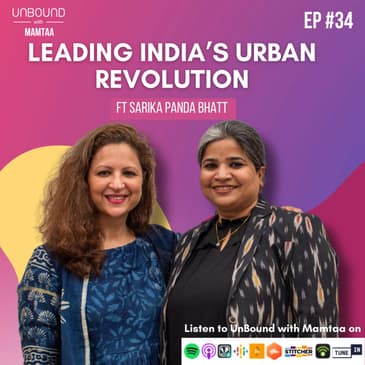
[00:00:01] Hi, I'm Bihalow and welcome to my show Unbound. I'm your host Mamtaa. A space curated for real stories of people from different walks of life who have sailed through uncharted waters and lived to tell their inspiring story.
[00:00:25] Unbound is a deep dive into their journeys, to unravel, unearth, uncover various facets of their lives as they remain unstoppable and continue to do the unthinkable. Hi, today on Unbound I have yet another unfazed human who is set to raise the bar for the safety of a soul.
[00:00:54] Although it is said that Lord's safety is a responsibility that we all should take, but Sarika Panda Bhatt has taken it on her shoulders to keep our roads streets, not only safe but entertaining too. Hi Sarika, welcome to Unbound. Hi, I'm Mamtaa. It's not just me though.
[00:01:15] There are a lot of people who have supported and you know to go beyond my capacity, my own comfort zone to do something that we are doing right now and doing it from last year. Yeah, go founder of Raguri, let's not add the play that part at all.
[00:01:37] You need to game sports cycling exercise code road, Paley. So how was this even thought? So that was our whole entire childhood, right? Now people say that our roads are for cars. But we want to build streets in our cities, not roads.
[00:01:56] So that is the streets that we used to enjoy in our childhood, that neighborhood street. freely that we need to walk, use to play on the street, hold gilly, thunder, cricket or anything, you know, chupan chupai, everything, so we all used to play that in our neighborhood street.
[00:02:14] That has totally gone. True. So trying to just try to bring back that to our cities. I really wish that those are our children. They came here and said, Mama, I am falling for ball, yeah cricket, but phone, but no, road pay.
[00:02:33] So what has really inspired you in this journey? Because roads streets as we think about them today is a place of horror sometimes. Yeah. It scares us. We have a big road, and we have a lot of space in the streets.
[00:02:51] And especially with bigger cities like Gorgão, Bombay, which are very high on high rises. So what really gave you that impetus, that in the Gorgão, we should start with a lot of things. We were the whole concept behind this
[00:03:10] and carasing citizens to get back their streets, and working with the government to give us that back that street. That we used to feel safe, the sense of freedom that we used to have when we were walking or going to a neighbors place or playing.
[00:03:31] So that we thought of bringing back. Yeah. So which was when I actually started when I shifted to Gorgão and when I met all this like-minded 7 people who wanted to jump into this fire, you know, and try to do something unique.
[00:03:51] Although globally many other cities were doing this really? Yeah, yeah. So it's 30, 40 years old concept. Yeah, so it started in Bagota and it started from there. They called it Siklovia in US. They called it Samar Street. Okay. Yeah, yeah. So many countries, many cities were doing this
[00:04:15] and then we thought of why not India? Yeah. And you know? Yeah. So that's one of the biggest gift you're given to the nation, to the citizens, to the people of Ariana, Delhi, Bombay, Chennai. I don't know where all how many cities have you covered with this, Sarika?
[00:04:32] So it started from Gorgão. 10 years' age is going to be 10 years. Wow, congratulations. Yeah, thank you so much, 2013. November 17 we started in Gorgão and then it spread across to almost 80 cities. 80 after 2013. 80? 80. 80. And almost 1920 states are new in territory. So many cities have their own names.
[00:05:01] So for example, South Indian cities never connected to the name, Rahagiri. Although Hyderabad they call it Rahagiri. But in Chennai they call it the Namachi, Namakai. Very interesting names. You know? And some city called it Sikol-Dae. Equal street and Bombay. And you know, happy streets in many cities.
[00:05:24] So it has spread across to many cities. It's not just that we were working in all these cities, but this concept has spread it out. Okay, you know? It becomes a self-assustainable model where the city is on the group in that city,
[00:05:38] the government in that city adopted this concept. So from architecture and design to road safety, how has your journey been? This is not a planned thing. Nothing, nothing actually. It came with flow. It came with personal experience.
[00:05:58] You know, the whole good safety thing is very personal to me. Okay. Because I have lost many of my near and dear ones. So that is very personal thing for me. Making. Yeah. And someone from your family. Yeah, my immediate cousins, plus my very, my father,
[00:06:16] very close friend, son, who was basically, he was a younger brother to me. Another family member last two years back. Two years back, a very close friend, husband and go down, you know, so many. There are so many.
[00:06:31] You know? So there are so many such incidents which actually motivated me to do something in road safety. It's a road safety is a very personal thing and it came with flow and when I did my architecture, all I thought I will do some nice buildings, houses,
[00:06:52] house-peter, I will design all this thing. But you know, and immediately I did my masters and it changed the whole thing. Yeah. And the way I walked actually in different organizations that also helped me so much to, you know, I learned so much.
[00:07:09] I learned so much when I walked in this area, actually what we should do. Because for everyone, for any laymen, or for anyone, you will see road safety men, educating people. Yeah, I know. Yeah, I know. But then you have to teach yourself how to teach yourself.
[00:07:29] But now that we are not here, people can't learn. We are physics chemistry. I can't understand everything. We can't understand everything. They are not learning road safety. So there must be some problem, right? In our approach. Yeah. So we need to change that approach.
[00:07:45] We need to look into a systemic approach. You know, scientific approach to, you know, address road safety problems. But I, you know, it's a very relevant point. You have touched because now that you're saying this and we come from that era,
[00:08:01] when Delhi may would redline or blue line. They used to be called like bloodlines because so many accidents, rash driving, road rage. We have seen it all. It reminds me of the conversations that I used to have in college that people would get a lot of clatter.
[00:08:20] And then they would say, that they would get a lot of weight. You know, that's cool. So, at that time, I didn't get it. Yeah. And it was, I mean, pardon me, but it used to be a joke, you know? And, like Bombay, we saw local trains.
[00:08:39] Yes, we saw them. We saw them. So I think that people have given their life in the dark. In Delhi, in the adventure, we go to the adventure. So, these are the things because they have a lot of confidence. One thing,
[00:08:57] is that the fact that the life of life is very common. Because we have a co-operative country. So, here we have a... And somebody gets wiped out. Exactly. Who is a person? Yes, absolutely. One is that human life's value is very common. That is one thing.
[00:09:16] But there is other things why people are taking risks. Everyone is taking risks. The one who is dying, the one who is a statistic. Okay, so we will say that there is no one who is dying. But the one who is dying, he is taking risks. Exactly.
[00:09:31] Yes, everyone is taking risks. Right? But, we are taking risks. Why are we taking risks? Because they don't have any choice. No. Yes, all of us are taking risks. We are taking risks. We are taking risks. We are taking risks. Okay. Only two person people are vehicles.
[00:09:50] But see our roads. You know, because the pedestrians, the cyclists, they are invisible. They don't see that they don't want to do anything. Okay. One guy is sitting in one place. He is sitting in the space. He is all that he is. But we have a developing country.
[00:10:09] We have developed a country. This is all. I am not saying that people will not be able to eat. This is not all. We are the families. But we are the friends who are living in their life. We cannot eat any family. We are thinking about them.
[00:10:26] We are the population of our country. More than 50 people. We are the population of 50 people. But if we are the people, we are living in the same place. We are living in the same place. We are living in the same place. We don't have any problems.
[00:10:42] We are living in the same place. Because there is a certificate. We don't have any problems. Yes. Then we get to work. We are the cycle. And people are the people. So we have been telling us about our needs.
[00:10:58] We have seen that the people are living in the same place. They are living in the same place. And they are living in the same place. We are making them do it for them. One question is all right. One thing that we are trying to promote
[00:11:13] to promote the people who are in their homes and their roads. And those who enjoy their spaces, they have an entertainment, physical activity, a family time-cazure, but on the other side, the statistics saying that these are the people who are on the roads were unguarded.
[00:11:38] They are the ones who are getting killed. But let's say, in this dilemma, you have to promote a thing and then you have to make a structure and save it. How do you, I mean, get married? So, whatever we have thought, this is the reason.
[00:11:59] People are looking at clarity. That's the way this is possible. Another thing is when they come to Rahagiri and they cycle there, they walk there so we believe that they will have certain kind of respect when they are driving a car towards the pedestrians and cyclists.
[00:12:19] They will not rush to them, they will not hang to them, which is so common. If you are walking or crossing a road, people will speed up more. Okay? Or they will hang on you instead of respecting. But if you go to the country, you will get old.
[00:12:34] If you cross a pedestrian crossing, there is no traffic signal here. So, the road is closed and you will cross it. Because the first road is on the road, you know, the first road is on the road. You know, the first road is on the road.
[00:12:50] But actually, the road is on the road. They don't know their right. Because the roads are on the road. So, they are very casually on their own. We have enjoyed our childhood. Just because of this, the freedom that we had.
[00:13:05] We were not dependent on our parents for our own recreation and enjoyment. We used to play with the house, we used to play with the house. Okay? Neighborhood streets are so safe. Actually, we don't want to be scared of the fear of the day.
[00:13:20] You know, but the poor perspective changed. Because the way we have designed planned and developed our city. That is the way we have committed to the community. Because there is no one to see. That is what we are doing.
[00:13:37] So, the crime has been also increased in terms of safety of women. You know, the eye on street that we called natural surveillance. When we used to walk or play in our neighborhood as a girl.
[00:13:48] So, we were safe because we knew that we would go to the city. We knew that we would go to the city. You know, if there was a person who was there, then we went to the city. So, we were at the sense of safety security and freedom.
[00:14:03] In today's date, we are not there. We are in the city of golf course road. We are in the city of Malzmals, Malzmals. We are going to the city of Malzmals. Now, when we don't see humans, we will feel safe. We will feel safe. We will feel safe.
[00:14:19] I go to the city, I go to the city, I go to the city, I don't want to go. I don't want to go there. It is not that human being is a person who is a second child. There is no one who can help a negative element.
[00:14:35] But we have been there for so many decades. You know, you are in the old Delhi. I am very happy to see the accidents in the old Delhi. And we are crying. I don't know why you are not speaking. You don't speak in the middle of the game.
[00:14:51] Yes. Let's see how different people are driving. How do they get to be? But when you make free, you have to make a very high-wares. So, you can make high speed corridors. So, people will see how they can do. They will respect their own business.
[00:15:09] They will think about their own business. Yes, they will see their business. I mean I've never seen it from that perspective but yeah. That is true. So the truth is not to say that it is very small term for the world.
[00:15:28] But it is the full impact of protection, surveillance, security, safety, independence, confidence. Everything. Social impact. I will tell you that you are the major impact of the market. In any case, there is a data that is in our data that is in the redvinar.
[00:15:56] I am telling them that we are working on this. We are working on this. We are working on this. We are working on this. That is why we are exposed. So, one girl, a bride, who is his daughter, what is she? Her family is a family. Right?
[00:16:17] You know then the woman of the family started taking the charge. She never does anything. She doesn't do anything. She does everything. She has different kinds of harassment and challenges. Challenges, she faces. Who never walked, never stepped out independently from the house.
[00:16:34] Then of course you need to survive, you need to educate your kid or you need to feed them. Then you have to work. So, this is so many cases I know personally has happened like this. Recently my domestic helps, brother passed away, he was a auto-excerdriver. Okay?
[00:16:51] And be hard. And this woman has never came out from the village. Having three kids, one is six month old. What this woman is going to do? Okay, so now he is looking for job. She is now looking for migrating to the city and doing domestic walks. Yeah.
[00:17:13] And can you imagine the kids also coming with her and the vulnerability, the kids will face in the city now. You know there are so many challenges. Second challenge is one is death, so you are moving on.
[00:17:24] Second is when this person gets disabled and permanently on the bed. Then you need to take care of him, medical. Okay? All medical expenses, everything. I might be sounding rude but can you imagine what happens to the family? Yeah.
[00:17:41] You know now you have to look after that person. You have to run your house, you need to take care of her children and everything. Actually that leads to poverty. Yeah. That leads to poverty. There are multiple other aspects.
[00:17:58] You know, so the data says that the people who are getting killed more than 50% are age group from 5 to 45. Okay? Okay. So which are the adults children? Yeah. You know it's one of the leading cause of death of children's. Yeah. Good accident. Good accidents.
[00:18:18] So we call it road crash because it's not an accident like nothing accidentally happening. It is because of our negligence, our mistakes. And so the street, the orphaned, you see, our streets. Yeah. Of course. Of course.
[00:18:36] You know sometimes their father dies, mother leave them and the street and go. Sometimes mother father both died. So so many such cases are there. That's really heart-wrenching. Sorry, but I would again go back to the question that we are talking about.
[00:18:55] And we are talking about that and maybe multi-layered, flyovers, highways. And the cities are going to be in the infrastructure to equip. We have to do it differently. Sustainable cities are going to be bad. But more and more. We have to put more to the roads.
[00:19:15] We have to put more to the structures. And the second thing that is a basic civic sense. Road sense. How do we match up to this gap? It's, you know, we need to really work hard on this.
[00:19:31] You know, actually, the problem is that we have no civics in it. We have to do some civics. We have to do some civics. We have to do some mark. We have to do some civics. We have to do some civics. We have to do some civics.
[00:19:48] So human respect is not what we say. It's not that we are going to respect. Because we have to do some responsibility as a citizen. We do our rights. But we have to do some responsibilities. To words, fellow, human, towards your city, towards your society, towards your family.
[00:20:10] And the responsibility is to our own. We have to do a responsibility. If we are going to go to the city, then... ...a very responsible responsibility. But why not? We have to do some responsibilities. We have to do some responsibilities. We have to do some responsibilities.
[00:21:06] We have to do something, not working. We have to do some mistakes. We have to do some fasteners. We are doing some right enforcement. We are doing right people. We are doing secondhand is human will do whatever we want. We are going to the robot.
[00:21:23] We will do whatever. Sometimes technology will only work. Because that's also human. Designed by human. Designed by human. So, if you are a human error, but that should not lead to anyone's death or serious injury. Okay. And we have to see that.
[00:21:48] We can see that the work is done. When we focus on the design of our streets, we will just start to look at it. You build roads, you build more roads, but it should be safe. The design should be considered as the safest design.
[00:22:03] And if you are having a 16-lane road, you keep 16-lane or 50... Well, you give as much as you want to give to the vehicles. But what we need is a 4-meter of food-path and cycle track. In that road, only 4-meter.
[00:22:21] In your 100-meter road, you just need a 4-meter food-path and cycle track. That's it. Simple, simple, simple. It's a little bit hard at the beginning, but... ...near-bear, just a case. In Delhi, just a centric political city.
[00:22:43] Oh, no. Was avoidable if there was road surveillance and road safety in place? Of course. Of course. Like, you saw what was happening in the bus. When this car was broken, it was a dead-said. It was not a street. You know, again, we have to make a dead-sities.
[00:23:08] We have to make a vibrant city. You know, surveillance, all these type of CCTV cameras are very difficult in Delhi. It can be used to be used. We have to make a dead-sities. Because we have to make a dead-sities. We have to make a dead-sities.
[00:23:29] We have to make a dead-sities. We have to make a dead-sities. But it doesn't mean that someone can harm me. You know, it's really painful and it's happening. Still happening. So many cases after nearby you can see such a, you know, such sad and depressing cases still happening.
[00:23:52] And when girls are out there alone or in the night, I'm like, why? So it is again, if our streets are more vibrant, then we can avoid such things. That's the... But what I mean is that they have to make a dead-sities. They have to make a dead-sities.
[00:24:13] Wow! I mean, to make a dead-sities, we will enjoy their night life and enjoy the night. We will get on a street and have lunch. And I'm really happy with the people who are so happy to be here. The body says that he's dead.
[00:24:31] I have been watching the music for 2 months, and I am sitting there and watching it. I am doing a save in Gujarat. I am in Mdaabad actually, Mdaabad is also another safety. When you look at the women, you will not see anything. So, after a year,
[00:24:48] I will make a bed in a bed. Oh wow! This is the culture. This is the culture. And I had a little bit of a mistake. Although we were thinking that we were going to be a little bit disappointed. We had a concept of the city.
[00:25:05] If you see the cities across the world, vibrant city, the city of Rath is the most safe place in the world. We go to the city of Bahr. I was there for two months before. Rath's two kids came from the other city
[00:25:25] and we get down from a railway station. In the two-camera metro and local train. From the railway station, which is Prague. Prague. Yes. I saw that those pictures. And in two o'clock in the night, the train was filled with the kids coming out from parties
[00:25:45] and they are travelling in train. Can you imagine that your parents are also feeling confident? Confident. And not on fear. And of course the citizens, the kids, the young generation, much more free, free to their commute. Wherever they are going. And free to be in this city.
[00:26:09] It's like rightfully there. Exactly. So terror or fear is in danger. At Unbound, we believe in the power of unhinged minds and untamed ideas of people from all walks of life. As we sit down to talk with some of them, we are listening to your voice as well.
[00:26:34] So share your thoughts, ideas or takeaways from this podcast as a review on Apple Podcasts. So this is Josa Rika. When she was born in that small town of Odisha, you know about her name? Bahrni Patna. Yes. Did you ever think?
[00:26:53] Did you ever have a remotes of in your even in your imagination or thought that a day, I was born in the city and the city's problems. I was worried about the people who enjoyed the most. I was like, I didn't. It was the paradox. Yes.
[00:27:15] I didn't think about it. But the day they were there, they were there in their experience. In some experience, I was in Delhi. I was in Delhi. I was almost 5 years old. I was in Delhi. So we were in the hostel, the New Friends,
[00:27:33] and the college, the ITU. So we went to the hotel. And we were thinking about it. We were thinking about something. We were thinking about something. And we were thinking about it. But I was not able to face it. I was traumatized. I was very traumatized.
[00:27:54] What is this experience? It's common in the hostel and other girls also. There were a lot of people who were coming from different parts of India to our college. We thought about it. We didn't have to worry about it. We didn't have to worry about it.
[00:28:10] We didn't have to worry about it. We had to take care of it. We had to take care of it. We had to take care of it. We started to stop going by bus. So do we blame the system that bus is not safe?
[00:28:27] No, the system is a bus. As a city bus service. As a public transport. Is that wrong? No. It's not wrong. It's always the people. Yeah. It's the way we are running it. Yeah. The way we are running it. Yeah.
[00:28:43] If you are not so overtrauded, bus is running. It's not wrong. No, exactly. So, when it's so demanding, it's the bus. Why don't we take care of our city? Yes. The way we are driving the city is the way we are driving.
[00:28:58] The way we are driving the city is the way we are driving the city. So, we are driving the way we are driving the public transport. So, what a difficult thing. And the way we are driving the city is the way we are driving.
[00:29:11] So, compared to other infrastructure development that we are providing to our citizens, providing subsidized public transport is one of the cheapest. It's a very expensive bus. And it's a very expensive way. When people are not going to commute,
[00:29:28] they will go to work, they will go to the station. They will go to the station. Education will be very high. When the mobility service will be good. The government schools will not be able to do so. They will work on the females.
[00:29:42] And the most expensive means that there is no good opportunity to go to the city. And the most expensive, safety, security, economic growth, everything will be fine. As a society we can be a better society. A mobility, a city we have to improve.
[00:29:58] So, anyway, we need to go to Delhi. I go by metro. So, we are going to the metro, metro, and auto. We are going to the district. That is also not the perfect thing but... Okay, okay. It's not so crowded, it's like you know, nightmare sometimes.
[00:30:14] Now, Rajip Chok has been there, I think the metro station is gone. So, if we know that it's so demanding, we all have something to do. Everything is the fact that we have to do everything. We have to make sure that we are in the right way.
[00:30:31] Okay, we have to improve the public transport. How do we do it? Why not? Why not? It's a big question. Why not? What is the big thing? What is the big thing? We are developing things. This is a small piece of art.
[00:30:51] I think a question here is that and the society is also an answer to that. What is the focus? The aim of the movement? The emergency is here. My child is a little small. My child is a little small. My child is a little small.
[00:31:09] My child is a little small. I am a little big child. I think... I think... Who is this problem? We are working on our decision. What do we have to do? We have to ask the people. What do we have to do with the pedestrians?
[00:31:24] They have to ask their children. What do we have to do with the children? What should we do with the children? We don't have to do this. We are in a closed door. We have to do this in a decision. The police are decision. Sorry.
[00:31:38] The police are not here. They are not here. They are not here. The police are not here. The police are here. The police are here. The main thing is the way a man can do things. And the way a man travel.
[00:31:52] And the way a woman travel is totally different. A woman to so much multiple trips. Especially you are a housewife. You know, you go for your shopping for vegetables. You go to drop your kids, picking up from bus to up. Do you sure?
[00:32:07] This is what a housewife do. Right? She is actually spending more time. What time on multiple trips? Multiple trips. Multiple trips. A woman do multiple trips. But nothing for them. So we need to put all these people in the decision making process. You know, and of course,
[00:32:27] Javhan Pala is a budget. You know, that is the main game changer. When we decide on budget for a state, for a city or for our country, we need to understand that we need to put a budget for this. It doesn't have a budget.
[00:32:45] So we take it from there. Then we focus on a budget. No, we don't do it. We don't have time lines or planning. So this is the institutional level. The budgeting planning, the resources, the allocation, and policy making. And the second thing is that the individual level
[00:33:04] is when I go to my house, when I travel to the house, when I travel somewhere, so I don't have any consonants here. I don't have any consonants here. I don't have any consonants here. We have a lot of text here. And we go to our roads.
[00:33:25] And we don't have any. We don't have any. We go to our roads. We don't have any people. We go to our roads. We go to our service. It's not a question. When we go to our road, we don't have any other way. We are using this.
[00:33:44] We have a lot of equipment. There are a lot of things that we have. Our funding is not going deep into the aid. But in that way, if we think that this is the way to take the money,
[00:34:00] we have to improve the public transport and improve it in the whole year. And we have to do the implementation. Correct. It's a very important time to do that. We don't have a lot of money. We don't have a lot of work.
[00:34:14] You know, there is an institutional capacity building. Who is going to implement? Who is going to implement? Who is designing? How are we thinking? Yeah. So this poor journey, which you are discovering, as a professional, as somebody, again, a social change agent, where have you seen yourself changing?
[00:34:38] What have been some of your key on learnings and learnings in this whole journey? Because, but the focus is up again. So a lot of learnings actually, to be patient, that is the first formula. You know, this is a total of two years. It will take years.
[00:35:04] So, it's a very important thing. If you are a social development sector, you can do it. So, it's not a nine to six job. Correct. So that is another learning. And another learning is working as a team. Like, you know, working with different organizations, you know, collaboration.
[00:35:33] Collaboration is very important. If you are working in silos, we will not get impact. You know? So collaboration, that is one of my learning. And especially Gurgao has taught me that. Yeah. Gurgao is blessed with so many such organizations. So many, you know,
[00:35:53] people who are willing to help you guide you. So that is one thing. Also, I have learned that, you know, work for solution. Yeah. Everyone knows the problem. Yeah. And, but problem is that, how you are going to implement.
[00:36:19] Everyone knows the problem and everyone knows what to do. So, the problem is that, how to do. So that is why we thought of, you know, we are developing a street here in Gurgao to demonstrate that, you know, how we can actually create smart streets in Gurgao.
[00:36:38] Create that vibrant street in Gurgao, which is not a rocket science. You can do it. Yeah. That's that's the agenda, you know? So working towards, you know, how, but more than, you know, the what part. What part? Yeah. And some of the earnings. Our learnings is, the major,
[00:37:03] the earning for me is, you know, don't follow the books. Seriously. Especially, you know, every corner of your city or anything. Yeah. Has it's own characteristics? Okay. So it's not about only copy pasting and and that's the, you know, on learning. Okay. Second on learning is,
[00:37:31] don't try to convince people much on something. They are not ready to hear. There is another way. So convincing on talking is not going to help. Convinced them by demonstrating, Wow, by doing it. Doing. Wow. You know, need to, So much. Are you, or the, yes, yes,
[00:37:56] No need to do that, you know? So convincing by doing it, prove yourself. We want it to prove right? You have to prove it. Wow. Yes. Or somebody's challenges. What are your, you may, Joie, the major challenge is, you know,
[00:38:16] telling everyone that road safety is a big problem. Actually a problem. You know, and convincing them that, you know, there is a certain way to deal with it rather than the old school, the way we are dealing it from us for four years. To left they go right,
[00:38:35] they go right, like they go, they go, and actually, you know, you know, you know, when you're crossing my cross, you know, you know, when you're crossing my cross, you know, you know, you can tell people to cross in the, you know, you're looking for a way.
[00:38:52] You know, you can tell people to cross in the, you know, you can tell people to cross in the, you know, you know, you know, you know, you know, you know, this is the right thing. That is one challenge and challenge is the sustainability of the work that,
[00:39:10] yeah, yeah, you know, there is very, very limited support on this area. You know, because the focus is something else. I understood, I've read a lot of, there are so many issues to address, in every country worldwide, right? Climate change, these there, where the food, the problem,
[00:39:30] what's happening, and this is a neglected, yeah. Yeah. It's not like the priority, but you know, you know, that you have no priority in any country, or it's not like that. So, it's not like that. Actually, so, oh, it's a challenge. Let's see how it goes.
[00:39:50] When this is a discouragement, when this is a neglected viewpoint, people are going to go to the ground zero, and we have to start to start to start to start. There are a lot of ground zeroes, so how do you keep pushing yourself to keep going?
[00:40:07] Every day, every morning, yeah. So, I have to push myself every day actually, most of the day, why I'm doing it. Every day that is a question, why I'm doing it, if that person is not interested, or why I'm doing it, you know, that authorities, whatever, you know?
[00:40:25] Yeah, yeah, yeah, yeah. So, that is a thing, but, I know, as I said to you, that I have so many personal, you know, experience in this, do they want you? That's. It hurts me. That's the problem. And that's why I think, in terms of going to more,
[00:40:54] I don't know, technicality or, voicing out in a, I talk to people in a very different way to this whole situation. And, that's why I think I'm not able to reach to that point also, because I drive myself emotionally to this subject. I hear that,
[00:41:23] rather than truly professionally. I don't take it as a job. I don't take as my work. I take it as my responsibility. I, it might be sounding, I'm throwing this big, big words, but that's the truth. That is the truth. That is the truth.
[00:41:41] I have taken it personally. True. That's the thing. True. And I hear you and I see that, I see that coming. That's the reason I asked you. There are many people who do come, how would you come? Not close. Not very close to me also.
[00:41:56] If I hear that, you know, this, that fact, it doesn't happen. It comes. It comes. It is my mind for many days. You know, we did, we've worked in a documentary movie on this subject. I and my met this victims for the first time in my life.
[00:42:13] You know, when, when I, when I go and meet them and when I talk about them and when I see, I watch their story and that movie. It's, it's, I can't, I cannot explain it actually. The feeling that I have. But I know,
[00:42:36] so many people have watched that movie. After watching that also, it was, that didn't help them driving it to something to do. Correct. You know that didn't encourage them or push them forget about encouraging, even pushing them to do something. Taking it as a priority.
[00:42:55] Taking it as a, something very important. You've let your heart take decisions. Yeah, so but sometimes actually, I don't know, I think for me personally, it's for my mental health. It's not good, you know? Then of course, I try to balance it out to do something something and
[00:43:20] like, going and enjoying, getting, meeting so many lovely people, their smiling faces there. And, but yes, you got it right, I get that. What is that makes you unbound, Sarika? What is that one thing that puts you in a space where you're completely on a free wheeling
[00:43:43] and you do not judge yourself, you do not, it could be any moment, it could be any place, it could be any activity, you are like, you totally unbound yourself. And I'm dancing. Oh wow! Yes, I love dancing. I'm a, meet myself, I think, and that self-awareness, happiness,
[00:44:07] yeah, that's the place. Wow. What have been some of your biggest fears in life? Failure. I don't take it very, in a right way, you know, although from the childhood, always, failure, help me coming up, yeah, but that is, that is a fear.
[00:44:33] I think that fear helps me again to push myself more. So, Sarika, but the thing about this, policy, responsibility, but what do you think is really working out for you? See, you know, you know, and he is the person actually, also who speaks from heart about this subject.
[00:45:02] Yeah. You know, and sometimes he admits that I've failed in this particular thing that I'm not able to reduce road traffic. That's, in open forums, in conferences, yeah. So, you can see that, from inside he is, general, genuinely talking about it and wanted to solve this problem.
[00:45:25] And that, the problem, which comes from the problem. It comes from the problem. It comes from the city, and it's always here. The same, so starting in a right direction, you know, is one thing, focus on We're going to do this for the next three days.
[00:45:47] We're in total of 50% of our daily traffic, so we can't do this for a long time. We can't do this for a long time. We have a lot of work to do for the day and night. So, we think it's a tipping point.
[00:46:10] And there, the city will be a bit of a mess. And I think that in the last five years, we'll see how many changes we'll get in the country. Hopefully we will be able to save thousands of lives. This experiment is not that simple.
[00:46:29] We've been through a programme for a long time, which is a master of the Master of Manohal. So, it can be a engineering problem. So, we fix engineering. Black spots design. They implement it. Sorry. Fairness campaign has been done. Enforcement was strong. They were all over speed.
[00:47:26] They were all very strong. So, when we got the department, we had to take the work of 3 years. and Gurga, we are doing Gurga, we are doing Vizandhiyur, through support from corporates like Nagar, and Maruti etc. Okay. So this is a corporate, social responsibility. Social responsibility?
[00:47:48] And what government is that? So in the third year, we have to go to Pandra to go to the Pandra. Wow. Pandra, so we are talking about one life here now. Because every year we have to go to the Pandra, but we were in the third year.
[00:48:04] And we started the start and we started Vizandhiyur, 18-19-23 years. And there is no problem with any problem. We started the time of the time. So once we started the ground study, we made a report, everything was done.
[00:48:21] We said, there is a problem, there is an identity problem. And the combination of the government and the coordination was our one person's team had a district in there and there was a closed-leap police team to do what they did. So when everyone is working,
[00:48:38] then everyone will be able to solve problems. When we work with silos, then the problem is that this department is doing this department so this is not possible in the subject, this department is department. Education can be that the education department is doing this.
[00:48:54] Like, we got to know about all the department involved. So, when we were going to reduce the speed, we were going to get a high speed. So, we were going to go to the 1500th place.
[00:49:11] And the one thing we are going to do is to make one point. We have the same idea. So, we saved so much money and we saved 16 crores. And then the second one, the government was in the first 16 hundred. 16 hundred crores. Yes. 16 hundred crores. We saved.
[00:49:37] Which is equivalent to some budget education budget or some budget of your entire state right. And then you can do so much out of that money. And then? So, the second thing is that the government already infrastructure develops.
[00:49:56] It is said that the government was designed to do well. What? What happened? There is no extra money in it. Simple things. You don't have money to do what you want to do. But we are saying that it is designed to involve design.
[00:50:15] That there is a way to do it. This is the way to design a CUN, this is the way to make a traffic signal. It is better to use the same amount of money as we have done better.
[00:50:25] And we, you know, with the transport department in the state, with the police department, the state, with the CM's office, they all worked together and had soft. It was one of the successful projects.
[00:50:39] And I hope that we could continue working in this project, but COVID has changed many things. We could not continue with that work. But now we can see that it is rising again. So, here, see these are two, there are like, you know, three areas that we work.
[00:50:56] Actually, one is of course the vision, you know. Which is totally focused on road safety. Second is our hagi di des, you know, creating that vibrant street, educating towards, you know, street sense and etc. And enjoying your street car.
[00:51:15] That is, and third is the street design that we are doing. You know, so we are designing a lot of streets. So we are implementing one through again, CSR and government. Again, you know, best example of how government incorporates and in, in geocon work together. We work together.
[00:51:32] We work together. So collaboratively, we are developing, we are going to first model street. Oh wow. Model vibrant street where you can, you know, walk freely safely with the lead street. We can lot of there. You can have good luck with happily. So it's like that, you know.
[00:51:52] And these are, these are the few areas we are working. Also, we do little bit of advocacy. We also have our podcasts. And now, you know, try to bring more knowledgeable people to the platform to share their knowledge and learning from them, etc.
[00:52:09] So few things with a very small group and we are very, very small organization with very little, you know, financial help also. But we are trying to do what best we can do. Absolutely. Absolutely. More Q-dose and more luck your way.
[00:52:30] And now, at this point of the show, we will get into one of my personal favorite segments. It's called Rapid Reflex. I'm going to throw a volume of questions that you say, okay. And you have to give me an answer. Maybe in a word or maximum of sentence.
[00:52:47] So are you ready for it? Yeah. Yeah. Hopefully. So let's get started. First thing. I think going to my balcony. Okay. Yes. One thing which is the last must do in your day. Last working. Your favorite book, are you a reader? Yeah. So recently I'm ready.
[00:53:15] I finished a ping point again. So I love that book. Also Sapiens was one of the favorite books. Wow. Love to you is. Love to me is respect. If not Rhodes, then. Forrest. Oh wow. Yes. All right. Happiness to you is.
[00:53:37] Happiness to me is being with good people. Your perfect idea of vacation. Going to nature. Success to you is. Creating some impact. Failure to you is. Failure to me is. Life I think. Yeah. Okay. Any one favorite quote.
[00:54:03] Actually it's not a quote but it's the song by Ravindrinath. So. The coitary daksune in Nathu, Ekla Chaluri. So. I try to you know follow that sometimes. But difficult. Yeah. So it's means you know if some people are not listening to you. Okay. Akka, let's go. Oh wow.
[00:54:33] Oh wow. Favorite movie? Favorite movie. Oh my God. I'm a movie free. So you know. Yeah. You just can't imagine but. So. So. It's so late. This movie can't be remake. You know. So late. All right. And just on the parting note. One thing.
[00:54:59] Maybe one sentence or just one thing that you would like to tell. All the viewers, all the listeners. One thought that you would want to leave everybody with. Listen to your heart and actually work for your heart.
[00:55:11] This is like you know if you are working for your heart. And you're listening to it closely. When I think every human can do good things only, they cannot be go wrong. Going wrong. Thank you so much for being here. Thank you.
[00:55:30] Thank you so much for being this visionary and thank you so much for being here. Thank you. Thank you so much. So the change mega tag is very big tag. No. But yes. Yeah. So thank you for inviting me here and thank you for the time. Sure.
[00:55:50] May you always keep traveling the road less travel. Yes. Amen. Amen. Amen. Thank you. Thank you. Thank you so much for listening to today's episode. I would love to know from you what idea or insight you unbox from today's conversation.
[00:56:11] Just drop your message over LinkedIn or in my inbox and remember to follow this podcast. So that when the next episode drops, you can join me for yet another one too. Keep coming and keep unbounding till then. This is your host, Mubta signing off.