
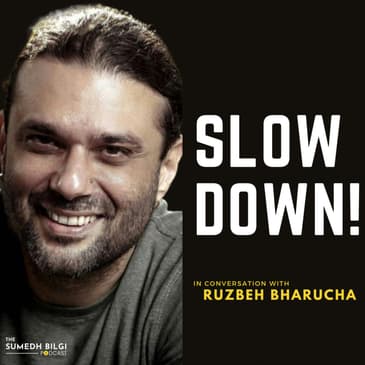

A devotee of Sai Baba of Shirdi, Ruzbeh N. Bharucha in one of the most influential spiritual writers in our times.
He is the author of fourteen books, including the bestselling The Fakir trilogy, which has been translated into several languages. Formerly a journalist, he is also a documentary film-maker with multiple awards next to his name.
In this chat, Ruzbeh and I chat the intention in our prayer, modern lives of no control and living beyond our means and living in surrender.
You can now follow me on Instagram: https://www.instagram.com/sumedhbilgi/
[00:00:01] I have learned this very recently, unfortunately very recently, but fortunate that I learnt it.
[00:00:08] It's not about your prayers, it's about how much you love the one you are praying to.
[00:00:16] Beautiful.
[00:00:17] It's not about your pooja, pats and your namaz and whatever.
[00:00:23] It's about do you love who you are praying to?
[00:00:28] Are you in a state of gratitude?
[00:00:33] What are you seeking?
[00:00:35] Are you seeking their love and their blessings or are you seeking XYZ?
[00:00:41] Because then that is not prayer, that's a business deal you're trying to make.
[00:00:54] The Sumedh Bilgi Podcast
[00:00:56] Hello and welcome to the podcast everyone.
[00:01:03] My name is Sumedh Bilgi and this is my show where we release episodes every alternative Thursdays about topics ranging between health, well-being, fitness, spirituality
[00:01:15] and seeking a life that we can value and treasure and be happy with.
[00:01:20] On today's episode, we host Ruzbe Bharucha who is one of the most profound spiritual writers of our times.
[00:01:26] Ruzbe is somebody that has been around the media circuit for a very very long time
[00:01:32] and continues to be contributing via his incredible array of books in the spirituality space.
[00:01:40] He is undoubtedly one of the most incredible thinkers that I've had a conversation with on this show and beyond as well.
[00:01:47] And I think you will really benefit from today's conversation.
[00:01:50] On the chat, we speak about a wide array of topics including acceptance, living a life of contentment,
[00:01:57] dealing with the difficult times that we're in, navigating through the threats, the dangers, the illusions, the attachments
[00:02:07] and everything that is out there to take us away from our ultimate goal which is of merging with the divine.
[00:02:15] We talk about how we need to address life's concerns and what is the right path to live well and to be content in life.
[00:02:25] So I'm struggling for words because this conversation ranges between multiple topics and I do not want to give any of it away.
[00:02:34] It is a conversation that you must listen and watch to its entirety and I guarantee that maybe a percentage of it at least will stick with you
[00:02:45] and stay with you and leave an imprint at a certain point.
[00:02:49] So I hope you like it.
[00:02:52] I hope you follow the podcast and I hope you share this episode with everybody around you
[00:02:59] because you do not really come across thinkers like Rizbe very often and I think it is our honour and our absolute privilege to be hosting him today on the show.
[00:03:09] Alright, let's roll the episode.
[00:03:11] Thank you so much for your presence. I'm very grateful.
[00:03:16] Thank you.
[00:03:17] Thank you.
[00:03:18] How have you been? It's my pleasure entirely to be hosting you.
[00:03:21] We've been in touch virtually for a while and to finally be able to do this is an absolute pleasure.
[00:03:28] So thank you so much for being on the podcast.
[00:03:31] It's my honour to be on the podcast.
[00:03:34] How have you been? How's life treating you?
[00:03:37] Since a little while I've not been too well but I guess everyone is going through this new wider that's going about in Mumbai, Pune, everywhere.
[00:03:51] And like everything this earlier, a viral would last for five days now it seems to be lasting for a few weeks.
[00:04:02] Yeah. It's been quite the time hasn't it? Last couple of years the world's been through so much.
[00:04:09] What's your reading been of it? The kind of change that we've been through?
[00:04:14] See I've written my first book was called The Last Marathon.
[00:04:19] It's a book Life After Death and Spirit Communication.
[00:04:23] And I had written it in 1998, 1999.
[00:04:28] And I'd interviewed Vira Keshwala who used to channel Audhara Mahayar Baba.
[00:04:35] And when COVID struck I got a lot of people who had sent me a paragraph from that book.
[00:04:43] We said that Audhara Mahayar Baba says through Vira Keshwala that from the year 2020 to the year 2030, mankind will go through things they've never gone through before.
[00:05:02] Now you must understand that book was written nearly 21 years before 2020.
[00:05:09] So if you look at it from that angle, maybe it is destined.
[00:05:15] Maybe this was what was planned much much before.
[00:05:19] Sometimes destiny enfolds in various strange ways and we are going to see a lot of strife for the next few years.
[00:05:37] Recession is knocking at our door.
[00:05:42] And I think the next few years are going to be a challenge for a lot of people.
[00:05:51] Plus I feel there is great civil unrest in our country, the form of communal divide.
[00:06:01] And I have a feeling sometime down the line we are going to experience a major communal riot or a major communal unrest.
[00:06:16] I think only those who are calm and who are centered are going to be less affected by all this.
[00:06:28] I feel we are always in the pursuit of something.
[00:06:31] We are always trying to chase something and you mentioned about being centered, about how people that are being centered will end up better off in the difficulties to come.
[00:06:43] Is this chase after material happiness and things that are outside of us at the core of the unrest that we feel?
[00:06:55] Not being content, always seeking, never being satisfied, trying to live up to the expectations and perceptions of people around.
[00:07:11] I think we create our own hell and then we look to blame it on others or God or destiny or the government.
[00:07:24] But I think most of the times, I am not saying all the times.
[00:07:28] Most of the times if we were just calm and centered giving our best to each moment and then leaving the rest to the Goddess God Guru's wisdom,
[00:07:39] I think we can go through the most turbulent times calmly.
[00:07:47] But at this present moment, most of us, a dog trying to catch its own tail and chase its own tail.
[00:07:55] And it's unfortunate.
[00:07:59] Of course one cannot disregard the fact that inflation is really moving at a rapid pace.
[00:08:09] Valories are not. Education has become phenomenally expensive.
[00:08:15] If you are ill and in the hospital, sometimes when you see the bill, you feel you are better off dead.
[00:08:25] So too strong a thing that is happening but yet only those who are going to be very still, very centered.
[00:08:37] Those are going to be able to keep their heads above water.
[00:08:45] And of course the new fad of living of EMI is a dangerous way of going about life.
[00:08:55] Sense of immediate gratification, right? We are always chasing this immediate gratification and I want that latest watch.
[00:09:04] I want to show off my shoes, my car, my house and the EMI is the quick antidote to that.
[00:09:12] Little little payments at the surface it doesn't seem like much.
[00:09:17] But it adds up.
[00:09:20] A few days back a father and son had come to meet me.
[00:09:26] Father had grown up the hard way.
[00:09:30] He was born in a poor family.
[00:09:34] But the son was born in a rich family because the father had made it.
[00:09:38] And the father was telling me that my son just bought a 16 lakh rupee watch.
[00:09:47] And he said I am wearing a 11,000 rupee watch and both the times are the same but it shows the time.
[00:09:57] So, you know, we are trying to meet our peers, compete with our peers.
[00:10:08] And it's you're going to go fucking downhill if you continue like this.
[00:10:16] I think being a part of this millennial generation myself and hanging out with people of my age and just observing them.
[00:10:27] What you mentioned boils down to awareness, comes down to awareness, being aware of what you're doing, where you're putting your energy.
[00:10:37] What are you really investing in?
[00:10:39] And it feels like we'd rather just continue on this whim that we get again and again.
[00:10:47] Then sit down and face things and be aware about things, you know, be aware about where we're putting our energy.
[00:10:53] What's coming back for us?
[00:10:56] What are the implications it has towards people around us?
[00:11:00] We'd rather just not face all of that and just carry on with one whim after the other, one way after the other.
[00:11:10] Is that what you observed as well?
[00:11:12] You know, Sumit, two things are important.
[00:11:15] Aadani ko apni aukkaat nahi bullne chahi.
[00:11:21] Jitna chabdhar hai upna bare phalao.
[00:11:24] Once you know what your priority in life is and you move towards that priority,
[00:11:32] eight out of ten times you will be on a safe record.
[00:11:35] How many of us really, really put money aside for emergencies, for, you know, we don't.
[00:11:50] We feel that it's okay, EMI hai, banks hai, kar liye de jab hoega.
[00:11:57] And you know when the growing is good everything is fine.
[00:12:02] But COVID has taught us that sometimes things are far beyond our control
[00:12:09] and that is the time when hell breaks loose.
[00:12:13] I have known so many families who have come to me.
[00:12:18] They were to call back the children from abroad midway in their education because COVID puts them back.
[00:12:28] Weddings were cancelled.
[00:12:30] You know what I'm saying?
[00:12:31] We need to have head on our shoulders and feet firmly on the ground.
[00:12:37] It feels like we're seeing beyond plain sight is something that we've completely forgotten.
[00:12:43] Whatever is immediately visible to us humbus vahidhya tha hai.
[00:12:48] And I think to tie into what we've met today to speak about,
[00:12:53] which is what you've written about so extensively, our spiritual life and spiritual practices.
[00:12:59] Seeing beyond plain sight is something that we've stopped practicing entirely, isn't it?
[00:13:07] That has been promoted to us from generations.
[00:13:11] And now we just don't, you know whatever is immediately visible to us.
[00:13:15] That's all that we look at and that's all that we perceive and react to.
[00:13:19] There's no second thought of looking beyond what is immediate.
[00:13:24] You see I think this whole culture starts from school.
[00:13:32] Where as a child itself you are taught by your parents that you know what?
[00:13:39] Look at the neighbor's son, he's studying so well you have to study harder.
[00:13:46] Look at this family's child is doing this.
[00:13:52] So there is always that competitive as well as the pressure of being either with your peers or one step ahead of your peers.
[00:14:04] And it starts from childhood.
[00:14:06] Parents compare siblings.
[00:14:10] Because of that comparison, an individual is not content with his or her own lot.
[00:14:18] You know what I'm saying?
[00:14:20] So I think it starts from school.
[00:14:23] It starts from when we are children this whole pressure of living up to the Jones,
[00:14:31] you know, trying to be in that crowd, trying to match up somebody else's lifestyle.
[00:14:39] And then it becomes your nature and then all your life that is all that you're doing chasing an illusion chasing a mirage.
[00:14:50] You know, you're drowning.
[00:14:55] And I've seen it in Covertime.
[00:14:58] I've seen it because a lot of families come for counseling, a lot of families come for help and I've seen it.
[00:15:04] I've seen it across the board.
[00:15:06] Poor middle class upper middle class rich you limit they have all got a banging and when I sit back and try and ask myself.
[00:15:19] What is that one common factor?
[00:15:22] And it's always this.
[00:15:26] Everybody seems to be living beyond the means.
[00:15:30] You know what I'm saying?
[00:15:34] Yeah, and please it's not only about middle classes about everybody, everybody.
[00:15:41] I have someone who works for me is, you know, he takes care of the house and this and that his salary must be 8000.
[00:15:50] That day he comes driving a Maruti.
[00:15:55] And I thought actually I thought it was his friends and he told me, sir, I bought a new car.
[00:16:04] I said, are you fucking joking?
[00:16:08] Yeah, doing.
[00:16:10] You understand what I'm saying?
[00:16:13] My brother-in-law has a car and my wife is pressurizing me that I should also have a car.
[00:16:20] So we have sold our gold and we have taken an EMI on a car.
[00:16:27] And so that's become part of psyche.
[00:16:34] It says that the banks are loading on money free of cost.
[00:16:40] To just trap my head around what you just mentioned, you know, just this life example of your help.
[00:16:47] Yeah.
[00:16:48] His wife and him together have taken this decision.
[00:16:53] Yeah.
[00:16:54] Gold off what the car.
[00:16:56] God forbid something happens.
[00:16:59] Who takes care of they might have a child, they might not have a child.
[00:17:03] Yeah, they just got a child some nine months back, 10 months back.
[00:17:08] What happens to the child? What happens to the parents?
[00:17:11] No, I honestly have no understanding.
[00:17:15] I can't wrap my head around this.
[00:17:18] Then why would you do something so suicidal?
[00:17:23] It's unbelievable.
[00:17:24] Yeah.
[00:17:25] And you know what is the best part is?
[00:17:28] Yeah.
[00:17:29] Medically, they don't have life insurance.
[00:17:32] But you are going to buy a car to keep up with the Jones.
[00:17:38] And I think that's the problem with our society.
[00:17:43] Is this just a signal of the times that we're in or has it just been a recurring feature that's, it's just the time?
[00:17:53] I have seen, I've been channeling for 25 years.
[00:17:57] I never saw it before.
[00:17:59] But since the past five, seven years, this problem has really exploded.
[00:18:07] What is the unlock?
[00:18:08] So what is the how do we get past this, you know, with your experience of human behavior and you've observed people all this while?
[00:18:17] What is the unlock?
[00:18:19] The only way to get about it is stop trying to live beyond your means to math.
[00:18:25] Stand that illness might come understand that there could be an emergency.
[00:18:30] You are going to get old, your parents are old, your children's education is going to virtually strangulate you.
[00:18:40] Yeah.
[00:18:41] Whatever you are earning, be wise in, you know, diversifying your whatever income you have into various pockets which might help you in on a rainy day.
[00:18:54] Yeah.
[00:18:55] On a personal level, on an individual level, right?
[00:18:59] Obviously, this is, you know, what we've been talking about a little bit about the material world and the outside and how you manage resources and how do you live?
[00:19:07] On an individual level, what are the, you know, I'm refraining from using the word spirituality because I think it is the most misused word.
[00:19:17] A lot of people just throw it around everywhere and say spirituality is going to unlock this for me and it's going to make this happen for me.
[00:19:26] Yeah.
[00:19:27] But I don't think they know much about what it really is.
[00:19:31] But at an individual level, what do you think is the way forward for people to live a little bit more centeredly and a little bit more, you know, to ensure that you withstand the storm and you live okay.
[00:19:46] See, the first thing is, you have to understand the difference between needs and wants.
[00:19:55] I think that concept has got blurred.
[00:20:00] An individual does not sit down with himself or herself and say, hey, I'm getting so much money every month.
[00:20:08] Yeah.
[00:20:09] What are my true needs?
[00:20:13] I need to spend it on that.
[00:20:15] And now what are my wants?
[00:20:19] And how am I wants in a time of trouble going to really create problems for my needs?
[00:20:29] I think when an individual sits down and actually writes column one needs column two wants, you know, we are not going to get out of this trap.
[00:20:47] I think the line between needs and wants have got very blurred.
[00:20:53] The example I gave you of my help buying the car.
[00:20:57] Yeah.
[00:20:58] I think it's a need.
[00:20:59] It's a good to compete with the brother-in-law.
[00:21:04] And the wife's desire.
[00:21:06] Yes.
[00:21:07] And the wife's desire to, you know, what not be looked down upon.
[00:21:13] You know, they think going to be looked down upon if you are riding a bike rather than driving a car.
[00:21:21] And I feel an individual does not understand needs and wants.
[00:21:28] And then what could emergency is being the future and start putting aside that kind of money for those emergencies?
[00:21:38] You don't really sit down and chart out your roadmap.
[00:21:44] Eight out of 10 times you're going to find yourself in deep shit.
[00:21:48] Yeah.
[00:21:50] I was just thinking about what are the emotions that we face a lot in today's world.
[00:21:56] And just when I was pondering about it, especially the negative ones, selfishness showed up attachments showed up illusions showed up.
[00:22:07] And I think the third one is rather peculiar and rather important because you know, just I like that we're building upon a story to talk about ideas with regards to, you know, your help.
[00:22:19] I hope, you know, your help does not find it.
[00:22:22] Take this personally when they see it or listen to it, but it just gives us an important, you know, ground to build upon a conversation.
[00:22:30] Yeah.
[00:22:31] But illusions is something that I'm rather, you know, very, very enamored by because we're we have these illusions in front of us of an ideal life of, you know, an ideal image of an ideal partner of an ideal society.
[00:22:47] How dangerous is that, sir?
[00:22:50] Okay.
[00:22:53] The two things which I'm very scared of one is expectations of the world and second is expectations of yourself.
[00:23:07] And the second thing is perceptions.
[00:23:11] Okay.
[00:23:13] If you see most of the times when people are dying and when a loved one talks to them saying, is there anything you regret 60 to 70% of people say, yes, I regret trying to live up to expectations and perceptions of people around me.
[00:23:44] More, not less. I'm really doubting it.
[00:23:49] I was reading a summary is doing research and they said, would you just go through the book and they've interviewed quite a few people.
[00:24:02] Those who on the deathbed, those who are very old and virtually all of them said the same thing that I wish I had not tried to live up to the expectations and perceptions of the world.
[00:24:20] The second thing which is common to all is I wish I had been content with my lot.
[00:24:32] Okay.
[00:24:33] Now it's very strange.
[00:24:35] Here are people who are about to die in a few months time, a few weeks time.
[00:24:41] These are the two regrets that have come out from them.
[00:24:46] Even in my counseling that I do.
[00:24:51] A lot of times, you know, I asked those people if there's one thing you would have avoided.
[00:25:00] What would it be?
[00:25:02] And the answer comes very fast.
[00:25:06] Trying to live up to expectations and perceptions of others trying to live up to, you know, matching the standard with our neighbors and colleagues and families.
[00:25:18] These are things that come out very fast.
[00:25:20] That is obviously playing in their mind somewhere.
[00:25:23] Okay.
[00:25:28] So I believe that if an individual can just take care of these two things, one is stop trying to meet up with expectations and perceptions of others.
[00:25:39] Trust me, God has failed in making everybody happy.
[00:25:43] You and I are not going to succeed in that.
[00:25:47] And second thing is being happy with your lot.
[00:25:56] I'm not saying being fatalistic.
[00:25:59] I'm saying you're giving best and then you're being happy with your lot.
[00:26:06] I saw that trade.
[00:26:07] I saw that trade in my mother.
[00:26:11] I saw that trade amongst my aunts and, you know, I was growing up.
[00:26:18] In a joint family, cousins staying together.
[00:26:21] I saw that trade in my maternal grandmother paternal grandfather and then I look at them.
[00:26:27] What is that one thing that they had in common?
[00:26:30] They were happy with the lot.
[00:26:32] They weren't seeking whole time something.
[00:26:35] They weren't wishing, oh, I wish this had happened.
[00:26:38] No, they didn't do all that.
[00:26:40] And we've come from a very humble family, nothing fancy.
[00:26:46] And trust me, those are the best days of my life because I lived among satisfied content people.
[00:26:55] And I think that's missing some of them.
[00:26:57] I think that's going out.
[00:26:59] That's going out and we're not inculcating it in our children.
[00:27:03] We're pushing our children.
[00:27:05] You know, you got to get better jobs so that you get better money and you're on a high post.
[00:27:15] You know, we are pushing our children.
[00:27:20] We're not telling them, but you know, you have go for your calling, be happy, give your best, enjoy.
[00:27:28] No, it's all about the position is all about the money and the package.
[00:27:34] So we are training our children from a very small age that that's what your focus should be.
[00:27:41] We are not talking about health is wealth relationships are wealth.
[00:27:49] Your connect with your goddess God guru is your wealth.
[00:27:53] No, we are saying your position in life and your bank balance is your wealth.
[00:27:59] And then what do you expect these children when they grow up?
[00:28:05] What do you expect them to do?
[00:28:07] Yeah.
[00:28:09] There are two areas that I want to take this because there are a couple of things that you mentioned very profound things.
[00:28:16] I would like to leave it to you to answer what is it? Where would you like to take it?
[00:28:21] So there are two things, the first thing that you spoke about is death and how people do you know at the time of their death.
[00:28:29] Somehow see things a little more clearly in hindsight and the role of and the importance to the body being dropped given in the spiritual lens in texts and you know,
[00:28:43] Guru's spiritual beings that have walked this earth they've always given death a very important role.
[00:28:52] So, you know the way we review our mortality is that something that you think has changed where we view it differently now to where we used to, you know, view it differently earlier.
[00:29:07] You see in ancient times, why ancient times? I mean, I've seen it in my grandparents.
[00:29:17] Yeah.
[00:29:18] They were very clear about two three things. They were clear that they are not the body. They were very clear.
[00:29:31] They were clear that your karma is going to decide where you land.
[00:29:39] And third, they were clear that as you saw, thus you shall reap.
[00:29:46] We have forgotten these simple truths.
[00:29:51] So may I remember one thing? Everyone says we come with nothing, we go back with nothing which I don't believe in.
[00:29:58] We come with a karma and we go back with a karma.
[00:30:03] We don't come empty handed.
[00:30:05] We come with a karma and we go back with a karma which is defined in an astrological chart.
[00:30:13] There's a section of I think Tibetan or Buddhist monks who have to every day in the morning when they wake up.
[00:30:29] They have to meditate on their death.
[00:30:34] So they have to lie down, imagine themselves dying and their families gathered around and the death ceremony every day.
[00:30:45] Every day. That is the first meditation that they are supposed to do.
[00:30:53] Why? My understanding, I may be wrong, but my understanding is reminding yourself that this body is a shell it will drop anytime.
[00:31:06] Number two, your name, your fame, your wealth, your position, your power is useless.
[00:31:15] You're not going to take any of that with you.
[00:31:18] And third very important thing, Sumit, how do you want to spend the day which could be the last day of your life?
[00:31:28] We've forgotten all that.
[00:31:34] For some reason, look around you for some reason we have kind of we believe that we can take all this crap with us.
[00:31:44] Money, ego, wealth, money, status, position.
[00:31:49] But the wise know that no, the only thing we can take is our good thoughts, good words, good deeds and their amifications are the fruits of those good thoughts, good words, good deeds.
[00:32:04] I believe we gravitate after the physical body ties to what we are giving energy to.
[00:32:21] That is why all the ancient masters say during the last moments of your about to pass over, think of your goddess God Guru.
[00:32:34] You gravitate towards your goddess God Guru.
[00:32:37] I don't remember.
[00:32:40] I have witnessed and I have been part of many people passing over in these 25 years of channeling.
[00:32:50] My last conversations with those who are about to die.
[00:32:54] I don't ever remember one single person talking about name, fame, bank balance, glory position.
[00:33:07] No. I see fear in their eyes.
[00:33:13] I see regret in their eyes.
[00:33:17] You know, I know they want to tell me I wish I had time to turn things around.
[00:33:26] I would have lived a more calm, centered, fruitful life.
[00:33:34] So that's why we don't say death because the body ties, the body dematerializes.
[00:33:45] The spirit within us keeps moving and that's a fact.
[00:33:51] But I think we've forgotten all that.
[00:33:53] We've forgotten all that.
[00:33:59] Because it's not immediately visible, right?
[00:34:02] It's not visible. It's not tangible. We can't hold it, touch it, feel it.
[00:34:06] Which is why also worshipping, being in prayer, being devoted to God is something that you...
[00:34:18] I don't see a lot of people being devoted.
[00:34:21] It's more about I will pray, I will do this, it'll get me something.
[00:34:27] I will do this and it'll get me something.
[00:34:31] Because the presence is not tangible to the immediate eye.
[00:34:33] Which ties in with what we spoke about earlier, which is seeing beyond plain sight, being aware.
[00:34:41] That's missing.
[00:34:43] You know, Sumit I'm 55 now, okay?
[00:34:47] If you ask me whatever I learned and I've learned this very recently, unfortunately very recently,
[00:34:58] but fortunate that I learned it.
[00:34:59] It's not about your prayers.
[00:35:03] It's about how much you love the one you're praying to.
[00:35:08] Beautiful.
[00:35:10] It's not about your puja, pats and your namaz and whatever.
[00:35:15] It's about do you love who you're praying to?
[00:35:20] Are you in a state of gratitude?
[00:35:25] What are you seeking?
[00:35:26] Are you seeking their love and their blessings or are you seeking XYZ?
[00:35:33] Because then that is not prayer.
[00:35:34] That's a business deal you're trying to make.
[00:35:37] Yeah.
[00:35:39] Okay.
[00:35:41] I've told this many times that I would hate it if my daughter were to come and tell me 108 times fast,
[00:35:48] I love you, I love you, I love you.
[00:35:50] I would rather she came once hugged me and said, I love you dad.
[00:35:57] With a full heart.
[00:35:59] Yes.
[00:36:01] I am sure that goddess god gurus also want this only.
[00:36:04] Yeah.
[00:36:08] You know, I've talked to a lot of people as to why do they pray?
[00:36:15] Yeah.
[00:36:17] And I think I've got two answers from most of the people.
[00:36:22] One is because we are seeking something and one is we are fearful that what we have might go away.
[00:36:31] Yeah.
[00:36:35] And I think that's a very sad relationship to have with your goddess god guru.
[00:36:43] So my mind went straight to Shirdi for some reason and I've noticed this that a lot of people when they go to Baba
[00:36:51] and obviously I mean, I'm glad that we are finally here at this point in the podcast where we can talk about Baba because
[00:36:59] I obviously learned a lot about you when I, you know, through a Baba network.
[00:37:06] And, you know, I've seen a lot of people go to Shirdi, drive to Shirdi all the way and donate money there.
[00:37:14] And it's always about, okay, Baba, I've come all the way now.
[00:37:21] Give me the promotion.
[00:37:24] Give me the this, give me the that.
[00:37:27] Yeah.
[00:37:29] And it's actually sad, you know, like I never, like I feel a sense of sadness when I, I mean, I don't know if you felt this as well, but
[00:37:37] I felt this when I've been to Shirdi. I feel very, very sad about it because the way, you know, people view and approach,
[00:37:46] you know, a relationship with Baba or it could be anybody and any God Guru, God is the way you say it.
[00:37:52] But, you know, just the way they approach it and, you know, in the chase of wanting something from Baba,
[00:38:00] they are missing out on the most beautiful relationship that you could have with anybody.
[00:38:08] You must understand one thing, Suman. Even when Baba was in his physical body,
[00:38:15] his last two, three years he was quite disillusioned. Okay?
[00:38:20] He said people are coming for rags when I want them to give the Khazana.
[00:38:26] Yeah.
[00:38:29] You know, I, I've asked this question a number of times to myself and to my people is let's say if Sai Baba of Shirdi somehow manages to make an announcement
[00:38:43] that my children, I will always love you.
[00:38:47] But from henceforth, I will not be able to do anything for you.
[00:38:51] That department, that portfolio has gone out of my hands.
[00:38:56] How many would still love him?
[00:38:59] I want to know how many people would go to Shirdi after that.
[00:39:05] I've asked myself many times this question about my own self, my own love.
[00:39:13] Same. Yeah.
[00:39:16] And I would like to believe that I only love him.
[00:39:19] I would like to believe that my destiny I have to go through and Baba might not be able to help me when my destiny is concerned.
[00:39:33] But I would just like him to be holding my hand when I'm going through that destiny.
[00:39:39] Yeah.
[00:39:41] We have made everything into a business deal.
[00:39:45] Yeah.
[00:39:46] Our Goddess God Guru has become the CEO of a company.
[00:39:55] That's it.
[00:39:57] You go to them for give me a raise, give me a holiday.
[00:40:01] We are just seeking, we are just seeking, we are just seeking, we are just seeking.
[00:40:06] How many times do we honestly with all our love say thanks so much Baba for everything?
[00:40:13] You've given me everything. How many times do we say it?
[00:40:19] Not often, I think.
[00:40:21] Yeah.
[00:40:23] Some never perhaps.
[00:40:25] Yeah.
[00:40:27] Dadavaswani when I was interviewing Dadavaswani told me something very very sweet.
[00:40:32] He told me, Ruchbe, sugar is the most powerful prayer.
[00:40:38] Sugar.
[00:40:40] Yeah.
[00:40:41] How many of us really, really interesting to know.
[00:40:45] Alright, it's time for a break on the Sumed Bilgi podcast.
[00:40:49] See you on the other side in a bit.
[00:40:57] Tell this story about when he was travelling I think in an ambulance or in a car and the road was bumpy.
[00:41:06] Yeah, you know when...
[00:41:08] Could you tell us that story? Yeah.
[00:41:09] Yeah, I think Dadavaswani was the last seven to ten years he was on bed or in a wheelchair.
[00:41:18] Though the physiotherapist would come and he would go through a lot of pain but so when he fell down in America you're playing I think table tennis and a shawl came.
[00:41:31] He was...
[00:41:33] The shawl came in his feet and he fell down and he broke his bone.
[00:41:43] The ambulance which came to take him to the hospital or this hotel or resort must have been in the back of the beyond.
[00:41:53] And the road was exceedingly bumpy.
[00:41:57] Now you can imagine he was around early 90s and he's broken his hip I think.
[00:42:10] Okay.
[00:42:14] And the bus is jerking on the road and it's I think night time so visibility is not too good and there are bumps and everything
[00:42:23] and all through the journey whenever he went through excruciating pain he would whisper Shukar.
[00:42:33] I mean these were giants.
[00:42:39] Yeah.
[00:42:41] These were giants.
[00:42:42] I mean you sat down with Dadav and in two minutes you forgot Dadav because Sadhu Vaswani is auto envelope tube because of Dadav's love for Sadhu Vaswani.
[00:42:56] Yeah.
[00:42:58] Those people I don't know now.
[00:43:01] I don't know.
[00:43:03] I know how you feel.
[00:43:05] I think one of the biggest regrets that I feel all the time is I haven't been able to meet a Siddha Purish.
[00:43:10] Like I haven't I don't know if I'll ever be able to you know.
[00:43:15] Can I tell you one thing?
[00:43:17] Yeah.
[00:43:19] I think your regret shouldn't be that you might not be able to meet a Siddha Purish.
[00:43:23] Your regret should be that you may have met the Siddha Purish and not recognized him.
[00:43:28] Not recognized yeah.
[00:43:30] Okay.
[00:43:32] You understand what I mean?
[00:43:34] Yeah of course absolutely.
[00:43:35] Because these Siddha Purish don't come about dressed like you know clowns.
[00:43:41] They are very simple people.
[00:43:43] Yeah.
[00:43:45] They are very simple people.
[00:43:47] They don't have all these fancy paraphernalia around them.
[00:43:53] So who knows?
[00:43:55] There could have been somebody in your family.
[00:43:58] There could have been somebody serving you in your family.
[00:44:01] Who could have been a Siddha Purish?
[00:44:03] Yeah.
[00:44:05] So it's to recognize the Siddha Purish.
[00:44:13] Right.
[00:44:15] I think I can finally use the S word spirituality because you know like I feel spirituality you know through this is something that you had said I think or had read somewhere is essentially recognizing the spirit within us which is a reflection of the divine.
[00:44:33] See in ancient times that was the meaning of spirituality.
[00:44:36] When you operated from the spirit within you you were called spiritual.
[00:44:42] It had nothing to do with prayers and charity and rituals and pilgrimages.
[00:44:47] Yeah.
[00:44:49] When you operated from the spirit within you, you were spiritual.
[00:44:54] Our word namaste the divine within me bows down to the divine within you.
[00:45:05] I mean how more classy can you get?
[00:45:07] Yeah.
[00:45:09] True.
[00:45:11] Okay.
[00:45:12] So it's all about connecting to the divinity within each one of us and operating from that state of the divine spark in each of us.
[00:45:30] I think that is spirituality.
[00:45:32] It's not about being knowledgeable being erudite knowing all the prayers and reading all the books and all that is great.
[00:45:43] That's Gyan which is great.
[00:45:45] Yeah.
[00:45:47] Gyan will make you reach the doorstep of heaven only through childlike love will make you enter it.
[00:45:57] So I don't get very impressed by people who know everything.
[00:46:07] Early I would as I've grown older, I only want to see are they operating from the divine spark?
[00:46:17] Are they operating from love?
[00:46:18] That is why I got in the other Vasvanian that is what I got in Murari.
[00:46:25] Murari Bapu that is what I got in Swamiji Naik.
[00:46:29] Like Murari Bapu I met him.
[00:46:32] You can feel the love.
[00:46:34] You know the other Vasvani you could just feel the love that divine love.
[00:46:39] You just felt comforted first book which really blew my mind off was autobiography for yogi.
[00:46:47] I read it when I was 17 my uncle Jimmy Ghasidhar had introduced me to it.
[00:46:54] I remember one line from that book that one line really really made a great great impact on me.
[00:47:04] When Sri Parmanasi Yogananda said God is simple everything else is complex.
[00:47:12] I feel unfortunately we are complicating spirituality.
[00:47:18] What is the role of religion then in spirituality?
[00:47:27] Religion is like a roadmap.
[00:47:33] They try to teach you a moral code of conduct.
[00:47:37] They try to guide you into certain activities or certain prayers or certain breathing.
[00:47:46] That will open this heart chakra of ours where we can operate from divine love.
[00:47:57] Spirituality is in my vocabulary being a decent kind compassionate human being operating with the knowledge that nothing is mine.
[00:48:17] Everything is yours.
[00:48:20] Everything has come from you.
[00:48:23] I too have come from you and I want to reach back home.
[00:48:30] Spirituality is the fragrance that comes out from a musk deer.
[00:48:37] The deer all its life is trying to find the scent which comes out.
[00:48:43] It is within.
[00:48:45] We are all like those musk deer.
[00:48:49] I think spirituality the true essence of spirituality is to spread the divine spark which is within you.
[00:48:59] Which has come from the divine flame which I would like to believe Zoroastrians would call Aurama Sada and Muslims would call Allah and Hindus would call Adi Shakti.
[00:49:15] Christians would call God.
[00:49:18] But I think it's going back home by spreading light.
[00:49:27] Spirituality is about oneness because the divine within me bows down to the divine within you.
[00:49:36] Right?
[00:49:38] It's oneness.
[00:49:41] But now unfortunately religion has become duality.
[00:49:45] My God versus your word, my prayers versus your prayers, my customs versus your customs.
[00:49:54] Now spirituality has become a diet.
[00:49:57] Preferences and...
[00:50:01] Yes.
[00:50:04] If somebody is waking up to this and waking up to life and finally beginning to try and reconstruct things and walk on the right path.
[00:50:14] Does that where sadhana and practice, spiritual practice come into play where after a sense of practice then you begin opening up to the divine.
[00:50:29] That's what I'm saying. Religion will have techniques allow you to reach a point where the heart opens up with oneness and to spread light and compassion.
[00:50:49] But if you get caught up in the technicalities of the sadhana, the technicalities of the prayer and 1008 times chant then I'm going and looking at my tikka.
[00:51:04] Then it is really formality that you're indulging in.
[00:51:10] I have known atheists who are far more spiritual than most of those who came to be religious or spiritual because the atheist comes from compassion, empathy, love.
[00:51:32] It's all about love, Sumeeth. It's all about love.
[00:51:36] I've been observing this recent wave of conversation around spirituality and like we mentioned earlier in our chat, the words being thrown around in various different ways.
[00:51:49] Like you mentioned, obsessed with technique. People want to know about things like Kundalini and they want to know about things like astral projections and going out of your body and these experiences and those projections.
[00:52:08] What do you think about our obsession with those things?
[00:52:11] So, you know, sometime back an elderly lady had come to meet me. She must have spent I think close to around 50 years in meditation.
[00:52:26] I can't fathom it. Wow.
[00:52:29] So I asked her that how do you meditate? And she told me you've got to sit down, lotus position and then you take in a breath and you count and then you retain the breath and then you exhale the breath and you count and then you again without breath you count
[00:52:59] and then you take this to your Muldara chakra and then get it to your Sarsara chakra. So I said damn good. I said but when do you start your meditation?
[00:53:11] And she said that's my meditation. I said according to you, what is meditation?
[00:53:17] And she said becoming one with my master. I said but you are whole time one with your counting. Where are you one with your master and this?
[00:53:26] I'll tell you what, we have got caught up with all the frills. All the frills.
[00:53:36] They have let go of the true essence. Somebody told me, Rishabh, why don't you hold a five day retreat on meditation?
[00:53:48] And I said, I'll be able to talk about meditation for 15 minutes. What the fuck am I going to do for the remaining so many days?
[00:54:02] Number one, Kundalini meditation can be done only in front of your master with guidance from a spiritual guru
[00:54:17] because the Kundalini Shakti is more powerful than all the nuclear energy in the world.
[00:54:27] And if you don't know what you're doing, if you're not being guided properly, you could face very dire consequences.
[00:54:40] And what is about Kundalini Shakti? So what if all your chakras are opened? How does that make you a better human being?
[00:54:48] How does that make you love your goddess god, Guru Gaur? There is a difference, Sumet between Shuddhi and Siddhi.
[00:54:59] We are all trying to move towards Siddhi where Shuddhi has been completely pushed aside.
[00:55:07] What is the difference? What's the difference? Shuddhi is purity.
[00:55:12] Siddhi is power. Shuddhi is purity. A decent human being.
[00:55:24] We're not bothered about that.
[00:55:26] Compassionate, giving, loving, spreading the light. That's Shuddhi.
[00:55:32] Siddhi is about chakras and Kundalini and astral travel and miracles and all the other stuff.
[00:55:41] But remember one thing, every true master has said Siddhi is the greatest obstacle on the path of spirituality.
[00:55:54] All the great masters have said these Siddhis are an obstacle on the path of spirituality.
[00:56:03] You couldn't have said it better. I mean Siddhi versus Shuddhi.
[00:56:10] I see a lot of content on YouTube on this where everybody in the name of spirituality, these podcasts only talk about all these things that will enhance your power so you can become something.
[00:56:25] This is all the process of just one-upping each other and trying to increase your position and try to become superhuman.
[00:56:37] And it's not really about love. It's not about love.
[00:56:43] It's not about oneness.
[00:56:45] Which is what I wanted to ask you about because there's so much about this.
[00:56:48] It's not about love. Anything which is not solely about love and oneness.
[00:56:54] Anything which is not about spreading compassion and light has moved away from the path of spirituality.
[00:57:02] Before we wind up, I think it's one of the most important things that you've mentioned in this conversation is karma and what you come with and what you live with.
[00:57:16] And that I think is such an important, it feels like I mean I'm here as a student. I'm here to learn.
[00:57:24] It just comes across as probably one of the most important variables in your journey in the physical plane.
[00:57:33] So if you could introduce people to the concept of karma because there is so much misconception about it.
[00:57:39] People have thrown around that word as well everywhere.
[00:57:43] What is karma and what do people need to know about it and how can you be on the right side of things?
[00:57:52] See, I like to believe one thing. The creator who is a mother and father is not unjust.
[00:58:01] Right? Fair. Not partial.
[00:58:07] If you remove karma from the equation, then you get a very partial God.
[00:58:15] I would not like to believe in God if karma was not in that equation.
[00:58:21] I refuse to believe my God can be partial.
[00:58:26] Yeah, I would rather not believe in God.
[00:58:30] Okay? Yeah.
[00:58:32] So for me, karma is the foundation for my beliefs in the existence of God.
[00:58:39] Right? Yeah.
[00:58:41] When we as tiny sparks of consciousness leave the great flame, who I would like to call Adi Shakti Param Kali.
[00:58:53] Okay? We have no karma. It is all free will.
[00:58:57] Okay, Sumed? Yeah.
[00:59:01] It is all free will.
[00:59:03] But as we start going through our journey, our wants, our needs, our ego, everything starts cropping up.
[00:59:16] And that is when we start doing things which are right and wrong, good and bad.
[00:59:22] Okay? So from complete free will, now slowly the consequences of the use of your free will has started. Right?
[00:59:36] Hmm.
[00:59:38] And then many times the consequences overcome the free will.
[00:59:43] And you will see people who are completely governed by what we would call circumstances or planets or whatever you want to call it.
[00:59:57] Karma is nothing but the fruits and ramifications of our thoughts, words and deeds.
[01:00:06] It's like going to a mall and using the credit card left, right and center.
[01:00:14] And at the end of the month the bill is going to come.
[01:00:17] Then you say, what the fuck?
[01:00:21] So karma is nothing but our own higher self making us experience
[01:00:31] the good and the bad of what we have let out in the universe.
[01:00:38] Our karma is stored, they say, the sages say, our karma is stored in our aura.
[01:00:45] Yeah.
[01:00:47] And there are times, particular time, logged in where it activates.
[01:00:55] So some are going through a beautiful period, five years, 10 years, 15 years, 20 years, great.
[01:01:02] And then suddenly shit hits the fan.
[01:01:05] Yeah.
[01:01:07] So karma is very simple as you saw you read.
[01:01:12] That's why I told you we don't come empty handed, Sumed.
[01:01:16] We come with our karma and we go with our karma.
[01:01:19] What is it that people need to be aware and cognizant about?
[01:01:24] Each moment.
[01:01:26] Each moment.
[01:01:28] Wow.
[01:01:30] Trust me, you know, Avatar Maya Baba has said God is all merciful but the path to God is merciless.
[01:01:39] One of the main foundations on that path is karma.
[01:01:46] So what are we?
[01:01:47] You have to go through it no matter what.
[01:01:51] This reminds me of the story that you mentioned again on another discourse about Sai Baba's devotee who died of a fire and she was very dear to him.
[01:02:05] And you know, you say, you know, Sai Baba was in the body then and everybody said, Baba, why couldn't you just save her?
[01:02:15] And you said, no, it was, you know, like I took all her karma away in a few minutes.
[01:02:21] Yes, Radha Krishna.
[01:02:24] Radha Krishna.
[01:02:26] All the customs that you see in Shirdi she has initiated.
[01:02:30] All that you see in Shirdi now she has initiated.
[01:02:35] She was less than 100 meters away from Baba and she burnt herself to death.
[01:02:45] And when people ask Baba, so when they asked Baba, Baba said that because of her karma and her tongue, he would have had to come five to seven times and suffer.
[01:03:01] Baba said I finished it off in a few minutes.
[01:03:05] So extraordinary.
[01:03:09] It is impossible to understand the working of the Guru, please.
[01:03:15] Yeah.
[01:03:17] It is impossible to understand the working of the Guru.
[01:03:20] A true Guru is only interested in cleansing you.
[01:03:25] Yeah.
[01:03:27] So that you can move on to the path of merger with Adeshakti, Param Kali.
[01:03:36] That is the only real, real calling of the Guru to get you out of darkness into light.
[01:03:45] I think a great way for us to wrap this conversation up is to talk about surrender.
[01:03:53] And it ties up with so many things.
[01:03:56] You spoke about desires, illusions, the number of things that we've spoken about today, attachments.
[01:04:06] The whole thing about people knowing things and pretending to know things when we really truly don't know anything.
[01:04:14] I think it all boils down to surrender, to absolute complete surrender.
[01:04:20] So before we wrap up, if you have anything else to say like our young audience, what would you like to leave us with?
[01:04:31] So we have karma that is non-negotiable.
[01:04:35] We have the wisdom of the Master which is unquestionable.
[01:04:40] I think the only true prayer that we can pray, which makes sense keeping in mind non-negotiable karma,
[01:04:51] is that Baba give me the strength and wisdom to go through whatever is in my lot, calmly, gracefully, with a lot of humor and fearlessly.
[01:05:05] Because I have faith in your wisdom that you know what is best.
[01:05:12] So when you talk about surrender, I find surrender a fancy word.
[01:05:19] True acceptance, joyous acceptance of our Goddess, God, Guru's wisdom
[01:05:29] that she or he knows what's best for me and my lot is the way forward.
[01:05:37] It's damn difficult, it's not easy.
[01:05:40] But if you are asking me what is the greatest way of showing true love to your Goddess, God, Guru, it is with this attitude
[01:05:50] that I have given my best now I'll leave the rest to your wisdom.
[01:05:53] You do what you want to do.
[01:06:24] Of every moment that I've spent with you on this show in this conversation,
[01:06:29] I'm very grateful to have come across you thanks to the internet.
[01:06:34] But I think there is a higher power beyond the internet that was responsible
[01:06:38] and that is responsible for all our interactions in the world.
[01:06:41] And I'd like to believe that our conversation was also divinely guided today.
[01:06:45] So I'd like to thank you for your time and I hope you had a good time being on the broadcast.
[01:06:54] It's always divine to spend time one seeker with another seeker.
[01:07:02] That's it. I'm honored that you had me on your show and I wish you and all the viewers
[01:07:10] all the happiness, all the contentment and all the protection may Baba Sai be with us all.
[01:07:18] Jai Baba.
[01:07:20] Jai Baba.
[01:07:21] Thank you.
[01:07:58] I'll see you around.