
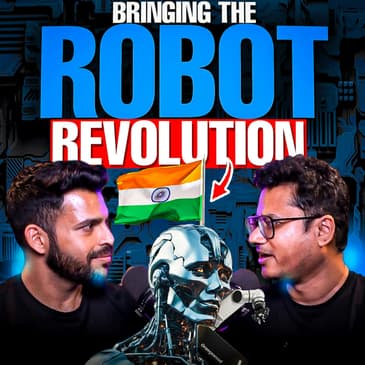

In this captivating interview, Abhinav Das, the Co-founder and CEO of Orangewood labs shares his entrepreneurial journey, spanning multiple startups and groundbreaking innovations. From collaborating with co-founders to revolutionizing Indian manufacturing, Abhinav's insights inspire and inform. He discusses commercialization strategies, staying innovative, and imparts valuable advice for new founders. Join us as we delve into the challenges and triumphs of building startups, navigating complexities of building in the Robotics space.
Topics:
00:00 Intro
01:45 The start of Abhinav's journey
15:14 Post Ahmedabad
20:54 Meeting his co-founders
23:40 Complexities of working with CNC machines
25:40 Building robotic arms
28:05 The 2nd startup
33:12 Going from Idea to product to company
39:02 Improving India's manufacturing
42:04 Commercialising your products
44:29 Staying innovative
49:44 What's next for orangewood?
51:31 Advice for new founders
52:40 Books and podcast recommendations
-------------------------------------
Click here to get regular WhatsApp updates:
https://wa.me/message/ZUZQQGKCZTADL1
-------------------------------------
Connect with Us:
Linkedin: https://www.linkedin.com/company/startup-operator
Twitter: https://twitter.com/OperatorStartup
-------------------------------------
If you liked this episode, let us know by hitting the like button and share with your friends and family. Please also remember to subscribe to our channel and switch on the notifications to never miss an episode!
[00:00:00] It was such and then at one time I was in such a bad situation personally and also
[00:00:06] company wise that I had to start calling my friends and guys if you have any money
[00:00:10] please give me some like 50,000 or 10,000 or something. You know this universe kind of helps
[00:00:15] you out if you're just wanting it so much. So I was just sitting there I remember and then this
[00:00:20] guy just comes in very thin guy comes in and says you know I want to work with him
[00:00:25] I said dude I don't have any money I may not be able to feed you as well and he said I don't care
[00:00:31] It's one of those things where you know I did not know the opportunity before we try to do exactly the opposite
[00:00:37] Like even if you have to fail at a customer end
[00:00:40] Hello and welcome to another episode of the startup operator podcast. I'm Roshan Karyapa.
[00:00:46] My guest today is Abhinav Das, who is the co-founder and CEO of Orangewood Labs.
[00:00:51] Orangewood builds robotic arms.
[00:00:54] Now that sounds like straight out of a sci-fi movie.
[00:00:58] And perhaps it is, if you look at their products, it's out of the world.
[00:01:03] We talked to Abhinav about his journey of building
[00:01:05] and tinkering for over 15 years.
[00:01:07] Some of the trials and tribulations he's faced.
[00:01:10] And then we delve into the nuances
[00:01:12] of building a hardware startup.
[00:01:15] How do you take to market?
[00:01:16] How do you commercialize?
[00:01:18] How do you build in a capital efficient way, so on and so
[00:01:21] forth?
[00:01:22] Aside from the many nuances on startup building that could be useful to you,
[00:01:27] I guarantee you that you will be super inspired from this conversation. My intention of the
[00:01:32] podcast was to help folks build better products and companies out of India and I'm sure that this
[00:01:39] conversation will help do just that. So yeah, I hope you like this conversation.
[00:01:45] And if you do, don't forget to like, share, and subscribe.
[00:01:48] So this is Abhinav Das of Orange Road Labs.
[00:01:59] Hey Abhinav, welcome to the startup operator podcast.
[00:02:01] Thank you so much for making the time.
[00:02:03] Yeah, absolutely glad to be here.
[00:02:04] And you know, I'm glad we're doing this.
[00:02:07] Yeah, man.
[00:02:08] We've been chatting for a couple of months.
[00:02:10] I'm really thrilled that we've finally made it here.
[00:02:13] And we're talking.
[00:02:16] So there's plenty that we can delve into,
[00:02:18] manufacturing, robotics, AI, so on and so forth.
[00:02:22] But I want to start this podcast with a few stories, right?
[00:02:26] A few stories from your life and your journey.
[00:02:29] And I think that will kind of set the tone for everything that follows afterwards, right?
[00:02:34] So the first story I want to start with is with you out of college writing your gate exam
[00:02:41] and then you have this sort of a what the f kind of movement, right?
[00:02:46] I mean, like what am I doing here? Why am I doing this and so on and so forth? So, can
[00:02:50] you just describe the circumstances around that and what it led to?
[00:02:53] Yeah, so I started my career. It actually started with an internship and this was a
[00:03:00] government organization which is called ICAT and I'm a mechanical engineer by training.
[00:03:07] I'm very much an automotive person.
[00:03:09] My live stream was to go and become a formula one engineer.
[00:03:14] And I was trying to pursue that.
[00:03:17] And one of the opportunities which I had at the time was, you know,
[00:03:21] going in and turning at first at ICAT, which was International Center for Automotive Technology.
[00:03:26] And they basically certified vehicles before they come on roads,
[00:03:31] one of those agencies.
[00:03:33] And then post that, I was working for this company called Sonakoyo
[00:03:36] Staring Systems Limited, which is like a tier one supplier.
[00:03:39] Now they're called something else,
[00:03:40] but they were a steering system supplier to different OEMs. So if you're driving
[00:03:46] an Indian car, 80% of the chances are that you might be holding a steering system which they've
[00:03:55] built. And while I was there, I was kind of getting bored. Like it was, there were things which they taught me.
[00:04:07] But then I think that there was a point,
[00:04:10] like within few months, it was pretty clear
[00:04:11] that I have learned enough to do something else.
[00:04:15] And I was getting bored.
[00:04:17] And there was one time one person introduced me
[00:04:21] to this thing called Jogard.
[00:04:23] And he told, and I've lived all my life in Delhi, you know,
[00:04:26] where I always had transportation, you know, there was a school bus or there was the, you
[00:04:32] know, the central Delhi transportation bus or so never really had transportation problems
[00:04:39] in, you know, like maybe the rest of the country faced. And this is like 2008.
[00:04:45] And he told me that you should just go and check out
[00:04:50] what's happening there.
[00:04:52] And previously, in college, I had built a car,
[00:04:56] built a smaller, there's this competition called Baha,
[00:05:00] where you basically engineering students come together
[00:05:03] and build a vehicle.
[00:05:04] And there's a racetrack where you have to do an endurance run.
[00:05:08] This happens in Indore every year.
[00:05:10] And we were in the first patch.
[00:05:12] So this 2007, 2008.
[00:05:15] And so I had some experience of looking at it
[00:05:21] where group of students have built a vehicle, which had to go through a very difficult
[00:05:27] terrain, which is not normal. And then, you know, it was like good enough for those things.
[00:05:33] And then I went to the rural area, I saw this Juwad vehicle, which had a pumps engine. It
[00:05:39] was extremely hard to sit on that. Right. I spent like maybe 15 minutes. I was having headache because there was like this
[00:05:47] engine who was throwing fumes on everyone who was sitting there and
[00:05:51] then it was vibrating so much and
[00:05:53] I found it very hard like how do people even like travel on this and then I started talking to the drivers
[00:06:00] Realize they don't actually make enough money. I mean it's like
[00:06:04] you know at that time
[00:06:06] I think they were making like thousand rupees a month after putting in everything, you know, all in.
[00:06:12] And I realize that it's actually not enough for even in back in 2008 for a family to survive.
[00:06:20] And one of the problems which they were facing was the fact that, the fact that they did not have property rights to that vehicle.
[00:06:32] So they basically had to save five years of money and buy one of these things and then they don't have any property rights. So, you know, I came back
[00:06:48] from that village and I was just thinking about this. You know, property rights, by that you mean
[00:06:53] that it's not a properly licensed vehicle and so on and so forth. It's a good way like confiscated
[00:06:58] and illegal. So, I think there was this movie called 12th past recently. Yeah, yeah. There those, yeah, 12th, sorry.
[00:07:05] So there those two brothers were basically driving that.
[00:07:08] Yeah.
[00:07:09] So there's a version of that anywhere in India.
[00:07:11] Not so anywhere.
[00:07:12] Exactly.
[00:07:13] Not south.
[00:07:14] You have like, I think Chennai, there used to be something called Mean 1D.
[00:07:17] There was a version in Gujarat, which was called the Chakra.
[00:07:21] And some of these vehicles are also like, you know, some of them are registered, some of them are not.
[00:07:27] But all of them are unsafe.
[00:07:30] And it's kind of hard to imagine,
[00:07:32] you know, like this country produces so many
[00:07:34] mechanical engineers who are not able to get jobs.
[00:07:36] And there are like so many problems
[00:07:38] which mechanical engineers could fix,
[00:07:41] but they're not fixing, they're not able to fix.
[00:07:44] So anyway, I was, I think this idealist 22 year old kid
[00:07:51] thought, you know what, I know how to build cars.
[00:07:56] If I go into let's say Formula One,
[00:07:58] maybe 20 years down the line, if whatever happens,
[00:08:02] like if I just live out the best of my life,
[00:08:05] my whole achievement might be just, you know, saving one second of a lap time for any of the best teams
[00:08:12] versus if I do this, you know, this is like something which I have the knowledge for
[00:08:17] and I can organize people to build something on this sort.
[00:08:21] I'll be able to change lives. And I think this kind of, you know, like if you give a cause to
[00:08:28] some 22 year old, yeah, it's, you know, exactly. So that's what happened to me. And I was thinking
[00:08:36] about it, you know, how do I do this? And obviously, you know, and by I think by December I left my job. Left or also laid off.
[00:08:47] It's funny that 2008 I can understand it.
[00:08:51] I graduated around the same time so I get the feeling.
[00:08:54] So 2008 it was.
[00:08:57] So I was given an option that either you stay but we'll have to fire someone.
[00:09:01] And then there was another guy who actually wanted to the job and I was like dude I can just
[00:09:07] not spend another day here and so I left and
[00:09:12] One of the ideas was okay, you know, I've told my parents. Yeah, I'm gonna write gate
[00:09:16] I think that's what everyone does so I'm gonna do M tech, you know get into something and while this idea was like sitting
[00:09:24] You know in my head, okay, you know what you could make something of while this idea was like sitting, you know, in my head,
[00:09:25] okay, you know, what you could make something of this sort. And then there was the gate exam.
[00:09:29] I was writing it and then there was like last 12 questions or so where you had to do some calculations.
[00:09:36] And I think I knew the how to do them and I don't think they allow calculators. So I would do like, you know, by hand, and I was like, dude, I
[00:09:46] don't want to do this. I have one hour left. It wasn't that difficult of an exam. I don't
[00:09:53] want to do this. And you know, it's like one of those times when you're like, you kind
[00:09:58] of know what you want. Yeah. Right. You have to go at some point to realize and it's like, I don't know, I don't want to spend
[00:10:08] another two years being in another college. That was not being very, very clear. So I just
[00:10:15] sat there and I was just planning. And then I decided, yeah, I think let's find some places
[00:10:21] where who can help me out to go and build this truck which I want to build.
[00:10:26] Awesome. I think as they say, you should have something to run towards and run away from.
[00:10:32] That's the strongest combination. After this, you go on to found evolving mobility or
[00:10:40] Evo-mo. You have a couple of folks with you. And then you move to Amda-Bha
[00:10:46] that at some point of time, you start living in the NID hostel or nearby. And then you
[00:10:55] have the situation where you're iterating on your prototype and whatnot and you're living living on $3,000 a month. So tell us that story.
[00:11:07] Yeah, so I think there's definitely something
[00:11:12] which I would want to also talk about a little bit,
[00:11:14] though I don't want to sound discouraging.
[00:11:17] But I do feel that the incubator system in India, which
[00:11:22] was like the university system, I don't think they're
[00:11:24] producing much. And there's a problem between people who run them they are not really entrepreneurs.
[00:11:29] So I think that's something which should be solved. It's a very academic outlook.
[00:11:33] I think they're bureaucrats. There's nothing wrong with them but I think they're doing
[00:11:37] they're in wrong place. So for them to understand you know what risk taking is, I don't think
[00:11:42] anyone understand that entrepreneurial risk taking right right? Like why do you take certain decisions which might just sound counterintuitive and
[00:11:49] you know might be like 40% of your burn for next six months but then you have to take those shots.
[00:11:54] I think they'll never do that versus you as an entrepreneur knows you know you'll have to take
[00:12:00] those kind of risks. I have to take that leap. Yeah. And I think for us, we were promised
[00:12:06] a certain amount of money. We never got that. And I mean, it was initially there. But you know,
[00:12:11] after that, like we got it to a point, but then after that, it was like, it's not gonna happen.
[00:12:17] So this became hard. You know, when you are again, 20 to year old idealist, you think that, yeah, everything is going to work out.
[00:12:28] And then there is some support.
[00:12:33] There's maybe 20% support.
[00:12:36] And then you're like, yeah, you know what, I'm going to get the rest of it.
[00:12:39] Which is how it should be working.
[00:12:41] But that did not happen.
[00:12:43] I was like, I had like half
[00:12:45] a prototype, like half the truck chassis, which we had, I had built mostly and then I had like
[00:12:50] few volunteers coming in. You know, I also talk about that. And then, you know, I could not build
[00:12:58] further. So it became difficult how to like, how to go go ahead and then I think that was a time which was one
[00:13:11] a very dark period in my life and also something which I'm really proud of. So I was one of those
[00:13:16] kids who never you know if like five kids would go to canteen there was one guy who will probably
[00:13:22] end up paying most even though that person may not be rich, I was that guy.
[00:13:25] Like I would not ask for money and you know, not ask for the heart or like anything.
[00:13:31] And then it was such and then at one time I was in such a bad situation personally and
[00:13:37] also company wise that I had to start calling my friends and guys if you have any money,
[00:13:42] please give me some like 50,000 or 10,000
[00:13:45] or something.
[00:13:46] I think I still owe some people that much.
[00:13:48] I think that the value of money has come down so maybe they don't care much or yeah
[00:13:53] but I should definitely be returning them.
[00:13:56] But yeah it's so and that's how like we really ended up building the truck prototype.
[00:14:05] Another thing which happened,
[00:14:07] and that's something which I believe,
[00:14:09] what I'd like to call as, it's almost magical.
[00:14:12] And almost every entrepreneur goes through these times.
[00:14:16] When you start walking, there is someone who gives you a lift.
[00:14:22] This universe helps you out if you're just
[00:14:25] wanting it so much. And, you know, I just found people, I just found people who will just come and
[00:14:32] volunteer like one of my like one of the people, my team members. You know, I remember like I was
[00:14:40] just having chai at an ID. There was this thing called Chai gate where you know, they would just serve Chai and then
[00:14:47] So I was just sitting there. I remember and then this guy just comes in very thin guy comes in and says, you know
[00:14:53] I want to work with you. I said dude, I don't have any money
[00:14:56] I may not be able to feed you as well and he said I don't care and then I found out that he was you know
[00:15:03] he
[00:15:04] He really wanted to get into automotive
[00:15:06] design, but he never got the chance. And I think there was, like in Indian universities,
[00:15:11] you have this thing that you need to have maths and, you know, 12 standard to pursue
[00:15:15] automotive architecture. And he did not have that. And because of that, he was kind of
[00:15:22] not allowed to sit for an ID and few other places.
[00:15:25] He was very, very talented.
[00:15:27] And then he just came in and we started working.
[00:15:32] So yeah, I mean, it does happen.
[00:15:34] Like people want to, I think there is,
[00:15:39] I think most people are just trying to protect themselves
[00:15:43] from this version of themselves who wants to go and build.
[00:15:48] Somehow comes out if you start building.
[00:15:53] I can actually attest to the similar experience.
[00:15:58] Random people just being very generous, sticking with this theme of kindness, of strangers, absolute strangers in
[00:16:05] your life, right? Talk about moving on from Ivo Mo perhaps and you know the first 10k check
[00:16:13] that you got and then the YC experience after that, right? I mean yeah, talk about the post,
[00:16:19] Ahmedabad the journey. Yeah, so I'll probably start with the time when I had to shut things down and that was very,
[00:16:26] very hard. I don't know it's still the way I've described it. It's like killing your own child
[00:16:33] with your own hands. I don't have children but it was painful. I remember I had this whole workshop full of things which I had to like for every
[00:16:47] tool I had to like maybe you know back borrow everything was so hard to put together and
[00:16:54] I had this whole workshop full of things and I just had to give it away for liquidation
[00:16:59] and I remember I had a prototype which I just had to leave. It was so hard. Like it was just three years of hard labor.
[00:17:07] I mean, if you've seen the truck prototype,
[00:17:11] I had like 90% of the welding was me personally.
[00:17:14] So it was very, very hard.
[00:17:16] And I remember, there was a time when I created a plan where
[00:17:21] if I had like one and a half lakh rupees,
[00:17:23] I would have built the next version, which was something which I could have actually put on roads.
[00:17:30] And I could not get in that. I tried very hard. Like I tried almost every friend.
[00:17:37] One and a half lakh rupees doesn't seem like much right now, but this was in 2014, mid-2014 and I was just done, like I had to give up.
[00:17:48] It was very, very hard. And then, you know, I also came to a point and then after that,
[00:17:59] I got a call from Y Combinator, like we kind of created a new, not an entity, but yeah, we created like,
[00:18:06] I found new co-founders.
[00:18:08] I thought, you know, let's create another version of this.
[00:18:11] I was trying to apply for YC,
[00:18:14] got into the interview stage.
[00:18:16] So first time we got a chance to go to the US.
[00:18:21] We interviewed, we didn't get in.
[00:18:25] Also found out like, yeah, this is a place
[00:18:26] where people might give you money.
[00:18:28] So I had this in the back of my head,
[00:18:31] but I also realized that, you know,
[00:18:32] I have to do something else.
[00:18:36] Like it started with this idea,
[00:18:38] you almost started with this idea that, yeah,
[00:18:39] if I, like it's fine if I'm as individual as up enough,
[00:18:43] you know, as making sacrifices end of the day.
[00:18:46] This is something which can pull people out of poverty. This is something which has the highest
[00:18:50] impact per unit suffering of up enough. So that was the idea and you know, I kind of failed at
[00:18:59] that point of time and you know failed to raise money, failed to get it to the market. I remember I had people calling me after years that if you can get us one, we want to buy.
[00:19:10] I felt very bad.
[00:19:11] I kind of felt like failing them.
[00:19:14] But I realized that I have to move on.
[00:19:17] There was a time when I realized that I wasn't growing, neither the company is growing and
[00:19:22] everything is at standstill and I'm not done much.
[00:19:25] And see, I mean, I've been through a similar situation, but in the software world, I'm
[00:19:32] not actually looking at a product like in York case, and I'm sure that it would have
[00:19:35] been worse for you, actually seeing something physical leaving that behind.
[00:19:40] But yeah, you know, right?
[00:19:42] I mean, it's just that you know but then that to
[00:19:45] digest that realization I mean it takes you a little while right until you when
[00:19:50] until when you finally make the decision and yeah I mean this was around 2016
[00:19:54] 2015 2016 time for me as well yeah perhaps one of the hardest things I've
[00:19:59] done yeah and I think it was it it became clear that yeah, I want to do something else for some time
[00:20:08] You know, I did not have a holiday at all like I don't know what all it is and I was just spending
[00:20:14] My time in California with my cousin at my cousin's place
[00:20:19] So that was fun like after a very long time. I had like some just chill time. Yeah, so it's just chill time when I'm not doing much. So, kind of realize that, yeah, maybe I'll do something else.
[00:20:28] Like, let's just take some time and figure out.
[00:20:30] So I started taking some consulting gigs after that.
[00:20:33] Yeah, I even though I had to shut down.
[00:20:37] I didn't realize I was also depressed at the time.
[00:20:39] Like, now if I look back, there are different signs
[00:20:42] how you show depression.
[00:20:43] And it's one of those things that I think it's as men or even as adults.
[00:20:47] We don't want to show out our emotions.
[00:20:50] Yeah.
[00:20:51] You know, there are certain things which we just want to like push into like this small
[00:20:56] hole in our, in our hearts or whatever.
[00:20:59] And we don't want to talk about this.
[00:21:01] And it, but you start showing different signs.
[00:21:04] So I remember like, after spending some
[00:21:07] time in Bangalore, I went back to Delhi, where my parents took a gig. It was a nice gig, you know,
[00:21:13] it was doing IoT stuff, which I really wanted to learn now. It was fun, but I was depressed, you
[00:21:20] know, I would sleep like 12 hours a day. I was getting fat because I was just eating and sleeping and not doing much.
[00:21:26] And then I realized, yeah, I mean,
[00:21:28] it's one of those things where they,
[00:21:31] there was this meme about,
[00:21:32] men will do something hard and not go to the do a therapist.
[00:21:37] So this was my thing, like, okay,
[00:21:38] men would do another hardware startup
[00:21:39] and not go to the therapist.
[00:21:42] So I thought, yeah, I mean, like in hindsight,
[00:21:44] but yeah, at the time I thought, yeah,
[00:21:46] I think I should do that.
[00:21:47] I should do something else.
[00:21:48] Maybe this time do something easier,
[00:21:51] not like as hard as building a truck.
[00:21:54] And so me and my co-founders, we were talking about things,
[00:21:58] you know, and one of the ideas was-
[00:21:59] How do you meet your co-founders?
[00:22:01] So we met at an ID at, so in Ahmedabad.
[00:22:04] So in fact, both of my co-founders. So we met at an ID at, so in Ahmedabad, so in fact both of my co-founders are
[00:22:09] Delhiites, just like me who lived in Ahmedabad during that time. So Aditya was my roommate,
[00:22:17] he was a student at an ID and Akash was from our investor side, So he was investing from the CI, the IMM, the World
[00:22:25] Incubator. So that's how I know them. And he used to like brainstorm a lot. Like this was one of
[00:22:31] those things we would just talk for hours for how things work. And yeah, it's so it was fun. Like
[00:22:40] and we kind of got back together to discuss things and And at that time, like 2016, 17, it was like the time of coworking spaces.
[00:22:48] You know, every entrepreneur who was not doing any,
[00:22:55] like they were in between startups, they would do a coworking space.
[00:22:58] So, like a lot of RPS were doing that.
[00:23:01] And, you know, it kind of became clear there, I mean,
[00:23:04] if we can supply furniture to them, so after like trying a lot of RPs who are doing that and you know it kind of became clear there. I mean if we can supply furniture to them so after like trying a lot of things.
[00:23:08] One of the ideas that that time was also like building an electric e-rich shop kind of a thing,
[00:23:12] a much better e-rich shop and then we thought hey that requires a lot more money.
[00:23:16] I was very clear I'm not going to go to any investors.
[00:23:18] You were still carrying some trauma from the...
[00:23:20] Yeah yeah and I was like okay if we have to build this, I know I didn't build this,
[00:23:25] but, and we can obviously do it much better
[00:23:27] than anything else,
[00:23:28] but one, it requires a lot more money.
[00:23:30] So let's find something which,
[00:23:32] let's do a business which does not require so much money,
[00:23:35] so that we can use that money
[00:23:37] and then put in our automotive thing.
[00:23:40] So yeah, and that's how like furniture
[00:23:42] was kind of in our sweet spot.
[00:23:44] A lot of co-working spaces are coming up. So we were clear that, yeah, there that's how like furniture was kind of in our sweet spot. A lot of co-working spaces were coming up.
[00:23:46] So we were clear that, yeah, there's a market.
[00:23:48] And if we can supply them faster than anyone else, they'll come to us.
[00:23:52] So that was like the initial thing.
[00:23:55] Of the idea.
[00:23:56] So, Orangewood started with that.
[00:23:59] You want to build furniture and so on.
[00:24:02] At some point you started using CNC machines for that.
[00:24:06] We started with CNC machines.
[00:24:10] It was also this idea that how do you make it faster?
[00:24:15] It was very clear that with other hand tools, you can only do certain things.
[00:24:20] With CNC machine, you can do intricate shapes.
[00:24:24] Theoretically, you have a furniture piece within few hours.
[00:24:27] If you don't have to finish things.
[00:24:29] So that was something very, very attractive for us.
[00:24:35] So IKEA wasn't in India at that time.
[00:24:37] And again, there was demand.
[00:24:40] So we built a CNC machine in my parents appearance basement and started making furniture out of that.
[00:24:47] Right.
[00:24:47] Can you explain the complexity of putting that CNC machine together?
[00:24:51] I mean, we had Koshik Mudha, who is the founder and CEO of Ethereum machines
[00:24:57] on the part car sometime back, and he spoke about it in some detail.
[00:25:00] But yeah, how does it all come together?
[00:25:02] So we...
[00:25:04] So, you know, I think I have huge respect for those guys.
[00:25:08] Like it's hard what we did.
[00:25:10] And I know like that's probably 10 or maybe 100 times harder
[00:25:14] than what they are doing.
[00:25:17] So this was just, it was just like imagine a 3D printer,
[00:25:21] but a very large 3D printer and instead of printing,
[00:25:24] it's cutting and it's only
[00:25:25] doing 2D space, so only flat pieces. And we used an open source design, changed like a couple of
[00:25:35] things just to have the, you know, the the material which was available. It was all you got like it
[00:25:40] that like I welded stuff together, there were nails going in and we did that to save money and time.
[00:25:49] And then we were very confident like yeah, everyone has been doing this.
[00:25:53] This would take just 15 days.
[00:25:55] What we didn't realize and we both, I mean, at that time we were
[00:26:00] studying electronics, like even though we were engineers, but
[00:26:02] we were studying electronics just to refresh
[00:26:05] and did not know the circuitry needs to be upgraded
[00:26:08] for larger loads.
[00:26:10] So things kept messing up.
[00:26:12] And then we had piles of furniture pieces
[00:26:19] which could not be made.
[00:26:20] And you are always losing money, right?
[00:26:22] Everything which doesn't get built, the machine would lose signals at certain temperatures.
[00:26:29] And then we didn't have any thermal to do any thermal planning for that.
[00:26:35] So, yeah, it kept failing.
[00:26:37] I think I took five months after five months it worked.
[00:26:40] How do you go from that to something like,
[00:26:43] okay, building robotic arms and so on?
[00:26:45] That was very, that was very, you know, need-based.
[00:26:51] When we started scaling, we realized that it's not only cutting furniture,
[00:26:56] which is the difficult part.
[00:26:58] It's also painting, the finishing part.
[00:27:00] That also needs to be done in a way which, you know, that also is like highly manual.
[00:27:09] And most of our painters would not come on time or you know would not like, would not
[00:27:17] be like they'll not show up certain days.
[00:27:21] And there was high attrition there.
[00:27:24] And it was more than other things.
[00:27:26] And it became very clear that there's something wrong there.
[00:27:29] And when we understood like the problem,
[00:27:31] nobody wanted to paint because it's one of those things,
[00:27:34] which is, you know, you're basically inhaling fumes
[00:27:36] the whole day.
[00:27:37] That's what painters do.
[00:27:39] And that's why they are always looking
[00:27:40] for other opportunities, even though they might have gone
[00:27:42] to ITI or some trained school
[00:27:45] to learn that.
[00:27:48] If they get to drive for Swiggy or do something else,
[00:27:50] they'll do that.
[00:27:52] So it became very clear that, yeah, this is a dying industry.
[00:27:55] And if we have to become a furniture company,
[00:27:58] we have to solve this as well.
[00:28:01] And also, out of engineers curiosity,
[00:28:03] like, yeah, we build a robot for cutting pieces of wood. Let's do it for painting wood. And so we built like a
[00:28:11] live wood prototype. It was for just $700 and we were like, yeah, this works. So.
[00:28:18] Awesome. Yeah. I mean, I think there's just so much value in just tinkering, right?
[00:28:25] I mean, I think there's just so much value in just tinkering, right? Otherwise, I mean, I feel like, you know, where we are with the startup ecosystem,
[00:28:29] I think where it's almost too sophisticated, right,
[00:28:32] where we start with some kind of go-to market already before you even think of product and so on.
[00:28:38] And I think that is necessary on balance.
[00:28:41] I think it's a net positive, but yeah, I mean, I just missed the tinkering
[00:28:45] that they used to be in the early days, I feel. Right. So, you know, from here on, right?
[00:28:52] I mean, I just want to take a small tangent and talk about your SF experience versus what
[00:28:57] you were seeing in India, at Ahmedabad and Delhi and so on. Right. How is the air different
[00:29:03] in SF? Right. What is the vibe different in SF? Where do you learn
[00:29:06] from your YC experience that you brought to bear in the second entrepreneurial venture?
[00:29:13] So, one of the incidents I wanted to talk about and I think that was your previous question as well.
[00:29:18] So, I remember after demo day and this was during the time when we were demoing the furniture idea. I remember like
[00:29:28] post demo day, I was closing like smaller checks on emails and phone calls. So previous time like
[00:29:37] you know seven, eight years of hard work in my 20s, it's hard to shut down for one and a half
[00:29:41] lakh rupees. Over here people are giving me money money, like over phone calls, over emails. I think the second person who I was a second investor,
[00:29:52] I actually did not talk to him like still maybe last year. Just send an email, dude,
[00:29:57] I like your presentation. Let's do this. Let me put 10K. And I remember, like, I hacked yours in my eyes, right?
[00:30:07] Like, OK, there was something wrong.
[00:30:09] And what I realized that, yes, there are certain places
[00:30:11] where things happen quickly.
[00:30:15] You know, there are like high trust environments.
[00:30:18] And I think Bangalore is kind of getting there.
[00:30:22] But yeah, at that time, that wasn't the case.
[00:30:24] So I was doing like my previous
[00:30:27] company was in Amdubar then you know it wasn't the case there.
[00:30:30] Right. So what is your mission at this point of time? Because you know when you say robotic
[00:30:36] arms right I mean obviously they could do a bunch of things. I see that you have about
[00:30:40] four or five different use cases. Like how, what is your stated mission
[00:30:45] and how are you sort of moving forward towards that?
[00:30:48] It's one of those things where, you know,
[00:30:49] I did not know the opportunity before.
[00:30:51] I think I kind of knew like, okay,
[00:30:53] something might happen.
[00:30:54] I did not know.
[00:30:55] It's not going to be useful.
[00:30:56] Yeah, I did not know like this is going to happen so soon.
[00:31:00] So we started playing with large language models,
[00:31:03] so, you know, back in August and back in August 2022.
[00:31:07] When they, we had like the GPT three and, you know, by, by April last year,
[00:31:14] we had what we call as the Rupa GPT,
[00:31:17] where you basically tell your what to do something and it has been pre-trained
[00:31:21] on those certain tasks and it can perform those tasks just by a
[00:31:25] natural language prompt. That natural language prompt can be in any language. So it's like it's
[00:31:30] almost like you're communicating with a human to do something and it's doing that. And for
[00:31:37] all of us, this idea of robots was essentially that, right? We've seen robots in Terminator,
[00:31:43] we've seen robots in Star Wars. And the idea of robots have always been around that. Like you tell a robot to, you know, clean
[00:31:50] my stuff or do something and then they'll do that. But actually like the industrial robots are
[00:31:58] extremely hard to program. It's because of the robot math and also about like how the robot industry has evolved over the years.
[00:32:13] And we wanted to change that. But now, like there's a much bigger opportunity. I think there was like
[00:32:21] you know, there was a video by Iliya, one of the co-founders of OpenAI, where he was talking about like why open AI kind of moved away from robotics?
[00:32:25] And he said that, you know, if you have to be, if you have to do something in robotics,
[00:32:30] you have to become a robotics company.
[00:32:32] You have to commit to being a robotics company and, you know, then only you can do that.
[00:32:36] And we realized, okay, we've committed ourselves to doing that.
[00:32:39] And so there is a very good chance that we are now calling ourselves, or rather we are
[00:32:47] doing what we call as the path to AGI. And we are uniquely positioned to do that because
[00:32:55] so currently large language models are like imagine a human who only can listen to words
[00:33:02] and maybe say words and does not have any sensory perceptions, right? That's how large language models are. But with robots,
[00:33:09] you can have more senses. You know, they can basically, you know, take this
[00:33:13] glass up and see what is happening, you know, like form experiences, the way
[00:33:17] humans do. There's a chance you can program large language models to do that.
[00:33:21] Fascinating. Exactly. And I mean, we are the company who can do this now because we are the ones who are, you know, building robots, building the right hardware, doing the hard thing.
[00:33:27] So yeah, that just brings us to like this very, you know, interesting, inflection point.
[00:33:34] Yeah.
[00:33:35] That's awesome. I mean, yeah, it's a lot more tangible, right?
[00:33:48] We never thought right like this wasn't like the 2019 Orange would. Yeah, we never knew this would
[00:33:53] happen, but now it is happening. Right. So, you know, if a word or think of building an MVP in SaaS,
[00:33:59] right? I mean, it's it's fairly, I mean, benchmarked right now, you know what to do, right? I mean,
[00:34:03] you could perhaps use some no code tools
[00:34:06] and then get it up and running very quickly, right?
[00:34:09] But if someone is sort of evaluating an idea in hardware
[00:34:13] or thinking of something to do with robotics and so on, right?
[00:34:16] How does someone go from idea to product to company?
[00:34:23] One of the things which we do is there is this urge to keep things in the lab as engineers.
[00:34:31] We try to do exactly the opposite.
[00:34:34] Even if you have to fail at a customer and you have to do that.
[00:34:39] Even if it's embarrassing for you, even if they might make some losses, you might have
[00:34:43] to pay from your, you know,
[00:34:45] your pocket.
[00:34:46] If they ask, though nobody has asked us now, till late,
[00:34:49] but even if that is the case, you still have to do that.
[00:34:54] You still have to go out there and, you know,
[00:34:56] be embarrassed, be embarrassed about your robot,
[00:34:59] be embarrassed about your machines,
[00:35:01] and then keep doing that.
[00:35:02] And then, you know, that would help you to be very, very driven
[00:35:06] towards building the right thing.
[00:35:08] I think as engineers, we want to build the perfect product in our heads and that does
[00:35:16] create a lot of problems.
[00:35:17] I think YC also teaches you the same thing.
[00:35:20] They want you to go and talk to as many customers as possible.
[00:35:29] I'm sure that it's easier today relative to when you started out.
[00:35:35] Now, if I were to build an application, I'm not building the security. I'm not building a bunch of things. Perhaps my app has some messaging layer.
[00:35:39] I can just integrate some stuff. And of course, leveraging like a thousand libraries,
[00:35:45] whatever, right, to code and so on and so forth.
[00:35:49] You think you're probably getting there
[00:35:51] with hardware as well, with robotics
[00:35:53] in terms of like being more modular
[00:35:56] to sort of assemble and like ship?
[00:35:58] I wish it was the case, at least on paper it is.
[00:36:02] But yeah, we're not there yet.
[00:36:04] It's a lot harder.
[00:36:06] Yeah. And I think it's because, you know, it's not because nobody has tried. It's because,
[00:36:15] you know, for the longest time, I think the robotics industry was not attracting the best software
[00:36:20] engineers. I think now that has changed. And I think within few years,
[00:36:26] you'll see like a drastic change, you know, something which hasn't happened in 20 years,
[00:36:29] it's going to happen like maybe next two. Right. And what do you think has caused the
[00:36:34] change? What do you think is the inflection point?
[00:36:36] So large language models definitely, I think the ability to write the best kind of code
[00:36:42] has become much easier.
[00:36:45] The barrier to entry has become much less, like much lower.
[00:36:48] So that would definitely be helpful.
[00:36:51] And second, I think the, now I think we are at that point where people want to solve
[00:36:57] hard problems.
[00:36:58] I think two years back, it was very hard to find good CS people for our company.
[00:37:05] Now it's completely different.
[00:37:08] I don't know what has happened but people want to solve those hard problems and CS engineers
[00:37:14] who would not even maybe talk to us, now they want to help us build this.
[00:37:21] So I think that change has happened.
[00:37:24] I think so too. I mean, I just like perceive it, right? Because obviously we do this podcast and
[00:37:29] you know, we've been doing this for about four years, spoken to over 200 plus founders and so on
[00:37:34] so forth. And just in the type of requests that we get to, you know, in terms of who we should host,
[00:37:40] what we should cover and so on and so forth. I think there's a deep interest for hardware, for cutting-edge stuff, right?
[00:37:46] I mean, it used to be the case for consumer internet
[00:37:49] at some point, then SAS.
[00:37:51] And now, I mean, everything is about, hey,
[00:37:54] robotics or AI or something like that.
[00:37:57] People have become super curious about it.
[00:37:59] And also, what is also helpful is
[00:38:03] that they're seeing live examples of either you or someone like
[00:38:07] Kaushik or even folks like Atemberg, right?
[00:38:10] I mean building a fan here, right?
[00:38:13] And competing with like a havers which is perhaps 11,000 crore business, right?
[00:38:19] And actually taking market share away from them, right?
[00:38:21] Kick-ass stories, absolutely.
[00:38:22] Absolutely.
[00:38:23] People are actually seeing those successes
[00:38:25] and they're getting a little more confidence that,
[00:38:28] hey, you know what, this is something that I know it's hard.
[00:38:30] It's challenging, but it's not out of reach.
[00:38:33] Yeah, I mean, see, we've, if you look at the Indian manufacturing
[00:38:38] history, we've done these things before.
[00:38:40] Yeah.
[00:38:41] And like, it's, you know, it's just that this mindset which needs to change, you know,
[00:38:48] we don't have to like, we just don't have to like think that, you know, these are not
[00:38:54] the kind of things which are worth pursuing.
[00:38:56] Yeah.
[00:38:57] And Atamburbe is like a very good example, right?
[00:38:59] Like this is, you know, a brushless DC motors.
[00:39:02] They have existed for a while.
[00:39:04] They don't exist in fans. And now let's make fans out of them.
[00:39:07] So it's just the, you know, one of those ideas, which if it scales, it scales so beautifully.
[00:39:14] And you know, say, I think that the, we should also talk about their success, how much energy
[00:39:19] they are saving for India, right?
[00:39:20] Like, that's such a huge thing.
[00:39:21] Yeah.
[00:39:22] Yeah.
[00:39:23] Yeah, we had Arindam of Atambag on the podcast.
[00:39:26] You guys should check it out if you haven't.
[00:39:28] Yeah, we've produced bloody good civil and mechanical engineers.
[00:39:32] Right? At some point of time, I mean, I think software became the
[00:39:35] path of least resistance for a lot of us.
[00:39:37] I mean, you can't really, I mean, we've benefited immensely out of that, for sure.
[00:39:41] Right? But yeah, but I think I definitely see that change happening from a manufacturing perspective.
[00:39:49] And here Mr. Protospings on Twitter
[00:39:53] keeps talking about the need for a wipe shift to manufacturing.
[00:39:57] So and I perceive that as well.
[00:40:00] I think that we definitely should start.
[00:40:03] For India to grow, I think all levers have to
[00:40:05] work. I mean, your services, your manufacturing, you can't neglect one thing or not prioritize it.
[00:40:12] And manufacturing is a core need, not just from an economy perspective, but even from a self-sufficient
[00:40:17] sea, like a security perspective. Absolutely.
[00:40:21] So, what do you think has to happen to sort of like get us like, you know, going on the
[00:40:27] manufacturing front?
[00:40:29] I think we need to start more companies.
[00:40:32] And this was, so I think two years back, I had like this theory that, you know, why
[00:40:39] we cannot find good electronics, hardware electronics engineers. Why it is so hard? So you do get
[00:40:48] like good CS engineers, you get good mechanical engineers also. And you know after like a lot
[00:40:56] of discussions with my friends and some of the people who have been doing this for a while
[00:41:00] who are electronics engineers or have either moved abroad or like doing some, you know,
[00:41:05] some PhD or something else. Like, what I was able to understand was that, you know, because
[00:41:13] this is an industry which has moved much faster than, let's say, the, you know, the industrial
[00:41:18] or mechanical industry or, and it requires certain infrastructure.
[00:41:30] It becomes very hard, like, unless you have companies which are global scale companies, if something would have started in 2005 in India, let's say
[00:41:34] imagine, you know, something like Samsung or even Xiaomi would have started in 2005,
[00:41:39] there would have been a trickle down effect of, you know, using those same
[00:41:43] engineering standards on in your local engineering colleges.
[00:41:46] They would have learned those skills.
[00:41:49] This happened with the mechanical engineering because of Maruti, because they got Suzuki
[00:41:55] in, and then we understood so much from the Japanese ecosystem.
[00:42:00] The same thing did not happen for the electronics industry. So that's why you never had people starting great companies
[00:42:09] which would keep giving jobs to other people and then there were no competitors.
[00:42:13] So that's a vicious cycle.
[00:42:16] I think now that is changing.
[00:42:17] There are so many good consumer electronics companies which are just,
[00:42:21] they have started in India now.
[00:42:23] So I think this is going to change next five, six years.
[00:42:26] Yeah.
[00:42:27] No, there's a huge theme of electronic manufacturing
[00:42:30] services and so on, where assembling stuff.
[00:42:33] And hopefully, from there on, we'll
[00:42:35] head to design and whatnot.
[00:42:37] Absolutely.
[00:42:37] It's sort of an actual process of evolution in that sense.
[00:42:42] Right? Yeah. So the other part is in terms of commercialization.
[00:42:47] Because we've been talking more from a builder's mindset.
[00:42:51] Now, if I want to commercialize my product or service,
[00:42:57] and it's definitely harder in terms of hardware and so on.
[00:43:02] But do you have any thoughts in terms of what people should do to make that a little more
[00:43:09] practical and hedge some risks as such?
[00:43:13] Yeah, so one of the things is like, again, the methodology which we use at our intro
[00:43:19] does just go and work with your customers.
[00:43:21] Just visit them, talk to them, understand what their pains are.
[00:43:31] You start forming a very clear picture of what they want, what is their main pain point. So for us, a lot of our customers, be it very large, be it in India or US,
[00:43:38] the biggest problem of our customers is that they cannot find more people to do low-color labor.
[00:43:43] versus that they cannot find more people to do low-color labor.
[00:43:44] They cannot find enough people,
[00:43:48] most of their workforces either retiring
[00:43:50] or getting too old or getting,
[00:43:53] finding other avenues.
[00:43:54] Exactly.
[00:43:55] So I think this is like the biggest pain point
[00:43:59] and this is a much larger trend.
[00:44:03] So it becomes very easy for us to like, you know,
[00:44:07] walking into anywhere and then talking about it. Yeah, this is what the robot
[00:44:10] can do. For I think everyone else, you know, we need to like be fine with like
[00:44:19] getting rejected. And also like as, you know, as individuals, we should stop taking ourselves too seriously.
[00:44:27] That's one of those things.
[00:44:28] Just do it for the process of doing it.
[00:44:31] For build up road, I go and show it to people.
[00:44:33] Go and show it to five factories or whoever you are building it for.
[00:44:38] If they like it, if they're ready to pay for it, start selling it.
[00:44:42] I think that's how easy it needs to be.
[00:44:44] Apart from obviously, there are times when things which are a little bit dangerous,
[00:44:49] you should obviously take care of the safety and other things, but try to like have more
[00:44:54] action orientation, right? Like have get the product out no matter what happens. Like it will fail,
[00:45:00] like be fine with failing. I think that's as a society we need to do that like we
[00:45:05] find with failing more. Right yeah yeah but there's actually like a very tangible
[00:45:10] cost to failure with hardware right I mean it's not like software where you
[00:45:14] know you're told to fail fast and yeah hey I mean it's gonna crash but then you
[00:45:17] know you're gonna put some patch run a fix and then like you know you're good
[00:45:22] with the next version in no time almost.
[00:45:25] I mean, here you're talking about not bits and bytes,
[00:45:29] I mean bits and bytes but also hard things.
[00:45:34] So in that case, how do you iterate and stay innovative?
[00:45:38] Yeah, so we've seen this happening again and again.
[00:45:41] We've as a company, we've ran out of money, we've been credit card debt, we've seen like really hard times as a company. And like for
[00:45:54] us, the only thing like which again, you know, I'll go back to my own enthusiasm about okay,
[00:46:01] the up and up suffering is, you know, is lesser than, let's say, the whole
[00:46:06] world which like, the shape of the world which we which will be creating or the impact which
[00:46:10] will be creating. I think, I actually don't have any answer. I don't know, like, because
[00:46:15] the capital, I don't know if it exists right now in India or not. But I think it's better now,
[00:46:21] much better. I think this is shock tank, right? Like I think most entrepreneurs
[00:46:25] are respected more because of shock tank. Oh yeah, my mother was asking me of market cap and things,
[00:46:32] you know. So I think that's changed. But yeah, I think the way we still have to like do that
[00:46:42] hard work. I think there's this this particular generation next five to six we still have to do that hard work. I think this particular generation next five to six years
[00:46:45] still have to keep doing this and create examples.
[00:46:49] You can be good at it.
[00:46:51] I think Twitter is one place where you could actually reach out to people for help.
[00:46:55] And this has been happening.
[00:46:57] I'm surprised.
[00:46:58] I'm very pleasantly surprised how many people just come out and help for things.
[00:47:02] Yeah.
[00:47:03] You know, startups are truly mainstream.
[00:47:05] I mean, like I remember when we started 15 years back or whatever, right?
[00:47:08] I mean, even two years into my job, my mom would tell me about this uncle who could refer
[00:47:13] me to some job in IBM or Infosys or whatever, right?
[00:47:17] I mean, it was just startups were just like a small company.
[00:47:21] I mean, you just like worked there because you didn't want a real job, so to speak.
[00:47:26] So, I mean, no one took you seriously, right? Whether it's your landlords or prospective father-in-laws,
[00:47:34] to now where, you know, because of Shark Tank and Watnod, it's become living room conversation,
[00:47:40] yeah. And I'm really looking forward to what happens over the next 5, 10, 15 years, man, because I think like really like there are massive opportunities in India and it's going to be in the hardware realm, I think.
[00:47:53] Absolutely, and India is very uniquely positioned.
[00:47:56] And you know, for us, like we are US headquartered company, but still like we invest a lot of money in India. And the reason for that is I think
[00:48:08] we are very uniquely positioned in terms of what we can do here. If you look at just looking
[00:48:16] at the labor cost, it's actually cheaper in India now. You do find those trained people and who can work at a much lower rate than in China.
[00:48:27] So those things are already happening and not just that.
[00:48:31] I think it's also about this part where Indians actually have to prove ourselves.
[00:48:36] That energy itself is not getting tapped in somewhere.
[00:48:40] And I do feel like we find ourselves lucky because we don't have people who have joined us at whatever they were being offered in different companies at a much lower pay scale.
[00:48:52] Yeah, I think it's so important to make something cool, right? Because look, I'm an instrumentation engineer. survived all of three months in the refinery. Because unlike my batch mates and friends who were
[00:49:08] in AC halls and coding away, I had to push switches and pull levers and stuff in 40 degrees heat.
[00:49:16] And what was I doing? I couldn't see what was the impact of what I did.
[00:49:21] Versus these guys who were actually seeing something at least,
[00:49:25] something tangible.
[00:49:27] But whereas, I mean, when I think about this, right,
[00:49:30] I mean, that I'm actually creating a robotic arm, right?
[00:49:33] I mean, that I think makes it cool, right?
[00:49:35] That makes a lot of people like say that, okay, no one,
[00:49:38] screw it.
[00:49:39] I mean, like, let me, let me just give this a shot at least.
[00:49:41] Absolutely.
[00:49:42] And, you know, I was having a discussion with, why do we do stuff?
[00:49:48] There are videos which we keep releasing.
[00:49:51] And you cannot be boring in a generating company.
[00:49:56] For us, that's really important.
[00:49:58] It's really important that he's doing the WALI Pooja
[00:50:01] and we'll be doing it exactly.
[00:50:03] It's necessary for us to do that.
[00:50:06] I mean, if, and you know, I have this conversation around,
[00:50:09] okay, you know, I mean, most of Elon Musk companies
[00:50:13] are really cool.
[00:50:14] And then, you know, they have this thing where, you know,
[00:50:16] they just shot like.
[00:50:18] He builds a flame thrower.
[00:50:20] Exactly.
[00:50:21] Just for kicks.
[00:50:21] Yeah, and then, you know, they just throw like a Tesla Roadster
[00:50:24] on in space. Like imagine having then, you know, they just throw like a Tesla Roadster on in space.
[00:50:25] Like imagine having that conversation, nah, sorry, like what would happen?
[00:50:31] But that's kind of makes it cool.
[00:50:33] And you need to keep that.
[00:50:35] And that's something which keeps our spirits really high.
[00:50:38] Yeah.
[00:50:39] You need to have the tinkerer spirit, right?
[00:50:40] I mean, you need to have that like, yeah, do things for shits and giggles. Yeah. Also, yeah. So what do you have coming up at
[00:50:50] Orangewood? What are you most excited for over the next like 18
[00:50:53] months or so? I think it's the easy. Like you'll start seeing
[00:50:56] things which are, you know, kind of scary and cool, which I mean,
[00:51:01] there are times when you know, and it's also about large language models, right?
[00:51:06] Like they are able to do things which are like scary and cool.
[00:51:09] So when you have working that with a robot,
[00:51:13] it just becomes something which you saw in sci-fi.
[00:51:18] It kind of happens in front of your eyes.
[00:51:20] And this has been happening in our labs for some time,
[00:51:23] where we have systems where
[00:51:26] two robots can talk to each other, to help each other out. We're doing experiments on these
[00:51:33] things. Obviously, it's not safe yet to be out there in a factory, but it's getting very, very
[00:51:40] interesting. You'll see a lot of interesting things happening over the next 18 months.
[00:51:45] I mean so if you guys haven't watched this video go see this Boston Dynamics video of
[00:51:50] their progress over 10 years or something it's just freaking mind-blowing right. It's crazy I mean
[00:51:56] what where things were even 10 years back and where we are right now. Exactly and I think that kind of
[00:52:01] led to you know the I think for they are like, they are like the, they are like the symbol of robotics.
[00:52:09] Like for, I think for our generation, it was Terminator or Star Wars.
[00:52:12] And now for the next generation is the Boston Dynamics Dog.
[00:52:16] And that has inspired so many other companies to build something similar.
[00:52:20] Yeah.
[00:52:20] Yeah.
[00:52:21] All right, man, I think we've covered plenty of facets.
[00:52:24] But if you were to sort of end this with your advice for
[00:52:29] Maybe people who are
[00:52:31] Contemplating, you know building something in the hardware world, right? Perhaps some some robotics startup, etc
[00:52:36] Water like you know two or three pieces of advice that you would offer to them
[00:52:41] I'll say just start building, you know start tinkering. It's
[00:52:44] I'll say just start building, you know, start tinkering. It's going to be anyway long and hard and you know...
[00:52:48] Always harder than you think, right?
[00:52:49] Yeah, exactly. It's not...
[00:52:51] It's going to be a quest, you know.
[00:52:54] It's going to be an adventure and you can't like decide,
[00:52:57] okay, you know, this is like a safe adventure and this is unsafe.
[00:53:01] You will have to commit to it and...
[00:53:04] But just start building.
[00:53:05] That has the best outcome.
[00:53:10] You get to learn so much.
[00:53:12] And in a way, we want to see what is going to happen.
[00:53:16] Like that's why we think of it.
[00:53:17] That's why we, as humans, we are really curious,
[00:53:21] what happens next?
[00:53:22] What if I do these things?
[00:53:23] What if I do these things, what if I, you know, push this code, what if I make this circuit, uh, the best ways to do that.
[00:53:31] Yeah.
[00:53:32] What if I shoot arrows at the cyber truck?
[00:53:34] Yeah.
[00:53:35] Absolutely.
[00:53:36] Right.
[00:53:37] And yeah, that's like a trillion dollar company.
[00:53:40] Oh man.
[00:53:41] Insane.
[00:53:42] Yeah.
[00:53:43] So, um, any books or podcasts that you would recommend to the audience?
[00:53:50] I'm like the recent book I've read as the Elon Musk biography by Walter Isaac.
[00:53:55] And you know, it kind of like reminded me of myself when I was graduating.
[00:54:01] You know, I used to think exactly like that.
[00:54:04] And you know, this idea this idea of like use first principle
[00:54:08] thinking. And that has like so many instances. The whole book is full of instances where Elon
[00:54:15] must kind of pushed apart some pseudo rule or some kind of...
[00:54:19] A national wisdom.
[00:54:20] Yeah. To do things and that has basically made his companies what they are.
[00:54:28] Obviously, things do get messed up in a very, very, very big way.
[00:54:33] But then there's net positive in the society.
[00:54:36] So I think that's worth it.
[00:54:38] Yeah.
[00:54:39] No, there is something to asking very first principles questions about like really large fundamental things, right?
[00:54:46] Like Tesla for example or SpaceX or Neuralink.
[00:54:50] Yeah, I mean, I don't think you get to that with very linear incremental thinking, right?
[00:54:57] Exactly. Yeah. Yeah.
[00:54:59] Hey, this has been a fascinating conversation and yeah,
[00:55:03] I think the work that you're doing is so inspiring.
[00:55:06] Your journey is inspiring.
[00:55:08] And I hope that people who are watching or listening to this
[00:55:12] are inspired to start their own orange woods.
[00:55:15] And yeah.
[00:55:17] Hey, thanks so much for joining us on the podcast.
[00:55:19] It was a super discussion.
[00:55:22] So thanks for tuning in, folks.
[00:55:23] I'll see you on another episode of the Startup Operator
[00:55:26] podcast with another interesting entrepreneur.
[00:55:29] And if you like this content, don't forget
[00:55:31] to share, subscribe, do all of the good stuff.
[00:55:34] I'll see you soon.