
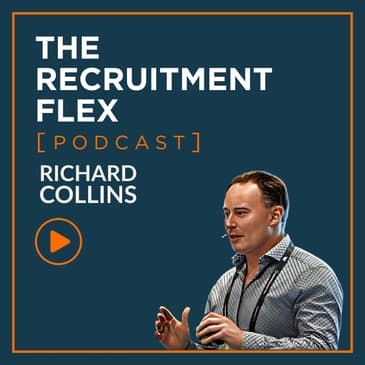

This week Serge (Sans Shelley) interviews Richard Collins, CEO of CVWallet,
- Richard shares insights from his career in recruitment and advertising, including the sale of ClickIQ to Indeed in 2019.
- CVWallet was founded to help job seekers prove their credentials, but shifted focus towards solving the recruiter paradox due to generative AI's rise.
- Some challenges generative AI, including an increase in applications and the need for verification to ensure candidate data reliability.
- He advises talent acquisition leaders to adopt scalable solutions capable of handling increased application volumes due to AI advancements.
- Some disappointment over Google discontinuing its job ads product, seeing it as a missed opportunity to shake up the recruitment advertising market.
[00:00:00] Welcome to the Recruitment Flex with Serge and Shelley. I'm Serge.
[00:00:09] And I'm Shelley. And we talk all things recruitment starting right now.
[00:00:17] Bonjour and welcome to the Recruitment Flex. of time on CV Wallet, but before we get there, I'm always very curious how transactions in this industry happen.
[00:01:42] And when you saw ClickIQ, it was in come out of nowhere and before you know it, you're having this conversation and the deals get done and I swear it's more luck than judgment. How long is the due diligence? Does this happen over a year? Does it happen over a couple of months?
[00:03:00] In the Indeed case, I think it took us nine months. But the really funny thing was that of right now in the industry. Yeah. What we started from is not really where we've ended up. The initial inspiration was around how can we help job seekers effectively prove their career credentials for want of a better world. It was built on the back of seeing some of the web3 technologies that were out there
[00:04:23] and just thinking if we could somehow use this, this would definitely add a lot of value but you're making that problem even worse. And I think it's also worth mentioning at this point, that's a recruiter problem, but that problem is caused by job seekers, not always personally and on purpose, but that is the cause of the issue in that job seekers been adopting increasingly rapidly generative AI, we have lots of easy applies going into places like Indeed. And then
[00:05:42] the other part is the whole skill shortage issue. So all of those things come together to create the job seeker side of CV wallet. It was about storing proof and it was about how can we verify people and how can we surface qualified applicants for a particular job. When Gen AI came in, we realized quite quickly that if that data can't be trusted, employers are going to want to do something about that trust.
[00:07:02] How do we build trust around the CV if A, experience skill we said why not prove to us that you have this particular skill or qualification and we came up with these three blue ticks. The idea with the blue ticks was to create trust with the employer because if you have some verification and proof behind it then
[00:08:23] you can actually trust that and therefore you have a good solution. So So, it's like doing the referencing piece, but instead of it being at the very end of the successful candidates in a costly way, I don't know, it costs 50 bucks, whatever it is to do a reference, I have no idea. We can do it for about 20 cents. The idea of doing it for everybody in a very low cost way at the very beginning then saves
[00:09:41] huge amounts of time with you basically don't have to do all this processing and interviewing
[00:09:46] of candidates who are not suitable. of it is, where it is, et cetera. The system then, as you put people through the verification process, it then optimizes the spend based on the conversion rate. So you get this CPA but optimized based on quality. And the output of that is a cost per qualified verified applicant. Now, what we're not doing is we're not trying to say
[00:11:01] to a customer, let's start with that.
[00:11:03] You have to go on a journey the same way as you,
[00:11:06] you start with cost per click and you try and figure out email address, upload the page of your driving license. That's it. And first of all, there's close to zero friction because they should have that documentation to hand. And secondly, the time saving of trawling through all of those people who frankly are not suitable because of these auto apply tools, because of globalization, all of this stuff. People apply
[00:12:21] for jobs picturing their future self. They don't be focused on those qualified applicants. How should they start looking at candidates differently and how they go in the market? Because there's also an argument of your employment brand, right? Having people opting out of applying for your job in this day and age is probably as important
[00:13:40] of people opting in to apply for your job. With advice you have for TA leaders that are looking, engineer, right? There was a point where everybody wanted prompt engineers, they would pay millions of dollars for them, then we all realized that we could all actually just put in a bunch of words into chat GPT and we could be prompt engineers too. But the speed of change of technology is such that it takes a while for those hard skills to catch up. The reality is nearly all hard skills
[00:15:01] can be measured through the CV, do you have them, then you bring people in, then you assess them. One of the approaches that we've taken,
[00:16:23] which I think is a little bit different, is're probably going to be okay in a customer service call center, for example. So it's thinking in those sort of terms. And I think we just need to be a bit more creative about how we go about that stuff in terms of finding applicants in those areas where there is a shortage of skills. You need to start training people if it's hard skills
[00:17:40] to get those skills, bringing people in who are smart and then putting them through your process.
[00:18:45] AI to do your recruitment for you is an eye-mehr because it's built on data and that data is, unless it's perfect, which none of it is, and it's invariably hidden
[00:18:49] behind the black box.
[00:18:50] It's very difficult to drill into it.
[00:18:53] In our view of the world, we believe that you are going to have a situation
[00:18:57] where you have bots talking to bots.
[00:18:59] There's no question about it.
[00:19:01] And from a job seeker side of things, the coming year. So jumping into TA leaders that are looking at all of the noise that is in the HR tech space and trying to figure out what systems they should be using.
[00:20:20] Do you have any advice for these TA leaders looking at,
[00:20:23] what's the best tools that I should be using
[00:20:25] for my talent acquisition department to be successful?
[00:21:23] and AI to make it as efficient as possible so that you can then scale it. But to me, it's about running those scenario planning.
[00:21:27] Trying to figure out the outcome before you look at these tools as well.
[00:21:30] It's probably critical.
[00:21:32] Yeah.
[00:21:32] So we're already in February, man.
[00:21:34] This year is flying by really quickly.
[00:21:37] But I always like to get a sense of what are we predicting for 2024?
[00:21:41] I had a prediction a couple of weeks ago.
[00:21:43] It's either going to be the most boring year in history or the most disastrous
[00:22:45] is not going to do it for you. I think we'll start to see the effects of that coming through. It has been so much money coming into the sector invariably. We'll see some issues with
[00:22:50] some people for sure. I think the job boards particularly will have a tough year. I think
[00:22:56] the reason why the job boards will have a tough year is because if people are getting
[00:23:01] lots of applications, that'll be the first thing that they turn off sadly. Then they'll
[00:23:05] realize they're mistaken, try and turn the things back on again. I think we'll see consolidations them business because what goes on Nasdaq is so much better than on the NICKA. It's an obvious thing and they took this money from private equity that was a bit weird back in the last year. They're a value creation private equity group. They must be thinking that. They'd make so much money doing it. That's my prediction. What's your thoughts around Google job ads
[00:24:23] basically not continuing after alpha testing? Were you surprised by that? And if anyone's played with like the AdSense board, like the manager, you need to know what the hell you're doing to be able to manage it. Yeah. I mean, I don't understand why they can't fix it. There are what, 30,000 job boards globally, right? Googles know who these people are. Just exclude them. If the problem is redirects and job boards, just exclude them and just do directs.
[00:25:42] Surely they can do that.
[00:25:43] This can't be hard.
[00:25:44] I think part of the issue has always been with jobs, isn't it?
[00:25:47] Is that job still alive?
[00:25:49] Yes.
[00:26:45] But I said, LinkedIn, we're always sort of around. Just drop us a line and always happy to chat.
[00:26:47] Perfect.
[00:26:48] Thank you so much for coming on.
[00:26:50] I appreciate it.
[00:26:51] Have a great day.
[00:26:52] Fantastic.
[00:26:53] Thanks.
[00:26:54] Thanks for inviting us.
[00:26:55] Au revoir.
[00:26:56] Shelley, let's face it.