
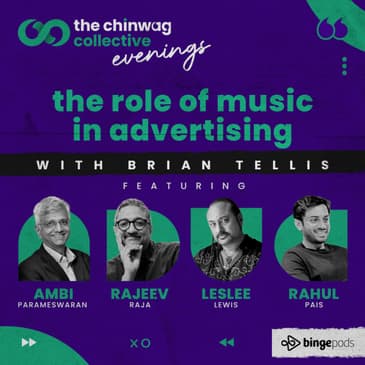
The Chinwag Collective is proud to host a special evening, featuring a live chat about music and advertising. The guests for the event include:
Ambi Parameswaran - Brand Coach, Brand Strategist and Founder Brand-Building.com a Brand Advisory.
Rajeev Raja - Creator of the term MOGO™ or 'musical logo', Rajeev
was a celebrated advertising Creative Director and is one of India's finest jazz and fusion flautists. His company BrandMusiq, brings the science of brands and the art of music together, creating tremendous value for clients.
Leslee Lewis - Leslee Lewis is an Indian singer and composer known for his work with Hariharan as the duo Colonial Cousins. Popularly known as 'Lezz' in the industry, Leslee Lewis is one of the first Indian composers to have introduced the Indian audiences to Rock and Pop music.
Rahul Pais - Composer and producer
[00:00:00] Hey all, welcome to The Chinwag Collective and specifically welcome to Chinwag evenings.
[00:00:11] Part of the Chinwag Collective, the podcast collective where we put out audio podcasts
[00:00:17] every price in a while and we're hoping this is the start of what will become a once
[00:00:22] a month meeting where we discuss stuff of relevance, we discuss stuff of importance
[00:00:28] around various areas, it could be music, experiential, theater, advertising, a combination of these.
[00:00:37] But the idea is for us to have real conversations and I do believe we have the right people
[00:00:44] both on this side of the fence as also your side of the fence live on ground with us.
[00:00:51] Want to say a big hello to all all of you who will be tuning in as we go along to the
[00:00:57] podcast, both audio and audio visually.
[00:01:00] Okay today we are hoping to hold in in the area of music and advertising and the topic
[00:01:08] of discussion really is what role does music play in advertising?
[00:01:15] Does it play a role in advertising?
[00:01:17] We've had a few animated discussions before we got the microphones and cameras rolling
[00:01:22] and we're hoping that we will revive those little early conversations today.
[00:01:28] And of course to do justice to a conversation like this or a discussion like this, I do
[00:01:34] believe you need the right people who are convicted in their point of view but are open
[00:01:38] to listening, debating, arguing, agreeing to disagree, disagreeing to agree killing each
[00:01:45] other.
[00:01:46] No, I didn't say that.
[00:01:47] And I do believe we have the right people in the house.
[00:01:49] I'm going to start off with Ambi who's spent a lifetime and a half in advertising, I look
[00:01:56] it too.
[00:01:57] A humble man as well as you can hear and see but Ambi brings with him experience that
[00:02:04] is rich to say the least and I don't want to get into bio data as yeah I don't believe
[00:02:09] the gentleman sitting here with me need specific and long introductions to my right is
[00:02:15] another gentleman whom we've known for a lifetime.
[00:02:18] I won't say lifetime and a half.
[00:02:20] You know Rajeev Rajah who's spent time in advertising now spending time in music insisted
[00:02:27] that I'm not in advertising.
[00:02:29] I am in music now so here you Rajeev also a wonderful musician of floutist and now of
[00:02:36] course spreading the musical word into logos and of more goes to be Rajeevish and
[00:02:45] my expression to my immediate left another dear dear friend from way back when he's only
[00:02:50] 21 years of age don't let me give you the wrong impression 22 22 22 let's be Lewis who's
[00:02:58] again spent a brilliant lifetime in music has done stuff in the world of music that people
[00:03:04] talk about passionately to date before we rolled cameras I could hear the two gentlemen
[00:03:11] on my left recounting songs done what a couple of decades ago Leslie comes with a rich
[00:03:16] rich history and it continues as we speak and of course to my extreme left is Rahul who
[00:03:22] really brings down you know the the geriatric age in this room he's a young man all of 13
[00:03:28] years well 12 12 there you go there you go but Rahul himself is honestly on a fantastic
[00:03:38] path in the world of music jam room producing music a musician himself you know providing facilities
[00:03:46] and indeed creating it. Rahul is a very precious part of the forum today as are the other three
[00:03:52] I'm going to interject once in a while and make sure that there is an honest and a fruitful debate
[00:03:59] not just for us in the room but for people who will tune in both audio and visually to our
[00:04:04] podcast as we go along so so welcome all I'm going to start off by maybe rolling back
[00:04:09] near as very quickly umby I'm looking at you specifically because you've had a glorious career
[00:04:15] and continue to both by way of your advertising career by way of your education career now
[00:04:21] educating career as also your book writing we had you know back in the 80s 90s maybe late 90s
[00:04:28] early 2000s as well like what people call a glorious era in advertising I want you to very quickly
[00:04:34] talk about it and in your opinion honest opinion tell us about what it was then what it is now
[00:04:42] going up going down what do you believe and I also want to say that if you feel you want to
[00:04:47] interject and disagree or agree hey I sound like I'm propagating trouble here but if you agree as
[00:04:55] feel free to kind of you know join in and so on be yours okay so you know you cast me
[00:05:01] in my near and worthwhile best so let me admit I started my career in advertising before probably
[00:05:09] anyone in the audience was born in 1979 yeah I started my I started my I started my I started
[00:05:21] in 1979 I was a young account executive fresh out of a B school working in a hot creative agency
[00:05:27] called Redefusion and I had the opportunity working with Arun Kale and Kamalesh Pandey and going
[00:05:35] and recording jingles in the famous western outdoor with Louis Banks remember doing a series
[00:05:41] of six jingle based ads for Apella Cadbury Apella I don't know brand has come and gone but the
[00:05:48] campaign actually won the campaign of the year award that time that was a wonderful I mean
[00:05:54] Redefusion used to do a lot of non musical ads as well a lot of dialogue based ad because you know
[00:06:00] combination is very good at writing dialogues stuff but those are great days of music because every
[00:06:05] all those great ads both 70s and 80s just think back you know growing up watching ads on
[00:06:13] you know cinema halls I don't know how many if you remember Usha Outhu Pius to sing come
[00:06:18] alive to the taste of Nescafe and you know in Neswati theatre you watch the Nescafe ad and you
[00:06:24] listen to her music it's and of course Karen Lunal cavoting under a waterfall with the la la la la
[00:06:31] la what what okay that that ad one couldn't really do anything but watch Karen and appreciate her
[00:06:38] that generally happened I think with Karen being in it of the music music so that's an original
[00:06:50] far commercial yes but the tune is amazing because it just used to get us you'd be humming that
[00:06:59] but you're watching Karen yeah exactly and of course I like his written story about how they were
[00:07:04] shooting this ad in the waterfall and Karen had to be given continuously fed a lot of rum or
[00:07:09] or any brandy or something to keep her warm but you know so and then little later of course highly
[00:07:16] memorable ad I think all of you would have probably seen remember Hamar Abhajaj you know nothing
[00:07:22] as little thing as that one that still stays in public memory Hamar Abhajaj those are the 80s
[00:07:29] and then now we come to early 90s whether I had moved and I'm going to advertising with Ulka
[00:07:35] and then we did the Dutkham as you and I think when you have probably grew up
[00:07:40] drinking milk to the tune of you know so thinking back I'm of course I'm looking at past with
[00:07:45] you know kind of pink colored lenses to say what a glorious tradition we've had
[00:07:51] of using music in advertising right and I remember I think 96 or 97 Alex here was a young
[00:08:00] account executive in our agency and I got one of the young guys to look at ads
[00:08:05] and say how many types of music have been used in Indian advertising
[00:08:10] and we had a count of something like 18 you know western classical we also use western
[00:08:15] classical you know many of our ads jazz right we used Kodo drums the Japanese drum which we all
[00:08:22] of us saw them playing during the Japanese World Cup right the so called the Kodo drums right
[00:08:28] Ranjit Baro did the music for Kunal Kapoor of course ball music was used by when we call you know
[00:08:36] Carnatic music was used of course we used what is known as Gregorian chant for ad for
[00:08:43] Volta's Michael Entry you know you know he knows a Kavina he knows a Kavina so I'm glad you kept
[00:08:54] your day job absolutely I'm watching Raji Veer what's the word no one's
[00:09:03] maybe there will be bloodshed I will be the first
[00:09:06] you'll get murdered so we've used you know some there's some Indian ads have used variety of music
[00:09:15] and we in advertising used to enjoy going and sitting with music directors getting music done I mean
[00:09:21] I've written about one of my books young music director was making this jingle for me
[00:09:27] for a small brand in Chennai the year was 92 and 93 and we were waiting for the singer to come
[00:09:38] and we were sitting in his house there was a little swing both were sitting on the swing
[00:09:42] and you know swinging away and then he said sir do you think there is a career in music in India sir
[00:09:51] that's it yeah were you asking were you asking I'm talking 90 to the real story I've written it so
[00:09:57] and he's not contradicted so which it happened
[00:10:01] sir were you asking sir things are tough sir
[00:10:05] so I said are you're highly talented you know you will do well you know I mean you're doing
[00:10:10] add jingles tomorrow today tomorrow you'll do something better don't give up you are India's growing
[00:10:15] and again one of those amaradeesh agi baghadeh all that kind of stuff to him in Tamil of course
[00:10:20] and we recorded the jingle and I said thank you very much and I left it turns out that young man
[00:10:26] whom I used to call Dilip is today known as ARreema right I'm not joking it really happened right
[00:10:33] so we in advertising used to love interacting with music directors going and spending time with
[00:10:39] them wiping with them and occasionally stopping them from leaving us and going to Australia
[00:10:46] this is advertising we loved it I mean there was nothing like you know talk to someone we'll talk
[00:10:53] to someone we'll talk to someone and we get one jingle on a mobile phone and listen to it no
[00:10:57] we were there I'm going to interject there thank you Ambi let me you represented the musician side of it
[00:11:05] like Ambi was talking about AR and give us your version of your life as a musician back then maybe
[00:11:12] the same era and then of course we'll move on I think what Ambi so far said is absolutely correct I
[00:11:17] mean even remand being Dilip see all the main ads were happening out of Bombay so he was also a
[00:11:23] fanboy man so when I went to Chennai called me to his house to his studio he wanted to show me
[00:11:30] stuff but he's amazingly talented he was then he still is I mean so I'm just saying it's not like
[00:11:35] something is developed along the way at the same time so for me I find that's not happening nowadays
[00:11:42] is what we were doing then we are apprenticed under somebody you worked under someone and not for
[00:11:48] one month and two months I spent four years with Louis Banks as a apprentice so our
[00:11:52] amara bhaja has yet everything I was there do this well right do this my own commercial so I
[00:11:58] was the composer for that that's after Louis but amara bhaja was when I was with Louis it had
[00:12:03] been four years from 1984 five six three two commercials are doing maybe three sometimes yeah
[00:12:12] and carrying your own gear and plugging your own and do we stuff is that how you started your Swiss
[00:12:17] account and stuff I lost the number actually so I've lost that account now I don't know where it is
[00:12:22] somebody finds it is so from my perspective I can see what remand was saying is it it's tough
[00:12:27] we want to do music but you can't so when I started off I was more like when I came from Mount
[00:12:35] Abu I was in the boarding school they came here and you nobody so somebody from my building introduced
[00:12:40] me to this is a fisherman club in colony in maim so there was an orchestra
[00:12:46] so I got to play I just wanted to play so somebody got me in there and I was playing on the road
[00:12:51] for gunpatthi you know on the bundle I was standing there and go miss him
[00:12:57] and I'm playing Gidav by tea that ought to be Hendrix but this guy is mad but that's a great visual
[00:13:03] right Hendrix playing at maim on the beach yeah gunpatthi wonder yeah no I just played
[00:13:08] tuk tuk tuk yeah Umbar Gau, Sat Parti, Palkar station I mean I just played it everywhere so
[00:13:15] I think that helped me to get the kind of understand the Indian vibe of Amjadda but as a musician
[00:13:23] you wanted to get ahead and then I met it is at that time that I made Andrew who was from my class
[00:13:30] and Andrew Tussuzan he was chosen as Joseph in a play in band and this Andrian Fair was
[00:13:38] happy and he came up to me and said hey does he do you want to play in our you know play guitar
[00:13:42] and I play we're looking for a guitar player and it started by another journey started and this guy was
[00:13:49] one of the young cast in Joseph and we've known Andrew in 1978 and we've been doing this thing forever
[00:13:58] so as a musician you know you just want to do music so I used to play for guzzles I used to play
[00:14:04] for all-India radio I used to play Dool Darshan I mean interestingly once I got to check for 200 bucks
[00:14:10] from Dool Darshan and I said man this so Ashok Patki was the music director and I see such a sweet guy
[00:14:16] because I would have got 100 bucks 50 bucks to come and play so next recording at Ashok Thank you very
[00:14:24] much so yes me how much did you get paid I said 200 you okay okay so what happened my check came
[00:14:32] to you and I was that good question so I got 200 bucks but he refused to take that money from me
[00:14:42] you know what I'm saying so it was all about music and and he wanted to play but I wanted to
[00:14:46] more and with Louis I got to do jazz and then I got it with Nandu Bhende as Savage encounters
[00:14:52] so you're doing rock and you're doing made for each other festivals from you know Ahmedabad to
[00:14:57] Calcutta Delhi so you're this traveling rock and roll band on the other side you know with Louis
[00:15:04] and Pam Crane and Ranjith Baro and Carl Peters you're doing this jazz thing which is now
[00:15:10] birdland concert and stuff like that and once I do doing Rastachap you know on the street music
[00:15:19] so having done all that you wanted to your own kind of music so when so as a guitar player I started
[00:15:25] getting called everywhere and so all the lot of the advertising work and guzzles and you know because
[00:15:31] it's light geethers Sangheethers classical there's only other beyond advertising that was the other
[00:15:36] recording there was Bollywood so my dad has been one of the biggest choreographers in Bollywood P and
[00:15:42] Raj so he's on show days are gone down KK Pandana's Yahu evening in Paris Jungry you name it
[00:15:48] in the comments like the turn of hits but so I grew up as a Bollywood kid so I was sitting with
[00:15:55] R.D. Burman's house while they're composing with Luxeficon parallel and I was the fly on the wall
[00:15:59] or they'd just tell you hey don't touch that sit quietly yes okay but I got to like see a lot of
[00:16:05] things but I didn't want to be that and my dad always thought and I want to play in a band so my
[00:16:10] dad said no you should play in films because there was nowhere else you could actually
[00:16:15] earn or you know could be a professional musician professional was in movies so everybody who
[00:16:21] learnt music whether they learned classical music they learned a while in they learned piano
[00:16:25] they went into Bollywood because that's where there was work and there was money after you
[00:16:29] learnt your craft you got somewhere to play it I mean as a there was no Phila Amonikokist
[00:16:33] or the symphony's play at that time so Bollywood was the only place so my dad wanted me to do that
[00:16:38] and I didn't want to do it and he was against it because he thought I think in our especially
[00:16:46] in the earlier days wine, women and song that goes to the band you're drinking can you talk
[00:16:53] further about this I mean you know but it was it was a standard shop if you played in a hotel
[00:17:01] band or some you were playing in a cabaret like yeah I did that too but it's a slip disc so wine
[00:17:10] women and songs my dad was worried that he'd start drinking because you know with a band means
[00:17:16] after the women you obviously going to womenize with the singer and get involved with you know
[00:17:20] it's a standard thing that's how it works and it's all about song you know it's all about music so
[00:17:26] and this is a real thing that's happened for so many musicians over the 70s 60s 70s 80s they've got
[00:17:32] involved with each other all these kind of you know whether alcohol whether it's women has not allowed
[00:17:37] these great artists to grow sometimes and my dad was like little worried he didn't want me do that
[00:17:42] but I was completely opposite I'd land up at my so I'd be playing at the Obera Hotel
[00:17:49] at the cafe Royal in those days and I'd be there at five o'clock in the evening just practicing
[00:17:54] myself I was just about the song wine had no time I was not only to it because my dad is to drink
[00:17:59] like crazy at points so he's get violent so I don't know what I have as you do wine so that's a good
[00:18:04] thing give me a good like you know women and song we can talk about right I didn't have time for
[00:18:08] touch but it's some woman found me and we believe you guys yeah but it's true I got found on a
[00:18:15] Bombay magazine cover I was playing guitar the over right and Jalal Laga decides to jump on the
[00:18:21] drum kit so the photographer takes that picture because there's a film star in that thing and that's how
[00:18:26] my first life found me what was relationship from what I understand and we'll come back to
[00:18:30] how you found your wife or she found you but you know we're talking about the relationship of music
[00:18:35] to advertising and it seems that there was a kind of a close-by between people who created the
[00:18:42] magic and people who propagated the magic or dressed it up for communication right and that's
[00:18:47] what I'm being saying see what it reminds me of stuff we are frustrated we want to do something
[00:18:52] not just the regular system stuff I don't want to just do ads I just want to play Gita and
[00:18:57] add so finally I ever playing guitar so that I could compose but nobody gave me any work for
[00:19:02] the same because you're struggling to do what you want to do no so do you believe les I'm sorry
[00:19:06] to interject but do you believe that musicians and I want Raul to jump in here as well do you believe
[00:19:11] musicians were or indeed are getting you know the raw end of the deal you know do you believe that
[00:19:19] and feel free to say it so that we can throw suggestions into the mix and just while I say
[00:19:24] that I must tell you people here that if you feel you want to contribute to this discussion
[00:19:30] feel absolutely free like I said there's a microphone doing the round so but coming back
[00:19:35] so I'm not sure about musicians getting the wrong end of the deal I think I mean there are a lot
[00:19:40] of similarities I'm just listening to the stories that Leslie was saying and I mean I think even
[00:19:44] though I mean we're probably a generation apart it's very much the same I mean you start off a
[00:19:50] practicing with somebody and it's very important because working with film it's not like working
[00:19:54] with anything else it's not like making a song you're making a piece of music for a specific media
[00:19:59] for a brand you have to know how film works you have to know what the brand wants you have to be
[00:20:04] able to communicate with people you can't just make what you want right you have to you're doing
[00:20:08] it for something its commission work and it's very important to get like a good grounding and
[00:20:12] understanding so I started working with my partner Nareem Anhu in turn started with Ram Sumpat
[00:20:19] another very famous composer right I'm sure you'll have all worked with him at some point
[00:20:23] and I think that taught me and allowed me to understand that it's not just enough to be a musician
[00:20:28] yes that's one thing but you have to think like a producer like a film composer there are so many
[00:20:33] other things that go along with it coming back to what Ambi said it was great there was a time
[00:20:38] when you used to be in the studio used to work with the person it was like an experience I hear
[00:20:43] stories from my older contemporaries who work some of the engineers about how fun it used to be
[00:20:47] in sessions and to an extent yes it is the same way although I feel like especially post-COVID
[00:20:53] people aren't coming into studios anymore I compose something I send it off somebody's listening
[00:20:58] to it on a phone and when I say come in here it on the speakers come in here it in a studio
[00:21:02] they're like no but this is how the consumer is going to react to it they're going to be listening
[00:21:05] so on the phone in some ways yes it is because the directors and all the ones you really want to
[00:21:11] get to work with are coming in there still coming in there is a dialogue I mean music can't be made
[00:21:15] in a vacuum that's my opinion I don't think anything artistic can be done in a vacuum you have to
[00:21:20] have collaborations you have to you're making the music for somebody else so they have to be involved
[00:21:25] in it and I hope you know with time things go back to going that way I can see it starting to happen
[00:21:29] again slowly slowly but I mean just to step in here one of the big joys of working in advertising
[00:21:37] is your vicariously working in in films you deal with you know music directors absolutely you
[00:21:44] deal with you know directors you go on shoots so you are kind of vicariously living in a different world
[00:21:51] and therefore I mean all of us used to take as youngsters you grow up going to shoots you look
[00:21:58] for an opportunity go and sit with the you know at the editing table I think for an opportunity go
[00:22:02] and sit with the music director when the music is being composed and add your two bits normally you're
[00:22:06] told shut up but you know but I know that I should ask you to shut up because you don't know what
[00:22:14] you do very often that you so we don't know anything about music but I feel like you know
[00:22:19] you know when you say you don't know anything about music but you feel like I believe that what
[00:22:24] you feel like is more important than doing something about music because at the end of the day I
[00:22:28] want to take this it's a piece of like it's meant for some consumption by somebody somebody you
[00:22:35] have a commission to do this when I want to do my own songs that's a very different thing
[00:22:38] then I become an independent artist I do my own songs the way I want to but if I'm working
[00:22:42] in advertising I'm working for a system that requires something out of me so no I think also
[00:22:48] I just want to go back I started maybe a decade later than I'm being when I came to Bombay
[00:22:55] you're being extreme he's like he's like he's like he's like he's like he's like he's like he's like
[00:23:03] you know from the few years you're like I said you're not okay but because I'm not okay so I
[00:23:11] come to Bombay in 1989 and I joined Mudra as a senior copywriter and within the first week of
[00:23:20] me coming I get a brief time I'm like overwhelmed by Bombay come from Bangalore with a insuzuki bike
[00:23:29] that's about it I get a brief for quality ice cream and my creative director at the time Walter
[00:23:37] Mendez the guy who wrote Kamalai taste of Nesca period actually briefs me and says this quality
[00:23:44] ice cream it's seen as mama and papa's brand you've got to make it younger you've got to make
[00:23:50] it for the younger generation so I was racking my brains at I said I need to create a campus
[00:23:56] lingo right so came up with this phrase go bonkers and then I presented it internally and Mr.
[00:24:06] Krishnamurti got very excited and he said I'm going to get you the best talent and Shantanu
[00:24:11] Shory walks into office I'm staying wow Shantanu Shory is here and he's going to do the film not his wife
[00:24:20] not Shantanu for me just beginning of name and Shantanu says hey this needs a jingle right so
[00:24:30] have you heard of Leslie Lewis? I was singing yeah sort of yeah I was new to Bombay right so he says
[00:24:40] okay we go to XIC we're going to meet Leslie and can you write a jingle out before we go
[00:24:47] so I wrote the jingle go bonkers go bonkers oh yeah something something quality ice cream
[00:24:53] okay now we go now talking of collaboration right this way I go and just present just give
[00:25:00] these lyrics to Leslie and Leslie sitting at the table and within an hour he comes back and says hey
[00:25:09] I've got this idea like you know Bobby McFarron kind of baseline
[00:25:14] do do do do do do do do do do do do do do do do do do and Kevin he sang out the entire jingle go bonkers
[00:25:22] go bonkers oh yeah done I was made I was made within a week of coming to Bombay I had this incredible
[00:25:33] jingle film shot by Shantanu Shory to the biggest hit quality ice cream took off
[00:25:38] and I had arrived in advertising.
[00:25:41] Thanks to Mr. Liss.
[00:25:43] Listen, you owe him one.
[00:25:44] You owe him one, yeah?
[00:25:46] I don't think it's thanks to be it's a collaborative.
[00:25:48] It's always a collaborative.
[00:25:49] Yeah, but it is like that, right?
[00:25:50] Okay, by the way, I charged 10% on all of you just saying,
[00:25:54] just saying, no, let's say we spoke about stuff
[00:25:58] in advertising and music in advertising
[00:26:00] and I want to ask a slightly more specific question.
[00:26:03] Now, we've seen the dude, which talks about Amol,
[00:26:06] we've seen washing powder, Nirmal, let's say,
[00:26:09] where the name of the brand or the product was put out there,
[00:26:15] you know, unabashedly.
[00:26:16] And that two limited understanding
[00:26:19] that I have brought about this recall value for the brand.
[00:26:23] I just want to your thoughts because a lot of stuff
[00:26:25] you see us today are stories that talk about the buy behind
[00:26:29] a product or a brand and they're not as direct
[00:26:32] if that's the word to use when you talk
[00:26:34] about the name of the brand.
[00:26:36] It's not necessarily used just a quick thoughts,
[00:26:39] you know, from your lawn how important was it then to use
[00:26:43] the names, you know, washing powder, Nirmas
[00:26:45] or Nirmas stuck whether you like it.
[00:26:47] Griefers as many times it can come in 30 seconds,
[00:26:49] 20 seconds just repeat that word as many times
[00:26:52] the signals great.
[00:26:52] Nirmal Nirmal Nirmal.
[00:26:54] Nirmal Nirmal.
[00:26:55] Yeah, Nirmal.
[00:26:56] That's it.
[00:26:57] You got it.
[00:26:58] No, but just transfer that vibe to today
[00:27:02] and maybe Raul you want to take this is it?
[00:27:04] I mean, I think that's very product based to be honest with you
[00:27:07] but I feel like there's a lot of my briefs
[00:27:09] I never use the product name.
[00:27:10] I mean, it's very, very rare that I do something.
[00:27:13] It's like even if I do like say a car brand
[00:27:15] I never once will you hear like Toyota Glanza
[00:27:17] or something like that.
[00:27:18] It's absurd to think about it and I think at least
[00:27:21] with taste changing or at least consumers
[00:27:23] I mean people want music.
[00:27:25] I think the format of the jingle is somewhat different today.
[00:27:28] I mean, you can call any piece of music on an ad jingle
[00:27:31] but I mean in my mind a jingle is Nirmal.
[00:27:34] It's dude, it's all those things.
[00:27:36] I got lyrics in it.
[00:27:36] It's got lyrics and then definitely says something about the brand name.
[00:27:40] Today I think that's perceived as a little conny
[00:27:42] you know disrespect to the people who create those things
[00:27:44] because taste have changed times of change.
[00:27:46] And also I know the other problem.
[00:27:48] How is that?
[00:27:49] It becomes uncool to use a brand name, you know?
[00:27:53] And therefore most credit directors
[00:27:56] will cut dead writing,
[00:27:58] I'm a Arab bhajaj, brand name and then you can't write anything better.
[00:28:02] Even then sometimes you know
[00:28:05] the tracks do this great track for Docomo
[00:28:09] which was done by you know
[00:28:13] the Ramcomo brand.
[00:28:15] Docomo suddenly it really broke through.
[00:28:18] It just broke through that very campaign went through the roof
[00:28:21] and the brand did very well as long as it lasted
[00:28:23] but he broke the, he said we will put this brand name
[00:28:27] in a musical tune.
[00:28:29] True.
[00:28:30] But you know same way.
[00:28:31] It's uncool today, you go and tell someone
[00:28:33] repeating the brand name three-four and all.
[00:28:35] But you know that's the exception.
[00:28:37] Same time period, same composer,
[00:28:39] the Airtel Jingle you know,
[00:28:40] Aj, Harif Red, Zaururi Hothayah.
[00:28:43] That tagline stuck and he wrote it
[00:28:45] but that's more of a song.
[00:28:47] I mean there's nothing now,
[00:28:48] mentions the brand.
[00:28:49] You know in the older days
[00:28:51] a lot of music came on radio.
[00:28:53] So there was the visual.
[00:28:55] So you had to have a hook line or something
[00:28:57] that you with the brand name.
[00:28:58] Like a gold smart or a link to the terms up,
[00:29:00] drink, drink, drink.
[00:29:01] That guy's going on the station and you hear this thing
[00:29:03] and you know it's the guys that are in closing.
[00:29:05] What he was saying is you have more repeatedly
[00:29:07] and you said now it's a radio jingle.
[00:29:09] So now it's become like a visual text
[00:29:11] that every brand has on in their ad word.
[00:29:14] So you don't need to repeatedly say it in the audio.
[00:29:16] You know what I mean?
[00:29:17] Because you have that visual connect now.
[00:29:19] Correct.
[00:29:20] And I'm saying even now that the video came in
[00:29:22] when ads started happening,
[00:29:23] it was still shot by camera.
[00:29:26] Somebody who had you know,
[00:29:27] erotic jingle the panel,
[00:29:29] the short breakdown,
[00:29:31] things were worked out and then it was shot accordingly
[00:29:33] and there was a tune that carried that thing.
[00:29:36] Ever since computer graphics have come in,
[00:29:38] it's a complete change.
[00:29:40] You don't need that song.
[00:29:41] It keeps disturbing this.
[00:29:42] It's so busy that you just want to vibe.
[00:29:46] So like what he's saying today is
[00:29:47] I would just do a vibe maybe the feel of it
[00:29:50] to let that film go through.
[00:29:52] No, I think what Leslie's saying is see
[00:29:54] it was basically a hangover of the radio era
[00:29:57] that got into early advertising.
[00:30:00] So radio was all about jingles.
[00:30:02] You had to have lyrics about the product.
[00:30:05] It washes better, it cleans better, it lights better,
[00:30:07] et cetera, all sun.
[00:30:09] That got into the earlier advertising jingles, et cetera.
[00:30:14] But even those days if you look at,
[00:30:16] okay there was Hamara Bajad,
[00:30:17] there was Washington,
[00:30:18] and Irma with the brand name built in.
[00:30:20] But if you go to Titan.
[00:30:24] Ta-ra-ra-ra-ra-ra-ra-ra-ra-ra-ra-ra-ra-ra-ra.
[00:30:27] No brand name.
[00:30:28] Yeah, Mr. Omnibani.
[00:30:30] Very strong, so right?
[00:30:32] Ting, ting, ting, ting.
[00:30:34] That was at 8.30 in the morning.
[00:30:37] Yeah, no brand name.
[00:30:38] But again, so the part of sound I think was there.
[00:30:42] I'm going to use an analogy actually
[00:30:44] to throw another point for this type of thing.
[00:30:47] You know, we talk about Hindi films.
[00:30:49] No Hindi film or no really complete
[00:30:52] without a lot of music slash songs and whatever.
[00:30:56] And I come from a time when in the Hindi films,
[00:30:59] it was an Amitabh song or a Vinod Karna song
[00:31:02] or a Rishi Kapoor song.
[00:31:04] Most often people didn't even know who the singer was
[00:31:07] or who the music director was in the film.
[00:31:09] It was so skewed towards the visual.
[00:31:12] I'm using the same analogy in the scene here
[00:31:16] with artists, both singers, creators, versus,
[00:31:21] let's say the advertising slash brand representatives.
[00:31:26] How can we kind of artist I know and I'd like to talk about this?
[00:31:31] I know that there is a vibe.
[00:31:32] But definitely there are artists feel
[00:31:34] kind of whether it is under recognized, underpaid
[00:31:39] and various other complaints that they have happening today.
[00:31:43] Happens then, happens today.
[00:31:44] Then it was more acceptable today.
[00:31:46] It wasn't and I want to discuss that because I think today,
[00:31:51] the time is right for us to actually give people
[00:31:53] their pride of place.
[00:31:55] It is respectable which side of the team they represent.
[00:31:59] Rahul, I'm going to lean on you for this one.
[00:32:01] Straight up, I think artists today,
[00:32:03] the biggest difference is that you have a mouthpiece
[00:32:06] in your pocket.
[00:32:07] Like creativity is democratized.
[00:32:09] Everybody in this room is a creator.
[00:32:10] You can just whip out your phone, put a YouTube video
[00:32:12] and if you have something interesting to say or sing,
[00:32:16] you have an audience built in right there.
[00:32:18] And I think a lot of brands are taking that,
[00:32:20] I mean at least the smart artists are the ones
[00:32:22] who have one eye on that side of it know how
[00:32:25] to monetize their own brand
[00:32:27] and know how to use their brand
[00:32:29] to then help sell other things.
[00:32:31] I mean for lack of a better word,
[00:32:33] I think you're going to see more and more of that.
[00:32:35] I think smartphone penetration is huge
[00:32:38] in like another five or six years.
[00:32:39] Everybody's going to have a phone.
[00:32:40] You could take a phone as it is.
[00:32:42] Sorry, you were talking about QR codes right?
[00:32:44] About artists and what they put out.
[00:32:46] And look, I mean all I can say is that
[00:32:49] look in the past you had like one or two radio
[00:32:52] and television right and you have
[00:32:54] force fed the message through those two things.
[00:32:56] There was no internet.
[00:32:57] There's nothing today.
[00:32:58] You wake up.
[00:32:59] You are bombarded with information from the moment
[00:33:01] you get up to the moment you sleep
[00:33:02] you can choose what entertainment you want
[00:33:04] whenever you want it.
[00:33:05] So you're competing with 10,000 other things
[00:33:08] for attention to try and keep something there right.
[00:33:11] Now a song definitely has value.
[00:33:14] It's just like Rajeev said,
[00:33:15] you remember the tink tink tink
[00:33:16] you remember the tunes,
[00:33:17] you remember something about it.
[00:33:18] And I think a song lives in your mind for a lot longer
[00:33:21] than a lot of other things possibly can right?
[00:33:24] I mean I feel there are so many times
[00:33:26] when we do a commercial,
[00:33:27] we still do songs for commercial.
[00:33:29] We might not have the brand name,
[00:33:30] we might not call them a jingle,
[00:33:31] but we do a ton of songs and very often
[00:33:34] I mean I have a like I say I put a real page up
[00:33:36] of my YouTube on YouTube of my work.
[00:33:39] Now millions of people who write release the song,
[00:33:41] release the song we want a full song.
[00:33:44] And if brands take notice of that
[00:33:45] it's very easy then for them to come to an artist
[00:33:47] or come to me a composer and say,
[00:33:49] hey you know this is doing really well for us
[00:33:51] we'd like you to create a two minute song
[00:33:52] we'll put it up on Spotify,
[00:33:54] we'll put it up on YouTube
[00:33:55] and we'll tag the ad,
[00:33:57] say it does really well put a cue
[00:33:58] I mean QR code is just an example
[00:34:01] because every phone has a scanner right?
[00:34:02] Here's a link to the full song.
[00:34:04] The brand can live in the memory of the whatever the song
[00:34:07] it takes a life of its own then
[00:34:08] it'll be allowed to just be more than the five,
[00:34:12] 10, 30 seconds if you get to see it right?
[00:34:15] The speaking of listening to the full song again
[00:34:17] this is an open-ended question.
[00:34:19] I mean our attention spans are tightening
[00:34:22] and tightening and tightening
[00:34:23] I mean today like you rightly said
[00:34:25] there are various options beyond the television
[00:34:28] and the radio thanks to digital and its invasion
[00:34:31] in our lives and I say this happily.
[00:34:33] Having said that,
[00:34:34] I mean you've got you know OTT platforms
[00:34:36] where you can skip ads
[00:34:38] even on television you know
[00:34:40] people hoped that they could skip ads.
[00:34:42] I mean why is this happening?
[00:34:44] If ads as we claim relevant are enjoyable,
[00:34:49] useful all be it from a brand perspective
[00:34:52] is it that consumer tastes are changing or consumption
[00:34:56] patterns are changing so radically
[00:34:58] or is it that we're not really catering
[00:35:02] to the consumer's taste?
[00:35:03] It's an open-ended like I said question
[00:35:06] but I'd like to spend a little time
[00:35:07] just getting your thoughts on it.
[00:35:08] First of all I don't think anybody finds ads enjoyable
[00:35:10] except for the people who work in them
[00:35:12] I think most people find them irritating
[00:35:14] but it's just a music.
[00:35:17] It's like it's low end language.
[00:35:19] No no no no
[00:35:20] Let me open it.
[00:35:23] Okay.
[00:35:24] No.
[00:35:25] So tap tap tap.
[00:35:26] Yeah.
[00:35:27] I'm writing words and it's going on.
[00:35:29] I'm writing words and it's going on.
[00:35:31] I mean let me first honest confession
[00:35:33] I am not working in any advertising agency today.
[00:35:36] I've not been working in advertising
[00:35:38] for six years.
[00:35:39] It's going to be seven years in March.
[00:35:41] But I worked in advertising
[00:35:42] at my 40 year career
[00:35:44] I was in advertising for probably 30 years
[00:35:46] out of the 40 years.
[00:35:47] It's fashionable to say that people hate advertising
[00:35:53] et cetera et cetera
[00:35:54] it's fashionable to say that
[00:35:56] but unlike the US
[00:35:59] I think in India
[00:36:00] fortunately for people like Rajeev,
[00:36:02] people like Leslie
[00:36:03] we have had very enjoyable advertising.
[00:36:06] In fact a lot of ads used to be
[00:36:10] and I still believe they still are
[00:36:13] very enjoyable because of the music
[00:36:15] because of the casting
[00:36:16] because of the acting
[00:36:18] because the attention to detail.
[00:36:19] I mean I still play that
[00:36:21] it didn't have music in it
[00:36:23] but I still play the Mudra's
[00:36:24] you know Dara Kamarsho
[00:36:26] right?
[00:36:27] in my classes when I teach
[00:36:28] it always brings the house down
[00:36:30] all I have to say is
[00:36:31] I've got you know when I talk about Manawa
[00:36:33] Mewd Noudalbuk
[00:36:34] and I say I've got one film
[00:36:36] where I think is the best film
[00:36:38] probably ever made in India
[00:36:39] featuring a child
[00:36:41] any guess
[00:36:42] and someone in the class
[00:36:43] who's probably never
[00:36:44] was not even born with the ad was made
[00:36:46] because the ad was made 26 years ago
[00:36:48] Dara
[00:36:49] he said what's your grade of Dara?
[00:36:50] Jalebi
[00:36:51] right
[00:36:52] and you know
[00:36:53] that Jalebi was actually thought
[00:36:55] of during the shoot by white light
[00:36:57] the original script
[00:36:58] was Kachori
[00:36:59] so the original script said Kachori
[00:37:04] and they changed it to
[00:37:05] right
[00:37:06] this guy
[00:37:07] Jagdish Acharya
[00:37:07] came and told me that
[00:37:08] Jagdish came and told me
[00:37:11] so you're in my life
[00:37:13] it was at that point
[00:37:14] yeah
[00:37:15] so it was actually
[00:37:16] I think Nometa
[00:37:17] which ended
[00:37:18] so they used to put so much
[00:37:20] attention love into every ad
[00:37:23] they made
[00:37:24] and actually the ads are better
[00:37:26] than the programming
[00:37:29] and so people used to love
[00:37:31] advertising
[00:37:32] that's true
[00:37:33] I hope and pray
[00:37:35] they still like the advertising
[00:37:37] there's exceptions
[00:37:38] like I think everybody
[00:37:39] would know
[00:37:40] the credit commercials
[00:37:41] that are really popular right now
[00:37:42] I don't think
[00:37:43] anybody skips a credit commercial
[00:37:44] even if you've seen it seven or eight times
[00:37:46] you watch it
[00:37:47] those are really good
[00:37:48] I mean, there are always going to be
[00:37:49] exceptions
[00:37:50] to any role
[00:37:51] just to come in
[00:37:52] unfortunately
[00:37:54] in the US
[00:37:55] advertising is
[00:37:56] hated
[00:37:57] because a lot of US advertising
[00:37:59] is by this today
[00:38:00] by this today
[00:38:01] whereas we
[00:38:03] fortunately
[00:38:04] because of our filmy heritage
[00:38:06] the kind of people
[00:38:07] who came
[00:38:08] advertising those days
[00:38:09] and later
[00:38:10] are advertising
[00:38:11] always a lot
[00:38:12] enjoyable
[00:38:13] again, I'm biased
[00:38:14] a lot of enjoyable
[00:38:15] it certainly was
[00:38:16] absolutely
[00:38:17] but if I can just add to this
[00:38:21] talking of short attention
[00:38:23] spans
[00:38:25] now the truth is
[00:38:27] that if you're looking
[00:38:28] at the future
[00:38:29] there is a clear trend here
[00:38:32] now just to give you an example
[00:38:34] if the television in my house
[00:38:36] cons out
[00:38:38] tomorrow
[00:38:40] I think I'll probably be the only guy
[00:38:42] who's saying hey man
[00:38:43] I can't watch football on the big screen
[00:38:45] or cricket on the big screen
[00:38:47] my kids forget it
[00:38:50] they're not worried
[00:38:52] if the television screen
[00:38:54] no longer works
[00:38:55] because they're consuming
[00:38:57] content today
[00:38:58] including television
[00:38:59] on their phones
[00:39:01] or on their laptops
[00:39:03] so on right
[00:39:04] so therefore
[00:39:05] when you're consuming content
[00:39:07] in such a small format
[00:39:09] medium it's much more intimate
[00:39:11] and therefore
[00:39:13] in that medium
[00:39:14] ads come through as
[00:39:15] intrusive
[00:39:16] okay
[00:39:17] we all know
[00:39:18] we are watching something
[00:39:19] on Facebook
[00:39:20] shit
[00:39:21] bloody ad comes in
[00:39:23] you're watching something
[00:39:24] on YouTube
[00:39:25] shit
[00:39:26] ad comes in
[00:39:27] on television
[00:39:28] it's okay
[00:39:29] because you're sitting at home
[00:39:30] you poured yourself a drink
[00:39:32] there's an ad break
[00:39:33] it's fine
[00:39:34] that was the earlier consumption pattern
[00:39:36] but today
[00:39:37] that's not the consumption pattern
[00:39:39] the trend rather
[00:39:41] so therefore
[00:39:43] the whole thing is
[00:39:45] brands are also realizing
[00:39:47] they cannot be as
[00:39:48] in your face
[00:39:49] as they were
[00:39:50] in the earlier era
[00:39:51] so it is not
[00:39:53] yes
[00:39:54] you guys are all
[00:39:55] sitting in Bantra
[00:39:56] recording the show
[00:39:57] and you think the whole world
[00:39:58] whole of India is watching
[00:39:59] things only on mobile phones
[00:40:01] I'm sorry
[00:40:02] well the whole of India
[00:40:03] 20% of advertising still happens
[00:40:05] on TV
[00:40:06] and it happens on TV
[00:40:07] because you know
[00:40:08] clients are not
[00:40:09] true
[00:40:10] because it works
[00:40:12] television works
[00:40:13] television is more credible
[00:40:15] I mean
[00:40:16] it's more expensive
[00:40:17] more television is
[00:40:18] you know
[00:40:19] YouTube is
[00:40:20] for a reason
[00:40:21] YouTube was
[00:40:22] charging too much
[00:40:23] so you know
[00:40:24] whatever CPM rates
[00:40:25] were 200 rupees
[00:40:26] so advertising
[00:40:28] there's still a lot of
[00:40:29] advertising happening on TV
[00:40:30] and a lot of it is still
[00:40:32] enjoyable
[00:40:33] I'm again biased
[00:40:34] so it's easy for us to sit here
[00:40:36] and say
[00:40:37] oh everyone is
[00:40:38] no one is watching TV
[00:40:39] everyone's
[00:40:40] consumer mobile
[00:40:41] blah blah
[00:40:42] it's true
[00:40:43] your children
[00:40:44] highly educated
[00:40:45] you know
[00:40:46] so they're watching on
[00:40:47] I'm sorry
[00:40:48] my
[00:40:50] that's not it
[00:40:51] I'm not
[00:40:52] nobody
[00:40:53] I see in bomb-based
[00:40:54] watching television
[00:40:55] now
[00:40:56] I'll take it to a friend
[00:40:58] I'll take it to a friend's house
[00:40:59] yeah
[00:41:00] you know
[00:41:01] creative director
[00:41:02] genius
[00:41:03] retired
[00:41:04] but his TV is on
[00:41:05] all the time in his house
[00:41:06] I keep getting irritated
[00:41:07] I go
[00:41:08] no I don't
[00:41:09] come on
[00:41:10] then he's not
[00:41:11] suddenly
[00:41:12] he's not watching the
[00:41:13] programming
[00:41:14] he's watching
[00:41:15] they had
[00:41:16] sorry I think this
[00:41:17] yeah
[00:41:18] that's all
[00:41:19] yeah
[00:41:20] hello gentlemen
[00:41:21] my name is Veda
[00:41:22] so my question
[00:41:23] actually
[00:41:24] and firstly can I just say
[00:41:25] I attest to what
[00:41:26] we were saying about advertising
[00:41:28] in the US
[00:41:29] I worked as a copywriter
[00:41:30] there for four years
[00:41:31] and I feel that
[00:41:32] he adds
[00:41:33] there are more focused
[00:41:34] on the writing than
[00:41:35] the music
[00:41:36] because a lot of the
[00:41:37] jingles are based
[00:41:38] on the copywriting
[00:41:39] there
[00:41:40] and secondly
[00:41:41] you know
[00:41:42] something that Rajiv said
[00:41:43] which is that
[00:41:44] you know
[00:41:45] you too
[00:41:46] an ad comes up
[00:41:47] or Spotify
[00:41:48] but that is
[00:41:50] and others
[00:41:51] and they're
[00:41:52] but so
[00:41:54] they're
[00:41:55] to skip ads or even
[00:41:56] in short
[00:41:57] that ads don't play
[00:41:59] by paying into their
[00:42:00] subscription program
[00:42:01] and do you feel that
[00:42:03] now there are organizations
[00:42:05] like Spotify and YouTube
[00:42:06] that are actively trying
[00:42:08] to encourage people
[00:42:09] to avoid advertising
[00:42:10] by just showing out a little
[00:42:11] money
[00:42:12] and how has that affected
[00:42:13] the advertising industry
[00:42:14] at large
[00:42:15] that's
[00:42:16] that stuff on TV you're going to watch it.
[00:42:18] Or you're just gonna have a wait,
[00:42:20] but with the skip ad,
[00:42:22] like you said, they're trying to get you to subscribe
[00:42:24] and it's not about the advertising.
[00:42:26] In fact, they want to irritate you with the advertising.
[00:42:28] Other problem with the skip ad is
[00:42:30] they allow you to run five seconds of ads
[00:42:34] or charging you for it.
[00:42:36] As a result all the managers in brand management
[00:42:38] and I can't execute it figured out,
[00:42:40] your ad has to be in first five seconds
[00:42:43] a full message ball though, correct?
[00:42:44] Because after that the customer's gonna skip.
[00:42:46] So if your whole messaging is compressed
[00:42:49] to four and a half seconds,
[00:42:50] where is the time for emotion?
[00:42:52] Where is the time for music?
[00:42:54] Where's the time for anything?
[00:42:55] In fact the music.
[00:42:56] So it's terrible, right?
[00:42:58] So I'm okay, I think you're making a very right point.
[00:43:01] So you look spotify when YouTube's belief is
[00:43:06] we want paid customers who will not be delivered ads
[00:43:10] and therefore I'm gonna get customers
[00:43:12] to actually skip ads and I tell them you can skip ads,
[00:43:17] you have to just pay me 35 rupees a month, right?
[00:43:20] And done.
[00:43:21] So probably that's also happening
[00:43:23] but it's also had a very bad effect on advertising.
[00:43:26] Most ads today, I mean, for example,
[00:43:29] we made the Naukri commercials.
[00:43:31] Some of you may remember, you know,
[00:43:32] Hari Sado, you know, H.F. Hitler, A.R.G.A.
[00:43:35] That kind of an ad,
[00:43:37] the brand name appears in the 25th second
[00:43:39] and it appears for two seconds.
[00:43:41] First 24 seconds, there's no brand name.
[00:43:44] Now will I be able to even think of running it on YouTube?
[00:43:46] I will not.
[00:43:47] So the first five seconds make some money.
[00:43:49] You know, sir, ring, ring, ring, and then the ad starts, right?
[00:43:53] Before that I've delivered ring before you skip ring,
[00:43:56] ring, so that's having a negative effect on advertising.
[00:44:00] Okay, so tragedy.
[00:44:01] Sorry, yeah one more question.
[00:44:02] And then we come to brand name.
[00:44:04] Hi, I'm Chinmay.
[00:44:05] Ad probably disagree with the notion
[00:44:07] that YouTube doesn't like ads.
[00:44:09] I mean, they make several billions of dollars a year on ads.
[00:44:13] I think what they're basically,
[00:44:15] yeah, I mean, they make billion businesses advertising.
[00:44:17] So I think what they're trying to do
[00:44:20] is really optimize ads so that someone
[00:44:21] who doesn't want to see an ad will skip it
[00:44:24] but someone who does want to see it,
[00:44:25] therefore is being served a far more highly targeted
[00:44:29] and so I would probably just kind of...
[00:44:31] No, sir, you have a valid point there,
[00:44:33] but...
[00:44:34] Does it trend?
[00:44:35] Yes, other events or changes
[00:44:39] is really what we want to get to know a little bit more of.
[00:44:43] Of speaking off which, I wanna come to you Rajiv, brand music,
[00:44:48] where you're integrating music with logos with the brand.
[00:44:52] Give us the thought behind why
[00:44:55] you're investing time, effort
[00:44:59] and all of your equity.
[00:45:00] Let us quickly know what the story is,
[00:45:02] what your belief is, both behind your spending time and effort
[00:45:05] as also your vision for it.
[00:45:08] No, I think it's linked to a lot of things we spoke about.
[00:45:10] And if you did any business from this group?
[00:45:12] Yes, I'm carrying my business cards.
[00:45:14] You know, 10, 11 years back
[00:45:17] I was National Creative Director at DDB Moodra
[00:45:20] and working on Volkswagen, great brand,
[00:45:23] we did doing great work
[00:45:25] but I was playing music all my life.
[00:45:27] I was a musician before I got into advertising.
[00:45:30] So I don't, but I had a very big concert at the NCPA
[00:45:33] with some seriously happening musicians
[00:45:37] and I found that I wasn't able to give enough time
[00:45:41] for my rehearsed practice every day, my rears.
[00:45:44] And as a result, I was actually not able to come up to the mark
[00:45:48] that I had wanted to for that concert.
[00:45:51] You know the moment of awakening
[00:45:52] and I decided that day that I'm gonna quit advertising
[00:45:57] and I'm gonna spend the rest of my ride around music.
[00:46:00] Now I couldn't just take the flute and go with my band
[00:46:03] and I play in the jazz and fusion space,
[00:46:05] there's no money in it.
[00:46:06] Okay?
[00:46:07] That is supporting the family.
[00:46:09] So I spoke to the family and said,
[00:46:11] I'm gonna quit but the whole,
[00:46:14] I was racking my brains.
[00:46:15] How do I monetize my passion?
[00:46:17] So I worked with brands, I've been a musician.
[00:46:20] How do I bring these two worlds together?
[00:46:22] So the easiest thing would have been to start a jingle shop
[00:46:26] right because I was also known
[00:46:28] even in advertising as a musician
[00:46:30] but even those days we realized that
[00:46:33] you know, the jingle was something of the past
[00:46:36] and the future really lay in this whole area
[00:46:40] called Sonic Branding.
[00:46:42] So what is Sonic Branding?
[00:46:43] Just as every brand has a visual identity,
[00:46:46] every brand has a logo,
[00:46:48] every brand has a set of colors that you associate with it
[00:46:51] which doesn't come randomly,
[00:46:53] it's designed according to the culture
[00:46:55] the brand is operating in the competition et cetera
[00:46:58] the category.
[00:46:59] Similarly we believe that every brand needs
[00:47:02] to have a sonic essence which reflects
[00:47:06] its personality.
[00:47:08] So if when we look at the rich legacy of India,
[00:47:12] the Raga system what we call the Rasa's
[00:47:15] which is how do you evoke emotions
[00:47:17] through artistic expression
[00:47:19] when we studied all that we understood
[00:47:20] we could create an entire framework
[00:47:22] which would understand the DNA of a brand,
[00:47:25] the emotional essence of a brand
[00:47:27] and using the science of sound be able to express
[00:47:30] the essence of that brand.
[00:47:32] So if we are talking of a motorbike brand,
[00:47:36] you wouldn't hear a melody like
[00:47:38] Ra Ra Ra
[00:47:41] you'd probably a rock
[00:47:42] gira ra ra ra ra ra ra ra
[00:47:46] that's giving you that feeling of thrill and excitement
[00:47:48] but on the other hand, if you're talking J&J baby
[00:47:51] you're talking of a sonic palate which is
[00:47:53] hmm hmm hmm hmm
[00:47:56] you know kind of thing.
[00:47:57] So that's where the exploration started
[00:47:59] we started creating this entire framework
[00:48:01] which was to understand what a brand is all about
[00:48:05] go deep into the essence of a brand and then create the essence of its sound.
[00:48:10] We created a term we call Mogo or musical logo and surrounding it is a Mogo skip which
[00:48:16] is the sonic palette of the brand and that is really where we are.
[00:48:20] It's been 11 years and today it's an emerging, it's still an emerging field sonic branding
[00:48:27] but it's exploding.
[00:48:28] We thought we'll close down during COVID, we doubled our turnover during COVID because
[00:48:32] the digital medium has come in.
[00:48:34] Short attention spans Mogo.
[00:48:38] Less overt in your face advertising by brands, more experience brand experience.
[00:48:44] Therefore a sonic field that accompanies the brand wherever it goes and that is really
[00:48:50] the future of sound as far as I'm concerned which is why I say I'm not an advertising
[00:48:55] I'm in music for brands which is much larger than just creating a jingle or creating something
[00:49:02] for a TV spot.
[00:49:04] Now you're suddenly talking of what we call ear points, you used to say touch points.
[00:49:09] I'm visually consistent across touch points.
[00:49:10] You have to be sonically consistent across ear points.
[00:49:14] It's not only an OTS was the media term.
[00:49:18] We say today you have to talk of OTS to here.
[00:49:25] It's not just opportunity to see.
[00:49:27] These two have to come together and if you're audio and visual work in a branded way there's
[00:49:34] an exponential kind of impact of the brand.
[00:49:38] That's a really, really effective summation of our discussion today about the role of music
[00:49:44] in that broadly speaking advertising but in branding as you've just pointed out we will
[00:49:49] charge you for the advertisement that you just put out.
[00:49:52] In this sort of sponsored event.
[00:49:56] And I'm getting free booze also.
[00:50:00] The wish you liked too?
[00:50:02] Okay, I'm going to very quickly ask for final comments on you know I'm really disappointed
[00:50:10] guys that they're all sitting and smiling at each other.
[00:50:13] I really want to close with the announcement of Unreleaves Residence tomorrow morning
[00:50:18] and since that's not happening you know we might as well get to know final comments and you
[00:50:24] know close the evening we'll throw it open as well like I've said right through to all
[00:50:28] our friends sitting here because it's your opinion as was few of you who put out questions
[00:50:33] or contributions.
[00:50:35] Please feel free to do so.
[00:50:36] I can see Alex looking into the aspect so yeah as also Ajay.
[00:50:40] Have a two part question based on what you just said you know short attention spans and
[00:50:45] reels is everything right now everyone's always on reels or on YouTube shots.
[00:50:49] One is as a consumer.
[00:50:52] What do you all think that this has done to the whole music space because you know I'm in
[00:50:56] the restaurant business and literally have influences coming to me saying I need a space
[00:50:59] to do hook steps.
[00:51:01] And even musicians like the other day we were talking to some musicians who perform and
[00:51:05] they're like should you know what will happen to our songs?
[00:51:07] We're making long songs with people are only listening to 10 seconds or 15 seconds so
[00:51:10] A what do you think it's done to the whole music space and B as a brand custodian.
[00:51:16] What do you think we can capitalize on this without keeping a brand in your face because
[00:51:20] what Instagram tells us is use trending songs in your reels right.
[00:51:25] Otherwise you're add or your real won't get the reach now I'm left banking on a song
[00:51:31] on which people are already making reels for my brand or my content to get that kind of
[00:51:35] reach you know how should I what should I do what suggestions do you have for brand
[00:51:39] people in general who want to use a medium which everybody is literally looking at all
[00:51:42] the time.
[00:51:43] I can answer the second question first I think the first question we should ask Leslie
[00:51:48] to you know answer which is how musicians are going to deal with shorter formats but
[00:51:53] before they're just answer the I think for brands that's why it's important to have a
[00:51:58] sonic identity that accompanies your brand right.
[00:52:02] So a sonic identity could be as short as for master we created the global sound for master
[00:52:07] card now there is something we've created called a mini mogo which is 1.5 seconds right then
[00:52:13] there is the mogo which is 4 seconds then there is the mogo's cape which can be 20 seconds
[00:52:19] 30 seconds 50 seconds 90 seconds whatever you want so whatever the brands requirements
[00:52:24] are the same identity will present itself in different forms.
[00:52:29] So there's a consistency of sound whether it's reels or whether it's a much longer you
[00:52:33] know 3 minute video episode that they're.
[00:52:36] But I popularize that on Instagram because it's not commercial it's not a trending
[00:52:40] sound it's not yeah there's a new concept called sonic watermarking which is no brand
[00:52:46] logo only a brand mogo so nobody knows it's branded but it's going in subliminally right
[00:52:53] but it's still your brand sound okay so we love it's a lot to talk about but maybe
[00:53:00] less could answer your first question which is shorter formats and how do musicians deal
[00:53:06] with this.
[00:53:07] I can really vote myself because we started doing ads for like 90 seconds normal ad was
[00:53:15] 1 minute and then got to Spotify and 30 and 20 and 10 so what's happening is with this
[00:53:22] attention span ever since social media has come in it's reduced everybody's attention span
[00:53:28] and like you can see now it's gone to reels and you know people don't have the space.
[00:53:34] But if I want to live my life creating music for social media then I have to share everything
[00:53:40] about songs melodies like I have to do what he does 1.5 seconds 4 seconds yeah I mean
[00:53:48] that's that's that's the only music you're going to get because like you know even Brian said
[00:53:53] there's no room for music what about emotion whatever all those things so unique time
[00:53:57] so you can talk about the old songs but that's about emotion that's about you know giving
[00:54:02] it enough time to sink in so now with things like reels along I totally get it what I did is
[00:54:09] I was doing 1 ad 2 ads a day on my own and then I said I was burning out so this was before
[00:54:16] colonial cousins also and I said man I'm just I'm not like the musician me in me is getting burnt
[00:54:21] out so I'm probably the only music director and advertising you anywhere to work 3 days a week
[00:54:27] Monday Wednesday Friday you want to work with me we work Monday Wednesday Friday what's the date
[00:54:32] check the day if it's Tuesday sorry I'm busy I'm going fishing that's what I need I've been
[00:54:36] fishing or I came to your office and discussed next week's ad that we want to do but I'm not going
[00:54:42] to sit in the studio so Monday Wednesday Friday and everybody said you want to lose all your work
[00:54:46] as it doesn't matter I stuck it out 3 years I probably did my I did Monday Wednesday Friday
[00:54:53] that saved me that allowed me to retain my musicality and that's what you're hearing as colonial
[00:54:58] cousins where I could breathe but I had to do 1 minute jingles 45 seconds 30 seconds to keep
[00:55:06] myself going now tomorrow if I have to do reels I'm cool I've been doing it all my life what we
[00:55:12] be doing as ads is today's reels you know in 1 minute and 30 seconds 15 seconds but that's what
[00:55:18] I'm good at so I can do a really if you want me to do a reel but on the flip side like Brian
[00:55:24] knows I've just released my first solo independent album I'm still going with the song format it's a
[00:55:29] 3 minute 4 minute song and hopefully you like it that's what I want to do for my soul just like I
[00:55:34] took 3 days off and Monday Wednesday Friday and I took the other days off when fishing I'm saying
[00:55:39] I'm still making songs for myself for my soul but yeah if you want to do like a 20 second I'm
[00:55:44] here I do it all the time I'm doing an ad tomorrow so I'm still doing commercials but I'm doing it
[00:55:49] for the thing so you're gonna have to decide what you're doing it for if it's for social media
[00:55:55] and you want to be a complete social media convert then you're gonna have to give up your songs
[00:55:59] you have to give up your music you can't win all in life you win some you lose some see other
[00:56:03] just to add to what they've said Alex I don't have an answer to you but you need to have a brand
[00:56:09] strategy your brand strategy cannot be dictated by insta saying reels for 15 seconds you have an
[00:56:15] overall brand strategy which may include the variety of things and insta 15 second reels should
[00:56:22] be part of that rather than optimizing your entire brand strategy brand music everything to a 15
[00:56:30] second insta it can't be no that's the recipe for disaster a lot of brands are doing it because
[00:56:37] you know a lot of brand managers are mistaking activity for achievement right so you do 20 things
[00:56:47] because you know I need to do this you know messy score to goal I need to post something you know
[00:56:52] on social media on that what the hell for what does messy scoring a goal got to do with your brand
[00:56:57] so this whole media about moment marketing etc is wrong you need to decide what is my brand
[00:57:03] what am I brand stand for where does insta reels fit in and how will I use it rather than the other
[00:57:10] way that insta given a choice if you know meta wants all your money right and more right so you
[00:57:17] got to keep them out sorry this is my strategy can you guys fulfill this can you deliver a million
[00:57:23] views of this then let's talk business don't come and tell me do that you know pushpa song what
[00:57:29] the tch tch tch tch tch tch some song song is there x that kind of a thing you make now I will give
[00:57:34] you 1 million deals sorry I will not make that doesn't fit in with my smokehouse brand identity
[00:57:40] I can't do that whatever that girl dancing right became a big hit no forget the song air which
[00:57:47] many many songs someone helped me yeah yeah something some girl dancing you know so
[00:57:54] no sorry that doesn't fit in with smokehouse jelly I will not make a 15 second insta
[00:58:00] thing just because you know that is easy for you to spread sorry where does it fit in your overall
[00:58:05] brand and then tell them this is what I'll pay for it if you pay tell deliver the impression
[00:58:12] French so don't get your brand you know the problem is if you start doing all these things
[00:58:18] your brand start going left right left right and within six months you don't know what your brand
[00:58:23] if you don't know what your brand your customers doesn't know what your brand is therefore
[00:58:28] you lost and then beating off meta I mean you know I was very tempted to to dwell on that because
[00:58:36] that's going to change things even more but I do believe that that's for another discussion
[00:58:41] probably we'll take an entire evening to sit down and discuss potential or otherwise
[00:58:46] but Ajith we have time maybe for a final one and you were looking if we can have Mike given to
[00:58:51] Ajith and I'm from iDebruz studios so we are a podcast company right and we work with
[00:58:58] brand and we put together the chinwack collector something for Raju sir you spoke about your
[00:59:03] memory about writing go bonkers right one of the challenges that we have today when we talk to
[00:59:10] brands and try to get brands on to podcasting is to think long form a large part of the fraternity
[00:59:18] who writes today probably writes 30 seconds right they've been groomed or trained or been
[00:59:26] you know raised with the fact that 30 seconds may create something nice so one of the
[00:59:32] challenges that we have when we go to brands is can you write 30 episodes how does a copyrighter
[00:59:39] brings to such a challenge given that podcasting is here to stay we are in a forum like this which
[00:59:46] a podcast right easy for a brand to slip in and be part of such wonderful stories but if somebody had
[00:59:53] to if I have to go out to a brand and kind of give up this fantastic pitch right how does
[00:59:59] a copyrighter today brace himself for writing long form right and then bring in music
[01:00:07] and all those wonderful terms that you'll use sonic effects and all of that for long forms how
[01:00:13] does somebody actually is a question more for a tip so that I can go and picture to some
[01:00:21] I think you know it will have to evolve because the copyrighter steeped in his current
[01:00:27] sort of window or boss blinkers is not going to find it easy to move into the long format
[01:00:32] it's like when we got into advertising we were like the tv generation we watched tv in our homes
[01:00:38] but lot of the earlier writers could only write for radio or could only write for print right so
[01:00:45] writing for tv is different from writing for radio for example so that evolution has to happen
[01:00:50] and I would say that long format writers also as podcasts grow you will find more and more
[01:00:56] writers coming in youngsters so one tip is actually to catch youngsters who are coming out of film
[01:01:04] writing schools right where they have learned the long format writing now my younger daughter for
[01:01:12] example studied in now she's got to look up your writing she's she's back to short format but before
[01:01:18] that she couldn't write short format she could only write long format because she had written 10
[01:01:23] Bollywood scripts during her film school right so you need to find writers who are in the long format space
[01:01:31] before I want to use the word corrupted before they get you know and to think audio while you're
[01:01:38] writing no but the question yeah yeah audio exactly what was the question we're asking you want
[01:01:42] people to write podcasts for you or do you want people to write ads which run in podcasts for you
[01:01:48] brands if they have to create content using the long format for audio for audio okay so you want
[01:01:56] so you want someone to sit and write a podcast show for a client it could be affection today brands talk
[01:02:04] about creating stories right and stories that are long form so that I think what he said is right you
[01:02:09] know the other thing is I find a lot of youngsters listen to podcasts so you got to find people who
[01:02:16] listen to podcasts they understand podcasts and they can write podcasts for you you know someone who's
[01:02:22] done advertising copy or he or she's not going to be able to write a podcast podcast calls for
[01:02:29] different kind of writing right so you need to find the right person and what you said is right
[01:02:33] today again there is a problem with advertisers understanding of podcasting a lot of them are
[01:02:39] seeing podcasting as having let's say commercial message in a podcast like a commercial
[01:02:45] message in a radio show which is wrong right the involvement level of a podcast listener is 10x
[01:02:53] that of you know radio is something you're doing you know you're driving guys something else
[01:02:57] where the podcast is you're listening it much more intensely yeah which is why globally it's
[01:03:02] recognized that for example a show which Brian is doing in the middle of the Brian say this show has
[01:03:07] been brought to you by so and so and then he tells a little story about them which could be a one
[01:03:11] minute story not a 30-minute story a one-minute story that is 10 time more effective than a TV
[01:03:18] spot or a radio spot Indian clients unfortunately many of them are wanting to create those really
[01:03:26] hicc 15 minute podcasts you know I've done a few but they say no no it's full from the beginning
[01:03:32] to the end the whole podcast is about that mutual fund mutual fund mutual fund mutual
[01:03:38] sorry no one is going to listen to it but they don't understand they don't understand
[01:03:42] that in a podcast which is let's say 60 minutes you got 10 minutes or 5 minutes of advertising
[01:03:48] that advertising is gold because that person is listening to it for 60 minutes right and that
[01:03:52] Brian comes and says this message is brought to you by Microsoft blah blah blah blah blah and links
[01:03:58] Microsoft to the show that is a lot more effective I mean that you know you know it's difficult to
[01:04:06] convince clients it's a tough sell so you're in the missionary space of selling don't I mean
[01:04:11] in India television has gone through that you know I remember meeting Kalanithi Maharan in Chennai
[01:04:18] when he had launched Sun TV and we were in a party together and he was telling me sir
[01:04:23] it is very difficult sir it is very difficult to get ads six months he was struggling he's not
[01:04:29] getting ads right then he set up a different way of selling ads he started making ads for those local
[01:04:34] you know the local you know heroine you know supari makers not Bombay supari other order
[01:04:42] I said you couldn't move that kind of supari he started making all that you know to get people
[01:04:47] to come on to a television the vision is going to put out a supari on me if I don't move to the next
[01:04:53] question so how about you you know identify yourself and hello my name is Adved so I want to ask
[01:05:01] something which is about the immersive worlds and metaphors so how do we envision music and sound
[01:05:07] into the Gen Z people and how would the role of music would interact in the virtual worlds
[01:05:14] basically in the metaphors the gaming which is much more cinematic nowadays right and how could be
[01:05:21] in the Indian space could leverage that I'm tempted to say buy a house next to Snoop dogs and
[01:05:27] the best you might have to pay a premium but you know there's the closest you can get sorry that
[01:05:32] is a really bad one but actually you run about this not an answer to your question you know I think
[01:05:38] music will have to be much more experiential in the metaphors it'll have to be much more immersive
[01:05:44] less intrusive unless somebody is coming to consume the musical content then that's a different
[01:05:51] matter but if it's there say during an e-commerce experience which is virtual the music has to
[01:06:00] maybe serve an immersive role at the same time maybe a navigational role where once you've
[01:06:07] say picked a certain product there is a musical cue now if that's all related to the brand
[01:06:14] that it's coming from those are the possibilities the second possibility I think is going to be the
[01:06:19] emergence of avatars and with each avatar there's a possibility that you can create a unique sound
[01:06:26] which is identifiable for that person's avatar so the mogo yeah my mogo it's my mogo right
[01:06:35] so you just multiplied with business by exactly that's where we're going that's where exactly
[01:06:42] where we're going personal branding and how sound everyone in this room can have their own
[01:06:47] coming to personal branding by it is book is on personal branding
[01:06:52] that's the plus one all the world all the world is a
[01:06:57] book called all the world's stage it's a personal branding story so I'm plugging my bit
[01:07:02] and I've read that and I enjoyed every thank you brand
[01:07:07] how do we start with our branding should I join your firm come come
[01:07:11] how office is very question I'm serious just give me a call
[01:07:16] so the question you asked about music in the matter was I'm saying nothing's going to work
[01:07:22] from here on until it's like he said experiential because you've seen tv you've seen mobile phone
[01:07:28] you've seen DVDs you've seen rock concerts or I want to be in it that immersive space is really
[01:07:34] the future so even now whatever I'm doing live gigs it's every day I'm doing the same songs
[01:07:41] but it's a new audience you know it's always been like that from the Beatles or from whatever
[01:07:46] that's the same song but is that immersive feeling which you know you could buy a ticket for that
[01:07:52] but once it goes to meta then how are they going to get music to make you feel that you're in it
[01:07:58] there's social animals at the end of the day and you know nothing really nothing can replace
[01:08:03] or even come close at their say to the same thing right yeah yeah so I think you know American pie
[01:08:10] it on my clean was performing in I think Dublin and we were there so we went
[01:08:15] and then he said this he said look you know people ask me where do you sing the same you know
[01:08:21] Vincent and American pie you know people have heard it versions of it he said but you people
[01:08:27] are compilizing to that and he played it at the last end of the show you know so we're already
[01:08:31] going to play that when it's you're gonna play when it's you're gonna play when it's you're gonna play
[01:08:33] and then he says okay I know what you come for I'm starting and then he started right because
[01:08:38] you want to feel it you know audience when they're sitting and listening to a song with their
[01:08:43] word hundred times they're actually co-creating it with the art and you've got to sing it live
[01:08:48] if you have a recorded version then it's like listening to your you know play list or something
[01:08:53] and then you could get it at home you can hear it in your car to hear the same song by the same artist
[01:08:58] some who sing it every night every night is never perfectly the same yeah and that difference
[01:09:03] is what you experience that night where some the next guy doesn't experience the next day
[01:09:08] and also what's going to happen is there's going to be a convergence of technology
[01:09:14] or you know for example we sit in our homes and we have 5.1 and 7.1 etc now all the you know
[01:09:21] Dolby Atmos etc they're just all going to get into the virtual space so it's very soon on headphones
[01:09:26] you'll be able to get 7.1 so you have it's only exists right by not a sound or a
[01:09:32] yeah by not a sound and that is the future that that's going to be the convergence now where just through
[01:09:37] your headphones you're going to be in and sound is going to play a big role in that a lot of the artists
[01:09:43] who are creators whatever they go away because AI is going to take over it's already taken over
[01:09:47] yeah a lot of ways so you can learn how's the music you want and study it all and then you'll have
[01:09:52] no job because somebody else will be doing it I don't want to sound like you know like voice
[01:09:57] of the doom something but it's a fact and it's going there I mean today I can create a whole
[01:10:03] background film score 15 seconds but you want to hear it like maybe a 1960s chase sequence I can do
[01:10:10] it press every track every sync mark everything is in place you know let's try to miss it
[01:10:15] mission impossible I think the new hour 10 seconds that's all it takes so what happens to all
[01:10:21] the musicians who we spent like days and days creating learning your music so I'm not saying don't
[01:10:26] learn you still need to learn your art and craft but it's going in that AI space so experiential is
[01:10:33] the only way right now there's no robof me so I can still get on stage and do my thing and still
[01:10:38] be me till they find somebody to be me there was a question from the back is well yeah hi guys
[01:10:44] Alti Ayyo we were talking about Mogo's right what do you feel about legacy brands
[01:10:50] switching their Mogo's to get in with the time like for instance Namakho Tata ka Tata namak okay they
[01:10:56] try to evolve from that and when I was working on a brand like few years back they wanted to go back
[01:11:02] from the thing they evolved to to the old one because they they realized maybe they made a mistake
[01:11:08] you know letting go of that as legacy brands would you say that they should evolve or stick to what
[01:11:15] they had I can answer just from a musical point of view maybe umby can add from a rather a brand
[01:11:20] strategy point of view but look anybody all of us look if you look at us as brands I've changed
[01:11:29] the way my hair is right I'm not I don't have the same hairstyle that I had whenever the 18 years old
[01:11:35] so brands also have to evolve with the times but they don't have to suddenly change what they
[01:11:41] stand for their personality because suddenly if I start behaving like somebody I'm not then
[01:11:47] it's not going to cut through right or it's not a come through ring true so therefore
[01:11:52] even in terms of the brand sound it has to be consistent with the truth of the brand
[01:11:59] and the truth of the brand has to evolve with the times without necessarily losing your essence
[01:12:05] like we none of us have lost our essence by evolution and our growth and I don't want to say the word
[01:12:11] aging but that's but so also with brands I think it's exactly like human beings you can't suddenly
[01:12:18] change and say hey man I'm cool dude you know that one ring true for me brands can't do that sound
[01:12:24] is a big part of that so they cannot change their basic sonic essence right Ambi you want to
[01:12:30] yeah I think if you're going to go back to something which you think worked very well for you in the
[01:12:36] past you got to confirm that it's really worth going back because it's you know if your brand
[01:12:42] is moved forward like for example Tata was Deish Kanama Tata you know they had that Tata and
[01:12:48] Amaka Nama Kata Kata Tata Nama he had factory Mbani Akeya okay aroma the first advertising you know
[01:12:55] and then later they moved to Deish Kanama and now you say no I want to go back to showing my factory
[01:13:01] and where my salt is being made and I'll play this song about Nama Kata Tata Nama Kata Tata Nama
[01:13:09] Bada Fakri Mbani A Bana Hobana Nama Kata Tata Tata you think it'll still work I doubt it
[01:13:16] it's a regression you got to be 100% sure sadly they wanted to go back to
[01:13:20] yeah so you can they can test it out by my feeling is that's gonna be make the brand look even older
[01:13:26] every brand wants to look young today right so you'll end up making it's like Nirmah going
[01:13:31] in doing washing water and Nirmah washing water but sometimes you do it cleverly it works right I
[01:13:36] mean Cadbury did it recently with the flipping you know Kya Swadeh Indagika they flip the boy girl
[01:13:43] it worked nicely it was cute it worked for a period of time it may not work in the long term
[01:13:47] they bring back Zuzu Zuzu may work if they bring back that boy with the little
[01:13:53] a dog chasing the boy or whatever boy chasing dog dog chasing what whatever it is so it'll work
[01:13:59] because it's it'll come back for a period after that the brand has to move forward brand has to move
[01:14:05] either with the consumer or have to be slightly ahead of the consumer right and if you don't do
[01:14:11] that you're gonna look old you're gonna look boring brands have to be interesting even if you're
[01:14:17] salt even if it's team you gotta be interesting you don't you won't be interesting if you play
[01:14:23] in 1960s and 70s you know messages and that's my two bits okay thank you so much I do believe we've
[01:14:29] run out of time there's both joy and disappointment the joy is that I think we've covered a fair amount
[01:14:35] today one could go on and on of course but I think we've had a really fruitful discussion
[01:14:40] that's one part of my joy the other part of my joy certainly is that chinwag evenings
[01:14:46] seem to be the way to go today has been rich in conversations not just the ones recorded but before
[01:14:53] and hopefully after so there's loads to celebrate about I want to thank people or before
[01:14:58] that let me talk about my disappointments that all of us are alive and well I thought they would be
[01:15:02] you know approved we won't go there for now but thank you guys
[01:15:08] the undertakers yeah you're the best you're gonna go pay there when you drop dead drop in drop in
[01:15:13] drop it was an advertising lie oh right guy was good yeah I was classic excuse me with what we are
[01:15:19] talking about except it's not very musical but but deep gratitude you'd firstly to the four gentlemen
[01:15:26] who have joined us this evening thank you Rajeev Les Brown thank you man really appreciate
[01:15:32] well you know chinwag evenings is about all of us as well I really really want to thank you guys
[01:15:42] for coming over spending time and I think the social aspect of meeting and chatting going way
[01:15:48] beyond what we're recording is gonna make a difference in now here's the sales pitch in the
[01:15:54] new year we at the chinwag collective are gonna be doing two podcasts the conventional way audio
[01:16:00] and once a month we're hoping to meet up like this and hopefully all the 10% that I earn if I do
[01:16:07] will pay for the stuff that goes into it but we're hoping more importantly and seriously to meet
[01:16:12] personally but we spoke about you know being social animals and we're hoping that this vibration
[01:16:18] will grow I want to specifically thank all of you for taking the time out to be with us to
[01:16:23] contribute to soak it in to help us have a few laughs and live life like we showed with a smile on
[01:16:29] face and heart I want to thank Alex and your team at Smokehouse for being the perfect host
[01:16:38] the bar stacked up right you know as also as also binge-pods iDBruce for being our podcast partner
[01:16:45] and and all of the guys at dishkow for helping us capture all of this and generally the team that's
[01:16:52] put it together okay speech for the evening over just want to let you know that we appreciate
[01:16:58] you being here and if you can once this is out be kind of advertising for us we'd really appreciate
[01:17:08] I said well said listen what I earn I promise you will be spent we're talking about developing a
[01:17:17] mutually beneficial society here so you've got a deal coming your way she's not as young as it
[01:17:22] like how to be but hey thanks again and what do I say let's continue to socialize thank you very
[01:17:28] much hey everyone thanks but tuning in catch us next week for more hijinks along with killer
[01:17:36] insights from the best in advertising theater music and experiential subscribe to the Chinwag
[01:17:42] collective wherever you get your podcasts