
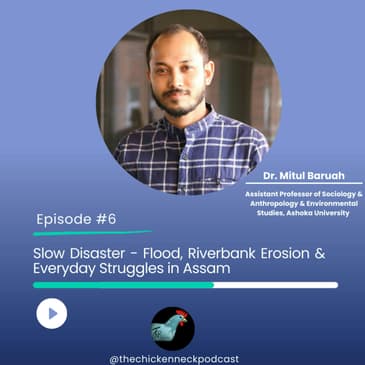

Join us in this compelling episode as we delve deep into the pressing issue of floods in Assam and their catastrophic impact on the captivating island of Majuli. Majuli, one of the largest river islands in the world, is at the brink of being lost forever due to a combination of flooding and erosion, exacerbated by inadequate policy measures. Our guest, Dr. Mitul Baruah, Assistant Professor of Sociology and Anthropology & Environmental Studies at Ashoka University, brings his expertise to shed light on this critical topic.
Dr. Baruah is the author of the thought-provoking book "Slow Disaster: Political Ecology of Hazards and Everyday Life in the Brahmaputra Valley, Assam," which unravels the struggles and everyday lives of rural communities in the hazardous geographies of the Brahmaputra Valley. With a focus on Majuli, his extensive ethnographic research highlights the immense challenges faced by its residents, including the loss of landmass, destruction of livelihoods, and forced displacement and outmigration.
In this episode, we explore the nuances surrounding Brahmaputra Valley's flood crisis, examining the interplay of natural and human factors that have contributed to the valley's vulnerability. We also discuss the historical context of Majuli's transformations, the impact on the local population, and the urgent need for sustainable solutions. Through our conversation with Dr. Baruah, we aim to understand the complexities of the flood issue and explore potential pathways towards building a sustainable mechanism for resolving this crisis. Join us as we navigate the waters, raise awareness, and seek actionable steps to rescue Majuli and safeguard its future.
Disclaimer: The views and opinions expressed in the podcast are those of the individual podcasters. Listener Discretion is advised.
Follow us on Twitter, Facebook, Instagram, and LinkedIn. You can listen to our show on all streaming platforms by clicking on the link:- https://bingepods.com/podcast/the-chicken-neck-podcast
Learn more about your ad choices. Visit megaphone.fm/adchoices
[00:00:00] Hello and welcome to the Chicken Neck Podcast.
[00:00:02] Supported by the IdeaBrives Network, we are a bunch of curious individuals based out of
[00:00:07] the Northeast, and we strive to bring you the best of policy discussions through the
[00:00:11] intersection with things that affect your and our daily lives.
[00:00:15] If you like what we do, show your support by sharing our work.
[00:00:18] Don't forget to leave your comments on this episode in our social media handbooks.
[00:00:23] Hello and welcome to another episode very large and long period. And it has been because not only is it historically and culturally very important, but because also the problems and the threats that flood causes in the region. To discuss further, I'd like to invite Dr. Boorwa to the podcast. Thank you so much, Boorwa, for joining us in this podcast today.
[00:01:42] Thanks a lot, Animesh and Suvam for having me. I'm really honored River Island Majuli, where I was born and raised. And so this book, so you know, this book is about, as you said, flood and riverbank erosion. And both of those, I grew up experiencing very, very intimately. Right. So, I mean, I guess we'll have more discussion about it. I'll tell, but just to kind of start off, you know, so like, you know, flood is something
[00:03:03] that used to affect us when I was a child in Majuli every year, sometimes, you know,
[00:03:08] like twice a year. I was trained at the political ecology. So I started to look at issues of flood and erosion in Assam kind of from a political ecology perspective. And so I wanted to understand this phenomena. I know flood and erosion, how it's affecting the entire Brahmaputra Valley, Majuli being one of those, because I have witnessed Majuli daily transforming over a period of time.
[00:04:23] Prior to that, of course, I have had exposure
[00:04:26] to environmental issues.
[00:04:27] I worked in this topic. So I thought, okay, I could do two things. One is this book is sort of, it could be my tribute to the island, tribute to my home,
[00:05:44] where I belong. Yeah. So, yeah, well, it's, you know, I call the book, sorry. No, please go ahead. Please go ahead. Yeah. I mean, it's because you ask, you know, the title of the book, I call it slow disaster, you know, because I'll explain probably briefly later, but it's a new kind of, you know, conceptual term. I want to look at these processes of flooding and erosion because unlike,
[00:08:05] of those sort of like newsmaking, headline making, big events. It's a very slow, I even call it sort of like incremental,
[00:08:11] accretive kind of process.
[00:08:13] It happens over a long period of time
[00:08:15] that goes almost unnoticed.
[00:08:17] But if you look at the larger implication over a long period
[00:08:21] of time, it's huge.
[00:08:25] So I kind of thought I we talk about the slow disaster angle. Because we normally only talk about climate change when let's say there's a tsunami or
[00:09:43] there's an earthquake.
[00:09:45] Not earthquakes most of the time, but let put a blind spot and I'll just look very neutrally into what
[00:11:01] is happening in Majulis. So tell us a bit about spoken in module E and you have like you know memories and you have all of those so you have particular reference points and so it's kind of sometimes you have access to things right you can easily access certain informations I mean relatively easily people will accept you they know your parents they know your family and blah blah blah so there are some kind of it's like going back home
[00:12:24] it's it's very comfortable you know, like it's a long gap, right? So there are a lot of things in me that have changed isn't it? Like, you know certain mannerisms etiquette, you know the way I carry myself, you know a lot of things have also changed I mean even something that probably I don't notice but people in Madhuli would notice right they find something about me Oh, he's one of us but not quite, you know, so so there are those things so, you know
[00:14:46] no such thing as value neutrality or you know, like objectivity, you know, like I think we all have, we are political being and when we pick up a research topic and we have our politics there,
[00:14:51] you know, I mean, the fact that, so which is okay, you know, so I do have a particular,
[00:14:57] I mean, I do care for Madhulini in touch with them, like occasionally, but with me, I belong. So even after I finish my field work and I return to US, and there will be WhatsApp messages and phone calls
[00:16:20] and asking me how is it going,
[00:16:22] what's going to come up and am I publishing soon?
[00:16:24] And am I going to present to the state
[00:16:27] and will the government do something? on a kind of lighter note, it's also very difficult sometimes to concentrate in your research if you belong to the place. There are lots of events that you are invited. You're invited to a wedding, you are invited to a village festival, to a bhauna, to a raslila, or you have to take part in community event because you are now back home for a year to do fieldwork.
[00:17:42] So you better participate in a building. So I actually use multiple methods so that my kind of's also kind of, I am one of them, I'm going back, right? So I have to be accountable to people. Like why did I say, it's not just that I can do research and just kind of move away and like, whatever, I don't need to revisit that place, not really.
[00:20:22] So I'm there, like, that's my home.
[00:20:24] So even if I asked you that question because you know, very broadly, I think when you are writing about your region and this is so much of which we see today, especially with shoes like let's say flood or disasters where somewhere or the other the government or the institutions,
[00:21:43] large government institutions are in picture, you see, evidence with a lot of storytelling, which is experiences of the people, which in a way narrates a very neutral idea where you're presenting to the reader the idea that, look, this is what is happening. Right. And when you say, and I think the last point that I found very interesting from what you made was the I was sometimes tempted to participate in certain meetings and, you know, certain kind of mobilization, political mobilization in a particular way. Right. Let's say there was a meeting on, you know, meeting by what is called the Majulis Surah
[00:24:21] Saman Naimansaw, you know.
[00:24:23] So they are talking about how best disaster angle and how it came about.
[00:25:41] So I just wanted to talk about you to come back to your question, there are, I am, in talking about slow disaster that is devastating Brahmaputra Valley and Brahmaputra Valley in general, I'm talking
[00:27:00] about the twin processes of flooding and riverbank erosion, as we in Assamese call Banpani Gora
[00:27:06] Cauhonia, right? flooding because then flood will bring in alluvium, what you call polo in SMEs, will make the land fertile and flood will replenish the wetlands, flood will be fun in the sense of fishing and so on, but flood also allows for navigation, transportation and so on. So flood is something people really kind of depended on and they also developed their agriculture
[00:28:25] and livelihood patterns around flooding. In fact, I islands will be formed. So this is a part of this very unstable, very kind of volatile, the Brahmaputra, this riverine ecology of Brahmaputra is very volatile, the flooding and erosion are part of it. Okay. So, but that's not kind of, you know, original to Assam, you know, it's kind of first built by the U.S. Army Corps of Engineers in the U.S. along the Mississippi and you know like it's a global thing,
[00:31:00] okay? So the embankments have kind of embankments behind let's say some of the great floods such as 1927, the Mississippi flood, et cetera,
[00:32:24] it's behind those were the levees which actually led to those massive flooding. which required however, the pre-independence, which required certain provisions like some sort of studies and kind of control mapping and so on and so forth. You can't just indiscriminately go on and building embankments. But the government found that a hurdle. So in 1953, we kind of got rid of that. We kind of now, okay, we can just build more and more embankments. Now, these
[00:33:42] embankments have contributed to more disastrous flooding, weak because of embankment. What have also happened is that we have divided the geography into two distinct areas. Like one which are protected, one which I call inside embankment and outside. That is like the countryside and the riverside.
[00:35:01] So now, because some areas are protected by embankments,
[00:35:05] areas outside the embankment,
[00:35:06] because of course the water will come,
[00:35:08] where will the water go? you know, like in for erosion, like concrete structures, this, that, and you know, like without really ever trying to adapt to the river and. And you know some of it is kind of eroded away, some of it is kind of full of like now you know like kind of it's choked
[00:37:43] with water hyacinths and so on because of these amendments. So it actually goes kind of unnoticed. This is like no big deal, you know? But then if you look at like, you know, like the incremental sort of impact of it, it is huge, you know, so Madhuli, all the transformation that I told you, you know, like, you know, something like today, there are like roughly 10,000 homeless,
[00:39:00] you know, families, government data,
[00:39:02] and you know, something like many thousands of families
[00:39:07] have moved out of Madhuli, Yeah. That's it. I mean, it's a very, I do not have the exact, the correct work for it because, you know, it's kind of also ironical because you, in your book you mentioned, and I'll come to a continuation of this point because you talk about embankments and Mathaur is a very popular word for some reason in Assam.
[00:40:22] But what is also interesting is that it is a very little instance where, you know, the Brahmaputta
[00:41:25] Right. And this is where I also come because come across this points you mean you talk about in bank embankments, you also slightly touched upon other concrete measures, right? So you talk about, let's
[00:41:31] say, boulders, you talk about RCC porcupines, that, that the board has tried to integrate as
[00:41:37] solutions to this problem. Right. Now, and then we also heavily. So just on to that, what do you think, why do you think this other measures other than embankments are not the solutions are doing more harm? And have you come across any case study where let's say anything has worked better than any of do more for kind of erosion control and so on. And that's when the Brahmaputra board came into the picture. This porcupines, you know, like geobags, geometrices, the boulder spars and, you know, it's not really that. It's more about what is the philosophy behind all of this, you know, what is the idea behind
[00:47:02] all of these infrastructures which all due respect to them, I know they do hard work. This is not a comment on them as individuals. But often local people tell me that how they have this model, Majuli model in Guwahati where there is a model where they look at and they try out their measures and these
[00:48:23] very young engineers come to Majuli and implement. structures. For them, the interesting flood and erosion, there were also soft measures, what they call, like something like flood forecasting, kind of capacity building, flood zoning and so on. But nanotubes become important for the government because they want to kind of demonstrate physically something big, something huge, so that people can see.
[00:50:43] So, how do we adapt? What kind of livelihoods should be people to practice?
[00:50:50] So I think there's a lot of other things that need to be looked at, simply not just this.
[00:50:54] So again, to go back to some of the so-called, what you said, other measures by the Brahmaputra
[00:51:00] board, and even to give you concrete examples, like why I also argued that they're not successful,
[00:51:05] is let's take the example of a boulder spar. So, you know, I don't know, I mean, you know, how kind of effective these structures really are, you know, so people don't, at least people don't find them very effective. Yeah. I think, of course, a lot is left to be desired even from people, like you said, building. I just kind of recalledutra board being, you know, not being, you know, properly, even with all of their hard work without questioning it. I think it's just that the solution is not there. And on a very lighter note't live there and you know, all that, but, but how about, you know, like, imagine like, madly, suppose we promote more of those still houses like Chang' erosion that you're talking about. Also, I mean, just to add on to that, again, I was going through some of the interviews and everything they were doing. Another very interesting aspect is the idea of Majuli and the UNESCO heritage site. So that's something also, I mean, it's, of course,
[00:56:20] it gives them great identity. But you know, so in Majuli, it's not simply about, you know, so agrarian crisis is like a, you know, like, as you can see, it's happening countrywide, you know, we are talking about agrarian distress, etc., that's affecting much of India.
[00:57:45] But in Majuli, it's kind of rather distinct, you know, they do not, they used to earlier, like I began this, you know, like in right in the beginning, like I said, they used to depend, look forward to flooding. You know, R it to the wetlands, make it to the bills and ponds and the streams, which affect, of course, definitely like the fishing community and the fish stock and so on. Right. Another issue that's happening in Maduli is because of a lot of because, you know, there is there isn't that much of and that's the same that the goals kind of that applies to rest of
[01:00:21] Assam also because of lack of rural livelihoods.
[01:00:24] A lot of people are youngsters are migrating, right?
[01:01:25] the residual cast. So they depended heavily on fishing for their livelihoods. You know, like, of course, a lot of other people also fish in Majulie to eat like, you know,
[01:01:29] I grew up doing that. But, you know, these two communities particularly fish to sell
[01:01:32] and kind of that's the livelihood. But now what has happened is that, you know, because
[01:01:38] again of this kind of embankments and erosion, longer viable. So they do now what is called goat trading or sagoli, papari, and asymis. Like basically they don't have land to do kind of animal husbandry, right?
[01:03:00] So they can't raise goats, but they go around
[01:03:02] on a bicycle, within mazuli, outside mazuli,
[01:03:04] all the way to other districts around, practice in one large village and it's very unique. You know this village called Salmara, Halmara in the kind of you know one extreme end of Madhuli where I've done my field work. It's a village of the Kumar community, the Potters where they also make pottery without potters wheel, they do everything by hand and it's a very large village.
[01:04:21] In fact the legend goes that this was is the pottery is in deep crisis because the clay that clay that they need to make pottery is disappearing because of erosion that clay that they use they get it on the riverbanks and riverbanks are kind of eroding you know and that's one but then there are they can also get it from
[01:06:45] So like people also tell me that one community that was depending a lot on their pottery was the missing community in Majuli.
[01:06:47] So of course they sell around the state, you know, to other places, but the missing community,
[01:06:53] the tribal community in Majuli, as well as some parts of Apparassam, would use their
[01:06:57] large pots a lot to actually store their rice beer upon, to brew and store. So, yeah, so, so the kind of I discussed this at length in the book, but these are kind of basically this is just to give you a sense of how the traditional livelihoods are affected by processes such as flood and erosion and also sometimes governments flows towards another community and the missing communities rise, bear, up on. Economics is impacted by the fact that clay is an issue in St. Mora. So I think it's a very wonderful, I think this is kind of
[01:09:43] like the perfect example of flood is such a huge, yes, Madhuli is indeed the hub of the Satras, you know, Satras for the audience, it's also like that it is basically the, you know, like the 14th century, sort of, you know, like asamis renezance and then the Neo-Vasnavite, a Sattra or somebody's house, right. So it is impacted Sattras as well. But of course, not as much, right, because as you know, I mean, as understandable as that, you know, they are also sort of located little safely in places which are not as vulnerable,
[01:12:25] you know, some of the Sattras are in the kind of, you know, not all some of the Sattras and Sattradikars rule, well, you know, so there is this Majuli Suraksha Saman name also, Majuli Khurekha Haman name also that was constituted to basically lobby for better kind of protection of the island, which originally was kind of founded by the a protest in maybe in this pool in capital or something. Satradikas have apparently actively kind of prevented that from happening. Right. So in fact, I was attending a meeting of the Maja Bishura Kasamunde Mansop where where Satradikas indeed, some of the Satradikas present were actually
[01:15:00] kind of almost scolding like some of the student leaders, you know,
[01:16:06] has been, you know, because of its cultural significance has been nominated as a UNESCO or latest site, it's not received it yet.
[01:16:09] But what has happened is that in the past decade or so, there has been a sort of, I
[01:16:18] would argue that there has been almost like a fetishization of the whole cultural sphere,
[01:16:23] you know, that the cult, a lot of everyday citizens, ordinary people living, you know, they really don't care about whether Mazzoli becomes a UNESCO heritage site or not really, you know, like they really want their village to be protected so that they don't want another 50% of the families move away,
[01:17:43] move out of Mazzoli or they don't want to. I mean, this is more specifically a society. But also from that to another very interesting part of your book where you call the state a disastrous state. So tell us a bit about why and what led you to call the state to be a disastrous state and what is it that you try to talk about
[01:19:04] from there? flood and erosion worse. So that's one. One is how the state has in the name of controlling or controlling disasters like flood control or erosion control, they've actually done this process is far more disastrous. So that now kind of with all these infrastructures kind of really
[01:20:20] there is wreaking havoc on the island. So that new house. Every time, you know, I talk about in, I think my chapter one, I talk about the case of a person who in the state is not doing anything, right? So if sort of, you know, a lot of farming people, communities are losing their land and now are left with meager sort of land holding and having to do all kinds of sort of, you know, ad hoc kind of livelihood, the state isn't really stepping in.
[01:23:02] So I'm saying that in all these ways, when you look at the state is instead of preventing
[01:24:07] also think about the importance of the role of somebody like a district collector, that's it, the DC, the role of DC. And DC not just administratively, but also policy-wise. Because
[01:24:12] what is the role of, let's say, DC? It's mostly administrative implementation. But is it also the
[01:24:18] reverse process where, let's say, the Brahmapodea, the bridge that we had now, of course, the bridge to Marjuli as well. As somebody who has lived there, who has researched there, researched about Marjuli, what is your opinion of the bridge to be very convincing and strong, you know, okay, and often it's like, okay, it's a public demand. I don't really think so. I don't think it's been a really popular demand, the bridge, you know, people talk about it, you know, and without thinking, you know, a bridge will kind of, you know, like kind of reduce the time that it takes to go to your heart
[01:27:00] on a ferry or something, you know, like,
[01:27:03] it's more like, we'll talk about it, you know,
[01:27:05] but there has not been really a consistent sort of And you have to incentivize, you know, like, okay, and how about we, we radically kind of revamp and, and upgrade the fairy system, right, you know, like faster, safer, better, more frequent fairy. I mean, it's actually beauty to be on those fairies, you know. Now, okay, so these are some things, but, you know, more thinking about more ecologically,
[01:28:24] you know, like the bridge is going to have a lot of, I mean, terms of all the, since there's dozens of large pillars on the river changing the whole kind of, you know, the course of the river, impacting the kind of, you know, like the sediment flow and all of that might have a lot of impact on the ecology downstream. It will have a lot of impact on sort of, you know, like the noise and all will have a lot
[01:29:42] of impact on the kind of, you know, like the aquatic diversity. might become more polluted and too many outsiders coming in. And then how about this very pristine so-called, or this nice quiet environment.
[01:31:02] And some people are even becoming nostalgic about the ferry have now got a UNESCO heritage, you know, but that aside, so they're keeping this heritage and they're keeping it separate. I mean, they're charging people money to get into those villages outside us, and into the tourists. So I think, and whether we'd like to believe it or not, Marjuli is a very important site for us that way. So let's say if tomorrow, too much of
[01:32:23] development, and of course, development has, you can call it visual anthropology, basically. So that's looking at Majuli, but not so much about Majuli only, but it's basically about these kind of, you know, like everyday life on this river and ecosystems in the larger context of climate change. So climate change is not something I've discussed a lot in my book, but this documentary is
[01:33:43] about looking into the fragility and, you know, like vulnerability of these landscapes
[01:33:48] in the context of climate change. work on Wetland. So I've just done preliminary field work, very little I'm just starting. So I'm now, in fact, I just am actually just kind of right now thinking through outlining these and collecting some data that is available, kind of government reports and so on reading
[01:35:00] up about you know, wetlands, other than kind of there in Marjouli, the economics, the livelihood, so many different dynamics of not just Majuli, but the problems that exist with regards to floods in Assam and what is the role of the state. So I think this, me personally, I think I learned a lot and there have been a lot of new insights other than the fact that both of us stay in Sonipa
[01:36:21] and we have been neighbors for some time now
[01:36:24] in different universities though.
[01:36:26] But on that note, thank you so much for coming