
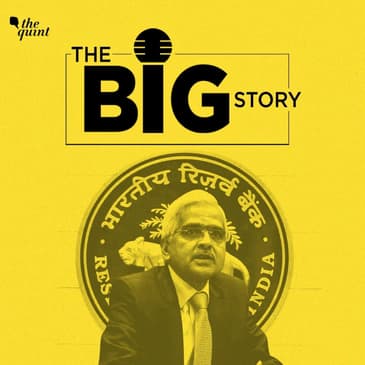

Unveiling the new policy on Wednesday, RBI Governor Shaktikanta Das said the bank is aiming to keep inflation – which is already close to 7 percent – at the desired level in the wake of the ongoing Russia-Ukraine war and increase in food and commodity prices globally.
However, there are a few puzzling takeaways from the central bank statement. First, is the fact that the bank has retained the accommodative monetary policy, which essentially means that the bank is prepared to expend the money supply to boost economic growth. This, obviously, runs counter to the bank's latest move.
Second is the timing of it. Less than a month ago on 8 April, the bank's Monetary Policy Committee – which decides the repo rate – decided to keep the rate unchanged despite rising inflation and tightened geopolitical uncertainty. And since the same factors remain even now, why the sudden hike? What changed?
In today’s episode, we break down what prompted the RBI to hike the repo rate, the significance of the move, and how it will impact the end consumer.
In today’s episode, you will hear from Ananth Narayan, Professor of Finance at SP Jain Institute of Management and Research, and Quantum Advisors India's Arvind Chari. You will also hear from Prosenjit Dutta, former editor of Businessworld and Business Today.
Host and Producer: Himmat Shaligram Editor: Shelly Walia
Music: Big Bang Fuzz
Listen to The Big Story podcast on:
Apple: https://apple.co/2AYdLIl Saavn: http://bit.ly/2oix78C Google Podcasts: http://bit.ly/2ntMV7S Spotify: https://spoti.fi/2IyLAUQ Deezer: http://bit.ly/2Vrf5Ng Castbox: http://bit.ly/2VqZ9ur
Learn more about your ad choices. Visit megaphone.fm/adchoices
[00:00:00] In a surprise move on 4th May, the Reserve Bank of India hiked the benchmark repo rate for the first time in four years by 40 basis points to 4.4%. Alongside this, the Central Bank also raised the cash reserve ratio or CRR by 50 basis points to 4.50%. Unveiling
[00:00:32] the new policy on Wednesday, Arbaik Governor Shakti Khan Tadas said that the bank is aiming to keep inflation, which is already close to 7%, at the desired level in the wake of the ongoing Russia-Ukrainian War and increase in food and commodity prices globally. However,
[00:00:46] there are a few puzzling takeaways from the Central Bank statement. First is the fact that the bank has retained the accommodative monetary policy, which essentially means that the bank is prepared to expand the money supply to boost economic growth. This obviously runs counter to the bank's latest move.
[00:01:01] And second is the timing of it. Less than a month ago on 8 April, the Bank's monetary policy committee, which decides the repo rate, decided to keep the rate unchanged despite rising inflation and tightened geopolitical uncertainty. And since the same factors remain
[00:01:14] even now, why the sudden hike? What changed? In today's episode we break down what prompted the Arbaik to hike the repo rate, the significance of the move, and how it will impact the end consumer. In this episode you'll hear from Anand Narayan, Professor of Finance
[00:01:27] at SP Jain Institute of Management and Research and Quantum Advisors India's Arvind Chari. You'll also hear from Prasindjit Dutta, former editor of Business World and Business Today. You're tuned in to the big story, the podcast where we
[00:01:41] dissect the headline making news for you, and I'm your host, Imat. Before we head further into the episode, let me give you a quick crash course into the possible business he jargons we will be hearing. The repo rate is the interest
[00:02:00] at which the Arbaik lends to banks like ICSEI, Kotak or AXIS. Cash is of ratio or CRR mandates the amount of liquid cash a bank must maintain. And finally, a basis point is one hundredth of a percentage point. So when you hear the
[00:02:12] repo rate has been increased by 40 basis points, that means an increase of 0.4%. Now why does the Arbaik do this? Essentially it's a tool to curtail inflation. The hike in the repo rate means that the cost of funds for banks will go up.
[00:02:25] This will prompt banks to raise lending and deposit rates in the coming days, which will then incentivize Indians to save more. With less cash available to spend, inflation or rising prices could be curtailed. And with the hike in CRR,
[00:02:36] which is 50 basis points, the Arbaik will suck out rupees 87,000 crores from the banking system. This in turn slows down the investment and reduces the supply of money in the economy. As a result, it helps bring down inflation.
[00:02:48] So now coming to why the Arbaik has increased these rates, there are several factors with the Arbaik governor listed in his address from rising global inflation rates to geopolitical tensions. Here is what he said.
[00:02:58] I would now like to set out the rationale behind the MPC's decision and the stance. Globally inflation is rising alarmingly and spreading fast. Geopolitical tensions are ratcheting up inflation to their highest levels in the last three to four decades in major economies
[00:03:18] while moderating external demand. Global crude prices, that is crude oil prices, are ruling above 100 US dollars per barrel and they remain volatile. Global food prices touched a new record in March and have firmed up even further since then. Inflation sensitive
[00:03:41] items relevant to India such as edible oils are facing shortages due to conflict in Europe and export ban by key producers. The jump in fertilizer prices and other input costs has a direct impact on food prices in India. Further, the normalization of monetary policy
[00:04:04] in major advanced economies is now expected to gain pace significantly both in terms of rate increases and unwinding of quantitative easing as well as rollout of quantitative tightening. These developments would have ominous implications for emerging economies including
[00:04:26] India. Meanwhile, COVID-19 infections and lockdowns in major global production hubs are likely to accentuate global supply chain bottlenecks while depressing growth. In fact, global growth projections have been revised downwards by up to 100 basis points for this calendar year.
[00:04:49] These dynamics pose upside risks to India's inflationary inflation trajectory set out in the MPC resolution of April. Now, the reason this hike has made headlines is the timing of it and there are two factors behind this according to our guest. First, Arbias MPC needs only once every
[00:05:07] two months and the meeting on 4th May was not scheduled. The MPC had met in February and then in April and was set to meet next in June. Now, in April the bank was expected to raise
[00:05:17] a rep rate but kept it at 4% despite the rise in global inflation and commodity prices. However, it hiked the rep rate this time around for those same reasons. So what has got them so worried this
[00:05:28] time around? Speaking to Bloomberg when Anand Narayan, a professor of finance at SPGN Institute of Management Research explains that the inflation rate on March which was unexpectedly higher at 6.95% than what the RBI had predicted and the expectation of inflation to
[00:05:41] continue to go up is what prompted the bank to hike the rates. Look, there were two surprises. I think that the RBI and the MPC were looking at. First is of course the inflation
[00:05:52] print for March which came at 6.95 probably higher than they expected. I sense that they also have a good sense where the April inflation print has been found and I suspect it's going to be
[00:06:03] closer to 8% than the 7 odd percent that people are expecting. Now, RBI by the way from what Little I know has a very, very good way of monitoring what's happening on inflation. So as of the end
[00:06:16] of April and the beginning of May they would have a very good sense of what that print is going to look like. So I sense that that's the immediate trigger which pushes all of the inflation
[00:06:25] trajectories going forward into a different orbit altogether. So while an RBI had been saying 5.7% for a 523 my own little spreadsheet now shows a good chance of overall inflation averaging about 7% at this current pace if things go the way they are just going by the future prices
[00:06:43] and oil. I think that's the immediate trigger. The fact that inflation is going to get in a sense unhinged. I think those three quarters of about 6% is now pretty much a given as things stand
[00:06:53] and it could extend to beyond as well. So I guess that was the immediate trigger for the action. The second factor is announcing the hikes before the US Federal Reserve does it,
[00:07:01] which was scheduled to do it on the same day. And this was a crucial factor because the US Fed raised its interest rate by 50 basis points, which is the steepest increment in the past 22 years. Quantum Advisors India's Arvind Chary explains that a possible thought behind RBI's
[00:07:15] unscheduled announcement is for it to not seem like it has been forced to hike the rates due to the hike in the US Federal Reserve policy. I think the monetary policy surprise as a
[00:07:25] monetary policy tool is back and at the times of why we did the issue use it quite often and it had the maximum. But apart from the inflation worry, I'll add two more points. One is the RBI officials were just last week attended the IMF World Bank meeting
[00:07:44] and India is still kind of outlier in terms of still not normalized or even not even talking about normalizing the crisis level COVID related pandemic related accommodation that we did. And the second would be timing to do it pre Fed and just Fed is supposed to act tonight
[00:08:05] and doing it pre Fed. And I think that monetary policy is all about managing expectations and helping manage expectations. And a big part of that comes from credibility. If the market believe your credible and your actions are such, then they will allow you to manage
[00:08:22] expectations in the way the central bank wants it to. I think these two factors have also gone into they doing a intermittent second, third is a holiday. They are getting meeting on
[00:08:30] fourth. I mean, there's a lot of, I think these two things also trying to do it before Fed because if the Fed would have hiked say 75 basis points tonight and then the RBI would have followed
[00:08:40] people would have said that RBI is being forced. They don't want to do it, but they're just being forced by doing what they did today. I think they are they are reaching in the
[00:08:49] capital cap because they are taking back the capability which kind of was lost in that February policy. Of course, a lot has changed since that, but a lot of us felt that that
[00:08:58] policy was just way off in terms of markets. I think this is a very good step from that perspective to tell the market that when circumstances change, we change and we are not only mollycoddling you the market, we're also willing to surprise and take the pain
[00:09:17] and pressure on them. The sudden announcement by the Dhan Gholz puts a question mark over inflation forecasting abilities, which according to an Indian Express report have contrasted with the actual inflation. For example, in its February policy, the RBI had
[00:09:29] projected inflation at 4.5% for 2022-23. However, just two months later, it raised the forecast to 5.7%. The report also points out that the RBI has failed to target retail inflation at 4%, which is mandated to do it by law. The central bank is also allowed to leave a
[00:09:45] of 2 percentage points on either side, meaning it can allow inflation to be at 2% or 6% in a particular month. However, since October 2019, there has been only one month where retail inflation has been close to 4% and the inflation mark has often stayed well above 4%,
[00:10:00] often going above the 6% mark as well. Prasanjit Datta, the former editor of Business World and Business Today says that RBI's gamble of waiting for the inflation to cool down and then hiking the rates did not play out. Thus they were forced to pay catch up.
[00:10:12] It has been late. There can be no two issues about it. None of the factors that listed yesterday were not there on April 8 when the previous policy was when he gave the same comment. He did not discuss exactly the same Russia-Ukraine war. They had discussed
[00:10:34] inflationary pressure. They had not talked about the crude oil prices. So they were nothing but changed. I can only think that they were possibly waiting for a miracle to happen and inflation to cool down and then they realized that it was unlikely to happen.
[00:10:53] Lightly, explanation is that they realized that once the Fed increased the rate and because of the time difference, the rates could be announced in the evening India time. There were far too many consequences including flight of capital, including what would happen to the bond, to the
[00:11:15] rupee value and stuff like that. So they decided to rush to do it. You cannot in less than one month you cannot completely rethink your stuff. You cannot say that on April 8, these are
[00:11:28] worried but they are not worried enough for me to change my policy date and then suddenly on May 4, you suddenly decided but they are far too worried. It is there that it will definitely
[00:11:38] be delayed. You would say that at least two NPCs in the past should have started raising rates by 25 basis points maybe or 50 basis points because the liquidity was not helping and the low rates were not helping. As I explained earlier, the increase in
[00:11:56] reparate makes borrowing expensive meaning that the bank will also increase the lending rates in particular home loan interest rates. Mr. Dutta unpacks how exactly the hike in reparates will translate into home loan interest rates increasing.
[00:12:07] Okay, so let's read back a little bit and just give a common citizen into two. The poor and the salaried middle class. So as far as the poor is concerned, my moon feeling is that
[00:12:21] this rate hike is going to do nothing to insulate it because a lot of it is based on supply problems, oil prices and all. And it is not demand issue. So inflation is not going to go down.
[00:12:34] Therefore as far as the poor are concerned, this particular rate hike which was announced yesterday it is going to do nothing to be alive because the inflation will continue biting them. It is not going to cool down inflation particularly it is not going to make any difference to
[00:12:48] their poor inflation. Yeah, it is not going to make any difference to the consumer price index in the short term. And anyway any RBI policy will intersect, hike always has a lag effect.
[00:12:59] It starts showing up after several months. Now taking going down to the middle class, the salaried class or the retired class who have put in the bank. So these people are both borrowers as well
[00:13:11] as their savers right quite a lot of deposits in the bank. Now those deposits will possibly marginally higher deposits but it will still not help them because your effective rates are still
[00:13:25] lower than inflation. So you were losing a lot of money by keeping your money in the bank earlier. Now you're going to lose slightly less money but since your inflation is higher than your
[00:13:37] savings rate, you're still going to lose money. It is only that by a smaller margin. But you will be paying more for your EMI definitely because the moment policy rates increase, commercial banks are very quick to transmit interest rate hike to borrowers.
[00:13:56] They are slower to transmit the rate hike to savers. So we will see the EMI almost anybody who is on a protege rate of any sort of EMI will immediately feel the pitch from the next
[00:14:10] curve within a month. The RBS hike in reparates confirms that inflation is here to stay but the big question which still remains unanswered is why did the central bank not plan for it?
[00:14:19] If you want to know more about the rate hikes head over to the Quinn's website where you'll find a detailed explainer on the same. If you like listening to this episode, please subscribe to the big story for episodic updates. We are available on Apple, Google Podcasts,
[00:14:33] Spotify, Geo7 and most of the other popular podcast streaming platforms. For other podcasts please log on to the Quinn website and for any feedback, please shoot an email to podcastatthequinn.com. Thanks for listening. Log on to the Quinn's website and check out our other podcasts.