
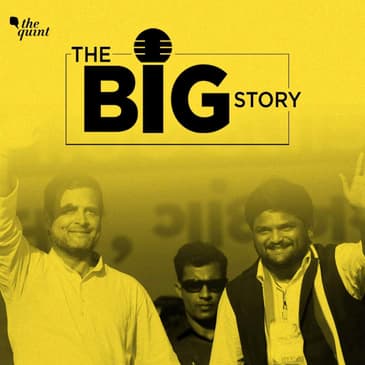

Taking swipes at senior leaders, he accused the party of lacking strong leadership both at the state and central levels. He said that Congress only plays the role of a “roadblock” when it comes to serious issues — be it about Ram Mandir, abrogation of Article 370 or GST.
While it’s not yet clear where Hardik will be headed next, resignations within the Congress party have been on the rise. There have been brazen expressions of discontentment over party leadership and the party's functioning from Congress leaders themselves.
Besides Hardik, many prominent and senior leaders – some of whom had decades-long association with the Congress – quit the party and switched over to opposition parties over the last few year.
In fact, earlier in the day a former senior leader of Congress from Punjab — Sunil Jakhar joined the Bharatiya Janata Party, merely days after quitting Congress.
But what doesn't make for good optics is that Hardik's resignation comes just days after the Congress wrapped up their 3-day 'Chintan Shivir' in Udaipur, where the party got together to chart out a plan for its revival. Jakhar, in fact, resigned while the Shivir was still underway.
So, we’ll look at two things in this episode: firstly, how does Hardik Patel and Sunil Jakhar’s exit stand to impact the Congress at a time when its fast losing its grip over its voters?
Secondly, what are the big takeaways from the Chintan Shivir? Is the Congress acknowledging the shortcomings that has been costing it so dearly?
Host and Producer: Shorbori Purkayastha
Guest: Aditya Menon, Political Editor, The Quint
Editor: Shelly Walia
Music: Big Bang Fuzz
Listen to The Big Story podcast on:
Apple: https://apple.co/2AYdLIl Saavn: http://bit.ly/2oix78C Google Podcasts: http://bit.ly/2ntMV7S Spotify: https://spoti.fi/2IyLAUQ Deezer: http://bit.ly/2Vrf5Ng Castbox: http://bit.ly/2VqZ9ur
Learn more about your ad choices. Visit megaphone.fm/adchoices
[00:00:00] On 18th May, Hardik Patel who came into the limelight in Gujarat on the back of the Patelar agitation ended his three-year-long stint at the Congress and quit the party. Taking swipes at senior leaders, he accused the party of lacking strong leadership both at the state
[00:00:27] and central levels. Explaining the reasons behind his decision to quit, he said that the party only plays the role of a quote-unquote roadblock when it comes to serious issues, be it the Ram Mandir issue, the abrogation of Article 370 or GST. While it's not yet
[00:00:43] clear where Hardik will be headed next, resignations within the Congress Party have been on the rise as we've seen brazen expressions of discontentment over party leadership and the party's functioning from Congress leaders themselves. And it's not just Hardik. Many
[00:00:58] prominent and senior leaders, some of whom had decades-long association with the Congress, quit the party and switched over to opposition parties over the last few years. In fact, as we talk about the Congress's decline, just earlier today a former senior leader
[00:01:13] of Congress from Punjab, Sunil Jhaka joined the Bhartya Janta Party merely five days after quitting the Congress. But what doesn't make for good optics is that Hardik's resignation comes just days after the Congress wrapped up at three-day Chintan
[00:01:27] Chiver in Udaipur, where the party got together to chart out a plan for its revival. Jagger in fact resigned while the Chiver was still underway and what prompted this political huddle are repeated electoral losses, criticisms over the lack of strong leadership at the
[00:01:43] helm and the fact that the party's own leaders have been urging for a major overhaul. So we look at two things in this episode. Firstly, how does Hardik Patel and Sunil Jhaka's exit stand to impact the Congress at a time when it's fast losing its grip over
[00:01:57] its voters? And secondly, what are the big takeaways from the Chintan Chiver? Is the Congress acknowledging the shortcomings that have been costing it so dearly? And our guest in today's episode is Aditya Menon, the Queen's political editor.
[00:02:10] You're tuned in to the big story, the podcast where we dissect the headline-making news for you. I'm your host, Shorbari. Perhaps Hardik Patel's departure wasn't unforeseen as the young leader had removed the word Congress from his Twitter bio earlier
[00:02:30] this month. And just to elaborate a little more about what the resignation letter that he had posted on Twitter said, I'm going to read out a few lines here. Quote, the youth of the country wants a strong and capable leadership. Over the last three
[00:02:42] years I've found that the Congress party and its leadership both at the center and state level have been reduced to merely opposing everything. Then he also said that the Grand Ole Party are not seriously engaged over issues. I'm again going
[00:02:55] to read out a few lines here. Quote, I've always felt that leaders were not truly interested in hearing about problems concerning the people of Gujarat but were more engrossed on what messages they had received on their mobile and other such
[00:03:08] trivial things. Whenever a country faced challenges and whenever the Congress needed leadership, Congress leaders were enjoying abroad. When it came to issues in India, Gujarat and my Patadar community was to oppose what the government of India led by Prime Minister Narendra Modi did.
[00:03:24] And soon enough there were counter allegations from the Congress as well. Arjun Muthwadia, former Gujarat Congress president, told the Quinn that Hardik wanted an quote-unquote easy life but he didn't get it. Raju Parmar, former MP and Gujarat Congress leader said that this points to an quote-unquote
[00:03:40] ideological bankruptcy. Senior leader Shakti Singh Gohil also went on to eletching a BJP hand in this. He said, quote, these are not allegations of someone who has quit Congress. These are all written down by the BJP.
[00:03:53] This mouth is theirs. The language is of BJP." But how will his exit impact the Congress in the state? Before we get to that, let's understand what kind of political influence he has had in Gujarat. So Hardik has been swung into
[00:04:09] the limelight in 2015 as we said as the Patadar court agitation that demanded OBC status for the community gathered steam in Gujarat. While he had voiced his support for Congress around 2017, he formally joined the party only in 2019 ahead of the Lok Sabha elections. But the BJP swept all
[00:04:26] 26 seats in Gujarat in the elections that year. However, his popularity among the young masses ensured that he was appointed as the working president of Gujarat Congress in 2020 and then in a few months, the BJP once again
[00:04:40] won all the eight Bipoles held in the state that year. But a number of factors have also contributed to Hardik's popularity waning. Aditya Menon explains how. Hardik Patel's popularity was at its peak around 2016-2017
[00:04:53] due to the Patadar agitation. The rallies that he addressed in the run-up to the 2017 assembly elections attracted massive crowds. Such crowds have not even been seen in Gujarat politics since decades and an equal number used to listen to
[00:05:10] his rallies online. He was hugely popular among Patadar youth. So at that time, yes, Hardik Patel was extremely popular but it was also in some ways not his personal popularity. It came from a larger community sentiment in favor of
[00:05:30] reservations for the Patadar community. A lot of the support that Hardik got was also due to certain Patadar organizations and even Patadar leaders within the BJP, tactically backing him to sort of undercut the state government, especially
[00:05:50] the authority of Chief Minister Anandipin Patel before her removal. So that also contributed to Hardik Patel's popularity. So these were also external factors, factors that one directly related to Hardik that led to the crowds that congregated at his function. So obviously after the limited
[00:06:14] purpose of these BJP leaders was achieved, that Anandipin Patel was removed, they withdrew support from Hardik Patel and then of course when the BJP managed to win the 2017 assembly elections, though by not a very big margin, there was probably a sense
[00:06:32] among the Patadar community that they have to somehow make peace with the BJP. Hardik Patel was subsequently embroiled in cases, he couldn't even contest the 2019 Lok Sabha elections because of his conviction in a local court in Gujarat.
[00:06:51] So a number of these factors contributed to Hardik's popularity waning even among the Patadar youth. But what does Hardik's exit mean for the Congress which has been out of power in Gujarat for the past 27 years? If we look at the 2017 assembly elections,
[00:07:08] the Congress had managed to restrict the BJP to double digits. But this was also in part aided by the support from the three young leaders, Dignesh Mewani, Alpesh Thakur and Hardik Patel, each of whom represent the OBC, the Dalit and the influential Patadar communities.
[00:07:25] With Hardik now gone, out of the three only Mewani remains since Alpesh Thakur had quit the party early in 2019 and switched to the BJP. So what kind of an impact are we looking at in the run up to the Gujarat elections? Aditya analyses this for us.
[00:07:39] In the 2017 assembly elections, yes, Hardik Patel did help the Congress in a very substantial way, even though he wasn't part of the party at that point of time. He joined only in 2019, but it was well known that he was tacitly supporting the Congress in that election.
[00:07:55] Congress would never have swept rural Saurashtra the way it did had Hardik Patel not been campaigning actively against the BJP. There was rural unrest against the BJP. The party that community had traditionally not been voting Congress for at least three decades, if not more. And
[00:08:18] therefore, Hardik Patel's rallies against the BJP did lead to a certain shift of party that votes in favor of the Congress in the 2017 assembly elections. However, that went by the time the 2019 Lok Sabha elections took place, the party that's moved firmly back into the BJP
[00:08:36] fold later they section of party that's even tactically back to the armadhani party in the Sura the municipal corporation elections. That also is said to have been hard to Hardik Patel's doing. So, yes, I think just in that one 2017 election the rural Saurashtra the
[00:08:55] Congress did do well partly because of Hardik Patel's support. But beyond that, Hardik Patel hasn't really helped the Congress in any substantial way. With Alpej gone and now Hardik as well, the youth factor that the Congress was trying to
[00:09:12] build up is likely to take a hit in Gujarat. One obvious casualty of Hardik Patel's exit would be in the morale in the Congress party. As it is, the party was not in a very great state,
[00:09:25] especially after a series of defections from its ranks to the BJP. Hardik is the latest among these leaders. Then the Congress in 2017 had really tried to tap on the youth factor by projecting Hardik Patel among party dars, Alpej Thakur among OBCs and Jignesh Mevani among Dalits.
[00:09:49] As this troika of young leaders representing the new Gujarat, Alpej Thakur left and joined the BJP in 2019. Hardik Patel has now gone out of the Congress. Some say he might join the BJP,
[00:10:04] some say he might join the ARP or form his own party that we don't know. But yes, at least this youth factor that the Congress was trying to play, it will now find it increasingly
[00:10:16] difficult to do that. Besides Mevani, it doesn't have too many young leaders on its ranks. Definitely among party dars there is a paucity of leadership. There is Paresh Dhanani who
[00:10:31] is the leader of opposition in the Gujarat Assembly. He is a party dars face but he is not really recognized as a party dars leader. I think to make up for that, the Congress is trying to
[00:10:41] woo Nareesh Patel who is an important community leader among party dars. So, yeah, if Nareesh Patel comes in, it will more than compensate for the laws of Hardik Patel. However, this resignation can't be viewed as a singular event. Rather, it's a symptom of the
[00:10:58] Congress's overall decline. Let's come to Sunil Jaghar, a former chief of the Punjab Congress who has now shifted to the BJP. Jaghar's family has been associated with the Congress for close to 50 years. His father Balram Jaghar was the Lok Sabha speaker. How will his shift to the
[00:11:14] BJP affect the Congress in Punjab? I think the Congress in Punjab is in a bit of a crisis. Sunil Kumar Jaghar, former Punjab Congress chief, he has now joined the BJP. Another former Punjab Congress chief, Navjot Singh Siddhu has been sentenced to a year in jail
[00:11:31] regarding a three-decade-old hit-and-run case. So, yes, I mean, there is a certain crisis in the Punjab Congress. However, Sunil Jaghar is not really a mass leader. He was just about popular in his seat of Abohar. Even that seat he lost in the 2017 assembly elections despite
[00:11:54] large Congress in the state. So, yes, Jaghar is not a mass leader. But then he has a certain symbolic value. Jaghar's family has been with the Congress for about 50 years. His father Balram Jaghar was the Lok Sabha speaker. There's a great deal of prestige associated
[00:12:14] with Jaghar. The second way Jaghar's exit could harm the Congress is because of the reason of his exit. Jaghar has been consistently saying that he was deprived of the Chief Minister's chair because central Congress leaders like Ambedkar Suni said that a Hindu cannot be Chief Minister.
[00:12:35] So, in that sense, Jaghar is trying to project himself as this sort of victim of certain anti-Hindu bias in the Congress. And now he has joined the BJP. So, he will now get a very strong
[00:12:50] platform to continue with that narrative. So, yes, I think what Jaghar could potentially represent may be harmful for the Congress. But in himself, Jaghar is not a very strong leader. BJP, of
[00:13:04] course, will now get a very articulate and respected talking head in Punjab. It may or may not affect the party's electoral choices. But yes, in terms of visibility and in terms of showing the BJP seriousness regarding Punjab, Jaghar's entry is going to be extremely beneficial for it.
[00:13:24] And as I said before, what doesn't make for good optics is that Hardik's resignation and Jaghar's shift to the BJP come right as the Chintan Shivir ended which was supposed to address the root of this very problem and brainstorm cause correction measures.
[00:13:38] This has been a long-standing demand for many Congress leaders as well, especially given the repeated electoral losses, disconnected ground level and the growing number of resignations in the party. It was in 2020 that a group of 23 senior leaders including
[00:13:53] Ghulam Nabi Azad, Kapil Sibyl, Shashi Tharoor and others were collectively referred to as the G23 had voiced an existential crisis in the party and called for organizational changes. Following that, there have been Congress working committee meetings to examine the party's losses
[00:14:08] and bring in a change but to a large extent things have been rather stagnant at the Congress. There were also murmurs then about roping in political strategist Prashant Kishore but it has been reported that he didn't join the party because of disagreements over his revival strategies
[00:14:23] for the Congress and so as the Chintan Shivir concluded on 15th May, political observers have been keenly watching out for whether the Nav Sankal declaration will usher in reforms in the Congress or not as the party acknowledges the niggling problems or not. And it's been
[00:14:38] reported that the gathering considered the ideas proposed by dissenting leaders, the need to build alliances with smaller parties and bring in younger leadership etc but will let Aditya take us through some of the key takeaways of what was discussed
[00:14:50] and some of the measures that were announced. So the Congress has introduced a few reforms through this Chintan Shivir. It has announced that 50% of the posts at every level will be reserved for leaders who are under 50 years of age. So there's some kind of a generational change
[00:15:08] that the Congress is trying to project. Then the party says that two people from the same family will not get a ticket unless of course the second person also has five years of organizational
[00:15:21] experience. So yes, with a caveat that may end up exempting most of the Congress's political families they have tried to introduce this measure. Then they have introduced a few new bodies within the party organization. One is an election management committee,
[00:15:42] the other is a committee that will provide data insights and feedback to the Congress consistently assuming that I think they're probably looking at a team that conduct surveys at a regular level. Then they also want certain some kind of assessment of party leaders but then
[00:16:05] many of these measures are also half-hearted. For instance, the assessment mechanism was initially proposed as a separate committee but now it will take place within the Congress's general secretary organization and his team. So in the end, the same people like say Casey Wenogopal, the present general secretary organization
[00:16:24] will remain in charge of this entire process. Also a body was being considered to sort of take key decisions for the party as some kind of a parliamentary board but that also did not eventually
[00:16:40] take place and instead what has been appointed is an ad hoc committee to sort of advise the Congress president on key issues. So this committee now does not have any real powers except advising the Congress president. A parliamentary board would have had some more statutory
[00:16:58] authority. So in that sense, many of these so-called reforms from the Congress are half-hearted. Then comes the question of alliances. Here again, the Congress has been a bit half-hearted. So on one hand their declaration says that they will try to build their base everywhere
[00:17:20] but they are open to entering into alliances based on particular circumstances. So on one hand they have made this slightly mild push towards alliances to defeat the BJP. On the other hand, Rahul Gandhi spent a great deal of his closing address on attacking regional
[00:17:39] parties. So it's a bit confusing that on one hand the parties says that they want to build themselves nationally but they are also open to alliances in some places but Rahul Gandhi also attacks regional parties. So I think the messaging is a bit confusing but some of,
[00:17:58] I think the biggest positive takeaway for the Congress from the Chintan Shivir was that the G23, the group of rebels who had written that letter of dissent to Congress president Sonia Gandhi, they have more or less been accommodated with this whole exception of
[00:18:18] the principle. Leaders like Gulam Nabi Azad, Anand Sharma, Shashi Tarur, Purithurat Sawant, Mukul Vaishanik, Pupinder Singh Huda were all given a great deal of respect at the Chintan Shivir. In fact, Mr. Huda and Mr. Vaishanik even ended up chairing key committees and
[00:18:39] Mr. Azad, Anand Sharma, Mr. Sawant were all key parts of important committees. So it seems that this G23 rebellion is almost over now. So in that sense, the Congress has managed to
[00:18:55] keep its flock much more united and prevent an outright split in the party. I think that's a limited achievement that the Congress can take away from the Chintan Shivir. Having said that what the party remains divided on Aditya says
[00:19:13] is how to counter the BJP's Hindu card. I think there was a clear North-South divide when it came to the playing the Hindu card or display of public rigidity by Congress leaders. On one hand, leaders from Hindi speaking states, particularly people like Bhupesh Bhagyal, Chief Minister of
[00:19:32] Shatisgarh and former Madhya Pradesh CM Kamal Nath, they seem to have suggested that party leaders should actively take part in religious functions, actively conduct religious functions and be seen to be engaging with the Hindu community to counter this anti-Hindu tag that
[00:19:57] the BJP seems to have given the Congress. On the other hand, there were leaders like Puthurath Sawant and a section of leaders from Kerala and Tamil Nadu who said that the Congress should
[00:20:09] steer clear of any amount of religion in politics and not try and play on the BJP's field. Those were the words that were used. So yes, there is a divide in the party. It's not a divide that is so
[00:20:25] fundamental that it's going to create some major fissures in the party. But yes, it did lead to some kind of exchange of words. And in the time to come, I think the party will need to take a call
[00:20:40] on this. The Chintan Chiver ended with a Bharath Joro call that echoes Mahatma Gandhi's famous Bharath Choro slogan. A Bharath Joro walk is also going to be held later this year, but will all this be able to turn tights for the Congress?
[00:20:56] If you like listening to this episode, please subscribe to the big story playlist for more updates. For other podcasts, please log on to the Quinn website and check out the podcast section for any feedback, shoot an email to podcasts at thequinn.com. Thanks for listening!